Ophthalmic Viscoelastic Devices Market Summary
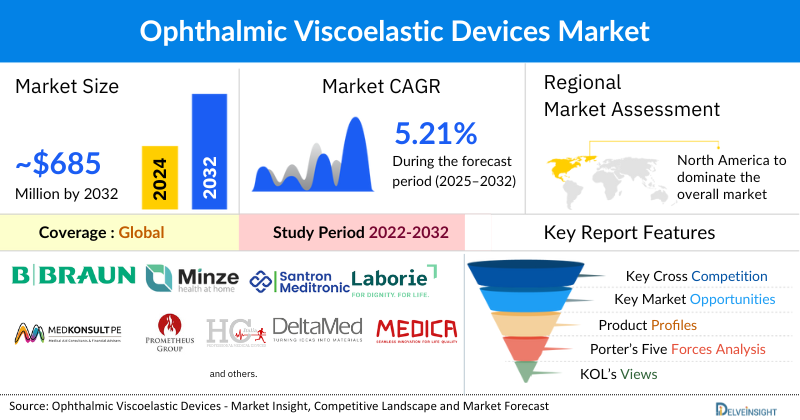
- The global ophthalmic viscoelastic devices market is expected to increase from USD 459.30 million in 2024 to USD 684.97 million by 2032, reflecting strong and sustained growth.
- The global ophthalmic viscoelastic devices market is growing at a CAGR of 5.21% during the forecast period from 2025 to 2032.
- The market of ophthalmic viscoelastic devices is being primarily driven by the rising prevalence of eye disorders, technological advancements in the product designs, rising awareness and access to eye care, an increase in diabetes prevalence, and an increase in product development activities among the key market players.
- The leading companies operating in the ophthalmic viscoelastic devices market include B. Braun SE, BestMedical, MINZE HEALTH, Santron Medtronic, Potent Medical, Laborie, MEDKONSULT medical technology s.r.o., The Prometheus Group®, HCItalia srl, DeltaMed, MEDICA S.P.A., Aymed Medical Technology, EV.SERVICE ITALIA, tic Medizintechnik GmbH & Co. KG, Creo Medical Ltd., Stericom Ltd., Amecath Medical Technologies, Cook, Well Lead Medical Co., Ltd., and others.
- North America is expected to dominate the overall Ophthalmic Viscoelastic Devices market due to the high prevalence of cataract and glaucoma cases, a rapidly aging population, and strong adoption of advanced ophthalmic surgical procedures. The region benefits from well-established healthcare infrastructure, availability of skilled ophthalmic surgeons, and favorable reimbursement policies. Additionally, the presence of leading market players and continuous product innovations further strengthens North America’s dominant position in the global market.
- In the type segment of the ophthalmic viscoelastic devices market, the cohesive ophthalmic viscoelastic category is estimated to account for the largest market share in 2024.
Ophthalmic Viscoelastic Devices Market Size and Forecasts
|
Report Metrics |
Details |
|
2024 Market Size |
USD 459.30 million |
|
2032 Projected Market Size |
USD 684.97 million |
|
Growth Rate (2025-2032) |
5.21% CAGR |
|
Largest Market |
North America |
|
Fastest Growing Market |
Asia-Pacific |
|
Market Structure |
Highly Concentrated |
Factors Contributing to the Growth of the Ophthalmic Viscoelastic Devices Market
- Rising prevalence of eye disorders leading to a surge in ophthalmic viscoelastic devices: The rising prevalence of eye disorders such as cataracts, glaucoma, and diabetic retinopathy is driving a surge in demand for ophthalmic viscoelastic devices, as these products play a critical role in ensuring safety and precision during eye surgeries. With increasing cases worldwide, especially among the aging population, the need for OVDs is growing significantly to support the rising volume of ophthalmic procedures.
- Rising awareness and access to eye care are escalating the market of ophthalmic viscoelastic devices: Rising awareness about eye health and expanding access to ophthalmic care, particularly in developing regions, are escalating the market for ophthalmic viscoelastic devices. Government initiatives, awareness campaigns, and improved availability of specialized eye hospitals and surgical centers are driving higher adoption of OVDs by enabling more patients to undergo advanced eye surgeries.
- Technological advancement in product design: Technological advancements in product design are boosting the ophthalmic viscoelastic devices market by introducing next-generation OVDs with improved viscosity, stability, and safety profiles. Innovations such as combination cohesive-dispersive formulations and enhanced biocompatibility are enabling better surgical outcomes, increasing surgeon preference, and driving wider adoption in ophthalmic procedures.
Ophthalmic Viscoelastic Devices Market Report Segmentation
This ophthalmic viscoelastic devices market report offers a comprehensive overview of the global Ophthalmic Viscoelastic Devices market, highlighting key trends, growth drivers, challenges, and opportunities. It covers detailed market segmentation by Type (Cohesive Ophthalmic Viscoelastic, Dispersive Ophthalmic Viscoelastic, Combination Ophthalmic Viscoelastic, and Visco-Adaptive Ophthalmic Viscoelastic), Application (Cataract Surgery, Glaucoma Surgery, Corneal Transplantation, Vitreoretinal Surgery, and Others), End-User (Hospitals, Ophthalmology Clinics, and Others), and geography. The report provides valuable insights into the competitive landscape, regulatory environment, and market dynamics across major markets, including North America, Europe, and Asia-Pacific. Featuring in-depth profiles of leading industry players and recent product innovations, this report equips businesses with essential data to identify market potential, develop strategic plans, and capitalize on emerging opportunities in the rapidly growing ophthalmic viscoelastic devices market.
Ophthalmic viscoelastic devices (OVDs), also known as ophthalmic viscosurgical devices, are a class of clear, gel-like substances used in eye surgery. The name "viscoelastic" comes from their dual properties: the viscosity of a fluid and the elasticity of a solid or gel. These substances are essential tools in modern eye surgery, particularly in cataract and intraocular lens (IOL) implantation procedures. These devices help secure the fragile eye structures, along with creating pressure in the anterior cavity, compartmentalizing the interior of the eye, and providing patients with faster healing for easier and safer surgery.
The overall market for ophthalmic viscoelastic devices is being collectively boosted by the rising prevalence of eye disorders, which is driving surgical demand, along with continuous technological advancements that enhance device performance and safety. Growing awareness and improved access to eye care are expanding patient reach, while the increasing prevalence of diabetes is further adding to the burden of vision-related disorders requiring surgical treatment. Additionally, intensified product development activities by key players are introducing innovative OVD solutions, strengthening market growth globally.
What are the latest Ophthalmic Viscoelastic Devices Market Dynamics and Trends?
The ophthalmic viscoelastic devices (OVDs) market is witnessing significant growth, primarily driven by the increasing prevalence of eye disorders such as cataracts, glaucoma, diabetic retinopathy, and refractive errors. According to DelveInsight’s analysis (2024), over 2.25 billion people worldwide suffer from near or distance vision impairment, creating a robust demand for corrective eye surgeries. Since OVDs play a vital role in stabilizing the anterior chamber, protecting the corneal endothelium, and enhancing surgical precision, the expanding global patient pool directly supports higher adoption of these devices.
Cataract surgery remains the leading application area for OVDs. In England alone, more than 516,000 cataract surgeries were performed in 2023 (UK Government, May 2024), highlighting the increasing surgical volume in aging populations. With cataract surgery being the most frequently performed ophthalmic procedure globally, the demand for OVDs is set to grow in tandem, particularly in developed markets with advanced healthcare infrastructure and supportive reimbursement frameworks.
Diabetic retinopathy (DR) is another major contributor, as it is among the most common diabetes-related eye complications, often requiring surgical interventions such as vitrectomy or combined cataract procedures. DelveInsight’s estimates (2024) indicate that more than 100 million adults worldwide were living with DR, with nearly 29 million cases of vision-threatening DR (VTDR). These surgical interventions heavily depend on OVDs to maintain anterior chamber depth and ensure safe tissue handling, further expanding their utilization.
Beyond disease burden, technological advancements in ophthalmic surgery are accelerating OVD demand. The adoption of femtosecond laser-assisted cataract surgery, minimally invasive glaucoma surgeries (MIGS), and premium intraocular lenses (IOLs) necessitates the use of high-quality viscoelastics for precision and safety. Moreover, the increasing availability of combination OVDs (dispersive + cohesive properties) is enhancing surgical outcomes and broadening their clinical applications.
Additionally, demographic shifts such as the rapidly aging global population, rising diabetes prevalence, and improved access to advanced ophthalmic care in emerging markets are expected to further fuel market expansion. Favorable government initiatives aimed at reducing avoidable blindness and growing investments in eye-care infrastructure also add to the momentum.
Taken together, the convergence of a growing patient pool, rising surgical volumes, increasing diabetes-related complications, and ongoing technological advancements is expected to significantly propel the ophthalmic viscoelastic devices market over the forecast period.
However, the ophthalmic viscoelastic devices (OVDs) market faces significant challenges, primarily driven by the high cost and complex reimbursement landscape, which can hinder adoption, particularly in budget-constrained healthcare systems. The development of new OVDs is also constrained by stringent regulatory hurdles and lengthy approval processes, which slow down innovation. A key operational challenge is the lack of awareness and specialized training among healthcare professionals, limiting the effective use of these devices. Furthermore, there is a constant risk of post-operative complications, such as increased intraocular pressure, if the OVDs are not used or removed correctly. The market also contends with intense competition from numerous players, as well as the potential for displacement by alternative surgical techniques that may reduce the need for OVDs. These factors, alongside raw material price volatility, collectively create notable restraints and complexities for the OVD market.
Ophthalmic Viscoelastic Devices Market Segment Analysis
Ophthalmic Viscoelastic Devices Market by Type (Cohesive Ophthalmic Viscoelastic, Dispersive Ophthalmic Viscoelastic, Combination Ophthalmic Viscoelastic, and Visco-Adaptive Ophthalmic Viscoelastic), Application (Cataract Surgery, Glaucoma Surgery, Corneal Transplantation, Vitreoretinal Surgery, and Others), End-User (Hospitals, Ophthalmology Clinics, and Others), and Geography (North America, Europe, Asia-Pacific, and Rest of the World)
By Type: Cohesive Ophthalmic Viscoelastic Category Dominates the Market
Within the type segment of the ophthalmic viscoelastic devices market, the cohesive OVD category is projected to account for the largest share at nearly 39% in 2024. Their dominance is driven by unique rheological properties, high molecular weight, high viscosity, and excellent space-maintaining capability, which make them particularly suitable for cataract and anterior segment surgeries. Cohesive OVDs help maintain anterior chamber depth, facilitate smooth capsulorhexis, and protect delicate ocular tissues such as the corneal endothelium, while their cohesive nature enables easy removal at the end of surgery, lowering the risk of postoperative complications such as elevated intraocular pressure.
Surgeons prefer cohesive OVDs due to their predictable handling, safety profile, and efficiency in maintaining surgical stability. With cataract surgery being the most commonly performed ophthalmic procedure globally, and volumes rising sharply due to an aging population and growing prevalence of vision impairment, the demand for cohesive OVDs has expanded proportionally.
Technological innovations have further reinforced this segment’s leadership. Companies are introducing dual-action viscoelastic systems that combine cohesive and dispersive properties, offering comprehensive protection and enhanced surgical outcomes. For instance, Bausch + Lomb’s StableVisc™, a cohesive OVD, and the TotalVisc™ Viscoelastic System, which pairs StableVisc™ with the dispersive ClearVisc™, provide advanced dual-action protection during cataract procedures. Similarly, Alcon’s DUOVISC® Viscoelastic System combines the cohesive PROVISC® with the dispersive VISCOAT®, giving surgeons flexibility in addressing different surgical needs.
Backed by widespread adoption, favorable clinical outcomes, and continuous product innovation, the cohesive OVD segment is expected to remain a key revenue driver in the ophthalmic viscoelastic devices market over the forecast period.
By Application: Cataract Surgery Dominates the Market
Within the application segment of the Ophthalmic Viscoelastic Devices (OVD) market, cataract surgery is projected to account for the largest share at approximately 51% in 2024. This dominance is primarily driven by the high global prevalence of cataracts, a leading cause of vision impairment and blindness, particularly in the aging population. As the number of elderly individuals continues to rise worldwide, the volume of cataract surgeries is increasing substantially, reinforcing the demand for OVDs.
OVDs play an indispensable role in cataract surgery by maintaining anterior chamber depth, protecting the corneal endothelium, and enabling the safe implantation of intraocular lenses (IOLs). Their cushioning effect safeguards delicate ocular tissues and reduces the risk of postoperative complications such as corneal edema and intraocular pressure spikes, thereby improving surgical outcomes and patient recovery.
The segment’s growth is further supported by advancements in OVD formulations, including cohesive, dispersive, and dual-action viscoelastic systems, which provide surgeons with greater flexibility and precision during surgery. The adoption of femtosecond laser-assisted cataract surgery and premium IOLs has also increased reliance on high-quality OVDs to ensure optimal surgical accuracy and safety.
Given the rising cataract burden globally, coupled with continuous innovation in viscoelastic technologies and expanding access to advanced ophthalmic care in emerging economies, cataract surgery is expected to remain the most significant contributor to the OVD market over the forecast period.
By End-User: Hospitals Dominate the Market
Hospitals are playing a pivotal role in boosting the ophthalmic viscoelastic devices (OVD) market by serving as the primary centers for eye surgeries, including cataract, glaucoma, and other anterior segment procedures. The presence of well-equipped operating rooms, advanced surgical instruments, and skilled ophthalmic surgeons enables the widespread use of OVDs, which are essential for maintaining anterior chamber stability, protecting delicate ocular tissues, and improving surgical outcomes. Moreover, hospitals are increasingly investing in specialized ophthalmic departments and adopting the latest surgical technologies, which drives the demand for high-quality OVDs. Large hospital networks also facilitate higher patient throughput, particularly in regions with growing elderly populations and rising prevalence of eye disorders, further escalating the consumption of these devices. Additionally, hospitals often follow standardized surgical protocols and quality requirements, which encourage the consistent use of approved OVD products, thereby reinforcing market growth.
Ophthalmic Viscoelastic Devices Market Regional Analysis
North America Ophthalmic Viscoelastic Devices Market Trends
North America is projected to dominate the global ophthalmic viscoelastic devices (OVD) market in 2024, capturing nearly 41% of the total share. This leadership is underpinned by the high prevalence of cataracts and glaucoma, coupled with a rapidly aging population that fuels the rising number of ophthalmic surgical procedures. The region’s advanced healthcare infrastructure, strong network of skilled ophthalmic surgeons, and supportive reimbursement frameworks further promote the adoption of premium surgical technologies, cementing its stronghold in the global market.
According to DelveInsight’s analysis (2024), in the United States alone, over 25.5 million people were affected by cataracts, while approximately 9.7 million were living with diabetic retinopathy (DR), a leading diabetes-related cause of vision impairment. Both cataracts and DR frequently require surgical interventions such as cataract extraction and vitrectomy, in which OVDs are indispensable for maintaining anterior chamber stability, protecting the corneal endothelium, and ensuring accurate intraocular lens (IOL) implantation. With the continued rise in diabetes prevalence and age-related ocular disorders, the surgical patient pool in North America is set to expand significantly, driving sustained demand for OVDs.
Technological innovation is another key growth accelerator in the region. Next-generation OVDs feature optimized viscosity profiles, dual-action (cohesive–dispersive) properties, and prefilled delivery systems that improve surgical efficiency, safety, and precision. For example, Alcon’s DUOVISC® Viscoelastic System, which combines PROVISC® (cohesive) with VISCOAT® (dispersive), provides surgeons with both mechanical support and endothelial protection during cataract procedures. Similarly, Bausch + Lomb’s StableVisc™ and TotalVisc™ systems reflect the ongoing trend toward dual-action OVDs that enhance tissue protection and surgical outcomes. Such innovations not only reduce complications and procedure time but also expand OVD applications to a broader range of surgeries, including glaucoma management and diabetic eye complications.
Additionally, North America’s OVD market is strengthened by the presence of leading global players such as Alcon, Bausch + Lomb, and Johnson & Johnson Vision, alongside frequent FDA approvals and product launches that accelerate adoption. The region also leads in the early integration of advanced ophthalmic technologies, including femtosecond laser-assisted cataract surgery, minimally invasive glaucoma surgeries (MIGS), and premium IOL implantation, all of which rely heavily on viscoelastic devices for optimal outcomes.
Taken together, the combination of a large and expanding patient pool, rising surgical volumes, robust healthcare infrastructure, favorable reimbursement, and ongoing product innovation is expected to fuel substantial and sustained growth of the North American OVD market over the forecast period, reinforcing its position as the global leader.
Europe Ophthalmic Viscoelastic Devices Market Trends
Europe is driving the growth of the ophthalmic viscoelastic devices (OVD) market through a combination of factors, including a high prevalence of eye disorders, well-established healthcare infrastructure, and increasing access to advanced surgical procedures. The region has a significant aging population, which contributes to a rising incidence of cataracts and other vision-impairing conditions, thereby increasing the demand for OVDs in surgeries. Additionally, European countries have strong ophthalmic research and development activities, fostering the introduction of innovative viscoelastic products with improved safety and efficacy. Government initiatives, favorable reimbursement policies, and growing awareness about eye health further support the adoption of OVDs across hospitals and specialized eye care centers. The presence of leading market players and continuous technological advancements in OVD formulations also reinforce Europe’s position as a key contributor to the overall growth of the global ophthalmic viscoelastic devices market.
Asia-Pacific Ophthalmic Viscoelastic Devices Market Trends
The Asia-Pacific region is emerging as a major growth driver of the ophthalmic viscoelastic devices (OVD) market due to a rapidly increasing patient pool with vision disorders, expanding healthcare infrastructure, and rising adoption of advanced ophthalmic surgeries. Countries such as China, India, and Japan are witnessing a growing prevalence of cataracts, glaucoma, and diabetic retinopathy, driven by aging populations and increasing rates of diabetes. Improved access to specialized eye care, government initiatives promoting eye health, and the expansion of hospitals and surgical centers are facilitating higher OVD utilization. Additionally, growing awareness among patients and healthcare professionals about the benefits of viscoelastic devices is boosting adoption in both urban and semi-urban regions. The combination of high unmet medical needs, increasing surgical volumes, and expanding healthcare investments makes the Asia-Pacific region a significant contributor to the global OVD market growth.
Who are the major players in the ophthalmic viscoelastic devices market?
The following are the leading companies in the ophthalmic viscoelastic devices market. These companies collectively hold the largest market share and dictate industry trends.
- B. Braun SE
- BestMedical
- MINZE HEALTH
- Santron Medtronic
- Potent Medical
- Laborie
- MEDKONSULT medical technology s.r.o.
- The Prometheus Group®
- HCItalia srl
- DeltaMed
- MEDICA S.P.A
- Aymed Medical Technology
- EV.SERVICE ITALIA
- Medizintechnik GmbH & Co. KG
- Creo Medical Ltd.
- Stericom Ltd.
- Amecath Medical Technologies
- Cook
- Well Lead Medical Co., Ltd.
- Others
How is the competitive landscape shaping the ophthalmic viscoelastic devices market?
The competitive landscape of the ophthalmic viscoelastic devices (OVD) market is highly consolidated, with a few major global players, notably Alcon, Johnson & Johnson Vision, Bausch + Lomb, and Carl Zeiss Meditec, holding a significant portion of the market share. This high market concentration is driven by the considerable investment required for research and development, regulatory approval, and building a strong reputation for product safety and efficacy. These market leaders leverage their extensive portfolios to offer a full range of OVD types (cohesive, dispersive, and viscoadaptive), often bundling them with other surgical equipment to secure contracts with hospitals and clinics. However, despite the dominance of these multinational corporations, the market also features several smaller, specialized companies and a growing presence of regional players, especially in the Asia-Pacific region. This dynamic environment encourages continuous innovation, with companies focusing on developing next-generation OVDs that improve surgical outcomes, are easier to remove, and address specific surgical needs, thereby shaping the market's evolution and forcing competitors to differentiate through technology and quality.
Recent Developmental Activities in the Ophthalmic Viscoelastic Devices Market
- In February 2025, the FDA granted clearance for the VIA360™ surgical system, designed to deliver controlled doses of viscoelastic fluid during ophthalmic surgeries, including trabeculotomy procedures.
- In April 2023, Bausch + Lomb launched StableVisc™, a cohesive ophthalmic viscosurgical device, and the TotalVisc™ Viscoelastic System in the U.S., offering surgeons advanced dual-action protection and enhanced safety during cataract surgery.
|
Report Metrics |
Details |
|
Study Period |
2022 to 2032 |
|
Base Year |
2024 |
|
Forecast Period |
2025 to 2032 |
|
Ophthalmic Viscoelastic Devices Market CAGR |
5.21% |
|
Key Companies in the Ophthalmic Viscoelastic Devices Market |
B. Braun SE, BestMedical, MINZE HEALTH, Santron Medtronic, Potent Medical, Laborie, MEDKONSULT medical technology s.r.o., The Prometheus Group®, HCItalia srl, DeltaMed, MEDICA S.P.A., Aymed Medical Technology, EV.SERVICE ITALIA, tic Medizintechnik GmbH & Co. KG, Creo Medical Ltd., Stericom Ltd., Amecath Medical Technologies, Cook, Well Lead Medical Co., Ltd., and others. |
|
Ophthalmic Viscoelastic Devices Market Segments |
by Type, by Application, by End-user, and by Geography |
|
Ophthalmic Viscoelastic Devices Regional Scope |
North America, Europe, Asia Pacific, Middle East, Africa, and South America |
|
Ophthalmic Viscoelastic Devices Country Scope |
U.S., Canada, Mexico, Germany, United Kingdom, France, Italy, Spain, China, Japan, India, Australia, South Korea, and key Countries |
Ophthalmic Viscoelastic Devices Market Segmentation
· Ophthalmic Viscoelastic Devices Type Exposure
o Cohesive Ophthalmic Viscoelastic
o Dispersive Ophthalmic Viscoelastic
o Combination Ophthalmic Viscoelastic
o Visco-Adaptive Ophthalmic Viscoelastic
· Ophthalmic Viscoelastic Devices Application Exposure
o Cataract Surgery
o Glaucoma Surgery
o Corneal Transplantation
o Vitreoretinal Surgery
o Others
· Ophthalmic Viscoelastic Devices End-Users Exposure
o Hospitals
o Ophthalmology Clinics
o Others
· Ophthalmic Viscoelastic Devices Geography Exposure
o North America Ophthalmic Viscoelastic Devices Market
§ United States Ophthalmic Viscoelastic Devices Market
§ Canada Ophthalmic Viscoelastic Devices Market
§ Mexico Ophthalmic Viscoelastic Devices Market
o Europe Ophthalmic Viscoelastic Devices Market
§ United Kingdom Ophthalmic Viscoelastic Devices Market
§ Germany Ophthalmic Viscoelastic Devices Market
§ France Ophthalmic Viscoelastic Devices Market
§ Italy Ophthalmic Viscoelastic Devices Market
§ Spain Ophthalmic Viscoelastic Devices Market
§ Rest of Europe Ophthalmic Viscoelastic Devices Market
o Asia-Pacific Ophthalmic Viscoelastic Devices Market
§ China Ophthalmic Viscoelastic Devices Market
§ Japan Ophthalmic Viscoelastic Devices Market
§ India Ophthalmic Viscoelastic Devices Market
§ Australia Ophthalmic Viscoelastic Devices Market
§ South Korea Ophthalmic Viscoelastic Devices Market
§ Rest of Asia-Pacific Ophthalmic Viscoelastic Devices Market
o Rest of the World Ophthalmic Viscoelastic Devices Market
§ South America Ophthalmic Viscoelastic Devices Market
§ Middle East Ophthalmic Viscoelastic Devices Market
§ Africa Ophthalmic Viscoelastic Devices Market
Ophthalmic Viscoelastic Devices Market Recent Industry Trends and Milestones (2022-2025)
|
Category |
Key Developments |
|
Ophthalmic Viscoelastic Devices Product Launches |
Bausch + Lomb has launched StableVisc™ |
|
Ophthalmic Viscoelastic Devices Regulatory Approvals |
New World Medical, Inc. - VIA360™ surgical system (FDA) |
|
Company Strategy |
Bausch + Lomb: Adding sorbitol to their OVDs, Bausch + Lomb is providing a new layer of chemical protection for ocular tissues against free radicals generated during phacoemulsification. Alcon: Advances phacoemulsification technology with fluidics and integrated software, where OVDs are a key consumable. |
|
Emerging Technology |
New Formulations with Enhanced Properties, Specialized Delivery Systems for Glaucoma Surgery, All-in-One and Preloaded Systems |
Impact Analysis
AI-Powered Innovations and Applications:
AI-powered innovations are increasingly influencing the ophthalmic viscoelastic devices (OVD) market by enhancing surgical precision, safety, and patient outcomes. Advanced AI algorithms integrated with ophthalmic imaging and diagnostic systems can analyze individual patient anatomy and ocular conditions to recommend the most appropriate type of OVD, whether cohesive, dispersive, combination, or visco-adaptive, for specific procedures. In AI-assisted or robotic-assisted cataract and anterior segment surgeries, AI can optimize parameters such as injection rate, volume, and placement of the OVD, ensuring stable anterior chamber maintenance and reducing the risk of complications. Additionally, AI-driven predictive models help surgeons anticipate post-operative outcomes, guiding the selection of OVDs and surgical strategies tailored to each patient. On the product development side, AI and machine learning are used to simulate viscoelastic properties and tissue interactions, accelerating the design of next-generation OVDs with improved biocompatibility, viscosity, and dual-action performance. Collectively, these AI-powered innovations are not only improving surgical efficiency and patient safety but also expanding the adoption and evolution of ophthalmic viscoelastic devices in modern ophthalmology.
U.S. Tariff Impact Analysis on Ophthalmic Viscoelastic Devices Market:
The U.S. tariff landscape has introduced significant challenges to the ophthalmic viscoelastic devices (OVD) market, impacting both manufacturers and healthcare providers. In 2025, the U.S. imposed a universal 5% baseline tariff on most imported medical devices and components, including critical raw materials like sodium hyaluronate, essential for OVD production.
These elevated tariffs have led to increased production costs, which are often passed on to healthcare providers and patients, potentially affecting the affordability and accessibility of eye surgeries. The optical industry has expressed concerns over these trade policies, highlighting the essential nature of vision care products and the financial strain on businesses, particularly smaller enterprises and independent retailers.
In response to these challenges, companies are exploring alternative sourcing strategies, such as diversifying supply chains and increasing domestic production, to mitigate the impact of tariffs. However, the uncertainty surrounding ongoing trade negotiations and potential future tariff adjustments continues to pose risks to the stability and growth of the OVD market in the U.S.
How This Analysis Helps Clients
- Cost Management: By understanding the tariff landscape, clients can anticipate cost increases and adjust pricing strategies accordingly, ensuring profitability.
- Supply Chain Optimization: Clients can identify alternative sourcing options and diversify their supply chains to reduce dependency on high-tariff regions, enhancing resilience.
- Regulatory Navigation: Expert guidance on navigating the evolving regulatory environment helps clients maintain compliance and avoid potential legal challenges.
- Strategic Planning: Insights into tariff impacts enable clients to make informed decisions about manufacturing locations, partnerships, and market entry strategies.
Key takeaways from the ophthalmic viscoelastic devices market report study:
- Market size analysis for the current ophthalmic viscoelastic devices market size (2024), and market forecast for 8 years (2025 to 2032)
- Top key product/technology developments, mergers, acquisitions, partnerships, and joint ventures happened over the last 3 years.
- Key companies dominating the ophthalmic viscoelastic devices market.
- Various opportunities available for the other competitors in the ophthalmic viscoelastic devices market space.
- What are the top-performing segments in 2024? How these segments will perform in 2032?
- Which are the top-performing regions and countries in the current ophthalmic viscoelastic devices market scenario?
- Which are the regions and countries where companies should have concentrated on opportunities for the ophthalmic viscoelastic devices market growth in the future?