
Oral Contraceptive Market Summary
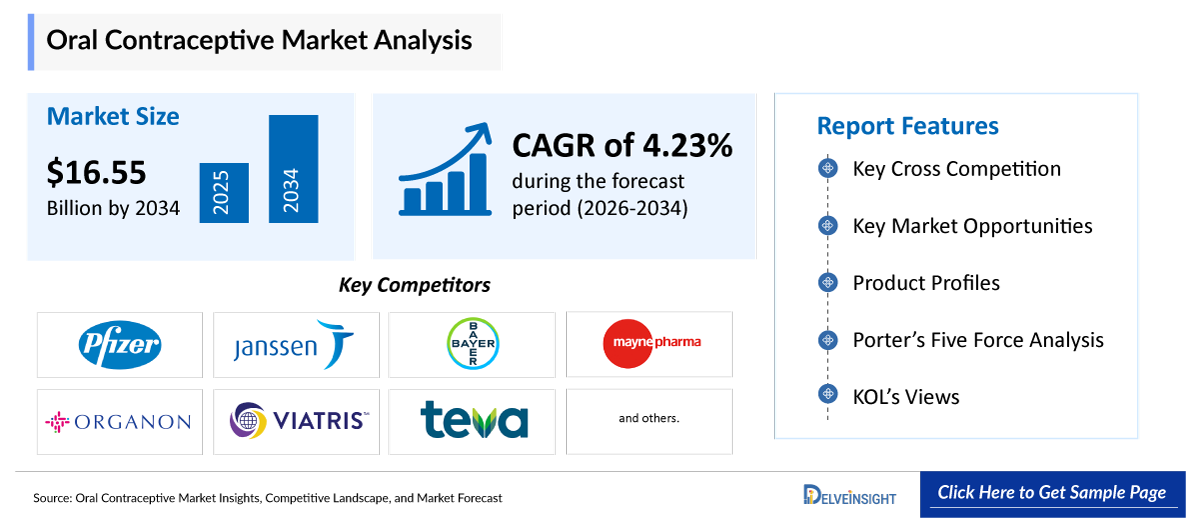
- The Oral Contraceptive Market is estimated at USD 9,907.69 million in 2025 and is projected to reach USD 14,856.33 million by 2034. Growth is anchored by rising rates of unintended pregnancy, expanding over-the-counter (OTC) access following the 2023 approval of Perrigo's Opill, continued generic penetration of combined and progestin-only formulations, and growing use of oral contraceptives for non-contraceptive indications such as acne, menstrual regulation, and premenstrual dysphoric disorder (PMDD).
- The Global Oral Contraceptive Market is growing at a CAGR of 4.69% during the forecast period from 2026 to 2034.
Oral Contraceptive Market Trends & Insights
- By product type, the Combined Oral Contraceptives (COCs) segment dominated the oral contraceptive market with a 72% share in 2025.
- By hormone type, the Estrogen and Progestin Combination segment dominated the oral contraceptive market with a 73% share in 2025.
- By drug class, the Levonorgestrel-Based segment dominated the oral contraceptive market with a 32% share in 2025.
- By prescription type, the Prescription (Rx)-based segment dominated the oral contraceptive market with a 92% share in 2025, although the Over-the-Counter (OTC) segment is the fastest-growing category following Opill's nationwide rollout.
- By drug type, the Branded segment dominated the oral contraceptive market with a 55% share in 2025, while the Generic segment continues to gain share as patents on combined formulations expire.
- By distribution channel, the Retail Pharmacies segment dominated the oral contraceptive market with a 65% share in 2025.
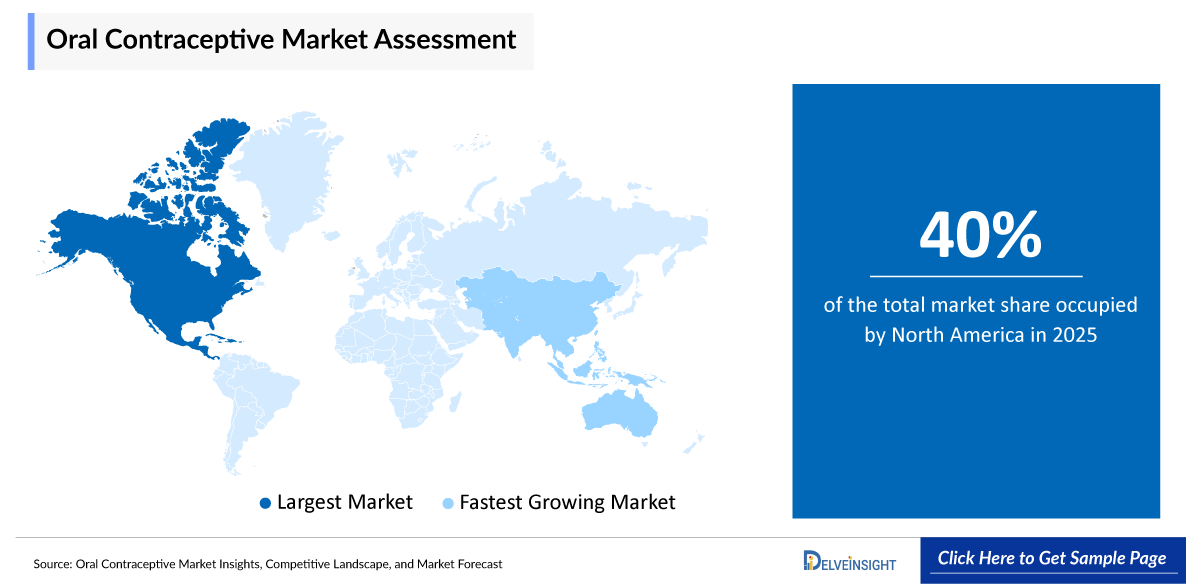
- North America dominated the global oral contraceptive market revenue with a 38% share in 2025, representing the highest regional market share globally.
Request for unlocking the Sample Page of the "Oral Contraceptive Market"
Oral Contraceptive Market Size
The following snapshot summarizes the principal report metrics for the Oral Contraceptive market.
|
Report Metrics |
Details |
|
2025 Oral Contraceptive Market Size | |
|
2034 Projected Oral Contraceptive Market Size | |
|
Oral Contraceptive Growth Rate (2026-2034) | |
|
Largest Oral Contraceptive Market |
North America |
|
Fastest Growing Oral Contraceptive Market |
Asia-Pacific |
|
Oral Contraceptive Market Structure |
Moderately Consolidated |
All market values are expressed in USD and represent DelveInsight estimates synthesized from primary and secondary research.
Factors Contributing to the Growth of the Oral Contraceptive Market
Oral Contraceptive Market Drivers
-
Expansion of Over-the-Counter (OTC) Access
The single most transformative driver of the Oral Contraceptive market is the emergence of a nonprescription channel. On July 13, 2023, the FDA approved Perrigo's Opill (norgestrel), a progestin-only pill originally developed by HRA Pharma (acquired by Perrigo in 2022), for OTC use by women and people of all ages, and the product became available in stores and online across the United States from March 2024.
Independent research published in JAMA Network Open in 2025 found that OTC access reduced barriers to contraceptive initiation among uninsured, rural, and adolescent populations, reinforcing the durability of this new demand channel. A second wave of OTC expansion is underway: startups such as Cadence OTC are pursuing an FDA Rx-to-OTC switch for a combined estrogen-progestin pill, a category used by more than 90% of pill users, which would extend nonprescription access to the largest product segment of the market.
-
Rising Prevalence of Unintended Pregnancy
Unintended pregnancy remains a persistent global public health challenge, with millions of pregnancies each year in the United States alone classified as unintended, underscoring the ongoing need for accessible, reliable, and reversible contraception.
Oral contraceptive pills remain the leading reversible method by usage share among women of reproductive age in the United States, according to CDC contraceptive-use data, and continued public health messaging and family-planning programs in both developed and developing markets are sustaining demand for combined and progestin-only pills.
-
Sustained Generic Penetration and Affordability
As patents on branded combined oral contraceptives such as Yaz, Yasmin, and Safyral have expired, generic manufacturers including Lupin, Teva, Amneal, Glenmark, Xiromed, and Apotex have secured Abbreviated New Drug Application (ANDA) approvals for AB-rated equivalents, including drospirenone-based and levonorgestrel-based combinations.
This has materially lowered out-of-pocket costs, expanded formulary coverage, and driven a structural shift of prescription volume from Branded to Generic products, a trend expected to continue as remaining combined-pill patents expire through the forecast period.
-
Growth of Telehealth and Online Pharmacy Channels
The expansion of telehealth consultation platforms and online and mail-order pharmacies has shortened the path from prescription to fulfillment and reduced geographic and time barriers to obtaining oral contraceptives, particularly for women in contraceptive deserts and rural communities. This channel shift is expanding the addressable market for both prescription and, increasingly, OTC oral contraceptives, and is expected to register the fastest growth among distribution channels through 2034.
-
Supportive Government and Payer Initiatives
Regulatory and reimbursement support is broadening affordable access to oral contraceptives across geographies. In the United States, insurance coverage mandates under the Affordable Care Act require most private health plans to cover FDA-approved contraceptives, including Opill, without cost-sharing.
In March 2025, Bayer's YAZ and YASMIN became the first oral contraceptives listed on Australia's Pharmaceutical Benefits Scheme (PBS) in more than three decades, materially improving affordability for Australian women. Such reimbursement expansions in additional geographies would be expected to further support branded and generic pill volumes.
-
Broadening Non-Contraceptive Clinical Use
Oral contraceptives are increasingly prescribed for indications beyond pregnancy prevention, including regulation of menstrual cycles, management of dysmenorrhea, endometriosis, and polycystic ovary syndrome (PCOS), and treatment of moderate Acne and premenstrual dysphoric disorder (PMDD). This therapeutic diversification is expanding the eligible patient base for combined and progestin-only pills and supporting continued physician-driven demand alongside contraceptive use.
-
Product Innovation and Formulation Advancements
Manufacturers continue to differentiate combined and progestin-only pills through formulation innovation. Teva's 2026 FDA approval of Femlyv, an oral dissolvable norethindrone acetate and ethinyl estradiol tablet, expands access for patients who have difficulty swallowing conventional tablets. Extended-cycle and lower-dose formulations from manufacturers including Viatris and Organon continue to broaden the range of options available across drug classes, supporting continued adoption among both new and switching users.
Oral Contraceptive Market Restraints
Despite strong underlying demand, the Oral Contraceptive market faces material constraints. Generic competition and mandated insurance coverage have compressed average selling prices for combined pills, pressuring branded revenue for originator companies such as Organon, whose NuvaRing and legacy pill brands have faced sustained double-digit declines from generic erosion.
Reimbursement and access to contraception remain uneven across geographies and are subject to shifting government policy, including recent U.S. federal policy changes affecting Title X funding and access programs that have pressured device volumes and could affect pill access for underserved populations. Concerns around cardiovascular and thromboembolic risk associated with estrogen-containing combined pills continue to require careful patient selection and contraindication screening, limiting eligibility for some patients and supporting continued use of progestin-only alternatives.
The combined pill Rx-to-OTC switch process remains lengthy, requiring extensive actual-use trials and FDA review, slowing the pace of nonprescription expansion for the largest product segment. Additionally, competition from long-acting reversible contraceptives (LARCs), including implants and intrauterine devices that require no daily adherence, continues to draw some patients away from daily oral pills. Together, these pricing, regulatory, policy, and product-substitution pressures temper the pace of growth even as OTC expansion and generic access remain firmly intact structural drivers.
Oral contraceptives, commonly referred to as birth control pills, are hormonal medications taken daily to prevent pregnancy by inhibiting ovulation, thickening cervical mucus to impede sperm motility, and thinning the uterine lining to prevent implantation. They are broadly classified into Combined Oral Contraceptives (COCs), which contain both synthetic estrogen and progestin, and Progestin-Only Pills (POPs or mini-pills), which contain a single hormone and are often preferred by women with contraindications to estrogen, including those who are breastfeeding.
Within combined and progestin-only formulations, oral contraceptives are further differentiated by drug class based on the specific progestin used, including levonorgestrel, drospirenone, norethindrone, norgestimate, and norgestrel, each associated with a distinct side-effect and tolerability profile. Beyond pregnancy prevention, oral contraceptives are widely prescribed to manage menstrual cycle irregularities, dysmenorrhea, endometriosis, polycystic ovary syndrome (PCOS), and moderate acne, and to treat premenstrual dysphoric disorder (PMDD), broadening their clinical utility well beyond contraception alone.
The market has historically been overwhelmingly prescription (Rx)-based, dispensed through hospital and retail pharmacies following a physician or nurse-practitioner visit, but the 2023 FDA approval of Perrigo's Opill (norgestrel) as the first nonprescription daily oral contraceptive established an entirely new over-the-counter channel, expanding access for populations that have historically faced barriers to obtaining a prescription.
The market's competitive structure is shaped by a small number of originator pharmaceutical companies that continue to hold significant branded revenue, and a much larger group of generic manufacturers that have progressively eroded branded combined-pill revenue as patents expire and Abbreviated New Drug Applications (ANDAs) are approved.
Distribution spans hospital pharmacies, retail pharmacies, and a rapidly growing online and telehealth-enabled pharmacy channel that has expanded contraceptive access, particularly among younger and rural populations.
Oral Contraceptive Market Key Growth Drivers
- The persistently high rate of unintended pregnancy, both in developed and developing economies, continues to sustain baseline demand for reliable, reversible, self-administered contraception, reinforcing oral contraceptive pills as the leading reversible method by usage share in the United States.
- The July 2023 FDA approval of Perrigo's Opill as the first nonprescription oral contraceptive, followed by its nationwide retail and online availability since March 2024, has removed a major access barrier and established an OTC channel that industry surveys and payer coverage expansions are expected to keep growing through the forecast period.
- Rapid growth of telehealth platforms and online pharmacies has shortened the path from consultation to prescription refill, expanding access for populations in contraceptive deserts and rural areas and supporting the online pharmacy distribution channel as one of the fastest-growing in the market.
- Continued approval and launch of generic combined and progestin-only formulations by manufacturers including Lupin, Teva, Amneal, Glenmark, Xiromed, and Apotex are lowering out-of-pocket costs and expanding formulary access, accelerating the shift of volume toward the Generic drug type segment.
- Government and payer initiatives supporting contraceptive access and affordability, including expanded insurance coverage mandates in the United States and new public reimbursement listings such as Australia's March 2025 Pharmaceutical Benefits Scheme (PBS) listing of Bayer's YAZ and YASMIN, are broadening affordable access to branded combined pills.
- Growing use of oral contraceptives for non-contraceptive indications, including acne management, menstrual cycle regulation, and treatment of premenstrual dysphoric disorder (PMDD), is expanding the eligible patient population beyond those seeking contraception alone.
- Innovation in pill formulation and delivery, such as Teva's 2026 FDA approval of Femlyv, the first oral dissolvable combined contraceptive tablet, is improving adherence among patients who have difficulty swallowing tablets and differentiating branded products in an increasingly genericized market.
- The convergence of expanding OTC access, sustained generic penetration, growing telehealth and online distribution, and broadening non-contraceptive clinical use is expected to sustain steady growth in the global oral contraceptive market through the forecast period, even as average selling prices continue to decline with generic competition.
Oral Contraceptive Companies
- Pfizer Inc.
- Janssen Pharmaceuticals
- Bayer AG
- Mayne Pharma
- Organon
- Viatris
- Teva Pharmaceuticals
- Lupin Limited
- AbbVie
- Exeltis USA
For illustrative purposes, only the top 10 companies are listed in the Table of Contents. The report may include analysis and references to additional companies relevant to the market assessment.
Oral Contraceptive Market Segment Analysis
The Oral Contraceptive Market by Product Type (Combined Oral Contraceptives (COCs) and Progestin-Only Pills (POPs/Mini Pills)), Hormone Type (Estrogen and Progestin Combination and Progestin-Only), Drug Class (Levonorgestrel-Based, Drospirenone-Based, Norethindrone-Based, Norgestimate-Based, Norgestrel-Based, and Others), Prescription Type (Prescription (Rx)-based and Over-the-Counter (OTC)), Drug Type (Branded and Generic), Distribution Channel (Hospital Pharmacies, Retail Pharmacies, Online Pharmacies, and Others), and Geography (North America, Europe, Asia-Pacific, Rest of World).
-
Oral Contraceptive Market Segmentation By Product Type
Dominant Subsegment: Combined Oral Contraceptives (COCs). The Combined Oral Contraceptives (COCs) category is expected to dominate the market.
Dominant: Combined Oral Contraceptives (COCs) ~ 72%
The combined oral contraceptives segment accounted for 72% of the oral contraceptive market in 2025. COCs, which contain both synthetic estrogen and progestin, remain the leading product type on the strength of decades of clinical familiarity, broad physician preference, and additional non-contraceptive benefits such as acne management and menstrual cycle regulation, and are used by more than 90% of pill users in markets such as the United States.
Progestin-Only Pills (POPs/mini pills) are the fastest-growing product type, supported by their favorable safety profile for breastfeeding women and patients with estrogen contraindications, and by their status as the only oral contraceptive formulation currently approved for OTC use in the United States through Perrigo's Opill. As combined pill manufacturers pursue their own Rx-to-OTC switch and continue to expand generic availability, COCs are expected to retain overall leadership across the forecast period.
-
Oral Contraceptive Market Segmentation By Hormone Type
Dominant Subsegment: Estrogen and Progestin Combination. The Estrogen and Progestin Combination category is expected to dominate the market.
Dominant: Estrogen and Progestin Combination ~ 73%
The estrogen and progestin combination segment accounted for 73% of the oral contraceptive market in 2025. Combination hormonal formulations dominate because they are more effective at suppressing ovulation and provide more predictable bleeding patterns than progestin-only regimens, in addition to established benefits for acne, dysmenorrhea, and PMDD.
The progestin-only segment is expanding steadily, aided by lower cardiovascular and thromboembolic risk, suitability for lactating women, and its OTC availability, and is expected to grow at a faster rate as OTC and telehealth-driven demand increasingly favors progestin-only formulations.
-
Oral Contraceptive Market Segmentation By Drug Class
Dominant Subsegment: Levonorgestrel-Based. The Levonorgestrel-Based category is expected to dominate the market.
Dominant: Levonorgestrel-Based ~ 32%
The levonorgestrel-based segment accounted for 32% of the oral contraceptive market in 2025. Levonorgestrel is the most extensively studied and widely prescribed progestin used in oral contraceptives, valued for its long safety record, low cost, and broad availability across both branded and generic combined formulations.
Drospirenone-based products, including Bayer's YAZ and YASMIN and their AB-rated generic equivalents from manufacturers such as Lupin and Teva, represent a significant and fast-growing class due to their additional indications for PMDD and acne. Norethindrone-based, norgestimate-based, and norgestrel-based formulations, including Perrigo's Opill, round out a diversified drug-class landscape, while the norgestrel-based class is the fastest-growing given its exclusive current association with the OTC channel.
-
Oral Contraceptive Market Segmentation By Prescription Type
Dominant Subsegment: Prescription (Rx)-based. The Prescription (Rx)-based category is expected to dominate the market.
Dominant: Prescription (Rx)-based ~ 92%
The prescription (Rx)-based segment accounted for 92% of the oral contraceptive market in 2025. The overwhelming majority of combined oral contraceptives remain available only by prescription, sustaining the leadership of the Rx-based segment.
The Over-the-Counter (OTC) segment, established in the United States by the 2023 approval and 2024 nationwide launch of Opill, is the fastest-growing prescription type, and further expansion is anticipated as combined-pill manufacturers and startups such as Cadence OTC pursue their own Rx-to-OTC switch applications for combination formulations.
-
Oral Contraceptive Market Segmentation By Drug Type
Dominant Subsegment: Branded. The Branded category is expected to dominate the market.
Dominant: Branded ~ 55%
The branded segment accounted for 55% of the oral contraceptive market in 2025, supported by continued physician familiarity, direct-to-consumer awareness, and, in select markets, new reimbursement listings such as the March 2025 PBS listing of Bayer's YAZ and YASMIN in Australia.
The generic segment is the fastest-growing drug type as combined-pill patents continue to expire and manufacturers including Lupin, Teva, Amneal, Glenmark, Xiromed, and Apotex secure ANDA approvals for AB-rated equivalents, progressively shifting prescription volume away from branded products, as illustrated by the sustained decline of Organon's legacy branded contraceptive revenue.
-
Oral Contraceptive Market Segmentation By Distribution Channel
Dominant Subsegment: Retail Pharmacies. The Retail Pharmacies category is expected to dominate the market.
Dominant: Retail Pharmacies ~ 65%
The retail pharmacies segment accounted for 65% of the oral contraceptive market in 2025. Retail pharmacies remain the dominant distribution channel because they provide immediate access, pharmacist counseling, and, since 2024, shelf availability of OTC Opill alongside prescription products.
Online pharmacies are the fastest-growing distribution channel, propelled by the expansion of telehealth consultation platforms, direct-to-consumer shipping models, and growing consumer comfort with digital prescription refills, while hospital pharmacies continue to serve as an important channel for postpartum and clinical-setting dispensing.
Oral Contraceptive Market Region Analysis
- Dominant Region: North America
- Dominant: North America ~ 38% (Largest)
North America accounted for 38% of the global oral contraceptive market revenue in 2025, representing the highest regional market share globally. The region's dominance reflects high contraceptive-use rates, well-established insurance coverage mandates for FDA-approved contraceptives, a mature retail and online pharmacy network, and the concentration of leading branded and generic manufacturers including Pfizer, Organon, Bayer, Viatris, and Perrigo.
According to the U.S. Centers for Disease Control and Prevention, a majority of women aged 15-49 in the United States use some form of contraception, with oral contraceptive pills among the most commonly used methods. The July 2023 FDA approval and March 2024 nationwide launch of Perrigo's Opill established the first OTC oral contraceptive channel in the region, and continued generic approvals for combined pills from manufacturers such as Lupin and Teva are reinforcing affordability and access.
Strong reimbursement frameworks, expanding telehealth-enabled prescribing, and continued innovation, including Teva's 2026 approval of the oral dissolvable Femlyv tablet, anchor the region's continued leadership across the forecast period.
- Fastest Growing Region: Asia-Pacific
Asia-Pacific is the fastest-growing region in the Oral Contraceptive market. The region's elevated CAGR is driven by rising awareness of family planning, expanding healthcare access, and growing government initiatives to promote modern contraceptive methods across China, Japan, India, South Korea, and Australia.
China continues to broaden public awareness of modern birth-control methods as part of population-health initiatives, Japan is expanding access within its universal-insurance healthcare system, and India is scaling distribution through both public health programs and growing private retail and online pharmacy networks.
Australia's March 2025 PBS listing of Bayer's YAZ and YASMIN illustrates the broader regional trend toward improved reimbursement and affordability. The combination of rising awareness, expanding healthcare infrastructure, and improving affordability positions Asia-Pacific as the principal source of incremental growth over the forecast period.
Oral Contraceptive Regional Commentary
- North America
North America accounted for 38% of the global Oral Contraceptive market revenue in 2025. The United States dominates on the strength of high contraceptive-use rates, comprehensive insurance coverage mandates, the world's first OTC oral contraceptive channel, and a dense retail, hospital, and online pharmacy network, while continued generic approvals and telehealth-enabled prescribing reinforce its leadership.
- Europe
Europe is a large and established regional market, supported by strong reimbursement frameworks, high contraceptive-use rates, and a well-developed base of both originator and generic manufacturers. Regulatory harmonization across the European Medicines Agency member states and growing public-health emphasis on family planning support continued demand for combined and progestin-only pills across Germany, France, the United Kingdom, Italy, and Spain.
- Asia-Pacific
Asia-Pacific is the fastest-growing region, propelled by expanding healthcare access, rising family-planning awareness, and growing government support for modern contraception across China, Japan, India, South Korea, and Australia. Australia's 2025 PBS reimbursement listing and India's expanding retail and online pharmacy penetration are accelerating regional demand for both branded and generic oral contraceptives.
- Rest of World
The Rest of World region, spanning Latin America, the Middle East, and Africa, is an emerging growth frontier. Expanding healthcare infrastructure, growing non-governmental and public-health family-planning programs, and rising distribution partnerships with international generic manufacturers are gradually increasing access to oral contraceptives across the region.
Oral Contraceptive Market Competitive Landscape
The Oral Contraceptive market is classified as Moderately Consolidated. A group of established originator pharmaceutical companies, including Bayer AG, Organon, Pfizer Inc., and Janssen Pharmaceuticals, anchors the branded tier through long-standing product portfolios, regulatory approvals, and global distribution networks, while a broad base of generic manufacturers, including Lupin Limited, Teva Pharmaceuticals, Viatris, Amneal Pharmaceuticals, Glenmark Pharmaceuticals, Xiromed LLC, and Apotex Inc., compete through ANDA approvals, pricing, and formulary access, sustaining a competitive and increasingly genericized supplier base.
The Oral Contraceptive competitive landscape can be evaluated across the following dimensions:
- Market concentration: Moderately consolidated, with a small group of established originator companies holding significant branded share alongside a broad base of generic manufacturers.
- Leading players: Bayer AG, Organon, Pfizer Inc., and Viatris anchor the top tier through long-standing branded and generic combined-pill portfolios and global distribution reach.
- Geographic reach: Leaders operate global distribution networks supplying retail, hospital, and online pharmacies across dozens of countries, supported by regional generic manufacturers such as Lupin and Glenmark in emerging markets.
- Product portfolio strength: Top players offer both combined and progestin-only formulations spanning multiple drug classes, including levonorgestrel-, drospirenone-, and norethindrone-based products.
- Regulatory access: Ownership of FDA-cleared OTC formulations, such as Perrigo's Opill, and AB-rated ANDA approvals held by leading generic manufacturers are decisive competitive advantages.
- Strategic partnerships: Collaborations between telehealth platforms, online pharmacies, and manufacturers are extending commercial reach into digitally enabled distribution channels.
- M&A activity: Continued consolidation in the women's health space, illustrated by Perrigo's 2022 acquisition of HRA Pharma, which brought the Opill franchise into Perrigo's consumer self-care portfolio.
- Manufacturing capabilities: GMP-compliant tablet manufacturing, reliable supply continuity, and cost-efficient generic production are key competitive moats.
- Innovation focus: Rx-to-OTC switch programs, oral dissolvable formulations such as Teva's Femlyv, and expansion into non-contraceptive indications are the leading edges of innovation.
Oral Contraceptive Market Recent Developmental Activities
- In 2026, Teva Pharmaceuticals received FDA approval for Femlyv (norethindrone acetate and ethinyl estradiol), the first oral dissolvable combined birth control tablet, expanding contraceptive access for patients who have difficulty swallowing conventional tablets. Strategic significance: Differentiates Teva's combined-pill portfolio in an increasingly genericized market and expands adherence-friendly options within the norethindrone-based drug class.
- In December 2025, Viatris Inc. announced that the FDA accepted for review, under the 505(b)(2) pathway, the New Drug Application for its investigational low-dose estrogen weekly contraceptive patch, with a PDUFA goal date of July 30, 2026. Strategic significance: Signals continued investment by a leading generic oral contraceptive manufacturer in expanding its broader women's health and contraception pipeline.
- In March 2025, Bayer AG achieved the first Pharmaceutical Benefits Scheme (PBS) listing of an oral contraceptive in Australia in over three decades, making YAZ and YASMIN (drospirenone and ethinyl estradiol) available at subsidized cost to Australian women. Strategic significance: Materially improves affordability and access for Bayer's leading drospirenone-based combined pill franchise in a key Asia-Pacific market.
- In 2024, Perrigo Company plc completed the nationwide U.S. retail and online rollout of Opill (norgestrel), the first FDA-approved nonprescription daily oral contraceptive, following its July 2023 approval and the 2022 acquisition of originator HRA Pharma. Strategic significance: Establishes Perrigo as the first mover in the OTC oral contraceptive category and creates a new, high-volume nonprescription distribution channel.
- In 2025 and 2026, Lupin Limited continued to expand its portfolio of AB-rated generic combined oral contraceptives, including drospirenone-based and levonorgestrel-based formulations marketed as generic equivalents of branded products such as Tydemy and Safyral. Strategic significance: Reinforces Lupin's position as a leading generic supplier within the drospirenone-based drug class and supports continued price erosion of branded combined pills.
- In 2025 and 2026, Organon & Co. reported continued double-digit declines in NuvaRing and legacy branded combined-pill revenue (Marvelon and Mercilon) due to sustained generic competition, while its Nexplanon implant and broader women's health portfolio continued to grow. Strategic significance: Illustrates the maturing, increasingly genericized nature of the combined oral contraceptive category and the strategic shift of originator companies toward long-acting reversible contraceptive devices.
- Ongoing, Cadence OTC (private company), continued its FDA Rx-to-OTC switch program for Zena, a combined estrogen-progestin oral contraceptive pill, having secured rights to three widely used combined-pill formulations and raised more than USD 35 million from investors to fund the multi-year switch process. Strategic significance: If approved, it would extend OTC access to the combined pill category used by the large majority of pill users, a segment not yet covered by Opill's progestin-only OTC approval.
Oral Contraceptive Market Segmentation
Oral Contraceptive Market by Product Type
- Combined Oral Contraceptives (COCs)
- Progestin-Only Pills (POPs/Mini Pills)
Oral Contraceptive Market by Hormone Type
- Estrogen and Progestin Combination
- Progestin-Only
Oral Contraceptive Market by Drug Class
- Levonorgestrel-Based
- Drospirenone-Based
- Norethindrone-Based
- Norgestimate-Based
- Norgestrel-Based
- Others
Oral Contraceptive Market by Prescription Type
- Prescription (Rx)-based
- Over-the-Counter (OTC)
Oral Contraceptive Market by Drug Type
- Branded
- Generic
Oral Contraceptive Market by Distribution Channel
- Hospital Pharmacies
- Retail Pharmacies
- Online Pharmacies
- Others
Oral Contraceptive Market by Geography
- North America Oral Contraceptive Market
- United States Oral Contraceptive Market Size in USD million (2023-2034)
- Canada Oral Contraceptive Market Size in USD million (2023-2034)
- Mexico Oral Contraceptive Market Size in USD million (2023-2034)
- Europe Oral Contraceptive Market
- Germany Oral Contraceptive Market Size in USD million (2023-2034)
- United Kingdom Oral Contraceptive Market Size in USD million (2023-2034)
- France Oral Contraceptive Market Size in USD million (2023-2034)
- Italy Oral Contraceptive Market Size in USD million (2023-2034)
- Spain Oral Contraceptive Market Size in USD million (2023-2034)
- Rest of Europe Oral Contraceptive Market Size in USD million (2023-2034)
- Asia-Pacific Oral Contraceptive Market
- China Oral Contraceptive Market Size in USD million (2023-2034)
- Japan Oral Contraceptive Market Size in USD million (2023-2034)
- India Oral Contraceptive Market Size in USD million (2023-2034)
- Australia Oral Contraceptive Market Size in USD million (2023-2034)
- South Korea Oral Contraceptive Market Size in USD million (2023-2034)
- Rest of Asia-Pacific Oral Contraceptive Market Size in USD million (2023-2034)
- Rest of the World (RoW) Oral Contraceptive Market
- Middle East Oral Contraceptive Market Size in USD million (2023-2034)
- Africa Oral Contraceptive Market Size in USD million (2023-2034)
- South America Oral Contraceptive Market Size in USD million (2023-2034)
Oral Contraceptive Market Recent Industry Trends and Milestones (2023-2026)
|
Category |
Key Developments |
|
Oral Contraceptive Market Product Approval |
Regulatory momentum is expanding nonprescription and adherence-friendly access. The FDA approved Perrigo's Opill for OTC use in July 2023, with nationwide availability from March 2024, and approved Teva's Femlyv oral dissolvable combined pill in 2026. Viatris' investigational low-dose estrogen contraceptive patch was accepted for FDA review in December 2025. Each approval creates durable demand for adherence-friendly and access-expanding contraceptive formulations. |
|
Oral Contraceptive Market Service Expansion |
Manufacturers and distributors broadened access across the value chain. Perrigo expanded Opill's retail and online distribution nationwide through 2024-2026. Bayer achieved the first PBS reimbursement listing of an oral contraceptive in Australia in three decades in March 2025. Telehealth platforms and online pharmacies continued to expand prescription and OTC contraceptive access across underserved and rural populations. |
|
Oral Contraceptive Market Investment |
Capital continued to flow toward OTC access expansion. Cadence OTC raised more than USD 35 million from investors, including RH Capital, NJF Capital, and the Global Fund for Women, to advance its combined-pill Rx-to-OTC switch program. Established generic manufacturers, including Lupin, Teva, and Amneal, continued to expand ANDA-based combined and progestin-only pill portfolios. |
|
Company Strategy |
Bayer AG: Branded leadership in drospirenone-based combined pills, reinforced by new reimbursement listings such as Australia's PBS. Perrigo: First-mover leadership in the OTC oral contraceptive category through Opill. Organon: Managing generic erosion of legacy combined-pill and vaginal-ring brands while growing its long-acting reversible contraceptive portfolio. Lupin Limited, Teva Pharmaceuticals, Viatris, Amneal Pharmaceuticals, Glenmark Pharmaceuticals, Xiromed LLC, and Apotex Inc.: Generic combined and progestin-only pill manufacturing and distribution across multiple drug classes. |
|
Emerging Technologies |
Rx-to-OTC switch programs are the leading edge of innovation, with Cadence OTC pursuing FDA review for a combined estrogen-progestin pill. Oral dissolvable tablet technology, exemplified by Teva's Femlyv, and non-oral hormonal delivery formats such as Viatris' investigational contraceptive patch are broadening the range of adherence-friendly contraceptive options available to patients. |
Oral Contraceptive Market Startup Funding and Investment Trends
Investment in the Oral Contraceptive ecosystem has concentrated on expanding over-the-counter access and improving adherence through novel formulations. The following companies illustrate recent funding and investment activity and technology focus.
|
Company |
Total Funding |
Funding Stage |
Main Offering |
Core Technology |
|
Cadence OTC |
USD 35+ million raised |
Private / Community Round |
Combined oral contraceptive pill (OTC switch) |
Rx-to-OTC combined pill (Zena) |
|
Perrigo Company plc (Opill/HRA Pharma) |
Acquired HRA Pharma (2022) |
Corporate Acquisition |
OTC progestin-only pill |
Norgestrel OTC formulation |
|
Request for unlocking the report of the @ Organ Preservation Solution Market | ||||
Capital continues to flow toward companies that combine regulatory expertise with consumer-access innovation. Cadence OTC's continued fundraising from mission-aligned investors underscores sustained conviction in the Rx-to-OTC switch model for combined oral contraceptives, while Perrigo's 2022 acquisition of HRA Pharma and subsequent Opill launch demonstrates the commercial value of first-mover OTC positioning. Generic manufacturers continue to invest in ANDA pipelines to capture share as remaining branded patents expire. Collectively, these investments signal conviction that OTC expansion, adherence-friendly formulations, and continued genericization will define the next phase of competitive advantage in the global Oral Contraceptive market.
Key Takeaways from the Oral Contraceptive Market Report Study
- Market size analysis for the current oral contraceptive market size (2025), and market forecast for 9 years (2026 to 2034).
- Top key product/regulatory developments, mergers, acquisitions, partnerships, and joint ventures that happened over the last 3 years.
- Key companies dominating the global oral contraceptive market.
- Various opportunities available for competitors in the oral contraceptive market space.
- What are the top-performing segments in 2025? How will these segments perform in 2034?
- Which are the top-performing regions and countries in the current oral contraceptive market scenario?
- Which are the regions and countries where companies should concentrate their opportunities for oral contraceptive market growth in the future?
Target audience who can benefit from this oral contraceptive market report study
- Oral contraceptive product providers
- Research organizations and consulting companies
- Oral contraceptive-related organizations, associations, forums, and other alliances
- Government and corporate offices
- Start-up companies, venture capitalists, and private equity firms
- Distributors and traders dealing in oral contraceptives
- Various end-users who want to know more about the oral contraceptive market and the latest developments in the oral contraceptive market.
Stay updated with us for Recent Articles @ New DelveInsight Blogs

