
Organ Preservation Solution Market Summary
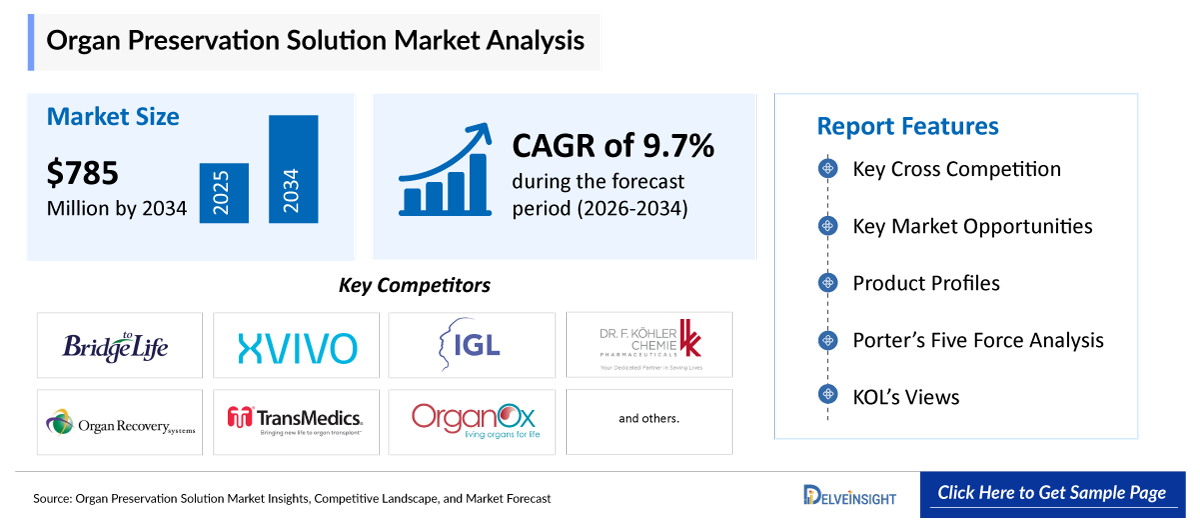
- The Organ Preservation Solution Market is estimated at USD 340 million in 2025 and is projected to reach USD 785 million by 2034. Growth is anchored by the rising number of organ transplant procedures and growing burden of end-stage organ failure, increasing organ donation rates, and expansion of transplant centers and organ procurement organizations, and increasing government initiatives supporting organ donation.
- The Global Organ Preservation Solution Market is growing at a CAGR of 9.7% during the forecast period from 2026 to 2034.
Organ Preservation Solution Market Trends & Insights
- By product/solution type, the Organ Preservation Solution segment dominated the Organ Preservation Solution market with a 61% share in 2025.
- By application, the procurement segment dominated the Organ Preservation Solution market with a 38% share in 2025.
- By organ type, the kidney segment dominated the Organ Preservation Solution market with a 42% share in 2025.
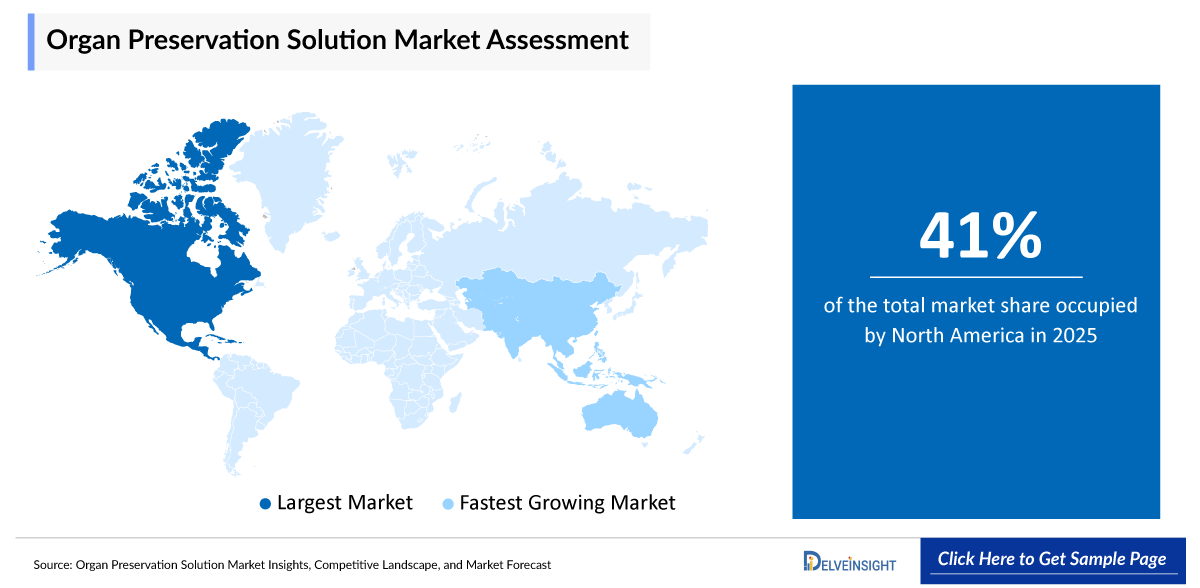
- North America dominated the global Organ Preservation Solution market revenue with a 41% share in 2025, representing the highest regional market share globally.
Request for Unlocking the Sample Page of the "Organ Preservation Solutions Market"
Factors Contributing to the Growth of the Organ Preservation Solution Market
Organ Preservation Solution Market Drivers
-
Rising Global Organ Transplant Volumes
The most powerful driver of the Organ Preservation Solution market is the steady rise in organ transplant procedures worldwide. The United States performed 48,149 total organ transplants in 2024, nearly 132 procedures per day, including 27,759 kidney transplants, 11,458 liver transplants, and 4,572 heart transplants, according to Organ Donor Organization 92026), while global transplant activity reported to the WHO-ONT Global Observatory (2026), exceeded 172,000 procedures in 2023, a 9.5% increase over 2022.
Every transplant procedure requires flushing, storage, and often perfusion with a preservation solution between procurement and implantation, so rising procedure counts translate directly into recurring, volume-driven demand for preservation and perfusion fluids. As surgical techniques and immunosuppressive regimens continue to improve transplant outcomes and expand eligibility, transplant volumes and associated preservation solution consumption are expected to rise steadily through 2034.
-
Expanding Donor Pool and Use of Marginal Organs
An expanding and diversifying donor pool is broadening demand for advanced preservation chemistry. Donation after circulatory death donors accounted for 5,896 of U.S. deceased donors in 2023, representing 36% of the total and requiring preservation approaches specifically suited to organs that have already experienced a period of warm ischemia. Extended-criteria and marginal organs, including older and steatotic donor livers, are increasingly being accepted for transplantation as hypothermic oxygenated perfusion demonstrates improved graft outcomes and preserved mitochondrial function in these higher-risk organs.
As transplant programs work to close the persistent gap between organ demand and donor supply by accepting a wider range of donor organs, preservation solutions engineered for higher-risk and extended-criteria grafts become an increasingly central part of the transplant workflow.
Organ Preservation Solution Market Restraints
Despite strong momentum, the Organ Preservation Solution market faces material constraints. Machine perfusion solutions and the platforms that deliver them carry substantially higher costs than conventional static cold storage, which can limit adoption among smaller transplant centers and in cost-constrained healthcare systems. The short viable window of donor organs imposes severe time and logistics constraints, requiring precise cold-chain handling and rapid transportation that can be difficult to guarantee across long distances or in regions with underdeveloped transplant infrastructure.
Regulatory approval pathways for new preservation and perfusion chemistries can be lengthy, as illustrated by delays in CE certification for novel heart preservation solutions pending additional scientific review, which slows the pace of new product introduction. Reimbursement for machine perfusion remains uneven across geographies, and a shortage of personnel trained in perfusion techniques constrains scale-up at transplant centers seeking to adopt newer technologies.
Global supply-chain fragility, including periodic delivery constraints for certain branded preservation solutions, can disrupt availability, while the persistent gap between organ demand and donor supply continues to cap the addressable procedure volume in many countries. Together, these cost, logistical, regulatory, workforce, and supply-chain barriers temper the pace of growth, even as the underlying drivers of rising transplant volumes and perfusion technology adoption remain firmly intact.
Organ Preservation Solution Overview
Organ Preservation Solution is a specialized sterile biochemical solution designed to maintain the structural integrity, viability, and physiological function of donor organs from the time they are recovered until transplantation. These solutions minimize ischemic injury by reducing cellular metabolism, preventing tissue swelling (edema), maintaining electrolyte balance, buffering pH changes, scavenging free radicals, and protecting cell membranes during cold storage or machine perfusion.
Organ Preservation Solutions contain a carefully balanced combination of electrolytes, impermeants (such as lactobionate, raffinose, or mannitol), osmotic agents, antioxidants, energy substrates, and buffering compounds that help preserve intracellular and extracellular homeostasis while reducing oxidative stress and inflammatory damage. By slowing metabolic activity under hypothermic conditions, these solutions extend the allowable preservation time for organs such as the kidneys, liver, heart, lungs, pancreas, and intestines, thereby increasing the likelihood of successful transplantation.
Widely used preservation solutions include the University of Wisconsin (UW) Solution, Histidine-Tryptophan-Ketoglutarate (HTK) Solution, Celsior Solution, Institut Georges Lopez (IGL) Solution, and Perfadex® for lung preservation. The selection of a preservation solution depends on the organ type, preservation technique (static cold storage or machine perfusion), expected ischemic duration, and clinical requirements.
Overall, Organ Preservation Solutions play a critical role in modern transplantation by improving graft quality, reducing ischemia-reperfusion injury, enhancing post-transplant organ function, and increasing long-term graft survival and patient outcomes.
Organ Preservation Solution Market Key Growth Drivers
- The rising number of organ transplantation procedures worldwide is significantly driving demand for Organ Preservation Solutions, supported by increasing kidney, liver, heart, lung, and pancreas transplant volumes and expanding transplant programs across developed and emerging economies.
- The growing shortage of donor organs is accelerating the adoption of advanced preservation solutions that extend organ viability, reduce ischemia-reperfusion injury, and improve graft utilization, thereby increasing the success rate of transplantation.
- The increasing prevalence of end-stage organ failure and chronic diseases, including Chronic Kidney Disease, Liver Cirrhosis, Heart Failure, and chronic lung diseases, is expanding the global transplant candidate pool and fueling demand for effective organ preservation technologies.
- Continuous advancements in hypothermic machine perfusion (HMP), normothermic machine perfusion (NMP), and ex vivo organ perfusion systems are boosting the use of specialized preservation solutions optimized for dynamic perfusion, improving organ quality and post-transplant outcomes.
- Rising investments by governments, transplant organizations, and healthcare institutions in organ donation awareness programs, transplant infrastructure, and organ procurement networks are increasing the number of donor organs recovered and preserved, supporting market growth.
- Regulatory approvals, clinical research, and commercialization of next-generation preservation solutions with enhanced antioxidant, anti-inflammatory, and cytoprotective properties are improving graft survival and expanding their adoption across multiple organ types.
- The convergence of increasing transplantation volumes, rising burden of end-stage organ diseases, technological advancements in organ preservation, expanding transplant infrastructure, and continued innovation in preservation solutions is expected to sustain strong growth in the global Organ Preservation Solution market through the forecast period.
Major Organ Preservation Solution Companies
- Bridge to Life Ltd.
- XVIVO Perfusion AB
- Institut Georges Lopez (IGL)
- Dr. Franz Köhler Chemie GmbH
- Organ Recovery Systems
- TransMedics, Inc.
- OrganOx Limited
- Preservation Solutions, Inc.
- Essential Pharmaceuticals LLC
- Paragonix Technologies
Organ Preservation Solution Market Segment Analysis
The Organ Preservation Solution Market Product Type (Organ Preservation Solutions [UW Solution, HTK Solution, Celsior Solution, IGL-1 Solution, Perfadex, EuroCollins/Collins Solution, and Others] and Perfusion Solutions/Machine Perfusion [Hypothermic Machine Perfusion (HMP) Solutions, Hypothermic Oxygenated Perfusion (HOPE/D-HOPE) Solutions, Normothermic Machine Perfusion (NMP) Solutions, Subnormothermic/Controlled Oxygenated Rewarming Solutions, and Other Proprietary Perfusion Solutions]), Application (Procurement, Preservation, Transportation, Pre-Implantation, and Post-Implantation), Organ Type (Kidney, Liver, Heart, Pancreas, and Others), and Geography (North America, Europe, Asia-Pacific, Rest of World).
-
Organ Preservation Solution Market Segmentation By Product/Solution Type
Dominant Subsegment: Organ Preservation Solutions. The Organ Preservation Solutions category is expected to dominate the market.
Dominant: Organ Preservation Solutions ~ 61%
The Organ Preservation Solutions segment accounted for 61% of the Organ Preservation Solutions market in 2025. Static Organ Preservation Solutions remain the leading product type because they are the established, universally required first step of preservation for every recovered organ, regardless of whether machine perfusion is subsequently used.
Within this segment, UW solution holds the largest share on the strength of its decades-long track record, proven efficacy in reducing cellular injury, and broad adoption for kidney, liver, and pancreas preservation, while HTK solution is favored for cardiac and select abdominal applications, Celsior and IGL-1 are increasingly used across Europe and Latin America, and Perfadex remains the standard flush solution used in more than 90% of lung transplant clinics worldwide.
While perfusion solutions used in machine perfusion platforms are the fastest-growing product type as hypothermic oxygenated and normothermic technologies gain clinical traction, the universal, recurring requirement for flush and static storage solutions in every procurement secures the leadership of Organ Preservation Solutions across the forecast period.
-
Organ Preservation Solution Market Segmentation By Application
Dominant Subsegment: Preservation. The preservation category is expected to dominate the market.
Dominant: Preservation ~ 38%
The preservation segment accounted for 38% of the Organ Preservation Solution market in 2025. Preservation is the leading application because it represents the core, unavoidable use case for every donor organ: maintaining viability in cold storage or on a perfusion platform for the duration between procurement and implantation. Every organ recovered for transplantation, regardless of organ type or preservation technique, consumes preservation solution volume during this stage, making it the largest and most consistent source of demand.
Procurement and transportation are also substantial, recurring applications, as organs must be flushed at recovery and often re-perfused or re-flushed during transit. Pre-implantation is the fastest-growing application, as transplant centers increasingly use machine perfusion not only to preserve organs but to actively assess graft viability and function immediately before surgery, supported by emerging biomarker-guided protocols.
Nonetheless, the sheer breadth and volume of the core preservation stage secure its leadership across the forecast period.
Organ Preservation Solution Market Region Analysis
- Dominant Region: North America
- Dominant: North America ~ 41% (Largest)
North America accounted for 41% of the global Organ Preservation Solution market revenue in 2025, representing the highest regional market share globally. The region’s dominance reflects a mature transplant ecosystem, a high volume of annual organ transplant procedures, advanced healthcare infrastructure, and a concentration of leading preservation and perfusion solution manufacturers.
The United States performed 48,149 organ transplants in 2024 alone, and sponsors benefit from proximity to established solution suppliers such as Bridge to Life and to a dense network of organ procurement organizations and transplant centers.
Regulatory clarity from the FDA, including the October 2025 clearance of expanded-label machine perfusion solutions and the January 2026 authorization of a new hypothermic oxygenated perfusion system, is accelerating adoption of next-generation preservation technologies.
Additionally, in October 2025, Bridge to Life received FDA 510(k) clearance for multi-sourced Belzer UW® and MPS® solutions, with expanded labeling that lets Belzer MPS® support hypothermic machine perfusion across all abdominal organs, a first for the field. Strong reimbursement frameworks, a well-established organ procurement organization network, and continued expansion of perfusion-based programs, including new ex vivo lung perfusion centers launched in 2026, anchor the region’s continued leadership across the forecast period.
- Fastest Growing Region: Asia-Pacific
Asia-Pacific is the fastest-growing region in the Organ Preservation Solution market. The region’s elevated CAGR is driven by rising organ failure prevalence, rapid expansion of transplant infrastructure, and growing healthcare investment across China, Japan, India, South Korea, and Australia.
China is expanding its transplant center network and standardizing donation and transplantation guidelines, Japan is integrating advanced preservation technologies within its universal-insurance healthcare system, and India is scaling transplant capacity supported by medical tourism and government initiatives to promote organ donation.
Government healthcare investment, expanding chronic disease burden, and growing public awareness of organ donation are accelerating adoption, while regional distributors increasingly partner with international preservation and perfusion solution manufacturers to broaden access. The combination of rising disease burden, transplant infrastructure build-out, and growing donation awareness positions Asia-Pacific as the principal source of incremental growth over the forecast period.
Organ Preservation Solution Market Regional Commentary
- North America
North America accounted for 41% of the global Organ Preservation Solution market revenue in 2025. The United States dominates on the strength of the world’s highest annual transplant volume, a dense network of organ procurement organizations and transplant centers, and clear FDA regulatory pathways, while accelerating clearances for machine perfusion solutions and platforms reinforce its leadership.
- Europe
Europe is a large and advanced regional market, supported by an established base of preservation solution manufacturers, including Dr. Franz Köhler Chemie in Germany and Institut Georges Lopez in France, and coordinated transplant and regulatory frameworks across Germany, France, the United Kingdom, Italy, and Spain. Growing adoption of hypothermic oxygenated perfusion for liver and abdominal organs reinforces the region’s role in both static solution manufacturing and perfusion technology innovation.
- Asia-Pacific
Asia-Pacific is the fastest-growing region, propelled by rising organ failure prevalence, expanding transplant infrastructure, and growing healthcare investment across China, Japan, India, South Korea, and Australia. China’s transplant center expansion, Japan’s quality-focused adoption of advanced preservation systems, and India’s growing transplant capacity are accelerating regional demand for both static and perfusion-based preservation solutions.
- Rest of World
The Rest of World region, spanning Latin America, the Middle East, and Africa, is an emerging growth frontier. Expanding transplant and healthcare infrastructure, rising demand for organ transplantation, and efforts to broaden access to advanced preservation technologies are gradually increasing adoption, while growing distribution partnerships with established international manufacturers support the build-out of regional supply.
Organ Preservation Solution Market Competitive Landscape
The Organ Preservation Solution market is classified as Fragmented. A semi-consolidated group of established solution manufacturers, including Bridge to Life, XVIVO Perfusion, Dr. Franz Köhler Chemie, and Institut Georges Lopez, anchors the leading tier through proprietary formulations, regulatory approvals, and global distribution networks, while numerous small- to mid-size regional producers, including Preservation Solutions, Waters Medical Systems, Carnamedica, and Global Transplant Solutions, compete through localized distribution, pricing, and niche organ-specific formulations, sustaining a broad and competitive supplier base.
The Organ Preservation Solution Competitive Landscape can be evaluated across the following dimensions:
- Market concentration: Fragmented, with a small group of established, globally distributed manufacturers leading and a broad base of regional small- to mid-size solution producers.
- Leading players: Bridge to Life, XVIVO Perfusion, Dr. Franz Köhler Chemie, and Institut Georges Lopez anchor the top tier through proprietary formulations and long-standing clinical adoption.
- Geographic reach: Leaders operate global distribution networks supplying organ procurement organizations and transplant centers across dozens of countries, supported by regional subsidiaries such as Waters Medical Systems in North America.
- Product portfolio strength: Top players offer both static preservation solutions and machine perfusion perfusates, spanning hypothermic, hypothermic oxygenated, and normothermic platforms.
- Regulatory access: Ownership of proprietary, regulator-cleared formulations, including FDA-cleared, expanded-label machine perfusion solutions, is a decisive competitive advantage.
- Strategic partnerships: Tie-ups with organ procurement organizations and transplant centers, such as XVIVO and Perfusion Solution’s 2026 partnership with OneLegacy, extend commercial reach.
- M&A activity: Active consolidation in the broader organ preservation ecosystem, illustrated by Getinge’s 2024 acquisition of perfusion device maker Paragonix Technologies for USD 253 million.
- Manufacturing capabilities: GMP-compliant sterile fluid manufacturing, cold-chain packaging, and global supply-continuity inventory buffers are key competitive moats.
- Innovation focus: Hypothermic oxygenated perfusion, biomarker- guided viability assessment, subnormothermic rewarming, and expansion of machine perfusion to heart and lung preservation.
Organ Preservation Solution Market Recent Developmental Activities
- In May 2026, Bridge to Life Ltd. presented new data at the ILTS 2026 meeting showing that its VitaSmart hypothermic oxygenated perfusion system expands utilization of steatotic and older donor livers while preserving mitochondrial function for real-time viability assessment. Strategic significance: Reinforces Bridge to Life’s leadership in perfusion-based preservation and strengthens the clinical case for broader hypothermic oxygenated perfusion adoption.
- In March 2026, Bridge to Life Ltd. announced that Duke University Hospital became the first U.S. transplant center to successfully implement the VitaSmart hypothermic oxygenated perfusion system commercially, preserving a donation-after-circulatory-death donor liver before transplantation. Strategic significance: Demonstrates early physician confidence and commercial traction for Bridge to Life’s FDA-cleared perfusion platform.
Organ Preservation Solution Market Segmentation
Organ Preservation Solution Market by Product Type
- Organ Preservation Solutions
- UW Solution (University of Wisconsin)
- HTK Solution (Histidine-Tryptophan-Ketoglutarate / Custodiol)
- Celsior Solution
- IGL-1 Solution
- Perfadex
- EuroCollins / Collins Solution
- Perfusion Solutions (Machine Perfusion)
- Hypothermic Machine Perfusion (HMP) Solutions
- Hypothermic Oxygenated Perfusion (HOPE/D-HOPE) Solutions
- Normothermic Machine Perfusion (NMP) Solutions
- Subnormothermic/Controlled Oxygenated Rewarming Solutions
- Other Proprietary Perfusion Solutions
Organ Preservation Solution Market by Application
- Procurement
- Preservation
- Transportation
- Pre-Implantation
- Post-Implantation
Organ Preservation Solution Market by Organ Type
- Kidney
- Liver
- Heart
- Pancreas
- Others
Organ Preservation Solution Market by Geography
North America Organ Preservation Solution Market
- United States Organ Preservation Solution Market Size in USD million (2023-2034)
- Canada Organ Preservation Solution Market Size in USD million (2023-2034)
- Mexico Organ Preservation Solution Market Size in USD million (2023-2034)
Europe Organ Preservation Solution Market
- Germany Organ Preservation Solution Market Size in USD million (2023-2034)
- United Kingdom Organ Preservation Solution Market Size in USD million (2023-2034)
- France Organ Preservation Solution Market Size in USD million (2023-2034)
- Italy Organ Preservation Solution Market Size in USD million (2023-2034)
- Spain Organ Preservation Solution Market Size in USD million (2023-2034)
- Rest of Europe Organ Preservation Solution Market Size in USD million (2023-2034)
Asia-Pacific Organ Preservation Solution Market
- China Organ Preservation Solution Market Size in USD million (2023-2034)
- Japan Organ Preservation Solution Market Size in USD million (2023-2034)
- India Organ Preservation Solution Market Size in USD million (2023-2034)
- Australia Organ Preservation Solution Market Size in USD million (2023-2034)
- South Korea Organ Preservation Solution Market Size in USD million (2023-2034)
- Rest of Asia-Pacific Organ Preservation Solution Market Size in USD million (2023-2034)
Rest of the World (RoW) Organ Preservation Solution Market
- Middle East Organ Preservation Solution Market Size in USD million (2023-2034)
- Africa Organ Preservation Solution Market Size in USD million (2023-2034)
- South America Organ Preservation Solution Market Size in USD million (2023-2034)
Key Takeaways from the Organ Preservation Solution Market Report Study
- Market size analysis for the current Organ Preservation Solution market size (2025), and market forecast for 9 years (2026 to 2034).
- Top key product/technology developments, mergers, acquisitions, partnerships, and joint ventures that happened over the last 3 years.
- Key companies dominating the global Organ Preservation Solution market.
- Various opportunities available for competitors in the Organ Preservation Solution market space.
- What are the top-performing segments in 2025? How will these segments perform in 2034?
- Which are the top-performing regions and countries in the current Organ Preservation Solution market scenario?
- Which are the regions and countries where companies should concentrate their opportunities for Organ Preservation Solution market growth in the future?
Target audience who can benefit from this Organ Preservation Solution market report study
- Organ Preservation Solution product providers
- Research organizations and consulting companies
- Organ Preservation Solution-related organizations, associations, forums, and other alliances
- Government and corporate offices
- Start-up companies, venture capitalists, and private equity firms
- Distributors and traders dealing in Organ Preservation Solutions
- Various end-users who want to know more about the Organ Preservation Solution market and the latest technological developments in the Organ Preservation Solution market.
Stay updated with us for Recent Articles @ New DelveInsight Blogs

