.png&w=256&q=75)
Liver Cirrhosis Market Summary
- The Liver Cirrhosis Treatment Market is anticipated to sustain a steady CAGR during the forecast period (2026–2036). This growth in Liver Cirrhosis Market revenue is primarily propelled by the rising prevalence of chronic liver diseases, increasing prevalence of MASH, alcohol-related liver disease, viral hepatitis, improved diagnostic capabilities, and growing awareness leading to earlier disease identification across the 7MM.
- The Liver Cirrhosis Treatment Market Size is influenced by various factors such as the pharmaceuticals and treatment options available for managing the condition, prevalence of Liver Cirrhosis, advancements in treatment options, healthcare infrastructure, and reimbursement policies.
- The future Liver Cirrhosis Therapeutics Market is expected to become increasingly competitive as multiple novel therapies targeting fibrosis, inflammation, metabolic dysfunction, and liver regeneration advance through clinical development. The potential introduction of effective disease-modifying treatments could significantly transform the Liver Cirrhosis Treatment landscape, improve patient outcomes, and accelerate overall market growth at a notable CAGR during the forecast period.
Liver Cirrhosis Market & Epidemiology Analysis
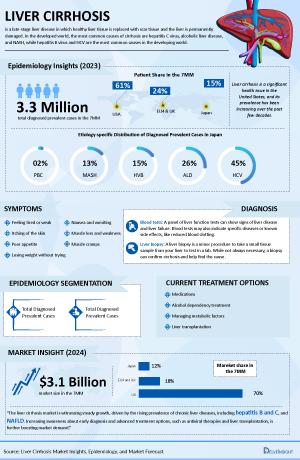
- DelveInsight suggests that within the 7MM, there are more than 3 million diagnosed prevalent cases of Liver Cirrhosis in 2025. Notably, the US contributes approximately majority of these cases, indicating a significant burden within the country compared to other nations in the 7MM.
- The increasing burden of Liver Cirrhosis may be attributed to a combination of factors, including the growing prevalence of obesity, diabetes, metabolic syndrome, excessive alcohol consumption, chronic hepatitis B and C infections, aging populations, and improved survival of patients with chronic liver disease.
- Although no approved therapy currently reverses Liver Cirrhosis, advances in disease management have significantly improved patient outcomes. Current treatment strategies focus on addressing the underlying cause, slowing disease progression, preventing complications such as portal hypertension, ascites, and hepatic encephalopathy, and optimizing supportive care. Combined with ongoing innovation in antifibrotic and regenerative therapies, these approaches offer promising opportunities to improve long-term outcomes and reduce the need for liver transplantation.
- Investigational drugs, including antifibrotic agents, anti-inflammatory therapies, and regenerative therapies, such as belapectin and efruxifermin, are being evaluated to improve the management of Liver Cirrhosis. Several additional candidates are in various stages of clinical development, indicating a promising pipeline that is expected to expand future treatment options
Request for unlocking the Sample Page of the "Liver Cirrhosis Treatment Market"
Key Factors Driving the Growth of the Liver Cirrhosis Market
-
Rising Prevalence of Liver Cirrhosis
The growing global burden of Liver Cirrhosis is increasing demand for effective diagnosis, treatment, and long-term disease management. Global cirrhosis incidence rose substantially between 1990 and 2021.
-
Increasing Alcohol Consumption
Chronic and excessive alcohol consumption remains a major contributor to Liver Cirrhosis and is expected to continue supporting demand for treatments targeting alcohol-associated liver disease.
-
Growing Burden of Metabolic Liver Diseases
Rising Obesity, Diabetes, Metabolic Syndrome, and metabolic dysfunction-associated steatotic liver disease are contributing to increasing cases of advanced fibrosis and cirrhosis.
-
Persistent Hepatitis B and C Infections
Chronic HBV and HCV infections remain important causes of cirrhosis globally, sustaining the need for antiviral therapies, monitoring, and management of liver-related complications.
-
Growing Demand for Early Diagnosis
Increasing awareness of liver health and improvements in diagnostic testing are encouraging earlier identification and monitoring of liver fibrosis and cirrhosis, supporting market expansion.
-
Advancements in Treatment Options
The development of novel therapies, including antifibrotic approaches and treatments targeting underlying liver diseases, is expanding the therapeutic landscape and creating new market opportunities.
-
Increasing Management of Cirrhosis Complications
Rising demand for therapies addressing complications such as ascites, variceal bleeding, hepatic encephalopathy, and infections is supporting continued treatment utilization.
-
Expansion of Liver Transplantation Programs
The increasing number of patients progressing to advanced or decompensated cirrhosis is driving demand for liver transplantation and associated pre- and post-transplant care.
DelveInsight’s “Liver Cirrhosis Market Insights, Epidemiology, and Market Forecast – 2036” report delivers an in-depth understanding of Liver Cirrhosis, historical and forecasted epidemiology, as well as the Liver Cirrhosis market trends in the United States, EU4 (Germany, France, Italy, and Spain), the United Kingdom, and Japan.
The Liver Cirrhosis Treatment Market Report delivers a comprehensive analysis of the current treatment landscape, including standards of care, clinical practices, and evolving therapeutic algorithms. It evaluates, Liver Cirrhosis patient burden trends, revenue & market share dynamics, peak patient share & therapy uptake analysis, and provides an in-depth market size assessment and growth rate projections (Historical & Forecast 2022–2036) across the 7MM regions. The report highlights key unmet medical needs in Liver Cirrhosis and maps the competitive and clinical landscape to uncover high‑value opportunities, providing a clear outlook on future market growth potential.
Scope of the Liver Cirrhosis Market Report | |
|
Study Period |
2022–2036 |
|
Historical Year |
2022–2025 |
|
Forecast Period |
2026–2036 |
|
Base Year |
2025 |
|
Geographies Covered |
|
|
Liver Cirrhosis Epidemiology Segmentation Analysis |
Patient Burden Assessment
|
|
Liver Cirrhosis Companies |
|
|
Liver Cirrhosis Market |
Segmented by
|
|
Analysis |
|
Liver Cirrhosis Understanding
Liver Cirrhosis Overview
Cirrhosis is the histological development of regenerative nodules surrounded by fibrous bands in response to chronic liver injury, leading to portal hypertension and end-stage liver disease. In this late-stage liver disease, the healthy liver tissue is replaced with scar tissue, and the liver is permanently damaged, and scar tissue keeps the liver from working properly. Cirrhosis has many signs and symptoms, such as fatigue and severe itchy skin, and they may not appear until the liver is badly damaged. Causes include alcoholic liver disease, nonalcoholic fatty liver disease, chronic hepatitis C, and chronic hepatitis B.
Most patients with early-stage cirrhosis are asymptomatic, and the disease is often detected incidentally through routine blood tests or imaging. Although liver biopsy remains the gold standard for confirming cirrhosis, it is an invasive procedure that many patients find uncomfortable. As symptoms such as jaundice appear only in advanced, irreversible stages, opportunities for early intervention are often missed.
Liver Cirrhosis Diagnosis
Current diagnostic approaches, including imaging and liver function tests, have limited sensitivity for detecting early disease and predicting progression, highlighting the need for more accurate, reliable, and non-invasive biomarkers for early diagnosis and disease monitoring.
Further details related to country-based variations are provided in the report…
Current Liver Cirrhosis Treatment Landscape
Liver Cirrhosis treatment depends on the underlying cause and the stage of disease. Although cirrhosis is generally irreversible, early management of the underlying condition, such as viral hepatitis or hemochromatosis, can slow disease progression, prevent liver failure, and may partially improve liver scarring. Supportive measures, including a balanced high-protein, low-fat diet, regular exercise, and management of nutritional deficiencies, also play an important role in improving patient outcomes and quality of life.
Patients with decompensated cirrhosis often develop serious complications, including ascites, hepatic encephalopathy, and variceal bleeding, which require intensive medical care and significantly impair daily functioning. Current treatments, such as medications, IV antibiotics, endoscopic procedures, and hemodialysis, are often expensive, associated with adverse effects, and may provide limited long-term benefit. Liver transplantation remains the only definitive treatment for end-stage cirrhosis; however, its high cost and the shortage of donor organs leave many patients without timely access. These challenges highlight the need for more effective, accessible, and affordable therapies to reduce complications and improve long-term outcomes.
Further details related to country-based variations are provided in the report…
Liver Cirrhosis Epidemiology
The epidemiology section of the Liver Cirrhosis Therapeutics Market report offers information on the patient populations, including historical and projected trends for each of the seven major markets. Examining key opinion leader views from physicians or clinical experts can assist in identifying the reasons behind historical and projected trends. The Liver Cirrhosis Diagnosed Patient Pool, their trends, and the underlying assumptions are all included in this section of the report. This section also presents the Liver Cirrhosis Prevalence Data with relevant tables and graphs, offering a clear and concise view of the prevalence of Liver Cirrhosis. Additionally, the report discloses the assumptions made during the analysis, ensuring data interpretation and presentation transparency. This epidemiological data is valuable for understanding the disease burden and its impact on the patient population across various regions.
Key Findings from Liver Cirrhosis Epidemiological Analysis and Forecast
- The US showed the highest diagnosed prevalent population of Liver Cirrhosis compared to the other 7MM countries, with more than 2 million cases in 2025. As per DelveInsight’s estimates, the country alone accounts for nearly 61% of total diagnosed prevalent cases for Liver Cirrhosis in the 7MM, followed by Japan, contributing 15% of all the Liver Cirrhosis cases.
- The etiology-specific distribution of diagnosed prevalent cases of Liver Cirrhosis showed NASH, HCV, HVB, ALD, and PBC comprised 28%, 27%, 11%, 33%, and 2% cases, respectively in the 7MM in 2025.
- EU4 and the UK accounted for approximately 1 million diagnosed prevalent cases of Liver Cirrhosis in 2025. Of these cases, Germany accounted for the highest number of diagnosed prevalent cases of Liver Cirrhosis between EU4 and the UK.
- Japan accounted for more than 500,000 cases of the total diagnosed prevalent cases of Liver Cirrhosis in the 7MM in 2025.
Liver Cirrhosis Epidemiology Segmentation in the 7MM
- Total Liver Cirrhosis Prevalent Cases
- Total Liver Cirrhosis Diagnosed Prevalent Cases
- Liver Cirrhosis Gender-specific Diagnosed Prevalent Cases
- Liver Cirrhosis Age-specific Diagnosed Prevalent Cases
- Etiology-specific Diagnosed Prevalent Cases
Liver Cirrhosis Market Recent Breakthroughs and Developments
- In August 2026, Can-Fite BioPharma continued the Phase III development of namodenoson for advanced hepatocellular carcinoma in patients with underlying Child-Pugh B7 liver cirrhosis, supporting its potential role in the treatment of liver disease-associated cancer.
Liver Cirrhosis Market Outlook
The Liver Cirrhosis Therapeutics Market is further expected to increase by the major drivers, such as the rising Liver Cirrhosis prevalence population, technological advancements, and upcoming therapies in the forecast period (2026–2036). With ongoing research and continued dedication, the future holds hope for effective treatments and, ultimately, a cure for this challenging condition. According to DelveInsight, the Liver Cirrhosis market in the 7MM is expected to change significantly during the forecast period 2026-2036.
Liver Cirrhosis Drug Analysis & Competitive Landscape
The Liver Cirrhosis drug chapter provides a detailed, market-focused review of approved therapies and the emerging Liver Cirrhosis Pipeline across Phase I-III clinical trials. It covers Liver Cirrhosis Mechanism of Action, clinical trial data, regulatory approvals, patents, collaborations, strategic partnerships upcoming key catalyst for each therapy, along with their advantages, limitations, and Liver Cirrhosis Recent Developments. This section offers critical insights into the Liver Cirrhosis treatment landscape, supporting market assessment, competitive analysis, and growth forecasting for the Liver Cirrhosis therapeutics market.
Liver Cirrhosis Pipeline Analysis
-
Efruxifermin: Akero Therapeutics
Efruxifermin (EFX), formerly AKR-001, is Akero’s lead product candidate for MASH cirrhosis. EFX is designed to offer convenient once-weekly SC dosing. The consistency and magnitude of observed effects position EFX to be a potentially best-in-class medicine if approved.
EFX is currently being evaluated in Phase IIb clinical trials in patients with biopsy-confirmed NASH: the SYMMETRY study in cirrhotic patients with compensated F4 fibrosis. EFX shows the potential to be an effective treatment for patients with cirrhosis due to MASH. Currently the drug is in Phase II of clinical development for the treatment of MASH cirrhosis.
Competitive Landscape of Liver Cirrhosis Pipeline Drugs | ||||||
|
Drug Name |
Company |
Highest Phase |
Indication |
RoA |
MoA |
Anticipated Launch in the US |
|
Efruxifermin |
Akero Therapeutics |
Phase III |
Mash cirrhosis |
SC |
FGF21 Stimulants |
Information is available in the full report |
|
Belapectin |
Galectin Therapeutics |
Phase III |
Mash cirrhosis |
IV |
Galectin 3 inhibitors |
Information is available in the full report |
Note: Detailed emerging therapies assessment will be provided in the final report…
Liver Cirrhosis Market Insights
DelveInsight’s ‘Liver Cirrhosis Market Insights, Epidemiology, and Market Forecast – 2036’ report provides a detailed outlook of the current and future Liver Cirrhosis market, segmented within countries, by therapies, and by classes. Further, the market of each region is then segmented by each therapy to provide a detailed view of the current and future market share of all therapies.
Liver Cirrhosis Market Size by Countries
The Liver Cirrhosis treatment market size is assessed separately for various countries, including the US, EU4 (Germany, France, Italy, and Spain), the UK, and Japan. In 2025, the US held a significant share of the overall 7MM (Seven Major Markets) Liver Cirrhosis market, primarily attributed to the country’s higher prevalence of the condition and the elevated cost of the available treatments. This dominance is projected to persist, especially with the potential early introduction of new products.
Country-wise Market Size Distribution of Liver Cirrhosis

Liver Cirrhosis Market Size by Therapies
Liver Cirrhosis treatment market size by therapies is categorized into current and emerging markets for the study period 2022–2036.

Note: Detailed market segment assessment will be provided in the final report.
Liver Cirrhosis Drug Uptake
This section focuses on the sales uptake of potential Liver Cirrhosis drugs that have recently been launched or are anticipated to be launched in the Liver Cirrhosis market between 2022 and 2036. It estimates the market penetration of Liver Cirrhosis drugs for a given country, examining their impact within and across classes and segments. It also touches upon the financial and regulatory decisions contributing to the probability of success (PoS) of the drugs in the Liver Cirrhosis market.
The emerging Liver Cirrhosis therapies are analyzed based on various attributes such as safety and efficacy in randomized clinical trials, order of entry and other market dynamics, and the unmet need they fulfil in the Liver Cirrhosis market.
Note: Detailed assessment of drug uptake and attribute analysis will be provided in the full report on Liver Cirrhosis
Liver Cirrhosis Market Access and Reimbursement
DelveInsight’s ‘Liver Cirrhosis Market Insights, Epidemiology, and Market Forecast – 2036’ report provides a descriptive overview of the market access and reimbursement scenario of Liver Cirrhosis. This section includes a detailed analysis of the country-wise healthcare system for each therapy, enlightening the market access, reimbursement policies, and health technology assessments.
Latest KOL Views on Liver Cirrhosis
To keep up with current Liver Cirrhosis Therapeutics Market Trends and fill gaps in secondary findings, we interview KOLs and SMEs’ working in the Liver Cirrhosis domain. Their opinion helps understand and validate current and emerging therapies and treatment patterns or Liver Cirrhosis Therapeutics Market Trends. This will support the clients in potential upcoming novel treatments by identifying the overall scenario of the market and the Liver Cirrhosis unmet needs.
Liver Cirrhosis KOL Insights
DelveInsight’s analysts connected with 50+ KOLs to gather insights; however, interviews were conducted with 15+ KOLs in the 7MM. These KOLs were from organizations, institutes, and hospitals, such as Duke University School of Medicine, University of Florida Gainesville, Stanford University, Liver Unit, Hospital Clinic of Barcelona, Iwate Medical University, Leipzig University Hospital, University of Florida Gainesville, Florida, Service des Maladies de l'Appareil digestif, Hôpital Huriez, CHU, Lille, France, Liver Unit, Hospital Clinic of Barcelona, Barcelona, Spain, Division of Hepatology, Department of Internal Medicine, Iwate Medical University, Morioka, among others.
Region |
Key Opinion Leaders (KOLs) and Subject Matter Experts (SMEs) |
|
United States |
“Liver Cirrhosis is a progressive liver disease characterized by fibrosis, portal hypertension, and multisystem complications. Patients often require multidisciplinary care involving hepatology, gastroenterology, nutrition, radiology, transplant medicine, and primary care. The disease ranges from compensated cirrhosis with minimal symptoms to decompensated disease with complications such as ascites, variceal bleeding, hepatic encephalopathy, and hepatocellular carcinoma, requiring individualized management throughout its course.” |
|
Germany |
“Effective management of Liver Cirrhosis relies on early diagnosis and accurate staging using clinical evaluation, laboratory tests, imaging, and, when appropriate, liver biopsy. A multidisciplinary approach and regular surveillance for complications are essential to optimize outcomes, while liver transplantation remains the definitive treatment for advanced decompensated disease.” |
Note: Detailed assessment of KOL Views will be provided in the full report on Liver Cirrhosis
Liver Cirrhosis Competitive Intelligence Analysis
We conduct a Competitive and Liver Cirrhosis Therapeutics Market Intelligence analysis of the Liver Cirrhosis Market, utilizing various Competitive Intelligence tools such as SWOT analysis and Market entry strategies. The inclusion of these analyses is contingent upon data availability, ensuring a comprehensive and well-informed assessment of the market landscape and competitive dynamics.
Liver Cirrhosis Clinical Development Activities
The Liver Cirrhosis Therapeutics Market Report offers an analysis of therapeutic candidates in Phase II and III stages and examines companies involved in developing targeted therapeutics for Liver Cirrhosis. It provides valuable insights into the advancements and progress of potential treatments in clinical development for this condition.
Liver Cirrhosis Pipeline Development Activities
The Liver Cirrhosis Therapeutics Market Report covers information on collaborations, acquisitions and mergers, licensing, patent details, and other information for emerging Liver Cirrhosis therapies.
Liver Cirrhosis Market Report Insights
- Liver Cirrhosis Patient Population
- Therapeutic Approaches
- Liver Cirrhosis Pipeline Drugs Analysis
- Liver Cirrhosis Market Size and Trends
- Liver Cirrhosis Market Opportunities
- Impact of Upcoming Therapies
Liver Cirrhosis Market Report Key Strengths
- 11 Years Liver Cirrhosis Market Forecast
- The 7MM Coverage
- Liver Cirrhosis Epidemiology Segmentation
- Key Cross Competition
- Highly Analyzed Liver Cirrhosis Market
- Liver Cirrhosis Drugs Uptake
Liver Cirrhosis Market Report Assessment
- Current Liver Cirrhosis Treatment Practices
- Liver Cirrhosis Unmet Needs
- Liver Cirrhosis Pipeline Drugs Profiles
- Liver Cirrhosis Therapeutics Market Attractiveness
Key Questions Answered in the Liver Cirrhosis Therapeutics Market
Liver Cirrhosis Treatment Market Insights
- How common is Liver Cirrhosis?
- What are the key findings of Liver Cirrhosis epidemiology across the 7MM, and which country will have the highest number of patients during the study period (2022–2036)?
- What are the currently available treatments for Liver Cirrhosis?
- What are the disease risk, burden, and unmet needs of Liver Cirrhosis?
- At what CAGR is the Liver Cirrhosis market and its epidemiology is expected to grow in the 7MM during the forecast period (2026–2036)?
- How would the unmet needs impact the Liver Cirrhosis market dynamics and subsequently influence the analysis of the related trends?
- What would be the forecasted patient pool of Liver Cirrhosis in the 7MM covering the United States, EU4 (Germany, France, Italy, and Spain), the UK, and Japan?
- Among EU4 and the UK, which country will have the highest number of patients during the forecast period (2026–2036)?
- How many companies are currently developing therapies for the treatment of Liver Cirrhosis?
Reasons to Buy the Liver Cirrhosis Therapeutics Market Report
- The Liver Cirrhosis Therapeutics Market Report will help in developing business strategies by understanding the latest trends and changing treatment dynamics driving the Liver Cirrhosis Drugs Market.
- Insights on patient burden/disease: Liver Cirrhosis Prevalence, evolution in diagnosis, and factors contributing to the change in the epidemiology of the disease during the forecast years.
- To understand the existing Liver Cirrhosis Drugs Market opportunity in varying geographies and the growth potential over the coming years.
- Distribution of historical and current patient share based on real-world prescription data along with reported Liver Cirrhosis sales of current treatment in the US, EU4 (Germany, France, Italy, and Spain), the United Kingdom, and Japan.
- Identification of strong upcoming players in the Liver Cirrhosis Drugs Market will help in devising strategies that will help in getting ahead of competitors.
- Detailed analysis and ranking of class-wise potential current and Liver Cirrhosis Emerging Therapies under the attribute analysis section to provide visibility around leading classes.
- Highlights of access and reimbursement policies of approved therapies, barriers to accessibility of off-label expensive therapies, and patient assistance programs.
- To understand the perspective of key opinion leaders around the accessibility, acceptability, and compliance-related challenges of existing treatment to overcome barriers in the future.
- Detailed insights on the unmet needs of the existing Liver Cirrhosis Drugs Market so that the upcoming players can strengthen their development and launch strategy.
Stay updated with us for Recent Articles