Medical Oxygen Concentrators Market Summary
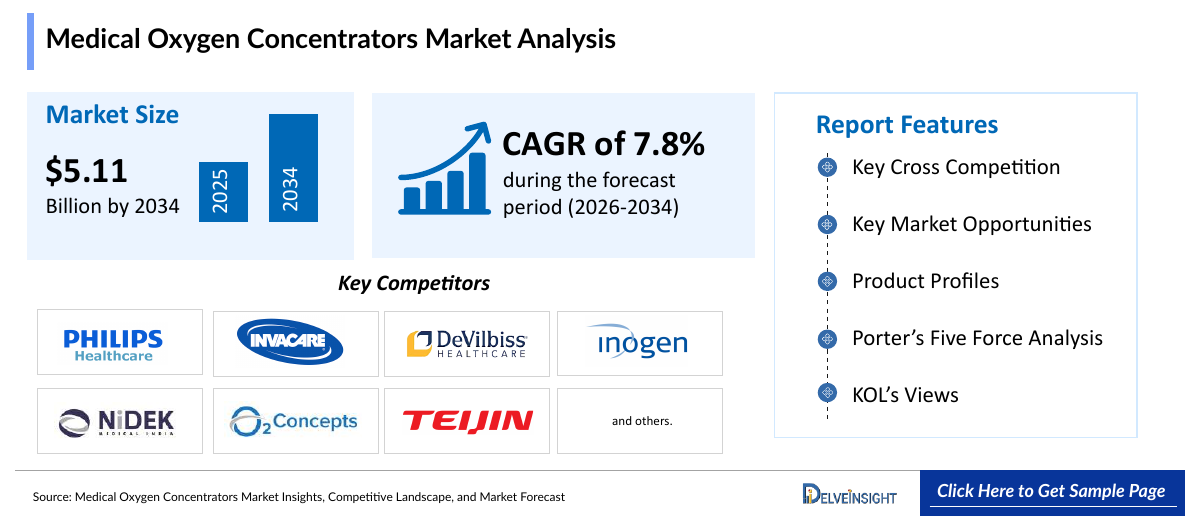
- The Medical Oxygen Concentrators market is estimated at USD 2.60 billion in 2025 and is projected to reach USD 5.11 billion by 2034. Growth is anchored in the rising burden of chronic obstructive pulmonary disease (COPD) and other chronic respiratory conditions, the steady shift of long-term oxygen therapy from hospitals to the home, and rapid innovation in lightweight portable devices.
- The global Medical Oxygen Concentrators market is growing at a CAGR of 7.8% during the forecast period from 2026 to 2034.
- By product, the portable segment dominated the Medical Oxygen Concentrators market with a 61% share in 2025.
- By technology, the pulse flow segment dominated the Medical Oxygen Concentrators market with a 44% share in 2025.
- By flow rate, the low-flow oxygen concentrators segment dominated the Medical Oxygen Concentrators market with an 82% share in 2025.
- By end-user, the homecare segment dominated the Medical Oxygen Concentrators market with a 66% share in 2025.
- North America dominated the global Medical Oxygen Concentrators market revenue with a 38% share in 2025, representing the highest regional market share globally.
A medical oxygen concentrator is an electrically powered medical device that draws in ambient air, removes nitrogen using molecular-sieve technology (typically pressure swing adsorption), and delivers oxygen-enriched air, generally at 87% to 96% purity, to patients who need supplemental oxygen. Unlike compressed gas cylinders or liquid oxygen systems, concentrators do not require refilling or scheduled delivery, which lowers the cost and logistical burden of long-term oxygen therapy. Stationary units run on mains power in the home or care facility and typically deliver continuous flow at up to 5 to 10 litres per minute, while portable units are battery-powered, lightweight devices that let ambulatory patients travel and stay active. The market is organized by product across stationary and portable concentrators; by technology across continuous flow, pulse flow, and devices offering both modes; by flow rate across low-flow and high-flow concentrators; and by end-user across homecare, hospitals and clinics, and others. Driven by the high prevalence of COPD, population aging, the migration of oxygen therapy to the home, and continuous improvement in battery life, weight, and oxygen delivery algorithms, medical oxygen concentrators have become the preferred, cost-efficient platform for delivering long-term oxygen therapy worldwide.
Medical Oxygen Concentrators Market Key Growth Drivers
- Rising prevalence of COPD and chronic respiratory disease is expanding the patient pool, with the Global Burden of Disease Study estimating that COPD affects approximately 392 million people globally and the World Health Organization reporting about 3.5 million COPD deaths in 2021.
- Population aging is increasing demand for long-term oxygen therapy, with the United Nations projecting that the share of the global population aged 65 and above will rise from about 10% in 2024 to about 16% by 2050.
- The shift of oxygen therapy from hospitals to the home is accelerating adoption, with more than 1 million Medicare beneficiaries in the United States receiving long-term oxygen therapy at home.
- Portable technology innovation, including Inogen's Rove 6 rollout in Brazil and Canada during 2026, CAIRE's FreeStyle Comfort with autoSAT technology in the United States, and O2 Concepts' Oxlife Liberty offering both continuous and pulse flow, is widening the addressable patient base.
- Cost, safety, and logistics advantages over compressed cylinders and liquid oxygen, including no scheduled refills and lower provider operating expenses, are driving replacement of legacy oxygen delivery.
- Supportive reimbursement signals, including CMS's decision to exclude oxygen from the next round of Medicare competitive bidding, and investment in hospital oxygen infrastructure are reinforcing demand.
- The convergence of rising disease burden, aging demographics, home-care migration, and device innovation is expected to sustain strong growth in the market through 2034.
Key Companies in Medical Oxygen Concentrators Market
The competitive landscape is led by the following active manufacturers:
- Koninklijke Philips N.V.
- Invacare Corporation
- DeVilbiss Healthcare LLC
- Inogen, Inc.
- Nidek Medical
- O2 Concepts
- Teijin Limited
- Supera Anesthesia Innovations
- GCE Group
- CAIRE
For illustrative purposes, only the top 10 companies are listed in the Table of Contents. The report may include analysis and references to additional companies relevant to the market assessment.
Medical Oxygen Concentrators Market Size
The following snapshot summarizes the principal report metrics for the Medical Oxygen Concentrators market.
|
Report Metrics |
Details |
|
2025 Market Size |
USD 2.60 billion |
|
2034 Projected Market Size |
USD 5.11 billion |
|
Growth Rate (2026-2034) |
7.8% CAGR |
|
Largest Market |
North America |
|
Fastest Growing Market |
Asia-Pacific |
|
Market Structure |
Moderately Concentrated |
All market values are expressed in USD and represent DelveInsight estimates synthesized from primary and secondary research.
Factors Contributing to the Growth of the Medical Oxygen Concentrators Market
Market Drivers
Rising Prevalence of COPD and Chronic Respiratory Disease
The most powerful driver of the Medical Oxygen Concentrators market is the growing global burden of chronic respiratory disease. The Global Burden of Disease Study, published by the Institute for Health Metrics and Evaluation, estimates that COPD affects approximately 392 million people worldwide, and the World Health Organization reports that COPD caused about 3.5 million deaths in 2021, making it one of the leading causes of death globally. Long-term oxygen therapy is a cornerstone of care for patients with chronic hypoxemia due to COPD, interstitial lung disease, and pulmonary hypertension, and oxygen concentrators are the most practical and economical way to deliver it for many hours a day. As diagnosis rates improve and patients live longer with chronic lung disease, the number of people prescribed supplemental oxygen continues to rise, directly expanding demand for both stationary and portable concentrators through 2034.
Aging Global Population
Population aging is a structural tailwind for the market. The United Nations projects that people aged 65 and above will rise from roughly 10% of the global population in 2024 to roughly 16% by 2050, and older adults are disproportionately affected by COPD, heart failure, sleep-disordered breathing, and other conditions that require supplemental oxygen. Elderly patients also place a premium on devices that are quiet, lightweight, and simple to use at home, which favors modern concentrators over bulky cylinders. As Japan, Europe, and North America age and as China and India follow, the pool of long-term oxygen therapy candidates expands steadily, supporting sustained replacement and new-patient demand for concentrators across the forecast period.
Shift Toward Home-Based Long-Term Oxygen Therapy
Healthcare systems are moving oxygen therapy out of hospitals and into the home to reduce costs, shorten inpatient stays, and improve quality of life. More than 1 million Medicare beneficiaries in the United States receive long-term oxygen therapy at home, and home medical equipment providers increasingly favor concentrators because they require minimal maintenance and no scheduled delivery of gas. Inogen has noted that virtually every patient who uses a portable concentrator also has a stationary concentrator at home, which means the two product categories reinforce each other. Remote monitoring, adherence tools such as the Questionnaire for Oxygen Therapy Evaluation (QuOTE) published by Inogen in 2026, and tele-respiratory care further support at-home management, and the homecare setting is expected to remain the dominant end-user through 2034.
Portable Technology Innovation and Hybrid Flow Delivery
Continuous product innovation is broadening the clinical and consumer appeal of concentrators. Manufacturers are reducing weight, extending battery life, lowering noise and power consumption, and adding intelligent delivery features. CAIRE's FreeStyle Comfort uses proprietary autoSAT technology that adjusts the oxygen bolus as a user's respiratory rate changes; Inogen launched its Rove 6 portable concentrator in Brazil in the first quarter of 2026 and in Canada in the second quarter, and O2 Concepts introduced the Oxlife Liberty, which delivers both continuous flow and pulse dose oxygen. Devices that combine both flow modes make portable units suitable for a wider range of prescriptions, including nocturnal use, and are among the fastest-growing technologies in the market. Each new generation encourages upgrades and attracts patients who previously relied on cylinders.
Cost, Safety, and Logistics Advantages over Cylinders and Liquid Oxygen
Oxygen concentrators offer clear economic and operational advantages over compressed gas cylinders and liquid oxygen. They generate oxygen from room air on demand, eliminating recurring cylinder refills, delivery routes, and storage hazards, and they can be operated for years with routine filter and sieve maintenance. For home medical equipment providers, concentrators and portable units are described by the industry as non-delivery solutions that reduce service visits and overall operating expense. For patients, there is no risk of running out of gas, and travel is easier, particularly with units approved for use on aircraft. For health systems in remote and resource-limited regions, locally generated oxygen is more resilient than supply chains that depend on delivery trucks, which supports both replacement of legacy oxygen sources and first-time adoption.
Supportive Reimbursement and Healthcare Policy
Stable reimbursement and favorable policy are supporting investment in the category. In November 2025, CMS finalized changes to the Medicare durable medical equipment, prosthetics, orthotics, and supplies competitive bidding program, and the next round was limited to remote item delivery categories and did not include oxygen, a result welcomed by home medical equipment suppliers because it avoids new pricing pressure on oxygen equipment. Public health programs in Europe and Asia-Pacific also reimburse home oxygen therapy for qualifying patients, and governments in several emerging economies have prioritized medical oxygen access after the shortages exposed by the COVID-19 pandemic. Predictable payment and policy attention give providers and manufacturers the confidence to invest in fleets, new platforms, and international expansion across the forecast period.
Expanding Hospital Oxygen Infrastructure and Emerging-Market Access
The COVID-19 pandemic exposed severe oxygen shortages in many countries and prompted governments, development agencies, and hospitals to invest in on-site oxygen generation and large-capacity concentrators. High-flow and hospital-grade concentrators, including 10-litre-per-minute home units and compact platforms, are being deployed in clinics, district hospitals, and field settings where cylinder supply is unreliable. Manufacturers are also expanding distribution into new geographies, as shown by Inogen's launches in Brazil and Canada and CAIRE's appointment of Sunset Healthcare Solutions as its Canadian distributor in June 2026. As healthcare infrastructure improves across Asia-Pacific, Latin America, the Middle East, and Africa, institutional and community demand for concentrators is expected to grow, adding a durable second leg to homecare-led growth.
Market Restraints
Despite strong momentum, the Medical Oxygen Concentrators market faces material constraints. Reimbursement pressure and pricing competition squeeze margins for manufacturers and home medical equipment providers, and Inogen has observed that as more patients enter long-term oxygen therapy through suppliers with a portable concentrator, the traditional funnel for rental equipment is narrowing. Product safety, recalls, and regulatory scrutiny are an ongoing risk, as illustrated by Drive DeVilbiss Healthcare's recall of an iGo2 portable concentrator DC car adapter after reports of overheating, and manufacturers must comply with FDA, European Medical Device Regulation, and other national quality and post-market surveillance requirements. Portable concentrators are limited by battery life, weight, and the oxygen volume they can deliver, which makes them unsuitable for some patients with high flow needs, while the proliferation of low-cost, uncertified units in price-sensitive markets raises quality and safety concerns. Supply-chain exposure to compressors, molecular sieve material, and lithium batteries, together with tariff and component cost volatility, can disrupt production and raise costs. Competition from cylinders and liquid oxygen in some regions, the need for trained service technicians, patient adherence challenges, and uneven reimbursement across geographies further temper the pace of growth, even as the underlying drivers of respiratory disease burden, aging, and home-care migration remain firmly intact.
Medical Oxygen Concentrators Market Segment Analysis
The Medical Oxygen Concentrators Market is segmented by product (stationary, portable), technology (continuous flow, pulse flow, both), flow rate (low-flow oxygen concentrators, high-flow oxygen concentrators), end-user (homecare, hospitals & clinics, others), and geography (North America, Europe, Asia-Pacific, Rest of World).
By Product
Dominant Subsegment: Portable.
The portable segment accounted for 61% of the Medical Oxygen Concentrators market in 2025. Portable concentrators lead because patients on long-term oxygen therapy increasingly want to remain mobile, travel, and work, and because lightweight battery-powered units now deliver clinically validated oxygen for 24-hour use. Their higher average selling price relative to stationary units gives the segment a disproportionate share of market value, and the category benefits from continuous product launches, including Inogen's Rove 6, CAIRE's FreeStyle Comfort with autoSAT, and O2 Concepts' Oxlife Liberty, as well as growing retail and direct-to-consumer sales that complement the traditional home medical equipment channel. Inogen reports that portable concentrator demand, particularly in international markets, drove its 2026 revenue growth. Stationary concentrators remain essential, since virtually every portable user also has a stationary unit at home, and new models such as CAIRE's IntenOxy 5 and the DeVilbiss compact 5-litre platform keep the segment healthy. Nonetheless, the value, mobility, and innovation advantages of portable units secure their leadership across the forecast period.
By Technology
Dominant Subsegment: Pulse Flow.
The pulse flow segment accounted for 44% of the Medical Oxygen Concentrators market in 2025. Pulse flow is the leading technology because it delivers oxygen only during inhalation, which allows portable concentrators to be far smaller, lighter, and more battery-efficient than continuous-flow designs. This efficiency is the foundation of the modern portable concentrator, and pulse-dose delivery underpins most flagship portable platforms on the market. Continuous flow remains indispensable for stationary home units, for sleeping patients, and for hospital and high-flow settings, and it retains a large share of the market. The fastest-growing category is devices that offer both continuous flow and pulse flow, such as O2 Concepts' Oxlife Liberty, because they let a single unit serve daytime ambulatory use and nighttime therapy and simplify inventory for providers. While hybrid devices post the fastest growth, the established base of pulse-dose portable concentrators secures pulse flow's leadership across the forecast period.
By Flow Rate
Dominant Subsegment: Low-Flow Oxygen Concentrators.
The low-flow oxygen concentrators segment accounted for 82% of the Medical Oxygen Concentrators market in 2025. Low-flow concentrators, which deliver oxygen at up to about 5 litres per minute, are the standard prescription for the majority of long-term oxygen therapy patients with COPD and chronic hypoxemia, and they account for the bulk of both stationary and portable device sales. Most home prescriptions fall within this range, and the devices are lighter, quieter, and less costly to operate than high-flow alternatives, which supports large, recurring replacement demand through home medical equipment providers. New products such as CAIRE's IntenOxy 5, which delivers 0.5 to 5 litres per minute, and compact 5-litre units from DeVilbiss continue to reinforce the segment. High-flow concentrators, which deliver up to 10 litres per minute or more, are the faster-growing category, driven by hospitals, clinics, and field-care settings that need higher oxygen output, as well as home patients with greater requirements, for example through the DeVilbiss 10-litre concentrator. Nonetheless, the breadth of the low-flow patient base secures its leadership across the forecast period.
By End-User
Dominant Subsegment: Homecare.
The homecare segment accounted for 66% of the Medical Oxygen Concentrators market in 2025. Homecare is the leading end-user because long-term oxygen therapy is predominantly delivered in the patient's residence, where concentrators have largely replaced cylinders and liquid oxygen as the equipment of choice. Home medical equipment providers, payers, and clinicians favor concentrators for their low maintenance, minimal delivery needs, and safety, and the combination of aging populations, chronic respiratory disease, and cost pressure on hospital stays is moving more patients to home-based care. Direct-to-consumer and retail sales of portable units add a further channel. Hospitals and clinics are the second-largest end-user and are expanding as facilities invest in on-site oxygen supply and high-flow concentrators, particularly in emerging markets, while the other category, covering long-term care facilities, emergency and field services, and military and humanitarian use, grows steadily. Nonetheless, the scale of home-based therapy secures homecare's clear leadership across the forecast period.
Medical Oxygen Concentrators Market Region Analysis
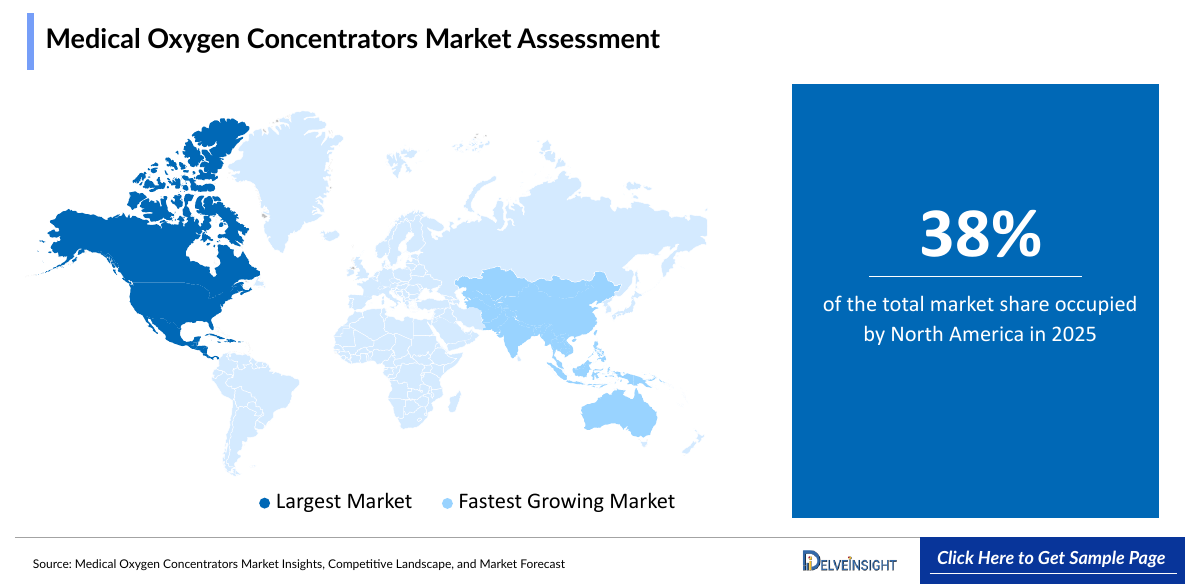
Dominant Region: North America
North America accounted for 38% of the global Medical Oxygen Concentrators market revenue in 2025, representing the highest regional market share globally. The region's dominance reflects a high prevalence of COPD, a mature home medical equipment channel, established Medicare and private payer coverage for home oxygen therapy, and a concentration of leading manufacturers such as Inogen, CAIRE, and Drive DeVilbiss Healthcare. More than 1 million Medicare beneficiaries receive long-term oxygen therapy at home in the United States, and providers favor non-delivery solutions such as stationary and portable concentrators that reduce operating costs. Strong product innovation, high patient awareness, and high adoption of premium portable devices, together with the retail and direct-to-consumer sales of portable units, anchor demand. CMS's decision to exclude oxygen from the next round of competitive bidding also supports pricing stability. Clear FDA regulatory pathways, strong reimbursement, and an established provider network anchor the region's continued leadership across the forecast period.
Fastest Growing Region: Asia-Pacific
Asia-Pacific is the fastest-growing region in the Medical Oxygen Concentrators market. The region's elevated CAGR is driven by a large and growing COPD patient population, rapid aging in Japan, China, and South Korea, rising healthcare spending, and expanding hospital and primary-care infrastructure across China, Japan, India, South Korea, and Australia. Japan has a long-established home oxygen therapy system supported by domestic players such as Teijin and Nidek; China and India are building local manufacturing capacity and expanding access to affordable concentrators; and Australia maintains strong homecare adoption. Government programs to improve medical oxygen availability after the COVID-19 pandemic, rising disposable income, and growing awareness of long-term oxygen therapy are accelerating adoption, while global manufacturers expand distribution partnerships across the region. The combination of demographic pressure, infrastructure build-out, and local manufacturing positions Asia-Pacific as the principal source of incremental growth over the forecast period.
Regional Commentary
North America
North America accounted for 38% of the global Medical Oxygen Concentrators market revenue in 2025. The United States dominates on the strength of its home medical equipment channel, Medicare coverage of home oxygen therapy, high COPD prevalence, and a concentration of leading manufacturers, while continued portable product innovation, direct-to-consumer sales, and expansion into Canada reinforce its leadership.
Europe
Europe is a large and advanced regional market, supported by national home oxygen therapy programs, high adoption of concentrators over cylinders and liquid oxygen, and strong manufacturing and R&D hubs, including Philips in the Netherlands and GCE Group in Sweden. The European Medical Device Regulation sets rigorous quality and post-market standards, and an aging population across Germany, France, the United Kingdom, Italy, and Spain sustains long-term oxygen therapy demand.
Asia-Pacific
Asia-Pacific is the fastest-growing region, propelled by rapid aging, a large COPD patient base, and growing healthcare investment across China, Japan, India, South Korea, and Australia. Japan's established home oxygen therapy system and domestic leaders such as Teijin and Nidek, China's and India's expanding manufacturing capacity, and rising hospital oxygen investment are accelerating regional growth.
Rest of World
The Rest of World region, spanning Latin America, the Middle East, and Africa, is an emerging growth frontier. Post-pandemic investment in hospital oxygen supply, expanding access to home respiratory care, and the entry of global brands, such as Inogen's launch of the Rove 6 in Brazil in 2026, are gradually broadening access, while local distribution partnerships and cost-effective stationary and high-flow concentrators support the build-out of regional capacity.
Medical Oxygen Concentrators Market Competitive Landscape
The Medical Oxygen Concentrators market is classified as Moderately Concentrated. A group of established players with broad respiratory portfolios, global distribution, and strong brands, including Koninklijke Philips, Inogen, CAIRE, and DeVilbiss Healthcare, anchors the top tier, while specialized and regional manufacturers such as Invacare, Nidek Medical, O2 Concepts, Teijin, Supera Anesthesia Innovations, and GCE Group compete through targeted product design, regional channel strength, and niche applications, increasing competition in the fastest-growing portable and hybrid-flow segments.
The competitive landscape can be evaluated across the following dimensions:
- Market concentration: Moderately concentrated, with established global respiratory players leading and a field of specialized and regional manufacturers competing in portable, hybrid-flow, and hospital-grade niches.
- Leading players: Koninklijke Philips, Inogen, CAIRE, and DeVilbiss Healthcare anchor the top tier through brand strength, broad portfolios, and extensive provider relationships.
- Geographic reach: Leaders operate global distribution networks; Inogen is expanding in Latin America and Canada, and CAIRE has appointed a Canadian distributor, while Japanese and European players retain strong home-region positions.
- Product portfolio strength: Top players offer both stationary and portable concentrators spanning low-flow and high-flow ranges, such as CAIRE's IntenOxy 5 and FreeStyle Comfort and DeVilbiss compact 5-litre and 10-litre units.
- Flow-mode technology: Pulse-dose efficiency, proprietary delivery algorithms such as autoSAT, and hybrid continuous and pulse devices such as the Oxlife Liberty are decisive differentiators.
- Strategic partnerships: Distributor and home medical equipment provider relationships, such as CAIRE's Canadian partnership with Sunset Healthcare Solutions, extend reach and market access.
- M&A activity: Portfolio consolidation continues, including the acquisition of Invacare's respiratory care product line by Ventec Life Systems, a subsidiary of React Health.
- Manufacturing capabilities: In-house design of compressors, sieve beds, sensors, and batteries, together with quality systems compliant with FDA and European MDR requirements, are key competitive moats.
- Innovation focus: Lighter and quieter devices, longer battery life, connectivity and remote monitoring, lower power consumption, and clinically validated evidence of therapy benefit.
Medical Oxygen Concentrators Market Recent Developmental Activities
In June 2026, CAIRE appointed Sunset Healthcare Solutions as its Canadian distributor for the FreeStyle Comfort portable oxygen concentrator and the Eclipse 5 transportable oxygen concentrator. Strategic significance: Extends CAIRE's portable oxygen reach in Canada through an established distribution partner.
In Q2 2026, Inogen, Inc., launched the Rove 6 portable oxygen concentrator in Canada, published the Questionnaire for Oxygen Therapy Evaluation (QuOTE) to standardize long-term oxygen therapy monitoring, and reported second-quarter revenue of USD 95.1 million, up 3.0%. Strategic significance: Advances international expansion and builds clinical evidence that supports device differentiation.
In Q1 2026, Inogen, Inc., launched the Rove 6 portable oxygen concentrator in Brazil, introduced Aurora CPAP masks in the United States, and authorized a USD 30.0 million share repurchase program, while reporting first-quarter revenue of USD 85.1 million, up 3.4%. Strategic significance: Opens a Latin American market and broadens Inogen's respiratory portfolio beyond oxygen.
In 2026, Inogen, Inc., expanded its home oxygen portfolio with the Voxi stationary concentrator, positioned as a high-quality alternative for home oxygen therapy. Strategic significance: Strengthens Inogen's stationary offering, complementing its portable concentrators for patients who use both.
In November 2025, the Centers for Medicare & Medicaid Services (CMS) finalized changes to the Medicare DMEPOS competitive bidding program, limiting the next round to remote item delivery categories that do not include oxygen. Strategic significance: Avoids new competitive-bid pricing pressure on oxygen concentrator suppliers and supports reimbursement stability.
In October 2025, CAIRE made its FreeStyle Comfort portable oxygen concentrator with proprietary autoSAT technology available in the United States. Strategic significance: Brings a self-adjusting bolus delivery feature to a flagship portable platform and strengthens CAIRE's premium portable position.
In January 2025, CAIRE launched the IntenOxy 5 stationary oxygen concentrator in the United States and Puerto Rico, delivering 0.5 to 5 litres per minute at up to 95.5% oxygen concentration, with Canadian availability planned. Strategic significance: Adds a lightweight, low-power stationary unit that pairs with FreeStyle Comfort for non-delivery oxygen solutions.
Medical Oxygen Concentrators Market Segmentation
Medical Oxygen Concentrators Market by Product
- Stationary
- Portable
Medical Oxygen Concentrators Market by Technology
- Continuous Flow
- Pulse Flow
- Both
Medical Oxygen Concentrators Market by Flow Rate
- Low-Flow Oxygen Concentrators
- High-Flow Oxygen Concentrators
Medical Oxygen Concentrators Market by End-User
- Homecare
- Hospitals & Clinics
- Others
Medical Oxygen Concentrators Market by Geography
- North America Medical Oxygen Concentrators Market
- United States Medical Oxygen Concentrators Market Size in USD million (2023-2034)
- Canada Medical Oxygen Concentrators Market Size in USD million (2023-2034)
- Mexico Medical Oxygen Concentrators Market Size in USD million (2023-2034)
- Europe Medical Oxygen Concentrators Market
- Germany Medical Oxygen Concentrators Market Size in USD million (2023-2034)
- United Kingdom Medical Oxygen Concentrators Market Size in USD million (2023-2034)
- France Medical Oxygen Concentrators Market Size in USD million (2023-2034)
- Italy Medical Oxygen Concentrators Market Size in USD million (2023-2034)
- Spain Medical Oxygen Concentrators Market Size in USD million (2023-2034)
- Rest of Europe Medical Oxygen Concentrators Market Size in USD million (2023-2034)
- Asia-Pacific Medical Oxygen Concentrators Market
- China Medical Oxygen Concentrators Market Size in USD million (2023-2034)
- Japan Medical Oxygen Concentrators Market Size in USD million (2023-2034)
- India Medical Oxygen Concentrators Market Size in USD million (2023-2034)
- Australia Medical Oxygen Concentrators Market Size in USD million (2023-2034)
- South Korea Medical Oxygen Concentrators Market Size in USD million (2023-2034)
- Rest of Asia-Pacific Medical Oxygen Concentrators Market Size in USD million (2023-2034)
- Rest of the World (RoW) Medical Oxygen Concentrators Market
- Middle East Medical Oxygen Concentrators Market Size in USD million (2023-2034)
- Africa Medical Oxygen Concentrators Market Size in USD million (2023-2034)
- South America Medical Oxygen Concentrators Market Size in USD million (2023-2034)
Medical Oxygen Concentrators Market Recent Industry Trends and Milestones (2023-2026)
|
Category |
Key Developments |
|
Medical Oxygen Concentrators Market Product Launches |
Product launches are broadening portable and stationary choices. CAIRE launched the IntenOxy 5 stationary concentrator in the United States and Puerto Rico in January 2025 and made its FreeStyle Comfort with autoSAT technology available in the United States in October 2025. Inogen launched the Rove 6 portable concentrator in Brazil and Canada in 2026 and expanded its home portfolio with the Voxi stationary unit. Drive DeVilbiss Healthcare introduced compact 5-litre and 10-litre concentrators, and O2 Concepts launched the Oxlife Liberty, which delivers both continuous flow and pulse dose oxygen. Each launch targets lighter weight, lower power consumption, quieter operation, and more flexible flow delivery. |
|
Medical Oxygen Concentrators Market Distribution and Portfolio Expansion |
Manufacturers are extending distribution and broadening portfolios. CAIRE appointed Sunset Healthcare Solutions as its Canadian distributor in June 2026 for the FreeStyle Comfort and Eclipse 5, while Inogen entered Brazil and Canada as part of a deliberate international expansion strategy and diversified into CPAP masks in the United States. Providers are favoring non-delivery solutions that pair a stationary concentrator with a portable unit to reduce service visits and operating expense. Direct-to-consumer and retail channels for portable concentrators continue to expand alongside the traditional home medical equipment channel. |
|
Medical Oxygen Concentrators Market Investment and Consolidation |
Capital deployment and consolidation are reshaping the competitive field. Ventec Life Systems, a subsidiary of React Health, acquired Invacare's line of respiratory care products, while Inogen authorized a USD 30.0 million share repurchase program in 2026 and raised its full-year adjusted EBITDA guidance to approximately USD 4.0 million after second-quarter revenue of USD 95.1 million. Policy developments also matter: CMS's November 2025 final rule limited the next round of Medicare competitive bidding to remote item delivery categories that exclude oxygen, supporting reimbursement stability for suppliers. |
|
Company Strategy |
Koninklijke Philips N.V.: Leveraging global scale and a broad respiratory and home-care portfolio. Invacare Corporation: Long-standing home respiratory heritage, with its respiratory care product line since it was acquired by Ventec Life Systems. DeVilbiss Healthcare LLC: Leadership in stationary and high-flow home concentrators, including compact 5-litre and 10-litre platforms. Inogen, Inc.: Portable-led growth, international expansion of the Rove 6, the Voxi stationary unit, and clinical evidence generation. Nidek Medical: Reliable stationary concentrators for home and clinical use. O2 Concepts: Hybrid continuous and pulse flow portable concentrators. Teijin Limited: Home oxygen therapy leadership anchored in Japan. Supera Anesthesia Innovations: Oxygen and anesthesia delivery solutions for hospital and resource-limited settings. GCE Group: Medical gas control and oxygen therapy equipment with European presence. CAIRE: Premium portable and stationary lineup, including FreeStyle Comfort, Eclipse 5, and IntenOxy 5, with expansion in Canada. |
|
Emerging Technologies |
Intelligent delivery is the leading edge of innovation, with proprietary algorithms such as autoSAT that adjust oxygen delivery to the user's breathing pattern, and hybrid devices that offer both continuous flow and pulse dose in one unit. Lighter materials, higher-capacity lithium batteries, quieter compressors, and lower power consumption are extending portable use and travel suitability, while connectivity, remote monitoring, and digital adherence tools such as QuOTE support better patient management and provider efficiency. Higher-output compact concentrators are expanding into hospital, clinic, and field use, and energy-efficient designs and refurbishment programs are advancing sustainability. Collaborations between manufacturers, home medical equipment providers, clinicians, and researchers are accelerating clinical validation of new devices and therapy pathways. |
Medical Oxygen Concentrators Market Startup Funding and Investment Trends
Investment in the Medical Oxygen Concentrators ecosystem has concentrated on lightweight portable platforms, hybrid continuous and pulse flow technology, and international distribution expansion. The following companies illustrate recent capital activity and technology focus.
|
Company |
Total Funding |
Funding Stage |
Main Offering |
Core Technology |
|
Inogen, Inc. |
Publicly traded; USD 30.0 million buyback authorized (2026) |
Public (Nasdaq: INGN) |
Portable and stationary oxygen concentrators |
Pulse-dose portable oxygen technology |
|
O2 Concepts |
Privately held; undisclosed |
Private |
Portable oxygen concentrators |
Hybrid continuous and pulse flow |
|
Request for unlocking the report of the @ Medical Oxygen Concentrators Market | ||||
Capital is flowing toward providers that deliver lighter, smarter, and more flexible oxygen devices and extend their reach into new geographies. Ventec Life Systems, a subsidiary of React Health, acquired Invacare's line of respiratory care products; Inogen authorized a USD 30.0 million share repurchase program and raised its 2026 adjusted EBITDA guidance after second-quarter revenue of USD 95.1 million, and CAIRE, DeVilbiss, and O2 Concepts continue to launch new stationary, high-flow, and hybrid-flow platforms. Collectively, these activities signal conviction that portable innovation, hybrid flow delivery, and homecare-led demand will define the next phase of competitive advantage in the global Medical Oxygen Concentrators market.
Key Takeaways from the Medical Oxygen Concentrators Market Report Study
- Market size analysis for the current medical oxygen concentrators market size (2025), and market forecast for 9 years (2026 to 2034).
- Top key product/technology developments, mergers, acquisitions, partnerships, and joint ventures that happened over the last 3 years.
- Key companies dominating the global medical oxygen concentrators market.
- Various opportunities available for competitors in the medical oxygen concentrators market space.
- What are the top-performing segments in 2025? How will these segments perform in 2034?
- Which are the top-performing regions and countries in the current medical oxygen concentrators market scenario?
- Which are the regions and countries where companies should concentrate their opportunities for medical oxygen concentrators market growth in the future?
Target audience who can benefit from this medical oxygen concentrators market report study
- Medical oxygen concentrator manufacturers and product providers
- Research organizations and consulting companies
- Medical oxygen concentrator-related organizations, associations, forums, and other alliances
- Government and corporate offices
- Start-up companies, venture capitalists, and private equity firms
- Distributors, home medical equipment providers, and traders dealing in medical oxygen concentrators
- Various end-users who want to know more about the medical oxygen concentrators market and the latest technological developments in the medical oxygen concentrators market.