---Market.png&w=256&q=75)
Post-Traumatic Stress Disorder (PTSD) Market Summary
- The Post-Traumatic Stress Disorder market size in the 7MM is expected to grow from USD 1,867 million in 2025 to USD 5,256 million in 2034.
- The Post-Traumatic Stress Disorder market is projected to grow at a CAGR of 12.2% by 2034 in leading countries like US, EU4, UK and Japan.
Post-Traumatic Stress Disorder Market and Epidemiology Analysis
- The United States accounted for the highest Post-traumatic stress disorder market size among the 7MM around 90% of the total PTSD market size.
- Pharmacological treatments for PTSD include antidepressants such as selective serotonin reuptake inhibitors (SSRIs), serotonin and norepinephrine reuptake inhibitors (SNRIs), monoamine oxidase (MAO) inhibitors, sympatholytic drugs such as alpha-blockers, antipsychotics, anticonvulsants, and benzodiazepines. Among these medications, fluoxetine, paroxetine, sertraline, topiramate, risperidone, and venlafaxine have been identified as efficacious in treatment. Ongoing Post-traumatic stress disorder clinical trials hold promise in addressing the unmet need for approved therapies in PTSD treatment. Investigational drugs, that are included in the pipeline, are brexpiprazole + sertraline (Otsuka Pharmaceutical), BNC210 (Bionomics), Psilocybin (Compass pathways), and others, which are being evaluated to advance the management of PTSD. Many drugs are also in their early stages of clinical development; hence the pipeline ensures better treatment in upcoming years.
- In December 2024, Bionomics Limited announced that positive results from its Phase 2 ATTUNE study have been published in NEJM Evidence. The data were also presented at the 63rd Annual Meeting of the American College of Neuropsychopharmacology (ACNP) during the inaugural “Promising Targets” session.
- In December 2024, Transcend therapeutics stated that it looks forward to continuing the advancement of its ongoing Phase II trial of TSND-201 for PTSD and sharing results from the randomized, placebo-controlled portion of the trial in the second quarter of 2025.
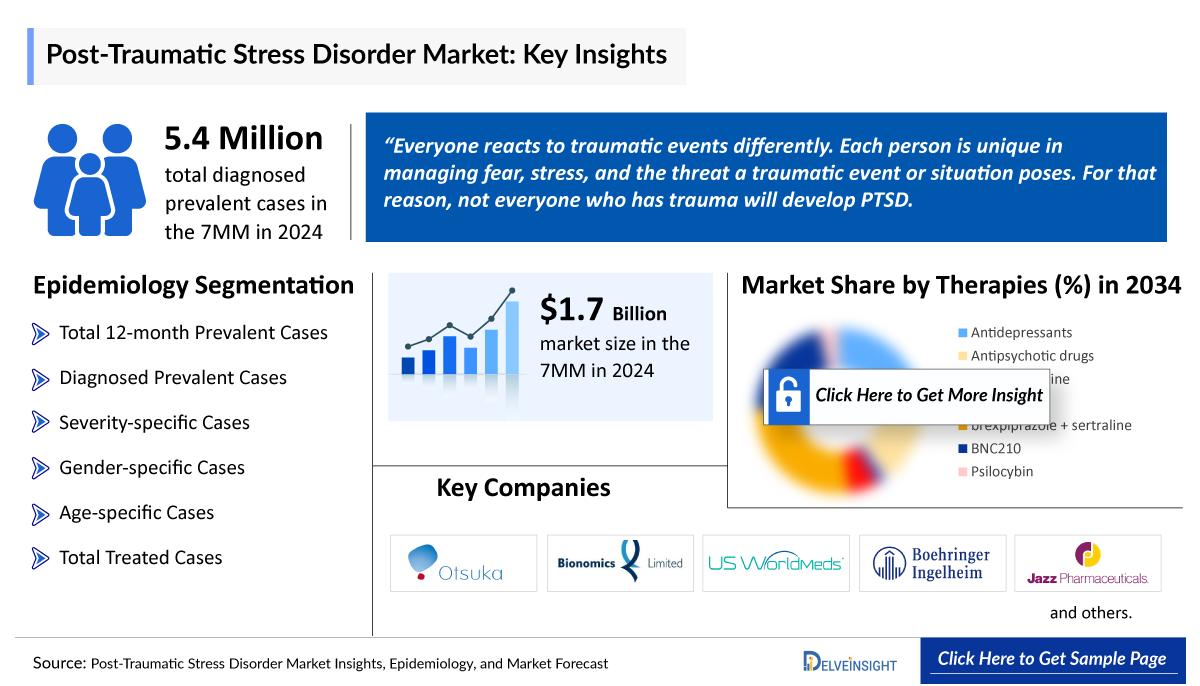
- In 2024, the diagnosed prevalent cases of PTSD were approximately 5,400,000 cases in the 7MM, which will increase by 2034. In the 7MM, the highest number of diagnosed prevalent cases of PTSD were observed in the US. In the US, females were more affected by PTSD than males, in 2024.
- Among EU4 and the UK, in 2024, France accounted for the highest number of PTSD cases, followed by Germany, whereas Italy accounted for the lowest number of diagnosed prevalent cases.
Post-Traumatic Stress Disorder Market size and forecast
- 2025 Market Size: USD 1,867 million in 2025
- 2034 Projected Market Size: USD 5,256 million in 2034
- Growth Rate (2025-2034): 12.2% CAGR
- Largest Market: United States
|
Scope of the Post-traumatic Stress Disorder Market Report | |
|
Study Period |
2020–2034 |
|
Forecast Period |
2025–2034 |
|
Geographies Covered |
US, EU4 (Germany, France, Italy, and Spain) and the UK, and Japan |
|
Post-traumatic stress disorder Epidemiology |
Segmented by:
|
|
PTSD Market |
Segmented by:
|
|
Post-traumatic stress disorder Market Analysis |
|
Key Factors Driving the Post-Traumatic Stress Disorder Market
Rising Post-Traumatic Stress Disorder Prevalence
Increasing awareness, improved diagnostic tools, and recognition of PTSD across diverse populations are driving the demand for effective therapies. In the United States alone, approximately 4 million cases were diagnosed in 2024, with the highest prevalence observed in the 45–59 age group, followed closely by individuals aged 30–44 years.
Pharmacological Treatments for PTSD
Current pharmacological management includes antidepressants such as selective serotonin reuptake inhibitors (SSRIs), serotonin and norepinephrine reuptake inhibitors (SNRIs), monoamine oxidase (MAO) inhibitors, sympatholytic drugs like alpha-blockers, antipsychotics, anticonvulsants, and benzodiazepines. Among these, medications such as fluoxetine, paroxetine, sertraline, topiramate, risperidone, and venlafaxine have demonstrated significant efficacy in improving PTSD symptoms and overall patient outcomes.
Ongoing Clinical Trials and Emerging Therapies
The PTSD treatment pipeline is robust, with ongoing clinical trials targeting the unmet needs in this therapeutic area. Investigational therapies include brexpiprazole + sertraline (Otsuka Pharmaceutical), BNC210 (Bionomics), Psilocybin (Compass Pathways), and several others in early-stage development. These emerging therapies show promise for improving efficacy, reducing side effects, and providing more personalized treatment options, ensuring better management of PTSD in the coming years.
Positive Outlook for PTSD Management
With advancements in clinical research, growing awareness, and continued innovation in pharmacological interventions, the PTSD market is poised for sustained growth. Improved diagnosis, combined with emerging treatment options, is expected to enhance patient care, provide more effective symptom management, and expand access to therapies for diverse populations worldwide.
Post-traumatic stress disorder Market
Various key Post-traumatic stress disorder (PTSD) companies are leading the treatment landscape of PTSD, such as Viatris, Apotex, Otsuka pharmaceuticals, Bionomics, and Others. The details of the country-wise and therapy-wise Post-traumatic stress disorder market size have been provided below.
- In the total PTSD market size in the 7MM, the United States accounted for the highest Post-traumatic stress disorder market share, i.e. ~90% in 2024, followed by France.
- Among EU4 and the UK, France accounted for the highest Post-traumatic stress disorder (PTSD) market size in 2024.
- The United States accounted for more than USD 1,500 million in 2024.
- Among the emerging Post-traumatic stress disorder therapies, the brexpiprazole & sertraline combination appears to be the drug that can potentially transform the PTSD market.
Post-traumatic stress disorder (PTSD) Drug Chapters
The section dedicated to drugs in the Post-traumatic stress disorder (PTSD) market report provides an in-depth evaluation of late-stage pipeline drugs (Phase III and Phase II) related to PTSD. The drug chapters section provides valuable information on various aspects related to clinical trials of PTSD, such as the pharmacological mechanisms of the drugs involved, designations, approval status, patent information, and a comprehensive analysis of the pros and cons associated with each drug. Furthermore, it presents the most recent news updates and press releases on drugs targeting PTSD.
Post-traumatic stress disorder (PTSD) Emerging Therapies
REXULTI (brexpiprazole) & ZOLOFT (sertraline): Otsuka Pharmaceuticals
Brexpiprazole & sertraline combination is an investigational therapy for the treatment of Post-traumatic stress disorder (PTSD). Brexpiprazole is a novel D2 dopamine and serotonin 1A partial agonist, called serotonin-dopamine activity modulator (SDAM), and a potent antagonist of serotonin 2A receptors, nor-adrenergic alpha 1B and 2C receptors. ZOLOFT is an antidepressant from a group of drugs called selective serotonin reuptake inhibitors (SSRIs). It affects chemicals in the brain that may be unbalanced in people with depression, panic, anxiety, or obsessive-compulsive symptoms.
In January 2025, Otsuka Pharmaceutical, announced that the FDA will host a Psychopharmacologic Drugs Advisory Committee (PDAC) meeting to discuss the Supplemental New Drug Application (sNDA) for brexpiprazole in combination with sertraline for treating PTSD in adults. The meeting, expected in the first half of 2025, will delay the previously set Prescription Drug User Fee Act (PDUFA) target action date of February 8, 2025.
BNC210: Bionomics Limited
BNC210 is Bionomics’s proprietary molecule in development for treating Social Anxiety Disorder (SAD), Post-traumatic stress disorder (PTSD), and anxiety disorders as a negative allosteric modulator of the alpha 7 nicotinic acetylcholine receptor (α7 nAChR). It has a novel mechanism of action, and extensive non-clinical and clinical studies have shown it has several properties that may be useful in treating PTSD, SAD, and anxiety disorders.
In December 2024, Bionomics Limited announced that positive results from its Phase 2 ATTUNE study have been published in NEJM Evidence. The data were also presented at the 63rd Annual Meeting of the American College of Neuropsychopharmacology (ACNP) during the inaugural “Promising Targets” session.
|
Comparison of Emerging Therapies | |||||||
|
Product |
Company |
Phase |
Indication |
Designation |
RoA |
MoA |
Molecule Type |
|
brexpiprazole + sertraline |
Otsuka Pharmaceutical |
III |
PTSD |
N/A |
Oral |
Brexpiprazole: dopamine D2 receptor agonist, Sertraline: selective serotonin reuptake inhibitor |
Small molecule |
|
BNC210 |
Bionomics Limited |
II |
PTSD |
FTD |
Oral |
Alpha7 nicotinic acetylcholine receptor antagonists |
Small molecule |
|
Lofexidine |
usworldmeds |
II |
PTSD |
N/A |
oral |
Alpha 2 adrenergic receptor agonists |
Small molecule |
|
BI 1358894 |
Boehringer Ingelheim |
II |
PTSD |
N/A |
oral |
TRPC4/5 cation channel inhibitors |
Small molecule |
Note: Detailed assessment will be provided in the final report of PTSD…
PTSD Market Outlook
Substantial progress in the biology and treatment of PTSD has occurred over the past two decades, making PTSD a model for progress in precision medicine. A thorough understanding of the molecular and cellular underpinnings of PTSD has led to the development of a targeted therapy, which has altered the natural history of the disease. However, there is still room for improvement in caring for patients with PTSD. The future approvals of PTSD move toward personalized patient-centered care with better options to reduce the frequency and self-administer medication. Auto-injections of SC compounds and oral drugs will increase patient autonomy, and compliance will become critical.
The US has the highest PTSD market share, followed by the EU4 and the UK, and Japan. Rising awareness about the disease and supporting government policies, funds, approvals, and emerging research would drive the Post-traumatic stress disorder market significantly in forecast periods (2025–2034).
.png)
Further details are provided in the report…
PTSD Disease Understanding
PTSD Overview
PTSD is a psychiatric disorder that can occur in people who have experienced or witnessed a traumatic event such as a natural disaster, a serious accident, a terrorist act, war/combat, or rape, or who have been threatened with death, sexual violence, or serious injury. People with PTSD have intense, disturbing thoughts and feelings related to their experience that last long after the traumatic event has ended. They may relive the event through flashbacks or nightmares; they may feel sadness, fear, or anger, detached or estranged from others. People with PTSD may avoid situations or people that remind them of the traumatic event and may have strong negative reactions to something as ordinary as a loud noise or an accidental touch.
PTSD symptoms may start within 1 month of a traumatic event, but sometimes symptoms may not appear until years after the event. These symptoms cause significant problems in social or work situations and relationships. They can also interfere with the ability to go about the normal daily tasks, and the symptoms are generally grouped into four types: intrusive memories, avoidance, negative changes in thinking and mood, and changes in physical and emotional reactions. Symptoms can vary over time or from person to person. Patients can develop PTSD when they go through, see, or learn about an event involving actual or threatened death, serious injury, or sexual violation.
Further details are provided in the report…
PTSD Diagnosis
PTSD is diagnosed when symptoms last for more than one month after a traumatic event. The diagnosis is based on the reported symptoms and any resulting functional impairments. When PTSD symptoms are present, the doctor begins by gathering a thorough medical history and performing a physical examination. Although there are no specific lab tests for PTSD, doctors may use tests to rule out other physical conditions that could explain the symptoms. If no physical cause is identified, the individual may be referred to a psychiatrist, psychologist, or another mental health professional who is trained to diagnose and treat psychiatric conditions. These specialists use specialized interviews and assessment tools to evaluate the person for PTSD or other mental health disorders.
Further details related to country-based variations are provided in the report…
PTSD Treatment
The treatment of PTSD involves a comprehensive, multidimensional approach. Key treatment options include patient education, social support, and anxiety management through psychotherapy and medication. Patient education and social support play a vital role in engaging the patient and reducing the effects of the traumatic event. Local and national support groups can help reduce the stigma associated with mental health diagnoses and reinforce the understanding that PTSD involves more than just a stress reaction and requires treatment. Support from family and friends fosters understanding and acceptance, which can help alleviate feelings of survivor guilt.
Treatment typically combines psychotherapy, counseling, and medication. Psychotherapy options are tailored to address trauma, including Brief Eye Movement Desensitization and Reprocessing (EMDR), Trauma-focused Cognitive Behavioral Therapy (CBT-T), Structured Writing Therapy (SWT), Interpersonal Psychotherapy (IPT), and Cognitive Therapy. Medications include selective serotonin reuptake inhibitors (SSRIs), serotonin-norepinephrine reuptake inhibitors (SNRIs), antipsychotics, tricyclic antidepressants (TCAs), monoamine oxidase inhibitors (MAOIs), and other antidepressants. Currently, the FDA has approved only ZOLOFT (sertraline) and PAXIL (paroxetine), both SSRIs, for the treatment of PTSD.
Further details related to treatment and management are provided in the report…
Recent Development
- In August 2026, Entropy Neurodynamics received HREC approval to launch a 72-patient Phase 1b/2a trial for TRP-8803, an IV-infused psilocin therapy. The trial evaluates safety and efficacy across eight psychiatric and somatic conditions, including TRD, OCD, and PTSD, to accelerate commercialization.
PTSD Epidemiology
The PTSD epidemiology chapter in the Post-traumatic stress disorder market report provides historical as well as forecasted epidemiology segmented by Total 12-month prevalent cases, Diagnosed prevalent cases, gender-specific cases, age-specific cases, severity-specific cases, and total treated cases in the United States, EU4 countries (Germany, France, Italy, Spain) and the United Kingdom, and Japan from 2020 to 2034.
Key Findings from Post-Traumatic Stress Disorder Epidemiological Analysis and Forecast:
- The total diagnosed cases of PTSD in the US were around 4,000,000 cases in 2024.
- In the United States, the highest number of age-specific cases were recorded for the 45-59 age group, followed by the age group of 30-44 yrs.
- France had the highest diagnosed prevalent cases of PTSD among the EU4 and the UK, accounting for more than 35% of cases in 2024.
- In 2024, the total treated cases of PTSD in the US were around 1,800,000.
Post-Traumatic Stress Disorder Epidemiology Segmentation:
- Total 12-month prevalent cases
- Diagnosed prevalent cases
- Gender-specific cases
- Age-specific cases
- Severity-specific cases
- Total treated cases
.png)
Latest KOL Views
To stay abreast of the latest trends in the PTSD drugs market, we conduct primary research by seeking the opinions of Key Opinion Leaders (KOLs) and Subject Matter Experts (SMEs) who work in the relevant field. This helps us fill any gaps in data and validate our secondary research.
We have reached out to industry experts to gather insights on various aspects of PTSD, including the evolving treatment landscape, patients’ reliance on conventional therapies, their acceptance of therapy switching, drug uptake, and challenges related to accessibility. The experts we contacted included medical/scientific writers, professors, and researchers from prestigious universities in the US, Europe, the UK, and Japan.
Our team of analysts at Delveinsight connected with more than 15 KOLs across the 7MM. We contacted institutions such as the University of Tsukuba, Duke University, University of Glasgow, Washington University School of Medicine, etc., among others. By obtaining the opinions of these experts, we gained a better understanding of the current and emerging treatment patterns in the PTSD market, which will assist our clients in analyzing the overall epidemiology and market scenario.
Qualitative Analysis
We perform Qualitative and Market Intelligence analysis using various approaches, such as SWOT analysis and Conjoint Analysis. In the SWOT analysis, strengths, weaknesses, opportunities, and threats in terms of disease diagnosis, patient awareness, patient burden, competitive landscape, cost-effectiveness, and geographical accessibility of therapies are provided. These pointers are based on the Analyst’s discretion and assessment of the patient burden, cost analysis, and existing and evolving treatment landscape.
Conjoint Analysis analyzes multiple approved and emerging Post-traumatic stress disorder therapies based on relevant attributes such as safety, efficacy, frequency of administration, designation, route of administration, and order of entry. Scoring is given based on these parameters to analyze the effectiveness of therapy. In efficacy, the trial’s primary and secondary outcome measures are evaluated, and based on these measures, the overall efficacy is evaluated.
Further, the therapies’ safety is evaluated wherein the acceptability, tolerability, and adverse events are majorly observed, and it sets a clear understanding of the side effects posed by the drug in the trials. In addition, the scoring is also based on the route of administration, order of entry and designation, probability of success, and the addressable patient pool for each therapy. According to these parameters, the final weightage score and the ranking of the emerging Post-traumatic stress disorder therapies are decided.
PTSD Market Access and Reimbursement
Because newly authorized drugs are often expensive, some patients escape receiving proper treatment or use off-label, less expensive prescriptions. Reimbursement plays a critical role in how innovative treatments can enter the market. The cost of the medicine, compared to the benefit it provides to patients who are being treated, sometimes determines whether or not it will be reimbursed. Regulatory status, target population size, the setting of treatment, unmet needs, the number of incremental benefit claims, and prices can all affect market access and reimbursement possibilities
The Post-traumatic stress disorder market report further provides detailed insights on the country-wise accessibility and reimbursement scenarios, cost-effectiveness scenario of approved therapies, programs making accessibility easier and out-of-pocket costs more affordable, insights on patients insured under federal or state government prescription drug programs, etc.
PTSD Market Report Scope
- The Post-traumatic stress disorder (PTSD) market report offers extensive knowledge regarding the epidemiology segments and predictions, presenting a deep understanding of the potential future growth in diagnosis rates, disease progression, and treatment guidelines. It provides comprehensive insights into these aspects, enabling a thorough assessment of the subject matter.
- Additionally, an all-inclusive account of the current management techniques and emerging Post-traumatic stress disorder (PTSD) therapies and the elaborative profiles of late-stage (Phase III, Phase II & Phase I) and prominent therapies that would impact the current treatment landscape and result in an overall Post-traumatic stress disorder market shift has been provided in the report.
- The Post-traumatic stress disorder (PTSD) market report also encompasses a comprehensive analysis of the PTSD market, providing an in-depth examination of its historical and projected market size (2020–2034). It also includes the Post-traumatic stress disorder (PTSD) market share of therapies, detailed assumptions, and the underlying rationale for our methodology. The report also includes drug outreach coverage in the 7MM region.
- The PTSD Market report includes qualitative insights that provide an edge while developing business strategies by understanding trends through SWOT analysis and expert insights/KOL views, including experts from various hospitals and prominent universities, patient journeys, and treatment preferences that help shape and drive the 7MM PTSD market.
PTSD Market Report Insights
- Post-traumatic stress disorder Patient Population
- Post-traumatic stress disorder Therapeutic Approaches
- PTSD Market Size
- Post-traumatic stress disorder Market Trends
- Existing PTSD Market Opportunity
Post-traumatic stress disorder Market Report Key Strengths
- Ten-year Forecast
- The 7MM Coverage
- PTSD Epidemiology Segmentation
- Key Cross Competition
PTSD Market Report Assessment
- Current Treatment Practices
- Reimbursements
- Post-traumatic stress disorder Market Attractiveness
- Qualitative Analysis (SWOT, Conjoint Analysis, Unmet needs)
Key Questions answered through our Post-traumatic Stress Disorder Market Report:
- Would there be any changes observed in the current treatment approach?
- Will there be any improvements in PTSD management recommendations?
- Would research and development advances pave the way for future tests and therapies for PTSD?
- Would the diagnostic testing space experience a significant impact and lead to a positive shift in the treatment landscape of PTSD?
- What kind of uptake will the new therapies witness in the coming years in PTSD patients?
Related Insights:
.png&w=256&q=75)
-pipeline-report.png&w=256&q=75)
-thumbnail.png&w=48&q=75)

-thumbnail.png&w=3840&q=75)
