
Postpartum Depression Epidemiology
Postpartum Depression (PPD) Trends
- PPD, a major form of depression occurring after childbirth, affect about 15% of all mothers of newborns. While many women experience the transient “baby blues” following the delivery, up to 1 in 7 develop more severe mood disorder known as PPD.
- Approximately 1 in 8 women experience PPD in the United States, corresponding to more than 460,000 affected women annually based on an estimated 3.7 million live births each year.
- In the UK, PPD affects a significant proportion of women, with more than 1 in 10 having electronic health records indicating depression diagnoses or depressive symptoms within a year after delivery.
- Diagnosis of PPD-related psychosis is clinical, involving identification of hallucinations and delusions in postpartum individuals, supported by psychiatric assessment, caregiver or family input, and exclusion of delirium, primary psychiatric disorders, or substance- or medication-induced causes.
Postpartum Depression (PPD) Epidemiology Forecast in the 7MM
- 2025 Prevalent Cases of PPD: ~XX Cases
- 2036 Projected PPD Prevalent Cases: ~XX Cases
- PPD Growth Rate (2026–2036): ~XX% CAGR
DelveInsight's ‘Postpartum Depression (PPD) Epidemiology Forecast – 2036’ report delivers an in-depth understanding of the PPD, historical and forecasted epidemiology, in the United States, EU4 (Germany, Spain, Italy, and France) and the United Kingdom, and Japan.
|
Study Period |
2022–2036 |
|
Historical Year |
2022–2025 |
|
Forecast Period |
2026–2036 |
|
Base Year |
2026 |
|
Geographies Covered |
|
|
Postpartum Depression (PPD) Epidemiology CAGR (Forecast period) |
~XX% (2026–2036) |
|
Postpartum Depression (PPD) Epidemiology Segmentation Analysis |
Patient Burden Assessment
|
Postpartum Depression (PPD) Understanding and Diagnosis Algorithm
Postpartum Depression (PPD) Overview
PPD is a serious mood disorder that occurs during pregnancy or, more commonly, within the weeks to months following childbirth. It is characterized by persistent feelings of sadness, anxiety, hopelessness, irritability, fatigue, sleep disturbances, impaired concentration, and difficulty bonding with the infant. Unlike the transient “baby blues,” which typically resolve within a few days to two weeks after delivery, PPD is more severe and can significantly impair a mother's ability to care for herself and her child. The condition is believed to result from a complex interplay of hormonal fluctuations, genetic predisposition, psychosocial stressors, prior psychiatric history, and environmental factors.
Further details are provided in the report.
Postpartum Depression (PPD) Diagnosis
Diagnosis of PPD is primarily clinical and is based on patient history, symptom assessment, and standardized screening tools. Healthcare providers commonly utilize the Edinburgh Postnatal Depression Scale (EPDS), the Patient Health Questionnaire-9 (PHQ-9), and diagnostic criteria outlined in the Diagnostic and Statistical Manual of Mental Disorders, Fifth Edition (DSM-5). Screening is increasingly being incorporated into routine prenatal and postpartum care to facilitate early identification of affected individuals. Accurate diagnosis is essential, as symptoms can overlap with other postpartum conditions, including anxiety disorders, bipolar disorder, and postpartum psychosis, each requiring distinct management approaches.
Further details are provided in the report.
Postpartum Depression (PPD) Epidemiology
Key Findings from Postpartum Depression (PPD) Epidemiological Analysis and Forecast
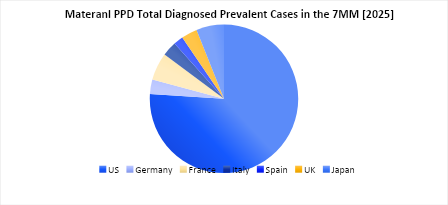
- In 2025, the total diagnosed prevalent cases of maternal PPD in the 7MM were ~1.3 million, and this number is expected to rise during the forecast period.
- Among the 7MM, the US accounted for the largest share of diagnosed prevalent cases of maternal PPD in 2025, with ~700,000 cases.
- Among EU4 and the UK, the UK accounted for the largest share of maternal PPD cases in 2025, contributing over 30% of the total cases.
- In 2025, Japan reported ~100,000 diagnosed prevalent cases of maternal PPD.
Scope of the Report
- The report covers a segment of a descriptive overview of PPD, explaining their causes, signs and symptoms, and pathogenesis.
- Comprehensive insight has been provided into the epidemiology segments and forecasts, the future growth potential of the diagnosis rate, and disease progression.
Report Insights
Postpartum Depression (PPD) Patient Population Forecast
Report Key Strengths
- Epidemiology‑based (Epi‑based) Bottom‑up Forecasting
- 11-year Forecast
- Patient Burden Trends (by Geography)
FAQs
- What are the disease risks, burdens, and unmet needs of PPD? What will be the growth opportunities across the 7MM concerning the patient population with PPD?
- What is the historical and forecasted PPD patient pool in the US, EU4 (Germany, France, Italy, and Spain), the UK, and Japan?
Reasons to Buy
- Insights on patient burden/disease prevalence, evolution in diagnosis, and factors contributing to the change in the epidemiology of the disease during the forecast years.
- To understand key opinion leaders’ perspectives around the diagnostic challenges to overcome barriers in the future.
- Detailed insights on various factors hampering disease diagnosis and other existing diagnostic challenges.