
SERD Market Summary
- The SERD Market is witnessing significant growth driven by the rising prevalence of hormone receptor-positive Breast Cancer, increasing demand for targeted therapies, and ongoing clinical research focused on developing novel oral SERDs with improved efficacy and safety profiles.
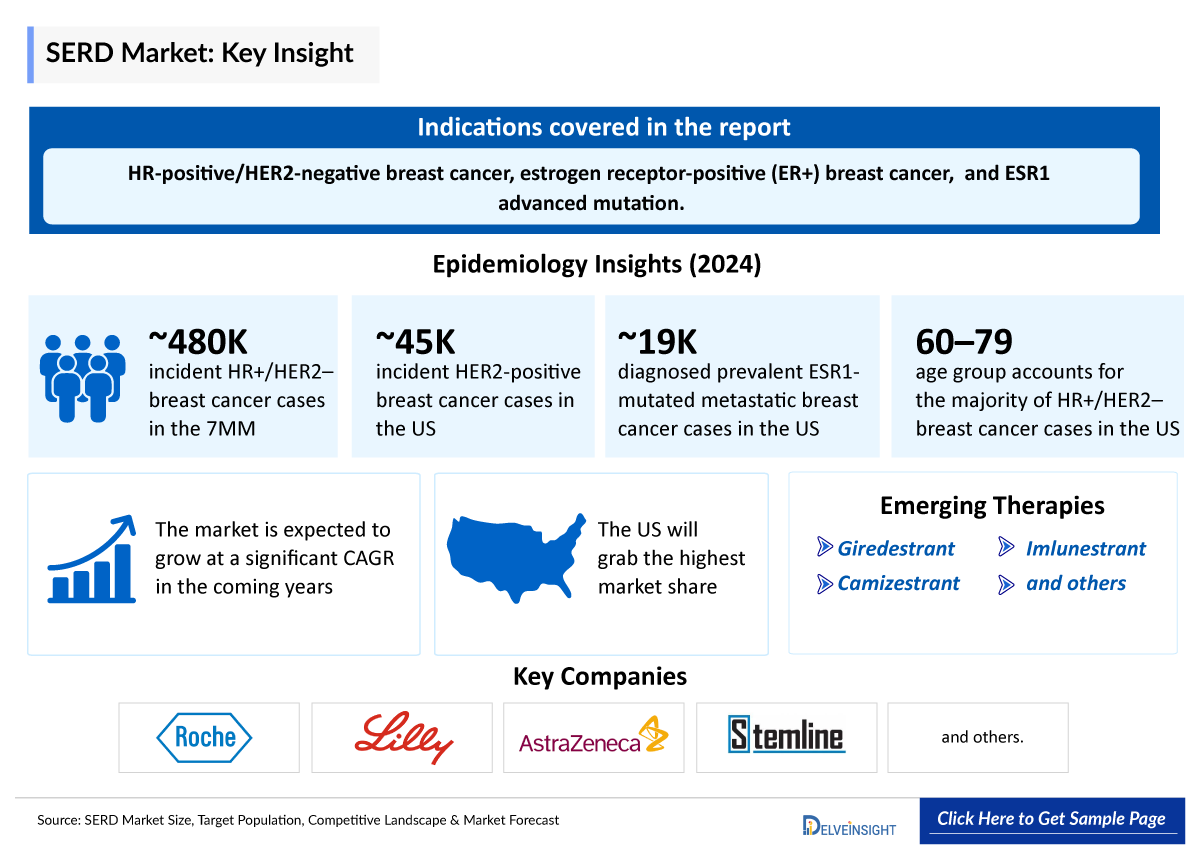
- The leading SERD Companies include Roche, Eli Lilly, AstraZeneca, Stemline Therapeutics, and others.
SERD Market Trends & Insights
- SERDs are an important endocrine therapy used to treat estrogen receptor-positive (ER+) breast cancer. Parenteral SERD fulvestrant has been approved and used in the treatment of metastatic ER-positive breast cancer. However, the need for large-volume intramuscular injections and poor bioavailability are important limitations of fulvestrant.
- Recently approved oral SERDs and other ER antagonist drugs offer promising alternatives, overcoming these challenges.
- The combination therapy, imlunestrant plus VERZENIO, significantly reduced the risk of progression or death by 43%, compared to imlunestrant alone, in all patients, regardless of ESR1 mutation status
- In 2023, ORSERDU was approved by the US FDA for the treatment of postmenopausal women or adult men with ER-positive, HER2-negative, ESR1-mutated advanced or metastatic breast cancer with disease progression following at least one line of endocrine therapy.
- PROTACs like vepdegestrant (ARV-471) offer a new mechanism for degrading the estrogen receptor and are currently being tested in combination with CDK4/6 inhibitors
- SERDs are pivotal in treating HR-positive/HER2-negative breast cancer and ESR1 advanced mutation.
- Most of the novel SERDs that are being developed demonstrated acceptable safety profiles and efficacy. In order to determine the position of oral SERDs in the hierarchy of therapy choices for luminal Breast Cancer, numerous clinical trials are enrolling patients.
- Multiple ongoing clinical trials are investigating the efficacy and safety of novel oral SERDs such as Giredestrant (RG6171), Imlunestrant and others in the early stage and metastatic settings of ER-positive/HER2-negative breast cancer. Similarly, investigations are ongoing into using oral SERDs in combination with various targeted therapies.
- Several SERD Companies, including Roche, Eli Lilly, AstraZeneca, and others, are engaged in the development of SERDs with a range of approved and emerging drugs.
- The SERD landscape is evolving, driven by technological advancements aimed at reducing toxicity, targeting specific receptors, and combining with other immunotherapies (e.g., checkpoint inhibitors). As the pipeline continues to mature, SERDs are expected to transform the treatment for many types of cancers.
Request to unlock the sample page of the “SERD Market”
Key Factors Contributing to the Growth of the SERD Market
-
Rising Prevalence of Hormone Receptor-Positive Breast Cancer
The increasing burden of hormone receptor-positive (HR+) breast cancer is driving demand for effective endocrine therapies, including selective estrogen receptor degraders (SERDs).
-
Growing Demand for Targeted Cancer Therapies
The shift toward targeted treatment approaches is supporting the adoption of SERDs, which aim to degrade estrogen receptors and inhibit estrogen-driven tumor growth.
-
Advancements in Oral SERD Development
Ongoing research and development of oral SERDs may improve treatment convenience, patient adherence, and therapeutic options for patients with advanced or metastatic breast cancer.
-
Increasing Clinical Trials and Pharmaceutical Investments
Growing investment by pharmaceutical and biotechnology companies in SERD research is expanding the clinical pipeline and supporting the development of next-generation therapies.
-
Rising Need for Treatments to Address Endocrine Resistance
The development of resistance to existing endocrine therapies is creating demand for novel SERDs that may offer additional treatment options for patients with HR-positive breast cancer, including those with ESR1 mutations.
DelveInsight’s “SERD Market, Target Population, Competitive Landscape, and Market Forecast – 2036” report delivers an in-depth understanding of the SERD, historical and Competitive Landscape as well as the SERD inhibitor market trends in the United States, EU4 (Germany, France, Italy, and Spain) and the United Kingdom, and Japan.
The SERD Market Report provides current treatment practices, emerging drugs, market share of individual therapies, and current and forecasted 7MM SERD market size from 2022 to 2036. The report also covers current SERD treatment practices/algorithms and unmet medical needs to curate the best opportunities and assess the market’s potential.
Scope of the SERD Market | |
|
Study Period |
2022 to 2036 |
|
Forecast Period |
2026-2036 |
|
Geographies Covered |
|
|
SERD Inhibitors Market |
|
|
SERD Inhibitors Market Size |
~USD XX Million by 2036 |
|
SERD Inhibitors Companies |
|
|
SERD Inhibitors Epidemiology Segmentation |
|
SERD Understanding
SERD Overview
Breast cancer is a leading cause of cancer-related deaths among women worldwide, most breast cancers express the estrogen receptor (80%). The estrogen receptor is important in cellular metabolism’s transcriptional and post-transcriptional regulation. Estrogen therapy blocks the estrogen receptor pathway and inhibits the growth and proliferation of ER+ breast cancer. Aromatase inhibitors (AI) and a selective estrogen receptor modulator, tamoxifen, have been used to treat estrogen receptor-positive breast cancers.
However, the development of resistance to these endocrine therapies has limited their effectiveness, driving the exploration of new treatment options. SERD represents a newer class of endocrine therapy that targets explicitly and degrades the estrogen receptor, reducing the estrogen receptor’s activity and inhibiting the growth of estrogen receptor-positive breast cancer.
SERD is a drug class that targets estrogen receptor alpha (ERα) for proteasome-dependent degradation. SERD can induce receptor degradation by creating an unstable protein complex, which may overcome resistance mechanisms to aromatase inhibitors and selective estrogen receptor modulators (SERM). SERD targets estrogen receptor alpha for proteasome-dependent degradation, potentially impacting estrogen receptor alpha heterodimerization with other proteins.
Further details related to country-based variations are provided in the report
SERD Market Overview
SERD is a newer class of endocrine therapy that binds to the estrogen receptor and induces its degradation, thereby reducing the overall activity of the receptor. Unlike SERMs, which can act as either agonists or antagonists, SERDs act exclusively as antagonists of the estrogen receptor. This class of drugs includes fulvestrant, the first and, until 2022, the only FDA-approved SERD.
The unique molecular mechanism of the fulvestrant as a SERD has led to its successful use in treating advanced estrogen receptor-positive breast cancer, both as a first-line therapy and in patients who have progressed on prior endocrine therapies as a single agent or in combination with other endocrine therapies or targeted therapies. ORSERDU (elacestrant) is a nonsteroidal oral SERD that degrades estrogen receptors and inhibits gene transcription, induction, and cell proliferation, specifically in estrogen receptor-positive breast cancer cell lines.
In January 2023, this drug became the first oral SERD to receive the FDA’s approval in treating estrogen receptor-positive HER2-negative metastatic breast cancer. Several other SERDs are also being developed to address the present drawbacks.
Further details related to country-based variations are provided in the report…
SERDs Epidemiology Insights
The SERDs epidemiology chapter in the report provides historical as well as forecasted epidemiology segmented as total cases of selected indication for SERD, total eligible patient pool for SERD in selected indication, total treated cases in selected indication for SERDs in the 7MM covering the United States, EU4 (Germany, France, Italy, and Spain), and the United Kingdom, and Japan from 2022 to 2036.
Key findings from SERD Epidemiological Analysis
- The total number of incident cases of HR+/HER2– breast cancer in the 7MM comprised approximately 480,000 cases in 2024.
In the United States, the maximum number of HR+/HER2– breast cancer patients lies in the age group of 60–79 years. - In 2024, the number of total incident cases of HER2-positive breast cancer in the United States was approximately 45,000.
- In Japan, a smaller proportion of HER2-positive breast cancer cases are diagnosed at Stage IV compared to earlier stages.
- In 2024, the United States accounted for the highest number of diagnosed prevalent cases of ESR1-mutated metastatic breast cancer with approximately 19,000 cases.
- ER-positive/HER2-negative subtype is the most common subtype of breast cancer (~70%), and mutations in ESR1 gene are common among ER-positive/HER2-negative patients who received endocrine therapy in the metastatic setting.
- In EU4 and the UK, in 2024, among all the indications, ER+/ HER2- breast Cancer accounted for highest number of prevalent cases, while ESR1 mutated breast Cancer occupied the bottom of the ladder.
SERD Epidemiology Segmentation in the 7MM
- Total Cases in Selected Indications for SERD Inhibitors
- Total Eligible Patient Pool in Selected Indications for SERD Inhibitors
- Total Treated Cases in Selected Indications for SERD Inhibitors
SERD Market Recent Breakthroughs and Developments
- In September 2026, the FDA approved AstraZeneca’s camizestrant (Etcamah) in combination with a CDK4/6 inhibitor for adults with HR-positive/HER2-negative locally advanced or metastatic breast cancer when an ESR1 mutation emerges during aromatase inhibitor + CDK4/6 inhibitor therapy.
- In June 2026, Roche announced FDA acceptance of its NDA for giredestrant in ER-positive early-stage breast cancer. The filing is based on the Phase III lidERA trial, which produced positive results in the adjuvant setting. Roche described giredestrant as the first oral SERD with positive Phase III results in the curative setting.
- In May 2026, the FDA approved vepdegestrant (Veppanu) for adults with ER-positive/HER2-negative, ESR1-mutated advanced or metastatic breast cancer whose disease progressed after at least one line of endocrine therapy. Unlike conventional SERDs, vepdegestrant is a PROTAC-based estrogen receptor degrader
SERD Drug Analysis
The drug chapter segment of the SERD therapeutics market reports encloses a detailed analysis of SERD-marketed drugs and late-stage (Phase III and Phase II) SERD Pipeline Drugs. It also helps to understand the SERD’s clinical trial details, expressive pharmacological action, agreements and collaborations, approval and patent details, advantages and disadvantages of each included drug and the latest SERD news and press releases.
SERD Marketed Drugs
-
ORSERDU (elacestrant): Stemline Therapeutics
ORSERDU is a SERD out-licensed to Menarini Group. It is indicated for the treatment of postmenopausal women or adult men with ER-positive, HER2-negative, ESR1-mutated advanced or metastatic breast cancer with disease progression following at least one line of endocrine therapy. Indeed, ORSERDU has been the first oral SERD to show positive results in a pivotal, Phase III trial as a monotherapy versus standard of care for the treatment of ER+/ HER2- advanced or metastatic breast cancer.
ORSERDU was approved by the US FDA in 2023 for the treatment of postmenopausal women or adult men, with ER-positive, HER2-negative, ESR1-mutated advanced or metastatic breast cancer with disease progression following at least one line of endocrine therapy. It received EU market authorization in September 2023.
-
FASLODEX (fulvestrant): AstraZeneca
FASLODEX, an estrogen receptor antagonist, is approved for treating hormone receptor-positive, HER2-negative advanced breast cancer in postmenopausal women, either as initial endocrine therapy or following progression on prior treatment. It is also indicated for use in combination with ribociclib, palbociclib, or abemaciclib for HR-positive, HER2-negative advanced or metastatic breast cancer in postmenopausal women who have experienced disease progression after endocrine therapy.
FASLODEX, initially approved in April 2002 by the US FDA for the treatment of hormone receptor-positive metastatic breast cancer in postmenopausal women, saw a significant milestone in September 2010 with the approval of a higher 500mg dose, enhancing its efficacy. Subsequent approvals in August 2017 expanded its use as monotherapy for HR+, HER2-advanced breast cancer in postmenopausal women who had not received previous endocrine therapy.
Further, in November 2017, the FDA approved FASLODEX's use in combination with abemaciclib for HR+, HER2- advanced or metastatic breast cancer in patients progressing after endocrine therapy.
|
Table 1: Comparison of Key Marketed Drugs | ||||
|
Product |
Company |
RoA |
Approval |
Indication |
|
ORSERDU (elacestrant) |
Stemline Therapeutics |
Oral |
US: 2023 EU: 2023 |
Postmenopausal women or adult men, with ER-positive, HER2-negative, ESR1-mutated advanced or metastatic breast cancer with disease progression following at least one line of endocrine therapy |
|
FASLODEX (fulvestrant) |
AstraZeneca |
Intramuscular injection |
US: 2002 EU: 2017 Japan: 2011 |
HR-positive, HER2-negative advanced breast cancer in postmenopausal women not previously treated with endocrine therapy |
Note: Detailed current therapies assessment will be provided in the full report.
SERD Emerging Drugs
-
Giredestrant: Roche
Giredestrant is an investigational SERD that blocks estrogen receptor signaling entirely with robust receptor occupancy. Estrogen encourages HR-positive breast cancer cells to grow by attaching to the estrogen receptor. It is being evaluated in different clinical trials to target various patient populations of breast cancer. The company has initiated an additional Phase III (pionERA) trial in 1L metastatic breast cancer (girdestrant + CDK4/6 of choice vs. fulvestrant + CDK4/6 of choice).
The first results from Phase III persevERA (1L metastatic breast cancer) and Phase III (pionERA) are expected by 2025. In December 2020, giredestrant received FDA Fast Track Designation for ER+/HER2− breast cancer for second and third-line metastatic breast cancer.
The company plans to file for the giredestrant–everolimus combination in ER+/HER2- breast cancer in 2025, followed by giredestrant–palbociclib for 1L ER+/HER2- metastatic disease in 2026, and giredestrant–PHESGO for 1L ER+/HER2+ breast cancer in 2027.
|
Comparison of Key Emerging Drugs | |||||
|
Product |
Company |
RoA |
Phase |
Designation |
Indication |
|
Giredestrant |
Roche |
Oral |
III |
US: Fast Track Designation |
ER+/ HER2- locally advanced or metastatic breast cancer |
|
Camizestrant (AZD9833) |
AstraZeneca |
Oral |
III |
US: Fast Track Designation |
HR+/HER2− metastatic breast cancer patients with detectable ESR1 mutation without disease progression during 1L treatment with AI + CDK4/6 inhibitor |
|
Imlunestrant (LY3484356) |
Eli Lilly |
Oral |
III |
NA |
ER+, HER2− Advanced Breast Cancer |
Note: Detailed emerging therapies assessment will be provided in the final report.
SERD Market Outlook
The SERD Market is expected to grow significantly in the coming years. This is due to the increasing number of patients who are being diagnosed with cancer, the growing awareness of SERDs, and the increasing number of SERDs that are under clinical trials and filed for approval by various companies.
The market outlook for SERDs in breast cancer treatment is promising, signaling a significant shift in therapeutic strategies. With the FDA approval of ORSERDU in January 2023 and the ongoing development of novel oral SERDs like giredestrant and camizestrant, the landscape of HR+ and HER2-negative breast cancer treatment is evolving rapidly. These oral SERDs address the limitations of intramuscular administration associated with fulvestrant, potentially offering more convenient options for patients.
Their approval underscores the growing recognition of the need for effective therapies targeting estrogen receptor signaling pathways, particularly post-CDK4/6 inhibitor therapy. This expansion highlights a move towards more tailored treatments, promising improved outcomes for patients. As research progresses, the integration of oral SERDs may significantly impact the future of breast cancer therapy, providing new avenues for personalized approaches.
Several SERD Companies, including Roche, Eli Lilly, AstraZeneca, and others, are involved in developing drugs for SERDs for various indications such as breast cancer, endometrial cancer, and ovarian cancer. Overall, this is an exciting new class of agents with great potential for development. The maturation of current studies over the next few years will lead to a better understanding of SERDs and define their role in the therapy of cancer.
SERD Drugs Uptake
This section focuses on the uptake rate of potential approved and emerging SERDs expected to be launched in the market during 2026–2036.
SERD Clinical Trials Activities
The SERD Market Report provides insights into different therapeutic candidates in Phase III, Phase II, and Phase I. It also analyzes key players involved in developing targeted therapeutics. The presence of numerous drugs under different stages is expected to generate immense opportunity for SERDs market growth over the forecasted period.
SERD Pipeline Development Activities
The report covers information on collaborations, acquisitions and mergers, licensing, and patent details for SERD therapies.
Latest KOL Views on SERD
To keep up with current and future SERD Market Trends, we take Industry Experts’ opinions working in the domain through primary research to fill the data gaps and validate our secondary research. Industry experts were contacted for insights on SERDs' evolving treatment landscape, patient reliance on conventional therapies, patient therapy switching acceptability, drug uptake, along challenges related to accessibility.
DelveInsight’s analysts connected with 20+ KOLs to gather insights; however, interviews were conducted with 10+ KOLs in the 7MM. Centers such as Johns Hopkins Sidney Kimmel Cancer Center, UCSF Health, Memorial Sloan Kettering Cancer Center, and others.
Their opinion helps understand and validate current and emerging therapy treatment patterns or SERD market trends. This will support the clients in potential upcoming novel treatments by identifying the overall scenario of the market and the unmet needs.
|
KOL Views |
|
“It is encouraging to see that, even in the early stages of the trial, the combination of elacestrant plus abemaciclib indicates a tolerable and manageable safety profile for the patients in the clinical trial.” |
SERD Report Qualitative Analysis
We perform Qualitative and SERD Market Intelligence analysis using various approaches, such as SWOT analysis. In the SWOT analysis, strengths, weaknesses, opportunities, and threats in terms of disease diagnosis, patient awareness, patient burden, competitive landscape, cost-effectiveness, and geographical accessibility of therapies are provided. These pointers are based on the analyst’s discretion and assessment of the patient burden, cost analysis, and existing and evolving treatment landscape.
SERD Market Access and Reimbursement
Reimbursement may be referred to as the negotiation of a price between a manufacturer and payer that allows the manufacturer access to the market. It is provided to reduce the high costs and make the essential drugs affordable. Health technology assessment (HTA) plays an important role in reimbursement decision-making and recommending the use of a drug. These recommendations vary widely throughout the seven major markets, even for the same drug.
In the US healthcare system, both Public and Private health insurance coverage are included. Also, Medicare and Medicaid are the largest government-funded programs in the US. The major healthcare programs including Medicare, Medicaid, the Children's Health Insurance Program (CHIP), and the state and federal health insurance marketplaces, are overseen by the Centers for Medicare & Medicaid Services (CMS). Other than these, Pharmacy Benefit Managers (PBMs), and third-party organizations that provide services, and educational programs to aid patients are also present.
FASLODEX Copay Savings Program
AstraZeneca provides reimbursement for FASLODEX under the AstraZeneca Access 360 program. The FASLODEX Copay Savings Program aims to assist eligible patients without pocket costs for FASLODEX (fulvestrant). Most eligible patients will pay USD 0 per dose and may have access to up to USD 6,000 per year to assist with FASLODEX out-of-pocket costs. There are no income requirements to participate in the program.
The eligibility requirements are: patients must be United States or Puerto Rico residents, and patients must have commercial health insurance that covers medication costs for FASLODEX but not the full cost to the patient. Patients are ineligible if prescriptions are paid by any state or other federally funded programs, including, but not limited to, Medicare Part B, Medicare Part D, Medicaid, Medigap, VA, or TRICARE, or where prohibited by law. The patients must also hold a valid prescription for the program’s services.
The SERD Market Report further provides detailed insights on the country-wise accessibility and reimbursement scenarios, cost-effectiveness scenario of approved therapies, programs making accessibility easier and out-of-pocket costs more affordable, insights on patients insured under federal or state government prescription drug programs, etc.
Scope of the SERD Market Report
- The SERD Market Report covers a segment of key events, an executive summary, and a descriptive overview, explaining its mechanism, and therapies (current and emerging).
- Comprehensive insight into the SERD Competitive Landscape and forecasts, the future growth potential of treatment rate, drug uptake, and drug information have been provided.
- Additionally, an all-inclusive account of the current and emerging therapies and the elaborative profiles of late-stage and prominent therapies will impact the current landscape.
- A detailed review of the SERD Market, historical and forecasted SERD Market Size, SERD Market Share by therapies, detailed assumptions, and rationale behind our approach is included in the report, covering the 7MM drug outreach.
- The SERD Market Report provides an edge while developing business strategies, by understanding trends, through SWOT analysis, expert insights/KOL views, and treatment preferences that help shape and drive the 7MM SERD market.
SERD Market Report Insights
- SERDs Targeted Patient Pool
- Therapeutic Approaches
- SERD Pipeline Analysis
- SERD Market Size and Trends
- Existing and Future Market Opportunity
SERD Market Report Key Strengths
- 11-Year SERD Market Forecast
- The 7MM Coverage
- Key Cross-Competition
- SERD Drug Uptake
- Key SERD Market Forecast Assumptions
SERD Market Report Assessment
- Current SERD Treatment Practices
- Unmet Needs
- Pipeline Product Profiles
- Market Attractiveness
- Qualitative Analysis (SWOT)
Key Questions Answered in the SERD Market Report
- What was the SERD Market Size, the SERD Market Size by therapy, SERD Market Share (%) distribution, and what would it look like in 2036? What are the contributing factors for this growth?
- Which drug is going to be the largest contributor in 2036?
- Which is the most lucrative SERDs Market?
- What are the pricing variations among different geographies for approved therapies?
- How has the reimbursement landscape for SERDs evolved since the first one was approved? Do patients have any access issues that are driven by reimbursement decisions?
- What are the risks, burdens, and unmet needs of treatment with SERDs? What will be the growth opportunities across the 7MM for the patient population of SERDs?
- What are the key factors hampering the growth of the SERD market?
- What are the indications for which recent novel therapies and technologies have been developed to overcome the limitations of existing treatments?
- What key designations have been granted to the therapies for SERDs?
- What is the cost burden of approved therapies on the patient?
- Patient acceptability in terms of preferred therapy options as per real-world scenarios?
- What are the country-specific accessibility issues of expensive, recently approved therapies?
Reasons to Buy the SERD Market Report
- The SERD Market Report will help develop business strategies by understanding the latest trends and changing dynamics driving the SERD Market.
- Understand the existing SERD Market opportunities in varying geographies and the growth potential over the coming years.
- Distribution of historical and current patient share based on real-world prescription data, along with reported sales of approved products in the US, EU4 (Germany, France, Italy, and Spain) and the United Kingdom, and Japan.
- Identifying strong upcoming players in the SERD Market will help devise strategies to help get ahead of competitors.
Detailed analysis and ranking of indication-wise current and SERD emerging therapies under the conjoint analysis section to provide visibility around leading indications. - Highlights of Access and Reimbursement policies of approved therapies, barriers to accessibility of expensive off-label therapies, and patient assistance programs.
- To understand Key Opinion Leaders’ perspectives around the accessibility, acceptability, and compliance-related challenges of existing treatment to overcome barriers in the future.
- Detailed insights on the unmet needs of the existing SERD Market so that the upcoming players can strengthen their development and launch strategy.
Stay updated with us for Recent Articles @ New DelveInsight Blogs