
Spinal Stenosis Devices Market
Spinal Stenosis Devices Market By Product Type (Interspinous Spacers, Stabilization Systems, Spinal Arthroplasty Systems, And Interbody Fusion Devices), By Application (Lumbar Spinal Stenosis, Cervical Spinal Stenosis, And Thoracic Spinal Stenosis), By End-User (Hospitals, Ambulatory Surgical Centres, And Others), and by geography is estimated to register a growth at a remarkable CAGR forecast during 2024-2030 owing to increasing prevalence of spinal stenosis and rising burden of geriatric population.
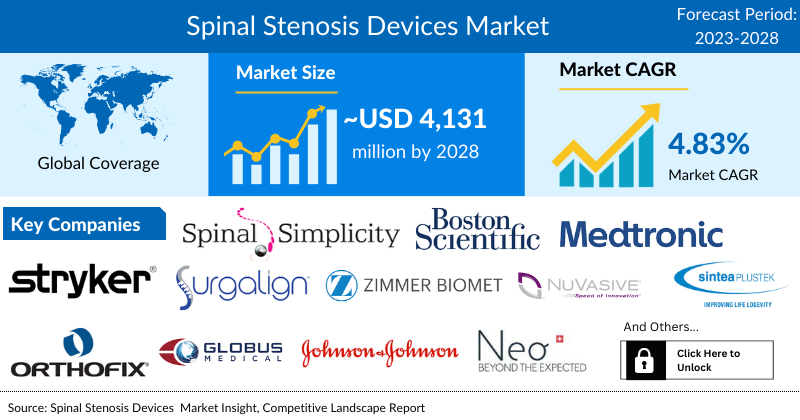
The global spinal stenosis devices market was valued at USD 3,122.95 million in 2023, growing at a CAGR of 4.83% during the forecast period from 2024 to 2030 to reach USD 4,131.08 million by 2030. The spinal stenosis devices market is slated to witness growth owing to factors such as increasing technological advancement, the rising burden of the geriatric population susceptible to developing spinal disorders, the increasing prevalence of spinal stenosis, the increase in the number of cases of spinal injuries, and the growing focus on improving the safety, affordability, and usability of spinal stenosis devices is expected to result in appreciable revenue growth in the spinal stenosis devices market during the forecast period (2024-2030).
Spinal Stenosis Devices Market Dynamics:
One of the noteworthy drivers of the spinal stenosis devices market is the rising cases of spinal stenosis among the growing geriatric population. It has been observed that as age progresses chances of suffering from spinal stenosis also increase at an alarming rate. The geriatric population is at the maximum risk of getting affected by spinal stenosis due to factors such as the continued degeneration of the aging spine that tends to progressively worsen over time.
Furthermore, according to the National Institute of Health Department 2021, lumbar stenosis is the most common form of spinal stenosis that can be observed among the elderly population, affecting about 11% of older adults in the United States in 2021.
As per DelveInsight’s analysis on spinal stenosis, the diagnosed patients for spinal stenosis in the United States were 3,674,901 in 2021 and it has been estimated that about 3,998,071 cases of spinal stenosis are going to be diagnosed in the United States by 2030.
Thus, due to such bodily changes with age, a significant increase in the old age population can be directly linked to an increase in the population suffering from spinal stenosis.
According to the World Health Organization (WHO) data published in October 2021, it was estimated that between the years 2015-2050, the number of individuals aged 60 years and more will be doubled by 12-22% and will reach 2.1 billion by 2050. Additionally, by the year 2030, one out of every six individuals in the world will be aged 60 years or beyond.
Also, according to the above-mentioned source, the number of individuals aged 80 years or more is expected to get tripled between the years 2020 and 2050 to reach 426 million population.
The rising incidences of spinal injuries among people due to various reasons are expected to be one of the key factors driving the spinal stenosis devices market. Spinal injuries can take place due to various reason such as traumatic injuries, road accidents, sports injuries, and fall among other. These injuries can lead to nerve compression and cause spinal stenosis. For instance, as per the US National Safety Council (NSC), in 2020, bicycling accounted for about 426,000 injuries, the most of any category of sports and recreation. This was then followed by 378,000 injuries caused due to exercise, with or without equipment, while ATV, moped, and minibike use with 230,000 injuries, and skateboard, scooter, and hoverboard use, with 218,00 injuries are ranked third and fourth respectively.
As per the data published by the World Health Organization 2021, every year between 250,000 and 500,000 people suffer a spinal cord injury (SCI) around the world and the majority of spinal cord injuries are due to road traffic crashes, falls, or violence.
Thereby, the above-mentioned factors are expected to accelerate the growth of the spinal stenosis devices market.
However, the high cost of the treatment procedures, the risk associated with procedures, and the stringent product approval process may act as restraining factors for the spinal stenosis devices market.
The COVID- 19 pandemic had a slightly negative impact on the market growth of spinal stenosis devices during the initial few months owing to the lockdown impositions, border closures, and others leading to the disruption in the manufacturing, supply, import, export, and other related activities of the spinal stenosis devices market. Also, owing to the fear of the spread of the SARS-CoV-2 virus which is the causative agent for COVID-19, and uncertainties revolving around the pandemic, many countries across the world were forced to close down spine-related clinics and specialty centers except in case of emergencies. However, the resumption of activities across industries including the healthcare sector has been uplifting the spinal stenosis devices market and will drive growth during the forecast period from 2024-2030.
Spinal Stenosis Devices Market Segment Analysis:
Spinal Stenosis Devices market Product type (Interspinous Spacers, Stabilization Systems, Spinal Arthroplasty Systems, and Interbody Fusion Devices) Application (Lumbar Spinal Stenosis, Cervical Spinal Stenosis, and Thoracic Spinal Stenosis) End-User (Hospitals, Ambulatory Surgical Centres, and Others), Geography (North-America, Europe, Asia-Pacific, Rest of the World).
In the product type segment of the spinal stenosis devices market, Stabilization System held the highest revenue share of 80% in 2021.
This can be attributed to the various properties, technical advantages, and the increasing product launches development activities such as collaborations and regulatory approvals of stabilization systems during the given forecast period.
Stabilization systems provide fixation in the form of pedicle screws that act as anchors for rods that provide fixation; or as an interbody cage placed in the disc space. Both of these fixation devices support fusion when used with bone graft material.
Stabilization may be an alternative to fusion in some patients with low back pain originating from chronic degeneration of the lumbar spine.
By altering load-bearing and controlling abnormal motion, stabilization helps limit the stress placed on the segment adjacent to the fusion level and thus helps prevent progressive degeneration.
In June 2022, NG Medical GmbH, a medical device manufacturer focused on creating innovative technologies for spinal applications, announced the launch of a new stabilization system, ART® Fixation System, in Europe. With a smaller instrument set and sterile-packed implants, ART® provides secure and straightforward instrumentation. One universal screw type is used in the lumbar fixation system's design to efficiently address all lumbar spinal fixation needs.
Hence, owing to all the aforementioned factors, the market will experience an increased demand for stabilization systems, thus driving the spinal stenosis devices market during the forecast period.
|
Report Metrics |
Details |
|
Study Period |
2020 to 2030 |
|
Base Year |
2022 |
|
Forecast Period |
2024 to 2030 |
|
CAGR | |
|
Spinal Stenosis Devices Market Size |
~USD 4,131 million by 2030 |
|
Key Spinal Stenosis Devices Companies |
Spinal Simplicity, Boston Scientific Corporation, Medtronic, Stryker, Surgalign, Zimmer Biomet, NuVasive Inc., Sintea Plustek LLC, Orthofix Medical Inc., Globus Medical, Alphatec Holdings, Inc., Johnson & Johnson, NEO-MEDICAL SA, Premia Spine, ulrich GmbH & Co. KG, B. Braun Melsungen AG, Spineart, Meril Life Sciences Pvt. Ltd., Empirical Spine, Inc., Empirical Spine, Inc., Cousin Surgery, and Many Others. |
North America is expected to dominate the overall Spinal Stenosis Devices Market:
Among all the regions, North America held the largest share of 59.57% in the spinal stenosis devices market in 2021.
The major factor driving the market is the steady rise in spinal stenosis cases due to spinal injuries and osteoarthritis. Osteoarthritis is an alarming health issue, especially in women and in the elderly population, thereby massively contributing to the market’s growth. As per the Centers for Disease Control and Prevention (CDC) 2021, OA affects over 32.5 million US adults.
Arthritis which is the foremost cause of spinal stenosis is the most prevalent chronic disease in Canada, thereby responsible for driving the market of spinal stenosis in Canada during the forecast period. For instance, according to the Arthritis Society of Canada, 2021, around 6 million Canadians were suffering from arthritis in 2021. Further, as per the same source, it has been estimated that there will be around 9 million cases of arthritis in Canada by 2040. Osteoarthritis can lead to disk degeneration and an enlargement or overgrowth of bone that narrows the central and nerve root canals, causing spinal stenosis.
Also, advanced product launches with numerous products receiving regulatory approval are further expected to fuel the market for spinal stenosis in the United States. For instance, in July 2021, Orthofix Inc., one of the prominent players in spinal injury devices received regulatory approval from the US Food and Drug Administration (FDA) for their Ascent POCT System, which is a spine stabilization system.
Also, in July 2022, Aurora Spine Corporation received the US FDA clearance for its ZIP™ MIS Interspinous Fusion System indicated for lumbar spinal stenosis.
Therefore, the above-mentioned factors are going to bolster the North America spinal stenosis devices markets.
Key Spinal Stenosis Devices Companies In The Market:
Some of the key Spinal Stenosis Devices companies operating in the Spinal Stenosis Devices market include Spinal Simplicity, Boston Scientific Corporation, Medtronic, Stryker, Surgalign, Zimmer Biomet, NuVasive Inc., Sintea Plustek LLC, Orthofix Medical Inc., Globus Medical, Alphatec Holdings, Inc., Johnson & Johnson, NEO-MEDICAL SA, Premia Spine, ulrich GmbH & Co. KG, B. Braun Melsungen AG, Spineart, Meril Life Sciences Pvt. Ltd., Empirical Spine, Inc., Empirical Spine, Inc., Cousin Surgery, and others.
Recent Developmental Activities in the Spinal Stenosis Devices Market:
- In December 2021, Spinal Simplicity, a medical device company, announced that the FDA has granted Indication for Use (IFU) approval for its Minuteman line of implants to treat lumbar spinal stenosis.
- In October 2020, Stryker announced the expansion of its lateral spine portfolio with the full launch of the Niagara Lateral Access System following the completion of 600 surgeries.
- In June 2019, Boston Scientific Corporation announced the closure of its acquisition of Vertiflex, Inc., (a privately-held company) that developed and commercialized the Superion® Indirect Decompression System, a minimally-invasive device used to improve physical function and reduce pain in patients with lumbar spinal stenosis (LSS) the narrowing of the spinal canal, which can cause compression of nearby nerves.
Key Takeaways From the Spinal Stenosis Devices Market Report Study
- Market size analysis for current spinal stenosis devices market size (2023), and market forecast for 5 years (2024-2030)
- The effect of the COVID-19 pandemic on this market is significant. To capture and analyze suitable indicators, our experts are closely watching the spinal stenosis devices market.
- Top key product/services/technology developments, mergers, acquisitions, partnerships, and joint ventures happened for the last 3 years.
- Key spinal stenosis devices companies dominating the global market.
- Various opportunities available for the other competitor in the spinal stenosis devices market space.
- What are the top-performing segments in 2023? How these segments will perform in 2030?
- Which are the top-performing regions and countries in the current spinal stenosis devices market scenario?
- Which are the regions and countries where ies should have concentrated on opportunities for spinal stenosis devices market growth in the coming future?
Target Audience who can be benefited from this Spinal Stenosis Devices Market Report Study
- Spinal stenosis devices companies
- Research organizations and consulting companies
- Spinal Stenosis Devices -related organizations, associations, forums, and other alliances
- Government and corporate offices
- Start-up companies, venture capitalists, and private equity firms
- Distributors and Traders dealing in spinal stenosis devices
- Various end users who want to know more about the spinal stenosis devices market and the latest technological developments in the spinal stenosis devices market.

