
Stereotactic Surgery Devices Market
Stereotactic Surgery Devices Market Summary
- The global stereotactic surgery devices market size is projected to grow at a 5.37% CAGR during the forecast period from 2025 to 2032.
- The stereotactic surgery devices market is experiencing significant growth due to several interconnected factors. Firstly, the rising prevalence of neurological conditions such as brain tumors, Parkinson’s disease, and epilepsy has increased the demand for precise surgical interventions that stereotactic devices can offer. Additionally, there is a growing adoption of minimally invasive procedures, driven by their benefits of reduced recovery times and lower complication rates. Furthermore, the ongoing product development activities by the key market players are enhancing the capabilities and features of stereotactic devices, leading to innovations that improve surgical outcomes and patient safety further propelling the market growth during forecast period from 2025 to 2032.
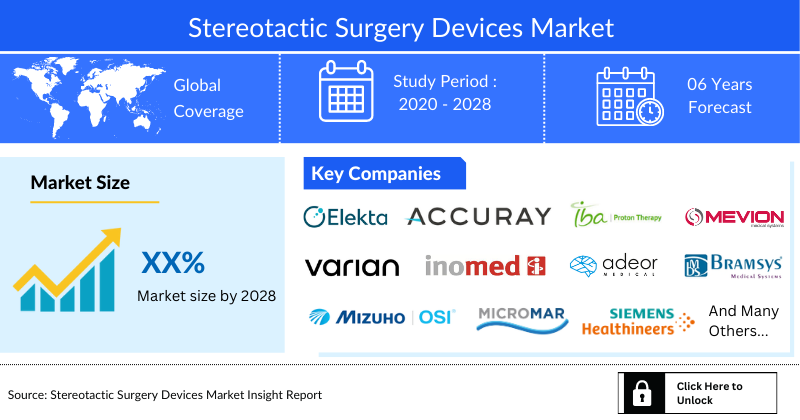
- The leading companies working in the stereotactic surgery devices market include Elekta AB, Accuray Incorporated, Ion Beam Applications S.A., Mevion Medical Systems, Varian Medical Systems, Inc. (Siemens Healthineers), inomed Medizintechnik GmbH, adeor medical AG, Bramsys Indústria e Comércio Ltd., Micromar Ind. E Com. LTDA, Mizuho Medical Co. Ltd., Shinva Medical Instrument co.,ltd., Panacea Medical Technologies Pvt. Ltd., Sumitomo Heavy Industries, Ltd., Hitachi Co. Ltd., ClearPoint Neuro, and others.
- Among all the regions, North America is anticipated to register the fastest growth in the Stereotactic Surgery Devices market during the forecasted period.
- In the product type segment of the overall stereotactic surgery devices market, the proton therapy system held the largest share in the year 2024.

Request for unlocking the report of the Stereotactic Surgery Devices Market
Factors Contributing to the Rise in Growth of the Stereotactic Surgery Devices Market
Rising prevalence of neurological disorders
Increasing cases of Parkinson’s disease, epilepsy, brain tumors, essential tremor and stroke are boosting demand for stereotactic interventions (DBS, lesioning, tumor targeting).
Shift toward minimally invasive and precision therapies
Stereotactic approaches reduce collateral damage and recovery time versus open surgery, so hospitals and surgeons prefer them for better outcomes and faster patient throughput.
Rapid technological advances (image-guidance, frameless systems, robotics)
Improvements in MRI/CT fusion, navigation software, frameless stereotactic platforms and robotic arms have increased targeting accuracy and surgeon confidence, expanding the number of treatable indications.
Growth in oncology use-cases (stereotactic radiosurgery and ablative procedures)
Stereotactic radiosurgery (SRS) and stereotactic ablative procedures for brain and metastatic tumors are rising as non-invasive cancer care options, driving device and system adoption.
This Stereotactic Surgery Devices market report offers a comprehensive overview of the global Stereotactic Surgery Devices market, highlighting key trends, growth drivers, challenges, and opportunities. It covers detailed market segmentation by Product Type (Gamma Knife, Linear Particle Accelerators, Proton Therapy Systems, and Stereotactic Systems), End User (Hospitals, Ambulatory Surgical Centers, and Others), and geographic regions. The report provides valuable insights into the competitive landscape, regulatory environment, and market dynamics across major markets, including North America, Europe, and Asia-Pacific. Featuring in-depth profiles of leading industry players and recent product innovations, this report equips businesses with essential data to identify market potential, develop strategic plans, and capitalize on emerging opportunities in the rapidly growing Stereotactic Surgery Devices market.
Stereotactic surgery devices are advanced medical tools designed to enable precise, minimally invasive surgical interventions in the brain and other parts of the body. These systems use a three-dimensional coordinate framework, often guided by imaging technologies such as CT, MRI, or PET scans, to accurately target small and deep-seated structures with high precision. They are widely employed in neurosurgical procedures for tumor biopsies, lesion removal, deep brain stimulation, and radiosurgery, minimizing damage to surrounding healthy tissue. By improving accuracy, reducing recovery time, and lowering surgical risks, stereotactic surgery devices have become essential in the treatment of complex neurological disorders such as Parkinson’s disease, epilepsy, and brain tumors.
The stereotactic surgery devices market demand is witnessing growth due to rising neurological disorders, technological advancements, and increased adoption of minimally invasive procedures, driving global market expansion and investment opportunities.
Get More Insights into the Report @ Stereotactic Surgery Devices Market
What are the Latest Stereotactic Surgery Devices Market Dynamics
According to the recent data provided by the GLOBOCAN, in 2022, globally the estimated new cases of brain and central nervous system cancer was estimated to be 322,000 per 100,000 population and the projection were estimated to increase 474,000 per 100,000 population by 2045.
Additionally, as per the recent data provided by the World Health Organization (2024), epilepsy affects approximately 50 million people worldwide, making it one of the most prevalent neurological disorders globally. Nearly 80% of those affected reside in low- and middle-income countries.
As these neurological conditions become more prevalent, there is an increased demand for precise and effective surgical solutions to manage and treat them. Stereotactic surgery devices play a pivotal role in accurately targeting and treating brain tumors, controlling epileptic seizures, and addressing stroke-related complications. Their ability to deliver targeted therapy with minimal invasiveness enhances treatment outcomes and reduces recovery times. Consequently, the growing number of cases necessitates advanced surgical technologies, driving the demand for stereotactic devices across the globe. The stereotactic radiosurgery Gamma Knife market is growing, offering precise, non-invasive treatment for brain tumors, vascular malformations, and neurological disorders, minimizing damage to surrounding healthy tissue and improving patient outcomes.
Along with the factors mentioned above, technological advancements in the field of stereotactic surgery devices such as the development of new techniques to enhance the yield and diagnostic accuracy are also expected to aid in the growth of the stereotactic surgery devices market. For instance, in June 2021, NaviNetics Inc. received the premarket product approval from the US Food and Drug Administration for their NaviNeticsD1 stereotactic system.
However, the risk associated with stereotactic surgery device such as infection, bleeding, or adverse reactions to anesthesia, and stringent regulatory concerns for product approval may hinder the growth of stereotactic surgery devices.
Stereotactic Surgery Devices Market Segment Analysis
Stereotactic Surgery Devices Market by Product Type (Gamma Knife, Linear Particle Accelerators, Proton Therapy Systems, and Stereotactic Systems), End User (Hospitals, Ambulatory Surgical Centers, and Others), and Geography (North America, Europe, Asia-Pacific, and Rest of the World).
In the product type segment of the overall stereotactic surgery devices market, the proton therapy system are expected to hold the largest share in the year 2023. Proton therapy, known for its precision and reduced collateral damage to surrounding healthy tissues, complements stereotactic surgery's focus on high-accuracy interventions. The integration of proton therapy systems into cancer treatment regimens highlights the need for advanced stereotactic devices to precisely target tumors and optimize therapeutic outcomes. Proton therapy's ability to deliver high doses of radiation with minimal exposure to healthy tissues supports the growing trend toward personalized and targeted cancer treatments, which, in turn, fuels the demand for stereotactic surgery systems that can accurately guide and monitor such therapies. The stereotactic surgery devices market trends are witnessing growth due to rising neurological disorder prevalence, technological advancements in minimally invasive procedures, increased adoption of image-guided systems, and expanding applications in brain and spine surgeries.
Additionally, the technological advancements driven by proton therapy innovations, fostering a competitive market environment that spurs continuous improvement and expansion. For instance, in October 2021, Ion Beam Applications SA announced the launch of the first online platform dedicated to proton therapy.
Hence, all the above-mentioned factors are expected to boost the growth of the segment, thus generating a considerable revenue for Proton Therapy Systems during the forecast period.
See More Insights of the Report @ Stereotactic Surgery Devices Market Trends
Stereotactic Surgery Devices Companies Active in the Market
Some of the key stereotactic surgery devices companies market include Elekta AB, Accuray Incorporated, Ion Beam Applications S.A., Mevion Medical Systems, Varian Medical Systems, Inc. (Siemens Healthineers), inomed Medizintechnik GmbH, adeor medical AG, Bramsys Indústria e Comércio Ltd., Micromar Ind. E Com. LTDA, Mizuho Medical Co. Ltd., Shinva Medical Instrument co.,ltd., Panacea Medical Technologies Pvt. Ltd., Sumitomo Heavy Industries, Ltd., Hitachi Co. Ltd., ClearPoint Neuro, and others.
Recent Developmental Activities in Stereotactic Surgery Devices Market
- In July 2024, Apollo Cancer Centres collaborated with Accuray to launch Indian sub- continent’s first robotic stereotactic radiotherapy program.
- In January 2024, ClearPoint Neuro announced the FDA clearance for SmartFrame OR™ stereotactic system.
Stereotactic Surgery Devices Market Segmentation
Stereotactic Surgery Devices Market By Product Type
- Gamma Knife
- Linear Particle Accelerators
- Proton Therapy Systems
- Stereotactic Systems
Stereotactic Surgery Devices Market By End User
- Hospitals
- Ambulatory Surgical Centers
- Others
Stereotactic Surgery Devices Market By Geography
- North America
- Europe
- Asia-Pacific
- Rest of the World
Stereotactic Surgery Devices Key Highlights Summary (2022–2025)
Key AI Advancements in Stereotactic Surgery Devices
Artificial Intelligence (AI) is transforming the field of stereotactic surgery by enhancing precision, reducing risks, and optimizing patient outcomes. Traditionally, stereotactic procedures have relied heavily on imaging, navigation systems, and surgeon expertise, but AI-driven technologies are now introducing automation, adaptability, and predictive capabilities.
AI-Enhanced Imaging and Navigation
AI algorithms are improving the accuracy of image segmentation, registration, and fusion from modalities such as MRI, CT, and PET scans. This allows stereotactic devices to create highly detailed 3D brain maps and identify optimal surgical trajectories. Real-time AI-based image correction helps compensate for brain shift and patient movement, thereby increasing precision during delicate neurosurgical interventions.
Machine Learning for Target Localization
Machine learning models assist in automatically identifying anatomical landmarks and pathological targets, such as tumors, lesions, or dysfunctional neural circuits. This reduces reliance on manual interpretation, minimizes inter-surgeon variability, and accelerates preoperative planning. In functional neurosurgery, AI helps refine electrode placement for deep brain stimulation (DBS) with improved accuracy.
Robotics with AI Guidance
Robotic stereotactic systems integrated with AI can autonomously adjust instrument positioning and trajectory in response to intraoperative feedback. AI-driven control enhances robotic stability, reduces micro-errors, and allows for minimally invasive approaches. These systems provide surgeons with augmented precision in biopsy, electrode placement, and radiosurgical procedures.
Predictive Analytics and Decision Support
AI-driven predictive models analyze patient-specific data, such as imaging features, genomics, and clinical history, to support surgical decision-making. These models can forecast surgical risks, outcomes, and potential complications, enabling personalized treatment strategies. In addition, reinforcement learning algorithms help optimize intraoperative parameters in real time.
Integration with Augmented and Virtual Reality (AR/VR)
AI enables stereotactic systems to merge imaging data with AR/VR platforms, creating immersive surgical simulations. Surgeons can rehearse procedures in virtual environments while AI adapts the models to patient-specific anatomy. Intraoperatively, AI-driven AR overlays help surgeons visualize trajectories and targets directly within the operative field.
Tariff Inclusion in Stereotactic Surgery Devices
The imposition of import tariffs on medical devices and components has significantly impacted the Stereotactic Surgery Devices sector. These tariffs have led to increased costs, supply chain disruptions, and strategic shifts in manufacturing and sourcing. Understanding and navigating these changes is crucial for stakeholders aiming to maintain competitiveness and ensure uninterrupted patient care.
How This Analysis Helps Clients:
- Cost Management
-
- Identifies tariff-related costs to optimize pricing and budgeting
- Helps negotiate better procurement terms with suppliers
- Assists in evaluating landed costs for different geographies
- Supply Chain Optimization
-
- Supports selection of suppliers and manufacturing locations with favorable tariffs
- Enables inventory planning to avoid delays or cost escalations
- Helps diversify supply sources to mitigate high-tariff risks
- Regulatory Navigation
-
- Provides insights into country-specific import/export regulations
- Ensures compliance with customs and trade laws to avoid penalties
- Facilitates smoother product registration and market entry
- Strategic Planning
-
- Guides decisions on regional expansion, partnerships, and M\&A considering tariff impacts
- Helps forecast market opportunities and competitive positioning
- Informs long-term sourcing, production, and distribution strategies
Key Takeaways from the Stereotactic Surgery Devices Market Report Study
- Market size analysis for current stereotactic surgery devices size (2024), and market forecast for 8 years (2025 to 2032)
- Top key product/technology developments, mergers, acquisitions, partnerships, and joint ventures happened for the last 3 years
- Key companies dominating the stereotactic surgery devices market.
- Various opportunities available for the other competitors in the stereotactic surgery devices market space.
- What are the top-performing segments in 2024? How these segments will perform in 2032?
- Which are the top-performing regions and countries in the current stereotactic surgery devices market scenario?
- Which are the regions and countries where companies should have concentrated on opportunities for stereotactic surgery devices market growth in the coming future?
Target Audience who can be benefited from this Stereotactic Surgery Devices Market Report Study
- Stereotactic surgery devices product providers
- Research organizations and consulting companies
- Stereotactic surgery devices -related organizations, associations, forums, and other alliances
- Government and corporate offices
- Start-up companies, venture capitalists, and private equity firms
- Distributors and traders dealing in stereotactic surgery devices
- Various end-users who want to know more about the stereotactic surgery devices market and the latest technological developments in the stereotactic surgery devices market.