
Stress Urinary Incontinence Market Summary
Stress Urinary Incontinence Market and Epidemiology Insights
- As per Rubilotta et al, (2020) stress Urinary Incontinence was present in 59.4% patients.
- The prevalence of clinical P-Stress Urinary Incontinence was 20.7%, while the prevalence of complicated Stress Urinary Incontinence (C-Stress Urinary Incontinence) was 79.3% in USA women.
- The Stress Urinary Incontinence epidemiology is segmented as Total Stress Urinary Incontinence Prevalent Cases, Stress Urinary Incontinence Cause-specific Prevalent Cases, Stress Urinary Incontinence Gender-specific Cases, Stress Urinary Incontinence Age-specific Prevalent Cases, Stress Urinary Incontinence Diagnosed and Treatable Cases in the stress urinary incontinence market report.
- The leading Stress Urinary Incontinence Companies such as Eli Lilly and Company, Changchun GeneScience Pharmaceutical Co., Ltd, Cook MyoSite, Taiho Pharmaceutical Co. Ltd, Solace Therapeutics Inc., Pneumoflex Systems LLC, Pfizer, and others.
Request for Unlocking the Sample Page of the "Stress Urinary Incontinence Treatment Market"
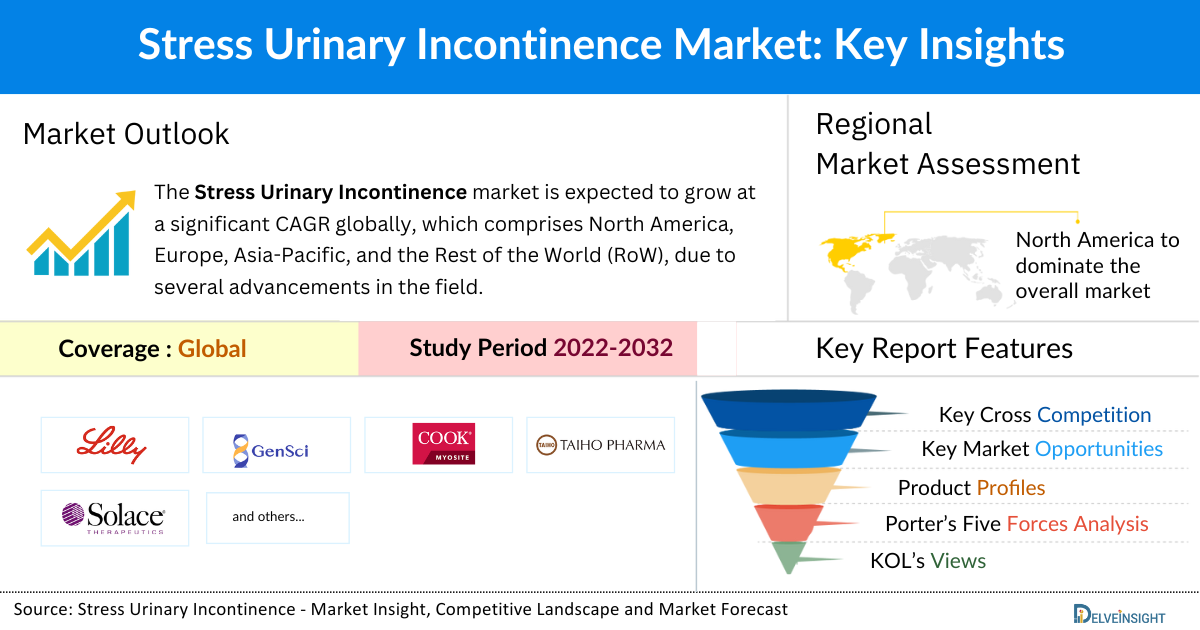
Key Factors Impacting the Stress Urinary Incontinence Market Growth
-
Rising Prevalence of Stress Urinary Incontinence
The growing incidence of stress urinary incontinence, particularly among women, is a major factor fueling market growth. Aging populations, increasing life expectancy, and higher prevalence of risk factors such as obesity, menopause, and multiple childbirths are contributing to a larger patient pool requiring long-term management and treatment.
-
Increasing Awareness and Diagnosis Rates
Improved awareness regarding urinary health and reduced social stigma around incontinence have encouraged more patients to seek medical care. Educational initiatives by healthcare providers and patient advocacy groups are leading to earlier diagnosis and higher treatment uptake, directly supporting market expansion.
-
Advancements in Treatment Options and Medical Devices
Technological progress in minimally invasive surgical procedures, sling systems, and bulking agents has significantly improved treatment outcomes for Stress Urinary Incontinence. These innovations offer better efficacy, reduced recovery time, and enhanced patient comfort, driving adoption among both patients and clinicians.
-
Growing Preference for Minimally Invasive and Non-Surgical Therapies
There is an increasing shift toward conservative and non-surgical treatment approaches, including pelvic floor muscle training, physiotherapy, and pharmacological therapies. The availability of multiple treatment modalities allows personalized care, thereby broadening the market scope.
-
Favorable Healthcare Infrastructure and Access to Specialized Care
Expansion of healthcare facilities, particularly in emerging markets, along with improved access to urology and gynecology specialists, is supporting the timely diagnosis and treatment of Stress Urinary Incontinence. This improved infrastructure enhances overall market penetration.
-
Rising Healthcare Expenditure and Focus on Women’s Health
Increased healthcare spending and a stronger focus on women’s health issues by public and private stakeholders are accelerating investments in Stress Urinary Incontinence therapies. This growing emphasis on quality-of-life disorders positions stress urinary incontinence as a key area of sustained market growth.
DelveInsight’s “Stress Urinary Incontinence Market Insights, Epidemiology, and Market Forecast – 2034” report delivers an in-depth understanding of disease, historical and forecasted epidemiology as well as the Stress Urinary Incontinence market trends in the United States, EU4 (Germany, France, Italy, Spain), the United Kingdom, and Japan.
The Stress Urinary Incontinence Treatment Market Report provides current treatment practices, emerging drugs, Stress Urinary Incontinence market share of the individual therapies, and current and forecasted Stress Urinary Incontinence market size from 2020 to 2034, segmented by seven major markets. The report also covers current Stress Urinary Incontinence treatment practices/algorithms and unmet medical needs to curate the best of the opportunities and assess the underlying potential of the market.
Scope of the Stress Urinary Incontinence Market Report | |
|
Study Period |
2020 to 2034 |
|
Forecast Period |
2024 to 2034 |
|
CAGR | |
|
Stress Urinary Incontinence Drugs |
|
|
Stress Urinary Incontinence Companies |
|
Stress Urinary Incontinence Understanding
The DelveInsight’s Stress Urinary Incontinence market report gives a thorough understanding of Stress Urinary Incontinence by including details such as disease definition, symptoms, causes, pathophysiology, diagnosis, and treatment. Stress Urinary Incontinence is when urine comes out with sudden pressure on the bladder and urethra, causing the sphincter muscles to open briefly. In mild Stress Urinary Incontinence, pressure can come from sudden violent activities such as moving, sneezing, laughing, or coughing, and in severe cases, it can come from less vigorous activities such as standing, walking, or bending over.
Stress Urinary Incontinence can occur when the pelvic tissues and muscles that support the bladder and urethra weaken and sink around the bladder neck (where the bladder and urethra intersect) during physical activity. Even the weakened sphincter muscle cannot stop the flow of urine under normal circumstances and with increased abdominal pressure. The weakness can occur from pregnancy, childbirth, aging, or previous pelvic surgery. Other risk factors for Stress Urinary Incontinence include chronic cough, obesity, and smoking.
Stress Urinary Incontinence Diagnosis
Urine sample to detect infections, blood traces or other abnormalities, brief neurological examination to identify, urinalysis, cystoscopy, pelvic nerve problems, urinary stress test, bladder function test are some of the common diagnostic methods.
Stress Urinary Incontinence Treatment
There are several treatment options for Stress Urinary Incontinence available and treatment of stress incontinence depends on how severe symptoms are and how much they affect day-to-day life. The five most common treatment options for Stress Urinary Incontinence are Behavior Changes, Kegel exercises, Vaginal Pessary, Urethral Bulking Agents, and Surgery. Pharmacological options for the treatment include Oxybutynin, Tricyclic anti-depressants, Estrogen Lugo and Riggs.
Stress Urinary Incontinence Epidemiology
The Stress Urinary Incontinence epidemiology section provides insights into historical and current Stress Urinary Incontinence patient pool and forecasted trends for seven individual major countries. It helps recognize the causes of current and forecasted trends by exploring numerous studies and views of key opinion leaders. This part of the Stress Urinary Incontinence report also provides the diagnosed patient pool, their trends and assumptions undertaken.
Key findings from the Stress Urinary Incontinence Epidemiological Analysis
- As per Rubilotta et al, (2020) study Stress Urinary Incontinence was present in 59.4% patients. The prevalence of clinical P-Stress Urinary Incontinence was 20.7%, while the prevalence of complicated Stress Urinary Incontinence (C-Stress Urinary Incontinence) was 79.3% in USA women.
- The Stress Urinary Incontinence epidemiology covered in the report provides historical as well as forecasted Stress Urinary Incontinence epidemiology [segmented as Total Stress Urinary Incontinence Prevalent Cases, Cause-specific Prevalent Cases of Stress Urinary Incontinence, Gender-specific Cases of Stress Urinary Incontinence, Age-specific Prevalent Cases of Stress Urinary Incontinence, Diagnosed and Treatable Cases of Stress Urinary Incontinence in the 7MM covering the United States, EU4 (Germany, France, Italy, Spain), the United Kingdom, and Japan from 2020 to 2034.
Country-wise Stress Urinary Incontinence Epidemiology
The epidemiology segment also provides the Stress Urinary Incontinence epidemiology data and findings across the United States, EU4 (Germany, France, Italy, Spain), the United Kingdom, and Japan.
Stress Urinary Incontinence Epidemiology Segmentation
- Total Stress Urinary Incontinence Prevalent Cases
- Cause-specific Prevalent Cases of Stress Urinary Incontinence
- Gender-specific Cases of Stress Urinary Incontinence
- Age-specific Prevalent Cases of Stress Urinary Incontinence
- Diagnosed and Treatable Cases of Stress Urinary Incontinence
Stress Urinary Incontinence Market Recent Breakthroughs and Breakthroughs
- In December 2025, Eli Lilly and Company announced that the GZPS master protocol will support two independent studies, J2A-MC-GZS1 and J2A-MC-GZS2. These studies are designed to evaluate the safety and efficacy of orforglipron in adult female participants with stress urinary incontinence (Stress Urinary Incontinence) who are overweight or obese. Stress Urinary Incontinence is characterized by involuntary urine leakage during physical movement or activities such as coughing, sneezing, or exercise. The total study duration for participants will be approximately 58 weeks, covering screening through the final safety follow-up.
- In December 2025, Levee Medical Inc. initiated a clinical study to assess the safety and effectiveness of the Voro Urologic Scaffold in adult men undergoing robotic-assisted radical prostatectomy, compared with a control arm. This multicenter, single-blind, randomized, controlled trial plans to enroll up to 266 participants across as many as 30 sites in the United States. The study includes a baseline assessment, scaffold implantation during robotic-assisted radical prostatectomy, catheter removal, and follow-up visits at 6 weeks, 6 months, 12 months, 18 months, and 24 months.
Stress Urinary Incontinence Drug Analysis
The drug chapter segment of the Stress Urinary Incontinence Therapeutics Market Report encloses the detailed analysis of Stress Urinary Incontinence marketed drugs and late-stage (Phase III and Phase II) Stress Urinary Incontinence Pipeline Drugs. It also helps understand the Stress Urinary Incontinence clinical trial details, expressive pharmacological action, agreements and collaborations, approval and patent details, advantages and disadvantages of each included drug, and the latest news and press releases.
Emerging Stress Urinary Incontinence Drugs
The report details the emerging Stress Urinary Incontinence therapies under the late and mid-stage of development for Stress Urinary Incontinence treatment.
Stress Urinary Incontinence Market Outlook
The Stress Urinary Incontinence market outlook of the report helps to build a detailed comprehension of the historical, current, and forecasted Stress Urinary Incontinence market trends by analyzing the impact of current therapies on the market, unmet needs, and demand for better technology.
This segment gives a thorough detail of the Stress Urinary Incontinence market trend of each marketed drug and late-stage pipeline therapy by evaluating their impact based on the annual cost of therapy, inclusion and exclusion criteria, mechanism of action, compliance rate, growing need for the market, increasing patient pool, covered patient segment, expected launch year, competition with other therapies, brand value, their impact on the market and view of the key opinion leaders. The calculated market data are presented with relevant tables and graphs to give a clear view of the market at first sight.
According to DelveInsight, the Stress Urinary Incontinence Treatment Market in 7MM is expected to witness a major change in the study period 2020–2034.
Key findings
This section includes a glimpse of the Stress Urinary Incontinence market in 7MM.
The United States: Stress Urinary Incontinence Market Outlook
This section provides the total Stress Urinary Incontinence market size and market size by therapies in the United States.
EU4 (Germany, France, Italy, and Spain), the United Kingdom: Stress Urinary Incontinence Market Outlook
The total Stress Urinary Incontinence market size and market size by therapies in Germany, France, Italy, Spain, and the United Kingdom are provided in this section.
Japan: Stress Urinary Incontinence Market Outlook
The total Stress Urinary Incontinence market size and market size by therapies in Japan are also mentioned.
Stress Urinary Incontinence Competitive Intelligence Analysis
We perform competitive and market intelligence analysis of the Stress Urinary Incontinence market by using various competitive intelligence tools that include – SWOT analysis, PESTLE analysis, Porter's five forces, BCG Matrix, Market entry strategies, etc. The inclusion of the analysis entirely depends on the data availability.
Key Stress Urinary Incontinence Companies
Merck Sharp & Dohme Corp., Cook MyoSite, Taiho Pharmaceutical, Gynamics, Solace Therapeutics, and others.
Stress Urinary Incontinence Drug Uptake
This section focuses on the rate of uptake of the potential Stress Urinary Incontinence drugs recently launched in the Stress Urinary Incontinence market or expected to get launched in the market during the study period 2020–2034. The analysis covers Stress Urinary Incontinence market uptake by drugs, patient uptake by therapies, and sales of each drug. This will help in understanding the Stress Urinary Incontinence drugs with the most rapid uptake and the reasons behind the maximal use of new drugs and allows the comparison of the drugs based on market share and size, which again will be useful in investigating factors important in the market uptake and in making financial and regulatory decisions.
Stress Urinary Incontinence Clinical Trials Activities
The Stress Urinary Incontinence Therapeutics Market Report provides insights into different therapeutic candidates in Phase II, and Phase III stages. It also analyses Stress Urinary Incontinence Companies involved in developing targeted therapeutics.
Stress Urinary Incontinence Pipeline Development Activities
The Stress Urinary Incontinence Therapeutics Market Report covers detailed information on collaborations, acquisitions, and mergers, licensing patent details, and other information for Stress Urinary Incontinence emerging therapies.
Stress Urinary Incontinence Reimbursement Scenario
Approaching reimbursement proactively can have a positive impact both during the late stages of product development and well after product launch. In a report, we consider reimbursement to identify economically attractive indications and market opportunities. When working with finite resources, the ability to select the markets with the fewest reimbursement barriers can be a critical business and price strategy.
Latest KOL Views on Stress Urinary Incontinence
To keep up with current epidemiology and market trends, we take KOLs and SMEs' opinions working in the Stress Urinary Incontinence domain through primary research to fill the data gaps and validate our secondary research. Their opinion helps to understand and validate current and emerging therapies and treatment patterns along with Stress Urinary Incontinence market trends. This will support the clients in potential upcoming novel treatments by identifying the overall scenario of the market and the unmet needs.
Scope of the Stress Urinary Incontinence Market Report
- Descriptive overview of Stress Urinary Incontinence, disease overview, patient journeys, treatment algorithms, diagnosis, and currently available therapies.
- Comprehensive insight into the Stress Urinary Incontinence epidemiology and forecasts in the 7MM.
- An all-inclusive account of both the current and emerging therapies for Stress Urinary Incontinence, along with the assessment of new therapies, is expected to have an impact on the current Stress Urinary Incontinence Treatment Market Landscape.
- Exhaustive analysis of the Stress Urinary Incontinence Treatment Market, historical and forecasted covering drug outreach in the 7MM.
- Detailed Patient-Based Stress Urinary Incontinence Market Forecasting determines the trends shaping and driving the Global Stress Urinary Incontinence market.
Stress Urinary Incontinence Market Report Highlights
- In the coming years, the Stress Urinary Incontinence Market is set to change due to the rising awareness of the disease and incremental healthcare spending across the world; which would expand the size of the market to enable the drug manufacturers to penetrate more into the market
- The Stress Urinary Incontinence Companies and academics are working to assess challenges and seek opportunities that could influence Stress Urinary Incontinence R&D. The therapies under development are focused on novel approaches to treat/improve the disease condition
- Major Stress Urinary Incontinence Companies are involved in developing Stress Urinary Incontinence therapies. The launch of emerging therapies will significantly impact the Stress Urinary Incontinence market
- A better understanding of Stress Urinary Incontinence pathogenesis will also contribute to the development of novel therapeutics for Stress Urinary Incontinence (Stress Urinary Incontinence)
- Our in-depth analysis of the Stress Urinary Incontinence Pipeline assets across different stages of development (Phase III and Phase II), emerging trends, and comparative analysis of pipeline products with detailed Stress Urinary Incontinence Clinical Trial profiles, key cross-competition, launch date along with product development activities will support the clients in the decision-making process regarding their therapeutic portfolio by identifying the overall scenario of the research and development activities
Stress Urinary Incontinence Market Report Insights
- Patient-Based Stress Urinary Incontinence Market Forecasting
- Therapeutic approaches
- Stress Urinary Incontinence Pipeline Analysis
- Stress Urinary Incontinence Market Size and Trends
- Stress Urinary Incontinence Drugs Market opportunities
- Impact of upcoming Stress Urinary Incontinence Therapies
Stress Urinary Incontinence Market Report Key Strengths
- 11-year Stress Urinary Incontinence Market Forecast
- 7MM Coverage
- Stress Urinary Incontinence epidemiology segmentation
- Key cross competition
- KOL views
- Stress Urinary Incontinence drugs uptake
Stress Urinary Incontinence Market Report Assessment
- Current Stress Urinary Incontinence Treatment Practices
- Stress Urinary Incontinence Unmet Needs
- Stress Urinary Incontinence Pipeline product profiles
- Stress Urinary Incontinence market attractiveness
Key Questions Answered in the Stress Urinary Incontinence Market Report
Stress Urinary Incontinence Market Insights:
- What would be the Stress Urinary Incontinence market growth till 2034, and what will be the resultant market size in 2034?
- What was the Stress Urinary Incontinence drug class share (in percentage) distribution in 2020, and how would it look in 2034?
- What would be the Stress Urinary Incontinence total market size and market size by therapies across the 7MM during the forecast period (2024–2034)?
- What are the key findings of the market across 7MM, and which country will have the largest Stress Urinary Incontinence market size during the forecast period (2024–2034)
- How would the unmet needs affect the Stress Urinary Incontinence market dynamics and subsequent analysis of the associated trends?
Stress Urinary Incontinence Epidemiology Insights:
- What are the disease risk, burden, and regional/ethnic differences of Stress Urinary Incontinence (Stress Urinary Incontinence)?
- What is the historical and forecasted Stress Urinary Incontinence patient pool in 7MM, and where can one observe the highest patient population and growth opportunities?
- What are the key factors driving the epidemiology trends for seven major markets covering the United States, EU4 (Germany, France, Italy, Spain), the United Kingdom, and Japan?
Current Stress Urinary Incontinence Treatment Scenario, Marketed Drugs, and Emerging Therapies
- What are the current treatment guidelines and treatment options, in addition to approved therapies for Stress Urinary Incontinence in the US, Europe, and Japan?
- What are the key collaborations (Industry–Industry, Industry-Academia), mergers and acquisitions, and licensing activities related to Stress Urinary Incontinence therapies?
- What are the recent novel therapies, targets, mechanisms of action, and technologies being developed to overcome the limitation of existing therapies?
- What are the clinical studies going on for Stress Urinary Incontinence and its status, along with the challenges faced?
Reasons to Buy the Stress Urinary Incontinence Market Report
- The Patient-Based Stress Urinary Incontinence Market Forecasting analysis will help in developing business strategies by understanding trends shaping and driving the Stress Urinary Incontinence market
- Organize Stress Urinary Incontinence Sales and marketing efforts by identifying the best opportunities for Stress Urinary Incontinence in the US, EU4 (Germany, France, Italy, and Spain), the United Kingdom, and Japan
- Identification of strong upcoming players in the Stress Urinary Incontinence Drugs Market that will help devise strategies that will help in getting ahead of competitors.
Stay updated with us for Recent Articles @ New DelveInsight Blogs