Synovial Sarcoma Pipeline Summary
- The Synovial Sarcoma Pipeline is witnessing steady progress, driven by increasing research activities and the development of novel therapeutic candidates across various stages of clinical trials.
- The leading Synovial Sarcoma Companies such as Advenchen Laboratories, Ipsen, OncoTherapy Science, C4 Therapeutics, Takara Bio, BioAtla Inc., Immatics Biotechnologies GmbH, Sapience Therapeutics, PharmaMar and others.
Request for Unlocking the Sample Page of the "Synovial Sarcoma Pipeline"
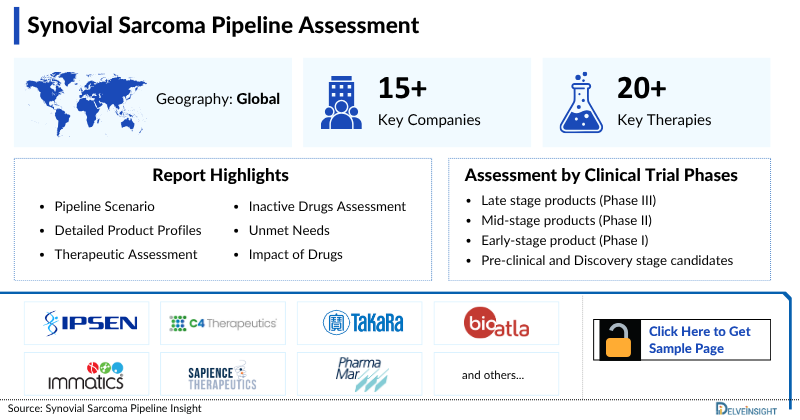
DelveInsight’s, “Synovial Sarcoma Pipeline Insight, 2026” report provides comprehensive insights about 15+ companies and 20+ pipeline drugs in Synovial Sarcoma pipeline landscape. It covers the pipeline drug profiles, including clinical and nonclinical stage products. It also covers the therapeutics assessment by product type, stage, route of administration, and molecule type. It further highlights the inactive pipeline products in this space.
Geography Covered
- Global coverage
Synovial Sarcoma Understanding
Synovial-Sarcoma Overview
Synovial sarcoma is a rare type of soft tissue sarcoma that arises primarily around joints, often affecting the arms or legs, though it can occur in other parts of the body as well. Despite its name, it does not originate from synovial tissue (the tissue lining joints) but tends to develop in areas near joints or tendons. The exact cause of synovial sarcoma remains unclear, though genetic mutations, particularly a specific translocation between chromosomes X and 18 (t(X;18)), play a crucial role in its development. This fusion gene, SS18-SSX, drives abnormal cell growth and differentiation, contributing to tumor formation.
Most cases of synovial sarcoma occur in adolescents and young adults, typically between the ages of 15 and 40, with a slight male predominance. The tumor can grow slowly, making it harder to detect until it becomes large or starts affecting surrounding structures like muscles, nerves, or bones. Common symptoms include swelling or a palpable mass near a joint, along with pain or tenderness, though some patients may initially be asymptomatic. As it progresses, synovial sarcoma may limit movement or cause joint dysfunction, depending on its location.
Diagnosis of synovial sarcoma usually involves a combination of imaging studies (such as MRI or CT scans), which help in visualizing the size and extent of the tumor, and a biopsy to confirm the histological characteristics of the sarcoma. Pathologically, synovial sarcoma can appear in two main forms: monophasic (composed of one type of cell, either epithelial or spindle-shaped) or biphasic (a mix of epithelial and spindle cells). Molecular testing is critical to identify the SS18-SSX fusion gene, which aids in distinguishing synovial sarcoma from other soft tissue tumors.
Synovial Sarcoma treatment strategies typically include a combination of surgery, radiation therapy, and chemotherapy. Surgical removal of the tumor with wide margins is the mainstay of treatment, aiming to prevent local recurrence. Radiation therapy is often used either before or after surgery to enhance local control, while chemotherapy may be considered in cases of high-grade or metastatic disease. Despite aggressive treatment, synovial sarcoma has a relatively high risk of recurrence and metastasis, especially to the lungs and lymph nodes, which can complicate management.
Explore More Insights into the Report @ Synovial Sarcoma Treatment Market
"Synovial Sarcoma Pipeline Insight, 2026" report by DelveInsight outlays comprehensive insights of present scenario and growth prospects across the indication. A detailed picture of the Synovial Sarcoma pipeline landscape is provided which includes the disease overview and Synovial Sarcoma treatment guidelines. The assessment part of the report embraces, in depth Synovial Sarcoma commercial assessment and clinical assessment of the pipeline products under development. In the Synovial Sarcoma Pipeline Report, detailed description of the drug is given which includes Synovial Sarcoma Mechanism of Action of the drug, clinical studies, NDA approvals (if any), and product development activities comprising the technology, Synovial Sarcoma collaborations, licensing, mergers and acquisition, funding, designations and other product related details.
Synovial Sarcoma Pipeline Report Highlights
The Synovial Sarcoma Companies and academics are working to assess challenges and seek opportunities that could influence Synovial-Sarcoma R&D. The Synovial Sarcoma Therapies under development are focused on novel approaches to treat/improve Synovial-Sarcoma.
Synovial-Sarcoma Emerging Drugs Chapters
This segment of the Synovial Sarcoma Pipeline Report encloses its detailed analysis of various drugs in different stages of clinical development, including phase III, II, II/III I, preclinical and Discovery. It also helps to understand Synovial Sarcoma Clinical Trials details, expressive pharmacological action, agreements and collaborations, and the latest news and press releases.
Synovial-Sarcoma Emerging Drugs
-
AL3818: Advenchen Laboratories
Anlotinib (AL3818) is a novel oral receptor Tyrosine Kinase Inhibitor targeting vascular endothelial growth factor receptor 2 and 3, fibroblast growth factor 1–4, platelet-derived growth factor receptor α and β, c-Kit and Ret. Anlotinib exerts inhibitory effects on tumor growth and angiogenesis. Anlotinib has encouraging efficacy and a manageable and tolerable safety profile in a broad range of malignancies, including Medullary Thyroid Cancer, Renal Cell Cancer, Gastric Cancer, and Esophageal Squamous Cell Carcinoma. Currently, the drug is in the Phase III stage of its development for the treatment of Synovial sarcoma.
-
Tazemetostat: Ipsen
Tazemetostat is a first-in-class, oral small molecule inhibitor of the epigenetic enzyme EZH2. It is one of the histone methyltransferases in the epigenetics-related protein group, and is thought to regulate the expression of cancer-related genes and suppress the growth of cancer cells by specifically targeting EZH2, which contributes to the cancer growth process. Eisai holds the rights for development and commercialization of tazemetostat in Japan, where it was approved for the indication of “relapsed or refractory EZH2 gene mutation-positive Follicular Lymphoma (only when standard treatment is not applicable)” in 2021, and manufactures and distributes the product. Currently, the drug is being evaluated in the Phase II stage of its development for the treatment of synovial sarcoma.
- DS-2243a: Daiichi Sankyo
DS-2243a is an investigational bispecific T-cell engager (BiTE) developed by Daiichi Sankyo, currently being studied for the treatment of advanced synovial sarcoma. This agent is designed to target tumors that express the HLA-A2 molecule and the cancer-testis antigen NY-ESO, both of which are commonly found in synovial sarcoma cells. By binding to both the tumor antigen and cytotoxic T lymphocytes, DS-2243a aims to direct the patient’s immune system specifically against synovial sarcoma cells, potentially improving the body’s ability to recognize and kill these cancerous cells. The ongoing Phase I clinical trial is focused on evaluating the safety, tolerability, and initial signs of efficacy of DS-2243a in patients with advanced synovial sarcoma who have limited treatment options.
Synovial-Sarcoma Pipeline Therapeutic Assessment
This segment of the Synovial Sarcoma Pipeline Report provides insights about the different Synovial Sarcoma Drugs segregated based on following parameters that define the scope of the report, such as:
Major Synovial Sarcoma Companies
There are approx. 15+ key companies which are developing the therapies for Synovial-Sarcoma. The Synovial Sarcoma Companies which have their Synovial-Sarcoma drug candidates in the most advanced stage, i.e. phase III include, Advenchen Laboratories.
Synovial Sarcoma Phases
DelveInsight’s Synovial Sarcoma Pipeline Report covers around 20+ products under different phases of clinical development like
- Late stage products (Phase III)
- Mid-stage products (Phase II)
- Early-stage product (Phase I) along with the details of
- Pre-clinical and Discovery stage candidates
- Discontinued & Inactive candidates
Synovial Sarcoma Route of Administration
Synovial-Sarcoma pipeline report provides the therapeutic assessment of the pipeline drugs by the Route of Administration. Products have been categorized under various ROAs such as
- Oral
- Intravenous
- Subcutaneous
- Parenteral
- Topical
Synovial Sarcoma Molecule Type
Synovial Sarcoma Products have been categorized under various Molecule types such as
- Recombinant fusion proteins
- Small molecule
- Monoclonal antibody
- Peptide
- Polymer
- Gene therapy
Synovial Sarcoma Product Type
Synovial Sarcoma Drugs have been categorized under various product types like Mono, Combination and Mono/Combination.
More Information on the Report @ Synovial Sarcoma Prevalence
Synovial-Sarcoma Clinical Trials Activities
The Synovial Sarcoma Pipeline Report provides insights into different therapeutic candidates in phase II, I, preclinical and discovery stage. It also analyses Synovial-Sarcoma therapeutic drugs key players involved in developing key drugs.
Synovial Sarcoma Pipeline Development Activities
The Synovial Sarcoma Pipeline Report covers the detailed information of collaborations, acquisition and merger, licensing along with a thorough therapeutic assessment of emerging Synovial Sarcoma Drugs.
Synovial-Sarcoma Pipeline Report Insights
- Synovial-Sarcoma Pipeline Analysis
- Synovial Sarcoma Therapeutic Assessment
- Synovial Sarcoma Unmet Needs
- Impact of Synovial Sarcoma Drugs
Synovial-Sarcoma Pipeline Report Assessment
- Synovial Sarcoma Pipeline Product Profiles
- Synovial Sarcoma Therapeutic Assessment
- Synovial Sarcoma Pipeline Assessment
- Inactive Synovial Sarcoma Drugs Assessment
- Synovial Sarcoma Unmet Needs
Stay ahead with DelveInsight's Synovial Sarcoma Market Forecast, Epidemiology and Market Insights– 2036 for strategic planning and competitive market intelligence.
Key Questions Answered in the Synovial Sarcoma Pipeline Report
Current Synovial Sarcoma Treatment Scenario and Emerging Therapies:
- How many companies are developing Synovial-Sarcoma drugs?
- How many Synovial-Sarcoma drugs are developed by each company?
- How many emerging drugs are in mid-stage, and late-stage of development for the treatment of Synovial-Sarcoma?
- What are the key collaborations (Industry–Industry, Industry–Academia), Mergers and acquisitions, licensing activities related to the Synovial-Sarcoma therapeutics?
- What are the recent trends, drug types and novel technologies developed to overcome the limitation of existing therapies?
- What are the clinical studies going on for Synovial-Sarcoma and their status?
- What are the key designations that have been granted to the emerging drugs?
Stay updated with us for Recent Articles @ New DelveInsight Blogs