
Tinlarebant Market Summary
Key Factors Driving Tinlarebant Growth
1. First-in-Class Therapy for a Disease with No Approved Treatments
One of the strongest growth drivers for Tinlarebant is the complete lack of approved pharmacological treatments for Stargardt disease, a rare inherited retinal disorder that leads to progressive central vision loss. The disease affects over 50,000 patients in the United States alone, with a significant global patient population, particularly among adolescents and young adults. Because Tinlarebant has the potential to become the first approved therapy for STGD1, it could rapidly achieve strong uptake upon approval due to the high unmet medical need. Rare disease therapies typically command premium pricing and benefit from orphan-drug exclusivity, which could translate into strong revenue potential despite the relatively small patient population.
2. Strong Clinical Efficacy Demonstrated in Phase III Trials
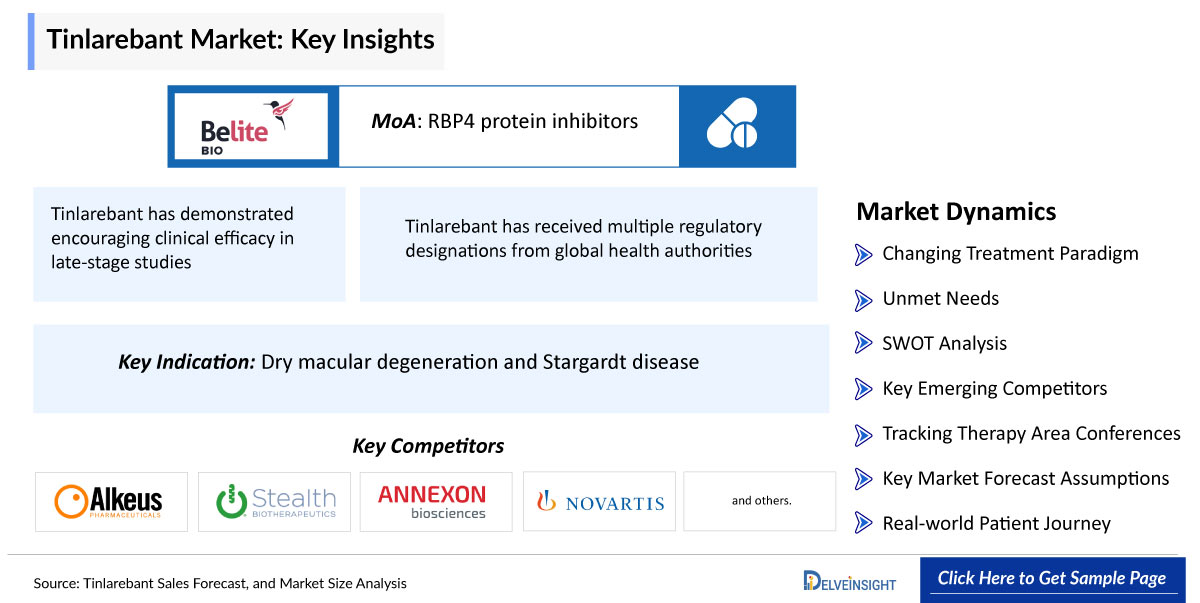
- Tinlarebant has demonstrated encouraging clinical efficacy in late-stage studies. In the global Phase III DRAGON trial, the drug achieved a 36% reduction in the growth rate of retinal lesions compared with placebo, meeting the study’s primary endpoint with statistical significance (p = 0.0033).
- The trial included 104 adolescent patients aged 12–20 years with Stargardt disease, and the therapy was generally well tolerated with only a few treatment-related discontinuations.
- Such robust efficacy in a pivotal trial significantly increases the probability of regulatory approval and enhances investor confidence in the asset’s commercial potential.
3. Favorable Regulatory Designations Accelerating Development
Tinlarebant has received multiple regulatory designations from global health authorities, including:
- Breakthrough Therapy Designation from the US FDA
- Fast Track Designation
- Rare Pediatric Disease Designation in the United States
- Orphan Drug Designation in the US, Europe, and Japan
- Sakigake (Pioneer Drug) designation in Japan
These designations provide benefits such as priority regulatory review, potential priority review vouchers, and extended market exclusivity, which can accelerate commercialization timelines and improve the product’s market penetration.
4. Oral Administration Provides Competitive Advantage
Tinlarebant is an oral small-molecule therapy, which differentiates it from many ophthalmology treatments that require intravitreal injections. The drug works by reducing serum retinol-binding protein 4 (RBP4), thereby limiting vitamin-A transport to the eye and reducing accumulation of toxic bisretinoids responsible for retinal degeneration.
An oral therapy provides several commercial advantages:
- Improved patient compliance
- Easier administration compared with injectable therapies
- Broader adoption in pediatric and adolescent populations
These factors may significantly improve real-world uptake.
5. Potential Label Expansion into Larger Retinal Disease Markets
- While Stargardt disease is a rare condition, Tinlarebant is also being evaluated for Geographic Atrophy in dry AMD, a much larger market. The ongoing Phase III PHOENIX trial is assessing the therapy in patients with geographic atrophy.
- If successful, this indication could expand the drug’s commercial opportunity significantly, as millions of patients globally suffer from dry AMD. Entry into this market would transform Tinlarebant from a rare-disease product into a broader retinal disease therapy.
6. Near-Term Regulatory Milestones and Commercialization Timeline
- Belite Bio expects to submit a New Drug Application (NDA) to the US FDA in the first half of 2026, following positive Phase III results.
- If approved, launch could occur around 2027, depending on regulatory review timelines and manufacturing readiness. This upcoming regulatory milestone is a key catalyst for the drug’s growth trajectory.
Tinlarebant Market Recent Developments
- In January 2026, Belite Bio, a clinical-stage drug development company focused on advancing novel therapeutics targeting degenerative retinal diseases that have significant unmet medical needs, announced the completion of enrollment of 60 subjects, including 15 Japanese subjects, in the Phase II/III DRAGON II clinical trial evaluating Tinlarebant for the treatment of Stargardt disease type 1 (STGD1).
- In September 2025, Belite Bio, a clinical-stage drug development company focused on advancing novel therapeutics targeting degenerative retinal diseases that have significant unmet medical needs, announced the completion of the last subject visit in the Phase III DRAGON clinical trial evaluating Tinlarebant for the treatment of Stargardt disease type 1 (STGD1).
“Tinlarebant Sales Forecast, and Market Size Analysis – 2034” report provides comprehensive insights of Tinlarebant for potential indication like Dry Macular Degeneration and Stargardt Disease in the 7MM. A detailed picture of Tinlarebant’s existing usage in anticipated entry and performance in potential indications in the 7MM, i.e., the United States, EU4 (Germany, France, Italy, and Spain) and the United Kingdom, and Japan for the study period 2020 –2034 is provided in this report along with a detailed description of the Tinlarebant for potential indications. The Tinlarebant Market Report provides insights about Tinlarebant’s sales forecast, mechanism of action (MoA), dosage and administration, as well as research and development including regulatory milestones, along with other developmental activities. Further, it also consists of historical and current Tinlarebant performance, future market assessments inclusive of the Tinlarebant market forecast analysis for potential indications in the 7MM, SWOT, analysts’ views, comprehensive overview of market competitors, and brief about other emerging therapies in respective indications. It also provides analysis of Tinlarebant sales forecasts, along with factors driving its market.
Tinlarebant Drug Summary
Tinlarebant (LBS-008) is an investigational, orally administered small molecule developed by Belite Bio that acts as a potent retinol binding protein 4 (RBP4) antagonist, designed to reduce the delivery of retinol (vitamin A) from the liver to the eye by inhibiting serum RBP4, the sole carrier protein for retinol transport. This mechanism minimizes the formation of cytotoxic bisretinoids—toxic by-products of the visual cycle that accumulate in the retina—thereby aiming to preserve retinal tissue integrity, slow vision loss, and treat conditions like Stargardt Disease type 1 (STGD1) and Geographic Atrophy (GA) in advanced dry Age-related Macular Degeneration (dry AMD). Currently in late-stage Phase III trials (e.g., DRAGON study completed in 2025), it has received Fast Track, Orphan Drug, and Rare Pediatric Disease designations from the FDA, as well as similar recognitions in Europe and Japan, positioning it as a potential first-in-class therapy with demonstrated target specificity and potency in clinical studies. The report provides Tinlarebant’s sales, growth barriers and drivers, post usage and approvals in multiple indications.
Scope of the Tinlarebant Market Report
The report provides insights into:
- A comprehensive product overview including the Tinlarebant MoA, description, dosage and administration, research and development activities in potential indication like Dry macular degeneration and Stargardt disease.
- Elaborated details on Tinlarebant regulatory milestones and other development activities have been provided in Tinlarebant market report.
- The report also highlights Tinlarebant‘s cost estimates and regional variations, reported and estimated sales performance, research and development activities in potential indications across the United States, Europe, and Japan.
- The Tinlarebant market report also covers the patents information, generic entry and impact on cost cut.
- The Tinlarebant market report contains current and forecasted Tinlarebant sales for potential indications till 2034.
- Comprehensive coverage of the late-stage emerging therapies for respective indications.
- The Tinlarebant market report also features the SWOT analysis with analyst views for Tinlarebant in potential indications.
Tinlarebant Methodology
The Tinlarebant market report is built using data and information sourced primarily from internal databases, primary and secondary research and in-house analysis by DelveInsight’s team of industry experts. Information and Tinlarebant Sales Data from the secondary sources have been obtained from various printable and nonprintable sources like search engines, news websites, global regulatory authorities websites, trade journals, white papers, magazines, books, trade associations, industry associations, industry portals and access to available databases.
Tinlarebant Analytical Perspective by DelveInsight
- In-depth Tinlarebant Market Assessment
This Tinlarebant sales market forecast report provides a detailed market assessment of Tinlarebant for potential indication like Dry macular degeneration and Stargardt disease in the seven major markets, i.e., the United States, EU4 (Germany, France, Italy, and Spain) and the United Kingdom, and Japan. This segment of the report provides current and forecasted Tinlarebant sales data uptil 2034.
- Tinlarebant Clinical Assessment
The Tinlarebant market report provides the clinical trials information of Tinlarebant for potential indications covering trial interventions, trial conditions, trial status, start and completion dates.
Tinlarebant Competitive Landscape
- The report provides Insights on competitors and marketed products within the domain, along with a summary of emerging products and their respective launch dates, posing significant competition in the market.
Tinlarebant Market Potential & Revenue Forecast
- Projected market size for the Tinlarebant and its key indications
- Estimated Tinlarebant sales potential (Tinlarebant peak sales forecasts)
- Tinlarebant Pricing strategies and reimbursement landscape
Tinlarebant Competitive Intelligence
- Number of competing drugs in development (pipeline analysis)
- Tinlarebant Market positioning compared to existing treatments
- Tinlarebant Strengths & weaknesses relative to competitors
Tinlarebant Regulatory & Commercial Milestones
- Tinlarebant Key regulatory approvals & expected launch timelines
- Commercial partnerships, licensing deals, and M&A activity
Tinlarebant Clinical Differentiation
- Tinlarebant Efficacy & safety advantages over existing drugs
- Tinlarebant Unique selling points
Tinlarebant Market Report Highlights
- In the coming years, the Tinlarebant Market scenario is set to change due to strong adoption, increased prescriptions and broader uptake in multiple immunological indications; which would expand the size of the market.
- The Tinlarebant Companies are developing therapies that focus on novel approaches to treat/improve the disease condition, assess challenges, and seek opportunities that could influence Tinlarebant’s dominance.
- Other emerging products for Dry macular degeneration and Stargardt disease are expected to give tough market competition to Tinlarebant and launch of late-stage emerging therapies in the near future will significantly impact the market.
- A detailed description of regulatory milestones, and developmental activities, provide the current development scenario of Tinlarebant in potential indications.
- Analyse Tinlarebant cost, pricing trends and market positioning to support strategic decision-making in the immunology landscape.
- Our in-depth analysis of the forecasted Tinlarebant sales data uptil 2034 will support the clients in decision-making process regarding their therapeutic portfolio by identifying the overall scenario of Tinlarebant in potential indications.
Key Questions Answered in the Tinlarebant Market Report
- What is the class of therapy, route of administration and Tinlarebant Mechanism of Action? How strong is Tinlarebant’s clinical and commercial performance?
- What is Tinlarebant’s clinical trial status in each individual indications such as Dry macular degeneration and Stargardt disease and study completion date?
- What are the key collaborations, mergers and acquisitions, licensing and other activities related to the Tinlarebant Manufacturers?
- What are the key designations that have been granted to Tinlarebant for potential indications? How are they going to impact Tinlarebant’s penetration in various geographies?
- What is the current and forecasted Tinlarebant market scenario for potential indications? What are the key assumptions behind the forecast?
- What are the current and forecasted Tinlarebant sales in the seven major countries, including the United States, Europe (Germany, France, Italy, Spain) and the United Kingdom, and Japan?
- What are the other emerging products available and how are these giving competition to Tinlarebant for potential indications?
- Which are the late-stage emerging therapies under development for the treatment of potential indications?
- How cost-effective is Tinlarebant? What is the duration of therapy and what are the geographical variations in cost per patient?
Stay updated with us for Recent Articles @ New DelveInsight Blogs

