Total Knee Arthroplasty Market Summary
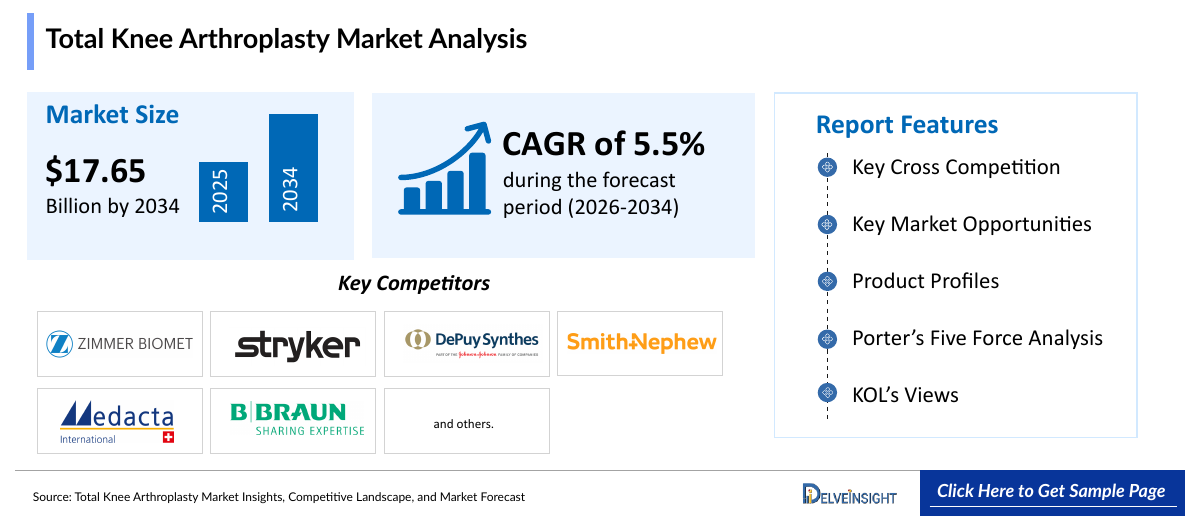
- The Total Knee Arthroplasty market is estimated at USD 10.90 billion in 2025 and is projected to reach USD 17.65 billion by 2034. Growth is anchored in the rising burden of knee osteoarthritis in an aging population, the rapid adoption of robotic-assisted and digitally enabled surgery, and the migration of knee replacement procedures into ambulatory surgical centers.
- The global Total Knee Arthroplasty market is growing at a CAGR of 5.5% during the forecast period from 2026 to 2034.
- By procedure type, the total knee replacement segment dominated the Total Knee Arthroplasty market with an 82% share in 2025.
- By implant fixation type, the cemented segment dominated the Total Knee Arthroplasty market with a 69% share in 2025.
- By material type, the metal alloys segment dominated the Total Knee Arthroplasty market with a 54% share in 2025.
- By implant component, the femoral components segment dominated the Total Knee Arthroplasty market with a 36% share in 2025.
- By indication, the osteoarthritis segment dominated the Total Knee Arthroplasty market with an 87% share in 2025.
- By end user, the hospitals segment dominated the Total Knee Arthroplasty market with a 71% share in 2025.
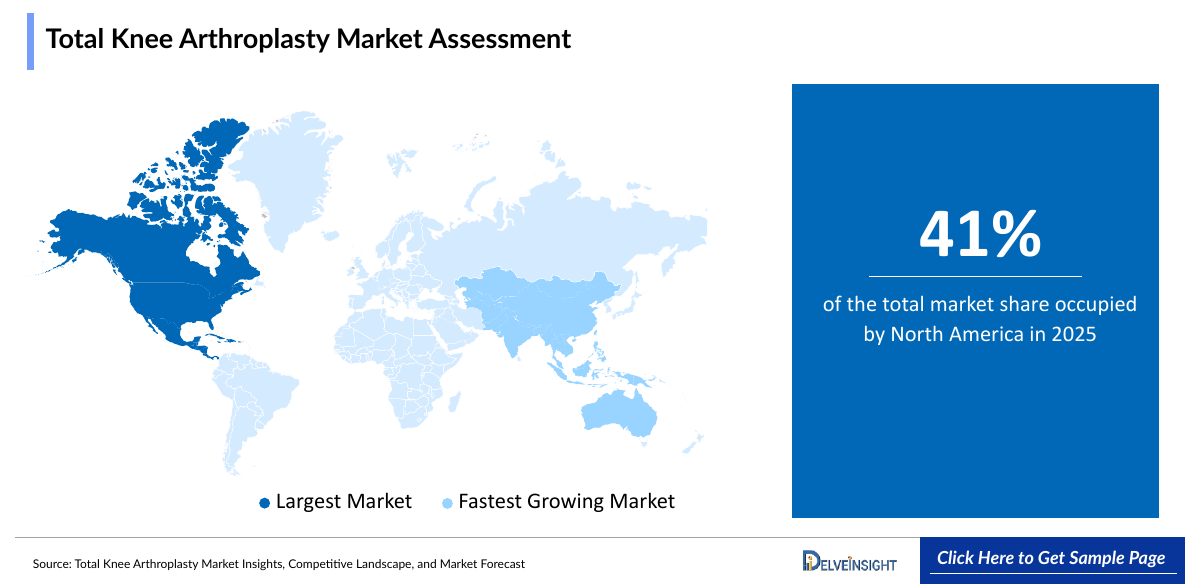
- North America dominated the global Total Knee Arthroplasty market revenue with a 41% share in 2025, representing the highest regional market share globally.
Total knee arthroplasty (TKA), also known as total knee replacement, is a surgical procedure in which the damaged articulating surfaces of the knee joint are removed and replaced with prosthetic implants to relieve pain, correct deformity, and restore mobility in patients whose joint disease has not responded to conservative care. A knee arthroplasty system typically combines a femoral component, a tibial component (tray), a tibial insert (bearing), and, in many cases, a patellar component, secured to bone with bone cement, through biological ingrowth into porous surfaces, or through a hybrid of the two. These implants are manufactured from cobalt-chromium and titanium alloys, highly cross-linked and antioxidant-stabilized polyethylene, ceramic and ceramic-coated metals, and oxidized zirconium, and are increasingly delivered with robotic, navigation, and patient-specific planning technologies. The market is organized by procedure type across total, partial, and revision knee replacement; by implant fixation type across cemented, cementless, and hybrid; by material type; by implant component; by indication, led by osteoarthritis; and by end user across hospitals, ambulatory surgical centers, and orthopedic specialty clinics. Driven by population aging, the high prevalence of osteoarthritis and obesity, the rapid adoption of robotics and cementless fixation, and favorable reimbursement for outpatient joint replacement, total knee arthroplasty has become one of the highest-volume and most commercially significant procedures in orthopedics.
Total Knee Arthroplasty Market Key Growth Drivers
- The rising prevalence of osteoarthritis in an aging global population is expanding the pool of patients eligible for knee replacement, with the United States alone performing more than 790,000 total knee replacements each year according to the American Academy of Orthopaedic Surgeons.
- Rapid adoption of robotic-assisted and digitally enabled surgery is reshaping the market, with Stryker's Mako platform used in over 2 million procedures across 46 countries and new handheld and enhanced systems launching in 2025 and 2026.
- The migration of knee replacement into ambulatory surgical centers, supported by Medicare reimbursement and the removal of total knee arthroplasty from the inpatient-only list, is lowering cost and expanding procedure capacity.
- Advances in implant design and materials, including 3D-printed porous cementless components, highly cross-linked polyethylene, and ceramic-coated and oxidized zirconium surfaces, are improving longevity and widening the eligible patient population.
- A growing revision burden and the demand from younger, more active, and more obese patients are increasing demand for durable primary implants and complex revision and hinge systems.
- Supportive regulatory momentum, including recent FDA clearances for next-generation knee systems and robotic platforms, is accelerating product turnover and technology refresh cycles.
- The convergence of demographic demand, robotics-led technology cycles, outpatient migration, and active strategic investment is expected to sustain steady mid-single-digit growth in the market through 2034.
Key Companies in Total Knee Arthroplasty Market
The competitive landscape is led by the following active orthopedic implant manufacturers and technology providers:
- Zimmer Biomet
- Stryker Corporation
- DePuy Synthes (Johnson & Johnson)
- Smith+Nephew
- Enovis Corporation
- Medacta International
- B. Braun (Aesculap)
- MicroPort Orthopedics
- Exactech
- Corin Group
For illustrative purposes, only the top 10 companies are listed in the Table of Contents. The report may include analysis and references to additional companies relevant to the market assessment.
Total Knee Arthroplasty Market Size
The following snapshot summarizes the principal report metrics for the Total Knee Arthroplasty market.
|
Report Metrics |
Details |
|
2025 Market Size |
USD 10.90 billion |
|
2034 Projected Market Size |
USD 17.65 billion |
|
Growth Rate (2026-2034) |
5.5% CAGR |
|
Largest Market |
North America |
|
Fastest Growing Market |
Asia-Pacific |
|
Market Structure |
Moderately Concentrated |
All market values are expressed in USD and represent DelveInsight estimates synthesized from primary and secondary research.
Factors Contributing to the Growth of the Total Knee Arthroplasty Market
Market Drivers
Rising Prevalence of Osteoarthritis and Population Aging
The most powerful driver of the Total Knee Arthroplasty market is the rising prevalence of knee osteoarthritis in an aging, increasingly overweight global population. A Global Burden of Disease analysis published in The Lancet Rheumatology estimated that approximately 595 million people were living with osteoarthritis worldwide in 2020 and projected the figure to approach 1 billion by 2050, with the knee the most commonly affected large joint. In the United States, the American Academy of Orthopaedic Surgeons reports that more than 790,000 total knee replacements are performed annually. As conservative options such as physical therapy, weight management, injections, and analgesics lose effectiveness in advanced disease, knee replacement remains the definitive and highly cost-effective treatment. Longer life expectancy, higher obesity rates, and patient expectations of an active lifestyle are pushing the treated population younger and larger, directly expanding procedure volumes and implant demand through 2034.
Expansion of Robotic-Assisted and Digitally Enabled Surgery
Robotics and enabling technologies have become a central competitive and growth lever in knee arthroplasty. Stryker's Mako platform has been used in more than 2 million procedures across 46 countries, and in 2026 the company moved from a limited release in February to a full U.S. commercial launch in July of Mako RPS, a handheld robotic system for total knee that pairs with the Triathlon implant. Zimmer Biomet received FDA 510(k) clearance in November 2025 for ROSA Knee with OptiMiZe, with commercial availability in the United States expected in the first quarter of 2026, while Smith+Nephew's CORI handheld robotics platform underpins its newly cleared LANDMARK Total Knee System. Robotic and navigation systems tie surgeons to a manufacturer's implant ecosystem, support personalized and kinematic alignment, and generate recurring implant and disposable revenue, reinforcing growth in premium implant demand.
Shift of Knee Replacement to Ambulatory Surgical Centers
The movement of joint replacement from inpatient hospital settings to ambulatory surgical centers is a structural growth engine. The Centers for Medicare & Medicaid Services removed total knee arthroplasty from its inpatient-only list in 2018 and added the procedure to the ASC covered procedures list in 2020, and the agency has continued to phase out the inpatient-only list. Improved anesthesia and pain-management protocols, enhanced recovery pathways, and patient-reported preference for same-day discharge are accelerating the transition, while payers favor the lower cost of outpatient episodes. Manufacturers are responding with compact, portable robotic and navigation systems, such as handheld robotics designed for both hospital and ASC use, and with streamlined instrument sets suited to high-throughput outpatient settings, expanding capacity and the addressable procedure base.
Advances in Implant Materials, Fixation, and 3D-Printed Designs
Continuous innovation in implant materials and fixation is improving durability and broadening patient eligibility. Highly cross-linked and antioxidant-stabilized polyethylene reduces wear, while oxidized zirconium and ceramic-coated alloys address patients with metal sensitivity and offer improved wear characteristics. Cementless fixation, enabled by 3D-printed porous titanium and advanced surface coatings, is gaining share because it can shorten operative time and support biological fixation in younger, active patients. Zimmer Biomet obtained FDA premarket approval in November 2024 for the Oxford Cementless Partial Knee, the only cementless partial knee approved in the United States, with a U.S. launch in the first quarter of 2025, and Smith+Nephew's LANDMARK system features a fully 3D-printed femoral component. These advances enable premium pricing and stimulate replacement of earlier-generation designs.
Supportive Reimbursement and Regulatory Momentum
A steady cadence of regulatory clearances and a broadly supportive reimbursement environment are reinforcing technology refresh cycles. In the United States, most knee systems and robotic platforms are cleared through the FDA 510(k) pathway, enabling frequent iteration, and recent clearances include Zimmer Biomet's ROSA Knee with OptiMiZe in November 2025 and Smith+Nephew's LANDMARK Total Knee System in September 2026. Medicare and commercial payers continue to cover knee replacement for qualifying patients across inpatient, outpatient, and ASC settings, and national joint registries in the United Kingdom, Sweden, Germany, Australia, and the United States provide long-term performance data that guide adoption and reward proven designs. Each new clearance, indication, and coverage expansion creates durable demand for next-generation systems across the forecast period.
Rising Revision Burden and Younger, More Active Patients
The growing installed base of knee implants and the profile of today's patients are expanding demand across both primary and revision procedures. As patients receive implants at younger ages and live longer, a larger share will outlive their first implant, supporting demand for revision systems, including Stryker's Triathlon Hinge revision knee system, which has been progressively released since its approval in August 2023. Younger and heavier patients also place higher functional demands on primary implants, encouraging adoption of cementless fixation, advanced bearings, and personalized alignment strategies. Partial knee replacement is gaining attention as a bone-preserving option for patients with isolated compartment disease. Together, these dynamics sustain demand for a broad product range and reward manufacturers with comprehensive primary, partial, and revision portfolios.
Strong Investment and Consolidation in Orthopedic Technology
Active investment and strategic consolidation are reshaping the competitive landscape and accelerating technology development. Zimmer Biomet completed its acquisition of robotics company Monogram Technologies in October 2025 for approximately USD 177 million, adding semi-autonomous and fully autonomous robotic total knee technology, and has partnered with THINK Surgical, which makes a wireless handheld robotic knee device. Enovis completed its acquisition of LimaCorporate in January 2024 to broaden its reconstructive portfolio, and Johnson & Johnson announced in October 2025 its intention to separate DePuy Synthes, with the company stating in October 2026 that it remains on track for a mid-2027 separation and is leaning toward a spin. The Big Four of Zimmer Biomet, Stryker, Johnson & Johnson MedTech, and Smith+Nephew control roughly 71% of worldwide joint replacement sales, while challengers such as Enovis and Medacta are closing the gap, sustaining a high pace of innovation and investment.
Market Restraints
Despite steady momentum, the Total Knee Arthroplasty market faces material constraints. The high cost of implants, robotic systems, and enabling technologies places pressure on hospital and ASC budgets, and capital-intensive robotic platforms can be difficult for smaller facilities to justify. Government pricing interventions have compressed implant revenue in important markets, including China's national volume-based procurement program for artificial joints, which sharply reduced knee implant prices, and India's price caps on knee implants introduced in 2017. Surgical risks, including infection, aseptic loosening, stiffness, and implant wear, along with the need for revision surgery, create clinical and economic burdens, and historical recalls, such as polyethylene insert recalls affecting certain knee systems, have shown how quality events can damage manufacturer reputations and market share. Stringent and evolving regulatory requirements, including the European Union Medical Device Regulation, raise compliance costs and lengthen timelines, while long surgical learning curves for robotic and kinematic alignment techniques and a shortage of orthopedic surgeons and operating-room capacity in many regions limit throughput. Reimbursement pressure from payers, bundled payment models, and lengthy waiting lists in publicly funded systems constrain procedure volumes, and trade tariffs and supply chain disruptions add cost and uncertainty. Together, these pricing, clinical, regulatory, workforce, and supply barriers temper the pace of growth, even as the underlying drivers of demographic demand, robotics-led innovation, and outpatient migration remain firmly intact.
Total Knee Arthroplasty Market Segment Analysis
The Total Knee Arthroplasty Market is segmented by procedure type (total knee replacement, partial knee replacement, revision knee replacement), implant fixation type (cemented, cementless, hybrid), material type (metal alloys, polyethylene, ceramic, oxidized zirconium, ceramic-coated metals), implant component (femoral components, tibial components, patellar components, tibial inserts), indication (osteoarthritis, rheumatoid arthritis, post-traumatic arthritis, other degenerative joint diseases), end user (hospitals, ambulatory surgical centers, orthopedic specialty clinics), and geography (North America, Europe, Asia-Pacific, Rest of World).
By Procedure Type
Dominant Subsegment: Total Knee Replacement.
The total knee replacement segment accounted for 82% of the Total Knee Arthroplasty market in 2025. Total knee replacement is the leading procedure type because it is the definitive treatment for advanced tricompartmental knee disease, which is the most common presentation of osteoarthritis, and because it carries the largest implant content and the highest average selling price of any knee procedure. The procedure benefits from decades of clinical evidence, well-established surgical technique, and strong registry-backed survivorship, and it is the primary use case for robotic platforms such as Mako, ROSA, VELYS, and CORI. High procedure volumes in the United States, Europe, and a growing share of Asia-Pacific sustain recurring demand. Partial knee replacement is growing as a bone-preserving option for isolated compartment disease, supported by innovations such as cementless partial implants, while revision knee replacement is the fastest-growing procedure type as the installed base of implants ages. Nonetheless, the scale of primary total knee procedures secures the segment's leadership across the forecast period.
By Implant Fixation Type
Dominant Subsegment: Cemented.
The cemented segment accounted for 69% of the Total Knee Arthroplasty market in 2025. Cemented fixation is the leading approach because it is the long-established gold standard, supported by extensive registry data showing reliable long-term survivorship, and because it performs predictably across a wide range of bone quality, including the osteoporotic bone commonly seen in older patients. Surgeons are familiar with cemented technique, and most widely used knee systems were developed and validated with cement. Cementless fixation is the fastest-growing category, driven by 3D-printed porous titanium surfaces, advanced coatings, shorter operative time, and growing use in younger, active patients and in ASC workflows, with manufacturers expanding cementless offerings across total and partial knee systems. Hybrid fixation, typically a cementless femur with a cemented tibia, offers a middle path. While cementless adoption is accelerating, the entrenched evidence base, surgeon familiarity, and reliability of cemented fixation secure its leadership across the forecast period.
By Material Type
Dominant Subsegment: Metal Alloys.
The metal alloys segment accounted for 54% of the Total Knee Arthroplasty market in 2025. Metal alloys are the leading material type because cobalt-chromium alloys remain the standard for femoral components, and titanium alloys are widely used for tibial trays, stems, and porous cementless surfaces, giving metals the largest share of implant material content and value. These alloys combine high strength, fatigue resistance, and a long clinical track record, and advances in additive manufacturing are enabling porous, patient-matched titanium structures that support biological fixation. Polyethylene is essential in virtually every knee bearing, with highly cross-linked and antioxidant-stabilized formulations improving wear performance, while ceramic, oxidized zirconium, and ceramic-coated metal surfaces serve patients with metal sensitivity and offer favorable wear characteristics, representing the fastest-growing niche. Despite the premium appeal of advanced bearing surfaces, the structural role, proven performance, and breadth of use of metal alloys secure their leadership across the forecast period.
By Implant Component
Dominant Subsegment: Femoral Components.
The femoral components segment accounted for 36% of the Total Knee Arthroplasty market in 2025. Femoral components are the leading implant component because they are the most technically complex and highest-value element of a knee system, requiring precision-engineered articular geometry, advanced alloys, and, increasingly, ceramic coatings or 3D-printed construction. Design innovation is concentrated at the femur, where anatomically driven geometries, kinematic-alignment-optimized shapes, and patient-specific options differentiate premium systems, as seen in recently launched knee platforms with fully 3D-printed femoral components. Tibial components, including trays and stems, form the second major revenue pool, while tibial inserts are a high-volume, recurring component whose advanced polyethylene formulations drive upgrades and revision demand. Patellar components are the smallest category. The design complexity, pricing power, and innovation intensity of the femoral component secure its leadership across the forecast period.
By Indication
Dominant Subsegment: Osteoarthritis.
The osteoarthritis segment accounted for 87% of the Total Knee Arthroplasty market in 2025. Osteoarthritis is overwhelmingly the leading indication because degenerative cartilage loss is by far the most common reason for knee replacement, driven by population aging, obesity, prior joint injury, and sedentary lifestyles. Global Burden of Disease analyses estimate that approximately 595 million people lived with osteoarthritis in 2020, with projections approaching 1 billion by 2050, and knee involvement accounts for a substantial share of that burden. As conservative therapies lose effectiveness in advanced disease, total knee arthroplasty is the standard of care. Rheumatoid arthritis has declined as an indication thanks to disease-modifying biologic therapies, though it continues to generate demand in patients with advanced joint destruction, while post-traumatic arthritis and other degenerative joint diseases form smaller, steady pools. The sheer prevalence and progressive nature of osteoarthritis secure its leadership across the forecast period.
By End User
Dominant Subsegment: Hospitals.
The hospitals segment accounted for 71% of the Total Knee Arthroplasty market in 2025. Hospitals are the leading end user because they perform the largest share of knee replacement procedures, including complex primary cases, revisions, and patients with significant comorbidities who require inpatient care and multidisciplinary support. Hospitals also hold the majority of installed robotic and navigation platforms and are the main purchasers of full implant portfolios under group purchasing and value-analysis arrangements. Ambulatory surgical centers are the fastest-growing end user, supported by Medicare coverage, lower episode costs, same-day discharge protocols, and the introduction of compact, portable robotic systems suited to outpatient settings. Orthopedic specialty clinics and physician-owned facilities provide a growing, surgeon-driven channel focused on efficiency and outcomes. While procedure migration to outpatient settings is accelerating, the breadth of cases, capital resources, and installed technology base keep hospitals the dominant end user across the forecast period.
Total Knee Arthroplasty Market Region Analysis
Dominant Region: North America
North America accounted for 41% of the global Total Knee Arthroplasty market revenue in 2025, representing the highest regional market share globally. The region's dominance reflects high procedure volumes, with the United States performing more than 790,000 total knee replacements each year, a high prevalence of osteoarthritis and obesity, strong reimbursement, and early, widespread adoption of robotic-assisted surgery and premium implants. North America is home to the headquarters and principal operations of leading manufacturers, including Zimmer Biomet in Warsaw, Indiana, and Stryker in Portage, Michigan, and it is the first market for most new product launches, including recent introductions of Mako RPS, ROSA Knee with OptiMiZe, and the LANDMARK Total Knee System. Favorable Medicare coverage across inpatient, outpatient, and ASC settings is accelerating outpatient migration, while a dense network of high-volume orthopedic centers and robust FDA pathways supports rapid technology uptake. Strong reimbursement, regulatory clarity, and technology leadership anchor the region's continued leadership across the forecast period.
Fastest Growing Region: Asia-Pacific
Asia-Pacific is the fastest-growing region in the Total Knee Arthroplasty market. The region's elevated CAGR is driven by rapidly aging populations, rising osteoarthritis and obesity prevalence, expanding access to orthopedic care, and growing healthcare investment across China, Japan, India, South Korea, and Australia. China's national volume-based procurement has lowered implant prices and broadened access, stimulating procedure volumes and favoring scaled domestic and multinational suppliers, while Japan's super-aged society sustains strong demand for joint replacement. India benefits from a large patient base, growing private hospital capacity, and regulated implant pricing that improves affordability, and South Korea and Australia are advanced markets with high adoption of robotics. Rising medical tourism, growing health insurance coverage, and the expansion of domestic manufacturers such as MicroPort Orthopedics are accelerating adoption. The combination of demographic pressure, access expansion, and technology adoption positions Asia-Pacific as the principal source of incremental growth over the forecast period.
Regional Commentary
North America
North America accounted for 41% of the global Total Knee Arthroplasty market revenue in 2025. The United States dominates on the strength of its procedure volumes, favorable reimbursement, early robotics adoption, ASC migration, and the presence of leading manufacturers, while Canada and Mexico contribute steady growth through expanding access and medical tourism.
Europe
Europe is a large and mature regional market, supported by aging populations, universal healthcare systems, and long-established national joint registries such as the National Joint Registry in the United Kingdom and the Swedish and German registries that inform implant selection. The region is home to leading orthopedic companies, including Smith+Nephew in the United Kingdom, Medacta in Switzerland, B. Braun (Aesculap) in Germany, and Corin Group in the United Kingdom, and procedure demand is strong across Germany, France, the United Kingdom, Italy, and Spain, although the European Union Medical Device Regulation and tender-based purchasing add compliance and pricing pressure.
Asia-Pacific
Asia-Pacific is the fastest-growing region, propelled by rapidly aging populations, rising osteoarthritis incidence, expanding access to orthopedic surgery, and growing healthcare investment across China, Japan, India, South Korea, and Australia. China's volume-based procurement, Japan's super-aged demographics, India's regulated implant pricing and private hospital growth, and the rise of regional manufacturers are accelerating adoption and procedure volumes.
Rest of World
The Rest of World region, spanning Latin America, the Middle East, and Africa, is an emerging growth frontier. Expanding private hospital networks, rising incomes and insurance coverage, growing medical tourism, and increasing orthopedic surgical capacity are gradually broadening access to knee replacement, while price sensitivity and uneven reimbursement continue to shape the pace of adoption.
Total Knee Arthroplasty Market Competitive Landscape
The Total Knee Arthroplasty market is classified as Moderately Concentrated. A group of global leaders with broad implant portfolios, robotic ecosystems, and extensive surgeon relationships, including Zimmer Biomet, Stryker Corporation, DePuy Synthes (Johnson & Johnson), and Smith+Nephew, anchors the top tier and together controls roughly 71% of worldwide joint replacement sales, while fast-growing challengers and specialists such as Enovis Corporation, Medacta International, B. Braun (Aesculap), MicroPort Orthopedics, Exactech, and Corin Group compete through differentiated implant designs, kinematic alignment, navigation and robotics, and regional strength, increasing competition in the fastest-growing segments.
The competitive landscape can be evaluated across the following dimensions:
- Market concentration: Moderately concentrated, with four global leaders anchoring the top tier and a growing field of challengers and regional specialists.
- Leading players: Zimmer Biomet, Stryker, DePuy Synthes, and Smith+Nephew anchor the top tier through broad portfolios, installed robotic bases, and surgeon relationships.
- Geographic reach: Leaders operate global sales and distribution networks; Stryker's Mako platform is used in more than 45 countries, and challengers such as Medacta, MicroPort, and Corin extend reach through regional strength.
- Product portfolio strength: Top players offer primary, partial, and revision knee systems across fixation types and bearing options, supported by instrumentation and digital planning tools.
- Robotics and enabling technology: Integrated robotic, navigation, and planning ecosystems, including Mako, ROSA, VELYS, CORI, and ARVIS, are a decisive advantage that ties surgeons to implant platforms.
- Strategic partnerships: Collaborations such as Zimmer Biomet's partnership with THINK Surgical and surgeon-developer co-design programs extend technology reach.
- M&A activity: Active consolidation, including Zimmer Biomet's acquisition of Monogram Technologies, Enovis' acquisition of LimaCorporate, and Johnson & Johnson's planned separation of DePuy Synthes.
- Manufacturing capabilities: Additive manufacturing of porous titanium and 3D-printed components, advanced polyethylene processing, and ceramic and oxidized zirconium surface technologies are key competitive moats.
- Innovation focus: Handheld and autonomous robotics, personalized and kinematic alignment, cementless fixation, ASC-optimized systems, and data-driven outcomes tracking.
Total Knee Arthroplasty Market Recent Developmental Activities
In September 2026, Smith+Nephew received FDA 510(k) clearance for its LANDMARK Total Knee System and completed the first surgical cases, an anatomy-driven system featuring a fully 3D-printed femoral component designed for use with the CORI KNEE handheld robotics platform, with broader commercial availability expected throughout 2027. Strategic significance: Refreshes Smith+Nephew's knee franchise with a differentiated implant and strengthens its hospital and ASC robotics proposition.
In July 2026, Stryker Corporation announced the full U.S. commercial launch of Mako RPS (Robotic Power System) for total knee replacement, introducing Mako Handheld Robotics alongside Mako SmartRobotics with Mako 4 and compatible with the Triathlon Total Knee System. Strategic significance: Extends Mako to a new segment of surgeons and care settings and deepens implant platform loyalty.
In February 2026, Stryker Corporation announced the limited market release of Mako RPS for Total Knee, a handheld robotic system combining Stryker's robotics and power tool legacies. Strategic significance: Opens a lower-capital robotics entry point for hospitals and ambulatory surgical centers.
In October 2025 (updated in October 2026), DePuy Synthes (Johnson & Johnson) announced its intent to separate the DePuy Synthes orthopedics business, with Johnson & Johnson stating in October 2026 that the separation remains on track for mid-2027 and that a spin-off is the leading option. Strategic significance: Would create one of the largest pure-play orthopedics companies and sharpen focus on knee, hip, and robotics investment.
In November 2025, Zimmer Biomet received FDA 510(k) clearance for ROSA Knee with OptiMiZe, an enhanced version of its robotic knee system offering personalized surgical planning, with U.S. commercial availability expected in the first quarter of 2026. Strategic significance: Strengthens Zimmer Biomet's robotic knee offering and supports installation growth.
In October 2025, Zimmer Biomet completed its acquisition of Monogram Technologies, a developer of a CT-based, semi-autonomous, AI-navigated total knee robot, in a deal valued at approximately USD 177 million. Strategic significance: Adds semi- and fully autonomous robotic capabilities and a pathway to differentiated robotics in orthopedics.
In November 2024 and Q1 2025, Zimmer Biomet obtained FDA premarket approval for the Oxford Cementless Partial Knee, the only FDA-approved cementless partial knee implant in the United States, and launched it in the first quarter of 2025. Strategic significance: Advances cementless partial knee adoption and reinforces leadership in bone-preserving procedures.
In 2025, Enovis Corporation grew its Recon segment by 8.2% to approximately USD 1.1 billion in revenue, supported by new product launches, while evaluating pathways in enabling technology, including its ARVIS augmented-reality system. Strategic significance: Demonstrates share gain by a challenger and a technology strategy aligned with ambulatory surgical centers.
In 2025 and 2026, Medacta International continued to expand adoption of its GMK Sphere and kinematic alignment (MyKA) knee platforms and its associated enabling technologies. Strategic significance: Reinforces Medacta's position as a fast-growing challenger in knee replacement.
In 2025 and 2026, B. Braun (Aesculap) continued to advance its knee implant portfolio and navigation solutions to support surgeons across Europe and other regions. Strategic significance: Sustains a differentiated, surgeon-focused offering and regional reach.
In 2025 and 2026, MicroPort Orthopedics continued to broaden global adoption of its knee implant systems and SkyWalker robotic-assisted arthroplasty platform. Strategic significance: Extends a technology-led challenger presence across Asia-Pacific and international markets.
In 2025 and 2026, Exactech and Corin Group continued to support their knee portfolios, including Exactech's Truliant knee system and Corin's OMNIBotics-enabled knee solutions, through surgeon engagement and technology integration. Strategic significance: Maintains competitive presence of specialist and mid-size players in the premium and robotic-enabled segments.
Total Knee Arthroplasty Market Segmentation
Total Knee Arthroplasty Market by Procedure Type
- Total Knee Replacement
- Partial Knee Replacement
- Revision Knee Replacement
Total Knee Arthroplasty Market by Implant Fixation Type
- Cemented
- Cementless
- Hybrid
Total Knee Arthroplasty Market by Material Type
- Metal Alloys
- Polyethylene
- Ceramic
- Oxidized Zirconium
- Ceramic-Coated Metals
Total Knee Arthroplasty Market by Implant Component
- Femoral Components
- Tibial Components
- Patellar Components
- Tibial Inserts
Total Knee Arthroplasty Market by Indication
- Osteoarthritis
- Rheumatoid Arthritis
- Post-Traumatic Arthritis
- Other Degenerative Joint Diseases
Total Knee Arthroplasty Market by End User
- Hospitals
- Ambulatory Surgical Centers
- Orthopedic Specialty Clinics
Total Knee Arthroplasty Market by Geography
- North America Total Knee Arthroplasty Market
- United States Total Knee Arthroplasty Market Size in USD million (2023-2034)
- Canada Total Knee Arthroplasty Market Size in USD million (2023-2034)
- Mexico Total Knee Arthroplasty Market Size in USD million (2023-2034)
- Europe Total Knee Arthroplasty Market
- Germany Total Knee Arthroplasty Market Size in USD million (2023-2034)
- United Kingdom Total Knee Arthroplasty Market Size in USD million (2023-2034)
- France Total Knee Arthroplasty Market Size in USD million (2023-2034)
- Italy Total Knee Arthroplasty Market Size in USD million (2023-2034)
- Spain Total Knee Arthroplasty Market Size in USD million (2023-2034)
- Rest of Europe Total Knee Arthroplasty Market Size in USD million (2023-2034)
- Asia-Pacific Total Knee Arthroplasty Market
- China Total Knee Arthroplasty Market Size in USD million (2023-2034)
- Japan Total Knee Arthroplasty Market Size in USD million (2023-2034)
- India Total Knee Arthroplasty Market Size in USD million (2023-2034)
- Australia Total Knee Arthroplasty Market Size in USD million (2023-2034)
- South Korea Total Knee Arthroplasty Market Size in USD million (2023-2034)
- Rest of Asia-Pacific Total Knee Arthroplasty Market Size in USD million (2023-2034)
- Rest of the World (RoW) Total Knee Arthroplasty Market
- Middle East Total Knee Arthroplasty Market Size in USD million (2023-2034)
- Africa Total Knee Arthroplasty Market Size in USD million (2023-2034)
- South America Total Knee Arthroplasty Market Size in USD million (2023-2034)
Total Knee Arthroplasty Market Recent Industry Trends and Milestones (2023-2026)
|
Category |
Key Developments |
|
Total Knee Arthroplasty Market Product Approval |
Regulatory momentum is refreshing knee portfolios. Smith+Nephew received FDA 510(k) clearance for its LANDMARK Total Knee System with a fully 3D-printed femoral component in September 2026, Zimmer Biomet received clearance for ROSA Knee with OptiMiZe in November 2025 after earlier approving the Oxford Cementless Partial Knee in November 2024, and Stryker progressed Mako RPS from limited release in February 2026 to full U.S. launch in July 2026. Stryker also continued the rollout of its Triathlon Hinge revision knee system. Each approval and clearance drives technology refresh cycles, supports premium pricing, and increases demand for compatible instrumentation and robotics. |
|
Total Knee Arthroplasty Market Technology Expansion |
Manufacturers broadened enabling technology and care-setting reach. Handheld robotics, including Stryker's Mako RPS and Smith+Nephew's CORI KNEE, were designed for both hospital and ambulatory surgical center use, while Zimmer Biomet expanded its ROSA platform and Enovis advanced its ARVIS augmented-reality system. Stryker's Mako platform surpassed 2 million procedures across 46 countries. Cementless fixation, 3D-printed porous components, kinematic alignment, and personalized surgical planning expanded across portfolios, and compact systems and streamlined instrumentation supported the shift of knee replacement to outpatient settings. |
|
Total Knee Arthroplasty Market Investment |
Capital and consolidation continued. Zimmer Biomet agreed to acquire Monogram Technologies in July 2025 and completed the deal in October 2025 for approximately USD 177 million; Enovis completed its acquisition of LimaCorporate in January 2024, and Johnson & Johnson announced in October 2025 its plan to separate DePuy Synthes, now targeted for mid-2027 with a spin-off as the leading option. Enovis' Recon segment reached approximately USD 1.1 billion in 2025, and the Big Four of Zimmer Biomet, Stryker, Johnson & Johnson MedTech, and Smith+Nephew continued to control roughly 71% of worldwide joint replacement sales while challengers such as Enovis and Medacta narrowed the gap. |
|
Company Strategy |
Zimmer Biomet: Robotics breadth through ROSA, Monogram, and THINK Surgical partnership, with cementless partial knee leadership. Stryker Corporation: Robotics leadership through Mako and Mako RPS paired with the Triathlon system. DePuy Synthes (Johnson & Johnson): Orthopedics separation and continued robotics and knee investment. Smith+Nephew: Implant renewal through LANDMARK and CORI handheld robotics. Enovis Corporation: Share gain through new launches, ARVIS, and the LimaCorporate acquisition. Medacta International, B. Braun (Aesculap), MicroPort Orthopedics, Exactech, and Corin Group: Differentiated implant designs, kinematic alignment, navigation and robotics, and regional strength. |
|
Emerging Technologies |
Robotics is the leading edge of innovation, with handheld, semi-autonomous, and fully autonomous systems entering the market alongside established robotic-arm platforms, supported by CT-based planning and AI-driven navigation. Cementless fixation, 3D-printed porous titanium, patient-specific and anatomy-driven implants, and advanced bearing materials, including highly cross-linked and antioxidant-stabilized polyethylene, oxidized zirconium, and ceramic coatings, are extending implant longevity. Augmented-reality navigation, wearable and sensor-based outcomes tracking, remote monitoring, and AI-enabled preoperative planning are emerging, while collaborations between manufacturers, surgeons, and academic centers are accelerating clinical validation and adoption of next-generation knee systems. |
Total Knee Arthroplasty Market Startup Funding and Investment Trends
Investment in the Total Knee Arthroplasty ecosystem has concentrated on robotics, autonomous surgery, and next-generation implant technologies. The following companies illustrate recent funding and investment activity and technology focus.
|
Company |
Total Funding |
Funding Stage |
Main Offering |
Core Technology |
|
Monogram Technologies |
~USD 177 million acquisition value |
Acquired by Zimmer Biomet (2025) |
Semi- and fully autonomous robotic total knee |
CT-based, AI-navigated robotics |
|
THINK Surgical, Inc. |
Venture-backed |
Growth venture |
Open-platform orthopedic robotics for knee replacement |
Wireless handheld robotics |
|
Request for unlocking the report of the @ Total Knee Arthroplasty Market | ||||
Capital is flowing toward providers that combine implant breadth with enabling technology. Zimmer Biomet's USD 177 million acquisition of Monogram Technologies underscores the strategic value of autonomous robotic capabilities, while its partnership with THINK Surgical gives it access to an open-platform handheld knee robot. Enovis' acquisition of LimaCorporate and Johnson & Johnson's planned separation of DePuy Synthes show strategic portfolio reshaping at scale, and challengers such as Medacta, MicroPort Orthopedics, and Enovis continue to invest in kinematic alignment, robotics, and ASC-ready systems. Collectively, these investments signal conviction that robotics, cementless and 3D-printed implants, and outpatient-ready systems will define the next phase of competitive advantage in the global Total Knee Arthroplasty market.
Key Takeaways from the Total Knee Arthroplasty Market Report Study
- Market size analysis for the current total knee arthroplasty market size (2025), and market forecast for 9 years (2026 to 2034).
- Top key product/technology developments, mergers, acquisitions, partnerships, and joint ventures that happened over the last 3 years.
- Key companies dominating the global total knee arthroplasty market.
- Various opportunities available for competitors in the total knee arthroplasty market space.
- What are the top-performing segments in 2025? How will these segments perform in 2034?
- Which are the top-performing regions and countries in the current total knee arthroplasty market scenario?
- Which are the regions and countries where companies should concentrate their opportunities for total knee arthroplasty market growth in the future?
Target audience who can benefit from this total knee arthroplasty market report study
- Total knee arthroplasty implant manufacturers and product providers
- Research organizations and consulting companies
- Total knee arthroplasty-related organizations, associations, forums, and other alliances
- Government and corporate offices
- Start-up companies, venture capitalists, and private equity firms
- Distributors and traders dealing in knee implants and orthopedic robotics
- Various end-users, including hospitals, ambulatory surgical centers, and orthopedic specialty clinics, who want to know more about the total knee arthroplasty market and the latest technological developments in the total knee arthroplasty market.