Vascular Closure Devices Market Summary
- The global vascular closure devices market was valued at USD 1.64 billion in 2025 and is projected to reach USD 2.70 billion by 2034.
- The market is expected to expand at a CAGR of 5.70% during the forecast period 2026-2034, supported by the rising prevalence of cardiovascular disease, the growing adoption of minimally invasive catheter-based procedures, the expansion of large-bore structural heart interventions, and continuous technological advancement in closure devices.
- By closure mechanism, the suture-mediated segment dominated the vascular closure devices market with a 38% share in 2025.
- By access site, the femoral segment dominated the vascular closure devices market with an 85% share in 2025.
- By sheath size, the small-bore segment dominated the vascular closure devices market with a 72% share in 2025.
- By end-user, the hospitals and clinics segment dominated the vascular closure devices market with a 68% share in 2025.
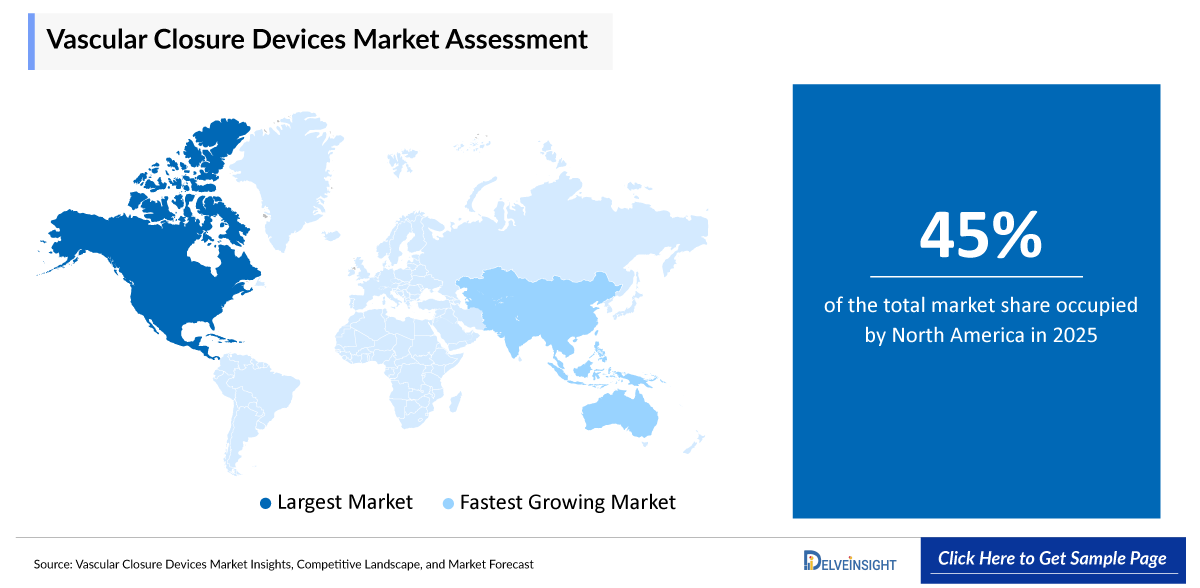
- North America accounted for the largest share of the vascular closure devices market at 45% in 2025, while Asia-Pacific is anticipated to register the fastest growth through 2034.
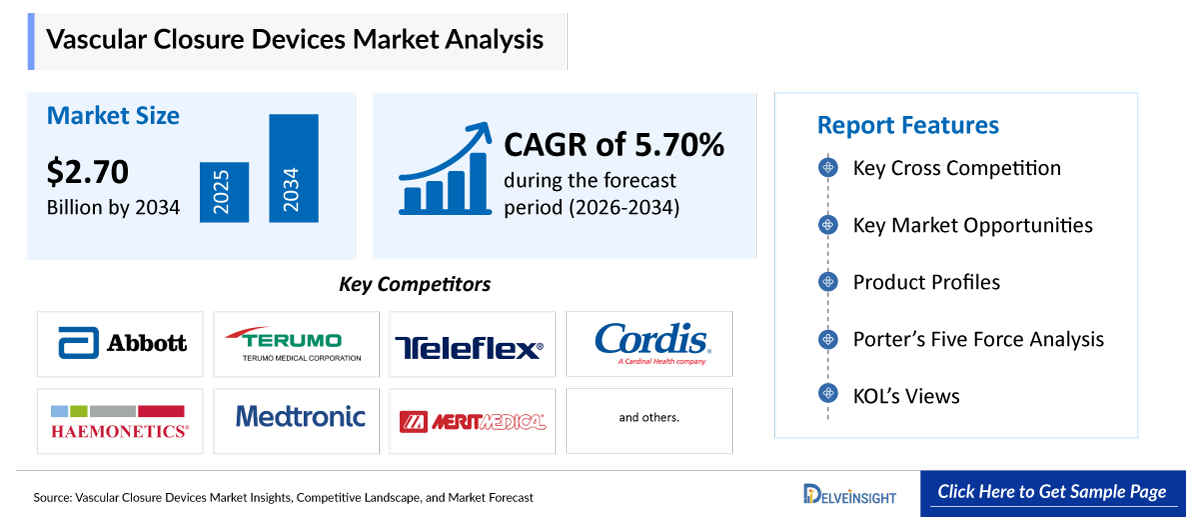
A vascular closure device is a medical device used to seal the puncture in an artery or vein created during a catheter-based procedure such as cardiac catheterization, coronary angioplasty, or a structural heart intervention. During these procedures, a catheter is inserted through a small percutaneous puncture, most commonly in the femoral artery of the groin or the radial artery of the wrist, and at the end of the procedure the access site must be closed to achieve hemostasis, replacing or supplementing manual compression. The market is best understood by the way manufacturers organize their portfolios, which is by the mechanism of closure and by the size of the arterial puncture. By mechanism, suture-mediated devices deploy a surgical suture to actively approximate the vessel wall, collagen-plug devices seal the puncture with a bioabsorbable collagen anchor and plug, sealant devices deploy an extravascular polyethylene glycol or gel sealant, clip-based devices close the arteriotomy with a small metal clip, and dedicated large-bore devices use bioresorbable patches, plugs, or membranes designed for the largest punctures. By sheath size, the market divides between small-bore closure for the 5 to 10 French access of diagnostic and coronary procedures and large-bore closure for the 12 to 25 French access of transcatheter aortic valve replacement, endovascular aneurysm repair, and other structural heart interventions, which is the fastest-growing and most strategically important segment. The contemporary market is defined by the expansion of large-bore structural heart procedures, the shift toward fully bioresorbable closure, and the growing use of closure to enable same-day discharge.
Vascular Closure Devices Market Key Growth Drivers
- Rising prevalence of cardiovascular disease, with DelveInsight estimating that the seven major markets accounted for some 26 million cases of atherosclerotic cardiovascular disease in 2023, projected to rise further by 2034.
- A large and growing diabetic population, with DelveInsight estimating that some 590 million adults aged 20 to 79 were living with diabetes worldwide in 2024, projected to reach 854 million by 2050, which sharply elevates cardiovascular risk.
- Growing adoption of minimally invasive catheter-based procedures such as angiography, angioplasty, and stenting that require arterial access and closure.
- The rapid expansion of large-bore structural heart procedures, including transcatheter aortic valve replacement and endovascular aneurysm repair, which require dedicated large-bore closure.
- The shift toward outpatient and same-day-discharge procedures, which vascular closure devices facilitate by shortening time to hemostasis and enabling earlier ambulation.
- Continuous technological advancement, including bioabsorbable materials, large-bore closure systems, and next-generation suture-based and sealant devices.
- Rising product development and regulatory approval activity among the leading manufacturers, broadening the range of closure solutions.
Key Companies in Vascular Closure Devices Market
The competitive field is led by a small group of large medical technology companies operating established closure franchises, challenged by specialists in large-bore and fully bioresorbable closure and by regional manufacturers. The leading participants in the vascular closure devices market include the following:
- Abbott Laboratories
- Terumo Corporation
- Teleflex Incorporated
- Cardinal Health (Cordis)
- Haemonetics Corporation
- Medtronic plc
- Merit Medical Systems Inc.
- Becton, Dickinson and Company (BD)
- Vivasure Medical Ltd.
- Vasorum Ltd.
For illustrative purposes, only the top 10 companies are listed in the Table of Contents. The report may include analysis and references to additional companies relevant to the market assessment.
Vascular Closure Devices Market Size
The following table summarizes the headline market metrics for the global vascular closure devices market across the base year and the forecast horizon.
|
Report Metrics |
Details |
|
2025 Market Size |
USD 1.64 billion |
|
2034 Projected Market Size |
USD 2.70 billion |
|
Growth Rate (2026-2034) |
5.70% CAGR |
|
Largest Market |
North America (45% share in 2025) |
|
Fastest Growing Market |
Asia-Pacific |
|
Market Structure |
Moderately Consolidated |
All market values are expressed in USD and represent DelveInsight estimates synthesized from primary and secondary research.
Factors Contributing to the Growth of the Vascular Closure Devices Market
Market Drivers
Rising Prevalence of Cardiovascular Disease
The foundational driver of the vascular closure devices market is the rising global prevalence of cardiovascular disease and its associated risk factors, which generates the volume of catheter-based procedures on which the entire category depends. An aging global population and lifestyle-related risk factors including hypertension, obesity, and diabetes are increasing the number of patients with cardiovascular disease, and DelveInsight estimates that the seven major markets accounted for some 26 million cases of atherosclerotic cardiovascular disease in 2023, a figure projected to rise further by 2034. Because coronary artery disease, structural heart disease, and peripheral vascular disease are managed increasingly through percutaneous catheter-based diagnosis and intervention, each requiring arterial or venous access that must subsequently be closed, the growing cardiovascular disease burden translates directly into demand for closure devices. Every diagnostic angiogram, coronary angioplasty, electrophysiology ablation, and structural heart procedure creates an access site that must achieve hemostasis, and closure devices reduce the bleeding and vascular complications, shorten the time to hemostasis, and accelerate ambulation and discharge that manual compression cannot match. As the cardiovascular disease burden rises and as a larger share of patients is managed interventionally rather than surgically, the base of procedures generating closure demand expands steadily and predictably, making the cardiovascular disease burden the most durable driver of the market.
Growing Diabetic Population and Cardiovascular Risk
The large and rapidly growing global diabetic population is a powerful driver of the vascular closure devices market, because diabetes sharply elevates cardiovascular risk and the need for the catheter-based procedures that closure devices support. DelveInsight estimates that some 590 million adults aged 20 to 79 were living with diabetes worldwide in 2024, a figure expected to reach 854 million by 2050, and in the United States some 38.6 million people were living with diabetes in 2024, projected to rise to 43.5 million by 2050. Diabetic patients face a substantially higher risk of coronary artery disease, peripheral arterial disease, and other vascular complications, and they consequently undergo angiography, angioplasty, and other catheter-based diagnostic and interventional procedures at higher rates than the general population, each of which requires arterial access and closure. The elevated bleeding and vascular complication risk in this population further increases the clinical value of reliable closure, since diabetic and anticoagulated patients benefit particularly from the rapid and secure hemostasis that closure devices provide. Because the diabetes epidemic is a durable and worsening global trend that is especially pronounced in the same emerging markets where interventional cardiology capacity is expanding, the growing diabetic population adds a large, structural, and accelerating source of demand to the market and reinforces the cardiovascular disease burden that underpins it.
Growing Adoption of Minimally Invasive Procedures
The growing global adoption of minimally invasive catheter-based procedures is a central driver of the vascular closure devices market, directly expanding the base of access sites that require closure. Minimally invasive interventions such as angioplasty, stenting, and structural heart procedures are increasingly favored over traditional open surgery because they offer smaller incisions, less pain, lower complication rates, and faster recovery, and they rely on percutaneous arterial or venous access that must be sealed efficiently at the end of the procedure. Vascular closure devices are essential to these procedures because they provide a quick and reliable way to seal the access site, significantly reducing the time to hemostasis compared with manual compression and allowing earlier patient mobilization and discharge, which improves patient comfort and the workflow efficiency of hospitals and ambulatory surgical centers. This shift is self-reinforcing, because the efficiency and safety that closure devices provide are themselves enablers of the migration of procedures toward outpatient and same-day-discharge models, and the growing volume and complexity of interventional cardiology, electrophysiology, and peripheral and structural heart procedures continually enlarges the addressable base. As health systems prioritize cost-effective, high-throughput, minimally invasive care, and as closure devices become a standard component of that model, the adoption of minimally invasive procedures functions as a broad and durable driver across the entire closure portfolio.
Expansion of Large-Bore Structural Heart Procedures
The rapid expansion of large-bore structural heart and endovascular procedures is among the most consequential drivers of the vascular closure devices market, because these procedures require dedicated large-bore closure and command premium pricing. Transcatheter aortic valve replacement, endovascular aneurysm repair, transcatheter mitral and tricuspid interventions, and mechanical circulatory support all require arterial or venous access far larger than that of coronary procedures, typically in the range of 12 to 25 French, and closing these large punctures safely is a distinct and demanding clinical challenge that manual compression and small-bore devices cannot reliably meet. This need has driven the development of dedicated large-bore closure systems, including plug-based, patch-based, and membrane-based devices and the technique of deploying multiple suture-mediated devices, and the segment is growing far faster than the overall market as the indications for transcatheter valve therapy expand to lower-risk and younger patients and as procedure volumes climb worldwide. Because large-bore closure devices are higher in value and because their reliable performance is essential to the safety and the same-day or next-day discharge economics of structural heart programs, the expansion of these procedures raises both the volume and the average value of the closure market. The competitive intensity concentrated upon large-bore closure, evidenced by dedicated product launches, expanded indications, and acquisitions, underscores its strategic importance as the principal engine of market growth over the forecast period.
Shift Toward Outpatient and Same-Day-Discharge Care
The structural shift of interventional procedures toward outpatient and same-day-discharge settings is an important driver of the vascular closure devices market, because closure devices are a key enabler of the rapid hemostasis and early ambulation that make same-day discharge possible. Manual compression of an arterial puncture requires prolonged bed rest and monitoring before a patient can safely ambulate and be discharged, which constrains throughput and lengthens stays, whereas closure devices achieve hemostasis within minutes and allow patients to sit up and ambulate far sooner, directly supporting the migration of diagnostic and interventional procedures into ambulatory surgical centers and office-based labs. This shift is driven by the cost-effectiveness, convenience, and lower infection risk of the outpatient setting and by reimbursement policies that increasingly favor it, and it aligns closely with the value proposition of closure devices, which reduce complications and improve workflow efficiency. As a growing share of coronary, electrophysiology, and peripheral procedures moves to same-day-discharge pathways, and as ambulatory centers expand their interventional capacity, the demand for the closure devices that enable these pathways grows correspondingly. Because this shift simultaneously increases closure device utilization and reinforces the clinical and economic rationale for choosing a device over manual compression, it is a durable and self-reinforcing contributor to market growth across both the small-bore and large-bore segments.
Technological Advancement and Bioabsorbable Materials
Continuous technological advancement and the shift toward bioabsorbable materials in particular are a central driver of the vascular closure devices market, improving safety, expanding the range of treatable access sites, and creating a cycle of product upgrades. Innovation in large-bore closure is supporting the complex structural heart and endovascular procedures that require devices to seal the largest punctures safely, and the use of bioabsorbable and fully bioresorbable materials reduces the long-term complications and imaging artifacts associated with permanent implants while improving patient safety, exemplified by fully absorbable sutureless systems designed for the large-bore access of transcatheter valve procedures and by sealant technologies engineered to resorb far faster than conventional collagen. Enhanced efficiency and simplified, more automated deployment in new devices help shorten procedure times, reduce operator variability, and facilitate faster recovery, broadening the population of operators able to achieve reliable closure. The pace of development is rapid across suture-mediated, collagen, sealant, clip, and dedicated large-bore mechanisms, and each advance either improves outcomes in an existing segment or opens a new procedural capability. Because the market rewards devices that reduce complications, shorten time to hemostasis, and enable same-day discharge, and because bioabsorbable and large-bore innovation directly serve those goals, technological advancement is among the most direct determinants of competitive position and market growth. Source: U.S. Food and Drug Administration; manufacturer disclosures.
Rising Product Development and Regulatory Approval
A sustained cadence of product development and regulatory approval is directly expanding the vascular closure devices market by broadening the range of closure solutions available across mechanisms, sheath sizes, and access sites, and by intensifying competition among manufacturers. Because the field competes on the reliability, speed, and applicability of closure across a widening range of procedures, each new clearance either introduces a differentiated mechanism or material or extends an existing device into a new indication such as venous or large-bore closure, and the pace of approval has been rapid. Recent activity illustrates the breadth of this dynamic, including regulatory approval of venous closure systems with fast-resorbing sealant technology, the market release of mid-bore venous closure systems for electrophysiology and left atrial appendage procedures, the European approval and expanded indication of fully bioresorbable sutureless large-bore closure, and the first international approvals of closure systems from emerging manufacturers entering new geographies. Each approval that adds a differentiated device or a new indication expands the addressable population and the value captured per procedure, and the active pipeline across the leading and emerging manufacturers signals sustained competitive investment. Because the installed base of interventional operators and catheterization laboratories grows only gradually, growth comes disproportionately from raising the applicability and value of the devices used, making the pace of product development a principal determinant of market expansion. Source: U.S. Food and Drug Administration; company disclosures.
Market Restraints
Despite a growing and broadly based demand, the vascular closure devices market faces material constraints that temper the pace of adoption. The most significant is the risk of complications associated with closure devices themselves. While these devices reduce the time to hemostasis and support early ambulation, they carry risks including bleeding, hematoma, vessel injury, infection, pseudoaneurysm, and arterial occlusion, and device failure can necessitate manual compression, surgical repair, or further intervention. These risks can lead to serious patient harm, increased healthcare costs, and a cautious approach among clinicians, some of whom continue to prefer manual compression in selected patients, and they underscore the clinical demand for safer materials and designs even as they constrain adoption of existing ones. The second constraint is the stringent regulatory standard imposed by authorities such as the United States Food and Drug Administration and the European Union Medical Device Regulation. The approval process for these implantable and access-critical devices is long, costly, and requires extensive clinical trials to demonstrate safety and efficacy, together with continuous post-market surveillance, which raises the barrier to entry for new products and smaller innovators and can delay market entry and stifle innovation. The third constraint is competition from manual compression and from the shift toward radial access, since transradial procedures, which carry a lower bleeding risk and are increasingly preferred for coronary intervention, are frequently managed with a simple compression band rather than a closure device, moderating closure device penetration in the coronary segment. Additional constraints include the cost of closure devices relative to manual compression, pricing pressure from competitive markets and consolidated purchasing, and the volatility that tariffs on imported components and finished devices add to cost and supply. Together, these clinical, regulatory, and economic factors ensure that growth, while structurally supported, proceeds unevenly across segments and geographies. Source: peer-reviewed literature; regulatory authorities; company disclosures.
Vascular Closure Devices Market Segment Analysis
The global vascular closure devices market is segmented by closure mechanism (suture-mediated devices, collagen-plug devices, sealant and gel-based devices, clip-based devices, and dedicated large-bore closure devices), by access site (femoral and radial), by sheath size (small-bore and large-bore), by end-user (hospitals and clinics, ambulatory surgical centers, and others), and by geography (North America, Europe, Asia-Pacific, and the Rest of the World).
By Closure Mechanism
Dominant Subsegment: Suture-Mediated Devices.
The suture-mediated category is expected to dominate the market.
Dominant: Suture-Mediated ~ 38%
The suture-mediated segment accounted for a 38% share of the vascular closure devices market in 2025. Suture-mediated devices dominate the closure-mechanism structure because they provide a highly reliable and versatile solution for sealing arterial access sites across the widest range of sheath sizes, from routine coronary access through the large-bore access of structural heart procedures. These devices use a precise suture-mediated mechanism to actively approximate and close the vessel wall, which delivers strong, durable hemostasis and, unlike collagen-based devices, leaves no re-access restriction and permits immediate durable closure without the anchor and plug that a collagen device retains. Their defining advantage is applicability to large-bore closure, since suture-mediated devices such as the Abbott Perclose ProGlide and ProStyle can be deployed singly or in combination to close the large punctures of transcatheter aortic valve replacement and endovascular aneurysm repair, making them the foundation device and the current standard of care for large-bore access, and the Perclose franchise is the global market share leader. Collagen-plug devices, exemplified by the Terumo Angio-Seal, constitute a large and clinically entrenched segment valued for three decades of safety data and a thrombin-rich matrix that accelerates clot formation. Sealant and gel-based devices such as the Cordis MYNX seal the puncture extravascularly with a polyethylene glycol sealant, clip-based devices close the arteriotomy with a small metal clip, and dedicated large-bore devices use bioresorbable patches, plugs, and membranes. Suture-mediated devices are expected to retain their leading share throughout the forecast period, reinforced by the growth of large-bore procedures.
By Access Site
Dominant Subsegment: Femoral.
The femoral category is expected to dominate the market.
Dominant: Femoral ~ 85%
The femoral segment accounted for an 85% share of the vascular closure devices market in 2025. The femoral access site dominates the access structure because the femoral artery remains the primary access route for the majority of cardiovascular and endovascular interventions, including large-bore procedures such as transcatheter aortic valve replacement and endovascular aneurysm repair, owing to its large caliber and the ease of catheter insertion it affords. Critically, femoral access carries a higher risk of bleeding and access-site complications than radial access, and this elevated risk is precisely what drives the demand for vascular closure devices, since suture-mediated approximators, collagen plugs, and sealant systems enable the rapid hemostasis, lower complication rates, and faster recovery that femoral punctures require. The large-bore structural heart and endovascular procedures that are growing most rapidly are performed almost exclusively through femoral access, because the radial artery is too small to accommodate the large sheaths involved, which concentrates the highest-value closure demand in the femoral segment. Supporting evidence from a study of over 28,000 atrial fibrillation patients showed that closure devices significantly reduced vascular complications and bleeding at the femoral site, reinforcing their clinical value. Radial access constitutes the second and growing segment, favored for routine coronary procedures because of its markedly lower bleeding risk, though it is frequently managed with a compression band rather than a closure device. The femoral segment is expected to retain its dominant share throughout the forecast period, anchored by the growth of large-bore femoral procedures.
By Sheath Size
Dominant Subsegment: Small-Bore.
The small-bore category is expected to dominate the market in the base year.
Dominant: Small-Bore ~ 72%
The small-bore segment accounted for a 72% share of the vascular closure devices market in 2025. Small-bore closure dominates the sheath-size structure in the base year because the very high volume of diagnostic angiography, coronary angioplasty, and electrophysiology procedures, all performed through 5 to 10 French access, vastly exceeds the volume of large-bore structural heart procedures, and this large procedural base sustains the majority of closure device usage. Small-bore closure is served by the full range of mechanisms, including suture-mediated, collagen-plug, sealant, and clip-based devices, and it benefits from the mature reimbursement, broad operator familiarity, and standardized workflows of routine interventional cardiology. The decisive dynamic in this axis, however, is the far faster growth of large-bore closure, which serves the 12 to 25 French access of transcatheter aortic valve replacement, endovascular aneurysm repair, and transcatheter mitral and tricuspid interventions. Large-bore closure commands premium pricing, is essential to the safety and same-day-discharge economics of structural heart programs, and is expanding rapidly as transcatheter valve therapy extends to lower-risk and younger patients, so the segment is growing well above the market average and drawing intense competitive investment in dedicated plug, patch, and membrane systems. The base-year dominance of small-bore closure therefore coexists with a decisive shift in incremental value toward large-bore closure, and the sheath-size structure of the market is expected to shift steadily toward the large-bore segment over the forecast period. Small-bore closure is expected to retain its majority share throughout the forecast period even as large-bore grows fastest.
By End-User
Dominant Subsegment: Hospitals and Clinics.
The hospitals and clinics category is expected to dominate the market.
Dominant: Hospitals and Clinics ~ 68%
The hospitals and clinics segment accounted for a 68% share of the vascular closure devices market in 2025. Hospitals and clinics dominate the end-user structure because they perform the high volume of cardiovascular and endovascular procedures that generate closure demand and because they possess the advanced catheterization laboratory infrastructure, skilled interventional specialists, and capability to manage complex interventions such as transcatheter aortic valve replacement, endovascular aneurysm repair, and angioplasty that closure devices support. The concentration of procedural volume in hospitals is reinforced by the acuity and complexity of structural heart and large-bore procedures, which require on-site surgical and intensive-care backup, and by the multidisciplinary heart-team model through which these interventions are delivered, all of which make the hospital the primary user of closure devices and especially of the high-value large-bore systems. The growing patient pool, the preference for minimally invasive treatment, and the continuous adoption of new closure technologies further strengthen the dominance of hospitals and clinics. Ambulatory surgical centers form the fastest-growing end-user segment, as the rapid hemostasis and early ambulation that closure devices enable make an expanding range of diagnostic and lower-complexity interventional procedures feasible in the outpatient setting, supported by favorable reimbursement and by the cost and convenience advantages of ambulatory care. Other settings, including office-based laboratories, serve a smaller role in routine diagnostic procedures. Hospitals and clinics are expected to retain their dominant share throughout the forecast period, even as ambulatory surgical centers grow faster.
Vascular Closure Devices Market Region Analysis
Dominant Region: North America
Dominant: North America ~ 45% (Largest)
North America accounted for a 45% share of the global vascular closure devices market in 2025. The region leads the global market, driven by the high prevalence of cardiovascular disease, an aging population that drives interventional procedure volume, and a well-established healthcare infrastructure, reinforced by high healthcare expenditure, rapid adoption of advanced technologies, favorable reimbursement, and a growing shift toward outpatient procedures that closure devices facilitate. According to DelveInsight estimates, the United States had some 38.6 million people living with diabetes in 2024, a figure projected to rise to 43.5 million by 2050, and in 2023 some 14 million males and a substantial number of females in the United States were affected by atherosclerotic cardiovascular disease, and the rising prevalence of diabetes and cardiovascular disease significantly boosts demand for closure devices because these conditions necessitate diagnostic and interventional procedures such as angiography, angioplasty, transcatheter aortic valve replacement, and endovascular aneurysm repair. Diabetic patients in particular face higher cardiovascular risk, requiring frequent arterial access and making effective closure essential to minimize bleeding, enhance recovery, and improve safety. The increasing preference for minimally invasive procedures, which rely on limited puncture-based access rather than open incision, creates additional momentum, and the United States is the reference market for regulatory approval, hosting recent clearances of next-generation venous and small-bore arterial closure systems. High procedure volumes, chronic disease burden, and sustained innovation position North America as the leading market, and it is expected to retain its dominant position throughout the forecast period.
Fastest Growing Region: Asia-Pacific
Asia-Pacific is projected to register the fastest compound annual growth rate in the vascular closure devices market through 2034. The region is emerging as a major growth driver, propelled by its large and growing patient population, the rising prevalence of diabetes and cardiovascular disease, and the increasing adoption of minimally invasive procedures. Rapid improvements in healthcare infrastructure, particularly in countries such as China, India, and Japan, are supporting higher volumes of catheter-based interventions including angioplasty and transcatheter aortic valve replacement, creating strong demand for reliable closure solutions. The expansion of catheterization laboratory capacity and interventional cardiology training is widening access to these procedures across the region. Greater awareness of advanced treatment options and rising investment by both global and regional players to introduce innovative closure devices, exemplified by the entry of emerging manufacturers securing their first regulatory approvals in Southeast Asian markets, are accelerating growth. Favorable government initiatives and improving reimbursement frameworks further boost adoption, and the coexistence of high-end international manufacturers and cost-competitive regional players broadens access across the price spectrum. China contributes the largest incremental volume, supported by a vast population, a rising cardiovascular burden, and a growing domestic device industry; Japan combines an aged population with advanced interventional practice and early adoption of bioresorbable closure; and India represents a substantial long-term opportunity as access broadens, tempered by price sensitivity. Regional growth is expected to exceed the global average across every segment, positioning Asia-Pacific as the fastest-growing market over the forecast period.
Regional Commentary
North America
North America leads on value, innovation, and regulatory precedence, holding a 45% share in 2025. The region combines a high cardiovascular and diabetes burden with advanced catheterization infrastructure, favorable reimbursement, high healthcare spending, and a strong shift toward outpatient procedures. DelveInsight estimates some 38.6 million people in the United States were living with diabetes in 2024, rising to 43.5 million by 2050. The United States is the reference market for new closure approvals, including next-generation venous and small-bore arterial systems. Near-term dynamics are shaped by the expansion of large-bore structural heart procedures, the shift to same-day discharge, bioresorbable closure, and tariff-driven supply reconfiguration.
Europe
Europe is a large and innovation-oriented market, driven by a rising cardiovascular disease burden, an aging population requiring more interventional procedures, and strong adoption of minimally invasive techniques such as angioplasty, transcatheter aortic valve replacement, and endovascular aneurysm repair. The region benefits from well-established healthcare infrastructure, growing investment in catheter-based intervention, and widespread physician preference for closure devices over manual compression, and it is frequently an early market for innovative large-bore and bioresorbable systems, exemplified by the CE Mark and expanded indication for fully bioresorbable sutureless large-bore closure. Supportive reimbursement across many European countries strengthens adoption, while the European Union Medical Device Regulation has raised the evidentiary burden for new approvals.
Asia-Pacific
Asia-Pacific is the fastest-growing region, propelled by a large and growing patient population, rising diabetes and cardiovascular disease prevalence, and increasing adoption of minimally invasive procedures. Rapid infrastructure improvement in China, India, and Japan supports higher volumes of catheter-based intervention, and rising investment by global and regional players, improving reimbursement, and government initiatives accelerate growth. China contributes the largest incremental volume, Japan combines deep aging with early bioresorbable adoption, and India offers a substantial long-term opportunity tempered by price sensitivity. The coexistence of international and cost-competitive regional manufacturers broadens access, and growth exceeds the global average across every segment.
Rest of World
The Rest of the World comprises the Middle East, Africa, and South America. Access is highly stratified. The Gulf Cooperation Council states and the larger South American markets, particularly Brazil, have invested in catheterization and structural heart capacity and increasingly perform contemporary interventional procedures with closure, representing growing markets, while much of Africa lacks the catheterization infrastructure, trained interventional workforce, and financing required, so a large share of cardiovascular disease is never treated interventionally. Cost and reimbursement constraints limit closure device penetration in developing countries. Regional growth will be driven by investment in cardiac catheterization capacity, rising cardiovascular burden, government health initiatives, and lower-cost devices from regional and Asian manufacturers.
Vascular Closure Devices Market Competitive Landscape
The global vascular closure devices market is classified as Moderately Consolidated. A small group of large medical technology companies, including Abbott, Terumo, Cardinal Health through Cordis, and Teleflex, dominates through strong brand presence, broad closure portfolios, and global distribution networks, while smaller companies drive innovation with bioabsorbable and specialized large-bore and venous closure solutions, often leading to acquisition by the larger firms. Competition centers increasingly on large-bore closure for procedures such as transcatheter aortic valve replacement and endovascular aneurysm repair, where dedicated technologies are becoming critical, and strategic mergers, partnerships, and geographic expansion into high-growth regions intensify the contest. The competitive landscape is evaluated across the following dimensions:
- Market concentration: Moderately consolidated, with a small group of large medical technology companies holding the majority of revenue through established closure franchises, alongside a growing tier of large-bore, bioresorbable, and venous closure specialists.
- Leading players: Abbott leads with its market-share-leading Perclose suture-mediated franchise, Terumo holds an entrenched position with the collagen-plug Angio-Seal, Teleflex competes in large-bore with MANTA, Cardinal Health through Cordis offers the MYNX sealant, and Haemonetics has built a venous and large-bore franchise through the Vascade portfolio and the Vivasure acquisition.
- Geographic reach: The leading participants maintain global commercial and clinical-education organizations built upon catheterization laboratory relationships, while regional manufacturers including Meril and Zylox-Tonbridge leverage cost advantages to serve price-sensitive and emerging markets.
- Product portfolio strength: Competitive advantage rests on breadth across closure mechanisms and sheath sizes, since operators select devices by procedure, and a portfolio spanning small-bore suture, collagen, and sealant devices through dedicated large-bore systems is the decisive competitive asset.
- Pipeline strength: Development is concentrated in dedicated large-bore closure for structural heart procedures, fully bioresorbable and sutureless systems, next-generation suture-mediated and sealant devices, and venous closure for electrophysiology and left atrial appendage procedures.
- Strategic partnerships: Collaboration spans alliances between closure developers and structural heart programs and clinical trial partnerships, exemplified by partnerships between Haemonetics and Vivasure, Teleflex and InSeal Medical, and Abbott and Essential Medical.
- M&A activity: Acquisition is a defining dynamic, exemplified by the Haemonetics acquisitions of Cardiva Medical and Vivasure Medical to build large-bore and venous closure, the Haemonetics acquisition of OpSens, and the Teleflex agreement to acquire the Biotronik vascular intervention business to complement MANTA.
- Innovation focus: Innovation is shifting toward large-bore and fully bioresorbable closure, sutureless and faster-resorbing sealant technologies, venous and structural heart closure, and the integration of artificial intelligence into access-site planning and deployment guidance.
- Regulatory standing: United States premarket approval and 510(k) clearance and European Union Medical Device Regulation certification are decisive competitive credentials, and the sequence of large-bore and venous closure approvals has become a principal axis of competition among the leaders.
Vascular Closure Devices Market Recent Developmental Activities
In January 2026, Haemonetics Corporation acquired Vivasure Medical for a reported USD 116 million upfront, expanding into large-bore structural heart and endovascular closure through the fully bioresorbable, sutureless PerQseal platform. Strategic significance: the acquisition gave a growing closure specialist a leading fully bioresorbable large-bore platform and a foothold in the fastest-growing segment of the market, consolidating large-bore closure among the larger players and intensifying competition for the structural heart opportunity.
In June 2025, Vivasure Medical announced that it had received European CE Mark approval for an expanded indication for its fully bioresorbable, sutureless PerQseal Elite, covering large-bore venous closure. Strategic significance: the expansion of a fully bioresorbable sutureless device into large-bore venous closure addressed the growing volume of transcatheter mitral and tricuspid and other venous structural heart procedures, extending the reach of bioresorbable technology into a new and expanding segment.
In May 2025, Zylox-Tonbridge Medical secured regulatory clearance for its ZYLOX Unicorn vascular closure device in Indonesia, marking its first international approval and first Southeast Asian market entry. Strategic significance: the international expansion of an emerging manufacturer into Southeast Asia illustrated the growing role of regional and cost-competitive players in extending access to closure devices across price-sensitive Asia-Pacific markets and intensifying global competition.
In March 2025, Vasorum USA Inc. received U.S. Food and Drug Administration approval for its Celt ACD Plus System, a next-generation small-bore arterial closure device designed to enhance procedural outcomes. Strategic significance: The United States approval of a next-generation small-bore arterial closure device broadened the competitive field in the large small-bore segment and reflected continued innovation in the routine diagnostic and interventional closure that constitutes the majority of procedure volume.
In February 2025, Teleflex Incorporated entered into a definitive agreement to acquire the Biotronik vascular intervention business, complementing its MANTA large-bore closure device with a broader interventional portfolio. Strategic significance: the acquisition strengthened the interventional and structural heart position of a leading large-bore closure player, aligning closure with a wider vascular intervention portfolio and reinforcing the strategic importance of large-bore closure to the structural heart opportunity.
In September 2024, Cordis, part of Cardinal Health, received U.S. Food and Drug Administration approval for its MYNX Control venous vascular closure device for access sites ranging from 6 to 12 French, using Grip Technology with hydrophilic polyethylene glycol whose sealant reportedly resorbs three times faster than collagen-based alternatives to enable rapid hemostasis. Strategic significance: the approval extended a fast-resorbing sealant platform into venous closure across a wide sheath range, addressing the growing volume of electrophysiology and structural heart venous procedures and differentiating on resorption speed and patient safety.
In August 2024, Haemonetics Corporation announced the full United States market launch of its Vascade MVP XL mid-bore venous closure system, featuring expanded collagen and a larger disc suitable for 10 to 12 French sheaths in procedures such as cryoablation and left atrial appendage closure, following an FDA premarket approval and a limited market release earlier in the year. Strategic significance: the launch extended the Vascade venous franchise into mid-bore closure for high-growth electrophysiology and structural heart procedures, strengthening the venous closure position of a specialist player in a rapidly expanding segment.
In July 2024, Cordis obtained U.S. Food and Drug Administration approval for the MYNX Control venous closure device for 6 to 12 French access sites, ahead of its subsequent market launch. Strategic significance: the regulatory clearance of the fast-resorbing sealant device positioned Cordis to compete in venous and mid-bore closure and reinforced the competitive emphasis on resorption speed and rapid hemostasis in the closure market.
In June 2024, Haemonetics Corporation introduced a limited market release of the Vascade MVP XL system, featuring collapsible disc technology and a resorbable collagen patch for quicker hemostasis. Strategic significance: the phased introduction of the mid-bore venous system demonstrated the disciplined commercialization of a differentiated venous closure technology and the strategic focus on the high-growth electrophysiology and structural heart venous segment.
In April 2024, Vivasure Medical announced the successful treatment of its first large-bore venous patient with the PerQseal Elite fully absorbable sutureless closure system, as part of the ELITE Venous Clinical Study led at Erasmus Medical Centre in Rotterdam. Strategic significance: the clinical milestone advanced the evidence base for fully bioresorbable sutureless large-bore venous closure, supporting the expansion of the technology into the growing venous structural heart segment and its subsequent regulatory and commercial progress.
In 2024, Haemonetics Corporation acquired OpSens Inc., adding optical sensor and physiology technology that complements its interventional and closure portfolio. Strategic significance: the acquisition broadened the interventional cardiology capabilities of a company building a closure and structural heart franchise, reflecting the strategy of assembling a complementary portfolio upon the high-growth closure and physiology segments.
In 2024 and 2025, the leading manufacturers advanced the integration of artificial intelligence into closure workflows, including AI analysis of patient imaging to identify optimal access sites and predict bleeding risk, AI-guided real-time deployment with ultrasound and fluoroscopy, and machine-learning-driven design of bioabsorbable and large-bore systems. Strategic significance: the extension of artificial intelligence across access-site planning, deployment guidance, and device design signaled the shift of competitive differentiation toward intelligent, imaging-integrated closure and reinforced the emphasis on safety, precision, and same-day-discharge workflows.
Vascular Closure Devices Market Segmentation
Vascular Closure Devices Market Assessment by Closure Mechanism
- Suture-Mediated Devices (Active Approximators)
- Collagen-Plug Devices
- Sealant and Gel-Based Devices
- Clip-Based Devices
- Dedicated Large-Bore Closure Devices (Patch, Plug, and Membrane)
- Assisted Compression and Others
Vascular Closure Devices Market Assessment by Access Site
- Femoral
- Radial
Vascular Closure Devices Market Assessment by Sheath Size
- Small-Bore (5-10F)
- Large-Bore (12-25F)
Vascular Closure Devices Market Assessment by End-User
- Hospitals and Clinics
- Ambulatory Surgical Centers
- Others
Vascular Closure Devices Market Assessment by Geography
- North America
- United States Vascular Closure Devices Market Size in USD million (2023-2034)
- Canada Vascular Closure Devices Market Size in USD million (2023-2034)
- Mexico Vascular Closure Devices Market Size in USD million (2023-2034)
- Europe
- France Vascular Closure Devices Market Size in USD million (2023-2034)
- Germany Vascular Closure Devices Market Size in USD million (2023-2034)
- United Kingdom Vascular Closure Devices Market Size in USD million (2023-2034)
- Italy Vascular Closure Devices Market Size in USD million (2023-2034)
- Spain Vascular Closure Devices Market Size in USD million (2023-2034)
- Rest of Europe Vascular Closure Devices Market Size in USD million (2023-2034)
- Asia-Pacific
- China Vascular Closure Devices Market Size in USD million (2023-2034)
- Japan Vascular Closure Devices Market Size in USD million (2023-2034)
- India Vascular Closure Devices Market Size in USD million (2023-2034)
- Australia Vascular Closure Devices Market Size in USD million (2023-2034)
- South Korea Vascular Closure Devices Market Size in USD million (2023-2034)
- Rest of Asia-Pacific Vascular Closure Devices Market Size in USD million (2023-2034)
- Rest of the World
- Middle East Vascular Closure Devices Market Size in USD million (2023-2034)
- Africa Vascular Closure Devices Market Size in USD million (2023-2034)
- South America Vascular Closure Devices Market Size in USD million (2023-2034)
Vascular Closure Devices Market Recent Industry Trends and Milestones (2023-2026)
|
Category |
Key Developments |
|
Vascular Closure Devices Market Product Approval |
The 2023 to 2026 period was defined by venous and large-bore closure approvals. Haemonetics obtained FDA premarket approval and launched the Vascade MVP XL mid-bore venous closure system in 2024 for electrophysiology and left atrial appendage procedures. Cordis received FDA approval for its MYNX Control venous closure device for 6 to 12 French access in July and September 2024, featuring a fast-resorbing polyethylene glycol sealant. Vivasure secured a European CE Mark and an expanded large-bore venous indication for its fully bioresorbable sutureless PerQseal Elite in 2025, and Vasorum USA obtained FDA approval for its next-generation Celt ACD Plus small-bore arterial device in March 2025. Zylox-Tonbridge entered Southeast Asia with its first international clearance in Indonesia in May 2025. Together, these approvals concentrated competition in venous, large-bore, and bioresorbable closure. |
|
Vascular Closure Devices Market Product Expansion |
Product expansion advanced along three axes. The first is sheath size, as manufacturers extended dedicated large-bore and mid-bore closure to serve the growing volume of transcatheter aortic valve replacement, endovascular aneurysm repair, and structural heart venous procedures. The second is material, as fully bioresorbable and sutureless systems and faster-resorbing sealant technologies displaced permanent implants and reduced imaging artifacts and re-access restrictions. The third is application, as closure extended from arterial into venous access for electrophysiology, left atrial appendage, and transcatheter mitral and tricuspid procedures. Suture-mediated devices broadened their large-bore applicability, collagen and sealant platforms extended into venous and mid-bore closure, and emerging manufacturers expanded geographically across Asia-Pacific. |
|
Vascular Closure Devices Market Investment |
Investment was shaped by consolidation in large-bore and venous closure. Haemonetics built a closure franchise through the acquisitions of Cardiva Medical, OpSens, and, in 2026, Vivasure Medical for a reported USD 116 million upfront, gaining a leading fully bioresorbable large-bore platform. Teleflex entered an agreement to acquire the Biotronik vascular intervention business to complement its MANTA large-bore device, and Abbott and Terumo continued to invest in their market-leading suture and collagen franchises, with Terumo expanding Angio-Seal manufacturing capacity. Venture and strategic capital supported large-bore and bioresorbable specialists such as Vivasure, funded through a Series D, and small-bore innovators such as Vasorum. Partnerships proliferated between closure developers and structural heart programs, and manufacturers pursued geographic expansion into high-growth Asia-Pacific markets. |
|
Company Strategy |
The unifying strategic theme is the contest for large-bore and venous closure alongside the defense of established small-bore franchises. Abbott is leveraging its market-share-leading Perclose suture-mediated franchise and targeting the large-bore segment through multi-device closure. Terumo is defending its entrenched Angio-Seal collagen position and expanding manufacturing capacity. Teleflex is building its large-bore position through MANTA and the Biotronik acquisition. Haemonetics is assembling a venous and large-bore franchise through the Vascade portfolio and the acquisitions of Cardiva and Vivasure. Cordis is differentiating on fast-resorbing sealant technology through MYNX. Specialists including Vivasure in bioresorbable large-bore closure and Vasorum in small-bore arterial closure, and regional manufacturers such as Zylox-Tonbridge and Meril, pursue differentiated and cost-competitive positions. |
|
Emerging Technologies |
The defining emerging technologies are dedicated large-bore closure systems, including plug, patch, and membrane devices designed to seal the 12 to 25 French access of structural heart and endovascular procedures; fully bioresorbable and sutureless closure that eliminates retained foreign material, imaging artifacts, and re-access restrictions; and faster-resorbing sealant technologies that achieve rapid hemostasis and resorb far more quickly than conventional collagen. Complementing these are venous closure systems for electrophysiology, left atrial appendage, and transcatheter mitral and tricuspid procedures, and the integration of artificial intelligence into access-site planning, real-time deployment guidance with ultrasound and fluoroscopy, and machine-learning-driven device design. Hybrid closure techniques that combine mechanisms for large-bore access round out the field. Across these, the trajectory is toward safer closure, fully absorbable, applicable to larger and venous access, and increasingly enabling of same-day-discharge structural heart care. |
Vascular Closure Devices Market Startup Funding and Investment Trends
Investment in the vascular closure field has concentrated on the technologies that address the limitations of the established devices, namely the retained foreign material and imaging artifacts of permanent implants, the difficulty of safely closing the large-bore access of structural heart procedures, and the re-access restrictions of collagen-based systems. The dominant theses are fully bioresorbable and sutureless closure, dedicated large-bore systems, and next-generation arterial and venous devices. Because the core market is dominated by large medical technology companies with entrenched franchises, most innovators pursue a differentiated technology that a strategic acquirer can absorb, and the field has seen a steady sequence of such acquisitions. The table below summarizes representative companies advancing the next generation of vascular closure devices.
|
Company |
Total Funding |
Funding Stage |
Main Product/Offering |
Core Technology |
|
Vivasure Medical |
Over EUR 30 million |
Series D (acquired) |
PerQseal large-bore closure |
Fully absorbable sutureless synthetic patch |
|
Vasorum Ltd. |
Over GBP 5 million |
Growth stage |
Celt ACD Plus |
Stainless-steel arterial and venous closure |
|
Request for unlocking the report of the @ Vascular Closure Devices Market | ||||
Capital formation in this field is shaped by the difficulty of competing directly against the large medical technology companies, whose entrenched suture and collagen franchises, catheterization laboratory relationships, and global distribution create high barriers, so investors have favored companies that introduce a differentiated technology suited to acquisition rather than those contesting the established small-bore segments. Fully bioresorbable and sutureless large-bore closure is the clearest technology thesis, seeking to serve the fast-growing structural heart segment while eliminating the retained material and imaging artifacts of permanent implants, and the acquisition of the bioresorbable large-bore leader Vivasure Medical by Haemonetics validated the category and the acquisition-driven exit model. Dedicated large-bore systems using membranes, plugs, and patches, and next-generation arterial and venous devices, constitute the other principal theses. The archetypal outcome is acquisition by one of the leading closure or structural heart companies seeking to add a differentiated large-bore or venous capability, exemplified by the sequence of Haemonetics and Teleflex transactions, which provides a defined exit that sustains earlier-stage investment. The principal risks are the lengthy and demanding regulatory pathway for access-critical implantable devices, the capital intensity of the clinical trials required to demonstrate safety in large-bore access, and the entrenched franchises and pricing power of the incumbents. Source: company disclosures.
Key Takeaways from the Vascular Closure Devices Market Report Study
- Market size analysis for the current vascular closure devices market size (2025), and market forecast for 9 years (2026 to 2034).
- Top key product/technology developments, mergers, acquisitions, partnerships, and joint ventures that happened over the last 3 years.
- Key companies dominating the global vascular closure devices market.
- Various opportunities available for competitors in the vascular closure devices market space.
- What are the top-performing segments in 2025? How will these segments perform in 2034?
- Which are the top-performing regions and countries in the current vascular closure devices market scenario?
- Which are the regions and countries where companies should concentrate their opportunities for vascular closure devices market growth in the future?
Target audience who can benefit from this Vascular Closure Devices market report study
- Herbal medicines product providers
- Research organizations and consulting companies
- Herbal medicines-related organizations, associations, forums, and other alliances
- Government and corporate offices
- Start-up companies, venture capitalists, and private equity firms
- Distributors and traders dealing in vascular closure devices
- Various end-users who want to know more about the vascular closure devices market and the latest technological developments in the vascular closure devices market.