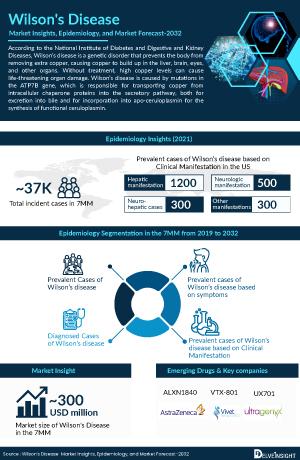
Wilson's Disease Insights and Trends
- According to DelveInsight's analysis, the Wilson's disease market across the 7MM including the United States, EU4 (Germany, France, Italy, and Spain), the United Kingdom, and Japan, is expected to grow steadily during the forecast period, driven by improved disease awareness, expanded genetic testing, increasing diagnosis rates, greater access to specialized care, and the anticipated launch of next-generation copper chelators and gene therapies.
- Wilson's disease is primarily diagnosed between 5 and 35 years of age, with the highest prevalence in individuals <40 years, according to the European Society for Pediatric Gastroenterology, Hepatology, and Nutrition. Improved genetic testing and earlier diagnosis are increasing the identified patient population, supporting market expansion.
- In Japan, approximately 50% diagnosed Wilson's disease cases present with hepatic manifestations, while neurological involvement accounts for ~18%, combined neuro-hepatic disease for ~14%, and other manifestations for ~19%.
- Copper chelators remain the cornerstone of Wilson's disease treatment, with trientine serving as a key alternative for patients intolerant to D-penicillamine. Introduced in 1969, trientine enhances urinary copper excretion and is typically administered at 750–1,500 mg/day during initial therapy and 750–1,000 mg/day for maintenance in divided doses.
- Off-label therapies, including dimercaprol and supportive neurological or psychiatric medications, continue to be used in select patients to manage treatment intolerance or disease-related complications.
- In 2022, trientine tetrahydrochloride (CUVRIOR) became the first FDA-approved trientine formulation for the treatment of adults with stable Wilson's disease who are de-coppered and tolerant to penicillamine, expanding therapeutic options.
- The Wilson's disease pipeline is increasingly focused on disease-modifying approaches, led by gene therapy candidates such as VTX-801 (Vivet Therapeutics in collaboration with Pfizer) and UX701 (Ultragenyx Pharmaceutical), which aim to restore ATP7B function and potentially provide durable clinical benefit.
- Despite available copper chelators and zinc therapies, significant unmet needs remain, as current treatments require lifelong administration, are associated with tolerability and adherence challenges, and do not correct the underlying genetic defect. Persistent neurological progression in some patients and the absence of approved curative therapies continue to drive demand for safer, disease-modifying, and potentially curative treatment options.
Wilson's Disease Market Size and Forecast in the 7MM
- 2025 Wilson's Disease Market Size: ~USD XX million
- 2036 Projected Wilson's Disease Market Size: ~USD XX million
- Wilson's Disease Growth Rate (2026–2036): ~XX% CAGR
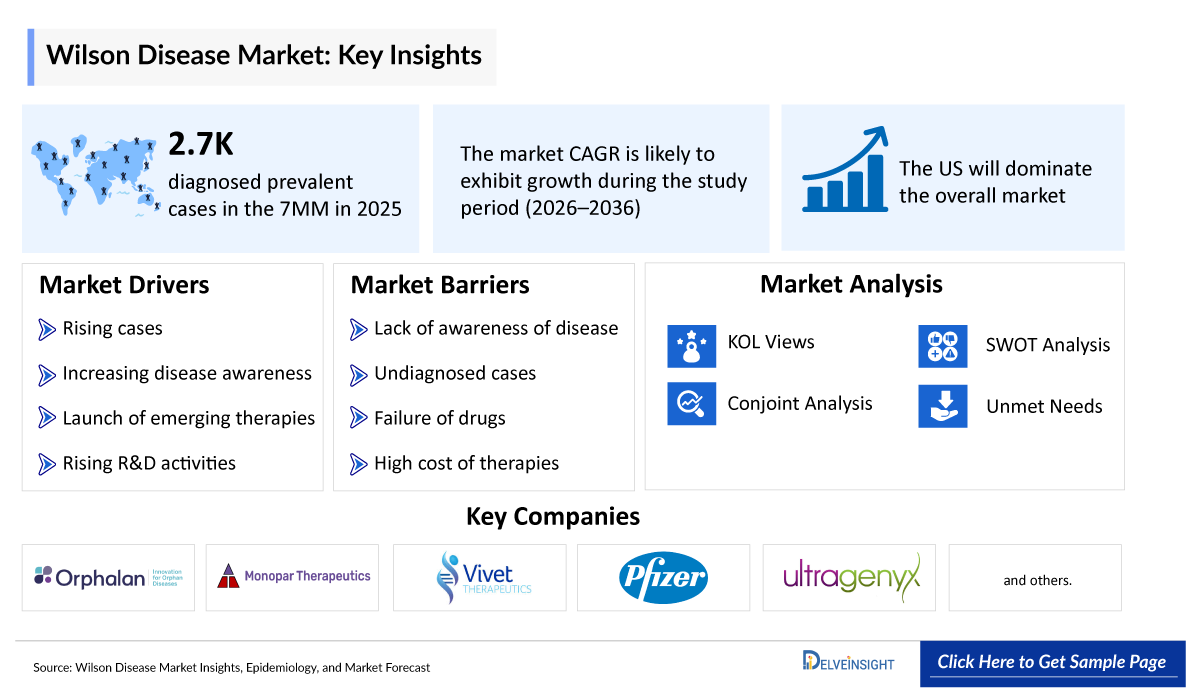
DelveInsight's ‘Wilson's Disease Market Insights, Epidemiology and Market Forecast – 2036’ report delivers an in-depth understanding of the Wilson's Disease, historical and forecasted epidemiology, as well as the Wilson's disease market trends in the United States, EU4 (Germany, Spain, Italy, and France) and the United Kingdom, and Japan.
The Wilson's Disease market report delivers a comprehensive analysis of the current treatment landscape, including standards of care, clinical practices, and evolving therapeutic algorithms. It evaluates Wilson's Disease patient burden trends, revenue & market share dynamics, peak patient share & therapy uptake analysis, and provides an in-depth market size assessment, and growth rate projections (historical & forecast 2022–2036) across global regions. The report highlights key unmet medical needs in Wilson's disease and maps the competitive and clinical landscape to uncover high‑value opportunities, providing a clear outlook on future market growth potential.
|
Study Period |
2022–2036 |
|
Historical Year |
2022–2025 |
|
Forecast Period |
2026–2036 |
|
Base Year |
2026 |
|
Geographies Covered |
|
|
Wilson's Disease Market CAGR (Forecast period) |
~XX% (2026–2036) |
|
Wilson's Disease Epidemiology Segmentation Analysis |
Patient Burden Assessment
|
|
Wilson's Disease Companies |
|
|
Wilson's Disease Therapies |
|
|
Wilson's Disease Market |
Segmented by
|
|
Analysis |
• Addressable Patient Population • Market Drivers And Market Barriers • Cost Assumptions And Pricing Analogues • KOL Views • SWOT Analysis • Reimbursement • Conjoint Analysis • Unmet Needs |
Key Factors Driving the Wilson’s Disease Market
- Growing adoption of established copper-chelating agents and zinc therapies
It is improving disease management and long-term outcomes, supporting sustained market growth.
- Supportive regulatory incentives for orphan diseases
This includes expedited review pathways and market exclusivity benefits, are encouraging pharmaceutical companies to expand their Wilson’s disease pipelines.
- Rising healthcare expenditure and improved access to specialized care centers
Improved healthcare infrastructure and greater access to specialized treatment centers are facilitating earlier diagnosis and optimized disease management, thereby driving treatment uptake in patients with Wilson’s disease.
Wilson's Disease Understanding and Treatment Algorithm
Wilson's Disease Overview and Diagnosis
Wilson’s Disease is a rare, autosomal recessive genetic disorder caused by mutations in the ATP7B gene, resulting in impaired copper transport and the progressive accumulation of copper in various organs, particularly the liver, brain, and eyes. The disease manifests with a broad spectrum of hepatic, neurological, and psychiatric symptoms, including liver dysfunction, tremors, movement disorders, behavioral changes, and the characteristic Kayser–Fleischer rings.
Diagnosis is based on a combination of clinical assessment, serum ceruloplasmin levels, 24-hour urinary copper excretion, ophthalmologic examination, liver biopsy, and genetic testing. Early recognition is critical, as untreated disease can lead to severe organ damage, liver failure, and significant neurological impairment. Current management focuses on lifelong copper control through chelating agents such as penicillamine and trientine, zinc salts that reduce intestinal copper absorption, dietary copper restriction, and liver transplantation in advanced cases. Treatment guidelines emphasize prompt initiation of therapy, regular monitoring of copper levels and organ function, and long-term adherence to prevent disease progression and improve clinical outcomes.
Further details are provided in the report.
Current Wilson's Disease Treatment Landscape
The management of Wilson’s Disease is centered on lifelong control of copper accumulation to prevent progressive organ damage and improve long-term outcomes. Current treatment strategies primarily involve using copper chelators (D-penicillamine and trientine) and zinc salts, while liver transplantation remains the only curative option for patients with acute liver failure or end-stage liver disease. The treatment landscape advanced with the approval of trientine tetrahydrochloride (CUVRIOR), the first new FDA-approved therapy for Wilson's disease in decades. However, current therapies require lifelong administration and are associated with tolerability, adherence, and efficacy limitations, with 30–40% of patients developing penicillamine intolerance and some experiencing persistent or worsening neurological symptoms. These unmet needs are driving the development of gene therapies, cell-based approaches, and other disease-modifying strategies aimed at restoring ATP7B function and providing durable or potentially curative treatment.
Further details related to country-based variations are provided in the report.
Wilson's Disease Unmet Needs
The section “unmet needs of Wilson's Disease” outlines the critical gaps between the current state of patient care, diagnosis, and the ideal & effective management of the disease. It highlights the obstacles experienced by patients, clinicians, and researchers and identifies potential solutions for future progress.
- Lifelong treatment due to the lack of curative therapies.
- Poor tolerability and adherence with long-term chelation therapy.
- Limited control of neurological and psychiatric manifestations.
- Delayed diagnosis leading to irreversible organ damage and others…..
Note: Comprehensive unmet needs insights in Wilson’s disease and their strategic implications are provided in the full report.
Wilson's Disease Epidemiology
Key Findings from Wilson's Disease Epidemiological Analysis and Forecast
- As per the analysis, it was observed that the United States accounted for the highest diagnosed prevalent cases of Wilson’s disease accounting for approximately 2,700 cases among the 7MM in 2024 followed by Japan with nearly 2,260 cases. On the other hand, Spain had the lowest diagnosed prevalent cases of Wilson’s disease.
- In 2025, the estimated incidence of Wilson's disease is approximately 1 per 30,000 population in the United States and 1 per 30,000–50,000 population in Europe.
- In 2024, there were approximately 86% symptomatic and 14% asymptomatic cases of Wilson’s disease in the 7MM.
- Wilson’s disease most commonly presents with hepatic manifestations, which occur in approximately 40–60% of patients, followed by neurological manifestations in about 40–50% of cases. Psychiatric manifestations are less common as the initial presentation, accounting for roughly 10–25% of patients.
- While hepatic involvement remains the predominant clinical presentation, considerable overlap exists between hepatic, neurological, and psychiatric symptoms, reflecting the heterogeneous nature of the disease and often contributing to delays in diagnosis and treatment initiation.
Wilson's Disease Drug Analysis & Competitive Landscape
The Wilson's disease drug chapter provides a detailed, market-focused review of approved therapies and the emerging pipeline across Phase I–III clinical trials. It covers the mechanism of action, clinical trial data, patents, collaborations, and strategic partnerships, upcoming key catalysts for each therapy, along with their advantages, limitations, and recent developments. This section offers critical insights into the Wilson's Disease treatment landscape, supporting market assessment, competitive analysis, and growth forecasting for the Wilson's Disease therapeutics market.
Approved Therapies for Wilson's Disease
Trientine tetrahydrochloride (CUVRIOR/CUPRIOR): Orphalan
Trientine tetrahydrochloride is a copper chelator indicated for the treatment of adult patients with stable Wilson’s disease who are de-coppered and tolerant to penicillamine. CUVRIOR is an oral trientine formulation. The active substance trientine is a chelating agent, and it works by attaching to copper in the body and forming a complex that is then eliminated in the urine.
Trientine tetrahydrochloride is the first innovative treatment for treating Wilson’s disease. The therapy was first approved in Europe as CUPRIOR in 2019, followed by US FDA approval as CUVRIOR in 2022, marking the first new FDA-approved treatment for Wilson's disease in decades. It provides a well-tolerated alternative for patients who are intolerant to or unable to continue penicillamine therapy.
Wilson's Disease Pipeline Analysis
VTX-801: Vivet Therapeutics/Pfizer
VTX-801 is a novel investigational rAAV-based gene therapy designed to deliver a functional mini-ATP7B transgene to restore copper homeostasis in patients with Wilson's disease. It has received Orphan Drug Designation (ODD) from both the US FDA and the European Commission, as well as Fast Track Designation (FTD) from the US FDA. Preclinical studies have demonstrated restoration of copper metabolism, reversal of liver pathology, and reduced brain copper accumulation, supporting its potential as a disease-modifying therapy.
VTX-801 is currently under evaluation in the Phase I/II GATEWAY trial for Wilson disease, with the study advancing through dose-escalation cohorts.
UX701: Ultragenyx Pharmaceutical
UX701 is an investigational AAV9 gene therapy designed to deliver a modified form of the ATP7B gene, to restore copper metabolism in patients with Wilson's disease. It utilizes Ultragenyx's Pinnacle PCL Platform and has demonstrated reduced hepatic copper accumulation, increased ceruloplasmin levels, and improved liver pathology in preclinical studies. UX701 has received ODD and FTD from the US FDA, as well as Orphan Medicinal Product designation from the EMA.
UX701 is currently under investigation in the Phase II/III Cyprus2+ trial for Wilson disease, with additional patient enrollment underway to evaluate an optimized dosing and immunomodulation regimen.
|
Comparison of Emerging Drugs Under Development | ||||||
|
Drug Name |
Company |
Highest Phase |
Indication |
RoA |
Molecule Type |
Anticipated Launch in the US |
|
ALXN1840 |
Monopar Therapeutics |
III |
Wilson Disease |
Oral |
Small molecule |
Information is available in the full report |
|
UX701 |
Ultragenyx Pharmaceuticals |
II/III |
Wilson Disease | Oral |
AAV9 gene therapy |
Information is available in the full report |
|
VTX-801 |
Vivet Therapeutics/Pfizer |
I/II |
Wilson Disease |
Oral |
rAAV-based gene therapy |
Information is available in the full report |
|
Note: Launch insights are provisional and may change with future report updates or the occurrence of major key catalysts. | ||||||
Note: Detailed emerging therapies assessment will be provided in the final report.
Wilson's Disease Key Players, Market Leaders and Emerging Companies
- Monopar Therapeutics
- Vivet Therapeutics
- Pfizer
- Ultragenyx Pharmaceutical
- Orphalan, and others
Wilson's Disease Drug Updates
- In May 2026, as per the Ultragenyx’s presentation UX701 is anticipated to report Stage 1 dose-finding data (Cohorts 1–4) in 2026, representing a key clinical milestone in the development of gene therapy for Wilson's disease.
- In January 2026, Hyloris Pharmaceuticals obtained exclusive license rights in Europe and Turkey from ArborMed for an investigational next-generation Wilson's Disease therapy, with first-in-human trials planned for 2026 and patient studies by 2027.
Wilson's Disease Market Outlook
Wilson’s disease is managed through lifelong pharmacological therapy aimed at reducing copper accumulation and preventing progressive organ damage. Current treatment options include copper-chelating agents such as D-penicillamine (CUPRIMINE) and trientine formulations (SYPRINE, CUVRIOR/CUPRIOR), as well as zinc salts that inhibit intestinal copper absorption. Despite their effectiveness, these therapies are limited by lifelong treatment requirements, drug intolerance, poor adherence, and incomplete neurological recovery. The pipeline is shifting toward disease-modifying approaches, with gene therapies such as VTX-801 and UX701 aiming to restore ATP7B function. UX701 is expected to report Stage I dose-finding data in 2026, while VTX-801 continues Phase I/II development with US FDA Fast Track and Orphan Drug Designations. Additionally, ALXN1840, a novel albumin tripartite complex (ATC), has re-emerged as a late-stage candidate under Monopar Therapeutics, with positive Phase II/III FoCus data and NDA submission activities underway, positioning it as a promising new treatment option for Wilson’s disease.
Further details will be provided in the report….
Drug Class/Insights into Leading Emerging and Marketed Therapies in Wilson's Disease (2022-2036)
The Wilson's Disease pipeline comprises therapies aimed at improving antifungal efficacy, enhancing nail penetration and drug delivery, shortening treatment duration, reducing recurrence, and reinfection rates, and overcoming the limitations of existing oral and topical therapies. These approaches seek to achieve higher mycological and complete cure rates, improve patient adherence and convenience, minimize treatment-related adverse effects, and ultimately enhance long-term clinical outcomes and quality of life for patients with Wilson’s Disease.
- AAV9-Based Gene Therapy: UX701 is an investigational AAV9-based gene therapy designed to deliver a functional ATP7B gene to hepatocytes, aiming to restore copper metabolism and provide a durable disease-modifying treatment for Wilson's disease.
- rAAV-Based Gene Therapy: VTX-801 is an investigational recombinant adeno-associated virus (rAAV)-based gene therapy designed to deliver a functional ATP7B gene to hepatocytes, aiming to restore normal copper metabolism and provide a durable, potentially one-time disease-modifying treatment for Wilson's disease.
Wilson's Disease Drug Uptake
This section focuses on the uptake rate of potential drugs expected to be launched in the market during the forecast period (2026–2036). The analysis covers the Wilson's disease drug’s uptake, performance at peak, factors affecting performance during prime years of growth, patient uptake by therapy, and anticipated sales generated by each drug.
Detailed insights into emerging therapies' drug uptake are included in the report.
Market Access and Reimbursement of Approved Therapies in Wilson's Disease
The report further provides detailed insights on the country-wise accessibility and reimbursement scenarios, cost-effectiveness scenario of approved therapies, programs making accessibility easier and out-of-pocket costs more affordable, insights on patients insured under federal or state government prescription drug programs, etc.
Reimbursement is a crucial factor that affects the drug’s access to the market. Often, the decision to reimburse comes down to the price of the drug relative to the benefit it produces in treated patients. To reduce the healthcare burden of these high-cost therapies, many payment models are being considered by payers and other industry insiders.
The programs available in the US are:
- Vaccines for Children Program (VFC)
- Children’s Health Insurance Program (CHIP)
- Medicare and Medicaid Coverage
NOTE: Further Details are provided in the final report….
Wilson's Disease Therapies Price Scenario & Trends
Pricing and analogue assessment of Wilson's disease therapies highlights evolving price dynamics structures. This section summarizes the cost of approved treatments, the closest and most appropriate analogue selection for emerging therapies, and the understanding of how pricing influences market access, adherence, and long-term uptake.
Industry Experts and Physician Views for Wilson's Disease
To keep up with Wilson's disease market trends, we take Key Opinion Leaders (KOLs) and Subject Matter Experts (SMEs) opinions working in the domain through primary research to fill the data gaps and validate our secondary research. Industry Experts were contacted for insights on Wilson's Disease emerging therapies, evolving treatment landscape, patient adherence to conventional therapies, therapy switching trends, drug adoption and uptake, accessibility challenges, and epidemiology and real-world prescription patterns in Wilson's Disease, including MD, PhD, Instructor, Postdoctoral Researcher, Professor, Researcher, and others.
DelveInsight’s analysts connected with 10+ KOLs to gather insights; however, interviews were conducted with 6+ KOLs in the 7MM. Centers such as the Hillman Cancer Center, Université Centre Léon Bérard, Society of Hematology, Aichi Medical University, etc. were contacted. Their opinion helps understand and validate current and emerging Wilson's disease therapies, highlight unmet medical needs, provide epidemiological context, and support strategic decisions for market access, therapy adoption, and pipeline prioritization in Wilson's Disease.
|
Region |
Key Opinion Leaders (KOLs) and Subject Matter Experts (SMEs) |
|
United States |
“Wilson’s disease is caused by mutations in the ATP7B gene, which is responsible for transporting copper from intracellular chaperone proteins into the secretory pathway, both for excretion into bile and for incorporation into apo-ceruloplasmin for the synthesis of functional ceruloplasmin.” |
|
Spain |
“Early diagnosis of Wilson’s disease is crucial and can be achieved through routine genetic screening in patients with unexplained liver disease. Increased clinician awareness of the disease’s varied symptoms is essential.” |
Qualitative Analysis: SWOT and Conjoint Analysis
We perform qualitative and market Intelligence analysis using various approaches, such as SWOT analysis and conjoint analysis.
In the SWOT analysis of Wilson's Disease, strengths, weaknesses, opportunities, and threats in terms of disease diagnosis, patient awareness, patient burden, competitive landscape, cost-effectiveness, and geographical accessibility of therapies are provided.
Conjoint analysis analyzes emerging therapies based on relevant attributes such as safety, efficacy, frequency of administration, route of administration, and order of entry. Scoring is given based on these parameters to analyze the effectiveness of therapy.
The team of analysts analyzes promising emerging therapies based on relevant attributes such as safety, efficacy, frequency of administration, route of administration, and order of entry. In efficacy, the trial’s primary and secondary outcome measures are evaluated, whereas the therapies’ safety is evaluated, wherein the acceptability, tolerability, and adverse events are mainly observed. In addition, the scoring is also based on the route of administration, order of entry, probability of success, and the addressable patient pool for each therapy. According to these parameters, the final weightage score and the ranking of the emerging therapies are decided.
Scope of the Report
- The report covers a segment of key events, an executive summary, a descriptive overview of Wilson's disease, explaining its causes, signs and symptoms, pathogenesis, and currently available treatments.
- Comprehensive insight has been provided into the epidemiology segments and forecasts, the future growth potential of the diagnosis rate, and disease progression along treatment guidelines.
- Additionally, an all-inclusive account of both the current and emerging treatments, along with the elaborative profiles of prominent therapies, will have an impact on the current treatment landscape.
- A detailed review of the Wilson's disease market, historical and forecasted market size, market share by therapies, detailed assumptions, and rationale behind our approach is included in the report, covering the 7MM drug outreach.
- The report provides an edge while developing business strategies by understanding trends through SWOT analysis and expert insights/KOL views, patient journey, and treatment preferences that help in shaping and driving the 7MM Wilson's disease market.
Report Insights
- Wilson's Disease Patient Population Forecast
- Wilson's Disease Therapeutics Market Size
- Wilson's Disease Pipeline Analysis
- Wilson's Disease Market Size and Trends
- Wilson's Disease Market Opportunity (Current and Forecasted)
Report Key Strengths
- Epidemiology‑based (Epi‑based) Bottom‑up Forecasting
- Artificial Intelligence (AI)-Enabled Market Research Report
- 11-Year Forecast
- Wilson's Disease Market Outlook (North America, Europe, Asia-Pacific)
- Patient Burden Trends (By Geography)
- Wilson's Disease Treatment Addressable Market (TAM)
- Wilson's Disease Competitive Landscape
- Wilson's Disease Major Companies Insights
- Wilson's Disease Price Trends and Analogue Assessment
- Wilson's Disease Therapies Drug Adoption/Uptake
- Wilson's Disease Therapies Peak Patient Share Analysis
Report Assessment
- Wilson's Disease Current Treatment Practices
- Wilson's Disease Unmet Needs
- Wilson's Disease Clinical Development Analysis
- Wilson's Disease Emerging Drugs Product Profiles
- Wilson's Disease Market attractiveness
- Wilson's Disease Qualitative Analysis (SWOT and Conjoint analysis)
FAQs
Market Insights
- What was the Wilson's disease market size, the market size by therapies, market share (%) distribution in 2025, and what would it look like by 2036? What are the contributing factors for this growth?
- What are the anticipated pricing variations among different geographies for the emerging therapies in the future?
- What can be the future treatment paradigm of Wilson's disease?
- What are the disease risks, burdens, and unmet needs of Wilson's disease? What will be the growth opportunities across the 7MM concerning the patient population with Wilson's disease?
- Who is the major future competitor in the market, and how will the competitors affect their market share?
- What are the current options for the treatment of Wilson's disease? What are the current guidelines for treating Wilson's disease in the US, Europe, and Japan?
Reasons to Buy
- The report will help in developing business strategies by understanding the latest trends and changing treatment dynamics driving the Wilson's disease market.
- Bottom-up forecasting builds from the affected population to product forecasts, delivering a robust, data-driven approach ideal for new therapies and novel classes.
- Insights on patient burden/disease incidence, evolution in diagnosis, and factors contributing to the change in the epidemiology of the disease during the forecast years.
- Understand the existing market opportunities in varying geographies and the growth potential over the coming years.
- Identifying strong upcoming players in the market will help devise strategies to help get ahead of competitors.
- Detailed analysis and ranking of class-wise potential emerging therapies under the conjoint analysis section to provide visibility around leading classes.
- To understand KOLs’ perspectives on the accessibility, acceptability, and compliance-related challenges of existing treatment to overcome barriers in the future.
- Detailed insights on the unmet needs of the existing market so that the upcoming players can strengthen their development and launch strategy.
- This Artificial Intelligence (AI)-enabled report summarizes and simplifies complex datasets within the report into clear, actionable insights for stakeholders, investors, and healthcare providers, enabling faster, data-driven decisions.