
Mobile Clinics Market
Mobile Clinics Market by Vehicle Type (Mobile Medical Van, Mobile Medical Bus, and Others), Specialty (Primary Care, Specialized Care, Emergency & Disaster Response, and Others), and Geography (North America, Europe, Asia-Pacific, and Rest of the World) is expected to grow at a steady CAGR forecast till 2032 owing to the growing healthcare access gaps and increasing collaboration and partnerships among key market players and hospitals to provide accessible healthcare.
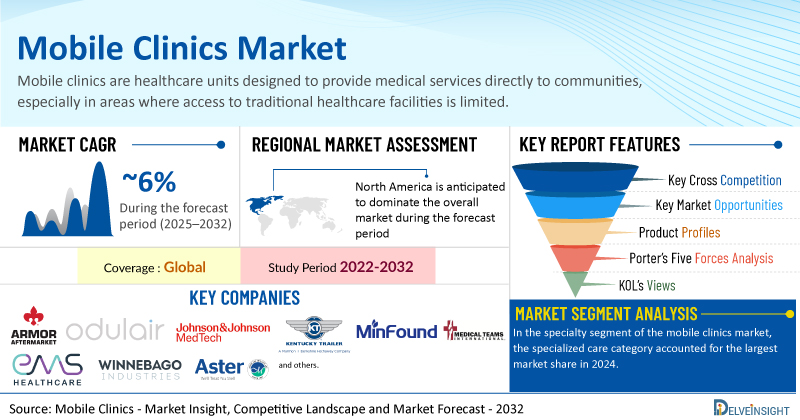
The mobile clinics market was valued at USD 3,362.50 million in 2024, growing at a CAGR of 5.99% during the forecast period from 2025 to 2032 to reach USD 5,338.17 million by 2032. The demand for mobile clinics is primarily driven by widening healthcare access gaps, particularly in low- and middle-income countries where adequate and accessible healthcare services remain limited. The rising incidence of acute and chronic conditions, especially injuries and musculoskeletal disorders, further fuels this demand. Additionally, increasing collaborations and partnerships among key industry players, healthcare providers, and government agencies to deliver accessible, community-based care are expected to be major contributors to the robust and sustained growth of the mobile clinics market during the forecast period from 2025 to 2032.
Mobile Clinics Market Dynamics:
According to data from the World Health Organization (2023), approximately 4.5 billion people, contributing to more than half of the global population, lacked full coverage of essential health services. This widespread lack of access is creating a significant and growing demand for flexible, on-the-ground healthcare solutions such as mobile clinics.
As reported by Rare Disease Europe (2025), over 30 million people in Europe face diagnostic delays and limited treatment access every year. Similarly, in the Asia-Pacific region, healthcare access disparities are also evident. Data from the Australian Bureau of Statistics (2024) revealed that more than 7% of individuals were unable to receive timely medical treatment due to the limited availability of healthcare facilities.
Mobile clinics are increasingly recognized as an effective, scalable, and cost-efficient solution to these challenges. By delivering diagnostic, preventive, and primary care services directly to underserved and remote communities, mobile units help bridge critical healthcare gaps and improve health equity.
According to the British Heart Foundation (2024), an estimated 640 million people worldwide were living with heart and circulatory conditions, a number that continues to rise due to the combined impact of sedentary lifestyles and a rapidly aging global population.
According to the World Health Organization (2023), in 2022, approximately 1.71 billion people suffered from musculoskeletal conditions globally. Moreover, the Spinal Injury Association reported approximately 4,400 new spinal injury cases in the UK each year, while Forward Ability Support (2022) stated that 15,000 people in Australia were living with spinal cord injuries. The rise in acute and chronic diseases is fueling demand for mobile clinics by increasing the need for accessible, on-the-go healthcare solutions, especially in underserved or remote areas. This supports early diagnosis, continuous care, and cost-effective disease management.
Moreover, key players in the mobile clinics market are increasingly focusing on strategic collaborations and partnerships to expand access to healthcare services, further propelling market growth. For instance, in August 2024, MedStar Health and Monumental Sports & Entertainment (MSE) announced a collaboration to launch the newly designed Kids Mobile Medical Clinic, an enhanced version of their well-known pediatric health center on wheels. This initiative underscores the growing commitment among healthcare providers and private sector partners to deliver community-based, child-focused care to underserved populations.
However, the high operational and initial investment costs and regulatory and licensing challenges, among others, are some of the key constraints that may limit the growth of the mobile clinics market.
Get a snapshot of how do mobile clinics serve marginalized communities? at Mobile Clinics Market Trends
Mobile Clinics Market Segment Analysis:
Mobile Clinics Market by Vehicle Type (Mobile Medical Van, Mobile Medical Bus, and Others), Specialty (Primary Care, Specialized Care, Emergency and Disaster Response, and Others), and Geography (North America, Europe, Asia-Pacific, and Rest of the World)
In the specialty segment of the mobile clinics market, the specialized care category is estimated to account for the largest market share in 2024. This growth is primarily driven by the increasing prevalence of chronic and complex diseases, such as cancer, kidney failure, dental disorders, and maternal health issues, combined with the limited availability of specialized healthcare services in remote and underserved regions.
The rising demand for targeted, condition-specific medical care is making mobile clinics an effective solution for reaching vulnerable populations that otherwise lack access to critical health services.
Mobile clinics equipped for specialized care, such as mobile mammography vans, dental care units, and others, allow healthcare providers to deliver advanced diagnostic and treatment services directly to patients in their communities. By offering on-site screenings, early diagnostics, and tailored interventions, these clinics address crucial gaps in care and enhance early detection and disease management, particularly in low-resource settings.
Moreover, the segment is witnessing increased activity from key market players who are launching new mobile healthcare units to extend specialized care into rural and underserved areas. For example, in January 2025, Artemis Hospital, in partnership with Signature Global Group, launched the AarogyaRise. This mobile clinic is equipped to deliver a wide range of services, including comprehensive cancer screenings, dental check-ups, eye exams, lung screening, X-rays, and other specialty services, specifically designed to address the healthcare needs of rural populations.
Such initiatives are not only improving access to care but also contributing significantly to revenue growth within the specialized care segment. As a result, this category is expected to play a pivotal role in driving the overall growth of the global mobile clinics market throughout the forecast period.
Therefore, owing to the above-mentioned factors, the specialized care segment is expected to contribute significantly to overall market revenues, playing a pivotal role in driving the growth of the global mobile clinics market.
North America is expected to dominate the overall mobile clinics market:
North America is projected to hold the largest share of the mobile clinics market in 2024, driven by several key factors. This dominance is driven by a combination of factors, including the growing need for improved healthcare access, rising prevalence of acute and chronic diseases, and the strong presence of key market players. Together, these factors are strengthening North America's position as the largest market share in the mobile clinics market.
As per the data from the Government of Canada (2023), more than 4.7 million people do not have access to healthcare facilities, with more than 2.5 million people reporting unmet medical needs in Canada. Mobile clinics help bridge gaps in medical infrastructure, especially where hospitals and primary care centers are lacking or distant. Therefore, rising healthcare access gaps are driving the market growth in the region.
According to data from the Commonwealth Fund (2024), in 2023, an estimated 26 million people, approximately 8% of the U.S. population, were uninsured. The high out-of-pocket costs associated with traditional hospitals and private clinics often discourage uninsured individuals from seeking timely care. In this context, mobile clinics offer a more affordable or even free alternative, enabling access to essential healthcare services in underserved communities.
Chronic disease prevalence is another major driver. As reported by the American Cancer Society (2025), over 2,041,910 new cancer cases were projected to occur in the U.S. in 2025. Rising incidences of chronic conditions such as cancer, diabetes, and heart disease are increasing the need for regular monitoring, early diagnosis, and continuous care. Mobile clinics serve this demand by offering community-based, accessible healthcare solutions, particularly in rural or low-resource settings.
In addition, major industry players are investing in partnerships and product innovation to enhance specialized care delivery through mobile units. For instance, in June 2024, Benco Dental and Matthews Specialty Vehicles unveiled the first production model of the industry’s most advanced mobile dental coach, further expanding the reach of dental services to underserved populations.
Collectively, the growing healthcare access gaps, particularly in rural areas, and collaborations among key players and healthcare providers, are propelling the demand for accessible healthcare in North America, reinforcing its position as a leading region in the global mobile clinics market.
Mobile Clinics Market Key Players:
Some of the key market players operating in the mobile clinics market include Armor Mobile Systems, ADI, Matthews Specialty Vehicles, Odulair LLC, Farber Specialty Vehicles, LifeLine Mobile, Inc., Johnson Medical International, Kentucky Trailer, La Boit Specialty Vehicles Inc., MinFound Medical Systems Co., Ltd., CVR Industries USA, Inc., EMS Healthcare, EMS Mobil Sistemler A.S., Winnebago Industries, LDV, Inc., Mobile Healthcare Facilities LLC, Mobile Concepts Specialty Vehicles, AB Volvo, Aster DM Healthcare, Medical Teams International, and others.
Recent Developmental Activities in the Mobile Clinics Market:
- In January 2025, Medical Teams International launched two new state-of-the-art mobile clinics aimed at expanding access to dental and primary healthcare services. Each of the distinctive red vehicles is equipped with two fully functional dental operatories, a dedicated reception area, and a specialized sanitizing zone. These mobile units are designed to deliver high-quality, on-the-go care to underserved communities across the Pacific Northwest, addressing both preventive and urgent dental needs.
- In February 2025, Aster Volunteers, the global CSR arm of Aster DM Healthcare, launched two new Mobile Medical Service units to serve villages in Sankari, Surat, and Khedbrahma in the Sabarkantha district of Gujarat. Equipped with state-of-the-art facilities, these units aim to deliver essential healthcare services directly to underserved populations, significantly improving access to medical care in remote areas.
- In May 2023, Volvo Group partnered with Narayana Health to launch ‘Wellness on Wheels’, an advanced and connected community mobile clinic. Specially customized for outreach healthcare, the mobile unit is equipped with cutting-edge screening and diagnostic tools, including ultrasound, ECG, and X-ray machines. It is designed to detect critical conditions such as cancer and heart ailments, bringing high-quality, non-invasive diagnostic services directly to underserved communities.
To read more about the latest highlights, get a snapshot of the key highlights entailed in the Global Mobile Clinics Market Forecast Report
Key takeaways from the mobile clinics market report study
- Market size analysis for the current mobile clinics market size (2024), and market forecast for 8 years (2025 to 2032)
- Top key product/technology developments, mergers, acquisitions, partnerships, and joint ventures happened over the last 3 years.
- Key companies dominating the mobile clinics market.
- Various opportunities available for the other competitors in the mobile clinics market space.
- What are the top-performing segments in 2024? How these segments will perform in 2032?
- Which are the top-performing regions and countries in the current mobile clinics market scenario?
- Which are the regions and countries where companies should have concentrated on opportunities for the mobile clinics market growth in the future?
Target audience who can benefit from this mobile clinics market report study
- Mobile clinics product providers
- Research organizations and consulting companies
- Mobile clinics-related organizations, associations, forums, and other alliances
- Government and corporate offices
- Start-up companies, venture capitalists, and private equity firms
- Distributors and traders dealing in mobile clinics
- Various end-users who want to know more about the mobile clinics market and the latest technological developments in the mobile clinics market.
Explore more about how do mobile clinics coordinate with in-person healthcare providers? at Mobile Clinics Market Outlook
Frequently Asked Questions for the Mobile Clinics Market:
1. What are mobile clinics?
Mobile clinics (also known as mobile health units or mobile medical clinics) are customized vehicles that deliver healthcare services directly to communities, especially those facing geographic, financial, or social barriers to accessing traditional healthcare facilities. These vehicles are equipped with medical equipment, diagnostic tools, and staff to provide a range of services.
2. What is the market for mobile clinics?
The mobile clinics market was valued at USD 3,362.50 million in 2024, growing at a CAGR of 5.99% during the forecast period from 2025 to 2032 to reach USD 5,338.17 million by 2032.
3. What are the drivers for the mobile clinics market?
The demand for mobile clinics is primarily driven by widening healthcare access gaps, particularly in low- and middle-income countries where adequate and accessible healthcare services remain limited. The rising incidence of acute and chronic conditions further fuels this demand. Additionally, increasing collaborations and partnerships among key industry players, healthcare providers, and government agencies to deliver accessible, community-based care are expected to be major contributors to the robust and sustained growth of the mobile clinics market during the forecast period from 2025 to 2032.
4. Who are the key players operating in the mobile clinics market?
Some of the key market players operating in the mobile clinics market include Armor Mobile Systems, ADI, Matthews Specialty Vehicles, Odulair LLC, Farber Specialty Vehicles, LifeLine Mobile, Inc., Johnson Medical International, Kentucky Trailer, La Boit Specialty Vehicles Inc., MinFound Medical Systems Co., Ltd., CVR Industries USA, Inc., EMS Healthcare, EMS Mobil Sistemler A.S., Winnebago Industries, LDV, Inc., Mobile Healthcare Facilities LLC, Mobile Concepts Specialty Vehicles, AB Volvo, Aster DM Healthcare, Medical Teams International, and others.
5. Which region has the highest share in the mobile clinics market?
North America is projected to hold the largest share of the mobile clinics market in 2024, driven by several key factors. This dominance is driven by a combination of factors, including the growing need for improved healthcare access, rising prevalence of acute and chronic diseases, and the strong presence of key market players. Together, these factors are strengthening North America's position as the largest market share in the mobile clinics market.

