Acute Pain Market Summary
- The Acute Pain Treatment Market Size is projected to grow from approximately USD 4.5 billion in 2025 to nearly USD 15.5 billion by 2036, expanding at a CAGR of 12% during the forecast period from 2026 to 2036.
- The leading Acute Pain Companies include Oculis, PainReform, Cali Biosciences, Neumentum, Vertex Pharmaceuticals, Hikma Pharmaceuticals, Hyloris Pharmaceuticals, AFT Pharmaceuticals, Heron Therapeutics, and others.
Acute Pain Market & Epidemiology Analysis
- Acute Pain treatment (both postoperative and non-postoperative) follows a multimodal approach, combining pharmacological and non-pharmacological therapies. Medications include opioids, nonsteroidal anti-inflammatory drugs (NSAIDs), acetaminophen, corticosteroids, anesthetics, and adjuncts like antidepressants, muscle relaxants, and cannabinoids. Non-pharmacological methods such as physical therapy, acupuncture, cognitive-behavioral therapy, massage, and Transcutaneous Electrical Nerve Stimulation (TENS) serve as effective complements, aiming to improve outcomes and reduce reliance on any single intervention.
- Multimodal treatment is crucial for optimizing pain relief because different modalities may be additive or synergistic; this approach can also reduce the potential for side effects. The cornerstones of multimodal treatment include nerve blocks or epidurals, opioids or other analgesics, adjunctive medications, physical modalities (Rest, Ice, Compression, Elevation [RICE]), and rehabilitation.
- In 2025, Among the 7MM, the US accounted for the largest share of Acute Pain cases (~45%), while the EU4, the UK, and Japan contributed comparatively lower case volumes, with Japan reporting the lowest burden.
- Current market therapies for postoperative Acute Pain include suzetrigine (JOURNAVX) (Vertex Pharmaceuticals), acetaminophen and ibuprofen (COMBOGESIC IV/MAXIGESIC IV) (Hikma Pharmaceuticals, Hyloris Pharmaceuticals, and AFT Pharmaceuticals), bupivacaine and meloxicam (ZYNRELEF) (Heron Therapeutics), loteprednol etabonate ophthalmic gel (LOTEMAX SM) (Bausch & Lomb), and others.
- Several therapies previously approved for Acute Pain treatment have been discontinued, highlighting the challenges in the market. Drugs like DSUVIA (sufentanil citrate) and OLINVYK (Olinvo) were withdrawn despite holding multiple patents, while combination therapies like SEGLENTIS (celecoxib and tramadol hydrochloride) and APADAZ (benzhydrocodone and acetaminophen) faced safety concerns or limited use.
- The emerging pipeline for Acute Pain treatments is quite robust, featuring numerous mid- and late-stage development products such as F14 (Arthritis Innovation/Medincell), OCS-01 (Oculis), NTM-001 (Neumentum), cebranopadol (TRN-228) (Tris Pharma), meloxicam (MR 107A 02) (Viatris), XG005 (Xgene Pharmaceutical), ATX101 (Allay Therapeutics), and others which hold significant potential for improving pain management options.
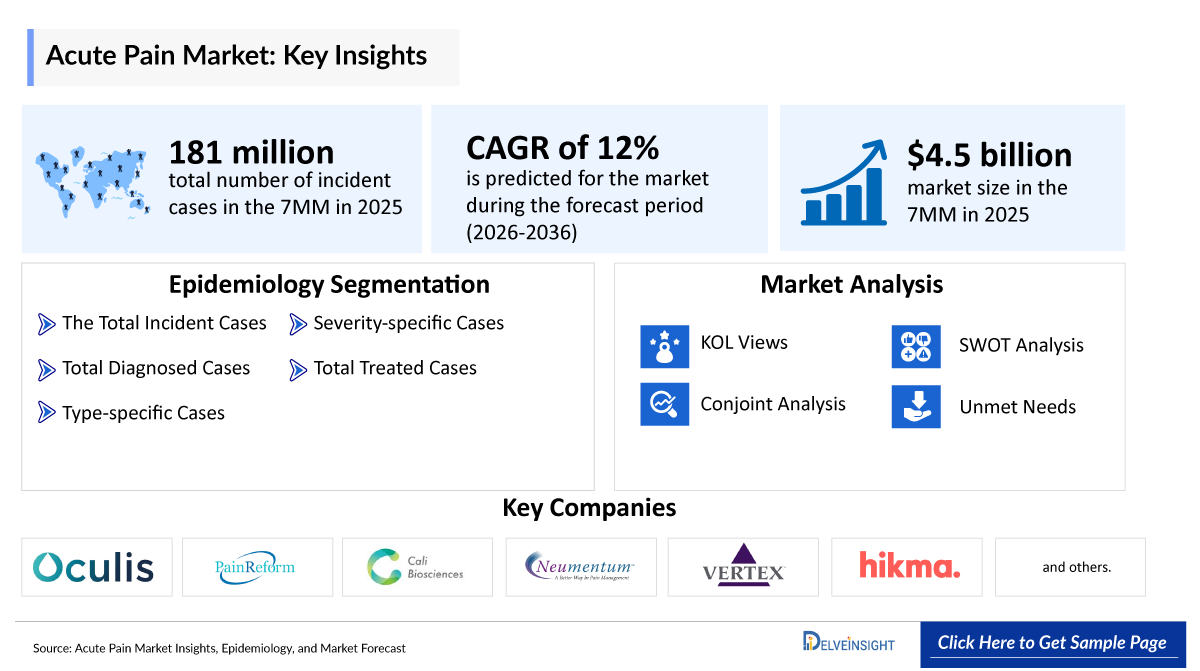
Acute Pain Market Size and Forecast in the 7MM
| 2025 Acute Pain Market Size | ~USD 4,500 million |
| 2036 Projected Acute Pain Market Size | ~USD 15,500 million |
| Acute Pain Growth Rate (2026–2036) | 12% CAGR |
Key Factors Driving the Acute Pain Market
-
Rising Global Disease Burden
Acute Pain represents a significant and widespread healthcare burden globally, arising from injuries, surgeries, trauma, and acute medical conditions, leading to substantial healthcare utilization and reduced quality of life. The high incidence and need for immediate management drive continuous demand for effective and fast-acting pain relief options.
-
Rising Opportunities in Acute Pain
The Acute Pain landscape is evolving with advancements in novel analgesics, non-opioid alternatives, targeted therapies, and improved delivery systems, alongside increasing emphasis on multimodal pain management strategies. Growing awareness of opioid-related risks, supportive guidelines from organizations like the World Health Organization, and rising investments in pain research are further accelerating innovation and expanding treatment opportunities.
DelveInsight’s “Acute Pain Market Insights, Epidemiology, and Market Forecast – 2036” report delivers an in-depth understanding of Acute Pain, historical and forecasted epidemiology as well as Acute Pain therapeutics market trends in the United States, EU4 (Germany, France, Italy, and Spain) and the United Kingdom, and Japan.
The Acute Pain Treatment Market Report provides current treatment practices, emerging drugs, market share of individual therapies, and current and forecasted 7MM Acute Pain market size from 2022 to 2036. The Acute Pain Treatment Market Report also covers current Acute Pain treatment practices/algorithms and unmet medical needs to curate the best opportunities and assess the market’s potential.
Scope of the Acute Pain Market Report | |
|
Study Period |
2022–2036 |
|
Historical Year |
2022–2025 |
|
Forecast Period |
2026–2036 |
|
Geographies Covered |
ü North America : The US; ü Europe: Germany, France, Italy, and Spain and the UK; ü Asia-Pacific: Japan |
|
Acute Pain Market CAGR (Forecast period) | |
|
Acute Pain Epidemiology Segmentation Analysis |
Patient Burden Assessment · Total Incident Cases of Acute Pain · Total Incident Cases of Acute Pain by Type · Severity-Specific Incident Cases of Acute Pain · Total Treated Cases of Acute Pain |
|
Acute Pain Key Companies |
· Oculis · PainReform · Cali Biosciences · Neumentum · Vertex Pharmaceuticals · Hikma Phatmaceuticals, Hyloris Pharmaceuticals, and AFT Pharmaceuticals · Heron Therapeutics, and others |
|
Acute Pain Key Therapies |
· JOURNAVX (suzetrigine) · ZYNRELEF (bupivacaine and meloxicam) · COMBOGESIC/MAXIGESIC (acetaminophen and ibuprofen) · PRF-110 · CPL-01 · NTM-001, and others |
|
Acute Pain Market |
Segmented by · Region/Geographies · Drugs/Therapies |
|
Analysis |
· KOL Views · SWOT Analysis · Reimbursement · Conjoint Analysis · Unmet needs |
Acute Pain Understanding
Acute Pain Overview and Diagnosis
Pain is an unpleasant sensory experience linked to actual or potential tissue damage, which may be acute (sudden and short-term) or chronic (persistent), and varies across individuals due to differences in nerve signaling and brain response. It is evaluated through clinical assessment of symptoms, history, and pain characteristics, supported by investigations such as imaging and laboratory tests.
Standardized pain scales, either unidimensional (measuring intensity) or multidimensional (assessing functional and emotional impact) are used to accurately assess pain and guide effective management.
Further details are provided in the report...
Acute Pain Treatment Landscape
The World Health Organization recommends a stepwise “pain relief ladder” approach, starting with non-pharmacological and non-opioid therapies, progressing to low-dose opioids, and then to stronger opioids for moderate-to-severe pain, with adaptations such as fast-tracking severe cases or adding advanced interventions like nerve blocks.
The primary goal is not complete pain elimination but achieving tolerable pain that allows optimal functioning with minimal risks, often through multimodal analgesia, which combines pharmacological and non-pharmacological strategies acting at different points in the pain pathway to enhance efficacy and reduce opioid reliance.
Non-pharmacological methods such as cold application, compression, physical therapy, yoga, massage, and hypnosis play a key role, particularly in early or mild pain, while pharmacological management includes non-opioids (e.g., NSAIDs, acetaminophen), topical agents, anticonvulsants, ketamine, and short-term opioids for more severe cases, ensuring a balanced and patient-centric approach to pain management.
Further details related to country-based variations are provided in the report...
Acute Pain Unmet Needs
The section “unmet needs of Acute Pain” outlines the critical gaps between the current state of patient care, diagnosis, and the ideal & effective management of the disease. It highlights the obstacles experienced by patients, clinicians, and researchers and identifies potential solutions for future progress.
- Limitations associated with current treatments
- Patient compliance challenges
- Challenges in balancing pain management and side effects
Awareness among clinicians regarding multimodal pain management is lagging behind, and others…..
Note: Comprehensive unmet needs insights in Acute Pain and their strategic implications are provided in the full report...
Acute Pain Epidemiology
The Acute Pain epidemiology section provides insights about the historical and current Acute Pain patient pool and forecasted trends for individual seven major countries. It helps to recognize the causes of current and forecasted trends by exploring numerous studies and views of key opinion leaders. This part of the Acute Pain market report also provides the diagnosed patient pool and their trends along with assumptions undertaken.
Key Findings from Acute Pain Epidemiological Analysis and Forecast
- The total number of incident cases of Acute Pain in the 7MM was around 181,208,000 in 2025.
- The total incident cases of Acute Pain in the US were around 87,410,000 in 2025. These cases are anticipated to increase in the upcoming years.
- In 2025, approximately 13% of the incident cases of Acute Pain were reported in Germany.
- In 2025, type-specific incident cases of Acute Pain in the 7MM comprised 89,907,500; 44,622,400; and 139,849,200 cases for postoperative pain, trauma pain, and acute medical illness, respectively.
- In 2025, there were ~20%; ~15%, and ~10% cases for mild, moderate, and severe, respectively, in Japan out of 7MM.
- In Germany in 2025, approximately 20% of Acute Pain cases were classified as mild, 15% as moderate, and around 10% as severe out of 7MM.
Acute Pain Epidemiology Segmentation
- Total Acute Pain Incident Cases
- Total Acute Pain Incident Cases by Type
- Acute Pain Severity Specific Incident Cases
- Total Acute Pain Treated Cases
Acute Pain Market Recent Breakthroughs and Developments
- In February 2026, Cidara Therapeutics announced MK-1406 (CD388) is currently being evaluated in the Phase III ANCHOR study (NCT07159763).
- In January 2026, Merck announced The company has successfully completed a cash tender offer, conducted via its subsidiary, for the acquisition of all outstanding common shares of Cidara Therapeutics.
- In March 2026, Cocrystalpharma announced The company plan to continue development of oral CC-42344 as a treatment for pandemic and seasonal Acute Pain with an additional Phase IIa study.
- In February 2026, The Committee for Medicinal Products for Human Use (CHMP) has adopted a positive opinion recommending the granting of a marketing authorisation for mCombriax, a vaccine developed by Moderna, for the prevention of influenza disease.
- In April 2025, Roche announced that New England Journal of Medicine (NEJM) has published a detailed analysis of the phase III CENTERSTONE trial of Xofluza showing a reduction in the transmission of influenza viruses.
Acute Pain Drug Analysis & Competitive Landscape
The Acute Pain drug chapter provides a detailed, market-focused review of approved therapies and the emerging pipeline across Phase I–III Acute Pain clinical trials. It covers mechanism of action, clinical trial data, regulatory approvals, patents, collaborations, strategic partnerships upcoming Key catalyst for each therapy, along with their advantages, limitations, and recent developments.
This section offers critical insights into the Acute Pain Treatment Market Landscape, supporting market assessment, competitive analysis, and growth forecasting for the Acute Pain therapeutics market.
Acute Pain Approved Therapies
-
JOURNAVX (suzetrigine): Vertex Pharmaceuticals
JOURNAVX (formally known as VX-548) is a first-in-class, oral, nonopioid, highly selective pain signal inhibitor that is selective for NaV1.8 relative to other NaV channels. Because JOURNAVX blocks pain signals only found in the periphery, not in the brain, JOURNAVX provides effective relief of pain without the limitations of currently available therapies, including the addictive potential of opioids.
-
- In January 2025, the US FDA approved JOURNAVX to treat moderate- to-severe Acute Pain in adults. JOURNAVX reduces pain by targeting a pain-signaling pathway involving sodium channels in the peripheral nervous system, before pain signals reach the brain. Launch of this drug in the US is underway.
-
ZYNRELEF (bupivacaine and meloxicam): Heron Therapeutics
ZYNRELEF (formerly known as HTX-011) (bupivacaine and meloxicam) contains bupivacaine, a local amide anesthetic, and meloxicam, a NSAID, and is indicated in adults for soft tissue or periarticular instillation to produce postsurgical analgesia for up to 72 h after a bunionectomy, open inguinal herniorrhaphy, and total knee arthroplasty. It is the first and only extended-release Dual-acting Local Anesthetic (DALA) and delivers 72 h of postoperative pain relief via a single needle-free application. It is formulated in Heron’s proprietary controlled-diffusion Biochronomer polymer for consistently regulated delivery of bupivacaine and meloxicam.
-
- In May 2021, the US FDA approved ZYNRELEF (bupivacaine and meloxicam) extended-release solution for adults for soft tissue or periarticular instillation to produce postsurgical analgesia for up to 72 h after a bunionectomy, open inguinal herniorrhaphy, and total knee arthroplasty.
Competitive Landscape of Marketed Acute Pain Therapies | |||
|
|
Company |
Indication |
|
|
|
Vertex Pharmaceuticals |
Moderate to severe Acute Pain in adults |
|
|
|
Heron Therapeutics |
Postoperative pain (To produce postsurgical analgesia after a bunionectomy, open inguinal herniorrhaphy, and total knee arthroplasty) |
|
|
|
Hikma Phatmaceuticals, Hyloris Pharmaceuticals, and AFT Pharmaceuticals |
Postoperative pain |
|
Note: Detailed marketed therapies assessment will be provided in the final report...
Acute Pain Pipeline Analysis
-
NTM-001: Neumentum
NTM-001 is a novel, alcohol-free formulation of the non-steroidal anti-inflammatory drug (NSAID), ketorolac, in a pre-mixed bag for continuous infusion over 24 h. The Phase III program is designed to achieve a broad indication for NTM-001 in the short-term management of moderately severe Acute Pain that requires analgesia at the opioid level, usually in the postoperative setting. NEMA research collaborated with Neumentum to carefully design and conduct the NTM-001 study.
-
CPL-01: Cali Biosciences
CPL-01 is a sustained-release injectable formulation of ropivacaine hydrochloride. Ropivacaine is a member of the amide class of local anesthetics indicated for the production of local or regional anesthesia for surgery and Acute Pain management. Ropivacaine hydrochloride injection is approved for local or regional anesthesia for surgery and Acute Pain management.
However, because of the short duration of effect of the traditional ropivacaine hydrochloride injection, infusion by catheter is required if protracted local analgesia is needed for postoperative pain management. Cali Biosciences has applied PG-Depot, a versatile drug delivery platform, in developing CPL-01 to prolong the duration of local site analgesic effect after a single local administration.
Competitive Landscape: Acute Pain Emerging Therapies | ||||||
|
Drug Name |
Company |
Highest Phase |
Indication |
RoA |
MoA |
Anticipated Launch in the US |
|
PRF-110 |
PainReform |
III |
Post-surgical pain following Unilateral Bunionectomy |
Intraoperative instillation |
Localized and extended postoperative analgesia |
Information is available in the full report |
|
CPL-01 |
Cali Biosciences |
III |
Postoperative pain after open inguinal herniorrhaphy, |
Infiltration into the surgical site |
Sodium channel antagonists |
Information is available in the full report |
|
NTM-001 |
Neumentum |
III |
postoperative pain after unilateral distal first metatarsal bunionectomy + osteotomy, |
IV infusion |
COX 1/2 inhibitors |
Information is available in the full report |
|
Note: Launch insights are provisional and may change with future report updates or the occurrence of major key catalysts. | ||||||
Acute Pain Companies
- Oculis
- PainReform
- Cali Biosciences
- Neumentum
- Vertex Pharmaceuticals
- Hikma Pharmaceuticals, Hyloris Pharmaceuticals, and AFT Pharmaceuticals
- Heron Therapeutics, and others.
Acute Pain Market Outlook
Acute Pain typically lasts less than seven days but can extend up to 30 days depending on the condition, and may recur periodically. In some cases, it persists and progresses to chronic pain. Pain is the most common reason for emergency department visits and is frequently managed in primary care, outpatient, and inpatient settings.
Management of Acute Pain is individualized, aiming to relieve pain, improve function and quality of life, and support recovery while minimizing adverse effects and avoiding opioid overuse. Effective treatment may also reduce the risk of chronic pain development, though gaps in care remain. Factors such as age, sex, race/ethnicity, pain severity, comorbidities, genetic traits, pregnancy or breastfeeding status, and the clinical setting all influence treatment decisions.
Non-pharmacological methods can effectively manage Acute Pain, either alone or with analgesics, depending on severity, availability, and patient preference. Early-phase pain can be treated with cold application, compression, elevation, and immobilization. For late-phase pain, physical therapy, yoga, massage, and hypnosis can provide relief.
Physical therapy improves mobility, yoga helps with back pain, massage reduces muscle pain and stress, and hypnosis promotes relaxation. These approaches help recovery and minimize reliance on medications.
Acute Pain, often nociceptive, responds to non-opioids like acetaminophen, NSAIDs, and topical agents for mild-to-moderate pain, while opioids are used for moderate-to-severe pain at lower doses. NSAIDs and acetaminophen manage pain without causing addiction, though they can have side effects like gastrointestinal or kidney issues. Topical agents like capsaicin offer short-term relief with fewer side effects. Anticonvulsants are effective for neuropathic pain, and ketamine is increasingly used for Acute Pain. For opioid treatment, short-acting options like oxycodone and hydrocodone are common.
The use of NSAIDs in Acute Pain management, while effective, poses significant risks of severe side effects such as gastrointestinal bleeding, renal impairment, and cardiovascular complications, especially when prescribed for prolonged periods or in high doses. These risks highlight the need for cautious use and close monitoring in patients.
Further details will be provided in the report...
Acute Pain Drug Class/Insights into Leading Emerging and Marketed Therapies (2026–2036 Forecast)
Small molecules: Small-molecule therapies for Acute Pain target key pathways involved in pain signaling and inflammation to provide rapid symptom relief. These agents, including NSAIDs, acetaminophen, and certain opioids, act by inhibiting inflammatory mediators, modulating nociceptive pathways, or altering central pain perception, thereby reducing pain intensity and improving patient comfort in acute settings.
Acute Pain Drug Uptake
This section focuses on the uptake rate of potential Acute Pain drugs expected to be launched in the market during 2022–2036. The landscape of Acute Pain treatment has experienced a profound transformation with the uptake of novel drugs. These innovative therapies are redefining standards of care.
Furthermore, the increased uptake of these transformative drugs is a testament to the unwavering dedication of physicians, professionals, and the entire healthcare community in their tireless pursuit of advancing disease care. This momentous shift in treatment paradigms is a testament to the power of research, collaboration, and human resilience.
Detailed insights of emerging therapies' drug uptake is included in the report..
Acute Pain Market Access and Reimbursement of Approved Therapies
The report further provides detailed insights on the country-wise accessibility and reimbursement scenarios, cost-effectiveness scenario of currently used therapies, programs making accessibility easier and out-of-pocket costs more affordable, insights on patients insured under federal or state government prescription drug programs, etc.
The United States
US Reimbursement of Therapies Approved for Acute Pain | |
|
Drug/Therapy |
Access Program |
|
JOURNAVX |
· JOURNAVX (suzetrigine) Co-pay Assistance Program · Patient Assistance Program (PAP) · JOURNAVX Savings Card |
NOTE: Further Details are provided in the final report...
Acute Pain Therapies Price Scenario & Trends
Pricing and analogue assessment of Acute Pain Therapies highlights evolving price dynamics structures. This section summarizes the cost of approved treatments, closest and most appropriate analogue selection for emerging therapies, and understanding of how pricing influences market access, adherence, and long-term uptake.
Acute Pain Industry Experts and Physician Views
To keep up with Acute Pain Therapeutics Market Trends, we take Key Opinion Leaders (KOLs) and Subject Matter Experts (SMEs) opinions working in the domain through primary research to fill the data gaps and validate our secondary research. Industry experts were contacted for insights on the Acute Pain emerging therapies, evolving treatment landscape, patient adherence to conventional therapies, therapy switching trends, drug adoption and uptake, accessibility challenges, and epidemiology and real-world prescription patterns in Influenza and others.
DelveInsight’s analysts connected with 15+ KOLs to gather insights at country level. Centers such as the Medicine at Harvard Medical School in the US, Oxford University in the UK, University of California, San Francisco, and University of Heidelberg in Germany, etc. were contacted.Their opinion helps understand and validate current and emerging Acute Pain therapies, highlight unmet medical needs, provide epidemiological context, and support strategic decisions for market access, therapy adoption, and pipeline prioritization in Acute Pain.
|
Region |
Key Opinion Leaders (KOLs) and Subject Matter Experts (SMEs) |
|
United States |
“The perioperative setting provides a unique opportunity for the prevention of chronic postsurgical pain. Research now supports the use of multimodal analgesia combining NSAIDs, local anesthetics, and adjunctive agents to target different nociceptive pathways. However, more consistent implementation and clinician education are needed to translate these protocols into everyday practice.” |
|
“Opioid prescribing after surgical procedures remains significantly higher compared to other countries. Despite similar pain levels, opioid use varies little, underscoring the need for broader adoption of nonopioid and multimodal analgesic strategies. Therapies such as Exparel, NSAIDs, radiofrequency nerve ablation, and neurostimulation are increasingly integrated into pain management protocols. However, closing the gap in opioid utilization between the US and other nations remains a critical challenge.” |
Acute Pain Report Qualitative Analysis: SWOT and Conjoint Analysis
We perform qualitative and Acute Pain Therapeutics Market Intelligence analysis using various approaches, such as SWOT analysis and conjoint analysis. In the SWOT analysis of Acute Pain , strengths, weaknesses, opportunities, and threats in terms of disease diagnosis, patient awareness, patient burden, competitive landscape, cost-effectiveness, and geographical accessibility of therapies are provided.
Conjoint analysis analyzes emerging therapies based on relevant attributes such as safety, efficacy, frequency of administration, route of administration, and order of entry. Scoring is given based on these parameters to analyze the effectiveness of therapy.
The team of analysts analyzes promising Acute Pain Emerging Therapies based on relevant attributes such as safety, efficacy, frequency of administration, route of administration, and order of entry. In efficacy, the trial’s primary and secondary outcome measures are evaluated, whereas the therapies’ safety is evaluated, wherein the acceptability, tolerability, and adverse events are majorly observed.
In addition, the scoring is also based on the route of administration, order of entry, probability of success, and the addressable patient pool for each therapy. According to these parameters, the final weightage score and the ranking of the emerging therapies are decided.
Scope of the Acute Pain Market Report
- The Acute Pain Therapeutics Market Report covers a segment of key events, an executive summary, a descriptive overview, explaining their causes, signs and symptoms, pathogenesis, and currently available treatments.
- Comprehensive insight has been provided into the epidemiology segments and forecasts, the future growth potential of the diagnosis rate, and disease progression along Acute Pain Treatment guidelines.
- Additionally, an all-inclusive account of both the current and emerging treatments, along with the elaborative profiles of late-stage and prominent therapies, will have an impact on the current Acute Pain Treatment landscape.
- A detailed review of the Acute Pain Therapeutics Market, historical and forecasted Acute Pain Treatment Market Size, Acute Pain Drugs Market Share by therapies, detailed assumptions, and rationale behind our approach is included in the report, covering the 7MM drug outreach.
- The Acute Pain Therapeutics Market Report provides an edge while developing business strategies by understanding trends through SWOT analysis and expert insights/KOL views, patient journey, and treatment preferences that help in shaping and driving the 7MM Acute Pain Drugs Market.
Acute Pain Market Report Insights
- Acute Pain Patient Population Forecast
- Acute Pain Therapeutics Market Size
- Acute Pain Pipeline Drugs Analysis
- Acute Pain Market Size and Trends
- Acute Pain Market Opportunity (Current and forecasted)
Acute Pain Market Report Key Strengths
- Epidemiology based (Epi based) Bottom up Forecasting
- Artificial Intelligence (AI)-Enabled Market Research Report
- 11-Year Forecast
- Acute Pain Market Outlook (North America, Europe, Asia-Pacific)
- Patient Burden Trends (By Geography)
- Acute Pain Treatment Addressable Market (TAM)
- Acute Pain Competitive Landscape
- Acute Pain Major Companies Insights
- Acute Pain Price Trends and Analogue Assessment
- Acute Pain Therapies Drug Adoption/Uptake
- Acute Pain Therapies Peak Patient Share Analysis
Acute Pain Market Report Assessment
- Current Acute Pain Treatment Practices
- Acute Pain Unmet Needs
- Acute Pain Clinical Development Analysis
- Acute Pain Emerging Drugs Product Profiles
- Acute Pain Therapeutics Market Attractiveness
- Acute Pain Qualitative Analysis (SWOT and conjoint analysis)
- Acute Pain Market Drivers
- Acute Pain Market Barriers
Key Questions Answered in the Acute Pain Treatment Market Report
Acute Pain Therapeutics Market Insights
- What was the Acute Pain Market Size, the Acute Pain Treatment Market Size by therapies, Acute Pain Drugs Market Share (%) distribution in 2025, and what would it look like by 2036? What are the contributing factors for this growth?
- What are the anticipated pricing variations among different geographies for the emerging therapies in the future?
- What can be the future treatment paradigm of Acute Pain?
- What are the disease risks, burdens, and unmet needs of Acute Pain?
- What will be the growth opportunities across the 7MM concerning the Acute Pain patient population?
- Who is the major future competitor in the market, and how will the competitors affect their market share?
- What are the current options for the treatment of Acute Pain?
- What are the current guidelines for treating Acute Pain in the US, Europe, and Japan?
Reasons to Buy Acute Pain Market Forecast Report
- The Acute Pain Therapeutics Market Report will help in developing business strategies by understanding the latest trends and changing treatment dynamics driving the Acute Pain Drugs Market.
- Bottom up forecasting builds from the affected population to product forecasts, delivering a robust, data driven approach ideal for new therapies and novel classes.
- Insights on patient burden/disease Acute Pain Incidence, evolution in diagnosis, and factors contributing to the change in the epidemiology of the disease during the forecast years.
- Understand the existing market opportunities in varying geographies and the growth potential over the coming years.
- Identifying strong upcoming players in the Acute Pain Drugs Market will help devise strategies to help get ahead of competitors.
- Detailed analysis and ranking of class-wise potential current and Acute Pain Emerging Therapies under the conjoint analysis section to provide visibility around leading classes.
- To understand KOLs’ perspectives on the accessibility, acceptability, and compliance-related challenges of existing treatment to overcome barriers in the future.
- Detailed insights on the unmet needs of the existing Acute Pain Drugs Market so that the upcoming players can strengthen their development and launch strategy.
- This Artificial Intelligence (AI) enabled report summarize and simplify complex datasets with in the report into clear, actionable insights for stakeholders, investors, and healthcare providers, enabling faster, data driven decisions.
Stay updated with us for Recent Articles