-pipeline.png&w=256&q=75)
Age-related macular degeneration (AMD) Pipeline Insight
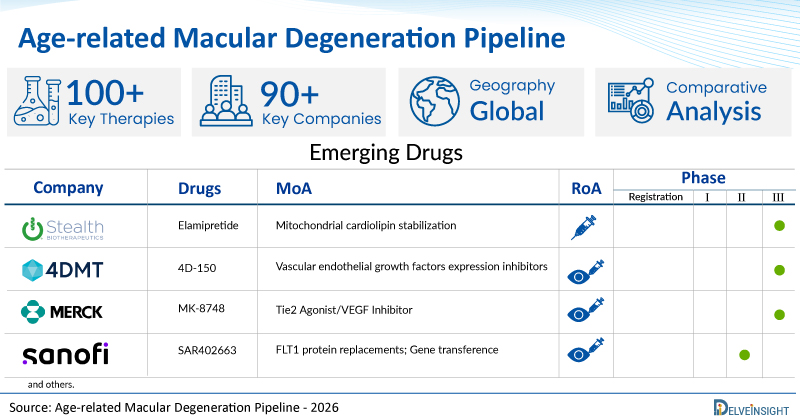
DelveInsight’s, “Age-related Macular Degeneration (AMD) Pipeline Insight, 2026” report provides comprehensive insights about 90+ companies and 100+ pipeline drugs in Age-related Macular Degeneration (AMD) pipeline landscape. It covers the pipeline drug profiles, including clinical and nonclinical stage products. It also covers the therapeutics assessment by product type, stage, route of administration, and molecule type. It further highlights the inactive pipeline products in this space.
Geography Covered
- Global coverage
Age-related Macular Degeneration Understanding
Age-related Macular Degeneration Overview
Age-related macular degeneration (AMD) is a progressive disorder of the macula and a leading cause of central vision loss in the elderly population. It primarily affects the outer retina, including photoreceptors and the retinal pigment epithelium (RPE), with early accumulation of drusen indicating impaired cellular waste clearance. As the disease advances, chronic inflammation, reduced choroidal blood flow, and RPE dysfunction contribute to photoreceptor degeneration and vision decline. Clinically, AMD progresses from early to late stages, manifesting as the slower dry form (geographic atrophy) or the more aggressive wet (neovascular) form driven by abnormal blood vessel growth. Patients typically experience central visual disturbances such as blurriness, distortion, or scotomas, while peripheral vision remains preserved, with symptoms often worsening rapidly in wet AMD due to fluid leakage or hemorrhage.
The pathophysiology of age-related macular degeneration (AMD) involves a gradual, multifactorial deterioration of the outer retina driven by cumulative stress on the retinal pigment epithelium (RPE), dysfunction of Bruch’s membrane, and progressive drusen accumulation. Age-related RPE damage compromises its role in maintaining retinal homeostasis, leading to impaired waste clearance, oxidative stress, and activation of chronic inflammatory pathways. These changes disrupt nutrient and oxygen exchange between the choroid and photoreceptors, accelerating cellular injury. Over time, this cascade results either in geographic atrophy marked by RPE and photoreceptor loss in dry AMD, or in pathological angiogenesis in wet AMD. In the latter, upregulation of vascular endothelial growth factor (VEGF) drives abnormal, fragile blood vessel formation, causing leakage, hemorrhage, and eventual scarring of the retina.
The diagnosis of age-related macular degeneration (AMD) is based on a combination of clinical assessment and advanced retinal imaging. It begins with a thorough patient history and dilated fundus examination to detect hallmark features such as drusen, pigmentary changes, geographic atrophy, or signs of neovascularization. Functional evaluation using visual acuity testing and tools like the Amsler grid helps identify central vision distortion or loss. Imaging modalities, particularly optical coherence tomography (OCT) and fundus photography, play a critical role in confirming structural changes, distinguishing dry AMD from wet AMD characterized by fluid accumulation, hemorrhage, and choroidal neovascularization.
The treatment of age-related macular degeneration (AMD) depends on the disease subtype, with distinct approaches for wet and dry forms. Wet AMD is primarily managed with intravitreal anti-VEGF agents such as aflibercept, which suppress abnormal retinal blood vessel growth and help preserve vision through tailored dosing schedules. In dry AMD, there is currently no definitive cure, and management focuses on disease monitoring, lifestyle modifications, and nutritional support with AREDS2 supplementation. More recently, complement inhibitors have been introduced for geographic atrophy, while several novel therapies targeting underlying disease pathways continue to be explored in clinical development.
"Age-related Macular Degeneration (AMD) Pipeline Insight, 2026" report by DelveInsight outlays comprehensive insights of present scenario and growth prospects across the indication. A detailed picture of the Age-related Macular Degeneration (AMD) pipeline landscape is provided which includes the disease overview and Age-related Macular Degeneration (AMD) treatment guidelines. The assessment part of the report embraces, in depth Age-related Macular Degeneration (AMD) commercial assessment and clinical assessment of the pipeline products under development. In the report, detailed description of the drug is given which includes mechanism of action of the drug, clinical studies, NDA approvals (if any), and product development activities comprising the technology, Age-related Macular Degeneration (AMD) collaborations, licensing, mergers and acquisition, funding, designations and other product related details.
Find out more about age-related macular degeneration drug development @ Age-related Macular Degeneration Treatment
Age-related Macular Degeneration Pipeline Report Highlights
The companies and academics are working to assess challenges and seek opportunities that could influence Age-related Macular Degeneration (AMD) R&D. The therapies under development are focused on novel approaches to treat/improve Age-related Macular Degeneration (AMD).
Age-related Macular Degeneration Emerging Drugs Analysis
This segment of the Age-related Macular Degeneration (AMD) report encloses its detailed analysis of various drugs in different stages of clinical development, including Phase III, II, I, Preclinical and Discovery. It also helps to understand clinical trial details, expressive pharmacological action, agreements and collaborations, and the latest news and press releases.
Age-related Macular Degeneration Emerging Drugs
Elamipretide: Stealth BioTherapeutics
Elamipretide is a mitochondria-targeted peptide developed to enhance cellular energy generation and limit oxidative stress, both of which play a significant role in age-related macular degeneration. It acts by stabilizing cardiolipin within the inner mitochondrial membrane, thereby supporting the function of photoreceptors and retinal pigment epithelium cells. In AMD, especially the dry form, this approach is intended to slow retinal deterioration and help maintain visual function over time. The therapy is currently under evaluation in a Phase III clinical trial for patients with age-related macular degeneration.
4D-150: 4D Molecular Therapeutics
4D-150 is an investigational intravitreal gene therapy being developed for neovascular (wet) age-related macular degeneration (AMD). It uses a customized AAV vector to deliver genes encoding anti-VEGF biologics, enabling sustained intraocular production of therapeutic proteins. By providing long-term suppression of VEGF, it aims to reduce treatment burden and control retinal fluid and neovascularization. The therapy is currently in Phase III stage of its clinical development.
MK-8748: Merck
MK-8748 (Tiespectus) is an investigational bispecific antibody being developed for neovascular (wet) age-related macular degeneration (AMD). It simultaneously activates the Tie2 pathway and inhibits vascular endothelial growth factor (VEGF), targeting vascular instability and leakage in the retina. This dual mechanism aims to stabilize retinal blood vessels, reduce fluid accumulation, and preserve visual function. The therapy is currently being evaluated in a pivotal Phase IIb/III clinical trial (MALBEC) for patients with wet AMD.
SAR402663: Sanofi
SAR402663 is an investigational one-time intravitreal gene therapy being developed for neovascular (wet) age-related macular degeneration (AMD). It delivers genetic material encoding soluble FLT01, which inhibits vascular endothelial growth factor (VEGF) to suppress abnormal blood vessel growth. By reducing vascular leakage and retinal damage, it aims to preserve vision and address the underlying disease pathology. The therapy is currently in Phase II clinical evaluation and has received fast track designation from the FDA.
Xelafaslatide: ONL Therapeutics
Xelafaslatide is an investigational first-in-class small molecule Fas inhibitor being developed for geographic atrophy associated with dry age-related macular degeneration (AMD). It works by blocking Fas-mediated cell death pathways, thereby protecting retinal cells such as photoreceptors from degeneration. By preserving retinal structure, it aims to slow disease progression and maintain visual function. The therapy is currently being evaluated in a global Phase II clinical trial for patients with dry AMD-related geographic atrophy.
HG202: HuidaGene Therapeutics
HG202 is an investigational CRISPR/Cas13-based RNA-editing therapy being developed for neovascular (wet) age-related macular degeneration (AMD). It utilizes a single AAV vector to deliver RNA-editing machinery that selectively knocks down VEGF-A mRNA, a key driver of abnormal blood vessel growth. By reducing VEGF expression, it aims to inhibit choroidal neovascularization and provide a durable, potentially one-time treatment option. The therapy is currently in early Phase I clinical evaluation following FDA IND clearance.
Learn more about the emerging age-related macular degeneration therapies @ Age-related Macular Degeneration Clinical Trials
Age-related Macular Degeneration Drug Therapeutic Assessment
This segment of the report provides insights about the different Age-related Macular Degeneration (AMD) drugs segregated based on following parameters that define the scope of the report, such as:
Major Age-related Macular Degeneration Players in Age-related Macular Degeneration
There are approx. 90+ key companies which are developing the therapies for Age-related Macular Degeneration (AMD). The companies which have their Age-related Macular Degeneration (AMD) drug candidates in the most advanced stage, i.e. Phase III include, Stealth BioTherapeutics.
Age-related Macular Degeneration Clinical Trial Phases
DelveInsight’s report covers around 100+ products under different phases of clinical development like
- Late stage products (Phase III)
- Mid-stage products (Phase II)
- Early-stage product (Phase I) along with the details of
- Pre-clinical and Discovery stage candidates
- Discontinued & Inactive candidates
Age-related Macular Degeneration Drug Route of Administration
Age-related Macular Degeneration (AMD) pipeline report provides the therapeutic assessment of the pipeline drugs by the Route of Administration. Products have been categorized under various ROAs such as
- Oral
- Intravenous
- Subcutaneous
- Parenteral
- Topical
Age-related Macular Degeneration Product Molecule Type
Products have been categorized under various Molecule types such as
- Recombinant fusion proteins
- Small molecule
- Monoclonal antibody
- Peptide
- Polymer
- Gene therapy
Age-related Macular Degeneration Product Type
Drugs have been categorized under various product types like Mono, Combination and Mono/Combination.
For further information on the age-related macular degeneration cure research, reach out @ Medication for Age-related Macular Degeneration Treatment
Age-related Macular Degeneration Clinical Trial Activities
The Age-related Macular Degeneration Pipeline report provides insights into different Age-related Macular Degeneration Clinical Trial within Phase III, II, I, preclinical and discovery stage. It also analyses Age-related Macular Degeneration (AMD) therapeutic drugs key players involved in developing key drugs.
Age-related Macular Degeneration Pipeline Development Activities
The Age-related Macular Degeneration Clinical Analysis report covers the detailed information of collaborations, acquisition and merger, licensing along with a thorough therapeutic assessment of emerging Age-related Macular Degeneration (AMD) drugs.
Age-related Macular Degeneration Pipeline Report Insights
- Age-related Macular Degeneration Pipeline Analysis
- Age-related Macular Degeneration Therapeutic Assessment
- Age-related Macular Degeneration Unmet Needs
- Impact of Age-related Macular Degeneration Drugs
Age-related Macular Degeneration Pipeline Report Assessment
- Age-related Macular Degeneration Pipeline Product Profiles
- Age-related Macular Degeneration Therapeutic Assessment
- Age-related Macular Degeneration Pipeline Assessment
- Age-related Macular Degeneration Inactive drugs assessment
- Age-related Macular Degeneration Market Unmet Needs
Key Questions Answered In the Age-related Macular Degeneration Pipeline Report
- Current Treatment Scenario and Emerging Therapies:
- How many companies are developing Age-related Macular Degeneration (AMD) drugs?
- How many Age-related Macular Degeneration (AMD) drugs are developed by each company?
- How many emerging drugs are in mid-stage, and late-stage of development for the treatment of Age-related Macular Degeneration (AMD)?
- What are the key collaborations (Industry–Industry, Industry–Academia), Mergers and acquisitions, licensing activities related to the Age-related Macular Degeneration (AMD) therapeutics?
- What are the recent trends, drug types and novel technologies developed to overcome the limitation of existing therapies?
- What are the clinical studies going on for Age-related Macular Degeneration (AMD) and their status?
- What are the key designations that have been granted to the emerging drugs?
Age-related Macular Degeneration Key Players
- Stealth BioTherapeutics
- Sanofi
- Merck
- HuidaGene Therapeutics
- ONL Therapeutics
- Molecular Therapeutics
- Evergreen Therapeutics
- Caregen Co. Ltd.
- SCAI Therapeutics
- Frontera Therapeutics
- Chengdu Origen Biotechnology Co., Ltd.
- BenoBio
- Skyline Therapeutics
- Perceive Biotherapeutics
- Sinocelltech Ltd.
- Tangram Therapeutics
- Character Biosciences
- Amarna Therapeutics
- Avirmax Biopharma
- Galimedix Therapeutics
- Rallybio
- Ikarovec
- 4P Pharma
- Surrozen
- Beacon Therapeutics
- Ray Therapeutics
Age-related Macular Degeneration Key Products
- Elamipretide
- SAR402663
- MK-8748
- HG202
- Xelafaslatide
- 4D-150
- EG-301
- CG-P5
- SCAI 010
- FT-003
- KH658
- BBC1501
- SKG0106
- VOY-101
- SCT520FF
- TGM-407
- CTX203
- AMA004
- ABI-201
- GAL-101
- RLYB114
- IKAR-002
- 4P020
- SZN-8141
- BTX-001
- RTX-021