Artificial Cornea and Corneal Implant Market Summary
- The Artificial Cornea and Corneal Implant market is estimated at USD 320 million in 2025 and is projected to reach USD 720 million by 2034. Growth is anchored in the rising global burden of corneal blindness, the persistent shortage of donor corneas, and rapid innovation in keratoprostheses, bioengineered corneas, and regenerative implants.
- The global Artificial Cornea and Corneal Implant market is growing at a CAGR of 9.5% during the forecast period from 2026 to 2034.
- By product type, the artificial cornea (keratoprosthesis) segment dominated the Artificial Cornea and Corneal Implant market with a 42% share in 2025.
- By material type, the polymer-based segment dominated the Artificial Cornea and Corneal Implant market with a share of 40% in 2025.
- By technology, the synthetic keratoprosthesis segment dominated the Artificial Cornea and Corneal Implant market with a share of 45% in 2025.
- By distribution channel, the direct sales segment dominated the Artificial Cornea and Corneal Implant market with a share of 38% in 2025.
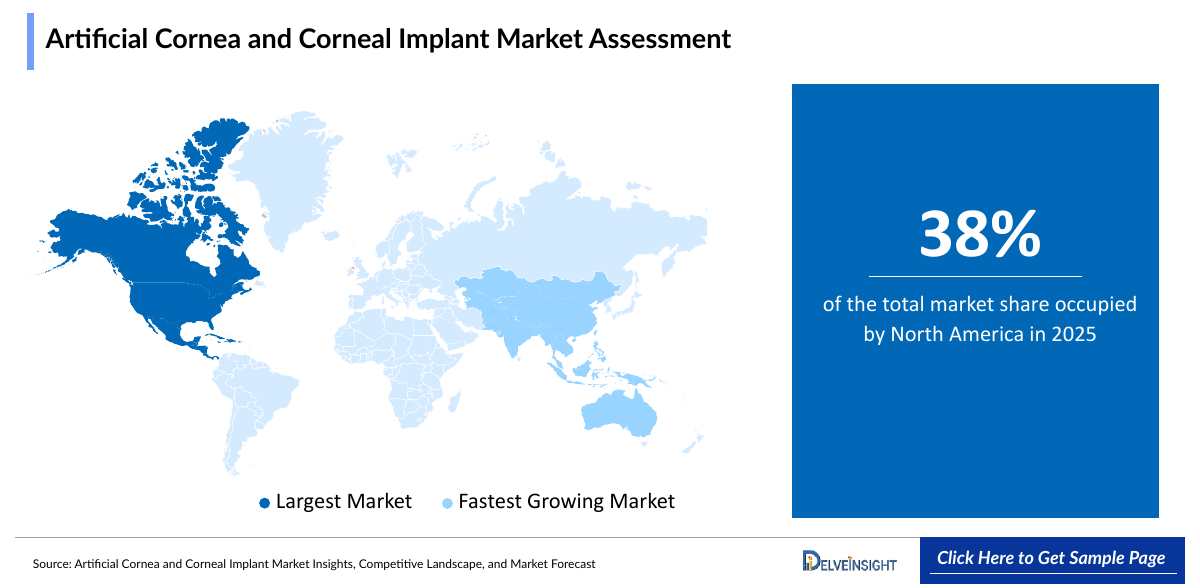
- North America dominated the global Artificial Cornea and Corneal Implant market revenue with a share of 38% in 2025, representing the highest regional market share globally.
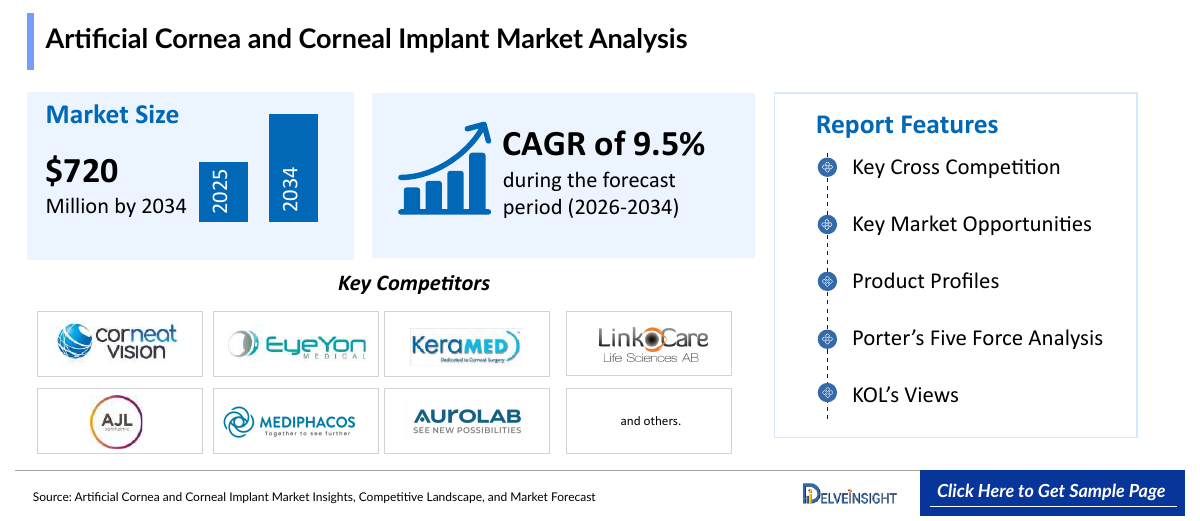
Artificial corneas and corneal implants are devices and bioengineered tissues used to restore vision in patients with corneal blindness or disease when donor corneal transplantation is unavailable, has failed, or is contraindicated. The category spans artificial corneas, or keratoprostheses, such as the Boston Keratoprosthesis and osteo-odonto-keratoprosthesis; corneal implants; bioengineered corneal implants derived from engineered or regenerative tissue; and synthetic corneal implants. These devices are made from polymer-based, collagen-based, hydrogel-based, biomimetic, and composite materials, and are produced using synthetic keratoprosthesis, tissue-engineered, three-dimensional bioprinted, and regenerative approaches. The field is served by specialized and emerging companies including CorNeat Vision, EyeYon Medical, KeraMed, LinkoCare Life Sciences, DIOPTEX, AJL Ophthalmic, and Mediphacos, alongside tissue and regenerative innovators such as Precise Bio and established eye-care organizations. Artificial corneas and corneal implants address corneal blindness caused by infection, injury, chemical burns, failed grafts, and disease, and are distributed through direct sales, medical device distributors, hospital procurement, and specialty ophthalmology suppliers. Over the past decade, the field has advanced from established keratoprostheses toward bioengineered, synthetic, and regenerative corneas designed to overcome the shortage of donor tissue and expand access. Driven by the large burden of corneal blindness, the shortage of donor corneas, and rapid technological innovation, the artificial cornea and corneal implant market is an emerging and fast-growing segment of ophthalmic devices.
Artificial Cornea and Corneal Implant Market Key Growth Drivers
- The large global burden of corneal blindness, a leading cause of vision loss affecting millions of people, is expanding demand for artificial corneas and corneal implants.
- The persistent and severe shortage of donor corneas relative to the need for transplantation is driving demand for artificial and bioengineered alternatives.
- Rapid innovation in keratoprostheses, bioengineered corneas, synthetic implants, and regenerative approaches is expanding treatment options.
- The rising incidence of corneal disease, injury, infection, and failed grafts is increasing the population requiring corneal restoration.
- Advances in biomaterials, tissue engineering, and three-dimensional bioprinting are improving implant performance and expanding possibilities.
- Expanding ophthalmic care access and awareness, particularly in emerging markets with high corneal blindness burden, is broadening demand.
- The convergence of corneal blindness burden, donor shortage, and technological innovation is expected to sustain strong growth in the global Artificial Cornea and Corneal Implant market through 2034.
Key Companies in Artificial Cornea and Corneal Implant Market
The competitive landscape is led by the following active developers and manufacturers of artificial corneas and corneal implants:
- CorNeat Vision Ltd.
- EyeYon Medical Ltd.
- KeraMed, Inc.
- LinkoCare Life Sciences AB
- DIOPTEX GmbH
- AJL Ophthalmic S.A.
- Mediphacos Ltda.
- Aurolab
- Precise Bio, Inc.
- CorneaGen Inc.
For illustrative purposes, only the top 10 companies are listed in the Table of Contents. The report may include analysis and references to additional companies relevant to the market assessment.
Artificial Cornea and Corneal Implant Market Size
The following snapshot summarizes the principal report metrics for the Artificial Cornea and Corneal Implant market.
|
Report Metrics |
Details |
|
2025 Market Size |
USD 320 million |
|
2034 Projected Market Size |
USD 720 million |
|
Growth Rate (2026-2034) |
9.5% CAGR |
|
Largest Market |
North America |
|
Fastest Growing Market |
Asia-Pacific |
|
Market Structure |
Fragmented |
All market values are expressed in USD and represent DelveInsight estimates synthesized from primary and secondary research.
Factors Contributing to the Growth of the Artificial Cornea and Corneal Implant Market
Market Drivers
Large Global Burden of Corneal Blindness
The large global burden of corneal blindness is the foundational driver of the artificial cornea and corneal implant market. Corneal disease is a leading cause of blindness and visual impairment worldwide, affecting millions of people, with a disproportionate burden in low- and middle-income countries, caused by infection, trauma, chemical burns, nutritional deficiency, and other conditions. Corneal transplantation is the standard treatment, but artificial corneas and corneal implants are essential for patients who are poor candidates for donor grafts, have experienced graft failure, or lack access to donor tissue. The large and growing population with corneal blindness, much of which is treatable, represents a substantial and underserved need that artificial and bioengineered corneas aim to address. As the burden of corneal blindness persists and access to restoration expands, demand for artificial corneas and corneal implants continues to grow, reinforcing sustained market growth throughout the forecast period.
Severe Shortage of Donor Corneas
The persistent and severe shortage of donor corneas is a defining driver of the market. The global demand for corneal transplantation vastly exceeds the supply of donor corneas, with estimates indicating that only a small fraction of the need is met and that a large majority of people requiring a corneal transplant lack access to donor tissue. This profound shortage, driven by limited eye banking infrastructure, donation rates, and distribution, particularly in developing regions, creates a compelling need for artificial and bioengineered corneas that do not depend on donor tissue. Keratoprostheses, synthetic implants, and bioengineered corneas directly address this gap. As the donor cornea shortage persists and bioengineered and synthetic alternatives advance, this unmet need is expected to be a leading driver of market growth across the forecast period, particularly in regions with limited access to donor tissue.
Rapid Innovation in Artificial and Bioengineered Corneas
Rapid innovation in keratoprostheses, bioengineered corneas, synthetic implants, and regenerative approaches is a defining driver of the market. Established keratoprostheses such as the Boston Keratoprosthesis have been joined by a wave of innovation, including CorNeat Vision's synthetic artificial cornea, EyeYon Medical's implants, bioengineered corneas from companies such as LinkoCare, and tissue-engineered and three-dimensional bioprinted corneas from innovators such as Precise Bio. These technologies aim to overcome the limitations of donor transplantation and earlier devices, improving biointegration, reducing complications, and expanding candidacy. Clinical progress and regulatory milestones for several novel devices are advancing the field toward broader use. As innovation continues to expand the range and performance of artificial and bioengineered corneas, technological advancement is expected to be a significant driver of market growth and transformation across the forecast period.
Rising Incidence of Corneal Disease and Graft Failure
The rising incidence of corneal disease, injury, infection, and failed grafts is a substantial driver of the market. Corneal conditions, including infectious keratitis, chemical and thermal injuries, keratoconus, dystrophies, and complications of prior surgery, are common and rising with population growth, aging, and environmental and occupational exposures. Patients with repeated graft failure, severe ocular surface disease, or conditions contraindicating donor transplantation are candidates for keratoprostheses and artificial corneas, and the growing number of such complex cases expands the addressable population. The limitations and failure rates of donor grafts in high-risk patients reinforce the role of artificial corneas. As the incidence of corneal disease and the number of patients with failed or contraindicated grafts rise, demand for artificial corneas and corneal implants is expected to grow across the forecast period.
Advances in Biomaterials and Bioprinting
Advances in biomaterials, tissue engineering, and three-dimensional bioprinting are improving implant performance and expanding possibilities, driving market growth. Progress in polymer, collagen, hydrogel, biomimetic, and composite materials improves biocompatibility, integration, transparency, and durability of corneal implants, and tissue engineering and bioprinting enable the creation of corneal tissue and structures that more closely mimic the natural cornea. Regenerative approaches aim to restore corneal tissue and function. These material and manufacturing advances address the limitations of earlier devices and donor tissue and expand the range of treatable conditions. Research and development in academic and commercial settings continue to advance these technologies toward clinical application. As biomaterials and bioprinting technologies continue to advance, they are expected to be an important driver of market growth and innovation across the forecast period.
Expanding Ophthalmic Care Access in Emerging Markets
Expanding ophthalmic care access and awareness, particularly in emerging markets with a high burden of corneal blindness, is opening significant growth opportunities. Much of the global burden of corneal blindness is concentrated in low- and middle-income countries with limited access to donor corneas and transplantation, and expanding ophthalmic care, surgical capacity, and awareness in these regions increases the potential for artificial and bioengineered corneas to address unmet need. Organizations such as Aurolab and others develop and provide affordable ophthalmic devices for these markets, and growing healthcare investment and philanthropic and public programs expand access. The large underserved populations represent major growth potential. As ophthalmic care access expands and affordable artificial corneas reach underserved populations, this expansion is expected to be an important driver of market growth across the forecast period, particularly in emerging markets.
Market Restraints
Despite strong growth potential, the Artificial Cornea and Corneal Implant market faces material constraints. The market remains emerging and relatively small, with many technologies still in clinical development or early commercialization, and the limited number of established, widely adopted artificial corneas constrains current market size. The complexity and risks of keratoprosthesis surgery, including complications such as device extrusion, infection, glaucoma, and retroprosthetic membrane formation, require specialized surgical expertise and careful patient selection, and outcomes can be variable, limiting adoption to specialized centers and complex cases. The high cost of artificial corneas and specialized surgery, together with limited reimbursement, constrains access, particularly in the low- and middle-income regions where the burden is greatest. The long and costly regulatory pathways for novel implantable ophthalmic devices, including Food and Drug Administration and European Medical Device Regulation requirements, and the need for long-term clinical evidence, slow commercialization. A shortage of surgeons trained in keratoprosthesis and advanced corneal procedures constrains capacity. Competition from donor corneal transplantation, which remains the standard where donor tissue is available, limits artificial corneas largely to complex and high-risk cases. Finally, the early stage of many bioengineered and bioprinted technologies and uncertain timelines to broad clinical use temper near-term growth across parts of the forecast period.
Artificial Cornea and Corneal Implant Market Segment Analysis
The Artificial Cornea and Corneal Implant Market is segmented by product type (artificial cornea or keratoprosthesis, corneal implants, bioengineered corneal implants, synthetic corneal implants), material type (polymer-based, collagen-based, hydrogel-based, biomimetic materials, composite materials), technology (synthetic keratoprosthesis, tissue-engineered corneas, 3d bioprinted corneas, regenerative corneal implants), distribution channel (direct sales, medical device distributors, hospital procurement channels, specialty ophthalmology suppliers), and geography (North America, Europe, Asia-Pacific, Rest of World).
By Product Type
Dominant Subsegment: Artificial Cornea (Keratoprosthesis).
The artificial cornea, or keratoprosthesis, segment accounted for 42% of the Artificial Cornea and Corneal Implant market in 2025. Keratoprostheses dominate because they are the most established and clinically proven category of artificial cornea, used for patients with corneal blindness who are poor candidates for or have failed donor transplantation. Devices such as the Boston Keratoprosthesis and osteo-odonto-keratoprosthesis have decades of clinical use and the largest installed experience, driving the largest share of the market. Corneal implants represent a broad category of implantable corneal devices, and bioengineered corneal implants, derived from engineered or regenerative tissue, represent a rapidly emerging and high-potential segment aimed at overcoming the donor tissue shortage, advanced by companies such as LinkoCare and tissue innovators. Synthetic corneal implants, including novel synthetic artificial corneas from companies such as CorNeat Vision, represent a fast-growing segment designed for durable biointegration without donor tissue. Nonetheless, the established clinical use and experience of keratoprostheses secure the leadership of this segment across the forecast period, with bioengineered and synthetic implants growing most rapidly as they advance through clinical development and commercialization.
By Material Type
Dominant Subsegment: Polymer-Based.
The polymer-based segment accounted for 40% of the Artificial Cornea and Corneal Implant market in 2025. Polymer-based materials dominate because the established keratoprostheses and many artificial corneas are made from polymers, most notably polymethyl methacrylate used in the Boston Keratoprosthesis and other durable, transparent, biocompatible polymers used in synthetic artificial corneas. Polymers offer the optical clarity, durability, and established biocompatibility required for artificial corneas, and novel synthetic devices such as CorNeat Vision's implant use advanced synthetic polymer materials designed for biointegration, driving the largest share of the market. Collagen-based materials represent an important and growing segment central to bioengineered and regenerative corneas that mimic natural corneal tissue, and hydrogel-based materials offer transparency and biocompatibility for implants. Biomimetic materials, designed to replicate the structure and function of the natural cornea, and composite materials combining multiple approaches, represent innovative and growing segments. Nonetheless, the established use, optical properties, and durability of polymer-based materials in keratoprostheses and synthetic implants secure the leadership of this segment across the forecast period, with collagen-based and biomimetic materials growing in bioengineered corneas.
By Technology
Dominant Subsegment: Synthetic Keratoprosthesis.
The synthetic keratoprosthesis segment accounted for 45% of the Artificial Cornea and Corneal Implant market in 2025. Synthetic keratoprosthesis technology dominates because it underlies the established and clinically proven artificial corneas, including the Boston Keratoprosthesis and newer synthetic artificial corneas, which provide a durable, donor-independent solution for corneal blindness in complex cases. The decades of clinical experience, established surgical techniques, and growing innovation in synthetic devices, including CorNeat Vision's synthetic cornea, drive the largest share of the market. Tissue-engineered corneas, which create corneal tissue from cells and scaffolds, represent a rapidly emerging and high-potential technology aimed at replacing donor tissue, and three-dimensional bioprinted corneas, which print corneal structures, represent a cutting-edge and fast-advancing area led by innovators such as Precise Bio. Regenerative corneal implants, which stimulate the restoration of corneal tissue, add further innovation. Nonetheless, the clinical maturity and established use of synthetic keratoprosthesis technology secure the leadership of this segment across the forecast period, with tissue-engineered, bioprinted, and regenerative technologies representing the fastest-growing frontier.
By Distribution Channel
Dominant Subsegment: Direct Sales.
The direct sales segment accounted for 38% of the Artificial Cornea and Corneal Implant market in 2025. Direct sales dominate because artificial corneas and corneal implants are highly specialized devices implanted by a limited number of trained corneal surgeons at specialized ophthalmology centers, and manufacturers, particularly emerging and specialized companies, often sell directly to these centers and surgeons to provide training, support, and clinical collaboration. The specialized, low-volume, and clinically intensive nature of these devices favors direct manufacturer relationships, driving the largest share of distribution. Medical device distributors represent an important channel for reaching broader geographies and markets, particularly where manufacturers lack a direct presence, and hospital procurement channels are significant for devices used in hospital-based ophthalmology and surgical settings. Specialty ophthalmology suppliers, which focus on ophthalmic devices and serve eye hospitals and clinics, represent an important channel for reaching the ophthalmic community. Nonetheless, the specialized, clinically intensive nature of artificial corneas and the prevalence of direct manufacturer relationships with specialized centers secure the leadership of the direct sales segment across the forecast period, with distributors and specialty suppliers important for broader reach.
Artificial Cornea and Corneal Implant Market Region Analysis
North America accounted for 38% of the global Artificial Cornea and Corneal Implant market revenue in 2025, representing the highest regional market share globally. The region's dominance reflects advanced ophthalmic care infrastructure, the established use of keratoprostheses, early adoption of novel artificial corneas, strong research and clinical leadership, and the presence of innovators. The United States leads on the strength of specialized corneal surgery centers, the development and use of the Boston Keratoprosthesis and other devices, early clinical adoption of novel synthetic and bioengineered corneas, and strong research, clinical, and investment activity. The regulatory environment is well established, with the Food and Drug Administration providing pathways and, for several novel devices, breakthrough device designations that support development. Strong clinical expertise, research infrastructure, and access to specialized care reinforce the market. This combination of infrastructure, established use, and innovation reinforces North America's leadership in the global market, although much of the global unmet need is concentrated in other regions.
Fastest Growing Region: Asia-Pacific
Asia-Pacific is the fastest-growing region in the Artificial Cornea and Corneal Implant market. The region's elevated CAGR is driven by the largest global burden of corneal blindness, very large populations, severe donor cornea shortages, and expanding ophthalmic care access across China, India, and Southeast Asia. A substantial share of the world's corneal blindness is concentrated in the region, particularly in India and other countries with high rates of corneal disease and injury and limited access to donor corneas, creating enormous unmet need and growth potential for artificial and bioengineered corneas. Expanding ophthalmic surgical capacity, growing awareness, affordable device development by organizations such as Aurolab, and rising healthcare investment broaden access. Both regional and multinational innovators are advancing and introducing devices. The combination of the largest disease burden, severe donor shortage, large populations, and expanding access positions Asia-Pacific as the highest-growth region over the forecast period.
Regional Commentary
North America
North America accounted for 38% of the global Artificial Cornea and Corneal Implant market revenue in 2025. The United States dominates the region on the strength of advanced ophthalmic care, established keratoprosthesis use, early adoption of novel artificial corneas, and strong research and innovation, while Canada contributes through its ophthalmic care system and Mexico expands access within its growing healthcare sector.
Europe
Europe represents a major regional market, led by Germany, the United Kingdom, and France, and home to several artificial cornea innovators such as DIOPTEX, AJL Ophthalmic, and LinkoCare. Growth is supported by advanced ophthalmic care and research, while the European Medical Device Regulation shapes product requirements and market access across the region.
Asia-Pacific
Asia-Pacific is the fastest-growing region and bears the largest global burden of corneal blindness, propelled by very large populations, severe donor cornea shortages, and expanding ophthalmic care access across China, India, and Southeast Asia. Affordable device development and expanding surgical capacity are broadening access to artificial corneas.
Rest of World
The Rest of World region, spanning the Middle East, Africa, and South America, carries a high burden of corneal blindness and is an emerging growth frontier. Severe donor cornea shortages, expanding ophthalmic care, and the development of affordable artificial corneas are broadening adoption from a developing base, while Latin American innovators such as Mediphacos contribute to the region.
Artificial Cornea and Corneal Implant Market Competitive Landscape
The Artificial Cornea and Corneal Implant market is classified as Fragmented. The market is emerging and composed largely of specialized and early-stage companies, including CorNeat Vision, EyeYon Medical, KeraMed, LinkoCare Life Sciences, DIOPTEX, AJL Ophthalmic, and Mediphacos, together with tissue and regenerative innovators such as Precise Bio and established eye-care organizations such as Aurolab and CorneaGen, with no single large dominant manufacturer.
The competitive landscape can be evaluated across the following dimensions:
- Market concentration: Fragmented and emerging, composed largely of specialized and early-stage companies with no single dominant large manufacturer.
- Leading players: CorNeat Vision, EyeYon Medical, KeraMed, LinkoCare Life Sciences, DIOPTEX, AJL Ophthalmic, and Mediphacos are prominent, alongside Precise Bio, Aurolab, and CorneaGen.
- Geographic reach: Companies range from regional specialists to emerging global innovators, with activity concentrated in North America, Europe, and increasingly Asia-Pacific.
- Product portfolio strength: Players hold keratoprostheses, synthetic artificial corneas, bioengineered and regenerative corneas, and related ophthalmic products.
- Pipeline strength: Deep clinical pipelines in synthetic artificial corneas, bioengineered and tissue-engineered corneas, and three-dimensional bioprinted corneas.
- Strategic partnerships: Collaborations with corneal surgery centers, academic institutions, and eye banks, and clinical research shape the landscape.
- M&A and investment activity: The field attracts venture investment and partnerships, with innovation-stage companies advancing novel technologies.
- Manufacturing and technology capabilities: Biomaterials, tissue engineering, and bioprinting capabilities are key competitive differentiators.
- Innovation focus: Synthetic artificial corneas, bioengineered and regenerative corneas, three-dimensional bioprinting, and donor-independent solutions.
Artificial Cornea and Corneal Implant Market Recent Developmental Activities
In 2023 and 2024, CorNeat Vision advanced its CorNeat KPro synthetic artificial cornea through clinical implantation and studies, including first implantations and expanding clinical programs. Strategic significance: Advances a novel synthetic, donor-independent artificial cornea toward broader clinical use.
In 2023 and 2024, EyeYon Medical advanced its corneal implant technologies, including implants for corneal edema and ocular surface conditions. Strategic significance: Expands the range of corneal implant options for specific conditions.
In 2023 and 2024, LinkoCare Life Sciences advanced bioengineered corneal implants derived from engineered collagen, including clinical progress. Strategic significance: Advances a bioengineered, donor-independent corneal implant addressing the donor shortage.
In 2023 and 2024, Precise Bio advanced three-dimensional bioprinted and tissue-engineered corneal technologies. Strategic significance: Advances cutting-edge bioprinting toward the creation of corneal tissue.
In 2023 and 2024, the established Boston Keratoprosthesis and other keratoprostheses continued to be used for complex corneal blindness cases. Strategic significance: Sustains the clinical foundation of the artificial cornea market.
In 2023 and 2024, novel artificial and bioengineered corneas received regulatory attention, including breakthrough device designations and clinical trial approvals for several devices. Strategic significance: Supports and accelerates the development of innovative corneal implants.
In 2023 and 2024, organizations such as Aurolab advanced affordable ophthalmic devices and keratoprostheses for emerging markets. Strategic significance: Expands access to artificial corneas in high-burden, low-resource regions.
In 2023 and 2024, DIOPTEX and AJL Ophthalmic advanced their keratoprosthesis and artificial cornea offerings. Strategic significance: Reinforces the specialized artificial cornea segment in Europe.
In 2023 and 2024, research in biomaterials, tissue engineering, and regenerative approaches for corneas advanced in academic and commercial settings. Strategic significance: Builds the pipeline of next-generation corneal implant technologies.
In 2023 and 2024, awareness of the donor cornea shortage and the burden of corneal blindness reinforced interest in artificial and bioengineered alternatives. Strategic significance: Underscores the large unmet need driving the market.
In 2023 and 2024, clinical studies and first-in-human implantations of several novel artificial and bioengineered corneas progressed. Strategic significance: Advances the clinical evidence base and moves novel devices toward commercialization.
In 2023 and 2024, the European Medical Device Regulation continued to shape requirements for implantable ophthalmic devices in Europe. Strategic significance: Raises compliance requirements and influences development and market-entry strategies.
Artificial Cornea and Corneal Implant Market Segmentation
Artificial Cornea and Corneal Implant Market by Product Type
- Artificial Cornea (Keratoprosthesis)
- Corneal Implants
- Bioengineered Corneal Implants
- Synthetic Corneal Implants
Artificial Cornea and Corneal Implant Market by Material Type
- Polymer-Based
- Collagen-Based
- Hydrogel-Based
- Biomimetic Materials
- Composite Materials
Artificial Cornea and Corneal Implant Market by Technology
- Synthetic Keratoprosthesis
- Tissue-Engineered Corneas
- 3D Bioprinted Corneas
- Regenerative Corneal Implants
Artificial Cornea and Corneal Implant Market by Distribution Channel
- Direct Sales
- Medical Device Distributors
- Hospital Procurement Channels
- Specialty Ophthalmology Suppliers
Artificial Cornea and Corneal Implant Market by Geography
- North America Artificial Cornea and Corneal Implant Market
- United States Artificial Cornea and Corneal Implant Market Size in USD million (2023-2034)
- Canada Artificial Cornea and Corneal Implant Market Size in USD million (2023-2034)
- Mexico Artificial Cornea and Corneal Implant Market Size in USD million (2023-2034)
- Europe Artificial Cornea and Corneal Implant Market
- Germany Artificial Cornea and Corneal Implant Market Size in USD million (2023-2034)
- United Kingdom Artificial Cornea and Corneal Implant Market Size in USD million (2023-2034)
- France Artificial Cornea and Corneal Implant Market Size in USD million (2023-2034)
- Italy Artificial Cornea and Corneal Implant Market Size in USD million (2023-2034)
- Spain Artificial Cornea and Corneal Implant Market Size in USD million (2023-2034)
- Rest of Europe Artificial Cornea and Corneal Implant Market Size in USD million (2023-2034)
- Asia-Pacific Artificial Cornea and Corneal Implant Market
- China Artificial Cornea and Corneal Implant Market Size in USD million (2023-2034)
- Japan Artificial Cornea and Corneal Implant Market Size in USD million (2023-2034)
- India Artificial Cornea and Corneal Implant Market Size in USD million (2023-2034)
- Australia Artificial Cornea and Corneal Implant Market Size in USD million (2023-2034)
- South Korea Artificial Cornea and Corneal Implant Market Size in USD million (2023-2034)
- Rest of Asia-Pacific Artificial Cornea and Corneal Implant Market Size in USD million (2023-2034)
- Rest of the World (RoW) Artificial Cornea and Corneal Implant Market
- Middle East Artificial Cornea and Corneal Implant Market Size in USD million (2023-2034)
- Africa Artificial Cornea and Corneal Implant Market Size in USD million (2023-2034)
- South America Artificial Cornea and Corneal Implant Market Size in USD million (2023-2034)
Artificial Cornea and Corneal Implant Market Recent Industry Trends and Milestones (2023-2026)
|
Category |
Key Developments |
|
Artificial Cornea and Corneal Implant Market Product Approval |
Novel artificial and bioengineered corneas received regulatory attention, including breakthrough device designations and clinical trial approvals; the established Boston Keratoprosthesis remained in use; the European Medical Device Regulation continued to shape requirements for implantable ophthalmic devices. |
|
Artificial Cornea and Corneal Implant Market Product Expansion |
CorNeat Vision advanced its synthetic artificial cornea; EyeYon Medical advanced corneal implants; LinkoCare advanced bioengineered corneas; Precise Bio advanced bioprinted corneal technology; DIOPTEX, AJL Ophthalmic, and Mediphacos advanced keratoprosthesis offerings; Aurolab advanced affordable devices. |
|
Artificial Cornea and Corneal Implant Market Product Investment |
The field attracted venture investment and partnerships for synthetic, bioengineered, and bioprinted corneas; companies invested in clinical trials and first-in-human implantations; research in biomaterials and tissue engineering advanced. |
|
Artificial Cornea and Corneal Implant Market Company Strategy |
CorNeat Vision Ltd. and EyeYon Medical Ltd.: Synthetic artificial corneas and implants. LinkoCare Life Sciences AB and Precise Bio, Inc.: Bioengineered and bioprinted corneas. KeraMed, DIOPTEX, AJL Ophthalmic, and Mediphacos: Keratoprostheses. Aurolab and CorneaGen: Affordable devices and eye-care solutions. |
|
Artificial Cornea and Corneal Implant Market Emerging Technologies |
Synthetic artificial corneas designed for biointegration; bioengineered corneas from engineered collagen; tissue-engineered corneas; three-dimensional bioprinted corneas; regenerative corneal implants; and advanced biomaterials for donor-independent corneal restoration. |
Artificial Cornea and Corneal Implant Market Startup Funding and Investment Trends
Investment in the artificial cornea ecosystem has concentrated on synthetic, bioengineered, and bioprinted corneas designed to overcome the donor tissue shortage. The following companies illustrate recent activity and technology focus.
|
Company |
Total Funding |
Funding Stage |
Main Product |
Core Technology |
|
CorNeat Vision Ltd. |
Venture funding |
Growth-stage venture |
CorNeat KPro synthetic artificial cornea |
Synthetic, donor-independent artificial cornea designed for biointegration with ocular tissue |
|
Precise Bio, Inc. |
Venture funding |
Growth-stage venture |
Bioprinted corneal tissue |
Four-dimensional bioprinting and tissue engineering for corneal and ocular tissue |
|
Request for unlocking the report of the @ Artificial Cornea and Corneal Implant Market | ||||
CorNeat Vision is developing the CorNeat KPro, a synthetic artificial cornea designed for durable biointegration without donor tissue, while Precise Bio develops bioprinted corneal tissue using advanced bioprinting and tissue engineering. Additional capital continues to flow toward synthetic, bioengineered, tissue-engineered, and bioprinted corneas, reflecting conviction that donor-independent corneal restoration addressing the vast unmet need in corneal blindness is a major opportunity. Collectively, these efforts signal sustained investment in advancing artificial and bioengineered corneas, overcoming the donor tissue shortage, and expanding access to sight-restoring corneal implants.
Key Takeaways from the Artificial Cornea and Corneal Implant Market Report Study
- Market size analysis for the current artificial cornea and corneal implant market (2025), and market forecast for 9 years (2026 to 2034).
- Top key product/technology developments, mergers, acquisitions, partnerships, and joint ventures that happened over the last 3 years.
- Key companies dominating the global artificial cornea and corneal implant market.
- Various opportunities available for competitors in the artificial cornea and corneal implant market space.
- What are the top-performing segments in 2025? How will these segments perform in 2034?
- Which are the top-performing regions and countries in the current artificial cornea and corneal implant market scenario?
- Which are the regions and countries where companies should concentrate their opportunities for artificial cornea and corneal implant market growth in the future?
Target audience who can benefit from this artificial cornea and corneal implant market report study
- Artificial Cornea and Corneal Implant product providers
- Research organizations and consulting companies
- Artificial Cornea and Corneal Implant-related organizations, associations, forums, and other alliances
- Government and corporate offices
- Start-up companies, venture capitalists, and private equity firms
- Distributors and traders dealing in artificial corneas and corneal implants
- Various end-users who want to know more about the artificial cornea and corneal implant market and the latest technological developments in the artificial cornea and corneal implant market.