Audiology Devices Market Summary
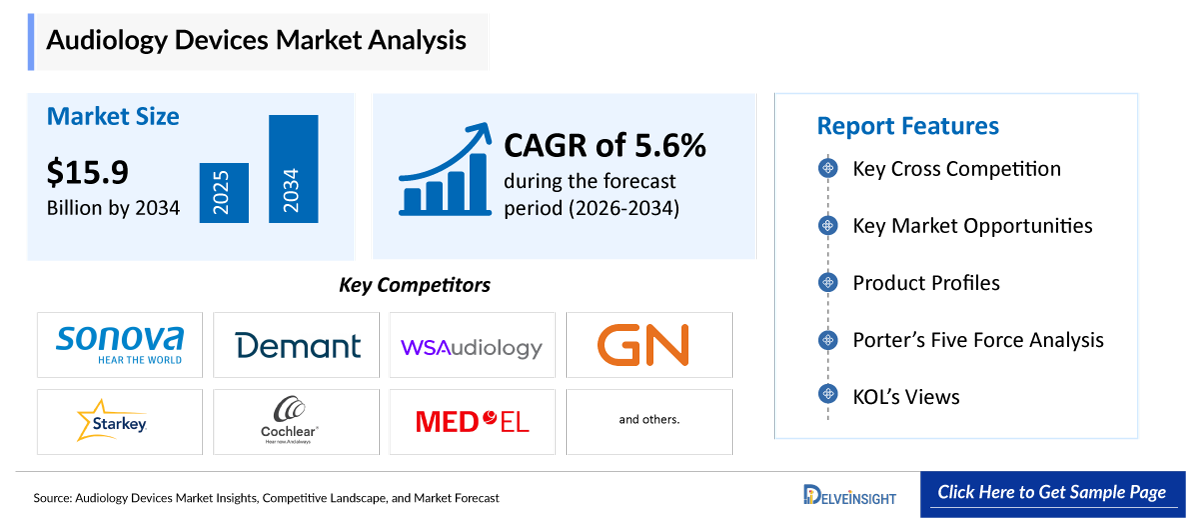
- The Audiology Devices market size is estimated at USD 9.7 billion in 2025 and is projected to reach USD 15.9 billion by 2034. Growth is anchored in the large and rising global burden of hearing loss, the aging population, and continued innovation in artificial-intelligence-enabled, rechargeable, and connected hearing devices alongside the expansion of over-the-counter hearing aids.
- The global Audiology Devices market is growing at a CAGR of 5.6% during the forecast period from 2026 to 2034.
- By product, the hearing aids segment dominated the Audiology Devices market with a 68% share in 2025.
- By technology, the digital hearing devices segment dominated the Audiology Devices market with a share of 92% in 2025.
- By patient type, the adult segment dominated the Audiology Devices market with a share of 76% in 2025.
- By end-user, the audiology and hearing aid retail centers segment dominated the Audiology Devices market with a share of 52% in 2025.
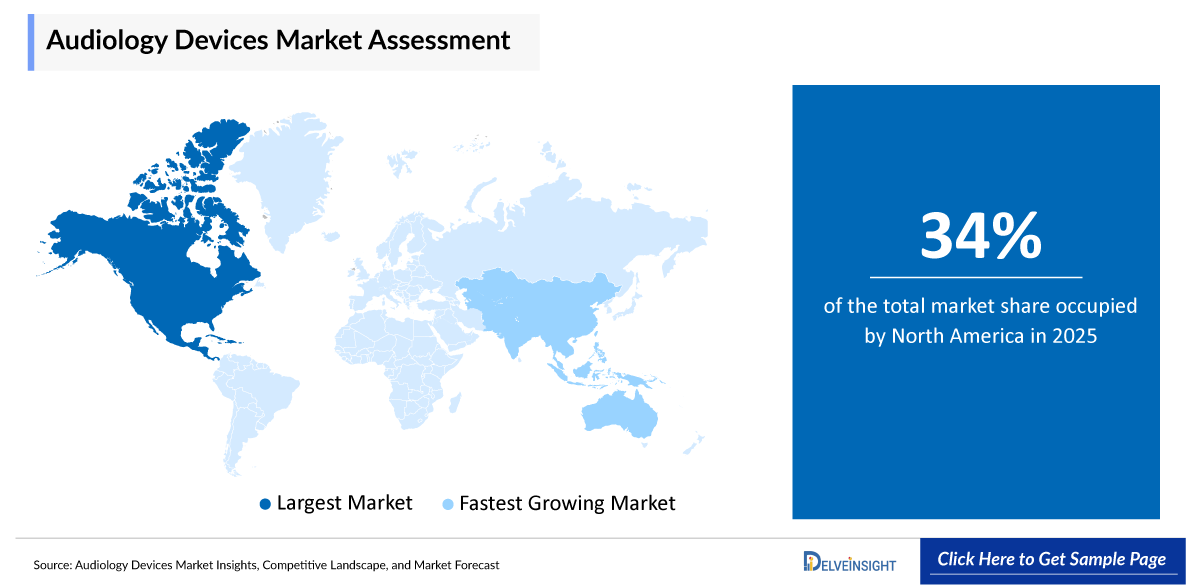
- North America dominated the global Audiology Devices market revenue with a share of 34% in 2025, representing the highest regional market share globally.
Audiology devices are medical technologies used to diagnose, manage, and treat hearing loss and balance disorders. The category spans hearing aids, available in behind-the-ear, receiver-in-the-ear, in-the-ear, and other styles; implantable devices, including cochlear implants and bone-anchored hearing aids for severe or specific types of hearing loss; and diagnostic devices such as audiometers, tympanometers, otoscopes, and otoacoustic emission and auditory brainstem response systems used to assess hearing. Modern hearing devices are overwhelmingly digital and increasingly incorporate rechargeable batteries, wireless connectivity, and artificial-intelligence-based sound processing. These devices serve adult and pediatric patients across hospitals and ear, nose, and throat clinics, audiology and hearing aid retail centers, and home settings. Over the past decade, the field has advanced from basic amplification toward artificial-intelligence-enabled, connected, and rechargeable hearing aids, next-generation cochlear implant processors, and the emergence of over-the-counter hearing aids, positioning audiology devices as a large and rapidly evolving segment addressing a substantial and growing global unmet need.
Audiology Devices Market Key Growth Drivers
- The large and rising global burden of hearing loss is a primary driver, with the World Health Organization reporting that over 1.5 billion people live with some degree of hearing loss and projecting that number to rise to around 2.5 billion by 2050.
- The growing population with disabling hearing loss, estimated by the World Health Organization at 430 million people and projected to reach 700 million by 2050, is expanding the need for hearing devices.
- The aging global population is increasing the prevalence of age-related hearing loss and demand for audiology devices.
- The establishment of the over-the-counter hearing aid category, following the United States Food and Drug Administration rule effective in 2022, is expanding access and market participation.
- Technological advances, including artificial-intelligence-based sound processing, rechargeable batteries, and wireless connectivity, are improving device performance and driving adoption.
- The low penetration of hearing aids relative to the large unmet need represents a substantial growth opportunity as awareness and access improve.
- The convergence of rising hearing loss burden, aging demographics, over-the-counter expansion, and device innovation is expected to sustain steady growth in the global Audiology Devices market through 2034.
Key Companies in Audiology Devices Market
The competitive landscape is led by the following active manufacturers and solution providers:
- Sonova Holding AG
- Demant A/S
- WS Audiology A/S
- GN Store Nord A/S (GN Hearing)
- Starkey Hearing Technologies
- Cochlear Limited
- MED-EL Medical Electronics
- Amplifon S.p.A.
- RION Co., Ltd.
- Envoy Medical, Inc., and others
For illustrative purposes, only the top 10 companies are listed in the Table of Contents. The report may include analysis and references to additional companies where relevant to the market assessment.
Audiology Devices Market Size
The following snapshot summarizes the principal report metrics for the Audiology Devices market.
|
Report Metrics |
Details |
|
2025 Market Size |
USD 9.7 billion |
|
2034 Projected Market Size |
USD 15.9 billion |
|
Growth Rate (2026-2034) |
5.6% CAGR |
|
Largest Market |
North America |
|
Fastest Growing Market |
Asia-Pacific |
|
Market Structure |
Consolidated |
All market values are expressed in USD and represent DelveInsight estimates synthesized from primary and secondary research.
Factors Contributing to the Growth of the Audiology Devices Market
Audiology Devices Market Drivers
- Large and Rising Global Burden of Hearing Loss: The substantial and growing global burden of hearing loss is the foundational driver of audiology device demand. According to the World Health Organization, over 1.5 billion people live with some degree of hearing loss, and this number is projected to rise to around 2.5 billion by 2050, driven by population growth, aging, noise exposure, and other risk factors. Of these, an estimated 430 million people have disabling hearing loss requiring rehabilitation, a figure projected to reach 700 million by 2050. Hearing loss affects communication, education, employment, and quality of life, and untreated hearing loss is associated with cognitive decline and social isolation, strengthening the case for intervention. Audiology devices, from hearing aids to cochlear implants, are the primary means of addressing this burden. As the prevalence of hearing loss continues to rise worldwide and awareness of its consequences grows, the population requiring hearing devices expands substantially, creating durable and growing demand that reinforces sustained market growth throughout the forecast period.
- Aging Population and Age-Related Hearing Loss: The aging of the global population is a powerful driver of audiology device demand. Age-related hearing loss, or presbycusis, is among the most common conditions affecting older adults, and the prevalence of hearing loss rises steeply with age. As the number of older adults grows worldwide, the population affected by age-related hearing loss expands correspondingly, increasing demand for hearing aids and, in cases of severe loss, cochlear implants. Older adults also increasingly seek to remain active, connected, and independent, and growing recognition of the links between untreated hearing loss and cognitive decline, dementia, and falls is encouraging earlier intervention. Cochlear implant candidacy has expanded to include more older adults with severe hearing loss. The demographic shift toward an older population is a structural and durable driver, steadily enlarging the addressable market for audiology devices. This aging-driven demand is expected to be a significant contributor to market growth across the forecast period.
- Establishment and Expansion of Over-the-Counter Hearing Aids: The establishment of the over-the-counter hearing aid category is expanding access and reshaping the market. Following the United States Food and Drug Administration rule that took effect in 2022, adults with perceived mild to moderate hearing loss can purchase hearing aids directly without a prescription or professional fitting, lowering cost and access barriers. This has attracted new entrants, including consumer electronics companies, and in 2024 the Food and Drug Administration authorized the first over-the-counter hearing aid software, enabling certain consumer earbuds to function as hearing aids. Over-the-counter availability addresses the large population with untreated mild to moderate hearing loss who have not adopted traditional hearing aids due to cost, stigma, or access. While it introduces competition and pricing pressure, it also expands the overall market and raises awareness, and established manufacturers are participating with dedicated over-the-counter offerings. The growth of the over-the-counter category is expected to broaden the market and drive adoption across the forecast period.
- Technological Advancement in Hearing Devices: Continuous technological innovation is enhancing device performance and driving adoption. Modern hearing aids are overwhelmingly digital and increasingly incorporate artificial-intelligence and deep neural network sound processing that improves speech understanding in noise, exemplified by platforms such as Sonova's Phonak Sphere, Demant's Oticon Intent, Starkey's Genesis AI, and GN's ReSound systems. Rechargeable lithium-ion batteries, wireless and Bluetooth connectivity, direct audio streaming, and smartphone app control have improved convenience and appeal, and new wireless broadcast standards expand connectivity. Cochlear implant technology has advanced with next-generation sound processors such as Cochlear's Nucleus 8. Miniaturization, improved comfort, and sensor-based health features further enhance the value proposition. These advances address longstanding barriers of sound quality, convenience, and stigma, encouraging earlier and broader adoption. As artificial intelligence, connectivity, and rechargeability continue to advance, ongoing innovation is expected to be a significant driver of audiology device adoption and premium positioning across the forecast period.
- Low Penetration and Large Unmet Need: The low penetration of hearing devices relative to the vast unmet need represents a substantial growth opportunity. Despite the large population with hearing loss, only a fraction of those who could benefit from hearing aids actually use them, due to cost, stigma, limited awareness, and access barriers, and the gap is even wider in low- and middle-income countries. This significant untapped population provides a long runway for market growth as awareness, affordability, and access improve. Efforts by the World Health Organization and national health systems to raise awareness, expand screening, and integrate ear and hearing care are helping to close the gap, and the over-the-counter category and direct-to-consumer models are lowering barriers. As stigma diminishes, connectivity makes devices more appealing, and access expands, adoption rates are expected to rise from currently low levels. The large unmet need and low penetration are expected to be an important structural driver of audiology device market growth across the forecast period.
- Rising Awareness, Screening, and Noise-Induced Hearing Loss: Growing awareness of hearing health, expanded screening, and rising noise-induced hearing loss are supporting audiology device demand. Newborn and school hearing screening programs identify hearing loss earlier, expanding pediatric device use, and growing awareness campaigns and integration of ear and hearing care into health systems, promoted by the World Health Organization World Report on Hearing, are encouraging earlier intervention. Rising exposure to recreational and occupational noise is increasing the incidence of noise-induced hearing loss, particularly among younger populations, broadening the future patient base. Increasing recognition of the association between untreated hearing loss and cognitive and mental health outcomes is prompting more proactive management. These trends expand both the identified population with hearing loss and the willingness to seek treatment. As awareness, screening, and the burden of noise-induced hearing loss continue to grow, demand for diagnostic and hearing devices is expected to increase, contributing to market growth across the forecast period.
Audiology Devices Market Restraints
Despite strong momentum, the Audiology Devices market faces material constraints. The high cost of hearing aids and, especially, cochlear implants places a significant barrier to adoption, and out-of-pocket costs are common because insurance and public coverage for hearing aids are limited or absent in many systems, including restricted coverage under some public programs. Low adoption and persistent stigma associated with hearing device use, along with limited awareness and the perception of hearing aids as markers of aging, reduce uptake even among those who would benefit. Access barriers, including a shortage of audiologists and hearing care professionals and limited services in rural and low-income regions, constrain diagnosis and fitting. The over-the-counter category, while expanding access, introduces pricing pressure and the risk of inappropriate self-treatment without professional guidance. Reimbursement variability across geographies affects adoption, and the affordability gap is acute in low- and middle-income countries where the majority of the hearing loss burden resides. Competition and commoditization at the lower end, and the entry of consumer electronics companies, pressure margins. Regulatory requirements under frameworks such as the European Medical Device Regulation raise evidence and compliance burdens. Finally, the need for professional fitting and follow-up for optimal outcomes, and uneven ear and hearing care infrastructure in emerging markets, restrain the pace of adoption across parts of the sector.
Audiology Devices Market Segment Analysis
The Audiology Devices Market is segmented by product (hearing aids, cochlear implants, bone-anchored hearing aids, diagnostic devices), technology (digital hearing devices, analog hearing devices), patient type (adult, pediatric), end-user (audiology and hearing aid retail centers, hospitals and ent clinics, others), and geography (North America, Europe, Asia-Pacific, Rest of World).
By Product
Dominant Subsegment: Hearing Aids.
The hearing aids segment accounted for 68% of the Audiology Devices market in 2025. Hearing aids dominate because they are the primary treatment for the large population with mild to severe hearing loss, vastly outnumbering candidates for implantable devices, and they are purchased and replaced by a broad global patient base. The segment spans behind-the-ear, receiver-in-the-ear, in-the-ear, and other styles, and is led by the major hearing aid manufacturers Sonova, Demant, WS Audiology, GN, and Starkey. Continuous innovation in artificial-intelligence sound processing, rechargeability, and connectivity, along with the expansion of the over-the-counter category, is broadening adoption and supporting the segment. Cochlear implants represent a high-value segment for severe to profound hearing loss, led by Cochlear, MED-EL, and Sonova, and bone-anchored hearing aids serve specific conduction and single-sided hearing losses. Diagnostic devices, including audiometers, tympanometers, otoscopes, and otoacoustic emission and auditory brainstem response systems, are essential for assessment and screening. Nonetheless, the large patient base, replacement cycles, and continuous innovation of hearing aids secure the segment's leadership across the forecast period.
By Technology
Dominant Subsegment: Digital Hearing Devices.
The digital hearing devices segment accounted for 92% of the Audiology Devices market in 2025. Digital technology overwhelmingly dominates because virtually all modern hearing aids and hearing device processors use digital signal processing, which enables superior sound quality, noise reduction, feedback cancellation, directional microphones, and programmability that analog devices cannot match. Digital platforms are the foundation for artificial-intelligence and deep neural network sound processing, wireless connectivity, and rechargeable designs that define contemporary hearing devices, exemplified by the digital platforms from Sonova, Demant, GN, Starkey, and WS Audiology. The transition from analog to digital hearing aids was largely completed over the past two decades, and digital processing is now standard across premium, mid-range, and over-the-counter devices. Analog hearing devices retain only a minimal residual presence in limited legacy and low-cost applications. The comprehensive clinical and performance advantages of digital technology, and its role as the platform for ongoing innovation, secure the overwhelming and durable leadership of the digital segment across the forecast period.
By Patient Type
Dominant Subsegment: Adult.
The adult segment accounted for 76% of the Audiology Devices market in 2025. Adults dominate because the prevalence of hearing loss rises steeply with age, and age-related hearing loss among older adults represents the largest source of demand for hearing aids and, increasingly, cochlear implants. The aging global population continues to expand this segment, and adults account for the vast majority of hearing aid purchases and replacements, as well as a growing share of cochlear implant recipients as candidacy has broadened to include more older adults with severe hearing loss. The over-the-counter category specifically targets adults with perceived mild to moderate hearing loss, further reinforcing adult demand. The pediatric segment, while smaller, is clinically critical and growing, driven by newborn and school hearing screening programs that enable early identification and intervention, and by pediatric cochlear implantation for congenital and early-onset hearing loss. Nonetheless, the steep age-related rise in hearing loss and the aging population secure the leadership of the adult segment across the forecast period, with pediatric care remaining an essential and growing area.
By End-User
Dominant Subsegment: Audiology and Hearing Aid Retail Centers.
The audiology and hearing aid retail centers segment accounted for 52% of the Audiology Devices market in 2025. Audiology clinics and hearing aid retail centers dominate because hearing aids, which represent the largest product segment, are predominantly dispensed through audiologists, hearing aid specialists, and retail hearing care networks rather than hospitals. These settings provide hearing assessment, device selection, fitting, and follow-up care, and large retail and franchise networks, exemplified by companies such as Amplifon and manufacturer-owned retail channels, drive substantial volume. The professional fitting and ongoing service model for hearing aids concentrates dispensing in these channels. Hospitals and ear, nose, and throat clinics represent an important end user, particularly for diagnostic evaluation, cochlear implantation, bone-anchored hearing aid surgery, and the management of complex cases. Other settings, including home and direct-to-consumer channels, are expanding with the growth of over-the-counter and online hearing aid sales. Nonetheless, the dominance of hearing aids and their dispensing through professional and retail hearing care channels secures the leadership of audiology and hearing aid retail centers across the forecast period.
Audiology Devices Market Region Analysis
Dominant Region: North America
North America accounted for 34% of the global Audiology Devices market revenue in 2025, representing the highest regional market share globally. The region's dominance reflects a high prevalence of hearing loss, high per-device spending, advanced hearing care infrastructure, and early adoption of premium and over-the-counter hearing devices. The United States leads on the strength of a large aging population, extensive audiology and hearing aid retail networks, and high adoption of advanced, artificial-intelligence-enabled devices. The regulatory environment has been a catalyst, with the Food and Drug Administration establishing the over-the-counter hearing aid category in 2022 and authorizing the first over-the-counter hearing aid software in 2024, expanding access and market participation. Awareness of hearing health and its links to cognitive outcomes is high, supporting adoption. While coverage for hearing aids under public programs is limited, high discretionary spending and a mature retail channel sustain demand, and a concentration of leading manufacturers and hearing care providers reinforces the market. This combination of demand, infrastructure, and regulatory innovation reinforces North America's leadership in the global market.
Fastest Growing Region: Asia-Pacific
Asia-Pacific is the fastest-growing region in the Audiology Devices market. The region's elevated CAGR is driven by very large and aging populations, a high and rising burden of hearing loss, and expanding healthcare access and awareness across China, Japan, India, South Korea, and Australia. Asia-Pacific accounts for a large share of the global hearing loss burden, and rising awareness, expanding newborn and school screening, and improving access to hearing care are increasing diagnosis and treatment. Growing healthcare investment, rising disposable incomes, and the increasing availability of affordable and over-the-counter devices are broadening adoption beyond major urban centers. Both global manufacturers and regional providers are expanding their presence with hearing aids, cochlear implants, and diagnostic devices tailored to local requirements, and government initiatives to address hearing loss further support growth. The combination of large populations, high unmet need, rising awareness, and expanding access positions Asia-Pacific as the highest-growth region over the forecast period.
Audiology Devices Market Regional Commentary
North America
North America accounted for 34% of the global Audiology Devices market revenue in 2025. The United States dominates the region on the strength of a large aging population, extensive audiology and retail hearing care networks, high adoption of premium and over-the-counter devices, and regulatory innovation, while Canada advances through public hearing care programs and Mexico expands access within its growing healthcare sector.
Europe
Europe represents a major regional market, led by Germany, France, and the United Kingdom, and is home to the leading hearing device manufacturers. Growth is supported by aging populations, established hearing care systems and reimbursement in several countries, and the presence of Sonova, Demant, WS Audiology, and GN, while the European Medical Device Regulation shapes requirements for audiology devices.
Asia-Pacific
Asia-Pacific is the fastest-growing region, propelled by very large aging populations, a high burden of hearing loss, and expanding awareness and access across China, Japan, India, South Korea, and Australia. Rising incomes, expanding screening, and the availability of affordable and over-the-counter devices are broadening adoption.
Rest of World
The Rest of World region, spanning the Middle East, Africa, and South America, is an emerging growth frontier with a large share of the global hearing loss burden. Improving awareness, expanding hearing care infrastructure, and increasing availability of affordable devices are expanding access, while World Health Organization initiatives and public programs support the broader adoption of audiology devices.
Audiology Devices Market Competitive Landscape
The Audiology Devices market is classified as Consolidated. A small group of global manufacturers controls the majority of hearing device revenue, led in hearing aids by Sonova, Demant, WS Audiology, GN, and Starkey, and in cochlear implants by Cochlear, MED-EL, and Sonova, while retail networks such as Amplifon and a broad field of diagnostic and regional providers compete across the value chain.
The competitive landscape can be evaluated across the following dimensions:
- Market concentration: Consolidated, with hearing aid revenue concentrated among a few global leaders and cochlear implants dominated by three players.
- Leading players: Sonova, Demant, WS Audiology, GN, and Starkey lead hearing aids, and Cochlear, MED-EL, and Sonova lead cochlear implants.
- Geographic reach: Leaders operate global manufacturing, commercial, and retail networks, with strong positions across North America, Europe, and Asia-Pacific.
- Product portfolio strength: Top players offer portfolios spanning hearing aids, cochlear and bone-anchored implants, diagnostic devices, and retail services.
- Pipeline strength: Active development in artificial-intelligence and deep neural network processing, rechargeability, connectivity, and next-generation implant processors.
- Strategic partnerships: Collaborations with technology and consumer electronics companies and retail networks extend reach and capability.
- M&A activity: Consolidation continues, exemplified by Cochlear's acquisition of the Oticon Medical cochlear implant business, and by retail network expansion.
- Manufacturing and retail capabilities: Scale manufacturing and extensive audiology and retail dispensing networks are key competitive moats.
- Innovation focus: Artificial-intelligence sound processing, connectivity and streaming, rechargeable designs, over-the-counter offerings, and implant advancement.
Audiology Devices Market Recent Developmental Activities
- In 2022, the United States Food and Drug Administration rule establishing the over-the-counter hearing aid category took effect, allowing adults with perceived mild to moderate hearing loss to purchase hearing aids without a prescription. Strategic significance: Expands access and market participation and attracts new entrants, reshaping the lower end of the market.
- In September 2024, the Food and Drug Administration authorized the first over-the-counter hearing aid software, enabling Apple AirPods Pro to function as a hearing aid for mild to moderate hearing loss. Strategic significance: Brings a major consumer electronics platform into hearing care, raising awareness and broadening access.
- In 2024, Sonova Holding AG launched the Phonak Audeo Sphere Infinio hearing aids with a dedicated artificial-intelligence chip for speech enhancement in noise. Strategic significance: Advances on-device artificial-intelligence sound processing and strengthens Sonova's premium leadership.
- In 2024, Demant A/S launched Oticon Intent hearing aids incorporating a deep neural network and sensor-based user-intent technology. Strategic significance: Differentiates Demant with intent-aware, artificial-intelligence-driven sound processing.
- In 2023 and 2024, GN Store Nord launched ReSound Nexia and Vivia hearing aids with next-generation connectivity and artificial intelligence. Strategic significance: Strengthens GN's position in connected and artificial-intelligence-enabled hearing aids.
- In 2023 and 2024, Starkey Hearing Technologies advanced its Genesis AI and Edge AI platforms with health and artificial-intelligence features. Strategic significance: Reinforces Starkey's focus on artificial intelligence and health-integrated hearing devices.
- In 2023 and 2024, WS Audiology advanced its Signia integrated Xperience platform and hearing aid portfolio. Strategic significance: Sustains WS Audiology's competitiveness across premium and mainstream hearing aids.
- In 2023, Cochlear Limited launched the Nucleus 8 sound processor for cochlear implant recipients. Strategic significance: Advances cochlear implant technology and connectivity, reinforcing Cochlear's implant leadership.
- In 2024, Cochlear Limited completed the acquisition of the Oticon Medical cochlear implant business from Demant. Strategic significance: Consolidates the cochlear implant segment and expands Cochlear's implant footprint.
- In 2023 and 2024, consumer electronics and new entrants, including earbud and direct-to-consumer providers, entered the over-the-counter hearing device space. Strategic significance: Increases competition and awareness while expanding the overall market.
- In 2023 and 2024, MED-EL Medical Electronics advanced its cochlear implant and hearing implant portfolio and processors. Strategic significance: Sustains competition in the cochlear and hearing implant segment.
- In 2024 and 2025, the transition to the European Medical Device Regulation continued to shape audiology device compliance and evidence requirements. Strategic significance: Raises clinical evidence standards and favors established manufacturers with resources to comply.
Audiology Devices Market Segmentation
Audiology Devices Market by Product
- Hearing Aids (Behind-the-Ear, Receiver-in-the-Ear, In-the-Ear, Others)
- Cochlear Implants
- Bone-Anchored Hearing Aids
- Diagnostic Devices (Audiometers, Tympanometers, Otoscopes, Others)
- Audiology Devices Market by Technology
- Digital Hearing Devices
- Analog Hearing Devices
- Audiology Devices Market by Patient Type
- Adult
- Pediatric
- Audiology Devices Market by End-User
- Audiology and Hearing Aid Retail Centers
- Hospitals and ENT Clinics
- Others
Audiology Devices Market by Geography
- North America Audiology Devices Market
- United States Audiology Devices Market Size in USD million (2023-2034)
- Canada Audiology Devices Market Size in USD million (2023-2034)
- Mexico Audiology Devices Market Size in USD million (2023-2034)
- Europe Audiology Devices Market
- Germany Audiology Devices Market Size in USD million (2023-2034)
- United Kingdom Audiology Devices Market Size in USD million (2023-2034)
- France Audiology Devices Market Size in USD million (2023-2034)
- Italy Audiology Devices Market Size in USD million (2023-2034)
- Spain Audiology Devices Market Size in USD million (2023-2034)
- Rest of Europe Audiology Devices Market Size in USD million (2023-2034)
- Asia-Pacific Audiology Devices Market
- China Audiology Devices Market Size in USD million (2023-2034)
- Japan Audiology Devices Market Size in USD million (2023-2034)
- India Audiology Devices Market Size in USD million (2023-2034)
- Australia Audiology Devices Market Size in USD million (2023-2034)
- South Korea Audiology Devices Market Size in USD million (2023-2034)
- Rest of Asia-Pacific Audiology Devices Market Size in USD million (2023-2034)
- Rest of the World (RoW) Audiology Devices Market
- Middle East Audiology Devices Market Size in USD million (2023-2034)
- Africa Audiology Devices Market Size in USD million (2023-2034)
- South America Audiology Devices Market Size in USD million (2023-2034)
Audiology Devices Market Recent Industry Trends and Milestones (2023-2026):
|
Category |
Key Developments |
|
Audiology Devices Market Product Approval |
The FDA rule establishing the over-the-counter hearing aid category took effect (2022), and the FDA authorized the first over-the-counter hearing aid software enabling Apple AirPods Pro as a hearing aid (September 2024); manufacturers obtained clearances and CE marking for artificial-intelligence-enabled hearing aids and next-generation cochlear implant processors; the European Medical Device Regulation reshaped compliance requirements for audiology devices. |
|
Audiology Devices Market Product Expansion |
Sonova launched Phonak Audeo Sphere Infinio with a dedicated AI chip (2024); Demant launched Oticon Intent with a deep neural network (2024); GN launched ReSound Nexia and Vivia; Starkey advanced Genesis AI and Edge AI; WS Audiology advanced Signia Integrated Xperience; Cochlear launched the Nucleus 8 sound processor; consumer electronics entrants expanded over-the-counter offerings. |
|
Audiology Devices Market Product Investment |
Cochlear acquired the Oticon Medical cochlear implant business from Demant (2024); manufacturers invested in on-device artificial intelligence, connectivity, and rechargeable technology; capital and partnerships flowed toward over-the-counter and direct-to-consumer hearing devices; retail networks such as Amplifon expanded their hearing care footprint. |
|
Company Strategy |
Sonova Holding AG, Demant A/S, WS Audiology A/S, GN Store Nord, and Starkey Hearing Technologies: Leadership in artificial-intelligence-enabled, connected, and rechargeable hearing aids. Cochlear Limited and MED-EL Medical Electronics: Cochlear and hearing implant leadership. Amplifon S.p.A.: Global hearing care retail. RION Co., Ltd. and Envoy Medical, Inc.: Diagnostic and implantable hearing device niches. |
|
Emerging Technologies |
On-device artificial-intelligence and deep neural network sound processing improving speech understanding in noise; over-the-counter and consumer-electronics-based hearing devices expanding access; rechargeable lithium-ion batteries and wireless and broadcast connectivity; next-generation cochlear implant sound processors; sensor-based health and activity features in hearing aids; teleaudiology and remote fitting and support. |
Audiology Devices Market Startup Funding and Investment Trends
Investment in the audiology ecosystem has concentrated on direct-to-consumer and over-the-counter hearing aids and digital ear and hearing health platforms. The following companies illustrate recent activity and technology focus.
|
Company |
Total Funding |
Funding Stage |
Main Product |
Core Technology |
|
Eargo, Inc. |
Public and venture funding |
Public / growth-stage |
Eargo Hearing Aids |
Direct-to-consumer rechargeable hearing aids |
|
Tympa Health Technologies Ltd |
Venture funding |
Growth-stage venture |
Tympa System |
All-in-one ear and hearing health assessment platform |
|
Request to unlock the report on the @ Audiology Devices Market Insights | ||||
Eargo is scaling direct-to-consumer, rechargeable over-the-counter hearing aids that lower cost and access barriers, while Tympa Health advances an all-in-one platform for ear and hearing health assessment that expands screening beyond specialist settings. Additional capital continues to flow toward over-the-counter and direct-to-consumer hearing devices, teleaudiology, and digital ear and hearing health platforms, reflecting conviction that expanded access, consumer-friendly technology, and digital care models are the next sources of competitive advantage. Collectively, these efforts signal sustained investment in closing the large gap between the hearing loss burden and treatment and in broadening access to hearing care.
Key Takeaways from the Audiology Devices Market Report Study
- Market size analysis for the current audiology devices market size (2025), and market forecast for 9 years (2026 to 2034).
- Top key product/technology developments, mergers, acquisitions, partnerships, and joint ventures that have happened over the last 3 years.
- Key companies dominating the global audiology devices market.
- Various opportunities available for competitors in the audiology devices market space.
- What are the top-performing segments in 2025? How will these segments perform in 2034?
- Which are the top-performing regions and countries in the current audiology devices market scenario?
- Which are the regions and countries where companies should concentrate their opportunities for audiology devices market growth in the future?
Target audience who can benefit from this audiology devices market report study
- Audiology Devices product providers
- Research organizations and consulting companies
- Audiology Devices-related organizations, associations, forums, and other alliances
- Government and corporate offices
- Start-up companies, venture capitalists, and private equity firms
- Distributors and traders dealing in audiology devices
- Various end-users who want to know more about the audiology devices market and the latest technological developments in the audiology devices market.