Cancer Anorexia Market Summary
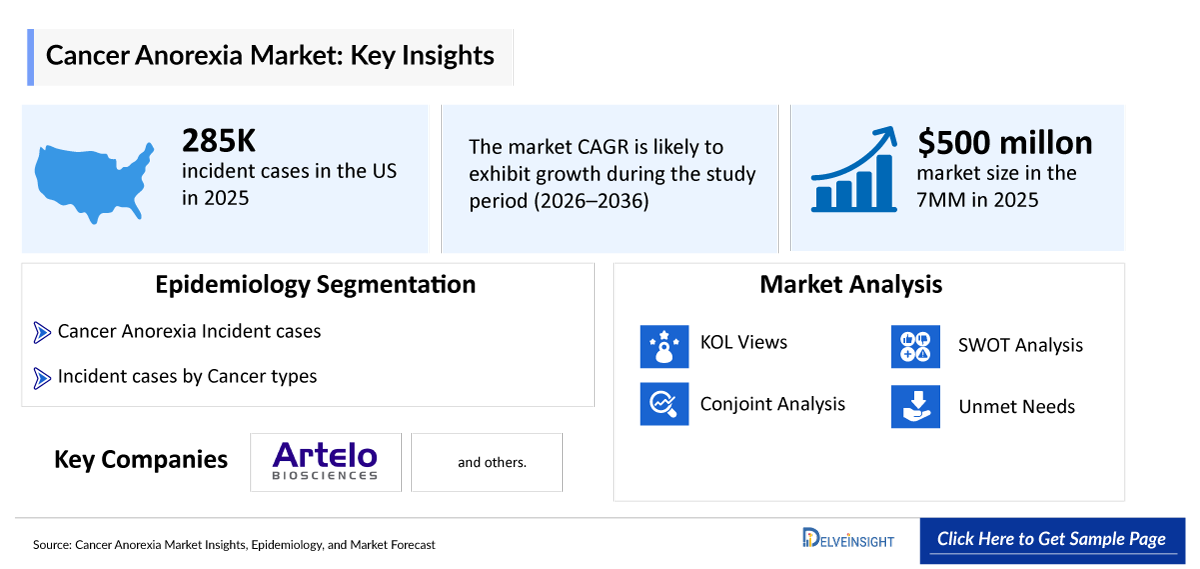
- The cancer anorexia market size was valued at approximately USD 500 million in 2025 and is projected to grow at a significant at a CAGR during the forecast period from 2026 to 2036.
- The leading Cancer Anorexia companies developing therapies in the treatment market include - Artelo Biosciences, and others.
Cancer Anorexia Market & Epidemiology Insights
- Cancer anorexia develops very frequently in patients with advanced cancers, such as colorectal cancer, lung cancer, pancreatic cancer, head and neck cancer, gastro-esophageal cancer, and liver cancer.
- Cancer Anorexia and Cachexia Syndrome (CACS) is marked by a loss of appetite and weight loss, along with a reduction in muscle mass and fatty tissues affecting advanced cancer patients with no FDA-approved treatment.
- CACS affects more than 60% of advanced-stage cancer patients.
- Cancer anorexia remains significantly underdiagnosed due to the lack of standardized screening protocols and clear diagnostic criteria in routine oncology practice.
- There are no regulatory authorized medicines for cancer anorexia in the US, Europe, and Japan.
- 2020 ASCO Guidelines recommend no specific pharmacological intervention as standard of care.
- Cancer anorexia, a key component of cancer cachexia, causes reduced appetite and weight loss with very limited treatment options, and no drug is specifically approved for cancer anorexia alone. Currently, Anamorelin (ADLUMIZ) by Helsinn Healthcare and Ono Pharmaceutical is the only approved therapy for cancer cachexia, available only in Japan.
- The cancer anorexia pipeline remains highly limited, with only a few emerging therapies under development. It is primarily driven by smaller biotech players such as Artelo Biosciences, reflecting an early-stage, innovation-focused landscape with relatively low overall industry activity.
- A key trend in the pipeline is the shift toward targeted biologics (monoclonal antibodies), moving away from non-specific agents like steroids and progestins.
- Current treatment options are largely limited to symptomatic management and fail to address the underlying metabolic and inflammatory drivers of the condition. There is a critical need for targeted therapies that can preserve muscle mass, improve functional outcomes, and provide sustained clinical benefit beyond temporary appetite stimulation.
Cancer Anorexia Market Size and Forecast in the 7MM
- 2025 Cancer Anorexia Market Size: ~USD 500 million
- 2036 Projected Cancer Anorexia Market Size: XX million
- Cancer Anorexia Growth Rate (2026–2036): XX% CAGR
Request for unlocking the CAGR of the Cancer Anorexia Market Insights
DelveInsight's "Cancer Anorexia Market Insights, Epidemiology and Market Forecast – 2036" report delivers an in-depth understanding of cancer anorexia, historical and forecasted epidemiology, as well as the cancer anorexia therapeutics market trends in the United States, EU4 (Germany, Spain, Italy, and France) and the United Kingdom, and Japan.
The cancer anorexia market report delivers a comprehensive analysis of the current treatment landscape, including standards of care, clinical practices, and evolving therapeutic algorithms. It evaluates cancer anorexia patient burden trends, revenue & market share dynamics, peak patient share & therapy uptake analysis, and provides an in-depth market size assessment, and growth rate projections (Historical & Forecast 2022–2036) across global regions. The report highlights key unmet medical needs in cancer anorexia and maps the competitive and clinical landscape to uncover high‑value opportunities, providing a clear outlook on future market growth potential.
Key Factors Driving the Cancer Anorexia Market
- Shift Toward Mechanism-Based Therapies: The market is moving beyond symptomatic treatments toward therapies targeting underlying biology, such as inflammatory cytokines and metabolic pathways. This shift is driving innovation and attracting investment.
- Aging Population: The rising geriatric population, which is more vulnerable to cancer and muscle wasting, is contributing to sustained demand for anorexia/cachexia treatments.
- Focus on Supportive & Palliative Care: There is increasing emphasis on improving patient’s quality of life alongside cancer treatment. This has positioned cachexia management as a key component of supportive oncology care.
Scope of the Cancer Anorexia Market Report | |
|
Study Period |
2022–2036 |
|
Historical Year |
2022–2025 |
|
Forecast Period |
2026–2036 |
|
Base Year |
2026 |
|
Geographies Covered |
ü North America: The US; ü Europe: Germany, France, Italy, Spain and the UK; ü Asia-Pacific: Japan |
|
Cancer Anorexia Market CAGR (Forecast period) |
XX% (2026–2036) |
|
Cancer Anorexia Epidemiology Segmentation Analysis |
Patient Burden Assessment
|
|
Cancer Anorexia Companies |
· Artelo Biosciences, and others |
|
Cancer Anorexia Therapies |
· ART27.13, and others |
|
Cancer Anorexia Market |
Segmented by · Region/Geographies · Drugs/Therapies |
|
Analysis |
· Addressable Patient Population · Market Drivers and Market Barriers · Cost Assumptions and Pricing Analogues · KOL Views · SWOT Analysis · Reimbursement · Conjoint Analysis · Unmet Need |
Cancer Anorexia Disease Understanding
Cancer Anorexia Overview
Cancer anorexia (often part of the broader CACS) is a complex metabolic condition seen in many patients with advanced malignancies. It is characterized by persistent loss of appetite, reduced food intake, weight loss, and progressive muscle wasting that cannot be fully reversed by conventional nutritional support. The condition is driven not only by reduced caloric intake but also by tumor-related inflammation, altered metabolism, and cytokine signaling (such as GDF-15 pathways). It significantly impacts quality of life, reduces tolerance to anticancer therapies, and is associated with poorer survival outcomes.
Cancer Anorexia Diagnosis
Diagnosis is primarily clinical and involves identifying unintentional weight loss (typically >5% over 6 months), decreased appetite, fatigue, and loss of muscle mass. Physicians also assess dietary intake, functional status, and symptoms such as early satiety, nausea, or taste changes. Imaging techniques like CT scans may be used to evaluate muscle mass, while laboratory markers such as inflammatory markers like CRP can support the diagnosis. Importantly, cancer anorexia/cachexia must be differentiated from simple starvation, as metabolic alterations and systemic inflammation play a central role in this condition.
Further details are provided in the report...
Current Cancer Anorexia Treatment Landscape
Management is multimodal and focuses on improving appetite, maintaining weight, and enhancing quality of life rather than complete reversal. Pharmacological options include appetite stimulants like megestrol acetate, short-term corticosteroids such as dexamethasone, and emerging agents targeting specific pathways. Nutritional support (dietary counseling, high-calorie supplements), physical activity (to preserve muscle mass), and symptom control (pain, nausea, depression) are essential components. Early intervention and a combination approach are key, as no single therapy is fully effective on its own.
Further details related to country-based variations are provided in the report...
Cancer Anorexia Unmet Needs
The section “unmet needs of cancer anorexia” outlines the critical gaps between the current state of patient care, diagnosis, and the ideal & effective management of the disease. It highlights the obstacles experienced by patients, clinicians, and researchers and identifies potential solutions for future progress.
- Lack of highly effective disease-modifying therapies
- Underdiagnosed and undertreated
- Lack of globally approved, standardized treatment guidelines
- Heterogeneous patient populations, and others
Note: Comprehensive unmet needs insights in Cancer Anorexia and their strategic implications are provided in the full report...
Cancer Anorexia Epidemiology
The Cancer Anorexia epidemiology section provides insights about the historical and current Cancer Anorexia patient pool and forecasted trends for individual seven major countries. It helps to recognize the causes of current and forecasted trends by exploring numerous studies and views of key opinion leaders. This part of the Cancer Anorexia market report also provides the diagnosed patient pool and their trends along with assumptions undertaken.
Key Findings from Cancer Anorexia Epidemiological Analysis and Forecast
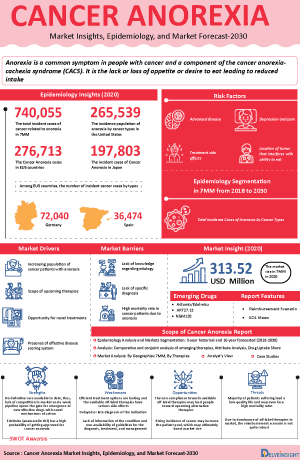
- Among the 7MM, the US accounted for the highest number of incident cases of cancer anorexia with ~285,600 cases in 2025.
- Among EU4 and the UK, Germany accounted for the highest number of incident cases of cancer anorexia, while Spain accounted for the fewest incident cases.
- Among all cancer types, lung cancer accounts for the highest incidence of cancer anorexia in the US.
- In 2025, the incident cases of pancreatic cancer were ~67,440, and incident cases of lung cancer were ~226,650 in the US.
- According tosecondary analysis, an estimated 72,680 people in the US will be diagnosed with cancer of the oral cavity, pharynx, or larynx, which are the major types of HNC in 2025.
- As per studies, nearly 153,000 new cases of CRC in 2025, with men expected to represent a slightly higher number of cases than women.
Cancer Anorexia Epidemiology Segmentation
- Total Incident Cases of Selected Indications
- Total Incident Cases Cancer Anorexia
- Treated Cases of Cancer Anorexia
Recent Developments in the Cancer Anorexia Treatment Landscape
- In November 2025, Artelo Biosciences provided business highlights. The interim Phase II Cancer Appetite Recovery Study (CAReS) results demonstrated meaningful efficacy, safety, and functional benefit in cancer-related anorexia and weight loss. Patients receiving top-dose ART27.13 achieved an average +6.4% weight gain.
Cancer Anorexia Drug Analysis & Competitive Landscape
The cancer anorexia drug chapter provides a detailed, market-focused review of the emerging pipeline across Phase III/II-I Cancer Anorexia clinical trials and preclinical trials. It covers the mechanism of action, clinical trial data, regulatory approvals, patents, collaborations, and strategic partnerships for each therapy, along with their advantages, limitations, and recent developments. This section offers critical insights into the cancer anorexia treatment landscape, supporting market assessment, competitive analysis, and growth forecasting for the cancer anorexia therapeutics market.
Cancer Anorexia Pipeline Analysis
ART27.13: Artelo Biosciences
ART27.13 (formerly known as NEO1940 and AZD1940) is a dual cannabinoid receptor (GPCR) agonist, being developed as a once-a-day, orally administered, benzimidazole derivative targeting CB1and CB2 receptors. Currently, there is no FDA-approved treatment for cancer anorexia cachexia syndrome. In the phase II interim results, ART27.13 was found to show efficacy versus placebo in lean body mass, weight gain, activity, and was well-tolerated up to 1300 μg per day (similar safety profile to Phase I). Initially developed by AstraZeneca plc, ART27.13 has been in seven clinical studies with over 280 participants. The company, in its 2026 investor presentation, anticipates top-line data read out of ART27.13 CAReS Phase II in the second half of 2026 or the first half of 2027.
Competitive Landscape of Cancer Anorexia Pipeline Drugs | ||||||
|
Drug Name |
Company |
Highest Phase |
Indication |
RoA |
MoA |
Anticipated Launch in the US |
|
ART27.13 |
Artelo Biosciences |
II |
Cancer-Related Anorexia |
Oral |
Dual GPCR agonist |
Information is available in the full report |
|
Note: Launch insights are provisional and may change with future report updates or the occurrence of major key catalysts. | ||||||
Cancer Anorexia Market Outlook
The treatment landscape for cancer anorexia has historically relied on symptomatic management, including nutritional support, appetite stimulants, and short-term use of corticosteroids. Commonly used agents such as progestins and steroids help improve appetite and body weight, but do not address the underlying metabolic and inflammatory drivers of the disease. A notable milestone is the approval of ADLUMIZ in Japan for the treatment of cancer cachexia, a complex metabolic syndrome closely associated with cancer anorexia and characterized by weight loss and muscle wasting. Nevertheless, its approval remains limited to Japan, and significant unmet needs persist globally in effectively managing both cachexia and its associated anorexia symptoms.
The pipeline for cancer anorexia is evolving toward targeted, disease-modifying approaches that address key biological pathways such as metabolic dysregulation and energy imbalance. Among emerging candidates, ART27.13 represents a differentiated strategy by targeting fatty acid binding protein pathways, aiming to modulate metabolism, improve energy homeostasis, and support appetite and body weight maintenance.
Overall, the cancer anorexia landscape remains highly underserved, with no approved therapies currently available and management still largely dependent on symptomatic approaches. The pipeline is limited, with ART27.13 emerging as a key investigational candidate targeting metabolic pathways to improve energy balance and appetite. Increasing clinical awareness and improved trial design are expected to support gradual innovation and market development across the 7MM from 2022 to 2036, yielding significant commercial opportunities for existing products and pipeline candidates.
Further details will be provided in the report...
Drug Class/Insights into Leading Emerging and Marketed Therapies in Cancer Anorexia (2022–2036 Forecast)
The cancer anorexia market (2022–2036 forecast) is increasingly shifting toward mechanism-based therapies that target underlying biological drivers such as inflammation, tumor-derived cytokines, and metabolic dysfunction. The market consists of monoclonal antibody.
- Monoclonal antibody: The current pipeline includes ART27.13, a differentiated investigational therapy that targets fatty acid binding protein pathways. By modulating lipid metabolism and energy homeostasis, it aims to improve appetite, stabilize body weight, and address underlying metabolic imbalances associated with cancer anorexia.
Overall innovation in cancer anorexia remains at an early stage, with no approved therapies currently available and development largely centered on a limited pipeline. The focus is gradually shifting toward metabolic modulation, with ART27.13 representing a key investigational candidate targeting energy balance and appetite regulation pathways. As clinical development progresses and awareness increases, these efforts are expected to begin moving the field beyond symptomatic care, addressing significant unmet needs and supporting gradual market evolution across major regions.
Cancer Anorexia Drug Uptake
This section focuses on the uptake rate of potential drugs expected to be launched in the market during the forecast period (2026–2036). The analysis covers the cancer anorexia drug’s uptake, performance at peak, factors affecting performance during prime years of growth, patient uptake by therapy, and anticipated sales generated by each drug.
Among pipeline agents, ART27.13 is expected to witness a moderate uptake upon potential approval, supported by its differentiated mechanism targeting fatty acid binding protein pathways. Its ability to modulate metabolism, improve energy balance, and support appetite and weight stabilization positions it as a promising candidate in this space. Overall uptake will depend on clinical efficacy, safety outcomes, and its positioning within a landscape currently dominated by symptomatic standard-of-care approaches.
Detailed insights of emerging therapies' drug uptake is included in the report...
Cancer Anorexia Market Access and Reimbursement of Approved Therapies Scenario
Reimbursement is a crucial factor that affects the drug’s access to the market. Often, the decision to reimburse comes down to the price of the drug relative to the benefit it produces in treated patients. To reduce the healthcare burden of these high-cost therapies, many payment models are being considered by payers and other industry insiders.
NOTE: Further Details are provided in the final report...
Cancer Anorexia Therapies Price Scenario & Trends
Pricing and analogue assessment of cancer anorexia therapies highlights evolving price dynamics structures. This section summarizes the cost of approved treatments, the closest and most appropriate analogue selection for emerging therapies, and understanding of how pricing influences market access, adherence, and long-term uptake.
Industry Experts and Physician Views for Cancer Anorexia
To keep up with cancer anorexia market trends, we take Key Opinion Leaders (KOLs) and Subject Matter Experts (SMEs) opinions working in the domain through primary research to fill the data gaps and validate our secondary research. Industry experts were contacted for insights on the cancer anorexia emerging therapies, evolving treatment landscape, patient adherence to conventional therapies, therapy switching trends, drug adoption and uptake, accessibility challenges, and epidemiology and real-world prescription patterns in cancer anorexia, including MD, PhD, Instructor, Postdoctoral Researcher, Professor, Researcher, and others.
DelveInsight’s analysts connected with 15+ KOLs to gather insights at the country level. Centers such as the Duke Molecular Physiology Institute, Department of Nephrology, Hospital Universitario Fundación Alcorcón, and Nippon Medical School, etc. were contacted. Their opinion helps understand and validate current and emerging cancer anorexia therapies, highlight unmet medical needs, provide epidemiological context, and support strategic decisions for market access, therapy adoption, and pipeline prioritization in cancer anorexia.
|
Region |
Key Opinion Leaders (KOLs) and Subject Matter Experts (SMEs) |
|
United States |
“In lung cancer patients, it is observed that the newly diagnosed patients are mostly diagnosed with cachexia. However, as the treatment proceeds following chemotherapy, the patients tend to develop anorexia which is quite higher in percentages as compared to cachexia. The patient suffers from the combined cachexia anorexia syndrome. Additionally, the patients are unaware of the fact that they are suffering from cachexia. As per my opinion, in lung cancer, there is the loss of weight first followed by the loss of appetite.” |
|
Germany |
“Cancer anorexia and cachexia is a phenomenon that occurs in patients with cancer very frequently in cases of advanced cancers, such as pancreatic and lung cancer and less frequent in patients with breast cancer. Furthermore, the patients assumed while receiving chemotherapy for early breast cancer they will lose a lot of weight, similarly as observed in advanced breast cancer patients.” |
Cancer Anorexia Report Qualitative Analysis: SWOT and Conjoint Analysis
We perform qualitative and market Intelligence analysis using various approaches, such as SWOT analysis and conjoint analysis.
In the SWOT analysis of cancer anorexia, strengths, weaknesses, opportunities, and threats in terms of disease diagnosis, patient awareness, patient burden, competitive landscape, cost-effectiveness, and geographical accessibility of therapies are provided.
Conjoint analysis analyzes emerging therapies based on relevant attributes such as safety, efficacy, frequency of administration, route of administration, and order of entry. Scoring is given based on these parameters to analyze the effectiveness of therapy.
The team of analysts analyzes promising emerging therapies based on relevant attributes such as safety, efficacy, frequency of administration, route of administration, and order of entry. In efficacy, the trial’s primary and secondary outcome measures are evaluated, whereas the therapies’ safety is evaluated, wherein the acceptability, tolerability, and adverse events are majorly observed. In addition, the scoring is also based on the route of administration, order of entry, probability of success, and the addressable patient pool for each therapy. According to these parameters, the final weightage score and the ranking of the emerging therapies are decided.
Scope of the Cancer Anorexia Market Report
- The report covers a segment of key events, an executive summary, a descriptive overview of cancer anorexia, explaining their causes, signs and symptoms, pathogenesis, and currently available treatments.
- Comprehensive insight has been provided into the epidemiology segments and forecasts, the future growth potential of the diagnosis rate, and disease progression along treatment guidelines.
- Additionally, an all-inclusive account of both the current and emerging treatments, along with the elaborative profiles of late-stage and prominent therapies, will have an impact on the current treatment landscape.
- A detailed review of the cancer anorexia market, historical and forecasted market size, market share by therapies, detailed assumptions, and rationale behind our approach is included in the report, covering the 7MM drug outreach.
- The report provides an edge while developing business strategies by understanding trends through SWOT analysis and expert insights/KOL views, patient journey, and treatment preferences that help in shaping and driving the 7MM cancer anorexia market.
Cancer Anorexia Market Report Insights
- Cancer Anorexia Patient Population Forecast
- Cancer Anorexia Therapeutics Market Size
- Cancer Anorexia Pipeline Analysis
- Cancer Anorexia Market Size and Trends
- Cancer Anorexia Market Opportunity (Current and forecasted)
Cancer Anorexia Market Report Key Strengths
- Cancer Anorexia Epidemiology‑based (Epi‑based) Bottom‑up Forecasting
- Artificial Intelligence (AI)-Enabled Market Research Report
- 11-Year Forecast
- Cancer Anorexia Market Outlook (North America, Europe, Asia-Pacific)
- Cancer Anorexia Patient Burden Trends (By Geography)
- Cancer Anorexia Treatment Addressable Market (TAM)
- Cancer Anorexia Competitve Landscape
- Cancer Anorexia) Major Companies Insights
- Cancer Anorexia Price Trends and Analogue Assessment
- Cancer Anorexia Therapies Drug Adoption/Uptake
- Cancer Anorexia Therapies Peak Patient Share Analysis
Cancer Anorexia Market Report Assessment
- Cancer Anorexia Current Treatment Practices
- Cancer Anorexia Unmet Needs
- Cancer Anorexia Clinical Development Analysis
- Cancer Anorexia Emerging Drugs Product Profiles
- Cancer Anorexia Market attractiveness
- Cancer Anorexia Qualitative Analysis (SWOT and conjoint analysis)
- Cancer Anorexia Market Drivers
- Cancer Anorexia Market Barriers
FAQs Realted to Cancer Anorexia Market Report:
Cancer Anorexia Market Insights
- What was the cancer anorexia market size, the market size by therapies, market share (%) distribution in 2026, and what would it look like by 2036? What are the contributing factors for this growth?
- What are the anticipated pricing variations among different geographies for the emerging therapies in the future?
- What can be the future treatment paradigm of cancer anorexia?
- What are the disease risks, burdens, and unmet needs of cancer anorexia? What will be the growth opportunities across the 7MM concerning the cancer anorexia patient population?
- Who is the major future competitor in the market, and how will the competitors affect their market share?
- What are the current options for the treatment of cancer anorexia? What are the current guidelines for treating cancer anorexia in the US, Europe, and Japan?
Reasons to Buy Cancer Anorexia Market Forecast Report
- The report will help in developing business strategies by understanding the latest trends and changing treatment dynamics driving the cancer anorexia market.
- Bottom up forecasting builds from the affected population to product forecasts, delivering a robust, data driven approach ideal for new therapies and novel classes.
- Insights on patient burden/disease incidence, evolution in diagnosis, and factors contributing to the change in the epidemiology of the disease during the forecast years.
- Understand the existing market opportunities in varying geographies and the growth potential over the coming years.
- Identifying strong upcoming players in the market will help devise strategies to help get ahead of competitors.
- Detailed analysis and ranking of class-wise potential emerging therapies under the conjoint analysis section to provide visibility around leading classes.
- To understand KOLs’ perspectives on the accessibility, acceptability, and compliance-related challenges of existing treatment to overcome barriers in the future.
- Detailed insights on the unmet needs of the existing market so that the upcoming players can strengthen their development and launch strategy.
- This Artificial Intelligence (AI) enabled report summarize and simplify complex datasets with in the report into clear, actionable insights for stakeholders, investors, and healthcare providers, enabling faster, data driven decisions.

-market.png&w=256&q=75)