Cardiogenic Shock Market Summary
- The Cardiogenic Shock Market is anticipated to sustain a steady Compound Annual Growth Rate (CAGR) during the forecast period 2025–2034.
- This growth is driven by rising Acute Myocardial Infarction and advanced Heart Failure cases, wider use of hemodynamic monitoring and mechanical circulatory support, an unmet need for safer inotropes and targeted biologics, active research and development, and expanded intensive care unit capacity and reimbursement.
Cardiogenic Shock Market & Epidemiology Analysis
- The increasing cases of cardiogenic shock may be attributed to an aging population with higher rates of coronary artery disease and AMI; improved survival after myocardial infarction leaving more patients at risk of heart failure; rising cardiometabolic comorbidities such as diabetes and hypertension; better recognition and monitoring; and wider use of high-risk cardiac interventions.
- Current treatment focuses on rapid hemodynamic stabilization with vasopressors and inotropes, urgent revascularization when AMI is the cause, and escalation to mechanical circulatory support devices (intra-aortic balloon pump, percutaneous ventricular assist devices, extracorporeal membrane oxygenation) along with organ support in intensive care units.
- There is no branded or patented pharmacologic therapy approved specifically for cardiogenic shock in the US, EU4, UK, or Japan, creating demand for safer, targeted agents that improve cardiac output without increasing myocardial oxygen demand and that reduce mortality and end-organ dysfunction.
- Emerging therapies such as istaroxime, procizumab, among others aim to address the lack of targeted pharmacologic options for cardiogenic shock by offering novel mechanisms of action that improve cardiac performance, restore hemodynamic stability, and potentially reduce mortality beyond the limits of current supportive care.
- In August 2025, Windtree reported interim Phase II results demonstrating that the addition of istaroxime to standard inotropes and vasopressors in Society for Cardiovascular Angiography and Interventions (SCAI) Stage C cardiogenic shock led to physiological improvements consistent with earlier studies, with no new safety concerns, supporting progression to a global Phase III trial.
Request for Unlocking the Sample Page of the "Cardiogenic Shock Treatment Market"
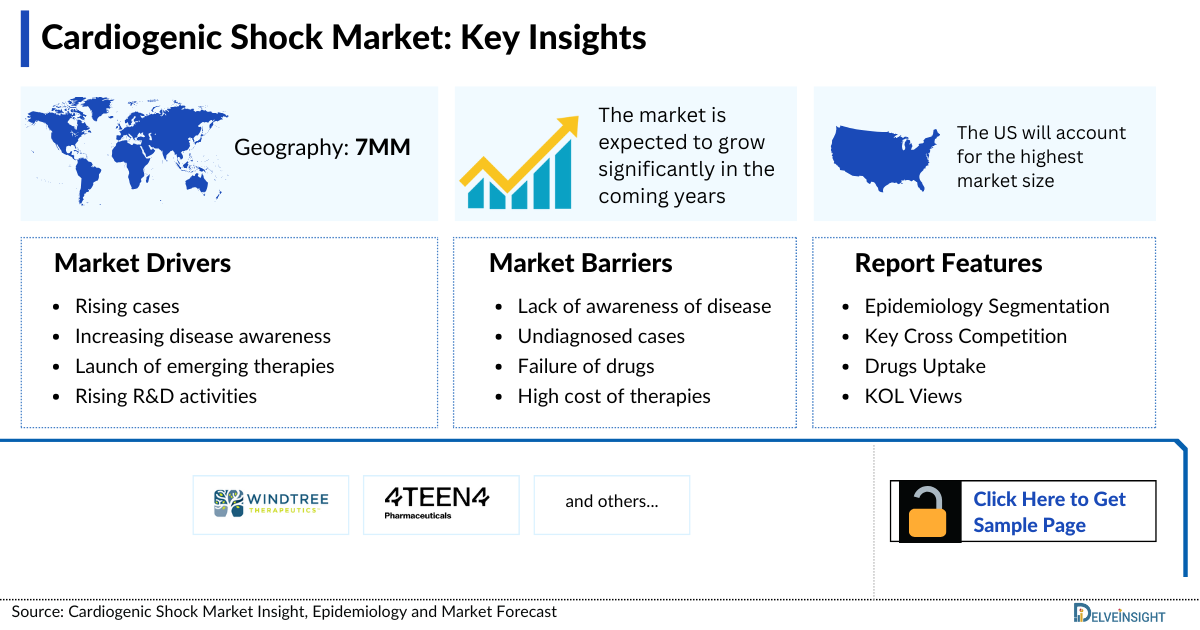
Key Factors Impacting the Cardiogenic Shock Market Growth
-
Rising Incidence of Acute Cardiovascular Events
Increasing cases of acute myocardial infarction, heart failure, and severe arrhythmias are significantly expanding the patient pool requiring urgent cardiogenic shock management.
-
Growing Aging Population
As the global geriatric population rises, the prevalence of underlying cardiac disorders increases, contributing to higher rates of cardiogenic shock and boosting treatment demand.
-
Advancements in Critical Care and Emergency Cardiology
Improved ICU management, rapid diagnosis tools, point-of-care testing, and enhanced monitoring technologies are supporting better identification and intervention.
-
Emergence of Mechanical Circulatory Support Devices (MCSDs)
Wider adoption of devices like intra-aortic balloon pumps, Impella systems, ECMO, and ventricular assist devices is driving significant market opportunities and improved outcomes.
-
Development of Novel Pharmacological Therapies
New inotropes, vasopressor agents, and targeted drugs under clinical evaluation are contributing to a more dynamic therapeutic landscape.
-
Increasing Awareness and Early Recognition
Growing medical education initiatives and hospital-based protocols for early detection of cardiogenic shock are improving treatment initiation rates.
-
Rising Investments in R&D and Clinical Trials
Strong industry focus on developing innovative interventions and evidence-based treatment strategies is accelerating market expansion.
-
Improved Access to Advanced Cardiac Care
Expansion of cardiac specialty centers, better-equipped emergency departments, and wider availability of advanced therapeutic devices are increasing patient access to life-saving care.
-
Integration of AI and Digital Health in Critical Care
AI-driven prediction models, remote monitoring, and digital triage systems are helping clinicians detect deterioration early, contributing to better outcomes and sustained market growth.
DelveInsight’s comprehensive report titled “Cardiogenic Shock Treatment Market Insights, Epidemiology, and Market Forecast – 2034” offers a detailed analysis of cardiogenic shock. The report presents historical and projected epidemiological data covering total incident cases of cardiogenic shock, etiology-specific cases of cardiogenic shock, and treated cases of cardiogenic shock. In addition to epidemiology, the market report encompasses various aspects related to the patient population. These aspects include the diagnosis process, prescription patterns, physician perspectives, market accessibility, treatment options, and prospective developments in the market across seven major markets: the United States, EU4 (Germany, France, Italy, and Spain), the United Kingdom, and Japan, spanning from 2020 to 2034.
The Cardiogenic Shock Treatment Market Report analyzes the existing treatment practices and unmet medical requirements in cardiogenic shock. It evaluates the market potential and identifies potential business prospects for enhancing therapies or interventions. This valuable information enables stakeholders to make well-informed decisions regarding product development and strategic planning for the market.
Scope of the Cardiogenic Shock Market | |
|
Study Period |
2020–2034 |
|
Forecast Period |
2025–2034 |
|
Geographies Covered |
US, EU4 (Germany, France, Italy, and Spain) and the UK, and Japan |
|
Cardiogenic Shock Epidemiology |
|
|
Cardiogenic Shock Market |
|
|
Cardiogenic Shock Market Analysis |
|
|
Cardiogenic Shock Companies |
|
|
Future opportunity |
The cardiogenic shock market is primed for growth as rising AMI and advanced heart failure cases drive demand for targeted, life-saving therapies. With no approved branded drugs in major markets, the need for agents that boost cardiac output, optimize oxygen use, and improve survival is pressing. Novel candidates like istaroxime and procizumab, alongside advances in mechanical support and critical care, could unlock transformative opportunities and redefine treatment standards. |
Cardiogenic Shock Disease Understanding
Cardiogenic shock is a severe state of heart failure primarily caused by extensive damage to the heart muscle, often due to a large Myocardial Infarction. This damage impairs the heart's ability to pump blood effectively, leading to low cardiac output and systemic hypoperfusion. Compensatory mechanisms like vasoconstriction and fluid retention initially attempt to maintain blood flow but eventually exacerbate tissue hypoxia, pulmonary edema, and multi-organ dysfunction. Inflammatory responses and microvascular disturbances further contribute to the progression of cardiogenic shock, creating a downward spiral of worsening cardiac function and systemic perfusion.
Cardiogenic Shock Diagnosis and Treatment Algorithm
Diagnosis of cardiogenic shock centers on identifying persistent low cardiac output accompanied by clinical signs of tissue hypoperfusion, such as altered mental status, cold extremities, reduced urine output, and elevated lactate levels. Echocardiography plays a critical role in assessing cardiac function and excluding other causes of shock. Additional laboratory tests and invasive hemodynamic monitoring may be used to confirm the diagnosis and differentiate cardiogenic shock from other shock types and acute-on-chronic heart failure presentations, guiding appropriate management strategies.
Cardiogenic Shock Treatment focuses on rapid restoration of coronary blood flow, especially in cases triggered by AMI, to salvage myocardium and improve survival. Supportive care includes the use of vasopressors and inotropes to maintain adequate tissue perfusion alongside mechanical circulatory support devices when needed. Early recognition and prompt intervention are crucial to interrupt the cycle of deteriorating cardiac output and organ failure, thereby improving outcomes in this life-threatening condition.
Cardiogenic Shock Epidemiology
The epidemiology section of the cardiogenic shock market report offers information on the patient populations, including historical and projected trends for each of the seven major markets. Examining key opinion leader views from physicians or clinical experts can assist in identifying the reasons behind historical and projected trends. The diagnosed patient pool, their trends, and the underlying assumptions are all included in this section of the report. This section also presents the data with relevant tables and graphs, offering a clear and concise view of the incidence of cardiogenic shock. Additionally, the report discloses the assumptions made during the analysis, ensuring data interpretation and presentation transparency. This epidemiological data is valuable for understanding the disease burden and its impact on the patient population across various regions.
Key Findings from the Cardiogenic Shock Epidemiological Forecast
- In the US, around 80% of cardiogenic shock cases follow an AMI, typically from left ventricular failure, while the remaining 20% result from AMI-related complications such as acute mitral regurgitation, ventricular septal defect, or free wall rupture; right heart failure, often linked to right ventricular AMI, can also be a cause.
- In 2018, hospitalizations due to cardiogenic shock in the US were 408 per 100,000, including 103 per 100,000 related to AMI–associated cardiogenic shock and 258 per 100,000 related to non–AMI cardiogenic shock.
- According to secondary sources, in 2017 the Incidence of cardiogenic shock based on hospitalizations in Germany was 53.7 per 100,000 person-years.
- Cardiogenic shock occurred in 6.1% of patients hospitalized with AMI in France.
- In Italy, cardiogenic shock accounted for 2.17% of general intensive care unit admissions, with etiologies including left heart failure (47.5%), AMI (32.6%), right heart failure (4.6%), and biventricular failure (4.8%).
- According to secondary research, in the UK cardiogenic shock complicated 13% of ST-elevation myocardial infarction cases.
- In Japan, the etiologies of cardiogenic shock were AMI 77.4%, heart failure 10.9%, arrhythmia 4.5%, valvular disease 2.7%, fulminant myocarditis 2.5%, and pulmonary embolism 2.0%.
- The epidemiology of cardiogenic shock is expected to change during the forecast period (2025-2034).
Cardiogenic Shock Market Recent Breakthroughs
- In December 2025, Samsung Medical Center initiated a study to evaluate the prognostic impact of frailty on cardiogenic shock outcomes across different age groups.
- In December 2025, Erasmus Medical Center announced a study assessing the effects of various patient management strategies aimed at improving venoarterial extracorporeal membrane oxygenation (VA-ECMO) weaning success, with the first trial domain focusing on the impact of left ventricular unloading using intra-aortic balloon pumping in VA-ECMO–supported patients.
Cardiogenic Shock Market Outlook
The cardiogenic shock therapeutics market is further expected to increase by the major drivers, such as the rising incidence population, technological advancements, and upcoming therapies in the forecast period (2025–2034). With ongoing research and continued dedication, the future holds hope for even more effective treatments and, ultimately, a cure for this challenging condition. According to DelveInsight, the Cardiogenic Shock market in the 7MM is expected to change significantly during the forecast period 2025–2034.
Cardiogenic Shock Drug Analysis
Emerging Cardiogenic Shock Drugs
The cardiogenic shock market is expected to evolve gradually, driven by the limited number of emerging therapies currently in development. Key players such as istaroxime, procizumab, among others are showing active commitment to addressing this unmet need, with ongoing efforts to advance novel treatment options for this complex condition.
-
Istaroxime: Windtree Therapeutics
Istaroxime, developed by Windtree Therapeutics, is a first-in-class, dual-mechanism therapy that improves both systolic and diastolic heart function. It increases myocardial contractility through Na⁺/K⁺-ATPase inhibition (positive inotropic effect) and enhances myocardial relaxation by activating the SERCA2a calcium pump to improve calcium reuptake into the sarcoplasmic reticulum. The drug has completed a Phase II study in cardiogenic shock and is now in Phase IIb development.
-
- In August 2025, Windtree announced that interim Phase II data for istaroxime in SCAI Stage C cardiogenic shock will be presented at the Heart Failure Society of America (HFSA) Annual Scientific Meeting 2025.
- In June 2025, Windtree announced the publication of its Phase II SEISMiC B study on early cardiogenic shock in the Journal of Heart and Lung Transplantation, reporting the safety and efficacy of intravenous istaroxime (up to 60 hours) in patients with poor cardiac function and low blood pressure requiring rapid treatment.
- In May 2025, Windtree presented data from the Phase IIb SEISMiC Extension study of istaroxime in early cardiogenic shock at the European Society of Cardiology Heart Failure 2025 Conference.
- In September 2024, the SEISMiC Extension study in 30 SCAI Stage B cardiogenic shock patients showed significant improvements in blood pressure, cardiac function, pulmonary congestion, and renal function using lower doses and longer infusions, optimizing dosing and confirming favorable safety. The SEISMiC C study in up to 100 Stage C patients is ongoing, with completion expected Q1 2026.
- In September 2022, results from the positive Phase II study of istaroxime in early cardiogenic shock were published in the European Journal of Heart Failure, following a May 2022 late-breaker presentation at the European Society of Cardiology Heart Failure Meeting. In April 2022, topline data showed that istaroxime rapidly and significantly increased systolic blood pressure while improving cardiac output and preserving renal function.
- In September 2020, a Phase II trial was initiated to assess istaroxime in more severe heart failure patients with cardiogenic shock, focusing on blood pressure (primary endpoint), cardiac function (secondary endpoint), and safety.
-
Procizumab (PCZ, AK1967): 4TEEN4 Pharmaceuticals
Procizumab (PCZ, AK1967) is a first-in-class monoclonal antibody targeting circulating dipeptidyl peptidase 3 (cDPP3) for the treatment of shock, particularly cardiogenic shock. By inhibiting cDPP3, it aims to restore cardiovascular stability in patients with severe circulatory failure. Clinical evidence indicates that procizumab is well tolerated, effectively blocks cDPP3 activity, and can rapidly reverse shock without significant adverse effects.
-
- In July 2025, 4TEEN4 Pharmaceuticals initiated the Phase Ib/IIa PROCARD1 trial of procizumab in cardiogenic shock and published European Journal of Heart Failure data showing the drug’s favorable tolerability, effective cDPP3 blockade, and rapid shock reversal within 48 hours without immediate adverse events.
- In April 2025, 4TEEN4 reported completion of the Phase I trial, confirming good tolerability across all tested doses, no significant safety concerns, and a favorable safety profile. The results supported advancement into the Phase Ib/IIa study to further evaluate its therapeutic potential in circulatory failure.
- In January 2025, the company raised approximately EUR 24 million in Series C financing to support the next clinical trials of procizumab in cardiogenic shock.
|
Drug |
MoA |
RoA |
Company |
Logo |
Phase |
|
Istaroxime |
Na+/K+ ATPase inhibition and SERCA2a activation |
IV |
Windtree Therapeutics |
|
IIb |
|
Procizumab (PCZ, AK1967) |
DPP3 inhibition |
IV |
4TEEN4 Pharmaceuticals |
|
Ib/IIa |
|
XX |
XX |
X |
XXX |
|
XX |
Note: Detailed emerging therapies assessment will be provided in the final report.
Cardiogenic Shock Market Segmentation
DelveInsight’s ‘Cardiogenic Shock – Market Insights, Epidemiology, and Market Forecast – 2034’ report provides a detailed outlook of the current and future cardiogenic shock market, segmented within countries, by therapies, and by classes. Further, the market of each region is then segmented by each therapy to provide a detailed view of the current and future market share of all therapies.
Cardiogenic Shock Market Size by Countries
The cardiogenic shock market size is assessed separately for various countries, including the United States, EU4 (Germany, France, Italy, and Spain), the UK, and Japan. In 2024, the United States held a significant share of the overall 7MM (seven major markets) cardiogenic shock market, primarily attributed to the country’s higher incidence of the condition and the elevated cost of the available treatments. This dominance is projected to persist, especially with the potential early introduction of new products.
Cardiogenic Shock Market Size by Therapies
Cardiogenic Shock Market Size by Therapies is categorized into current and emerging markets for the study period 2020–2034.
Note: Detailed market segment assessment will be provided in the final report.
Cardiogenic Shock Drugs Uptake
This section focuses on the sales uptake of potential cardiogenic shock drugs that have recently been launched or are anticipated to be launched in the cardiogenic shock market between 2020 and 2034. It estimates the market penetration of cardiogenic shock drugs for a given country, examining their impact within and across classes and segments. It also touches upon the financial and regulatory decisions contributing to the probability of success (PoS) of the drugs in the cardiogenic shock market. The emerging cardiogenic shock therapies are analyzed based on various attributes such as safety and efficacy in randomized clinical trials, order of entry and other market dynamics, and the unmet need they fulfill in the cardiogenic shock market.
Cardiogenic Shock Market Access and Reimbursement
DelveInsight’s ‘Cardiogenic Shock Market Insights, Epidemiology, and Market Forecast – 2034’ report provides a descriptive overview of the market access and reimbursement scenario of cardiogenic shock. This section includes a detailed analysis of the country-wise healthcare system for each therapy, enlightening the market access, reimbursement policies, and health technology assessments.
Latest KOL Views on Cardiogenic Shock
To keep up with current cardiogenic shock market trends and fill gaps in secondary findings, we interview KOLs and SMEs’ working in the cardiogenic shock domain. Their opinion helps understand and validate current and emerging therapies and treatment patterns or cardiogenic shock market trends. This will support the clients in potential upcoming novel treatments by identifying the overall scenario of the market and the cardiogenic shock unmet needs.
Cardiogenic Shock KOL Insights
DelveInsight’s analysts connected with 25+ KOLs to gather insights; however, interviews were conducted with 10+ KOLs in the 7MM. These KOLs were from organizations, institutes, and hospitals, such as Columbia University Irving Medical Center, US, University Hospital Tübingen, Germany, Lariboisière University Hospital, France, University of Barcelona, Spain, University of Milan, Italy, University of Leeds, UK, and University of Tokyo, Japan, among others.
“Cardiogenic shock occurs when the heart fails to pump enough blood, often after a severe heart attack that damages a large portion of the left ventricle. Reduced contractility triggers compensatory mechanisms like vasoconstriction and fluid retention, which initially aim to preserve blood flow but ultimately worsen hypoperfusion, pulmonary congestion, and multiorgan dysfunction, often accelerated by inflammatory and microvascular disturbances.”
“Diagnosis focuses on identifying low cardiac output with clear signs of tissue hypoperfusion while ruling out other types of shock. Clinicians rely on clinical signs such as altered mental status, cold extremities, low urine output, and rising lactate levels, supported by echocardiography, lab tests, and sometimes invasive monitoring to distinguish between acute cases and acute-on-chronic presentations.”
“Treatment prioritizes rapid restoration of coronary blood flow in heart attack–related cases, combined with supportive measures like vasopressors, inotropes, and mechanical circulatory support when needed. Swift recognition and early intervention are essential to break the cycle of worsening organ failure and improve survival.”
Note: Detailed assessment of KOL Views will be provided in the full report on Cardiogenic Shock.
Cardiogenic Shock Competitive Intelligence Analysis
We conduct a Competitive and Market Intelligence analysis of the cardiogenic shock Market, utilizing various Competitive Intelligence tools such as SWOT analysis and Market entry strategies. The inclusion of these analyses is contingent upon data availability, ensuring a comprehensive and well-informed assessment of the market landscape and competitive dynamics.
Cardiogenic Shock Clinical Trials Activities
The report offers an analysis of therapeutic candidates in Phase II and I stages and examines Cardiogenic Shock Companies involved in developing targeted therapeutics for cardiogenic shock.
Cardiogenic Shock Pipeline Development Activities
It provides valuable insights into the advancements and progress of potential treatments in clinical development for this condition. The report covers information on collaborations, acquisition and merger, licensing, patent details, and other information for emerging cardiogenic shock therapies.
Cardiogenic Shock Market Report Insights
- Patient-based Cardiogenic Shock Market Forecasting
- Therapeutic Approaches
- Cardiogenic Shock Pipeline Analysis
- Cardiogenic Shock Market Size and Trends
- Cardiogenic Shock Market Opportunities
- Impact of Upcoming Therapies
Cardiogenic Shock Market Report Key Strengths
- 10-Year Cardiogenic Shock Market Forecast
- The 7MM Coverage
- Cardiogenic Shock Epidemiology Segmentation
- Key Cross Competition
- Highly Analyzed Cardiogenic Shock Drugs Market
- Cardiogenic Shock Drugs Uptake
Cardiogenic Shock Market Report Assessment
- Cardiogenic Shock Current Treatment Practices
- Cardiogenic Shock Unmet Needs
- Cardiogenic Shock Pipeline Product Profiles
- Cardiogenic Shock Market Attractiveness
Key Questions Answered in the Cardiogenic Shock Market
Cardiogenic Shock Market Insights
- How common is cardiogenic shock?
- What are the key findings of cardiogenic shock epidemiology across the 7MM, and which country will have the highest number of patients during the study period (2020–2034)?
- What are the currently available treatments for cardiogenic shock?
- What are the disease risk, burden, and unmet needs of cardiogenic shock?
- At what CAGR is the cardiogenic shock market and its epidemiology is expected to grow in the 7MM during the forecast period (2025–2034)?
- How would the unmet needs impact the cardiogenic shock market dynamics and subsequently influence the analysis of the related trends?
- What would be the forecasted patient pool of cardiogenic shock in the 7MM covering the United States, EU4 (Germany, France, Italy, and Spain), the UK, and Japan?
- Among EU4 and the UK, which country will have the highest number of patients during the forecast period (2025–2034)?
- How many companies are currently developing therapies for the treatment of cardiogenic shock?
Reasons to Buy the Cardiogenic Shock Market Report
- The Cardiogenic Shock Therapeutics Market Report will help in developing business strategies by understanding the latest trends and changing treatment dynamics driving the Cardiogenic Shock Drugs Market.
- Insights on patient burden/disease Cardiogenic Shock incidence, evolution in diagnosis, and factors contributing to the change in the epidemiology of the disease during the forecast years
- To understand the existing Cardiogenic Shock Drugs Market opportunity in varying geographies and the growth potential over the coming years.
- Distribution of historical and current patient share based on real-world prescription data along with reported sales of current treatment in the US, EU4 (Germany, France, Italy, and Spain), the United Kingdom, and Japan.
- Identification of strong upcoming players in the Cardiogenic Shock Drugs Market will help in devising strategies that will help in getting ahead of competitors.
- Detailed analysis and ranking of class-wise potential current and Cardiogenic Shock emerging therapies under the attribute analysis section to provide visibility around leading classes.
- Highlights of Access and Reimbursement policies of approved therapies, barriers to accessibility of off-label expensive therapies, and patient assistance programs.
- To understand the perspective of Key Opinion Leaders around the accessibility, acceptability, and compliance-related challenges of existing treatment to overcome barriers in the future.
- Detailed insights on the unmet needs of the existing Cardiogenic Shock Drugs Market so that the upcoming players can strengthen their development and launch strategy.
Stay updated with us for Recent Articles @ New DelveInsight Blogs

-pipeline.png&w=256&q=75)
-market.png&w=256&q=75)

