
Hypoxia Market
- Hypoxia market is expected to rise in the upcoming years, estimated by DelveInsight.
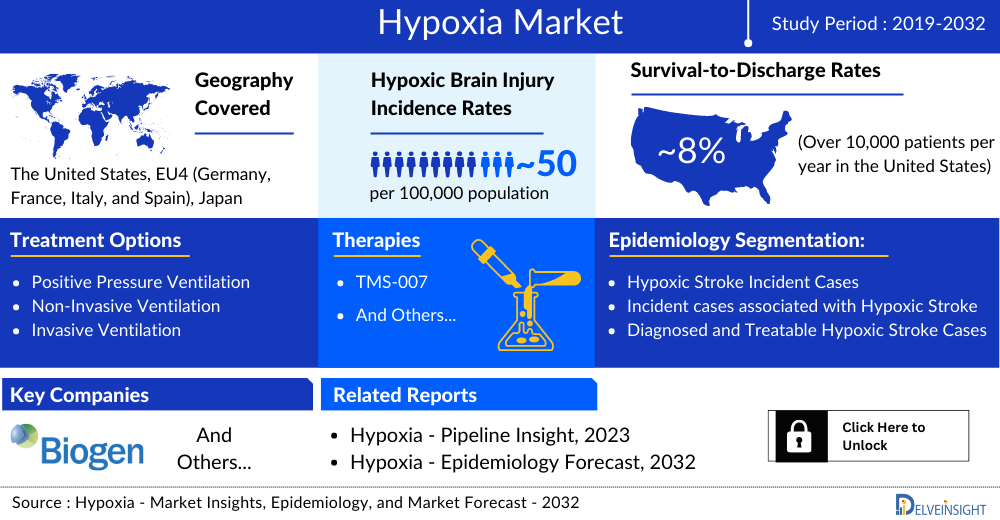
- As per the study conducted by Myriam Lacerte et al. (2020) the incidence rates of Hypoxic Brain Injury are approximately 50 per 100,000 population and survival-to-discharge rates of roughly 8% which represents over 10,000 patients per year in the United States alone.
- Hypoxia epidemiology is segmented as Incident Cases of Stroke, Incident cases associated with Hypoxic Stroke, Diagnosed and Treatable Cases of Hypoxic Stroke in the Hypoxia treatment market report.
Request for unlock CAGR of Hypoxia Market
DelveInsight's "Hypoxia—Market Insights, Epidemiology, and Market Forecast—2032" report delivers an in-depth understanding of the Hypoxia, historical and forecasted epidemiology as well as the Hypoxia market trends in the United States, EU5 (Germany, Spain, Italy, France, and the United Kingdom) and Japan.
The Hypoxia market treatment report provides current treatment practices, emerging hypoxia drugs, Hypoxia market share of the individual therapies, current and forecasted Hypoxia market Size from 2019 to 2032 segmented by seven major markets. The report also covers current Hypoxia treatment practice/algorithm, and unmet medical needs to curate best of the opportunities and assesses the underlying potential of the market.
Geography Covered
- The United States
- EU5 (Germany, France, Italy, Spain, and the United Kingdom)
- Japan
Study Period: 2019–2032
Hypoxia Disease Understanding and Treatment Algorithm
The DelveInsight’s Hypoxia therapeutics market report gives a thorough understanding of Hypoxia by including details such as disease definition, symptoms, causes, pathophysiology, diagnosis, and treatment.
Hypoxia is a state in which oxygen is not available in sufficient amounts at tissue level to maintain adequate homeostasis; this can result from inadequate oxygen delivery to the tissues either due to low blood supply or low oxygen content in blood. Hypoxia can be distinguished into four types, the hypoxemic type, in which the oxygen pressure in the blood going to the tissues is too low to saturate the hemoglobin; the anemic type, in which the amount of functional hemoglobin is too small, and hence the capacity of the blood to carry oxygen is too low; the stagnant type, in which the blood is or may be normal but the flow of blood to the tissues is reduced or unevenly distributed; and the histotoxic type, in which the tissue cells are poisoned and are therefore unable to make proper use of oxygen. In its extreme form, where oxygen is entirely absent, the condition is called anoxia.
The symptoms of hypoxia can vary based on the condition’s cause and severity. Generally, they include coughing, wheezing, increased heart rate, headache, and a bluish color in the skin, lips, or fingernails (called cyanosis). Severe cases might even cause fainting or seizures. In the case of cerebral hypoxia, a person might experience confusion, difficulty speaking, temporary memory loss, difficulty moving, or coma. Hypoxia majorly affects brain and heart. Cerebral hypoxia refers to a situation in which there is a decrease of oxygen supply to the brain even though there is adequate blood flow, it affects the largest parts of the brain, called the cerebral hemispheres.
Hypoxia Diagnosis
Diagnosis of hypoxia generally begins with a physical examination to evaluate the heart and lungs. If hypoxia signs are detected then tests like pulse oximetry and arterial blood gas test are performed, and in case of cerebral hypoxia imaging tests like MRI, CT scan, echocardiogram, or electroencephalogram (EEG) are performed.
Hypoxia Treatment
The hypoxia treatment depends on the specific underlying cause. Treatment may include oxygen therapy, mechanical ventilation and medications to treat the underlying conditions.
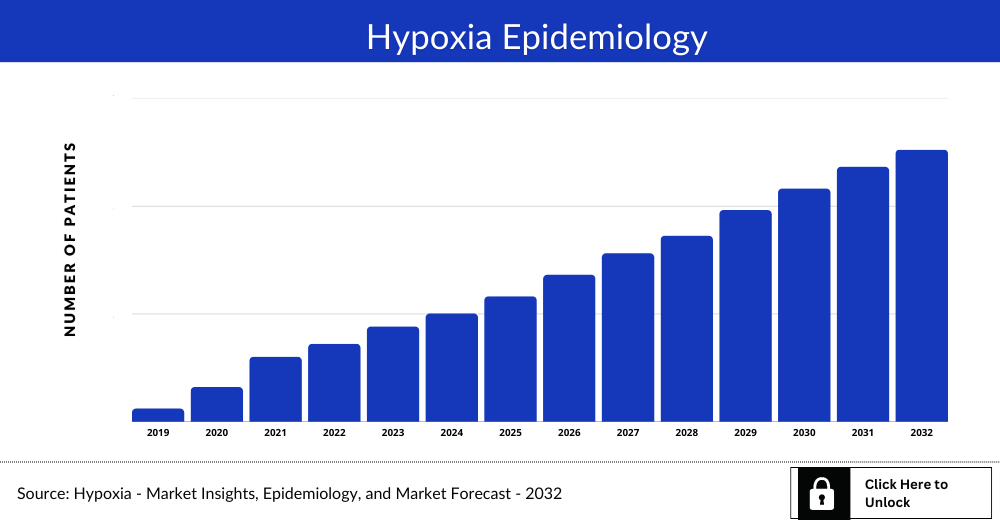
Hypoxia Epidemiology
The Hypoxia epidemiology section provides insights about historical and current Hypoxia patient pool and forecasted trends for individual seven major countries. It helps to recognize the causes of current and forecasted trends by exploring numerous studies and views of key opinion leaders. This part of the report also provides the diagnosed patient pool and their trends along with assumptions undertaken.
Key Findings
- As per the study conducted by Myriam Lacerte et al. (2020) the incidence rates of Hypoxic Brain Injury are approximately 50 per 100,000 population and survival-to-discharge rates of roughly 8% which represents over 10,000 patients per year in the United States alone.
- The disease epidemiology covered in the report provides historical as well as forecasted Hypoxia epidemiology [segmented as Incident Cases of Stroke, Incident cases associated with Hypoxic Stroke, Diagnosed and Treatable Cases of Hypoxic Stroke] in the 7MM covering the United States, EU5 countries (Germany, France, Italy, Spain, and the United Kingdom), and Japan from 2019 to 2032.
Country Wise—Hypoxia Epidemiology
This section provides glimpse of the Hypoxia epidemiology in the United States, EU5 (Germany, Spain, Italy, France, and the United Kingdom), and Japan.
Learn more about the evolving epidemiology trends and key developments: Hypoxia Epidemiology Forecast
Hypoxia Drug Chapters
The drug chapter segment of the Hypoxia report encloses the detailed analysis of marketed Hypoxia drugs and late stage (Phase-III and Phase-II) pipeline Hypoxia drugs. It also helps to understand the Hypoxia clinical trial details, expressive pharmacological action, agreements and collaborations, approval and patent details, advantages and disadvantages of each included drug, and the latest news and press releases.
Marketed Hypoxia Drugs
Note: Detailed Current hypoxia therapies assessment will be provided in the full report of Hypoxia
CURRENT MAJOR HYPOXIA TREATMENT OPTIONS
- Maintaining Patient Airways
- Increase Fraction of the Inspired O2 (FiO2)
- Improve the Diffusion of Oxygen through the Alveolar Interstitial Tissue
- Other treatment (blood thinners, antibiotics)
- Improve the Diffusion of Oxygen through the Alveolar Interstitial Tissue
Emerging Hypoxia Drugs
TMS-007: Biogen
It is a plasminogen activator with a novel hypoxia mechanism of action associated with breaking down blood clots and is believed to inhibit local inflammation at the site of thrombosis. This unique combination could position TMS-007 as a best in class thrombolytic for individuals with acute ischemic stroke (AIS) with potential for an extended treatment window as compared to current thrombolytic agents. TMS-007 is a small molecule which has previously demonstrated an acceptable safety profile in a Phase I study and has also reduced infarct volume (area of dead tissue resulting from failure of blood supply) in experimental, preclinical, embolic and thrombotic stroke models. TMS-007 was evaluated in a double-blind, placebo-controlled Phase II study in Japan, designed to investigate the safety and efficacy of a single IV administration of TMS-007.
Note: Detailed emerging therapies assessment will be provided in the full report of Hypoxia
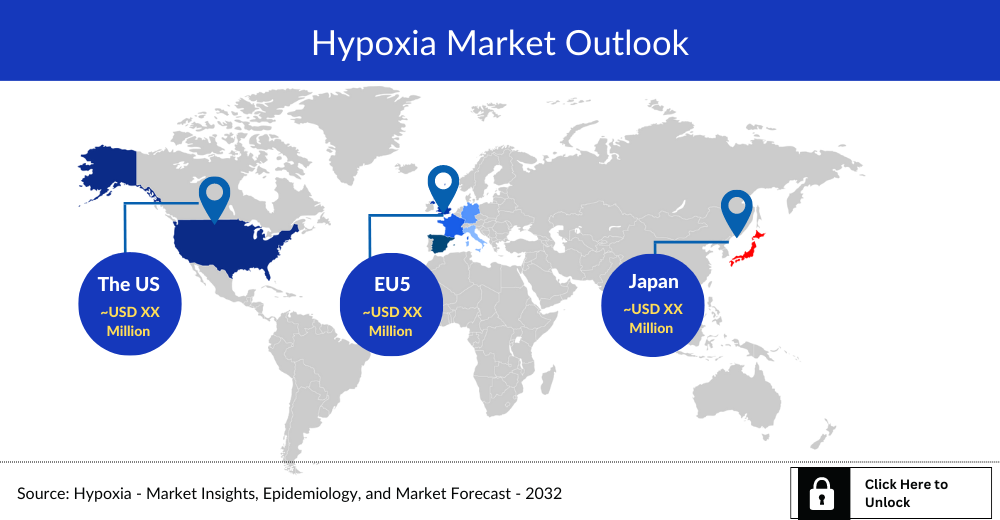
Hypoxia Market Outlook
The market comprises a variety of options for the treatment of Hypoxia. Treatment of vascular brain disorders has great impact clinically, financially, and socially throughout the world. Prevention of their occurrence through lifestyle adjustments and clinical antihypertensive treatment is an essential part of the therapy to reduce stroke probability and vascular malfunction-related gradual decline in memory.
Treatment depends on the underlying cause of the hypoxia, the most important treatment for cerebral hypoxia involves removing the source of the oxygen deprivation, along with extensive physical, occupational, or speech therapy to teach brain how to work around any damaged areas. Such therapy can be challenging and emotionally draining, but the more committed treatment approaches.
Management of hypoxia falls under 3 categories: maintaining patent airways, increasing the oxygen content of the inspired air, and improving the diffusion capacity.
Some other treatments include hypoxia drugs to prevent future hypoxia episodes; this may include the use of blood thinners, antibiotics to treat infections that caused or resulted from the hypoxia, surgery to remove any blockages or to discover the source of the blockage. Also, it is supported by the use of assistive gear, such as a wheelchair, psychotherapy and basic life-support systems (mechanical ventilation to secure the airway; fluids, blood products, or medications to support blood pressure and heart rate; and medications to suppress seizures).
Positive Pressure Ventilation: it includes Non-Invasive Ventilation and Invasive Ventilation.
Non-Invasive Ventilation: Continuous Positive Airways Pressure Mask (CPAP) is mainly used in patients with obstructive sleep apnea or in acute pulmonary edema. It delivers oxygen (or air) under pre-determined high pressure via a tightly fitting face mask. Bilevel Positive Airways Pressure (BiPAP) is used in patients with acute Hypercarbia as in patients with COPD exacerbation and ARDS patients.
Invasive Ventilation: it is positive pressure ventilator attached to (usually) endotracheal tube. Allows for accurate delivery of predetermined minute ventilation as well as accurate FiO2 and positive end-expiratory pressure
Key players such as Biogen along with few others are involved in developing therapies for Hypoxia.
According to DelveInsight, Hypoxia therapeutics market in 7MM is expected to witness a major change in the study period 2019-2032.
Analyst Commentary
- The pipeline of Hypoxia is very robust, many potential therapies are being investigated for the treatment of Hypoxia, and it is safe to predict that the treatment space will experience a significant impact on the market during the forecast period
- The expected introduction of emerging therapies with improved efficacy, more awareness initiatives programs, and further improvement in the diagnosis rate, are likely to boost the growth of the Hypoxia treatment market in the 7MM. Aside from that, the market size of Hypoxia may flourish due to increased research and development, label-expansion of approved therapies into other epilepsy in this field
- The market growth of Hypoxia may offset by failures and/or discontinuation of the emerging therapies, unaffordable pricing, market access and reimbursement issues, and a scarcity of healthcare specialists
Hypoxia Drugs Uptake
This section focusses on the rate of uptake of the potential hypoxia drugs recently launched in the Hypoxia therapeutics market or expected to get launched in the market during the study period 2019-2032. The analysis covers Hypoxia therapeutics market uptake by drugs; patient uptake by therapies; and sales of each drug.
This helps in understanding the hypoxia therapies with the most rapid uptake, reasons behind the maximal use of new hypoxia therapies, and allows the comparison of the hypoxia based on market share and size which again will be useful in investigating factors important in market uptake and in making financial and regulatory decisions.
Note: Detailed emerging therapies assessment will be provided in full report of Hypoxia.
Hypoxia Pipeline Development Activities
The report provides insights into different therapeutic candidates in Phase II and Phase III stage. It also analyses Hypoxia key players involved in developing targeted therapeutics.
Pipeline Development Activities
The report covers the detailed information of collaborations, acquisition and merger, licensing, patent details and other information for Hypoxia emerging therapies.
Learn more about the emerging therapies and key companies active in the therapeutics segment: Hypoxia Pipeline Insight
Reimbursement Scenario in Hypoxia
Approaching reimbursement proactively can have a positive impact both during the late stages of product development and well after product launch. In a report, we consider reimbursement to identify economically attractive indications and market opportunities. When working with finite resources, the ability to select the markets with the fewest reimbursement barriers can be a critical business and price strategy.
KOL- Views
To keep up with current market trends, we take KOLs and SMEs ' opinions working in the Hypoxia domain through primary research to fill the data gaps and validate our secondary research. Their opinion helps to understand and validate current and emerging therapies treatment patterns or Hypoxia market trends. This will support the clients in potential upcoming novel treatment by identifying the overall scenario of the market and the unmet needs.
Competitive Intelligence Analysis
We perform Competitive and Market Intelligence analysis of the Hypoxia treatment Market by using various Competitive Intelligence tools that include - SWOT analysis, PESTLE analysis, Porter's five forces, BCG Matrix, Market entry strategies etc. The inclusion of the analysis entirely depends upon the data availability.
Scope of the Hypoxia Treatment Market Report
- The report covers the descriptive overview of Hypoxia, explaining its causes, signs and symptoms, pathophysiology, diagnosis, and currently available therapies
- Comprehensive insight has been provided into the Hypoxia epidemiology and treatment in the 7MM
- Additionally, an all-inclusive account of both the current and emerging therapies for Hypoxia are provided, along with the assessment of new therapies, which will have an impact on the current treatment landscape
- A detailed review of the Hypoxia therapeutics market; historical and forecasted is included in the report, covering drug outreach in the 7MM
- Detailed Patient Based Market Forecasting determines the trends shaping and driving the global Hypoxia treatment market
Hypoxia Market Report Highlights
- In the coming years, the Hypoxia treatment market is set to change due to the rising awareness of the disease, and incremental healthcare spending across the world; which would expand the size of the market to enable the drug manufacturers to penetrate more into the market
- The companies and academics are working to assess challenges and seek opportunities that could influence Hypoxia R&D. The therapies under development are focused on novel approaches to treat/improve the disease condition
- Major players are involved in developing therapies for Hypoxia. The launch of emerging therapies will significantly impact the Hypoxia therapeutics drugs market
- A better understanding of disease pathogenesis will also contribute to the development of novel therapeutics for Hypoxia
- Our in-depth analysis of the pipeline assets across different stages of development (Phase III and Phase II), different emerging trends, and comparative analysis of pipeline products with detailed Hypoxia clinical trial profiles, key cross-competition, launch date along with product development activities will support the clients in the decision-making process regarding their therapeutic portfolio by identifying the overall scenario of the research and development activities
Hypoxia Report Insights
- Patient Based Market Forecasting
- Therapeutic Approaches
- Hypoxia Pipeline Analysis
- Hypoxia Therapeutics Drugs Market and Hypoxia Market Trends
- Market Opportunities
- Impact of upcoming Therapies
Hypoxia Report Key Strengths
- 11 Years Forecast
- 7MM Coverage
- Hypoxia Epidemiology Segmentation
- Key Cross Competition
- Highly Analyzed Market
- Drugs Uptake
Hypoxia Report Assessment
- Current Treatment Practices
- Unmet Needs
- Pipeline Product Profiles
- Market Attractiveness
Key Questions
Market Insights:
- What was the Hypoxia drug class share (%) distribution in 2019 and how it would look like in 2032?
- What would be the Hypoxia total market size as well as market size by therapies across the 7MM during the forecast period (2019-2032)?
- What are the key findings of the market across 7MM and which country will have the largest Hypoxia market size during the forecast period (2019-2032)?
- At what CAGR, the Hypoxia market is expected to grow by 7MM during the forecast period (2019-2032)?
- What would be the Hypoxia market outlook across the 7MM during the forecast period (2019-2032)?
- What would be the Hypoxia market growth till 2032, and what will be the resultant market Size in the year 2032?
- How would the unmet needs affect the market dynamics and subsequent analysis of the associated trends?
Epidemiology Insights:
- What are the disease risk, burden, and regional/ethnic differences of Hypoxia?
- What are the key factors driving the epidemiology trend for seven major markets covering the United States, EU5 (Germany, Spain, France, Italy, and the UK), and Japan?
- What is the historical Hypoxia patient pool in seven major markets covering the United States, EU5 (Germany, Spain, France, Italy, and the UK), and Japan?
- What would be the forecasted patient pool of Hypoxia in seven major markets covering the United States, EU5 (Germany, Spain, France, Italy, and the UK), and Japan?
- Where will be the growth opportunities in the 7MM concerning the patient population about Hypoxia?
- Out of all 7MM countries, which country would have the highest incident population of Hypoxia during the forecast period (2019-2032)?
- At what CAGR the patient population is expected to grow by 7MM during the forecast period (2019-2032)?
Current Treatment Scenario, Marketed Drugs, and Emerging Therapies:
- What are the current options for the Hypoxia treatment in addition to the approved therapies?
- What are the current treatment guidelines for the treatment of Hypoxia in the USA, Europe, and Japan?
- What are the marketed Hypoxia drugs and their respective hypoxia MOA, regulatory milestones, product development activities, advantages, disadvantages, safety, efficacy, etc.?
- How many companies are developing therapies for the treatment of Hypoxia?
- How many therapies are in-development by each company for Hypoxia treatment?
- How many are emerging therapies in mid-stage, and late stage of development for Hypoxia treatment?
- What are the key collaborations (Industry - Industry, Industry-Academia), Mergers and acquisitions, licensing activities related to the Hypoxia therapies?
- What are the recent novel therapies, targets, hypoxia mechanism of action, and technologies being developed to overcome the limitation of existing therapies?
- What are the hypoxia clinical trials going and what is its status?
- What are the current challenges faced in drug development?
- What are the key designations that have been granted for the emerging therapies for Hypoxia?
- What are the global historical and forecasted markets of Hypoxia?
Reasons to buy
- The Patient Based Market Forecasting analysis will help in developing business strategies by understanding trends shaping and driving the Hypoxia market
- Organize sales and marketing efforts by identifying the best opportunities for Hypoxia in the US, Europe (Germany, Spain, Italy, France, and the United Kingdom), and Japan
- Identification of strong upcoming players in the market will help in devising strategies that will help in getting ahead of competitors
- Organize sales and marketing efforts by identifying the best opportunities for the Hypoxia market
- To understand the future market competition in the Hypoxia market
Get detailed insights @ DelveInsight Blogs

-inhibitor-pipeline.png&w=256&q=75)

-inhibitor-pipeline.png&w=256&q=75)

