Cardiovascular Imaging Equipment Market Summary
• The Cardiovascular Imaging Equipment market is estimated at USD 1.6 billion in 2025 and is projected to reach USD 2.9 billion by 2034. Growth is anchored in the rising global burden of cardiovascular disease, the aging population, and continuous technological advances in echocardiography, cardiac computed tomography, and artificial intelligence-enabled imaging.
• The global Cardiovascular Imaging Equipment market is growing at a CAGR of 6.71% during the forecast period from 2026 to 2034.
• By device type, the echocardiography segment dominated the Cardiovascular Imaging Equipment market with a 35% share in 2025.
• By application, the coronary artery disease segment dominated the Cardiovascular Imaging Equipment market with a share of 40% in 2025.
• By end-user, the hospitals segment dominated the Cardiovascular Imaging Equipment market with a share of 58% in 2025.
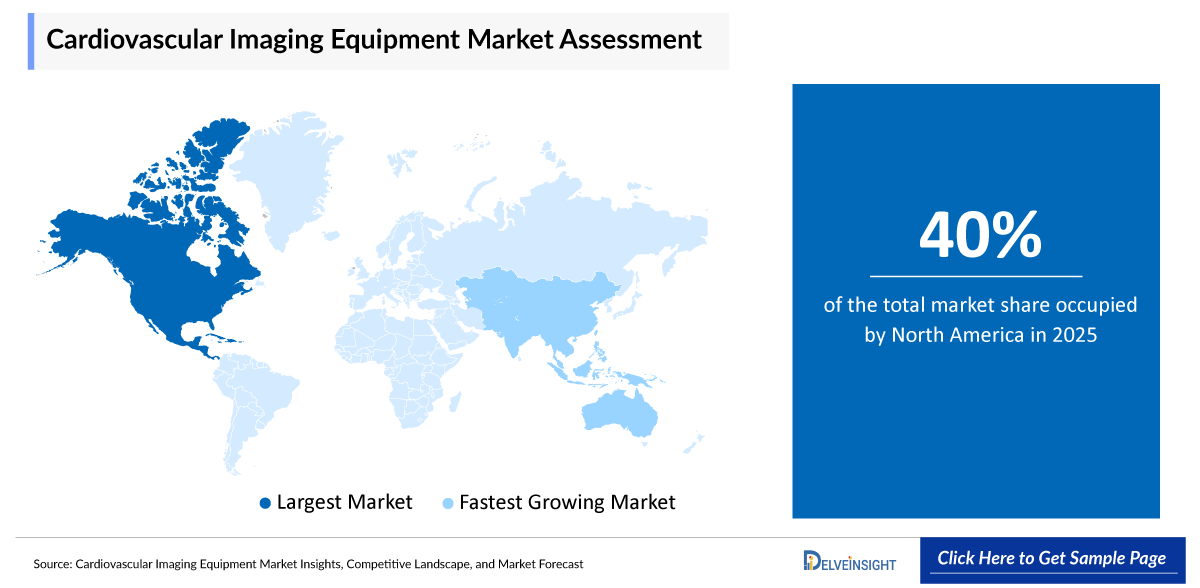
• North America dominated the global Cardiovascular Imaging Equipment market revenue with a share of 40% in 2025, representing the highest regional market share globally.
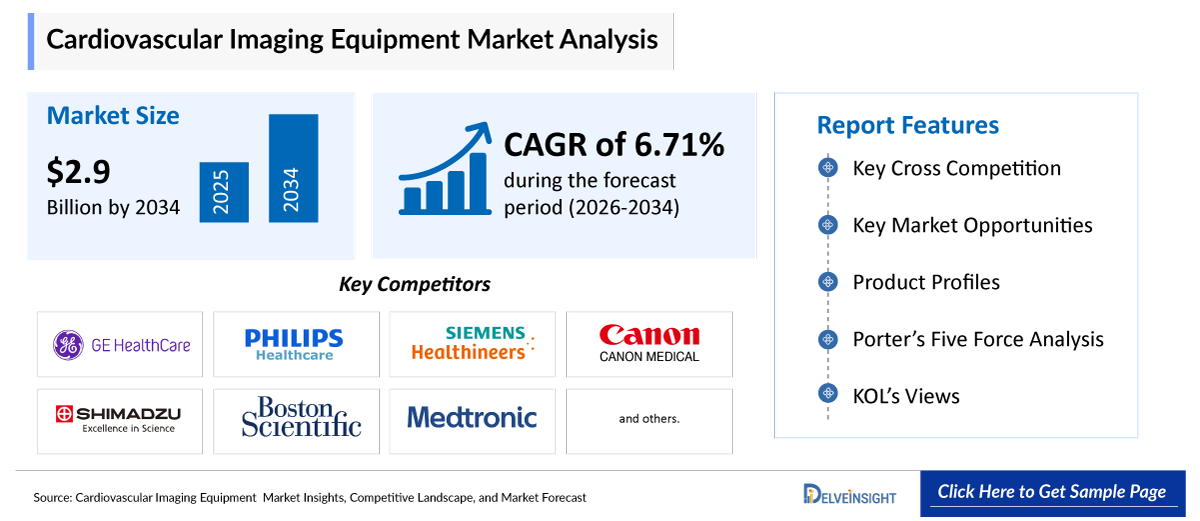
Cardiovascular imaging equipment comprises the systems used to visualize the heart and blood vessels for the diagnosis, assessment, and management of cardiovascular disease. The category spans echocardiography and cardiac ultrasound systems; cardiac computed tomography; cardiac magnetic resonance imaging; nuclear cardiac imaging using single-photon emission computed tomography; cardiac positron emission tomography; angiography and cardiac catheterization laboratory systems; and intravascular imaging using intravascular ultrasound and optical coherence tomography. These systems are supplied by leading medical imaging manufacturers including GE HealthCare, Philips, Siemens Healthineers, Canon Medical, Shimadzu, and Fujifilm, and by interventional and intravascular imaging specialists including Abbott and Boston Scientific. Cardiovascular imaging is used across coronary artery disease, heart failure, valvular heart disease, congenital heart disease, and other indications, in hospitals, specialty and cardiac clinics, and diagnostic imaging centers. Over the past decade, the field has advanced from conventional two-dimensional imaging toward three- and four-dimensional echocardiography, high-resolution and photon-counting cardiac computed tomography, advanced cardiac magnetic resonance, and artificial intelligence-enabled acquisition, quantification, and interpretation. Driven by the escalating global burden of cardiovascular disease, an aging population, the growth of structural heart and interventional procedures, and rapid technological innovation, cardiovascular imaging equipment has become an essential pillar of modern cardiology.
Cardiovascular Imaging Equipment Market Key Growth Drivers
• The rising global burden of cardiovascular disease, identified by the World Health Organization as the leading cause of death worldwide with an estimated 17.9 million deaths each year, is expanding demand for cardiac imaging.
• The aging global population, which carries a higher prevalence of coronary artery disease, heart failure, and valvular disease, is increasing the need for cardiovascular imaging.
• Continuous technological advances, including three- and four-dimensional echocardiography, photon-counting computed tomography, advanced cardiac magnetic resonance, and artificial intelligence, are improving diagnostic capability and driving adoption.
• The growth of structural heart and interventional cardiology procedures, such as transcatheter valve replacement and repair, is increasing demand for advanced procedural and intravascular imaging.
• Rising awareness, screening, and early diagnosis of cardiovascular disease are expanding the use of cardiac imaging across health systems.
• Expanding healthcare access, cardiac care infrastructure, and imaging capacity in emerging markets are broadening the global demand for cardiovascular imaging equipment.
• The convergence of rising cardiovascular disease burden, procedural growth, and imaging innovation is expected to sustain steady growth in the global Cardiovascular Imaging Equipment market through 2034.
Key Companies in Cardiovascular Imaging Equipment Market
The competitive landscape is led by the following active developers and manufacturers of cardiovascular imaging equipment:
• GE HealthCare Technologies Inc.
• Koninklijke Philips N.V.
• Siemens Healthineers AG
• Canon Medical Systems Corporation
• Shimadzu Corporation
• FUJIFILM Holdings Corporation
• Abbott Laboratories
• Boston Scientific Corporation
• Medtronic plc
• Shenzhen Mindray Bio-Medical Electronics Co., Ltd.
Factors Contributing to the Growth of the Cardiovascular Imaging Equipment Market
Market Drivers
Rising Global Burden of Cardiovascular Disease
The escalating global burden of cardiovascular disease is the foundational driver of cardiovascular imaging equipment demand. According to the World Health Organization, cardiovascular disease is the leading cause of death worldwide, responsible for an estimated 17.9 million deaths each year, and its prevalence continues to rise with aging, urbanization, and lifestyle factors. Coronary artery disease, heart failure, valvular heart disease, and other conditions require imaging for diagnosis, risk assessment, treatment planning, and monitoring, generating sustained and growing demand for echocardiography, cardiac computed tomography, cardiac magnetic resonance, nuclear imaging, and angiography. Cardiac imaging is central to the modern cardiology pathway, from initial evaluation of chest pain and heart failure to guidance of interventional and structural heart procedures. As the incidence and prevalence of cardiovascular disease continue to increase across both developed and developing countries, demand for cardiovascular imaging continues to grow, reinforcing sustained market growth throughout the forecast period.
Aging Global Population
The aging of the global population is a powerful driver of cardiovascular imaging demand. Older adults carry a substantially higher prevalence of coronary artery disease, heart failure, valvular heart disease, and arrhythmia, and the number of people aged 60 and older is rising rapidly worldwide. This demographic shift expands the population requiring cardiac evaluation, imaging, and ongoing monitoring, and older patients often require repeated and more advanced imaging to guide complex management. The growth of age-related conditions such as aortic stenosis and heart failure with preserved ejection fraction increases the use of echocardiography, computed tomography, and magnetic resonance imaging, and supports the growth of structural heart procedures that depend on imaging. As populations continue to age and the burden of age-related cardiovascular disease grows, demographic trends are expected to be a significant driver of cardiovascular imaging equipment demand across the forecast period.
Market Restraints
Despite strong momentum, the Cardiovascular Imaging Equipment market faces material constraints. The high capital cost of advanced imaging systems, particularly cardiac computed tomography, magnetic resonance, and hybrid catheterization laboratories, limits adoption, especially among smaller facilities and in resource-limited settings, and long equipment lifecycles extend replacement intervals. Reimbursement pressure and cost-containment in many health systems constrain imaging volumes and capital purchases, and coverage for advanced cardiac imaging varies across payers and countries. A shortage of trained cardiologists, imaging specialists, and technologists constrains capacity and can limit the adoption of advanced modalities. Concerns regarding ionizing radiation dose in computed tomography and nuclear imaging, and the use of contrast agents, add clinical and regulatory considerations and drive demand for dose reduction that can raise system cost. Rigorous and evolving regulatory requirements for medical imaging devices, including Food and Drug Administration clearance and the European Medical Device Regulation, add cost and complexity to product development and market entry. Market concentration among a few large manufacturers and long procurement cycles can slow adoption, and competition among modalities and from lower-cost or refurbished systems pressures pricing. Finally, uneven infrastructure, service capacity, and affordability constraints in emerging markets can limit access and adoption across parts of the forecast period.
Cardiovascular Imaging Equipment Market Segment Analysis
The Cardiovascular Imaging Equipment Market is segmented by device type (echocardiography, cardiac computed tomography, cardiac magnetic resonance imaging, nuclear cardiac imaging, cardiac positron emission tomography, angiography and cardiac catheterization systems, intravascular imaging), application (coronary artery disease, heart failure, valvular heart disease, congenital heart disease, others), end-user (hospitals, specialty and cardiac clinics, diagnostic imaging centers, others), and geography (North America, Europe, Asia-Pacific, Rest of World).
By Device Type
Dominant Subsegment: Echocardiography.
The echocardiography segment accounted for 35% of the Cardiovascular Imaging Equipment market in 2025. Echocardiography dominates because cardiac ultrasound is the most widely used, versatile, and accessible cardiovascular imaging modality, employed as the first-line test for the evaluation of cardiac structure and function across a broad range of conditions. Echocardiography is used for heart failure, valvular disease, congenital heart disease, and general cardiac assessment, and its non-invasive, radiation-free, portable, and cost-effective nature supports very high procedure volumes in hospitals, clinics, and at the point of care. Leading systems from GE HealthCare, Philips, Siemens Healthineers, Canon Medical, Fujifilm, and Mindray have advanced to three- and four-dimensional imaging, strain analysis, artificial intelligence-assisted quantification, and handheld devices, and echocardiography is essential to the planning and guidance of structural heart procedures. Cardiac computed tomography is a large and rapidly growing segment driven by coronary computed tomography angiography and photon-counting technology, while cardiac magnetic resonance, nuclear imaging, positron emission tomography, angiography, and intravascular imaging serve important specialized roles. Nonetheless, the breadth of clinical use, high procedure volumes, accessibility, and continued innovation in echocardiography secure the segment's leadership across the forecast period.
By Application
Dominant Subsegment: Coronary Artery Disease.
The coronary artery disease segment accounted for 40% of the Cardiovascular Imaging Equipment market in 2025. Coronary artery disease dominates because it is the most common and deadliest form of cardiovascular disease and relies heavily on imaging for diagnosis, risk stratification, and treatment guidance. A wide range of modalities is used, including coronary computed tomography angiography and calcium scoring for diagnosis and risk assessment, nuclear and positron emission tomography perfusion imaging for ischemia, invasive angiography for definitive assessment, and intravascular ultrasound and optical coherence tomography to guide percutaneous coronary intervention. The high prevalence of coronary artery disease, the large volume of diagnostic evaluations for chest pain and suspected ischemia, and the growth of coronary computed tomography angiography and computed tomography-derived fractional flow reserve drive the leading share of this application. Heart failure represents a large and growing application, driven by rising prevalence and the central role of echocardiography and magnetic resonance, and valvular heart disease, congenital heart disease, and other applications add substantial demand, reinforced by structural heart procedure growth. Nonetheless, the prevalence, testing intensity, and breadth of imaging used in coronary artery disease secure the leadership of this segment across the forecast period.
Cardiovascular Imaging Equipment Market Region Analysis
Dominant Region: North America
North America accounted for 40% of the global Cardiovascular Imaging Equipment market revenue in 2025, representing the highest regional market share globally. The region's dominance reflects a high burden of cardiovascular disease, advanced cardiac care infrastructure, rapid adoption of new imaging technologies, and strong reimbursement. The United States leads on the strength of a large and well-equipped hospital and cardiac care network, high procedure volumes, early adoption of advanced modalities such as photon-counting computed tomography and artificial intelligence-enabled imaging, and the presence of leading manufacturers and interventional imaging specialists including GE HealthCare, Abbott, and Boston Scientific. Disease burden is substantial, with cardiovascular disease among the leading causes of death and a large population with coronary artery disease and heart failure. The regulatory environment is well established, with the Food and Drug Administration providing clearance pathways and a track record of clearing advanced cardiac imaging systems and software. Reimbursement supports cardiac imaging, and strong research infrastructure and capital investment further reinforce the market. This combination of disease burden, infrastructure, and technology adoption reinforces North America's leadership in the global market.
Fastest Growing Region: Asia-Pacific
Asia-Pacific is the fastest-growing region in the Cardiovascular Imaging Equipment market. The region's elevated CAGR is driven by large populations, a rising burden of cardiovascular disease, expanding healthcare access, and growing investment in cardiac care and imaging infrastructure across China, India, Japan, South Korea, and Southeast Asia. Rising cardiovascular disease prevalence, aging populations in several countries, and increasing diagnosis and treatment rates are expanding demand for cardiac imaging, and growing healthcare investment and insurance coverage are improving access to advanced modalities. China and India are expanding hospital and diagnostic imaging capacity and domestic manufacturing, and companies such as Mindray are growing rapidly in cardiac ultrasound. Government initiatives to strengthen cardiac care, together with rising incomes and awareness, further support growth. Both multinational and regional manufacturers are expanding their presence and value-tier offerings. The combination of large patient populations, rising disease burden, expanding access, and growing imaging infrastructure positions Asia-Pacific as the highest-growth region over the forecast period.
Regional Commentary
North America
North America accounted for 40% of the global Cardiovascular Imaging Equipment market revenue in 2025. The United States dominates the region on the strength of advanced cardiac care infrastructure, rapid adoption of new imaging technologies, and the presence of leading manufacturers, while Canada contributes through its hospital networks and Mexico expands access within its growing healthcare sector.
Europe
Europe represents the second-largest regional market, led by Germany, France, and the United Kingdom. Growth is supported by a high cardiovascular disease burden, established cardiac care infrastructure, and the presence of major manufacturers such as Philips and Siemens Healthineers, while the European Medical Device Regulation shapes product requirements and market access across the region.
Asia-Pacific
Asia-Pacific is the fastest-growing region, propelled by large populations, a rising burden of cardiovascular disease, expanding healthcare access, and growing investment in cardiac care and imaging infrastructure across China, India, Japan, South Korea, and Southeast Asia. Expanding domestic manufacturing and value-tier offerings are broadening access and adoption.
Rest of World
The Rest of World region, spanning the Middle East, Africa, and South America, is an emerging growth frontier. A rising burden of cardiovascular disease, improving cardiac care and imaging infrastructure, and expanding healthcare investment are broadening adoption, while investment in hospitals and diagnostic centers supports growth.
Cardiovascular Imaging Equipment Market Competitive Landscape
The Cardiovascular Imaging Equipment market is classified as Consolidated. A small group of large medical imaging companies holds the majority of revenue across modalities, led by GE HealthCare, Philips, and Siemens Healthineers, with Canon Medical, Shimadzu, and Fujifilm holding significant positions, while Abbott and Boston Scientific lead in intravascular imaging and a field of regional players competes across the market. The competitive landscape can be evaluated across the following dimensions:
• Market concentration: Consolidated, with revenue concentrated among a few large imaging manufacturers alongside interventional imaging specialists and regional players.
• Leading players: GE HealthCare, Philips, and Siemens Healthineers anchor the top tier across modalities, with Canon Medical, Shimadzu, and Fujifilm holding significant positions and Abbott and Boston Scientific leading intravascular imaging.
• Geographic reach: Leaders operate global commercial, manufacturing, and service networks, with strong positions across North America, Europe, and Asia-Pacific.
• Product portfolio strength: Top players hold broad portfolios spanning echocardiography, computed tomography, magnetic resonance, nuclear imaging, angiography, and imaging software.
• Pipeline strength: Deep pipelines in photon-counting computed tomography, advanced echocardiography and magnetic resonance, artificial intelligence, and intravascular imaging.
• Strategic partnerships: Collaborations with hospitals, health systems, and artificial intelligence and software companies shape the competitive landscape.
• M&A activity: Consolidation and acquisitions, including in artificial intelligence-enabled cardiac imaging and software, continue to shape the market.
• Manufacturing capabilities: Large-scale imaging system manufacturing, installed base, and global service networks are key competitive strengths and barriers to entry.
• Innovation focus: Photon-counting computed tomography, three- and four-dimensional and handheld echocardiography, artificial intelligence, computed tomography-derived fractional flow reserve, and intravascular imaging.
Cardiovascular Imaging Equipment Market Recent Developmental Activities
In 2023 and 2024, Siemens Healthineers expanded its photon-counting computed tomography platform, including cardiac applications that improve coronary imaging at lower dose. Strategic significance: Advances a next-generation computed tomography technology and strengthens leadership in cardiac computed tomography.
Cardiovascular Imaging Equipment Market Segmentation
Cardiovascular Imaging Equipment Market by Device Type
• Echocardiography
• Cardiac Computed Tomography (CT)
• Cardiac Magnetic Resonance Imaging (MRI)
• Nuclear Cardiac Imaging (SPECT)
• Cardiac Positron Emission Tomography (PET)
• Angiography and Cardiac Catheterization Systems
• Intravascular Imaging (IVUS and OCT)
Cardiovascular Imaging Equipment Market by Application
• Coronary Artery Disease
• Heart Failure
• Valvular Heart Disease
• Congenital Heart Disease
• Others
Cardiovascular Imaging Equipment Market by End-User
• Hospitals
• Specialty and Cardiac Clinics
• Diagnostic Imaging Centers
• Others
Cardiovascular Imaging Equipment Market by Geography
• North America Cardiovascular Imaging Equipment Market
United States Cardiovascular Imaging Equipment Market Size in USD million (2023-2034)
Canada Cardiovascular Imaging Equipment Market Size in USD million (2023-2034)
Mexico Cardiovascular Imaging Equipment Market Size in USD million (2023-2034)
• Europe Cardiovascular Imaging Equipment Market
Germany Cardiovascular Imaging Equipment Market Size in USD million (2023-2034)
United Kingdom Cardiovascular Imaging Equipment Market Size in USD million (2023-2034)
France Cardiovascular Imaging Equipment Market Size in USD million (2023-2034)
Italy Cardiovascular Imaging Equipment Market Size in USD million (2023-2034)
Spain Cardiovascular Imaging Equipment Market Size in USD million (2023-2034)
Rest of Europe Cardiovascular Imaging Equipment Market Size in USD million (2023-2034)
• Asia-Pacific Cardiovascular Imaging Equipment Market
China Cardiovascular Imaging Equipment Market Size in USD million (2023-2034)
Japan Cardiovascular Imaging Equipment Market Size in USD million (2023-2034)
India Cardiovascular Imaging Equipment Market Size in USD million (2023-2034)
Australia Cardiovascular Imaging Equipment Market Size in USD million (2023-2034)
South Korea Cardiovascular Imaging Equipment Market Size in USD million (2023-2034)
Rest of Asia-Pacific Cardiovascular Imaging Equipment Market Size in USD million (2023-2034)
• Rest of the World (RoW) Cardiovascular Imaging Equipment Market
Middle East Cardiovascular Imaging Equipment Market Size in USD million (2023-2034)
Africa Cardiovascular Imaging Equipment Market Size in USD million (2023-2034)
South America Cardiovascular Imaging Equipment Market Size in USD million (2023-2034)
Key Takeaways from the Cardiovascular Imaging Equipment Market Report Study
• Market size analysis for the current cardiovascular imaging equipment market size (2025), and market forecast for 9 years (2026 to 2034).
• Top key product/technology developments, mergers, acquisitions, partnerships, and joint ventures that have happened over the last 3 years.
• Key companies dominating the global cardiovascular imaging equipment market.
• Various opportunities available for competitors in the cardiovascular imaging equipment market space.
• What are the top-performing segments in 2025? How will these segments perform in 2034?
• Which are the top-performing regions and countries in the current cardiovascular imaging equipment market scenario?
• Which are the regions and countries where companies should concentrate their opportunities for cardiovascular imaging equipment market growth in the future?
Target audience who can benefit from this cardiovascular imaging equipment market report study
• Cardiovascular Imaging Equipment product providers
• Research organizations and consulting companies
• Cardiovascular Imaging Equipment-related organizations, associations, forums, and other alliances
• Government and corporate offices
• Start-up companies, venture capitalists, and private equity firms
• Distributors and traders dealing in cardiovascular imaging equipment
• Various end-users who want to know more about the cardiovascular imaging equipment market and the latest technological developments in the cardiovascular imaging equipment market.