Cranial & Auricular Electrotherapy Stimulation Devices Market Summary
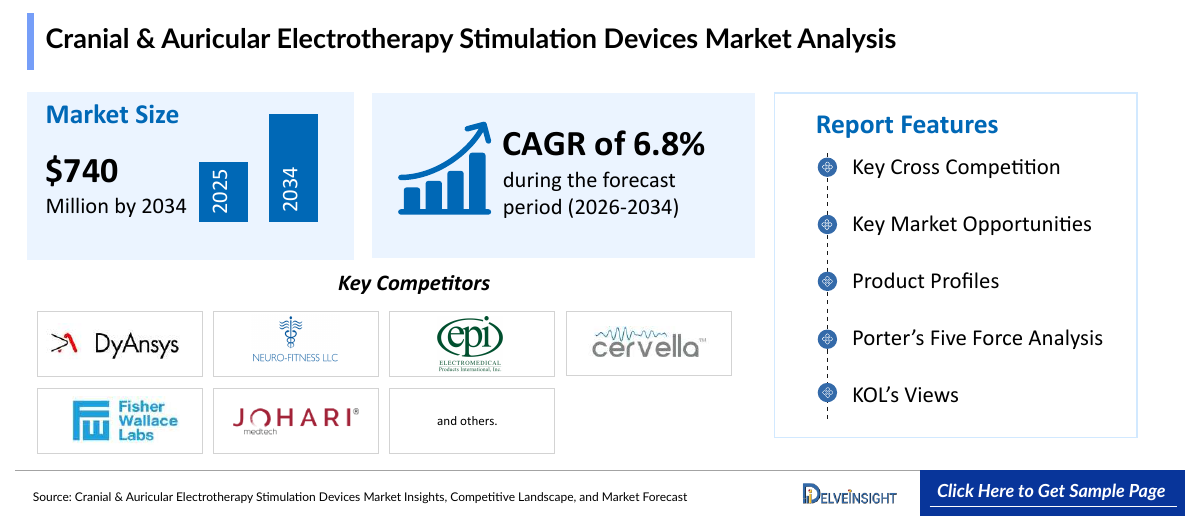
- The Cranial & Auricular Electrotherapy Stimulation Devices market is estimated at USD 410 million in 2025 and is projected to reach USD 740 million by 2034. Growth is anchored in the rising burden of anxiety, depression, and insomnia, growing preference for drug-free neuromodulation, and the shift toward home-based, wearable stimulation devices.
- The global Cranial & Auricular Electrotherapy Stimulation Devices market is growing at a CAGR of 6.8% during the forecast period from 2026 to 2034.
- By product type, the cranial electrostimulation devices segment dominated the Cranial & Auricular Electrotherapy Stimulation Devices Market with a 66% share in 2025.
- By application, the anxiety segment dominated the Cranial & Auricular Electrotherapy Stimulation Devices Market with a 34% share in 2025.
- By end user, the hospitals & clinics segment dominated the Cranial & Auricular Electrotherapy Stimulation Devices Market with a 47% share in 2025.
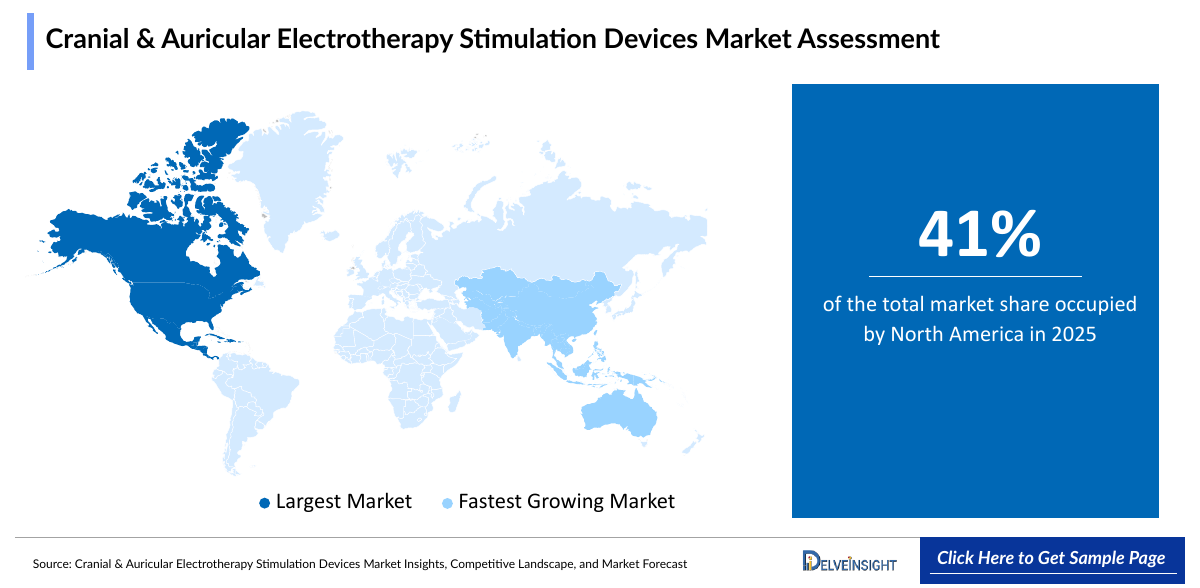
- North America dominated the global Cranial & Auricular Electrotherapy Stimulation Devices Market revenue with a 41% share in 2025, representing the highest regional market share globally.
Cranial and auricular electrotherapy stimulation devices are non-invasive or minimally invasive neuromodulation devices that deliver low-level electrical current to the head or to the external ear to modulate neural activity for the management of insomnia, anxiety, depression, pain, and related conditions. Cranial electrostimulation (CES) devices typically apply microcurrent through electrodes placed on the earlobes, temples, or mastoids, while auricular electrostimulation devices stimulate branches of the cranial nerves that innervate the outer ear, including percutaneous electrical nerve field stimulation (PENFS) and transcutaneous auricular vagus nerve stimulation. The devices range from clinic-based and prescription systems to compact, battery-powered wearables suited to home use. The market is organized by product type across cranial electrostimulation devices and auricular electrostimulation devices; by application across insomnia, depression, anxiety, pain management, and others; by end user across hospitals and clinics, specialty neurology and psychiatry centers, rehabilitation centers, and others; and by geography. Driven by the global mental health burden, demand for drug-free alternatives, the FDA's reclassification of CES devices for anxiety and insomnia into Class II, and the migration of therapy into the home, these devices have become an important and fast-evolving segment of the non-invasive neuromodulation landscape.
Cranial & Auricular Electrotherapy Stimulation Devices Market Key Growth Drivers
- The rising global burden of anxiety, depression, and insomnia is expanding the pool of patients seeking non-drug options, with the World Health Organization estimating that more than one billion people live with a mental health condition.
- Growing demand for drug-free, non-pharmacological therapies, driven by concerns over medication side effects, dependence, and the long-term use of sedative-hypnotics and anxiolytics, is widening adoption of electrotherapy devices.
- Regulatory clarity in the United States, including the FDA's December 2019 final order reclassifying CES devices intended to treat anxiety or insomnia into Class II (special controls), has lowered barriers to market entry and supports new product clearances.
- The shift toward home-based care, telehealth-supported treatment, and compact wearable devices is making daily, self-administered stimulation practical and extending the reach of clinician-prescribed therapy.
- Expanding clinical use of auricular neurostimulation for opioid withdrawal and pain, supported by FDA clearances such as the NSS-2 Bridge, DyAnsys Drug Relief, and Sparrow systems, is opening a new growth vector beyond psychiatric indications.
- Technology innovation, including app-connected, personalized, and multimodal neuromodulation platforms, is improving usability, adherence, and clinical integration.
- The convergence of mental health burden, demand for drug-free care, regulatory clarity, and home-based delivery is expected to sustain steady growth in the market through 2034.
Key Companies in Cranial & Auricular Electrotherapy Stimulation Devices Market
The competitive landscape is led by the following active manufacturers:
- DyAnsys Inc
- Neuro-Fitness LLC
- Electromedical Products International, Inc.
- INNOVATIVE NEUROLOGICAL DEVICES
- Fisher Wallace
- Johari Digital
- SzeleSTIM GmbH
- Soterix Medical Inc
- Brainbox Ltd
- Neurocare Group AG.
For illustrative purposes, only the top 10 companies are listed in the Table of Contents. The report may include analysis and references to additional companies relevant to the market assessment.
Cranial & Auricular Electrotherapy Stimulation Devices Market Size
The following snapshot summarizes the principal report metrics for the Cranial & Auricular Electrotherapy Stimulation Devices market.
|
Report Metrics |
Details |
|
2025 Market Size |
USD 410 million |
|
2034 Projected Market Size |
USD 740 million |
|
Growth Rate (2026-2034) |
6.8% CAGR |
|
Largest Market |
North America |
|
Fastest Growing Market |
Asia-Pacific |
|
Market Structure |
Fragmented |
All market values are expressed in USD and represent DelveInsight estimates synthesized from primary and secondary research.
Factors Contributing to the Growth of the Cranial & Auricular Electrotherapy Stimulation Devices Market
Market Drivers
Rising Burden of Anxiety, Depression, and Insomnia
The most fundamental driver of the Cranial & Auricular Electrotherapy Stimulation Devices Market is the rising global prevalence of anxiety, depression, and insomnia. The World Health Organization estimates that more than one billion people are living with a mental health condition, with anxiety and depressive disorders among the most common, and sleep disturbance accompanies a large share of these cases. Demand for effective treatment continues to outstrip the supply of psychiatrists, therapists, and sleep specialists, leaving many patients reliant on medication alone or untreated. Cranial and auricular stimulation devices offer a low-risk, scalable option that clinicians can prescribe alongside, or in place of, drug therapy and psychotherapy. As awareness of mental health grows and stigma declines, more patients are seeking treatment, and the addressable population for electrotherapy devices expands steadily across the forecast period.
Demand for Drug-Free, Non-Pharmacological Therapies
Patients and clinicians are increasingly looking for alternatives to medication. Benzodiazepines, sedative-hypnotics, and some antidepressants carry risks of dependence, tolerance, cognitive effects, and withdrawal, and many patients do not respond adequately or discontinue treatment because of side effects. Cranial electrotherapy stimulation is generally associated with mild and transient adverse effects such as skin irritation, headache, or dizziness, which makes it attractive as an adjunct or alternative. Auricular stimulation is also gaining attention as a drug-free approach to opioid withdrawal and postoperative pain, in the context of efforts to reduce opioid exposure. This broader shift toward non-pharmacological care, supported by clinical guidelines that favor behavioral and device-based options where appropriate, directly supports demand for these devices.
FDA Reclassification and Regulatory Clarity
Regulatory developments have improved the commercial environment. In December 2019, the FDA issued a final order reclassifying cranial electrotherapy stimulators intended to treat anxiety or insomnia from Class III to Class II, subject to special controls covering clinical testing, biocompatibility, and electrical safety and electromagnetic compatibility. CES devices are identified as prescription devices, which reinforces clinician involvement and supports reimbursement discussions. Auricular devices have followed a parallel path, with the NSS-2 Bridge cleared through the de novo pathway and subsequent 510(k) clearances for systems such as DyAnsys Drug Relief and Sparrow Ascent. A clearer and lower-burden pathway for anxiety and insomnia encourages new entrants, supports label expansions, and increases clinician confidence, reinforcing market growth across the forecast period.
Shift to Home-Based and Wearable Devices
Therapy is moving from the clinic to the home. Compact, battery-powered CES wearables can be used for about twenty minutes a day at home, and some auricular systems are worn for several days at a time, reducing the need for repeated visits. Telehealth, remote monitoring, and smartphone-based controls help clinicians supervise therapy and improve adherence. Device makers including Fisher Wallace and Electromedical Products International have built prescription and direct-to-patient channels, and educational programs such as Soterix Medical's workshops on home-based stimulation are broadening clinician familiarity. This shift lowers the cost and inconvenience of care, expands access in underserved areas, and creates recurring demand for devices and consumables, strengthening market growth through 2034.
Expansion of Auricular Neurostimulation into Opioid Withdrawal and Pain
Auricular electrostimulation is extending the market beyond psychiatric indications. Percutaneous and transcutaneous auricular devices stimulate cranial nerve branches in and around the ear and have secured FDA clearance for reducing symptoms of opioid withdrawal and for pain management. The NSS-2 Bridge was cleared through the de novo pathway; DyAnsys received clearance for Drug Relief V1 in November 2021 and for a percutaneous device for post-cardiac surgery pain in September 2022; and Spark Biomedical's Sparrow Ascent received 510(k) clearance in June 2023. These clearances show that auricular neurostimulation can address urgent unmet needs in addiction medicine and perioperative care, attracting hospital, clinic, and rehabilitation-center adoption and supporting faster growth of the auricular segment.
Technology Innovation and Clinical Integration
Continuous innovation is improving the performance and appeal of these devices. Manufacturers are developing personalized waveform and dosing, app-connected tracking, integrated audio and sleep features, and closed-loop designs that adapt stimulation to physiological signals. Platform companies such as Neurocare Group combine neuromodulation, neurofeedback, and cloud software within broader mental health treatment pathways, and Soterix Medical offers a wide range of transcranial and auricular stimulation research and clinical tools. Better ergonomics, simpler controls, and more robust clinical evidence make the devices easier to prescribe and use, while integration with digital therapeutics and multimodal care plans positions electrotherapy as a complement to psychotherapy, medication, and sleep hygiene programs.
Growing Clinical Research and Investor Interest in Neuromodulation
Neuromodulation is attracting growing scientific, clinical, and investor attention. Academic and industry studies continue to examine cranial and auricular stimulation across anxiety, insomnia, depression, pain, and substance use disorders, and positive findings feed into guidelines, payer reviews, and clinician training. Privately held developers have used equity crowdfunding and venture financing to fund clinical trials and commercialization; Fisher Wallace Laboratories, for example, raised capital through an equity crowdfunding campaign to support clinical studies. Larger neuromodulation players are broadening portfolios and clinic networks. This inflow of research and capital builds the evidence base, supports regulatory submissions, and funds distribution, sustaining demand for devices across the forecast period.
Market Restraints
Despite steady momentum, the Cranial & Auricular Electrotherapy Stimulation Devices Market faces material constraints. Inconsistent reimbursement and limited clinical standardization are the most significant barriers: many private and public payers treat cranial electrotherapy and auricular electrostimulation as investigational, which shifts the cost to patients and slows adoption in institutional settings. The evidence base is uneven across indications, and the FDA has noted that support for the effectiveness of CES in depression is the weakest of the three principal indications, which is why devices intended to treat depression remain in Class III and require premarket approval. Heterogeneity in devices, waveforms, electrode placement, and treatment protocols makes trial results difficult to compare and complicates guideline development. Awareness among clinicians and patients remains limited, and some practitioners remain skeptical of low-intensity stimulation. Device cost, especially for prescription-grade systems, can be a hurdle for self-paying patients and for health systems in emerging economies. The presence of unregulated or poorly validated consumer devices can erode trust in the category, while evolving regulations such as the European Union Medical Device Regulation raise compliance costs for smaller manufacturers. Mild adverse effects such as skin irritation, headache, or dizziness can affect adherence, and competition from established therapies, including medication, psychotherapy, and transcranial magnetic stimulation, constrains share. Together, these reimbursement, evidence, standardization, awareness, and regulatory barriers temper the pace of growth, even as the underlying drivers of mental health burden, demand for drug-free therapy, and home-based care remain intact.
Cranial & Auricular Electrotherapy Stimulation Devices Market Segment Analysis
The Cranial & Auricular Electrotherapy Stimulation Devices Market is segmented by product type (cranial electrostimulation devices, auricular electrostimulation devices), application (insomnia, depression, anxiety, pain management, others), end user (hospitals & clinics, specialty neurology & psychiatry centers, rehabilitation centers, others), and geography (North America, Europe, Asia-Pacific, and Rest of World).
By Product Type
Dominant Subsegment: Cranial Electrostimulation Devices.
The cranial electrostimulation devices segment accounted for 66% of the Cranial & Auricular Electrotherapy Stimulation Devices Market in 2025. Cranial electrostimulation devices are the leading product type because they have the longest clinical history, the broadest base of FDA-cleared products, and the most established prescription and home-use channels. Devices such as Alpha-Stim from Electromedical Products International, the Fisher Wallace Stimulator, and Cervella from Innovative Neurological Devices target anxiety, insomnia, and related conditions, and the 2019 reclassification of CES for anxiety and insomnia into Class II has reinforced their regulatory footing. Compact, battery-powered designs that patients can use daily at home support recurring demand, and the combination of familiar technology, a deep evidence base, and wide distribution sustains the segment's scale. While auricular electrostimulation devices are the fastest-growing product type, propelled by clearances for opioid withdrawal and pain and by growing interest in vagus nerve pathways, the maturity and breadth of the cranial segment secure its leadership across the forecast period.
By Application
Dominant Subsegment: Anxiety.
The anxiety segment accounted for 34% of the Cranial & Auricular Electrotherapy Stimulation Devices Market in 2025. Anxiety is the leading application because it is the most prevalent condition addressed by these devices and one of the two indications, with insomnia, for which CES holds Class II status in the United States. Anxiety disorders are among the most common mental health conditions worldwide, and many patients seek alternatives to benzodiazepines and other medications because of dependence and side-effect concerns. Established devices from Electromedical Products International and Fisher Wallace are marketed principally for anxiety, supported by years of clinical studies and clinician familiarity. Insomnia is a close second, benefiting from the same regulatory status and from strong demand for non-drug sleep solutions. Depression is growing but constrained by the Class III premarket approval requirement for CES, while pain management is expanding quickly on the strength of auricular PENFS devices, and other uses, including opioid withdrawal, add further breadth. Nonetheless, the size of the anxiety population and the clarity of its regulatory pathway secure the segment's leadership across the forecast period.
By End User
Dominant Subsegment: Hospitals & Clinics.
The hospitals & clinics segment accounted for 47% of the Cranial & Auricular Electrotherapy Stimulation Devices Market in 2025. Hospitals and clinics are the leading end user because cranial electrotherapy stimulators are prescription devices, and clinicians in primary care, psychiatry, pain, and addiction medicine initiate and supervise most therapy. Many auricular devices, including percutaneous PENFS systems, are applied by trained clinicians in outpatient and perioperative settings, which concentrates demand in institutional channels. Established procurement, reimbursement pathways, and the ability to combine stimulation with other treatments reinforce the segment's scale. Specialty neurology and psychiatry centers are growing quickly as dedicated neuromodulation programs expand and as clinics integrate stimulation with neurofeedback and structured therapy plans, while rehabilitation centers sustain steady demand for pain and recovery applications. The Others category, including home care settings and research institutions, is gaining share as patients take devices home under clinician guidance. Even so, the central role of prescribing clinicians secures the leadership of hospitals and clinics across the forecast period.
Cranial & Auricular Electrotherapy Stimulation Devices Market Region Analysis
Dominant Region: North America
North America accounted for 41% of the global Cranial & Auricular Electrotherapy Stimulation Devices Market revenue in 2025, representing the highest regional market share globally. The region's dominance reflects a clear FDA regulatory framework, including the 2019 reclassification of CES for anxiety and insomnia, a high prevalence of anxiety, depression, and insomnia, strong awareness of non-drug therapy, and the presence of leading manufacturers such as Electromedical Products International, Fisher Wallace, DyAnsys, Soterix Medical, and Innovative Neurological Devices. Opioid-related public health priorities have encouraged the adoption of auricular neurostimulation for withdrawal and pain, while veteran and military health programs, specialty psychiatry practices, and a growing base of neuromodulation clinics add institutional demand. Greater willingness to pay for self-directed wellness technology and an established prescription-to-home channel further support volumes. Regulatory clarity, high awareness, and an innovation-rich ecosystem anchor the region's continued leadership across the forecast period.
Fastest Growing Region: Asia-Pacific
Asia-Pacific is the fastest-growing region in the Cranial & Auricular Electrotherapy Stimulation Devices Market. The region's elevated CAGR is driven by a rising burden of stress, anxiety, and sleep disorders, growing healthcare spending, and an expanding middle class across China, Japan, India, South Korea, and Australia. Auricular therapy has deep roots in traditional ear acupuncture across East Asia, which supports acceptance of auricular electrostimulation, while China and Japan are investing in neuromodulation research and domestic device manufacturing. India benefits from low-cost electrotherapy manufacturers such as Johari Digital and a large underserved patient base, and Australia hosts neuromodulation clinics operated by international platforms such as Neurocare Group. Rising awareness of mental health, increasing availability of clinician training, and improving regulatory frameworks are accelerating adoption, positioning Asia-Pacific as the principal source of incremental growth over the forecast period.
Regional Commentary
North America
North America accounted for 41% of the global Cranial & Auricular Electrotherapy Stimulation Devices Market revenue in 2025. The United States dominates on the strength of FDA regulatory clarity, a large base of cleared CES and auricular devices, high awareness of drug-free therapy, and the concentration of leading manufacturers, while opioid-related public health priorities and growing neuromodulation clinics reinforce its leadership.
Europe
Europe is a large and advanced regional market, supported by strong neuromodulation research, CE-marking pathways under the Medical Device Regulation, and an established tradition of vagus nerve and transcranial stimulation. Companies such as Neurocare Group and SzeleSTIM in Germany and Brainbox in the United Kingdom reinforce the region's role across Germany, France, the United Kingdom, Italy, and Spain, although reimbursement variability across national health systems tempers adoption.
Asia-Pacific
Asia-Pacific is the fastest-growing region, propelled by a rising burden of stress, anxiety, and sleep disorders, growing healthcare investment, and cultural familiarity with ear acupuncture across China, Japan, India, South Korea, and Australia. Domestic manufacturing, low-cost devices in India, and expanding clinic networks are accelerating regional adoption and clinician training.
Rest of World
The Rest of World region, spanning Latin America, the Middle East, and Africa, is an emerging growth frontier. Rising awareness of mental health, expanding private healthcare, and growing availability of imported and locally distributed neuromodulation devices are gradually broadening access, while affordability and limited reimbursement remain the principal constraints.
Cranial & Auricular Electrotherapy Stimulation Devices Market Competitive Landscape
The Cranial & Auricular Electrotherapy Stimulation Devices Market is classified as Fragmented. Specialized cranial and auricular stimulation developers, including Electromedical Products International, Fisher Wallace, DyAnsys, and Innovative Neurological Devices, anchor the established base of FDA-cleared devices, while broader neuromodulation platform companies such as Soterix Medical and Neurocare Group, together with regional specialists such as SzeleSTIM, Johari Digital, Brainbox, and Neuro-Fitness, compete through clinical evidence, regulatory clearances, device usability, and distribution reach, increasing competition in the fastest-growing auricular and home-use segments.
The competitive landscape can be evaluated across the following dimensions:
- Market concentration: Fragmented, with a mix of specialized device makers and neuromodulation platform companies, and no single player holding a dominant share.
- Leading players: Electromedical Products International, Fisher Wallace, DyAnsys, and Innovative Neurological Devices anchor the established base of FDA-cleared cranial and auricular products.
- Geographic reach: North American players lead on regulatory clearances and clinical channels, while European and Asian specialists such as Neurocare Group, SzeleSTIM, Brainbox, and Johari Digital extend regional reach.
- Product portfolio strength: Leading players offer prescription CES systems, percutaneous and transcutaneous auricular devices, and complementary neuromodulation or neurofeedback tools.
- Regulatory standing: FDA clearances and CE marking, particularly Class II status for anxiety and insomnia, are decisive competitive advantages.
- Clinical evidence: Published trials and real-world data on anxiety, insomnia, pain, and opioid withdrawal strongly influence clinician prescribing and payer coverage.
- Channel strategy: Companies combine prescription channels, clinic partnerships, and direct-to-patient sales to reach both institutional and home users.
- Manufacturing capabilities: Reliable low-current electronics, biocompatible electrodes, and quality systems compliant with FDA and EU requirements are important competitive moats.
- Innovation focus: App-connected and personalized stimulation, wearable and multi-day auricular designs, closed-loop feedback, and integration with digital therapeutics.
Cranial & Auricular Electrotherapy Stimulation Devices Market Recent Developmental Activities
In August 2025, Soterix Medical Inc. held its Advanced Neuromodulation and Neuromonitoring Training Workshop in New York, covering conventional and high-definition transcranial stimulation, transcutaneous auricular vagus nerve stimulation, and a session on home-based tDCS. Strategic significance: Expands clinician training and awareness and supports the broader adoption of home-based neuromodulation.
In June 2023, Spark Biomedical, Inc., received FDA 510(k) clearance for Sparrow Ascent, a prescription transcutaneous auricular neurostimulation system for use in clinical settings and at home. Strategic significance: Adds to the auricular device base and reinforces the clinical credibility of ear-based neurostimulation.
In September 2022, DyAnsys Inc. announced FDA clearance for a percutaneous electrical neurostimulation device designed to manage pain after cardiac surgery. Strategic significance: Extends auricular PENFS into perioperative pain management and supports adoption in hospital settings.
Cranial & Auricular Electrotherapy Stimulation Devices Market Segmentation
Cranial & Auricular Electrotherapy Stimulation Devices Market by Product Type
- Cranial Electrostimulation Devices
- Auricular Electrostimulation Devices
Cranial & Auricular Electrotherapy Stimulation Devices Market by Application
- Insomnia
- Depression
- Anxiety
- Pain Management
- Others
Cranial & Auricular Electrotherapy Stimulation Devices Market by End-User
- Hospitals & Clinics
- Specialty Neurology & Psychiatry Centers
- Rehabilitation Centers
- Others
Cranial & Auricular Electrotherapy Stimulation Devices Market by Geography
- North America Cranial & Auricular Electrotherapy Stimulation Devices Market
- United States Cranial & Auricular Electrotherapy Stimulation Devices Market Size in USD million (2023-2034)
- Canada Cranial & Auricular Electrotherapy Stimulation Devices Market Size in USD million (2023-2034)
- Mexico Cranial & Auricular Electrotherapy Stimulation Devices Market Size in USD million (2023-2034)
- Europe Cranial & Auricular Electrotherapy Stimulation Devices Market
- Germany Cranial & Auricular Electrotherapy Stimulation Devices Market Size in USD million (2023-2034)
- United Kingdom Cranial & Auricular Electrotherapy Stimulation Devices Market Size in USD million (2023-2034)
- France Cranial & Auricular Electrotherapy Stimulation Devices Market Size in USD million (2023-2034)
- Italy Cranial & Auricular Electrotherapy Stimulation Devices Market Size in USD million (2023-2034)
- Spain Cranial & Auricular Electrotherapy Stimulation Devices Market Size in USD million (2023-2034)
- Rest of Europe Cranial & Auricular Electrotherapy Stimulation Devices Market Size in USD million (2023-2034)
- Asia-Pacific Cranial & Auricular Electrotherapy Stimulation Devices Market
- China Cranial & Auricular Electrotherapy Stimulation Devices Market Size in USD million (2023-2034)
- Japan Cranial & Auricular Electrotherapy Stimulation Devices Market Size in USD million (2023-2034)
- India Cranial & Auricular Electrotherapy Stimulation Devices Market Size in USD million (2023-2034)
- Australia Cranial & Auricular Electrotherapy Stimulation Devices Market Size in USD million (2023-2034)
- South Korea Cranial & Auricular Electrotherapy Stimulation Devices Market Size in USD million (2023-2034)
- Rest of Asia-Pacific Cranial & Auricular Electrotherapy Stimulation Devices Market Size in USD million (2023-2034)
- Rest of the World (RoW) Cranial & Auricular Electrotherapy Stimulation Devices Market
- Middle East Cranial & Auricular Electrotherapy Stimulation Devices Market Size in USD million (2023-2034)
- Africa Cranial & Auricular Electrotherapy Stimulation Devices Market Size in USD million (2023-2034)
- South America Cranial & Auricular Electrotherapy Stimulation Devices Market Size in USD million (2023-2034)
Cranial & Auricular Electrotherapy Stimulation Devices Market Recent Industry Trends and Milestones (2023-2026)
|
Category |
Key Developments |
|
Cranial & Auricular Electrotherapy Stimulation Devices Market Product Approval |
Regulatory momentum is supporting commercialization. In December 2019, the FDA reclassified cranial electrotherapy stimulators for anxiety or insomnia from Class III to Class II with special controls, while devices intended to treat depression remain Class III and require premarket approval. Auricular devices have advanced through the NSS-2 Bridge de novo authorization and subsequent clearances including DyAnsys Drug Relief V1 (November 2021), a DyAnsys percutaneous device for post-cardiac surgery pain (September 2022), and Spark Biomedical's Sparrow Ascent (June 2023). Each clearance strengthens clinician confidence and widens the indications and settings in which these devices can be used. |
|
Cranial & Auricular Electrotherapy Stimulation Devices Market Expansion |
Manufacturers broadened portfolios across form factors and indications. Prescription CES systems such as Alpha-Stim, the Fisher Wallace Stimulator, and Cervella address anxiety, insomnia, and related conditions, while auricular systems extended into opioid withdrawal, perioperative pain, and other pain conditions. Compact, battery-powered wearables, multi-day auricular devices, and app-enabled controls expanded home use, and neuromodulation platform companies such as Soterix Medical and Neurocare Group added transcranial and auricular tools to their offerings. |
|
Cranial & Auricular Electrotherapy Stimulation Devices Market Investment |
Capital and research investment supported clinical validation and commercialization. Privately held developers used equity crowdfunding and venture financing to fund clinical trials, regulatory submissions, and scale-up, while platform companies invested in clinic networks, training programs, and software. Growing clinical research across anxiety, insomnia, pain, and substance use disorders is strengthening the evidence base that underpins payer reviews and clinician adoption. |
|
Company Strategy |
DyAnsys Inc: Auricular percutaneous neurostimulation for opioid withdrawal and perioperative pain. Neuro-Fitness LLC: Specialized neurostimulation offerings for clinical and home use. Electromedical Products International, Inc.: Evidence-led CES leadership through Alpha-Stim. INNOVATIVE NEUROLOGICAL DEVICES: Feature-rich CES systems such as Cervella and auricular neurostimulation. Fisher Wallace: Wearable CES for depression, anxiety, and insomnia with direct-to-patient reach. Johari Digital: Affordable electrotherapy devices for emerging-market clinics. SzeleSTIM GmbH: European auricular and vagus nerve stimulation solutions. Soterix Medical Inc: Broad transcranial and auricular stimulation platforms for research and clinical use. Brainbox Ltd: Neurophysiology and neuromodulation solutions for clinical and research users. Neurocare Group AG: Integrated neuromodulation, neurofeedback, and clinic-network model. |
|
Emerging Technologies |
Innovation is centered on personalization, connectivity, and convenience. Closed-loop stimulation that adapts to physiological signals, app-connected dosing and adherence tracking, integrated audio and sleep features, and miniaturized wearables are improving usability. Transcutaneous auricular vagus nerve stimulation is attracting research interest across mood, sleep, and pain, and multi-day percutaneous auricular systems are expanding in hospital and outpatient care. Integration with digital therapeutics, telehealth, and neurofeedback is positioning electrotherapy within multimodal mental health pathways, while collaborations between manufacturers, academic centers, and clinics are accelerating larger and more standardized clinical trials. |
Cranial & Auricular Electrotherapy Stimulation Devices Market Startup Funding and Investment Trends
|
Company |
Total Funding |
Funding Stage |
Main Offering |
Core Technology |
|
Fisher Wallace Laboratories |
Equity crowdfunding (StartEngine) |
Growth (crowdfunded) |
Wearable CES for depression, anxiety, and insomnia |
Pulsed cranial electrotherapy |
|
Request to unlock the report on the @ Cranial & Auricular Electrotherapy Stimulation Devices Market | ||||
Investment in the Cranial & Auricular Electrotherapy Stimulation Devices Market ecosystem has concentrated on clinical validation, regulatory clearances, and the expansion of wearable and home-use devices. The following companies illustrate recent funding activity and technology focus.
Capital is flowing toward developers that can demonstrate clinical evidence and secure regulatory clearances. Privately held companies such as Fisher Wallace Laboratories have used equity crowdfunding to finance clinical studies, while auricular specialists including DyAnsys and Spark Biomedical have advanced FDA-cleared devices for opioid withdrawal and pain. Established players such as Electromedical Products International and Innovative Neurological Devices, and platform companies such as Soterix Medical and Neurocare Group, continue to invest in product development, training, and clinic networks. Collectively, these investments signal conviction that clinical validation, home-based delivery, and auricular neurostimulation will define the next phase of competitive advantage in the global Cranial & Auricular Electrotherapy Stimulation Devices Market.
Key Takeaways from the Cranial & Auricular Electrotherapy Stimulation Devices Market Report Study
- Market size analysis for the current Cranial & Auricular Electrotherapy Stimulation Devices market size (2025), and market forecast for 9 years (2026 to 2034).
- Top key product/technology developments, mergers, acquisitions, partnerships, and joint ventures that happened over the last 3 years.
- Key companies dominating the global Cranial & Auricular Electrotherapy Stimulation Devices market.
- Various opportunities available for competitors in the Cranial & Auricular Electrotherapy Stimulation Devices market space.
- What are the top-performing segments in 2025? How will these segments perform in 2034?
- Which are the top-performing regions and countries in the current Cranial & Auricular Electrotherapy Stimulation Devices market scenario?
- Which are the regions and countries where companies should concentrate their opportunities for Cranial & Auricular Electrotherapy Stimulation Devices market growth in the future?
Target audience who can benefit from this Cranial & Auricular Electrotherapy Stimulation Devices market report study
- Cranial & Auricular Electrotherapy Stimulation Devices product providers
- Research organizations and consulting companies
- Cranial & Auricular Electrotherapy Stimulation Devices -related organizations, associations, forums, and other alliances
- Government and corporate offices
- Start-up companies, venture capitalists, and private equity firms
- Distributors and traders dealing in Cranial & Auricular Electrotherapy Stimulation Devices
- Various end-users who want to know more about the Cranial & Auricular Electrotherapy Stimulation Devices market and the latest technological developments in the Cranial & Auricular Electrotherapy Stimulation Devices market.