Endometrial Cancer Pipeline Insight 2025
DelveInsight’s, “Endometrial Cancer Pipeline Insight, 2026,” report provides comprehensive insights about 50+ companies and 55+ pipeline drugs in Endometrial Cancer pipeline landscape. It covers the Endometrial Cancer pipeline drug profiles, including clinical and nonclinical stage products. It also covers the Endometrial Cancer therapeutics assessment by product type, stage, Endometrial Cancer route of administration, and Endometrial Cancer molecule type. It further highlights the inactive pipeline products in this space.
Geography Covered
- Global coverage
Endometrial Cancer Understanding
Endometrial cancer, originating from the inner lining of the uterus (endometrium), stands as the most prevalent gynecologic malignancy in developed nations, with its incidence on the rise. This increase is attributed to factors such as aging populations and escalating obesity rates. The majority of cases are diagnosed in postmenopausal women, with abnormal uterine bleeding serving as the most common presenting symptom. Early detection is common due to this symptom, leading to diagnoses at initial stages where treatment outcomes are more favorable.
Several risk factors contribute to the development of endometrial cancer. Obesity, metabolic syndrome, and diabetes are significant contributors, with obesity alone accounting for approximately 40% of cases. Reproductive factors such as early menarche, late menopause, nulliparity, and infertility also elevate risk. Genetic predispositions, notably Lynch syndrome, further increase susceptibility. Conversely, the use of combined oral contraceptives has been associated with a reduced risk of endometrial cancer.
Diagnosis typically involves an endometrial biopsy, often preceded by transvaginal ultrasound to assess endometrial thickness. However, studies have indicated that transvaginal ultrasound may yield false-negative results, particularly in Black women, suggesting that tissue biopsy remains the gold standard for accurate diagnosis. Surgical staging, guided by the International Federation of Gynecology and Obstetrics (FIGO) system, is crucial for determining the extent of disease and informing treatment strategies.
Treatment approaches are stage-dependent. Early-stage endometrial cancer is primarily managed through total hysterectomy with bilateral salpingo-oophorectomy. Adjuvant therapies, including radiation and chemotherapy, are considered based on individual risk factors. For advanced or recurrent cases, emerging treatments such as immunotherapy have shown promise. Notably, the combination of dostarlimab (Jemperli) with chemotherapy has demonstrated improved survival rates in patients with advanced or recurrent endometrial cancer. Ongoing research continues to refine these therapeutic strategies, aiming to enhance patient outcomes.
"Endometrial Cancer- Pipeline Insight, 2026" report by DelveInsight outlays comprehensive insights of present scenario and growth prospects across the indication. A detailed picture of the Endometrial Cancer pipeline landscape is provided which includes the disease overview and Endometrial Cancer treatment guidelines. The assessment part of the report embraces, in depth Endometrial Cancer commercial assessment and clinical assessment of the pipeline products under development. In the report, detailed description of the drug is given which includes mechanism of action of the drug, clinical studies, NDA approvals (if any), and product development activities comprising the technology, Endometrial Cancer collaborations, licensing, mergers and acquisition, funding, designations and other product related details.
Endometrial Cancer Report Highlights
The companies and academics are working to assess challenges and seek opportunities that could influence Endometrial Cancer R&D. The therapies under development are focused on novel approaches to treat/improve Endometrial Cancer.
Endometrial Cancer Emerging Drugs Chapters
This segment of the Endometrial Cancer report encloses its detailed analysis of various drugs in different stages of clinical development, including phase II, I, preclinical and Discovery. It also helps to understand clinical trial details, expressive pharmacological action, agreements and collaborations, and the latest news and press releases.
Endometrial Cancer Emerging Drugs
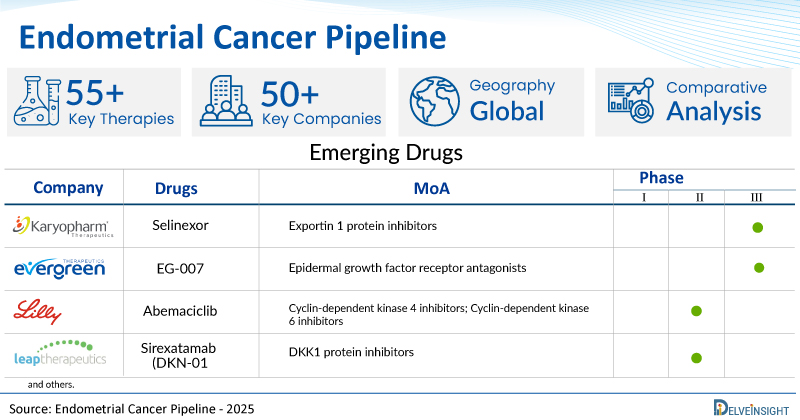
- Selinexor: Karyopharm Therapeutics
Selinexor (XPOVIO) is a first-in-class, oral exportin 1 (XPO1) inhibitor. XPOVIO functions by selectively binding to and inhibiting the nuclear export protein XPO1. The drug is being explored as a maintenance therapy for patients with advanced or recurrent endometrial cancer, particularly those with TP53 wild-type tumors. This approach is based on findings from the Phase III SIENDO study, which has shown promising results in improving progression-free survival (PFS) for this specific patient population. Currently it is being investigated in Phase III stage of development for the treatment of patients with Endometrial Cancer.
- Abemaciclib: Eli Lilly and Company
Abemaciclib, developed by Eli Lilly, is showing promising clinical activity in combination with hormonal therapies for recurrent estrogen receptor (ER)-positive endometrioid endometrial cancer (EEC). In a phase 2 trial, abemaciclib plus hormonal therapy achieved a clinical benefit rate of 67% in EEC patients, with partial and complete responses observed and a median progression-free survival (PFS) around 6.1 months. Another study combining abemaciclib with letrozole demonstrated a 30% objective response rate and a median PFS of 9.1 months, with durable tumor shrinkage or stabilization in 75% of patients. Adding metformin to this combination further improved outcomes, inducing deeper and more durable responses by targeting multiple cancer pathways including estrogen receptor, CDK4/6, and PI3K. These findings support abemaciclib plus hormonal therapy as a promising treatment approach for recurrent ER-positive endometrial cancer, with ongoing trials confirming safety and efficacy.
- NP137: NETRIS Pharma
NP137 is a humanized monoclonal antibody (IgG1) targeting netrin-1, a protein overexpressed in a large proportion of human cancers and associated with disease severity and resistance to therapy. By blocking netrin-1, NP137 is designed to restore apoptosis and reverse epithelial-to-mesenchymal transition (EMT), addressing critical mechanisms of resistance that limit the effectiveness of immune checkpoint inhibitors. Preclinical and early clinical studies have shown that NP137 has anti-cancer effects both as a monotherapy and in combination with chemotherapy or immunotherapy, with a favorable safety profile. According to the company’s pipeline the drug is in the Phase II stage of development for the treatment of patients with Endometrial Cancer.
- CT-0508: Carisma Therapeutics
CT-0508 is a human epidermal growth factor receptor 2 (HER2) targeted chimeric antigen receptor macrophage (CAR-M). It is being evaluated in a landmark Phase I multi-center clinical trial that focuses on patients with recurrent or metastatic HER2-overexpressing solid tumors whose cancers are not eligible for treatment with currently available HER2-targeted therapies or who do not respond to treatment. The trial is enrolling participants who have tumors of any anatomical origin, but with the commonality of overexpressing the HER2 receptor on the cell surface, which is the target for our CAR-M. The Phase 1 clinical trial is first-of-its-kind, marking the first time that genetically engineered macrophages are being studied in humans. The trial continues to enroll patients at seven clinical sites in the U.S., including (i) the University of Pennsylvania Abramson Cancer Center, (ii) the University of North Carolina Lineberger Comprehensive Cancer Center, (iii) the City of Hope National Medical Center, (iv) the MD Anderson Cancer Center, (v) the Sarah Cannon Cancer Research Institute, (vi) Oregon Health & Science University and (vii) Fred Hutchinson Cancer Center.
Further product details are provided in the report……..
Endometrial Cancer Therapeutic Assessment
This segment of the report provides insights about the different Endometrial Cancer drugs segregated based on following parameters that define the scope of the report, such as:
Major Players in Endometrial Cancer
There are approx. 50+ key companies which are developing the therapies for Endometrial Cancer. The companies which have their Endometrial Cancer drug candidates in the mid to advanced stage, i.e. Phase III include Merck & Co.
Endometrial Cancer Phases
DelveInsight’s report covers around 55+ products under different phases of clinical development like
- Late-stage products (phase III)
- Mid-stage products (Phase II and Phase I/II)
- Early-stage products (Phase I/II and Phase I) along with the details of
- Pre-clinical and Discovery stage candidates
- Discontinued & Inactive candidates
Endometrial Cancer Route of Administration
Endometrial Cancer pipeline report provides the therapeutic assessment of the pipeline drugs by the Route of Administration. Products have been categorized under various ROAs such as
- Subcutaneous
- Intravenous
- Oral
- Intramuscular
Endometrial Cancer Molecule Type
Products have been categorized under various Molecule types such as
- Small molecules
- Natural metabolites
- Monoclonal antibodies
Endometrial Cancer Product Type
Drugs have been categorized under various product types like Mono, Combination and Mono/Combination.
Endometrial Cancer Pipeline Development Activities
The report provides insights into different therapeutic candidates in phase II, I, preclinical and discovery stage. It also analyses Endometrial Cancer therapeutic drugs key players involved in developing key drugs.
Pipeline Development Activities
The report covers the detailed information of collaborations, acquisition and merger, licensing along with a thorough therapeutic assessment of emerging Endometrial Cancer drugs.
Access the Endometrial Cancer Market Forecast 2034 report for in-depth market analysis, patient segmentation, and competitive insights driving informed healthcare decisions.
Endometrial Cancer Report Insights
- Endometrial Cancer Pipeline Analysis
- Therapeutic Assessment
- Unmet Needs
- Impact of Drugs
Endometrial Cancer Report Assessment
- Pipeline Product Profiles
- Therapeutic Assessment
- Pipeline Assessment
- Inactive drugs assessment
- Unmet Needs
Key Questions
Current Treatment Scenario and Emerging Therapies:
- How many companies are developing drugs in the Endometrial Cancer Market?
- How many Endometrial Cancer drugs are developed by each company?
- How many emerging drugs are in mid-stage, and late-stage of development for the treatment of Endometrial Cancer?
- What are the key collaborations (Industry–Industry, Industry–Academia), Mergers and acquisitions, licensing activities related to the Endometrial Cancer therapeutics?
- What are the recent trends, drug types and novel technologies developed to overcome the limitation of existing therapies?
- What are the clinical studies going on for Endometrial Cancer and their status?
- What are the key designations that have been granted to the emerging drugs?
Get detailed insights through our blogs @ DelveInsight Blogs