Glaucoma Drainage Devices Market Summary
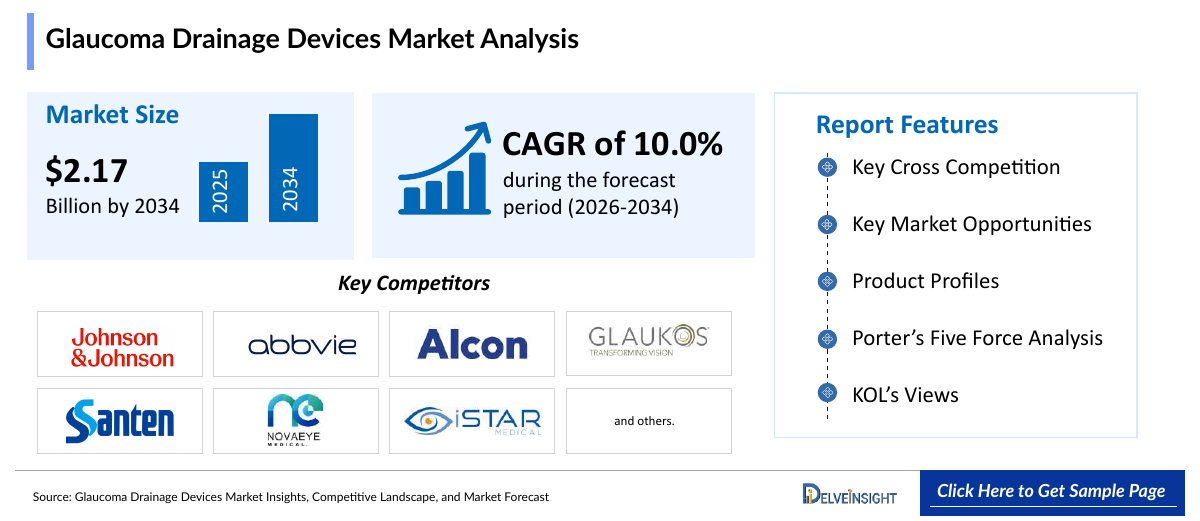
- The Glaucoma Drainage Devices market is estimated at USD 0.92 billion in 2025 and is projected to reach USD 2.17 billion by 2034. Growth is anchored in the rising global burden of glaucoma, the shift toward minimally invasive glaucoma surgery, and continuous innovation in drainage implant design.
- The global Glaucoma Drainage Devices market is growing at a CAGR of 10.0% during the forecast period from 2026 to 2034.
- By product type, the conventional glaucoma drainage devices segment dominated the Glaucoma Drainage Devices market with a 57% share in 2025.
- By conventional device type, the valved glaucoma drainage devices segment dominated the Glaucoma Drainage Devices market with a 32% share in 2025.
- By MIGS device type, the Schlemm’s canal MIGS devices segment led the MIGS category with a 21% share of the overall Glaucoma Drainage Devices market in 2025.
- By end-user, the hospitals segment dominated the Glaucoma Drainage Devices market with a 52% share in 2025.
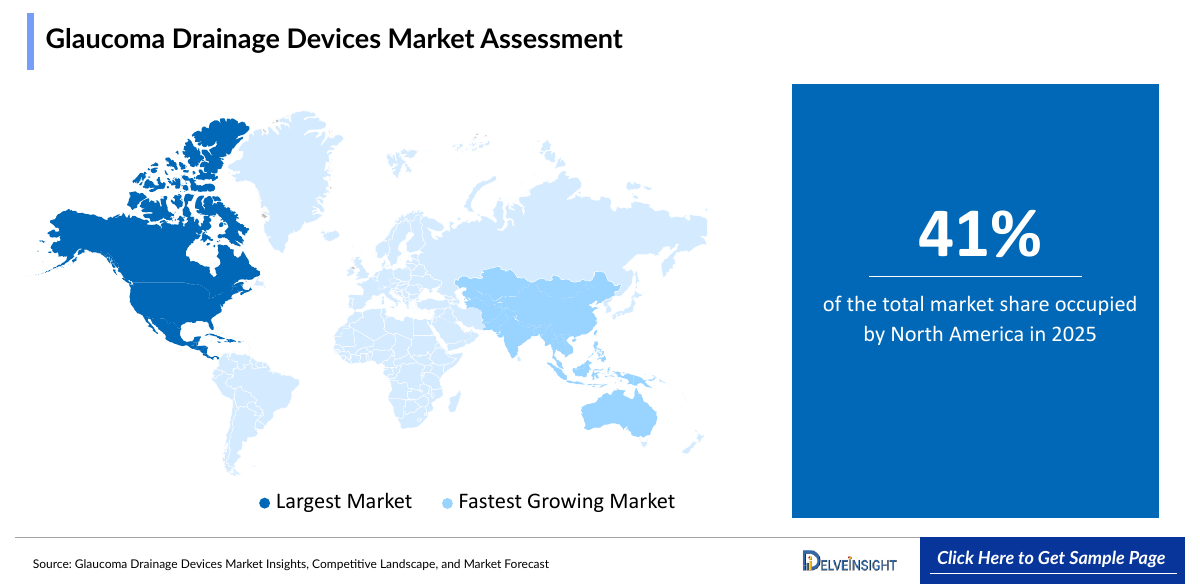
- North America dominated the global Glaucoma Drainage Devices market revenue with a 41% share in 2025, representing the highest regional market share globally.
Glaucoma drainage devices are implantable ocular devices that create or regulate an alternative pathway for aqueous humor to leave the eye, lowering intraocular pressure (IOP) and slowing optic nerve damage in patients with glaucoma. Conventional glaucoma drainage devices are tube-and-plate implants, either valved, such as the Ahmed Glaucoma Valve, or valveless, such as the Baerveldt and Molteno implants, and are typically used in refractory, secondary, or advanced glaucoma where medications, laser, or prior filtering surgery have failed. Minimally invasive glaucoma surgery (MIGS) devices are micro-scale implants placed through small incisions, often at the time of cataract surgery, and are classified by the drainage route they use: Schlemm’s canal devices such as iStent and Hydrus, suprachoroidal devices such as MINIject, and subconjunctival devices such as the XEN gel stent and the PRESERFLO MicroShunt. The market is organized by product type across conventional glaucoma drainage devices, covering valveless and valved devices, and MIGS devices, covering Schlemm’s canal, suprachoroidal, and subconjunctival devices; by end-user across hospitals, ambulatory surgical centers, and specialty clinics; and by geography. Driven by an aging global population, the shift toward interventional glaucoma care, and ongoing implant innovation, glaucoma drainage devices have become a core component of the surgical armamentarium for lowering IOP.
Glaucoma Drainage Devices Market Key Growth Drivers
- The rising global burden of glaucoma is expanding the surgical candidate pool, with approximately 76 million people affected in 2020 and a projected 111.8 million by 2040.
- The shift toward minimally invasive glaucoma surgery and interventional glaucoma care is accelerating adoption, with Glaukos reporting more than 3 million iStent devices implanted.
- Persistent demand for conventional drainage implants in refractory, neovascular, uveitic, and advanced glaucoma, where low adherence to topical therapy and prior surgical failure limit other options, sustains the core market.
- Technology innovation, including the adjustable eyeWatch implant, the small-tube PAUL Glaucoma Implant, and the suprachoroidal MINIject device, is improving outcomes and expanding indications.
- Regulatory approvals and label expansions, including the January 2026 FDA approval for repeat administration of iDose TR and the 2024 expanded indication for KDB GLIDE, are widening the addressable patient base.
- Strategic acquisitions and alliances, including Alcon’s acquisition of Ivantis and AbbVie’s alliance with iSTAR Medical, are bringing capital and global distribution to innovative implants.
- The convergence of demographic growth, MIGS adoption, product innovation, and outpatient surgical expansion is expected to sustain double-digit growth in the market through 2034.
Key Companies in Glaucoma Drainage Devices Market
The competitive landscape is led by the following active manufacturers:
- Johnson & Johnson
- AbbVie Inc
- Alcon Inc
- Glaukos Corporation
- Santen Pharmaceutical Co., Ltd
- NovaEye Medical Limited
- iSTAR Medical SA
- Rheon Medical SA
- Advanced Ophthalmic Innovations Pte Ltd
- New World Medical Inc.
For illustrative purposes, only the top 10 companies are listed in the Table of Contents. The report may include analysis and references to additional companies relevant to the market assessment.
Glaucoma Drainage Devices Market Size
The following snapshot summarizes the principal report metrics for the Glaucoma Drainage Devices market.
|
Report Metrics |
Details |
|
2025 Market Size |
USD 0.92 billion |
|
2034 Projected Market Size |
USD 2.17 billion |
|
Growth Rate (2026-2034) |
10.0% CAGR |
|
Largest Market |
North America |
|
Fastest Growing Market |
Asia-Pacific |
|
Market Structure |
Moderately Concentrated |
All market values are expressed in USD and represent DelveInsight estimates synthesized from primary and secondary research.
Factors Contributing to the Growth of the Glaucoma Drainage Devices Market
Market Drivers
Rising Global Prevalence of Glaucoma and Population Aging
The most powerful driver of the Glaucoma Drainage Devices market is the growing global burden of glaucoma. Glaucoma is a leading cause of irreversible blindness, and epidemiological projections estimate that approximately 76 million people were living with the disease in 2020, rising to 111.8 million by 2040, with the heaviest growth in Asia and Africa. IOP reduction remains the only proven modifiable factor for slowing progression, and a meaningful share of patients cannot reach target pressure with medication or laser therapy alone. As screening improves and more patients are diagnosed, a larger number progress to surgical intervention, directly enlarging demand for conventional drainage implants used in refractory disease and for MIGS devices used earlier in the treatment pathway. This demographic and clinical pressure underpins sustained volume growth through 2034.
Shift Toward MIGS and Interventional Glaucoma Care
Glaucoma management is moving from a drop-first model toward interventional glaucoma, in which procedures and implants are offered earlier to reduce dependence on daily topical therapy that many patients struggle to follow consistently. MIGS devices use small incisions and typically an ab interno approach, offering shorter procedures, faster recovery, and a more favorable safety profile than traditional filtering surgery, and they are frequently combined with cataract surgery. Glaukos reports more than 3 million iStent devices implanted, and its iDose TR travoprost intracameral implant, approved by the FDA and commercially launched in the United States in 2024, extends the procedural pharmaceutical concept. Alcon’s Hydrus Microstent and AbbVie’s XEN gel stent broaden the choice of Schlemm’s canal and subconjunctival options. This shift expands the treated population and supports rapid growth in the MIGS category.
Technology Innovation in Implant Design
Manufacturers are addressing the long-standing limitations of drainage surgery, including hypotony, the hypertensive phase, and implant failure, through new designs. Rheon Medical’s eyeWatch, CE-marked in 2019 and granted FDA Breakthrough Device Designation, is an implant whose flow resistance can be adjusted non-invasively after surgery using an external magnetic device. Advanced Ophthalmic Innovations’ PAUL Glaucoma Implant combines a Baerveldt-style plate with a much smaller valveless tube intended to be less disruptive inside the eye. iSTAR Medical’s MINIject, CE marked in 2021, targets the suprachoroidal space, while New World Medical’s Ahmed ClearPath offers a valveless option with a contoured plate and anteriorly positioned suture points. These innovations improve outcomes in difficult cases, extend the use of implants to new patient groups, and support continued adoption.
Regulatory Approvals and Label Expansions
A steady cadence of regulatory decisions is broadening the addressable patient base. In January 2026, the FDA approved a labeling supplement allowing repeat administration of Glaukos’ iDose TR in patients who maintain a healthy cornea. New World Medical’s KDB GLIDE excisional goniotomy blade received a 510(k) expanded indication in 2024 covering use in adult primary open-angle glaucoma during cataract surgery or as a standalone procedure, and Santen’s PRESERFLO MicroShunt, first CE marked in 2012, has gained approval in markets including Canada and Australia. Each approval or expansion lowers adoption barriers, supports reimbursement discussions, and encourages surgeons to extend device use to earlier lines of treatment and new settings, sustaining demand for implants and associated surgical systems through the forecast period.
Strategic Acquisitions, Partnerships, and Investment
Large ophthalmic companies are using acquisitions and alliances to secure positions in glaucoma surgery. Alcon completed its acquisition of Ivantis, developer of the Hydrus Microstent, in January 2022, after agreeing to pay USD 475 million upfront plus milestone payments. AbbVie entered a strategic alliance with iSTAR Medical in July 2022 for MINIject, including a USD 60 million non-dilutive upfront payment and an exclusive right to acquire iSTAR after its US pivotal study. Nova Eye Medical acquired the Molteno3 glaucoma drainage device platform in 2020 to build a portfolio spanning all stages of glaucoma, and Bausch + Lomb acquired Elios Vision in December 2024. In 2021, Santen licensed exclusive PRESERFLO commercialization rights in the United States and several other territories to Glaukos. These transactions bring capital, regulatory expertise, and global distribution to innovative implants, accelerating commercialization.
Expansion of Outpatient and Ambulatory Surgical Settings
Glaucoma procedures are increasingly performed in outpatient settings, particularly when MIGS is combined with cataract surgery, a high-volume procedure already concentrated in ambulatory surgical centers. Shorter operating times, topical or light anesthesia, and predictable recovery make ambulatory settings attractive to surgeons and payers, and MIGS devices are designed to integrate efficiently into the cataract workflow. Hospitals remain the primary setting for complex tube-shunt surgery in refractory, neovascular, uveitic, and pediatric glaucoma, where operating-room resources and perioperative care are required. The expansion of outpatient capacity, together with growing surgeon training in interventional glaucoma, widens access to devices and supports volume growth across the forecast period.
Market Restraints
Despite strong momentum, the Glaucoma Drainage Devices market faces material constraints. Surgical complications remain the most significant barrier: tube-shunt implants carry risks of hypotony, hypertensive phase, tube or plate exposure, corneal endothelial cell loss, diplopia, and eventual encapsulation, and failure rates over time can require reoperation, which tempers surgeon and patient willingness to proceed. Learning curves and training requirements for newer MIGS and bleb-forming devices limit uptake outside high-volume centers. Reimbursement is uneven across geographies, and scrutiny of MIGS procedure coverage in the United States adds uncertainty for devices that depend on cataract-combination economics. Competition from alternatives, including selective laser trabeculoplasty, sustained-release drug implants such as iDose TR, and traditional trabeculectomy, constrains device volumes in earlier disease. Regulatory pathways can be long and unpredictable, as illustrated by the extended US review of the PRESERFLO MicroShunt, which has been CE-marked since 2012, and clinical trial requirements raise development costs for smaller innovators. Low glaucoma screening rates, limited access to specialist surgeons, and cost sensitivity in emerging economies slow adoption where disease burden is rising fastest, and intense competition among a small number of large players pressures pricing. Together, these clinical, reimbursement, regulatory, and access barriers temper the pace of growth, even as the underlying drivers of aging populations, MIGS adoption, and product innovation remain firmly intact.
Glaucoma Drainage Devices Market Segment Analysis
The Glaucoma Drainage Devices Market is segmented by product type (conventional glaucoma drainage devices [valveless glaucoma drainage devices and valved glaucoma drainage devices], minimally invasive glaucoma surgery (migs) devices [Schlemm’s canal MIGS devices, suprachoroidal MIGS devices, and subconjunctival MIGS devices]), end-user (hospitals, ambulatory surgical centers, and specialty clinics), and geography (North America, Europe, Asia-Pacific, and Rest of World).
By Product Type
Dominant Subsegment: Conventional Glaucoma Drainage Devices.
The conventional glaucoma drainage devices segment accounted for 57% of the Glaucoma Drainage Devices market in 2025. Conventional tube-and-plate implants lead because they are the established standard for refractory, secondary, and advanced glaucoma, where medications, laser therapy, and prior filtering surgery have failed, and MIGS devices are not indicated. Devices such as the Ahmed Glaucoma Valve, the Baerveldt implant, and the Molteno3 have decades of clinical experience, large bodies of comparative evidence, and broad surgeon familiarity, and they are used across neovascular, uveitic, congenital, and pediatric glaucoma. Reimbursement for tube-shunt surgery is well established in major markets, and hospitals continue to perform these procedures at high volumes. Newer designs, including the adjustable eyeWatch and the small-tube PAUL Glaucoma Implant, are refreshing the category. While MIGS devices are the fastest-growing product type, propelled by interventional glaucoma care and cataract-combination procedures, the clinical necessity and established base of conventional implants secure the segment’s leadership across the forecast period.
By Conventional Device Type
Dominant Subsegment: Valved Glaucoma Drainage Devices.
The valved glaucoma drainage devices segment accounted for 32% of the Glaucoma Drainage Devices market in 2025. Valved implants lead the conventional category because their built-in flow-restricting mechanism, exemplified by New World Medical’s Ahmed Glaucoma Valve, provides immediate IOP control and reduces the risk of early postoperative hypotony, which makes them a preferred choice in eyes with neovascular, congenital, and uveitic glaucoma. Their predictable early performance and long clinical track record support steady use across hospitals worldwide. Valveless devices, including the Baerveldt implant, Molteno3, Ahmed ClearPath, and the PAUL Glaucoma Implant, account for the remaining share of conventional devices, and head-to-head studies have reported greater long-term IOP reduction with valveless designs, which sustains their role in advanced disease. Nonetheless, the early safety profile, familiarity, and breadth of indications of valved implants keep the segment dominant across the forecast period.
By MIGS Device Type
Dominant Subsegment: Schlemm’s Canal MIGS Devices.
The Schlemm’s canal MIGS devices segment accounted for 21% of the overall Glaucoma Drainage Devices market in 2025, leading the MIGS category. Schlemm’s canal devices lead because they use the eye’s natural outflow pathway through an anterior approach, carry a favorable safety profile, and are well suited to combination with cataract surgery in mild-to-moderate open-angle glaucoma. The category includes Glaukos’ iStent family, including iStent inject W and iStent infinite, and Alcon’s Hydrus Microstent, supported by long-term clinical data, established reimbursement, and large installed surgeon bases. Suprachoroidal MIGS devices, such as iSTAR Medical’s CE-marked MINIject, and subconjunctival devices, such as AbbVie’s XEN gel stent and Santen’s PRESERFLO MicroShunt, address patients needing lower target pressures and are growing quickly from a smaller base. The combination of safety, workflow fit, and evidence secures the leadership of Schlemm’s canal devices across the forecast period.
By End-User
Dominant Subsegment: Hospitals.
The hospitals segment accounted for 52% of the Glaucoma Drainage Devices market in 2025. Hospitals lead because complex tube-shunt surgery for refractory, neovascular, uveitic, and pediatric glaucoma is performed predominantly in hospital operating rooms, where perioperative care, anesthesia support, and post-operative management are available. Tertiary and academic eye centers also act as referral hubs and as early adopters of new implants and clinical trial sites, including for adjustable and next-generation devices. Hospital procurement of higher-value implants and established reimbursement for inpatient and outpatient hospital procedures reinforce the segment’s scale. Ambulatory surgical centers are the fastest-growing end-user, propelled by MIGS procedures combined with cataract surgery in efficient outpatient settings, while specialty clinics sustain steady demand through surgeon-led practices. Nonetheless, the complexity of conventional implant surgery and the concentration of referral care keep hospitals the dominant end-user across the forecast period.
Glaucoma Drainage Devices Market Region Analysis
Dominant Region: North America
North America accounted for 41% of the global Glaucoma Drainage Devices market revenue in 2025, representing the highest regional market share globally. The region’s dominance reflects a high prevalence of glaucoma in an aging population, a large base of glaucoma and cataract surgeons, established reimbursement for both tube-shunt surgery and MIGS procedures, and a strong FDA pathway that has produced approvals for devices and procedural pharmaceuticals such as iStent Infinite and iDose TR. The region hosts the headquarters or principal operations of leading players including Alcon, AbbVie, Glaukos, Johnson & Johnson, and New World Medical, and is the home market for the Ahmed Glaucoma Valve, the Hydrus Microstent, and the XEN gel stent. Early adoption of interventional glaucoma, a large ambulatory surgery network, and active clinical research, including US pivotal studies for next-generation implants, anchor the region’s continued leadership across the forecast period.
Fastest Growing Region: Asia-Pacific
Asia-Pacific is the fastest-growing region in the Glaucoma Drainage Devices market. The region’s elevated CAGR is driven by a large and rapidly aging population, a high burden of both open-angle and angle-closure glaucoma, expanding ophthalmology infrastructure, and rising healthcare spending across China, Japan, India, South Korea, and Australia. Japan is an established market for MIGS, with iStent approved there, China is opening its regulatory pathway to international and domestic implants, including clinical trials by Advanced Ophthalmic Innovations to support NMPA approval, and India and Southeast Asia are expanding surgical capacity and local manufacturing. Singapore serves as a hub for innovation, as the origin of the PAUL Glaucoma Implant, and Australia is a key market for devices such as PRESERFLO and Molteno3. Growing awareness, screening, and access to surgery position Asia-Pacific as the principal source of incremental growth over the forecast period.
Regional Commentary
North America
North America accounted for 41% of the global Glaucoma Drainage Devices market revenue in 2025. The United States dominates on the strength of its prevalence base, reimbursement framework, FDA pathway, and the concentration of leading manufacturers, while Canada and Mexico contribute through expanding access to MIGS and tube-shunt surgery.
Europe
Europe is a large and advanced regional market, supported by a well-established CE-mark and EU MDR framework that has often provided first access to new implants such as MINIject, eyeWatch, and PRESERFLO. Strong public health systems, specialist glaucoma centers, and active clinical research across Germany, France, the United Kingdom, Italy, and Spain reinforce demand for both conventional drainage devices and MIGS.
Asia-Pacific
Asia-Pacific is the fastest-growing region, propelled by rapid population aging, a high glaucoma burden, and expanding ophthalmology infrastructure across China, Japan, India, South Korea, and Australia. Regulatory progress in China, MIGS adoption in Japan, and regional innovation from Singapore are accelerating device uptake and clinical-trial activity.
Rest of World
The Rest of World region, spanning Latin America, the Middle East, and Africa, is an emerging growth frontier. Rising awareness of glaucoma, expanding access to ophthalmic surgery, and growing distribution networks, including regional agreements for adjustable and low-cost drainage implants, are gradually broadening access, while cost sensitivity and limited surgeon availability continue to moderate the pace of adoption.
Glaucoma Drainage Devices Market Competitive Landscape
The Glaucoma Drainage Devices market is classified as Moderately Concentrated. A group of large ophthalmic companies with broad surgical portfolios and global distribution, including Johnson & Johnson, AbbVie, Alcon, and Glaukos, anchors the top tier, while specialized and fast-evolving providers such as Santen, NovaEye Medical, iSTAR Medical, Rheon Medical, Advanced Ophthalmic Innovations, and New World Medical compete through differentiated implant designs, surgeon-focused training, and regional distribution, increasing competition in the fastest-growing MIGS and adjustable-implant segments.
The competitive landscape can be evaluated across the following dimensions:
- Market concentration: Moderately concentrated, with large, diversified ophthalmic companies leading and a field of specialized implant developers competing on design differentiation.
- Leading players: Johnson & Johnson, AbbVie, Alcon, and Glaukos anchor the top tier through established implant franchises, surgeon relationships, and global commercial reach.
- Geographic reach: Leaders operate direct sales organizations across North America, Europe, and Asia-Pacific, while smaller players such as Rheon Medical, Advanced Ophthalmic Innovations, and New World Medical rely on distributor networks to access additional regions.
- Product portfolio strength: Top players cover multiple device categories, from Baerveldt and Ahmed tube shunts to Schlemm’s canal, suprachoroidal, and subconjunctival MIGS implants and procedural pharmaceuticals.
- Clinical evidence and regulatory track record: Long-term clinical data, comparative trials, and approvals across the FDA, CE mark, and Asia-Pacific regulators are decisive in surgeon adoption and payer coverage.
- Strategic partnerships: Alliances such as AbbVie and iSTAR Medical on MINIject and Santen and Glaukos on PRESERFLO extend reach and share development risk.
- M&A activity: Active consolidation, including Alcon’s acquisition of Ivantis, Nova Eye Medical’s acquisition of the Molteno3 platform, and Bausch + Lomb’s acquisition of Elios Vision.
- Reimbursement and surgeon training: Coverage for MIGS procedures and structured training programs are key competitive levers in driving device utilization.
- Innovation focus: Adjustable and flow-controlled implants, smaller-profile tubes, suprachoroidal and subconjunctival devices, and procedural pharmaceutical therapies that reduce dependence on topical medication.
Glaucoma Drainage Devices Market Recent Developmental Activities
In April 2026, Glaukos Corporation presented multiple scientific abstracts at the American Society of Cataract and Refractive Surgery (ASCRS) 2026 Annual Meeting, supporting its iStent and iDose TR platforms. Strategic significance: Reinforces clinical evidence for Glaukos’ interventional glaucoma portfolio and supports surgeon adoption.
In January 2026, Glaukos Corporation received US FDA approval of an NDA labeling supplement allowing re-administration of iDose TR using a repeat treatment protocol in patients with a healthy cornea. Strategic significance: Extends the lifetime treatment value of the procedural pharmaceutical implant and strengthens Glaukos’ position in sustained-release glaucoma therapy.
In 2025, AbbVie Inc., advanced its XEN63 gel stent into a US prospective, multicenter study of ab interno and ab externo implantation in approximately 130 participants across about 32 sites. Strategic significance: Seeks to expand the XEN franchise into refractory glaucoma and supports AbbVie’s subconjunctival MIGS portfolio.
In December 2024, Bausch + Lomb acquired Elios Vision, developer of the ELIOS excimer-laser MIGS system, to expand its glaucoma surgical capabilities. Strategic significance: Indicates continued consolidation among large ophthalmic companies seeking glaucoma surgery exposure.
In May 2024, New World Medical Inc. received FDA 510(k) clearance for an expanded indication of its KDB GLIDE excisional goniotomy blade, covering use in adult primary open-angle glaucoma during cataract surgery or as a standalone procedure. Strategic significance: Broadens the addressable procedure base for New World Medical’s glaucoma portfolio alongside the Ahmed Glaucoma Valve.
In 2024, Glaukos Corporation commenced commercial launch of iDose TR, the first intracameral procedural pharmaceutical implant for glaucoma, following FDA approval. Strategic significance: Establishes a new dropless therapy category adjacent to implantable devices.
In 2023, NovaEye Medical Limited secured several regulatory registrations in key strategic markets outside the United States for its glaucoma portfolio. Strategic significance: Supports international expansion of its Molteno3-based glaucoma drainage device portfolio.
Glaucoma Drainage Devices Market Segmentation
Glaucoma Drainage Devices Market by Product Type
- Conventional Glaucoma Drainage Devices
- Valveless Glaucoma Drainage Devices
- Valved Glaucoma Drainage Devices
- Minimally Invasive Glaucoma Surgery (MIGS) Devices
- Schlemm’s Canal MIGS Devices
- Suprachoroidal MIGS Devices
- Subconjunctival MIGS Devices
Glaucoma Drainage Devices Market by End-User
- Hospitals
- Ambulatory Surgical Centers
- Specialty Clinics
Glaucoma Drainage Devices Market by Geography
- North America Glaucoma Drainage Devices Market
- United States Glaucoma Drainage Devices Market Size in USD million (2023-2034)
- Canada Glaucoma Drainage Devices Market Size in USD million (2023-2034)
- Mexico Glaucoma Drainage Devices Market Size in USD million (2023-2034)
- Europe Glaucoma Drainage Devices Market
- Germany Glaucoma Drainage Devices Market Size in USD million (2023-2034)
- United Kingdom Glaucoma Drainage Devices Market Size in USD million (2023-2034)
- France Glaucoma Drainage Devices Market Size in USD million (2023-2034)
- Italy Glaucoma Drainage Devices Market Size in USD million (2023-2034)
- Spain Glaucoma Drainage Devices Market Size in USD million (2023-2034)
- Rest of Europe Glaucoma Drainage Devices Market Size in USD million (2023-2034)
- Asia-Pacific Glaucoma Drainage Devices Market
- China Glaucoma Drainage Devices Market Size in USD million (2023-2034)
- Japan Glaucoma Drainage Devices Market Size in USD million (2023-2034)
- India Glaucoma Drainage Devices Market Size in USD million (2023-2034)
- Australia Glaucoma Drainage Devices Market Size in USD million (2023-2034)
- South Korea Glaucoma Drainage Devices Market Size in USD million (2023-2034)
- Rest of Asia-Pacific Glaucoma Drainage Devices Market Size in USD million (2023-2034)
- Rest of the World (RoW) Glaucoma Drainage Devices Market
- Middle East Glaucoma Drainage Devices Market Size in USD million (2023-2034)
- Africa Glaucoma Drainage Devices Market Size in USD million (2023-2034)
- South America Glaucoma Drainage Devices Market Size in USD million (2023-2034)
Glaucoma Drainage Devices Market Recent Industry Trends and Milestones (2023-2026)
|
Category |
Key Developments |
|
Glaucoma Drainage Devices Market Product Approval |
Regulatory momentum is broadening the addressable patient base. The FDA approved a labeling supplement for Glaukos’ iDose TR allowing re-administration (January 2026), granted New World Medical’s KDB GLIDE an expanded indication including standalone use (May 2024), and granted Rheon Medical’s eyeWatch Breakthrough Device Designation. iSTAR Medical’s MINIject received CE marking in 2021, Santen’s PRESERFLO MicroShunt gained approvals in Canada and Australia in 2021, and Glaukos’ iStent Infinite obtained EU MDR certification. Each approval supports surgeon adoption, reimbursement discussions, and expansion into earlier lines of treatment. |
|
Glaucoma Drainage Devices Market Expansion |
Manufacturers broadened portfolios across both conventional and MIGS categories. New World Medical added Ahmed ClearPath (2019) and the STREAMLINE Surgical System (2022) to the Ahmed Glaucoma Valve franchise, Nova Eye Medical acquired the Molteno3 drainage device platform (2020), and Advanced Ophthalmic Innovations advanced the PAUL Glaucoma Implant with trials in China to pursue NMPA approval. Glaukos launched iDose TR in 2024 alongside the iStent family, and AbbVie advanced XEN63 into a US multicenter study. The category is shifting toward adjustable, smaller-profile, and procedurally efficient devices. |
|
Glaucoma Drainage Devices Market Investment |
Capital and consolidation have concentrated on MIGS and next-generation implants. Alcon completed its acquisition of Ivantis for USD 475 million upfront plus milestones (January 2022), AbbVie entered a strategic alliance with iSTAR Medical with a USD 60 million upfront payment and an option to acquire (July 2022), and Bausch + Lomb acquired Elios Vision (December 2024). Rheon Medical raised CHF 5.6 million in a Series C round (December 2020) to expand European commercialization and launch the FDA process, and Santen licensed PRESERFLO commercialization rights to Glaukos in the United States and other territories (2021). |
|
Company Strategy |
Johnson & Johnson: Established tube-shunt franchise through the Baerveldt implant and ophthalmic surgical reach. AbbVie Inc: Subconjunctival MIGS through the XEN gel stent and suprachoroidal entry through its MINIject alliance. Alcon Inc: Schlemm’s canal MIGS leadership through the Hydrus Microstent. Glaukos Corporation: Interventional glaucoma leadership through the iStent family and iDose TR. Santen Pharmaceutical Co., Ltd: Subconjunctival microshunt through PRESERFLO and geographic partnering. NovaEye Medical Limited: Molteno3 drainage portfolio and international registrations. iSTAR Medical SA, Rheon Medical SA, Advanced Ophthalmic Innovations Pte Ltd, and New World Medical Inc: Differentiated suprachoroidal, adjustable, small-tube, and valved or valveless implants with distributor and surgeon-partnership models. |
|
Emerging Technologies |
Innovation is concentrated on controlling postoperative pressure and reducing complications. Adjustable implants such as eyeWatch allow non-invasive flow adjustment after surgery, smaller-diameter tubes such as the PAUL Glaucoma Implant aim to reduce intraocular disruption, and suprachoroidal and subconjunctival micro-implants broaden options beyond the trabecular pathway. Procedural pharmaceuticals such as iDose TR combine implant delivery with sustained medication, while excisional goniotomy tools and canal-based systems expand minimally invasive options. Digital surgical planning, improved imaging, and surgeon training programs are emerging to improve patient selection and outcomes, and biomaterials research is aimed at reducing fibrosis and bleb failure. |
Glaucoma Drainage Devices Market Startup Funding and Investment Trends
|
Company |
Total Funding |
Funding Stage |
Main Offering |
Core Technology |
|
iSTAR Medical SA |
USD 60 million upfront alliance payment |
Strategic alliance with acquisition option (AbbVie) |
MINIject suprachoroidal MIGS implant |
Suprachoroidal micro-implant |
|
Request to unlock the report on the @ Glaucoma Drainage Devices Market | ||||
Investment in the Glaucoma Drainage Devices ecosystem has concentrated on suprachoroidal and adjustable implants, minimally invasive devices, and strategic alliances with large ophthalmic companies. The following companies illustrate recent funding and investment activity and technology focus.
Capital is flowing toward developers that differentiate on implant design and secure large-company partners. AbbVie’s USD 60 million upfront payment to iSTAR Medical and its option to acquire the company, Alcon’s USD 475 million upfront payment for Ivantis, and Rheon Medical’s CHF 5.6 million Series C round illustrate the range of capital available to MIGS and adjustable-implant developers. Emerging providers such as Advanced Ophthalmic Innovations are pursuing regulatory entry into China and the United States, while established players including Glaukos, Santen, NovaEye Medical, and New World Medical expand portfolios through internal development and licensing. Collectively, these investments signal conviction that adjustable and low-complication implants, suprachoroidal and subconjunctival MIGS devices, and procedural pharmaceutical approaches will define the next phase of competitive advantage in the global Glaucoma Drainage Devices market.
Key Takeaways from the Glaucoma Drainage Devices Market Report Study
- Market size analysis for the current Glaucoma Drainage Devices market size (2025), and market forecast for 9 years (2026 to 2034).
- Top key product/technology developments, mergers, acquisitions, partnerships, and joint ventures that happened over the last 3 years.
- Key companies dominating the global Glaucoma Drainage Devices market.
- Various opportunities available for competitors in the Glaucoma Drainage Devices market space.
- What are the top-performing segments in 2025? How will these segments perform in 2034?
- Which are the top-performing regions and countries in the current Glaucoma Drainage Devices market scenario?
- Which are the regions and countries where companies should concentrate their opportunities for Glaucoma Drainage Devices market growth in the future?
Target audience who can benefit from this Glaucoma Drainage Devices market report study
- Glaucoma Drainage Devices product providers
- Research organizations and consulting companies
- Glaucoma Drainage Devices -related organizations, associations, forums, and other alliances
- Government and corporate offices
- Start-up companies, venture capitalists, and private equity firms
- Distributors and traders dealing in Glaucoma Drainage Devices
- Various end-users who want to know more about the Glaucoma Drainage Devices market and the latest technological developments in the Glaucoma Drainage Devices market.