
Hearing Aid Devices Market Summary
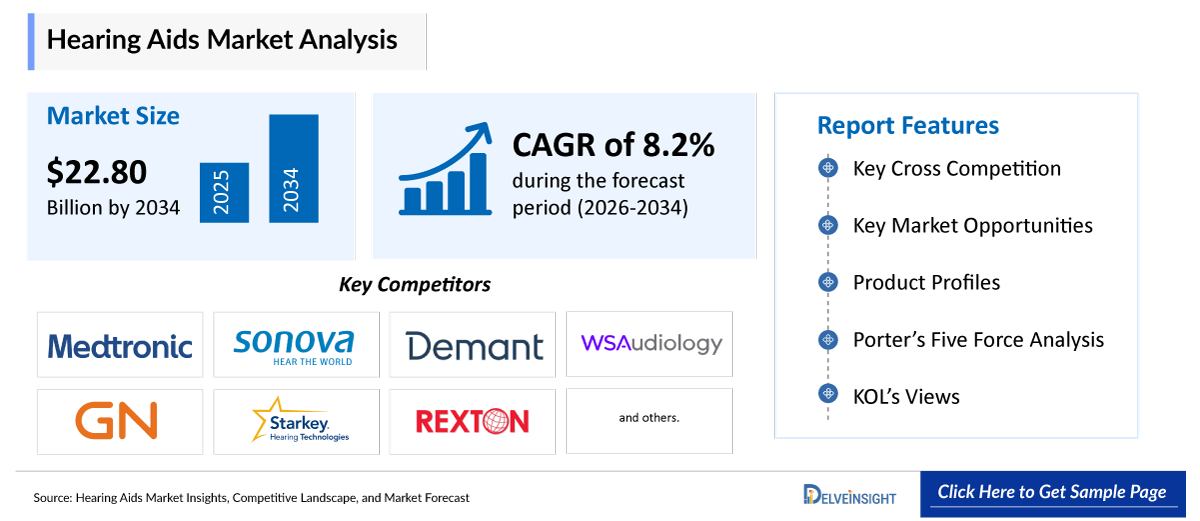
- The hearing aids market size is estimated at USD 10.90 billion in 2025 and is projected to reach USD 22.80 billion by 2034. Growth is anchored in the rising global prevalence of disabling hearing loss, rapid adoption of AI-enabled and Bluetooth-connected devices, and expanding direct-to-consumer and over-the-counter (OTC) accessibility.
- The global hearing aids market is growing at a CAGR of 8.2% during the forecast period from 2026 to 2034.
- By product type, the Receiver-in-Canal (RIC)/Receiver-in-the-Ear (RITE) segment dominated the Hearing Aids market with a 38% share in 2025.
- By technology, the digital hearing aids segment dominated the Hearing Aids market with a 94% share in 2025.
- By hearing loss type, the sensorineural hearing loss segment dominated the Hearing Aids market with a 78% share in 2025.
- By connectivity, the wireless/Bluetooth-enabled hearing aids segment dominated the Hearing Aids market with a 44% share in 2025.
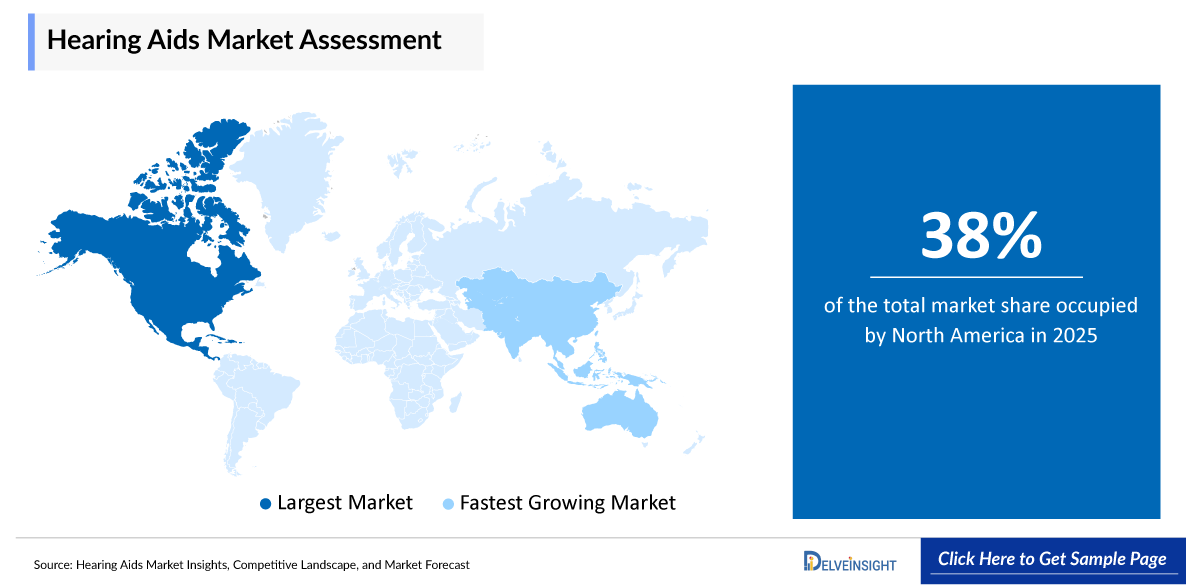
- North America dominated the global hearing aids market revenue with a 38% share in 2025, representing the highest regional market share globally.
A hearing aid is a small electronic medical device worn in or behind the ear that amplifies and processes sound to improve hearing and speech comprehension for individuals with hearing loss. Modern hearing aids combine miniaturized microphones, digital signal processors, and receivers with wireless connectivity, rechargeable batteries, and increasingly, AI-driven sound processing that adapts to the wearer's listening environment in real time. The market is organized by product type across Behind-the-Ear (BTE), Receiver-in-Canal (RIC)/Receiver-in-the-Ear (RITE), In-the-Ear (ITE), In-the-Canal (ITC), Completely-in-Canal (CIC), and Invisible-in-Canal (IIC) devices; by technology across analog and digital hearing aids; by hearing loss type across sensorineural, conductive, and mixed hearing loss; by patient type across adults and pediatrics; by connectivity across conventional, wireless/Bluetooth-enabled, and AI-enabled smart hearing aids; and by end user across hospitals, audiology & hearing care centers, ENT specialty clinics, and home care settings. Driven by an aging global population, rising noise-induced hearing loss, expanding over-the-counter access following regulatory reform, and continuous innovation in AI-powered and Bluetooth LE Audio/Auracast-enabled devices, hearing aid manufacturers and hearing care retail networks have become central to the global hearing healthcare ecosystem.
Hearing Aids Market Key Growth Drivers
- The rising global prevalence of disabling hearing loss is expanding the addressable patient population, with the World Health Organization estimating that over 430 million people currently live with disabling hearing loss, a figure projected to exceed 700 million by 2050.
- Rapid technological advancement in AI-enabled sound processing, rechargeable lithium-ion batteries, and Bluetooth LE Audio/Auracast streaming is driving device upgrades and a shift toward a higher-value product mix.
- Expanding direct-to-consumer and over-the-counter (OTC) hearing aid accessibility, following the FDA's 2022 OTC hearing aid rule, is broadening access and lowering barriers to first-time adoption.
- Growing awareness, early diagnosis, and government hearing-screening initiatives are increasing diagnosis rates and treatment-seeking behavior, particularly for mild-to-moderate hearing loss.
- Favorable and expanding reimbursement policies and insurance coverage in select markets are improving affordability and adoption.
- Strategic M&A and retail network consolidation among leading manufacturers, including vertical integration into hearing care clinic networks, is expanding distribution reach.
- Rising disposable income and improving audiology infrastructure across emerging markets are broadening the global addressable market.
- The convergence of demographic aging, technology adoption, OTC accessibility, and retail consolidation is expected to sustain steady growth in the market through 2034.
Key Companies in Hearing Aids Market
The competitive landscape is led by the following active players:
- Sonova
- Cochlear Ltd.
- Demant
- WS Audiology
- GN Hearing
- Starkey
- Rexton (WS Audiology)
- Amplifon
- Eargo
- MED-EL, and others
For illustrative purposes, only the top 10 companies are listed in the Table of Contents. The report may include analysis and references to additional companies relevant to the market assessment.
Hearing Aids Market Size
The following snapshot summarizes the principal report metrics for the hearing aids market.
|
Report Metrics |
Details |
|
2025 Market Size |
USD 10.90 billion |
|
2034 Projected Market Size |
USD 22.80 billion |
|
Growth Rate (2026-2034) |
8.2% CAGR |
|
Largest Market |
North America |
|
Fastest Growing Market |
Asia-Pacific |
|
Market Structure |
Highly Concentrated |
All market values are expressed in USD and represent DelveInsight estimates synthesized from primary and secondary research.
Factors Contributing to the Growth of the Hearing Aids Market
Hearing Aids Market Drivers
- Rising Global Prevalence of Disabling Hearing Loss and Population Aging: The most fundamental driver of the Hearing Aids market is the rising global prevalence of disabling hearing loss. The World Health Organization estimates that more than 430 million people currently live with disabling hearing loss, a figure projected to exceed 700 million by 2050, driven by population aging, increasing life expectancy, and rising exposure to occupational and recreational noise. Adults aged 60 and above account for the large majority of hearing aid users, and as the global geriatric population continues to expand, the number of individuals experiencing age-related sensorineural hearing loss rises in step. Because hearing loss is often progressive and under-diagnosed, growing awareness and screening are converting a historically underserved population into active hearing aid users. This demographic and epidemiological momentum underpins durable, long-term demand for hearing aids across both mature and emerging markets through 2034.
- Rapid Advancement of AI-Enabled and Connected Hearing Aid Technology: Continuous innovation in AI-enabled sound processing, rechargeable batteries, and wireless connectivity is reshaping the hearing aids market and driving device upgrades. Leading manufacturers now embed AI-driven sound separation, speech-in-noise enhancement, and health-sensing features such as fall detection and heart-rate tracking directly into hearing aids, while Bluetooth LE Audio and Auracast broadcast streaming enable seamless connectivity to smartphones, televisions, and public audio systems. Lithium-ion rechargeable batteries have largely displaced disposable zinc-air cells, improving convenience and reducing total cost of ownership. These innovations are expanding the value proposition of hearing aids beyond amplification toward broader hearing wellness and health monitoring, encouraging both first-time adoption and earlier replacement cycles among existing users, and supporting a favorable shift toward premium, AI-enabled devices through the forecast period.
- Expanding Direct-to-Consumer and Over-the-Counter Accessibility: Regulatory reform has significantly broadened access to hearing aids and reshaped the competitive landscape. The FDA's 2022 rule establishing an over-the-counter category for adult hearing aids removed the requirement for a medical exam or professional fitting for mild-to-moderate hearing loss, enabling direct-to-consumer brands and retail channels to reach a large population of previously untreated individuals. E-commerce platforms, self-fitting devices, and app-based hearing tests have lowered the cost and convenience barriers that historically limited adoption, particularly among younger and first-time users reluctant to visit a clinic. As similar regulatory frameworks gain traction in other geographies and awareness of the OTC category grows, direct-to-consumer and retail distribution channels are expected to meaningfully expand the addressable market and accelerate overall adoption rates through 2034.
- Growing Awareness, Early Diagnosis, and Government Screening Initiatives: Expanding awareness campaigns and government-backed hearing-screening initiatives are increasing diagnosis rates and treatment-seeking behavior. Public health agencies and hearing-loss advocacy organizations across North America, Europe, and Asia-Pacific are running campaigns to reduce the stigma associated with hearing aid use and to promote earlier intervention, since delayed treatment is associated with increased risk of cognitive decline and social isolation in older adults. Routine hearing screening programs in schools and workplaces are improving early detection of both pediatric and noise-induced hearing loss. As diagnosis rates rise and the historical treatment gap gradually narrows, the pool of diagnosed, treatment-seeking patients available to hearing aid manufacturers and dispensers continues to expand.
- Favorable Reimbursement Policies and Insurance Coverage Expansion: Improving reimbursement and insurance coverage is easing the affordability barrier that has historically constrained adoption. A growing number of private insurers, employer health plans, and government health systems in markets such as France, the United Kingdom, and select U.S. states now offer partial or full coverage for hearing aids, while veterans' health programs provide devices to eligible populations at no direct cost. As reimbursement frameworks mature and hearing aids are increasingly recognized as essential rather than elective devices, out-of-pocket costs decline for a meaningful share of patients, supporting higher conversion from diagnosis to purchase and reducing the price sensitivity that has traditionally slowed replacement cycles.
- Strategic M&A and Retail Network Consolidation Among Key Players: Leading manufacturers are pursuing acquisitions of hearing care clinic networks and competing manufacturers to expand distribution reach and vertically integrate the value chain. Recent examples include WS Audiology's acquisition of Germany's Ohwerk Group, Demant's acquisition of Dansk HøreCenter to expand its Danish clinic footprint, and Amplifon's pursuit of a landmark acquisition of GN Hearing, one of the largest proposed consolidations in hearing care industry history. This wave of consolidation is concentrating retail distribution among a small number of vertically integrated manufacturers, increasing their control over the patient journey from diagnosis to fitting, and reinforcing barriers to entry for smaller, independent players across the forecast period.
- Rising Disposable Income and Expanding Audiology Infrastructure in Emerging Markets: Rising disposable income and improving audiology infrastructure across emerging markets, particularly in Asia-Pacific and Latin America, are broadening the global addressable market for hearing aids. Expanding middle-class populations, growing healthcare investment, and the build-out of audiology clinics and hearing care retail networks in countries such as China, India, and South Korea are improving access to diagnosis and treatment. As affordability improves and awareness spreads, manufacturers are increasingly localizing product portfolios, including lower-cost digital devices tailored to price-sensitive markets, to capture rising demand in regions that remain significantly under-penetrated relative to mature markets.
Hearing Aids Market Restraints
Despite strong momentum, the Hearing Aids market faces material constraints. The high cost of advanced, AI-enabled hearing aids remains a significant barrier in markets lacking robust reimbursement, excluding lower-income patients and slowing adoption in many emerging economies. Persistent social stigma associated with hearing aid use, particularly among working-age adults, continues to suppress treatment-seeking behavior even where hearing loss is diagnosed. Low awareness of hearing loss and available treatment options in developing regions, combined with a shortage of trained audiologists and hearing care professionals, constrains market penetration outside mature markets. The proliferation of low-quality, unregulated sound amplification products in some markets undermines confidence in the broader category and can delay adoption of clinically validated devices. Long device replacement cycles, often five years or more, limit recurring revenue relative to other consumer electronics categories, while reimbursement and regulatory frameworks remain highly uneven across geographies, creating inconsistent demand conditions. Together, these affordability, awareness, workforce, and regulatory barriers temper the pace of growth, even as the underlying drivers of demographic aging, technology adoption, and OTC accessibility remain firmly intact.
Hearing Aids Market Segment Analysis
The Hearing Aids by Product Type (Behind-the-Ear (BTE), Receiver-in-Canal (RIC)/Receiver-in-the-Ear (RITE), In-the-Ear (ITE), In-the-Canal (ITC), Completely-in-Canal (CIC), and Invisible-in-Canal (IIC)), Technology (Analog Hearing Aids, Digital Hearing Aids), Hearing Loss Type (Sensorineural Hearing Loss, Conductive Hearing Loss, Mixed Hearing Loss), Patient Type (Adults, Pediatrics), Connectivity (Conventional Hearing Aids, Wireless/Bluetooth-Enabled Hearing Aids, AI-Enabled Smart Hearing Aids), End User (Hospitals, Audiology & Hearing Care Centers, ENT Specialty Clinics, Home Care Settings), and Geography (North America, Europe, Asia-Pacific, and Rest of World).
By Type
Dominant Subsegment: Receiver-in-Canal (RIC)/Receiver-in-the-Ear (RITE). The Receiver-in-Canal (RIC)/Receiver-in-the-Ear (RITE) category is expected to dominate the market.
Dominant: Volumetric Pumps ~ 38%
The RIC/RITE segment accounted for 38% of the Hearing Aids market in 2025. RIC/RITE devices lead the product-type segment because they combine a compact, largely discreet behind-the-ear housing with an in-canal receiver that delivers natural, high-fidelity sound while remaining comfortable for extended daily wear. Their slim form factor, open-fit design that reduces the occlusion effect, and compatibility with rechargeable batteries and premium AI-enabled sound processors have made RIC/RITE the platform of choice for most new digital hearing aid launches from leading manufacturers. BTE hearing aids remain the second-largest category, valued by older adults and pediatric patients for their durability, larger batteries, and ease of handling, particularly for users with dexterity limitations. Meanwhile, discreet in-canal styles, including ITC, CIC, and IIC, are the fastest-growing product types as miniaturized components and improved battery technology make near-invisible designs viable for a broader range of hearing-loss severities. Nonetheless, the balance of sound quality, comfort, and technological upgradeability keeps RIC/RITE the leading product type across the forecast period.
By Technology
Dominant Subsegment: Digital Hearing Aids. The Digital Hearing Aids category is expected to dominate the market.
Dominant: Digital Hearing Aids ~ 94%
The digital hearing aids segment accounted for 94% of the Hearing Aids market in 2025. Digital technology dominates because digital signal processors enable precise, programmable sound amplification tailored to a user's specific audiogram, along with noise reduction, feedback cancellation, directional microphones, and wireless connectivity that analog circuitry cannot replicate. Virtually all new hearing aids launched by leading manufacturers, including AI-enabled and Bluetooth-connected models, are built on digital platforms, and clinics and retailers have largely phased out analog inventory. Analog hearing aids retain a small residual share in select low-income and rural markets where cost sensitivity and limited access to programming equipment favor simpler, less expensive devices. As component costs continue to decline and digital platforms become more affordable at entry price points, the residual analog segment is expected to keep shrinking, reinforcing digital technology's near-total leadership through 2034.
By Hearing Loss Type
Dominant Subsegment: Sensorineural Hearing Loss. The Sensorineural Hearing Loss category is expected to dominate the market.
Dominant: Sensorineural Hearing Loss ~ 78%
The sensorineural hearing loss segment accounted for 78% of the Hearing Aids market in 2025. Sensorineural hearing loss, caused by damage to the inner ear or auditory nerve, is overwhelmingly the leading hearing loss type because it is the most common form of hearing impairment globally, driven primarily by age-related degeneration (presbycusis) and cumulative noise exposure. Because sensorineural hearing loss is typically permanent and cannot be corrected surgically in most cases, hearing aids are the primary standard-of-care treatment, sustaining great and recurring demand for amplification devices across the aging population. Conductive hearing loss, often caused by structural or middle-ear issues, is comparatively less common and in many cases treatable through medical or surgical intervention rather than long-term hearing aid use. Mixed hearing loss, combining sensorineural and conductive elements, represents a smaller but clinically important segment. The sheer scale of age-related and noise-induced sensorineural hearing loss secures its leadership across the forecast period.
By Patient Type
Dominant Subsegment: Adults. The Adults category is expected to dominate the market.
Dominant: Adults ~ 86%
The adults segment accounted for 86% of the Hearing Aids market in 2025. Adults, and particularly the geriatric population aged 60 and above, dominate the patient-type segment because age-related sensorineural hearing loss is by far the most prevalent form of hearing impairment, and the global population of older adults continues to expand rapidly. Rising life expectancy, growing awareness of the link between untreated hearing loss and cognitive decline, and expanding OTC and retail access are all concentrated on the adult population, reinforcing this segment's scale. The pediatric segment, while considerably smaller, remains a clinically essential category, supported by universal newborn hearing screening programs in many developed markets, early intervention protocols, and specialized pediatric hearing aid designs built for durability and growth. Continued expansion of newborn and school-based screening programs is expected to support steady growth in pediatric diagnosis and treatment, but the scale of the aging adult population keeps adults the clearly dominant patient type through 2034.
By Connectivity
Dominant Subsegment: Wireless/Bluetooth-Enabled Hearing Aids. The Wireless/Bluetooth-Enabled Hearing Aids category is expected to dominate the market.
Dominant: Wireless/Bluetooth-Enabled Hearing Aids ~ 44%
The wireless/Bluetooth-enabled hearing aids segment accounted for 44% of the Hearing Aids market in 2025. Wireless connectivity has become a near-standard expectation among hearing aid users, allowing direct streaming of phone calls, music, and television audio, along with remote programming and app-based fine-tuning by audiologists. The rollout of Bluetooth LE Audio and the Auracast broadcast standard is extending this connectivity further, enabling hearing aids to receive public audio broadcasts in venues such as airports, theaters, and lecture halls. AI-enabled smart hearing aids, which layer real-time environmental sound classification, speech-in-noise enhancement, and health-sensing features onto wireless connectivity, are the fastest-growing connectivity segment as leading manufacturers race to differentiate premium product lines. Conventional hearing aids without wireless capability persist mainly at entry price points and in cost-sensitive markets. As component costs decline and connectivity becomes standard even in mid-tier devices, wireless and AI-enabled categories are expected to continue gaining share through the forecast period.
By End User
Dominant Subsegment: Audiology & Hearing Care Centers. The Audiology & Hearing Care Centers category is expected to dominate the market.
Dominant: Audiology & Hearing Care Centers ~ 41%
The audiology & hearing care centers segment accounted for 41% of the Hearing Aids market in 2025. Audiology and hearing care centers, including both independent clinics and the vertically integrated retail networks operated by leading manufacturers such as Amplifon and WS Audiology, lead the end-user segment because they provide the specialized diagnostic testing, professional fitting, and ongoing follow-up care that most hearing aid users require, particularly for premium and AI-enabled devices. Hospitals and ENT specialty clinics play an important complementary role, particularly for complex cases, pediatric diagnosis, and patients with comorbid ear, nose, and throat conditions. Home care settings are the fastest-growing end-user category, propelled by the rise of teleaudiology, remote fitting and fine-tuning via smartphone apps, and direct-to-consumer OTC devices that allow patients to select, fit, and adjust hearing aids without an in-clinic visit. Nonetheless, the professional expertise and trust associated with dedicated audiology and hearing care centers keep this channel the leading end-user segment across the forecast period.
Hearing Aids Market Region Analysis
Dominant Region: North America
Dominant: North America ~ 38% (Largest)
North America accounted for 38% of the global Hearing Aids market revenue in 2025, representing the highest regional market share globally. The region's leadership reflects a large and rapidly aging population, high awareness of hearing health, well-established audiology and retail hearing care infrastructure, and the 2022 FDA rule establishing an over-the-counter hearing aid category, which has accelerated adoption among previously untreated adults in the United States. Favorable reimbursement expansion among select insurers and veterans' health programs, combined with the presence of major manufacturers' retail networks and a mature direct-to-consumer ecosystem, further reinforce demand. Continued innovation in AI-enabled and Bluetooth-connected devices, strong consumer purchasing power, and sustained OTC market expansion are expected to anchor North America's continued leadership across the forecast period.
Fastest Growing Region: Asia-Pacific
Asia-Pacific is the fastest-growing region in the Hearing Aids market. The region's elevated CAGR is driven by a rapidly aging population, particularly in Japan, China, and South Korea, rising prevalence of noise-induced hearing loss among younger urban populations, and expanding healthcare investment and audiology infrastructure across China, India, and Southeast Asia. China's large and aging population and growing middle-class healthcare spending, Japan's exceptionally high proportion of elderly citizens, India's expanding retail hearing care networks and rising affordability, and South Korea's strong consumer adoption of connected technology are all accelerating regional demand. Government initiatives to expand hearing screening and improve reimbursement, combined with manufacturers localizing lower-cost digital product lines, position Asia-Pacific as the principal source of incremental growth over the forecast period.
Hearing Aids Regional Commentary
North America
North America accounted for 38% of the global hearing aids market revenue in 2025. The United States dominates the hearing aids market owing to its well-established audiology and hearing healthcare infrastructure, high prevalence of age-related hearing loss, favorable reimbursement coverage for eligible populations, widespread adoption of technologically advanced digital and AI-enabled hearing aids, and the strong presence of leading manufacturers such as Starkey, GN Hearing, Sonova, Demant, and WS Audiology, which continuously introduce innovative Bluetooth-enabled, rechargeable, and AI-powered hearing aid solutions across the country.
Europe
Europe is a large and mature regional market, supported by strong healthcare systems, favorable reimbursement in markets such as France, Germany, and the United Kingdom, and the headquarters presence of leading manufacturers including Sonova, Demant, and GN Hearing. Continued clinic network consolidation, exemplified by Demant's acquisition of Dansk HøreCenter and WS Audiology's acquisition of Ohwerk Group, and steady adoption of AI-enabled and rechargeable devices reinforce the region's advanced market position across Germany, France, the United Kingdom, Italy, and Spain.
Asia-Pacific
Asia-Pacific is the fastest-growing region in the hearing aids market, driven by its large and rapidly aging population, rising prevalence of hearing impairment, increasing awareness of early hearing loss diagnosis, and expanding access to audiology and hearing healthcare services across China, Japan, India, South Korea, and Australia. Growing disposable incomes, supportive government initiatives for hearing screening and rehabilitation, improving healthcare infrastructure, and the increasing adoption of technologically advanced digital, rechargeable, and AI-enabled hearing aids are further accelerating regional market growth.
Rest of World
The Rest of World region, spanning the Middle East, Africa, and South America, is an emerging growth frontier. Expanding healthcare infrastructure, rising awareness of hearing loss and available treatment options, and gradually improving affordability are broadening access, while international manufacturers and hearing care networks are increasingly establishing distribution partnerships and retail presence to serve historically underserved populations.
Hearing Aids Market Competitive Landscape
The Hearing Aids market is classified as Highly Concentrated. A small group of vertically integrated manufacturers, including Sonova, Demant, WS Audiology, GN Hearing, and Starkey, collectively account for the large majority of global revenue, combining in-house device manufacturing with extensive owned or affiliated retail and hearing care networks. Amplifon operates one of the world's largest independent hearing care retail networks and competes both as a distribution partner and, following its pursuit of GN Hearing, an increasingly integrated manufacturer. Specialized and direct-to-consumer providers, including Eargo, MED-EL, and Cochlear Ltd., compete through OTC innovation and leadership in cochlear and bone-anchored implant solutions, sustaining innovation at the category's edges.
The competitive landscape can be evaluated across the following dimensions:
- Market concentration: Highly concentrated, with the top five manufacturers accounting for the large majority of global hearing aid revenue.
- Leading players: Sonova, Demant, WS Audiology, GN Hearing, and Starkey anchor the top tier through global manufacturing scale and multi-brand portfolios.
- Retail integration: Leaders increasingly own or control hearing care retail networks; Amplifon operates one of the world's largest independent hearing care retail networks spanning thousands of clinics.
- Product portfolio strength: Top players offer full-line portfolios spanning BTE, RIC/RITE, ITE, ITC, CIC, and IIC devices across multiple price tiers and connectivity levels.
- Technology leadership: AI-enabled sound processing, Bluetooth LE Audio/Auracast connectivity, and rechargeable battery platforms are decisive competitive differentiators.
- Strategic partnerships and consolidation: Active consolidation, including WS Audiology's acquisition of Ohwerk Group, Demant's acquisition of Dansk HøreCenter, and Amplifon's pursuit of GN Hearing, is reshaping distribution and ownership structures.
- Implant and specialty leadership: MED-EL and Cochlear Ltd. lead in cochlear and bone-anchored implant solutions, complementing the conventional hearing aid category for severe-to-profound hearing loss.
- Innovation focus: AI-driven health sensing, Auracast broadcast audio, teleaudiology platforms, and OTC/direct-to-consumer self-fitting technology.
Hearing Aids Market Recent Developmental Activities
- In 2026, Amplifon entered advanced discussions to acquire GN Hearing (ReSound) from GN Store Nord, a deal described by industry commentators as one of the largest proposed consolidations in hearing care industry history. Strategic significance: Would combine one of the world's largest independent hearing care retail networks with an established device manufacturer, reshaping distribution across the industry.
- In 2025 and 2026, Sonova reported strong financial results and market-outperforming growth across its Phonak, Unitron, and Sennheiser consumer hearing brands. Strategic significance: Reinforces Sonova's position as the global hearing aid market leader through continued share gains.
- In February 2025, WS Audiology acquired Germany's Ohwerk Group, integrating 77 hearing care clinics into its retail network. Strategic significance: Expands WS Audiology's German clinic footprint and strengthens vertical integration between manufacturing and retail.
- In August 2024, Demant acquired Dansk HøreCenter, doubling its hearing care clinic network in Denmark. Strategic significance: Deepens Demant's domestic retail presence and reinforces distribution for its Oticon brand.
- In 2025 and 2026, Demant advanced its exit from implantable hearing solutions, including bone-anchored and cochlear implant devices, to concentrate resources on its core hearing aid and hearing care businesses. Strategic significance: Reshapes the competitive landscape for implantable hearing solutions and sharpens Demant's strategic focus.
- In June 2025, Cochlear Ltd. launched the Cochlear Nucleus Nexa System, a smart cochlear implant platform incorporating AI-driven sound processing. Strategic significance: Strengthens Cochlear's leadership in implantable hearing solutions for severe-to-profound hearing loss.
- In 2025, GN Hearing advanced its ReSound Nexia hearing aid line with Auracast-ready Bluetooth LE Audio support. Strategic significance: Positions GN Hearing at the forefront of next-generation broadcast audio connectivity.
- In 2025, Starkey continued to expand its Edge AI hearing aid line, incorporating health-sensing features such as fall detection and activity tracking alongside AI-driven sound processing. Strategic significance: Differentiates Starkey's premium portfolio through health-and-wellness positioning.
- In 2025, Eargo continued to focus on its FDA-cleared over-the-counter hearing aid portfolio and direct-to-consumer distribution model. Strategic significance: Reinforces Eargo's position as a leading OTC and direct-to-consumer specialist following the FDA's 2022 OTC rule.
- In 2025, MED-EL continued to expand its global footprint in cochlear and middle-ear implant solutions, complementing conventional hearing aid manufacturers in addressing severe-to-profound hearing loss. Strategic significance: Strengthens the broader hearing-restoration ecosystem alongside conventional hearing aid providers.
- In 2025, Rexton (WS Audiology) expanded its value-tier digital hearing aid portfolio to serve price-sensitive and emerging markets under the WS Audiology umbrella. Strategic significance: Broadens WS Audiology's reach into cost-sensitive market segments.
Hearing Aids Market Segmentation
- Hearing Aids Market by Product Type
- Behind-the-Ear (BTE)
- Receiver-in-Canal (RIC)/Receiver-in-the-Ear (RITE)
- In-the-Ear (ITE)
- In-the-Canal (ITC)
- Completely-in-Canal (CIC)
- Invisible-in-Canal (IIC)
- Hearing Aids Market by Technology
- Analog Hearing Aids
- Digital Hearing Aids
- Hearing Aids Market by Hearing Loss Type
- Sensorineural Hearing Loss
- Conductive Hearing Loss
- Mixed Hearing Loss
- Hearing Aids Market by Patient Type
- Adults
- Pediatrics
- Hearing Aids Market by Connectivity
- Conventional Hearing Aids
- Wireless/Bluetooth-Enabled Hearing Aids
- AI-Enabled Smart Hearing Aids
- Hearing Aids Market by End User
- Hospitals
- Audiology & Hearing Care Centers
- ENT Specialty Clinics
- Home Care Settings
Hearing Aids Market by Geography
- North America Hearing Aids Market
- United States Hearing Aids Market Size in USD million (2023-2034)
- Canada Hearing Aids Market Size in USD million (2023-2034)
- Mexico Hearing Aids Market Size in USD million (2023-2034)
- Europe Hearing Aids Market
- Germany Hearing Aids Market Size in USD million (2023-2034)
- United Kingdom Hearing Aids Market Size in USD million (2023-2034)
- France Hearing Aids Market Size in USD million (2023-2034)
- Italy Hearing Aids Market Size in USD million (2023-2034)
- Spain Hearing Aids Market Size in USD million (2023-2034)
- Rest of Europe Hearing Aids Market Size in USD million (2023-2034)
- Asia-Pacific Hearing Aids Market
- China Hearing Aids Market Size in USD million (2023-2034)
- Japan Hearing Aids Market Size in USD million (2023-2034)
- India Hearing Aids Market Size in USD million (2023-2034)
- Australia Hearing Aids Market Size in USD million (2023-2034)
- South Korea Hearing Aids Market Size in USD million (2023-2034)
- Rest of Asia-Pacific Hearing Aids Market Size in USD million (2023-2034)
- Rest of the World (RoW) Hearing Aids Market
- Middle East Hearing Aids Market Size in USD million (2023-2034)
- Africa Hearing Aids Market Size in USD million (2023-2034)
- South America Hearing Aids Market Size in USD million (2023-2034)
Hearing Aids Market Recent Industry Trends and Milestones (2023-2026):
|
Category |
Key Developments |
|
Hearing Aids Market Product Approval |
Regulatory momentum continues to expand market access. The FDA's 2022 rule establishing an over-the-counter hearing aid category for mild-to-moderate hearing loss remains a foundational driver of direct-to-consumer adoption. Cochlear Ltd. launched the Nucleus Nexa smart cochlear implant system in June 2025, and GN Hearing advanced Auracast-ready, Bluetooth LE Audio-enabled devices under its ReSound Nexia line, expanding the scope of connected, regulator-cleared hearing solutions. |
|
Hearing Aids Market Expansion |
Leading manufacturers expanded retail and clinical capacity. WS Audiology acquired Germany's Ohwerk Group, adding 77 clinics, while Demant acquired Dansk HøreCenter, doubling its Danish clinic network. Amplifon continued to expand its global independent retail footprint, and teleaudiology and app-based remote fitting services scaled rapidly across both OTC and prescription channels. |
|
Hearing Aids Market Investment |
Capital and consolidation accelerated. Amplifon pursued a landmark acquisition of GN Hearing, described as one of the largest proposed consolidations in hearing care history, while Demant advanced its exit from implantable hearing solutions to refocus resources on core hearing aid and hearing care operations. Emerging AI-hearing-aid startups such as Whisper and Audicus continued to attract venture investment. |
|
Company Strategy |
Sonova: Global leadership through Phonak, Unitron, and Sennheiser, reinforced by market-outperforming growth. Demant: Clinic network consolidation and exit from implantable solutions to sharpen focus on Oticon-brand hearing aids. WS Audiology: Retail expansion through the Ohwerk Group acquisition and value-tier growth via Rexton. GN Hearing: Auracast and Bluetooth LE Audio innovation via ReSound Nexia, alongside a proposed combination with Amplifon. Starkey: AI-driven health-sensing differentiation through its Edge AI portfolio. Amplifon: Retail network scale and pursuit of vertical integration through the GN Hearing transaction. Eargo: OTC and direct-to-consumer specialization. MED-EL and Cochlear Ltd.: Leadership in cochlear and implantable hearing solutions for severe-to-profound hearing loss. |
|
Emerging Technologies |
AI-driven sound processing and health sensing, including fall detection, heart-rate tracking, and real-time language translation, are becoming standard in premium hearing aids. Bluetooth LE Audio and the Auracast broadcast standard are expanding public and personal audio streaming capability. Rechargeable lithium-ion batteries continue to displace disposable cells, while teleaudiology platforms and self-fitting OTC devices are broadening remote access to hearing care. |
Hearing Aids Market Startup Funding and Investment Trends
Investment in the hearing aids ecosystem has concentrated on AI-driven sound processing, direct-to-consumer distribution models, and over-the-counter innovation. The following companies illustrate recent funding and investment activity and technology focus.
|
Company |
Total Funding |
Funding Stage |
Main Offering |
Core Technology |
|
Whisper |
USD 53 million |
Series B |
Subscription-based AI hearing aid system |
Real-time AI sound separation engine |
|
Audicus |
USD 20+ million |
Growth / Venture |
Direct-to-consumer affordable hearing aids |
Online hearing test and remote fitting platform |
|
Request for unlocking the report of the @ Hearing Aids Market Insights | ||||
Capital continues to flow toward companies that combine AI-driven sound processing with direct-to-consumer distribution. Whisper has raised USD 53 million to develop its subscription-based AI hearing system, while Audicus has raised more than USD 20 million to scale its online hearing test and remote fitting platform. Eargo's earlier trajectory, having raised more than USD 200 million in venture funding before its public listing, illustrates the scale of capital available to direct-to-consumer hearing aid innovators. Collectively, these investments signal conviction that AI-enabled sound processing, teleaudiology, and OTC accessibility will define the next phase of competitive advantage in the global Hearing Aids market.
Key Takeaways from the Hearing Aids Market Report Study
- Market size analysis for the current hearing aids market size (2025), and market forecast for 9 years (2026 to 2034).
- Top key product/technology developments, mergers, acquisitions, partnerships, and joint ventures that happened over the last 3 years.
- Key companies dominating the global hearing aids market.
- Various opportunities available for competitors in the hearing aids market space.
- What are the top-performing segments in 2025? How will these segments perform in 2034?
- Which are the top-performing regions and countries in the current hearing aids market scenario?
- Which are the regions and countries where companies should concentrate their opportunities for hearing aids market growth in the future?
Target audience who can benefit from this Hearing Aids market report study
- Hearing aids product providers
- Research organizations and consulting companies
- Hearing aids-related organizations, associations, forums, and other alliances
- Government and corporate offices
- Start-up companies, venture capitalists, and private equity firms
- Distributors and traders dealing in hearing aids
- Various end-users who want to know more about the hearing aids market, and the latest technological developments in the hearing aids market.
Frequently Asked Questions
Q1. What is the growth rate of the hearing aids market?
The hearing aids market is projected to expand at a CAGR of 8.2% during the forecast period from 2026-2034.
Q2. What is the market size of the Hearing Aids market?
The Hearing Aids market size is estimated at USD 10.90 billion in 2025 and is projected to reach USD 22.80 billion by 2034.
Q3. Which region dominates the Hearing Aids market?
North America dominated the Hearing Aids market with a 38% share of global revenue in 2025, supported by a large aging population, mature audiology and retail infrastructure, FDA over-the-counter regulatory reform, and strong consumer purchasing power. Asia-Pacific is the fastest-growing region over the forecast period.
Q4. What are the key drivers of the Hearing Aids market?
The principal drivers are the rising global prevalence of disabling hearing loss, with the World Health Organization projecting cases to exceed 700 million by 2050; rapid advancement of AI-enabled and connected hearing aid technology; expanding direct-to-consumer and over-the-counter accessibility following the FDA's 2022 OTC rule; growing awareness and government screening initiatives; and strategic M&A and retail network consolidation among key players.
Q5. Who are the major players in the Hearing Aids market?
The leading Hearing Aids companies in the market include - Sonova, Demant, WS Audiology, GN Hearing, Starkey, Rexton (WS Audiology), Amplifon, Eargo, MED-EL, and Cochlear Ltd., among others.