
Tinnitus Market Summary
- The Tinnitus Market is primarily driven by high disease burden and the absence of approved curative therapies, with leading assets in development including SPI-1005, GW-TT2/3/5, AC102, NHPN-1010, OPI-001, and others.
- The leading Tinnitus Companies such as Sound Pharmaceuticals, Gateway Biotechnology, AudioCure Pharma, Otologic Pharmaceuticals, and others.
Tinnitus Market and Epidemiological Analysis
- Tinnitus is a common problem for millions of people, as epidemiologic studies have reported its prevalence to be between 8–25.3% of the population of the US.
- Currently, there are no Food and Drug Administration (FDA)-approved drugs for tinnitus, and management focuses on sound therapy, cognitive-behavioral therapy, hearing aids, and counseling for habituation and quality-of-life improvement.
Request for Unlocking the Sample Page of the "Tinnitus Treatment Market"
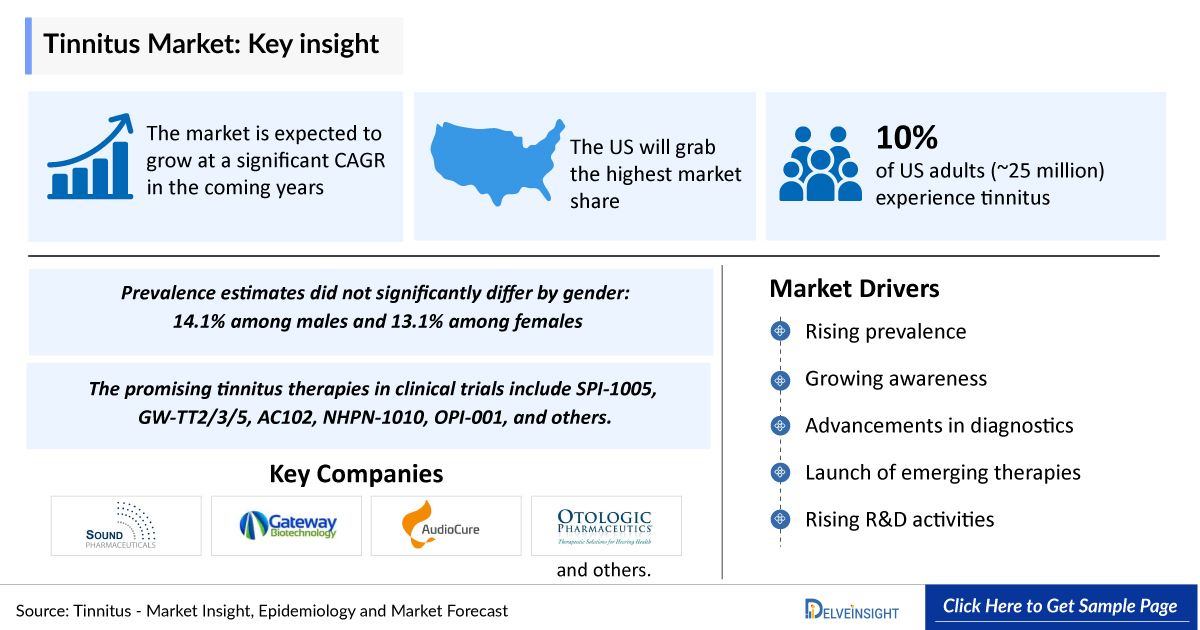
Factors contributing to the Growth of the Tinnitus Market
-
Rising Prevalence of Tinnitus and Related Disorders
Tinnitus affects a significant percentage of the global population, particularly among older adults and individuals exposed to prolonged noise. Increased incidence of hearing loss, age-related auditory decline, and chronic conditions such as hypertension and diabetes contribute to higher rates of tinnitus, expanding the pool of patients seeking therapeutic solutions.
-
Growing Geriatric Population
Aging populations in developed and emerging economies are a major growth driver. Aging is strongly associated with sensory impairments, including hearing loss and tinnitus. As life expectancy increases worldwide, the number of elderly individuals susceptible to tinnitus continues to grow, fueling demand for effective treatments and auditory support technologies.
-
Rising Awareness and Diagnosis Rates
Greater awareness about tinnitus, partly due to public health campaigns and increased media coverage, has encouraged more individuals to seek medical evaluation. Enhanced screening practices in audiology clinics, broader clinical recognition of tinnitus symptoms, and improved patient education contribute to higher diagnosis rates, driving market growth.
-
Technological Advancements in Diagnosis and Treatment
Innovations in diagnostic tools such as advanced audiometry, imaging, and electrophysiological testing have improved the accuracy and efficiency of tinnitus assessment. Additionally, research and development in therapeutic solutions — including neuromodulation devices, sound therapy innovations, and digital health platforms — are expanding treatment options. These technological developments attract both clinicians and patients, further stimulating market demand.
-
Increasing Healthcare Expenditure
Rising healthcare spending and better insurance coverage in many countries enhance patient access to tinnitus-related care. Allocation of funds toward audiology research and healthcare infrastructure supports the availability and adoption of novel treatment modalities, leading to market expansion.
-
Product Launches and Pipeline Innovations
The tinnitus therapeutic landscape is evolving, with several novel drugs, medical devices, and digital therapeutics in development. Active clinical programs aiming to address the unmet need for effective pharmacological interventions create optimism within the clinical community and among patients. Frequent product launches and strategic collaborations between biotech companies and research institutions foster a competitive environment, accelerating market growth.
-
Increasing Use of Hearing Aids and Assistive Devices
Hearing aids, sound generators, and wearable auditory devices are increasingly used for managing tinnitus symptoms. Rising adoption of these devices, supported by technological improvements that offer personalized sound therapy, is contributing to the overall market revenue.
DelveInsight's "Tinnitus Market Insights, Epidemiology, and Market Forecast-2036" report delivers an in-depth understanding of the Tinnitus, historical and forecasted epidemiology as well as the Tinnitus market trends in the United States, EU5 (Germany, Spain, Italy, France, and United Kingdom) and Japan.
The Tinnitus Treatment Market Report provides current treatment practices, emerging drugs, Tinnitus market share of the individual therapies, current and forecasted Tinnitus market Size from 2022 to 2036 segmented by seven major markets. The Report also covers current Tinnitus treatment practice/algorithm, market drivers, market barriers and unmet medical needs to curate the best of the opportunities and assesses the underlying potential of the Tinnitus market.
Scope of the Tinnitus Market Report | |
|
Study Period |
2022 to 2036 |
|
Forecast Period |
2026-2036 |
|
Geographies Covered |
|
|
Tinnitus Market |
|
|
Tinnitus Market Size | |
|
Tinnitus Companies |
|
Tinnitus Disease Understanding
Tinnitus is the perception of sound without an external source, often described as ringing, humming, or buzzing, and may result from hearing loss, ear or vascular disorders, inflammation, stress, or occur even in individuals with normal hearing. Tinnitus is a neurological and auditory condition characterized by the perception of sound in the absence of an external source. Patients commonly describe it as ringing, buzzing, hissing, clicking, or roaring in one or both ears. Rather than being a standalone disease, tinnitus is typically a symptom of an underlying condition, most commonly sensorineural hearing loss. It can be classified as subjective tinnitus (heard only by the patient and accounting for the majority of cases) or objective tinnitus (rare and caused by vascular or muscular abnormalities).
Tinnitus Diagnosis
Tinnitus diagnosis involves a comprehensive evaluation by a primary care doctor, audiologist, or ENT specialist, focusing on identifying underlying causes like hearing loss, jaw joint issues, or vascular problems. Common diagnostic methods include physical exams, detailed medical history, audiograms (hearing tests), and, if needed, imaging studies (MRI or CT scans). The Tinnitus Diagnosis is primarily clinical and begins with a comprehensive patient history and physical examination. Physicians evaluate the onset, duration, laterality (unilateral or bilateral), sound characteristics, and associated symptoms such as hearing loss, vertigo, or neurological deficits. Audiological assessment is a cornerstone of diagnosis. Pure-tone audiometry is commonly performed to detect hearing impairment. Additional tests such as tympanometry assess middle ear function, while otoacoustic emissions may evaluate cochlear integrity. In cases of unilateral tinnitus or suspected structural abnormalities, imaging studies such as Magnetic Resonance Imaging (MRI) are recommended to rule out Vestibular Schwannoma or other intracranial pathologies.
Tinnitus Treatment
Currently, there are no Food and Drug Administration (FDA)-approved drugs for tinnitus, and management focuses on sound therapy, cognitive-behavioral therapy, hearing aids, and counseling for habituation and quality-of-life improvement. Non-rhythmic tinnitus is managed with hearing rehabilitation and sound-based habituation therapies, while rhythmic tinnitus is treated by correcting the underlying cause through medical or surgical intervention, with sound therapies used when no cause is identified.
Tinnitus Epidemiology Segmentation in the 7MM
The tinnitus treatment market report proffers epidemiological analysis for the study period 2022–2036 in the leading markets, segmented into:
- Total Prevalent Cases of Tinnitus
- Age-specific Prevalent Cases of Tinnitus
- Severity-specific Prevalent Cases of Tinnitus
- Total Prevalent Cases of Tinnitus Based on Onset
- Total Treated Cases of Tinnitus
Key Findings from Tinnitus Epidemiological Analysis
The disease epidemiology covered in the report provides historical as well as forecasted Tinnitus epidemiology scenario in the 7MM covering the United States, EU5 countries (Germany, Spain, Italy, France, and the United Kingdom), and Japan from 2022 to 2036.
- According to Battsa and Stankovic (2024), the US prevalence of tinnitus was 11.2% (∼27 million people) in 2014.
- According to Hobeika et al. (2025), analysis of the UK Biobank dataset showed that among individuals with tinnitus, 29.0% reported no distress, 48.3% mild distress, 19.0% moderate distress, and 3.7% severe distress.
Tinnitus Market Recent Developments and Breakthroughs
- In December 2025, Sound Pharmaceuticals Incorporated announced the initiation of a study evaluating the safety of open-label SPI-1005 administered at 400 mg twice daily (BID) in adults with Meniere’s Disease (MD) over a duration of 6 or 12 months. The study aims to generate data supporting the chronic or chronic intermittent use of SPI-1005 in this patient population.
- In June 2025, AudioCure Pharma reported that preclinical research showed that AC102 restored inner-ear–auditory nerve connections and eliminated tinnitus, with its efficacy in sudden hearing loss and tinnitus now under clinical investigation.
- In February 2025, Sound Pharmaceuticals presented SPI-1005 preclinical and clinical data on hearing loss and tinnitus at the Defense Health Agency Hearing Center of Excellence Symposia and the ARO Midwinter Meeting.
Tinnitus Drug Analysis
The drug chapter segment of the Tinnitus Therapeutics Market Report encloses the detailed analysis of Tinnitus marketed drugs and late-stage (Phase-III and Phase-II) Tinnitus Pipeline Drugs. It also helps to understand the Tinnitus clinical trial details, expressive pharmacological action, agreements and collaborations, approval and patent details, advantages and disadvantages of each included drug and the latest news and press releases.
Tinnitus Marketed Drugs
The Tinnitus Therapeutics Market Report provides the details of the marketed products/off-label treatments available for Tinnitus treatment.
Tinnitus Emerging Drugs
-
SPI-1005: Sound Pharmaceuticals
SPI-1005 is an investigational new drug that contains ebselen, a new chemical entity. SPI-1005 is a selenorganic compound that mimics and induces glutathione peroxidase (GPx) activity and is effective in reducing neuroinflammation across the central and peripheral nervous system. SPI-1005 is being developed for several neurotologic indications including Meniere’s disease (hearing loss, tinnitus, intermittent dizziness, and episodic vertigo), noise-induced hearing loss (including tinnitus) and two types of ototoxicity (hearing loss, tinnitus, dizziness, or vertigo) caused by aminoglycoside antibiotics (such as tobramycin or amikacin) or platinum-based chemotherapy (such as cisplatin or carboplatin).
SPI, a pioneer in neurotologic drug development for sensorineural inner ear diseases, leverages its expertise in molecular biology, immunohistochemistry, and electrophysiology to develop preclinical models of hearing loss and tinnitus that are successfully translating into novel clinical trials. In February 2025, Sound Pharmaceuticals presented SPI-1005 preclinical and clinical data on hearing loss and tinnitus at the Defense Health Agency Hearing Center of Excellence Symposia and the ARO Midwinter Meeting.
-
GW-TT2, GW-TT3, GW-TT5: Gateway Biotechnology
Gateway Biotechnology is actively developing multiple drug modalities for tinnitus treatment. GW-TT5: GW-TT5 is a first-in-class gene therapy being developed for chronic tinnitus. GW-TT5 employs Designer Receptors Exclusively Activated by Designer Drugs (DREADD)-based chemogenetic tools which enables precise neuronal targeting and suppression of tinnitus through activation with orally administered designer drugs. The company expects that successful outcomes from the GW-TT5 program will pave the way for novel gene therapies.
Proof-of-concept studies demonstrate successful brain delivery and neuronal targeting of AAV-based DREADDs with confirmed auditory perceptual effects, and a Phase I clinical study is in development. GW-TT3: GW-TT3 is a novel small-molecule therapy and new chemical entity with potential for tinnitus treatment. Animal pharmacodynamics and pharmacokinetics studies are currently underway to evaluate its efficacy and therapeutic profile. GW-TT2: A nasal formulation using an FDA-approved drug to enable targeted brain delivery for recent-onset tinnitus. The FDA also indicated that the 505(b)(2) NDA approval pathway is an acceptable approach for GW-TT2 drug development.
Tinnitus Market Outlook
The tinnitus market is shaped by a large patient population, a chronic disease course, and a persistent lack of curative treatment, positioning it as a high-burden yet under-penetrated therapeutic area. Although tinnitus affects a substantial proportion of the global population, only a limited share of patients receive active or long-term treatment, largely due to the modest efficacy of available therapies and inconsistent reimbursement frameworks. This disconnect between disease prevalence and treated population defines the current market structure and constrains overall market expansion.
Emerging therapeutic modalities, including transcranial magnetic stimulation, electrical stimulation, and other neuromodulation techniques, show promise by targeting the neural pathways implicated in tinnitus perception, reflecting a growing shift toward neurobiologically informed treatments beyond traditional management. Despite these advances, the pipeline remains scarce, with few disease-modifying therapies. Several high-profile candidates, such as OTO-313, AM-101, AUT00063, and BGG492, have been discontinued or faced clinical setbacks, underscoring the high development risk in this field.
The neurobiological complexity of tinnitus, often compounded by co-morbidities such as anxiety, sleep disturbances, and cognitive dysfunction, significantly increases the clinical burden and complicates treatment. Additionally, the economic burden is substantial, with high direct and indirect costs, including disability claims and long-term management, highlighting the financial incentive for developing more effective therapies. Looking ahead, the market shows potential through innovations such as neuromodulation, gene therapy, and AI-enabled digital therapeutics, which could improve patient outcomes and broaden adoption. Growth is expected to be steady but moderate, driven by unmet medical needs and symptomatic management, while long-term expansion will depend on the emergence of truly effective, disease-modifying therapies.
According to DelveInsight, the Tinnitus Treatment Market in 7MM is expected to witness a major change in the study period 2022-2036.
Tinnitus Drugs Uptake
This section focuses on the rate of uptake of the potential Tinnitus drugs recently launched in the Tinnitus market or expected to get launched in the market during the study period 2022-2036. The analysis covers Tinnitus market uptake by drugs; patient uptake by therapies; and sales of each drug. Tinnitus Drugs Uptake helps in understanding the drugs with the most rapid uptake, reasons behind the maximal use of new drugs, and allow the comparison of the drugs on the basis of Tinnitus market share and size which again will be useful in investigating factors important in market uptake and in making financial and regulatory decisions.
Tinnitus Clinical Trials Activities
The Tinnitus therapeutics market report provides insights into different therapeutic candidates in Phase II, and Phase III stage. It also analyses Tinnitus Companies involved in developing targeted therapeutics.
Tinnitus Pipeline Development Activities
The Tinnitus Therapeutics Market Report covers the detailed information of collaborations, acquisition, and merger, licensing, patent details, and other information for Tinnitus emerging therapies.
Tinnitus Reimbursement Scenario
Approaching reimbursement proactively can have a positive impact both during the late stages of product development and well after product launch. In a report, we take reimbursement into consideration to identify economically attractive indications and market opportunities. When working with finite resources, the ability to select the markets with the fewest reimbursement barriers can be a critical business and price strategy.
Latest KOL- Views on Tinnitus
To keep up with current Tinnitus market trends, we take KOLs and SMEs ' opinion working in the Tinnitus domain through primary research to fill the data gaps and validate our secondary research. Their opinion helps to understand and validate current and emerging therapies treatment patterns or Tinnitus market trends. This will support the clients in potential upcoming novel treatment by identifying the overall scenario of the market and the unmet needs.
Tinnitus Competitive Intelligence Analysis
We perform Competitive and Market Intelligence analysis of the Tinnitus Market by using various Competitive Intelligence tools that include - SWOT analysis, PESTLE analysis, Porter's five forces, BCG Matrix, Market entry strategies etc. The inclusion of the analysis entirely depends upon the data availability.
Major Tinnitus Companies
Sound Pharmaceuticals, Gateway Biotechnology, AudioCure Pharma, Otologic Pharmaceuticals, and others.
Scope of the Tinnitus Market Report
- The Tinnitus Therapeutics Market Report covers the descriptive overview, explaining its causes, signs and symptoms, pathophysiology, diagnosis and currently available therapies
- Comprehensive insight has been provided into the Tinnitus epidemiology and treatment in the 7MM
- Additionally, an all-inclusive account of both the current and emerging therapies for Tinnitus is provided, along with the assessment of new therapies, which will have an impact on the current treatment landscape
- A detailed review of the Tinnitus Treatment Market; historical and forecasted is included in the report, covering drug outreach in the 7MM
- The Tinnitus Therapeutics Market Report provides an edge while developing business strategies, by understanding trends shaping and driving the global Tinnitus Drugs Market
Tinnitus Market Report Highlights
- In the coming years, the Tinnitus Treatment Market is set to change due to the rising awareness of the disease, and incremental healthcare spending across the world; which would expand the size of the market to enable the drug Tinnitus manufacturers to penetrate more into the market
- The Tinnitus Companies and academics are working to assess challenges and seek opportunities that could influence Tinnitus R&D. The therapies under development are focused on novel approaches to treat/improve the disease condition
- Major Tinnitus Companies are involved in developing therapies for Tinnitus. The launch of emerging therapies will significantly impact the Tinnitus market
- A better understanding of disease pathogenesis will also contribute to the development of novel therapeutics for Tinnitus
- Our in-depth analysis of the Tinnitus Pipeline assets across different stages of development (Phase III and Phase II), different emerging trends and comparative analysis of pipeline products with detailed clinical profiles, key cross-competition, launch date along with product development activities will support the clients in the decision-making process regarding their therapeutic portfolio by identifying the overall scenario of the research and development activities
Tinnitus Market Report Insights
- Tinnitus Patient Population
- Therapeutic Approaches
- Tinnitus Pipeline Analysis
- Tinnitus Market Size and Trends
- Tinnitus Market Opportunities
- Impact of upcoming Tinnitus Therapies
Tinnitus Market Report Key Strengths
- 11 Years Tinnitus Market Forecast
- 7MM Coverage
- Tinnitus Epidemiology Segmentation
- Key Cross Competition
- Highly Analyzed Tinnitus Drugs Market
- Tinnitus Drugs Uptake
Tinnitus Market Report Assessment
- Current Tinnitus Treatment Practices
- Tinnitus Unmet Needs
- Tinnitus Pipeline Product Profiles
- Tinnitus Drugs Market Attractiveness
- Tinnitus Market Drivers and Barriers
Key Questions Answered in the Tinnitus Market Report
Tinnitus Market Insights:
- What was the Tinnitus drugs market share (%) distribution in 2022 and how it would look like in 2036?
- What would be the Tinnitus total market size as well as market size by therapies across the 7MM during the forecast period (2026-2036)?
- What are the key findings pertaining to the market across 7MM and which country will have the largest Tinnitus market size during the forecast period (2026-2036)?
- At what CAGR, the Tinnitus market is expected to grow by 7MM during the forecast period (2026-2036)?
- What would be the Tinnitus market outlook across the 7MM during the forecast period (2026-2036)?
- What would be the Tinnitus market growth till 2036, and what will be the resultant market Size in the year 2036?
- How would the unmet needs affect the market dynamics and subsequent analysis of the associated trends?
Tinnitus Epidemiology Insights:
- What are the disease risk, burden, and regional/ethnic differences of the Tinnitus?
- What are the key factors driving the epidemiology trend for seven major markets covering the United States, EU5 (Germany, Spain, France, Italy, UK), and Japan?
- What is the historical Tinnitus patient pool in seven major markets covering the United States, EU5 (Germany, Spain, France, Italy, UK), and Japan?
- What would be the forecasted patient pool of Tinnitus in seven major markets covering the United States, EU5 (Germany, Spain, France, Italy, UK), and Japan?
- Where will be the growth opportunities in the 7MM with respect to the patient population pertaining to Tinnitus?
- Out of all 7MM countries, which country would have the highest prevalent population of Tinnitus during the forecast period (2026-2036)?
- At what CAGR the patient population is expected to grow in 7MM during the forecast period (2026-2036)?
Current Tinnitus Treatment Scenario, Marketed Drugs and Emerging Therapies:
- What are the current options for the Tinnitus treatment in addition to the approved therapies?
- What are the current treatment guidelines for the treatment of Tinnitus in the USA, Europe, and Japan?
- What are the Tinnitus marketed drugs and their respective Tinnitus MOA, regulatory milestones, product development activities, advantages, disadvantages, safety and efficacy, etc.?
- How many companies are developing therapies for the treatment of Tinnitus?
- How many therapies are in-development by each company for Tinnitus treatment?
- How many are emerging therapies in mid-stage, and late stage of development for Tinnitus treatment?
- What are the key collaborations (Industry - Industry, Industry - Academia), Mergers and acquisitions, licensing activities related to the Tinnitus therapies?
- What are the recent novel therapies, targets, mechanisms of action and technologies being developed to overcome the limitation of existing therapies?
- What are the clinical studies going on for Tinnitus and their status?
- What are the current challenges faced in drug development?
- What are the key designations that have been granted for the emerging therapies for Tinnitus?
- What are the global historical and forecasted Tinnitus Market?
Reasons to Buy the Tinnitus Market Report
- The Tinnitus Therapeutics Market Report will help in developing business strategies by understanding trends shaping and driving the Tinnitus Drugs Market
- To understand the future Tinnitus Drugs Market competition in the Tinnitus Market and Insightful review of the key Tinnitus market drivers and barriers
- Organize sales and marketing efforts by identifying the best opportunities for Tinnitus in the US, Europe (Germany, Spain, Italy, France, and the United Kingdom) and Japan
- Identification of strong upcoming players in the Tinnitus Drugs Market will help in devising strategies that will help in getting ahead of competitors
- Organize sales and marketing efforts by identifying the best opportunities for the Tinnitus Drugs Market
- To understand the future market competition in the Tinnitus Drugs Market
Stay updated with us for Recent Articles:-