
Keratoconus Pipeline Summary
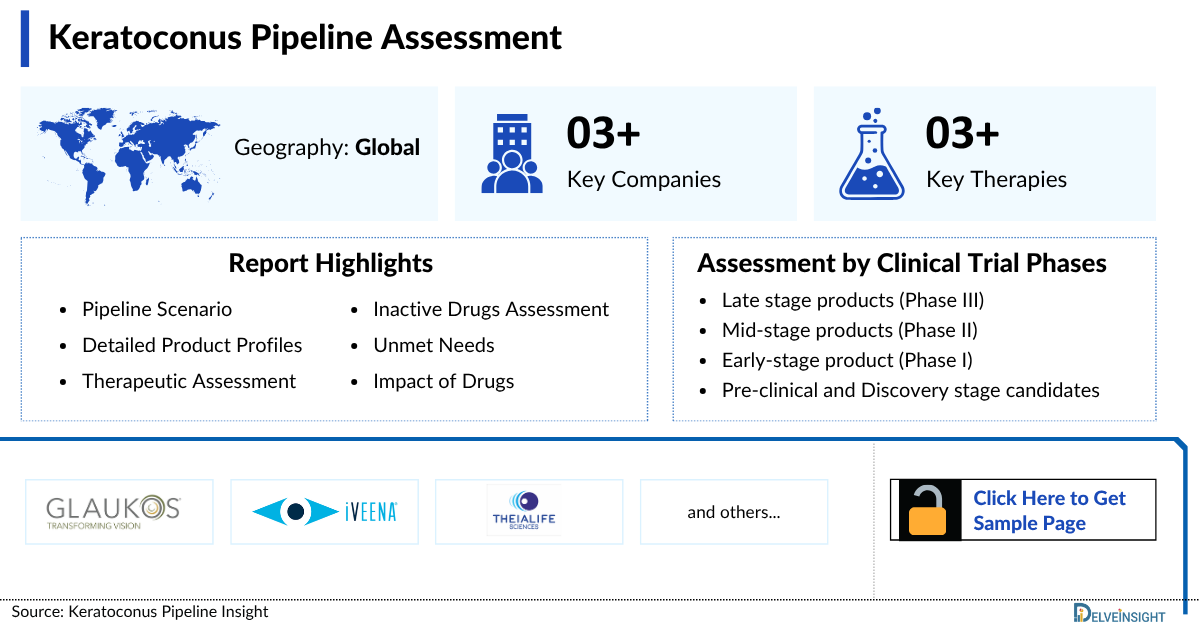
DelveInsight’s, “Keratoconus Pipeline Insight, 2026” report provides comprehensive insights about 3+ companies and 3+ pipeline drugs in Keratoconus pipeline landscape. It covers the pipeline drug profiles, including clinical and nonclinical stage products. It also covers the therapeutics assessment by product type, stage, route of administration, and molecule type. It further highlights the inactive pipeline products in this space.
Geography Covered
- Global coverage
Keratoconus Disease Understanding
Keratoconus Overview
Keratoconus is a progressive, bilateral corneal ectatic disorder characterized by thinning and cone-shaped protrusion of the cornea, leading to irregular astigmatism, myopia, visual distortion, glare, and reduced visual acuity. The condition typically develops during adolescence or early adulthood, often affecting both eyes asymmetrically, and is a leading indication for corneal transplantation in many countries. Although historically considered a non-inflammatory disorder, emerging evidence suggests that inflammatory mechanisms may contribute to its pathogenesis, alongside genetic predisposition and associations with certain ocular and systemic conditions. Disease progression varies among individuals and generally stabilizes by middle age, with severe cases potentially resulting in acute corneal hydrops. Current management focuses on improving vision and preventing progression through interventions such as corneal collagen cross-linking, specialty contact lenses, and, in advanced cases, corneal transplantation.
The exact cause and pathogenesis of keratoconus remain incompletely understood, although the disease is believed to result from a multifactorial interplay of genetic, environmental, biochemical, and mechanical factors. Corneas affected by keratoconus typically exhibit reduced collagen content and altered tissue remodeling, leading to progressive thinning and ectasia. Established risk factors include a family history of keratoconus, genetic predisposition, systemic disorders such as Down syndrome and Ehlers-Danlos syndrome, atopic conditions including asthma and allergic eye disease, and persistent eye rubbing, which may accelerate disease progression through repeated mechanical trauma. While advances in corneal imaging have improved the early detection of asymptomatic and familial cases, current evidence suggests that keratoconus is a complex polygenic disorder influenced by multiple genetic variants in combination with environmental triggers.
Although keratoconus has traditionally been considered a non-inflammatory disorder, growing evidence suggests that inflammation contributes to its pathogenesis through increased expression of inflammatory cytokines and dysregulated cellular signaling. The disease is characterized by alterations in corneal biomechanics, extracellular matrix remodeling, impaired wound healing, oxidative stress, and abnormal protein expression, all of which compromise corneal integrity. Disruption of key signaling pathways, including WNT and Hedgehog, along with changes in cell adhesion molecules and structural proteins, contributes to progressive corneal thinning and ectasia. Elevated oxidative stress, reduced antioxidant defenses, increased degradative enzyme activity, and collagen breakdown further weaken the corneal stroma, resulting in progressive cone formation. These molecular and cellular abnormalities are most pronounced in the central cornea, where tissue damage is greatest, highlighting the multifactorial nature of keratoconus progression.
The diagnosis of keratoconus is based on a comprehensive clinical evaluation supported by advanced corneal imaging techniques. Initial assessment includes refraction, slit-lamp biomicroscopy, keratometry, retinoscopy, and pachymetry, while corneal topography and tomography are the gold-standard modalities for detecting early disease, monitoring progression, and guiding treatment. Additional imaging techniques, such as anterior segment optical coherence tomography (OCT) and Scheimpflug imaging, provide detailed evaluation of corneal thickness, curvature, epithelial distribution, and posterior corneal elevation, enabling the identification of subtle structural abnormalities even before clinical signs become apparent. Emerging technologies, including corneal biomechanical assessment, optical coherence elastography, and artificial intelligence-based diagnostic algorithms, are further enhancing the early detection, risk stratification, and management of keratoconus by improving the sensitivity and accuracy of disease assessment.
The management of keratoconus is individualized according to disease severity and progression, with the primary goals of improving visual function and preventing further corneal deterioration. Early-stage disease is typically managed with spectacles, while progression often necessitates rigid gas-permeable, hybrid, scleral, or custom specialty contact lenses to optimize visual correction. Corneal collagen cross-linking is the standard treatment for progressive keratoconus, strengthening the corneal stroma to halt or slow disease progression and reduce the risk of vision loss. For patients with persistent visual impairment, additional interventions such as intracorneal ring segments, refractive procedures, or intraocular lenses may be considered in appropriately selected cases. Advanced keratoconus that is unresponsive to conservative therapy may require corneal transplantation, including penetrating keratoplasty or deep anterior lamellar keratoplasty, to restore vision. Emerging regenerative approaches, such as anterior limiting lamina transplantation and intrastromal stem cell therapy, are also being investigated as potential alternatives for preserving corneal structure and delaying the need for transplantation.
"Keratoconus Pipeline Insight, 2026" report by DelveInsight outlays comprehensive insights of present scenario and growth prospects across the indication. A detailed picture of the Keratoconus pipeline landscape is provided which includes the disease overview and Keratoconus treatment guidelines. The assessment part of the report embraces, in depth Keratoconus commercial assessment and clinical assessment of the pipeline products under development. In the report, detailed description of the drug is given which includes mechanism of action of the drug, clinical studies, NDA approvals (if any), and product development activities comprising the technology, Keratoconus collaborations, licensing, mergers and acquisition, funding, designations and other product related details.
Keratoconus Pipeline Report Highlights
The companies and academics are working to assess challenges and seek opportunities that could influence Keratoconus R&D. The therapies under development are focused on novel approaches to treat/improve Keratoconus.
Keratoconus Emerging Drugs Chapters
This segment of the Keratoconus report encloses its detailed analysis of various drugs in different stages of clinical development, including Phase III, II, I, Preclinical and Discovery. It also helps to understand clinical trial details, expressive pharmacological action, agreements and collaborations, and the latest news and press releases.
Keratoconus Emerging Drugs
IVMED-80: Glaukos Corporation / iVeena Delivery Systems
IVMED-80 is a proprietary topical eye-drop therapy under development by iVeena Delivery Systems for the treatment of keratoconus, designed to strengthen the cornea by pharmacologically inducing collagen cross-linking via upregulation of the enzyme lysyl oxidase (LOX); it’s a non-surgical, non-invasive daily eyedrop formulation that has completed early clinical trials and demonstrated corneal flattening effects in keratoconus patients compared with placebo. The U.S. Food and Drug Administration (FDA) granted Orphan Drug Designation to IVMED-80 for keratoconus, providing regulatory incentives for its development in this rare disease. iVeena licensed IVMED-80 to Glaukos Corporation under an exclusive global agreement, with Glaukos assuming responsibility for further development and commercialization of the product. In August 2022, iVeena Delivery Systems Inc., a clinical stage biopharmaceutical company with developmental products in keratoconus and pediatric myopia, had entered into a strategic licensing agreement with Glaukos Corporation that granted Glaukos an exclusive global license to develop and commercialize IVMED-80, a pharmacologic treatment for keratoconus. According to company’s pipeline, the drug is in Phase II stage of its development for the treatment of Keratoconus.
Further product details are provided in the report...
Keratoconus Therapeutic Assessment
This segment of the report provides insights about the different Keratoconus drugs segregated based on following parameters that define the scope of the report, such as:
Major Players in Keratoconus
There are approx. 3+ key companies which are developing the therapies for Keratoconus. The companies which have their Keratoconus drug candidates in the most advanced stage, i.e. Phase II include, Glaukos Corporation / iVeena Delivery Systems.
Keratoconus Pipeline Drug Phases
DelveInsight’s report covers around 3+ products under different phases of clinical development like
- Late stage products (Phase III)
- Mid-stage products (Phase II)
- Early-stage product (Phase I) along with the details of
- Pre-clinical and Discovery stage candidates
- Discontinued & Inactive candidates
Keratoconus Drugs Route of Administration
Keratoconus pipeline report provides the therapeutic assessment of the pipeline drugs by the Route of Administration. Products have been categorized under various ROAs such as
- Oral
- Intravenous
- Subcutaneous
- Parenteral
- Topical
Keratoconus Drug Molecule Type
Products have been categorized under various Molecule types such as
- Recombinant fusion proteins
- Small molecule
- Monoclonal antibody
- Peptide
- Polymer
- Gene therapy
Keratoconus Pipeline Product Type
- Drugs have been categorized under various product types like Mono, Combination and Mono/Combination.
Keratoconus Pipeline Development Activities
The Keratoconus pipeline report provides insights into different therapeutic candidates in Phase III, II, I, preclinical and discovery stage. It also analyses Keratoconus therapeutic drugs key players involved in developing key drugs.
Keratoconus Clinical Trials and Development Activities
The Keratoconus clinical trial analysis report covers the detailed information of collaborations, acquisition and merger, licensing along with a thorough therapeutic assessment of emerging Keratoconus drugs.
Keratoconus Pipeline Report Insights
- Keratoconus Pipeline Analysis
- Keratoconus Therapeutic Assessment
- Keratoconus Unmet Needs
- Impact of Keratoconus Drugs
Keratoconus Pipeline Report Assessment
- Keratoconus Pipeline Product Profiles
- Keratoconus Therapeutic Assessment
- Keratoconus Pipeline Assessment
- Inactive Keratoconus drugs assessment
- Keratoconus Unmet Needs
Key Questions Answered in the Keratoconus Pipeline Report:
- Current Treatment Scenario and Emerging Therapies:
- How many companies are developing Keratoconus drugs?
- How many Keratoconus drugs are developed by each company?
- How many emerging drugs are in mid-stage, and late-stage of development for the treatment of Keratoconus?
- What are the key collaborations (Industry–Industry, Industry–Academia), Mergers and acquisitions, licensing activities related to the Keratoconus therapeutics?
- What are the recent trends, drug types and novel technologies developed to overcome the limitation of existing therapies?
- What are the clinical studies going on for Keratoconus and their status?
- What are the key designations that have been granted to the emerging drugs?
Key Keratoconus Companies
- Glaukos Corporation
- iVeena Delivery Systems
- Theinova Ltd
- Theialife Sciences
Key Keratoconus Pipeline Products
- IVMED-80
- TN-001
- rHCT3-2