
Medical Device Reprocessing Market Summary
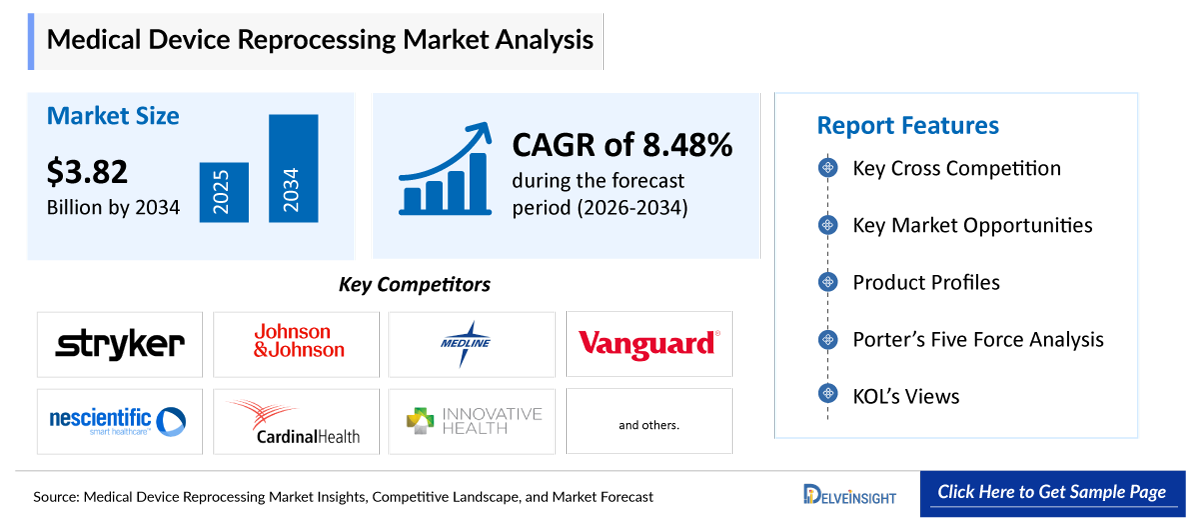
- The Global Medical Device Reprocessing Market is expected to increase from USD 1.83 billion in 2025 to USD 3.82 billion by 2034, reflecting strong and sustained growth driven by escalating healthcare cost-containment imperatives, expanding ESG sustainability mandates across hospital networks, continuous FDA regulatory support for reprocessed single-use devices (SUDs), and rapid technological advances enabling the safe reprocessing of increasingly complex device categories.
- The Global Medical Device Reprocessing Market is growing at a CAGR of 8.48% during the forecast period from 2026 to 2034.
Medical Device Reprocessing Market Size and Forecasts
- The escalating pressure on hospital systems to contain procurement costs with the Association of Medical Device Reprocessors (AMDR) reporting that 36 million reprocessed devices were sold to more than 9,000 hospitals and surgical centers in 2024 saving facilities USD 451 million in supply chain costs, the FDA's well-established 510(k) regulatory pathway providing institutional confidence in reprocessed device safety and equivalence, the growing global sustainability mandate driving hospital ESG programs that target medical waste reduction, and continuous advancements in sterilization technology and AI-enabled traceability expanding the range and complexity of reprocessable device categories are collectively driving robust growth in the Medical Device Reprocessing market throughout the forecast period from 2026 to 2034.
- The leading Medical Device Reprocessing Companies include Stryker Corporation (Sustainability Solutions), Johnson & Johnson Services, Inc. (Sterilmed), Medline Industries, L.P. (Medline ReNewal), Arjo Inc. (ReNu Medical, Inc.), Vanguard AG, NEScientific, Inc., Cardinal Health, Inc. (Sustainable Technologies), Innovative Health, LLC, SureTek Medical, Inc., SteriPro Canada, Inc., Case Medical, Inc., and Soma Tech International, and others.
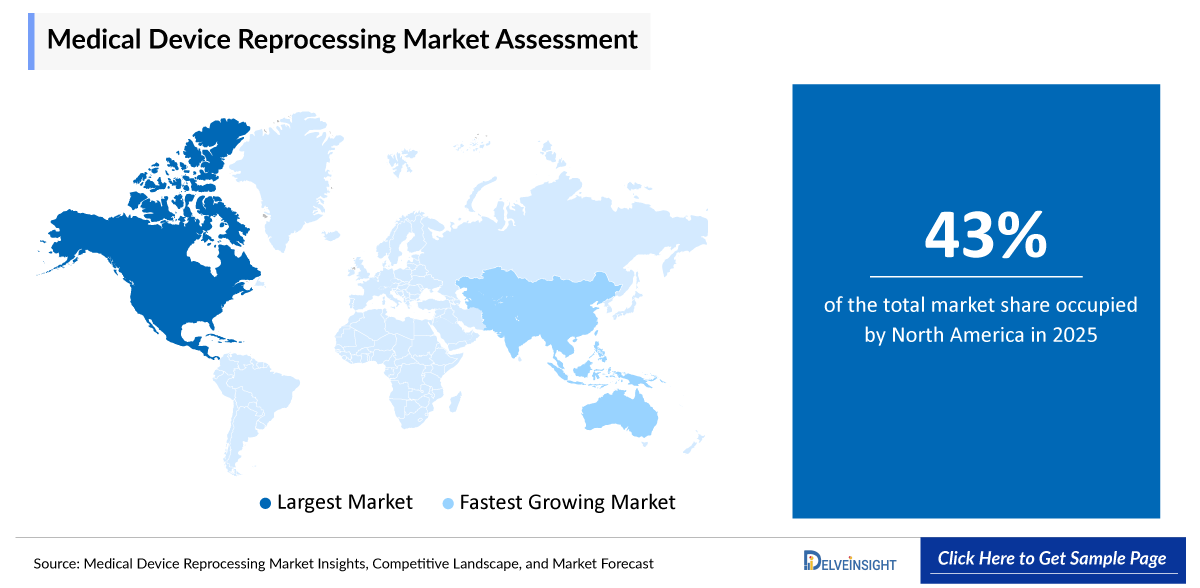
- North America is expected to dominate the Medical Device Reprocessing Market with 43% of global market revenue in 2025, driven by the U.S. FDA's long-established and comprehensive regulatory framework for SUD reprocessing that provides healthcare facilities with institutional confidence, the presence of the world's leading reprocessing companies headquartered in the United States, the highest per-capita surgical procedure volumes globally requiring extensive device supply chain management, strong hospital ESG program adoption aligning reprocessing with sustainability key performance indicators, and the AMDR's well-developed industry infrastructure supporting collection, validation, and distribution of reprocessed devices across more than 9,000 U.S. healthcare facilities.
- In the type segment of the Medical Device Reprocessing Market, the third-party reprocessing category accounted for 84% of Global Medical Device Reprocessing Market revenue in 2025, driven by the decisive economies of scale that specialized reprocessing facilities achieve in sterilization, validation, quality documentation, and logistics that are structurally inaccessible to individual hospitals operating small in-house programs at capital outlays exceeding USD 5 million per site for comparable infrastructure.
Request for Unlocking the Sample Page of the "Medical Device Reprocessing Market"
Medical Device Reprocessing Market Size and Forecasts
Report Metrics |
Details |
|
2025 Medical Device Reprocessing Market Size | |
|
2034 Projected Medical Device Reprocessing Market Size | |
|
Medical Device Reprocessing Growth Rate (2026-2034) | |
|
Largest Medical Device Reprocessing Market |
North America |
|
Fastest Growing Medical Device Reprocessing Market |
Asia-Pacific |
|
Medical Device Reprocessing Market Structure |
Moderately Concentrated |
|
|
|
|
|
|
Factors Contributing to the Growth of the Medical Device Reprocessing Market
-
Escalating healthcare cost-containment pressures are driving hospital adoption of reprocessed devices
Rising healthcare expenditure and constrained hospital budgets are the primary structural drivers for the Medical Device Reprocessing market. According to the Association of Medical Device Reprocessors (AMDR), reprocessed medical devices are 30% to 50% cheaper than their new counterparts, and maximizing the use of reprocessed SUDs could save U.S. hospitals approximately USD 2.28 billion annually.
In 2024, AMDR documented that 36 million reprocessed devices were sold to more than 9,000 hospitals and surgical centers, saving those facilities USD 451 million in supply chain costs, reducing medical waste by 12 million pounds, and reducing CO2 emissions by 115 million pounds.
According to the Centers for Medicare & Medicaid Services (CMS, 2024), U.S. national health expenditure reached USD 4.9 trillion, representing 17.6% of GDP, creating intensifying institutional pressure to adopt every available cost-containment mechanism, including SUD reprocessing programs that deliver measurable per-procedure savings without compromising patient safety.
-
FDA regulatory support and global regulatory framework expansion, building institutional confidence
The U.S. Food and Drug Administration (FDA) has established a comprehensive and well-defined regulatory framework for SUD reprocessing, requiring third-party reprocessors to obtain 510(k) clearance and demonstrate that reprocessed devices are substantially equivalent to predicate devices in safety and performance through validated cleaning, sterilization, and functional testing protocols.
The FDA has cleared reprocessing for over 70 device families, including high-risk categories such as electrophysiology catheters, balloon angioplasty catheters, and guidewires. In 2024, the FDA introduced dedicated online resources and frequently asked questions (FAQs) specifically addressing SUD reprocessing for healthcare facilities, demonstrating the agency's active support for expanding reprocessing adoption.
Internationally, the Association of Medical Device Reprocessors (AMDR) reports that Japan has joined the growing number of countries establishing clear regulatory pathways for reprocessed SUDs, expanding the global market opportunity. The 2026 FDA QSR-ISO 13485 alignment is expected to simplify dual-compliance burdens for certified reprocessors, further reducing barriers to market entry and adoption.
-
Environmental sustainability mandates and ESG commitments are driving hospital program adoption
The global healthcare sector's accelerating commitment to environmental sustainability and ESG (Environmental, Social, and Governance) performance is creating a powerful institutional demand driver for Medical Device Reprocessing that operates independently of, and reinforces, cost-savings motivations.
The World Health Organization (WHO, 2022) estimates that the healthcare sector contributes up to 4.4% of global greenhouse gas emissions, with single-use medical device waste representing a significant and addressable component of this environmental burden. The United Kingdom's NHS has formally targeted the elimination of avoidable single-use medical goods by 2045, positioning SUD reprocessing as a central compliance mechanism for healthcare organizations seeking to meet this mandate.
Northwestern Medicine's reprocessing program diverted over 400,000 pounds of waste since its 2018 launch, including 68,000 pounds in 2025 alone, illustrating the concrete environmental impact achievable through systematic reprocessing programs. The AMDR reported that 2024 reprocessing activities diverted 12 million pounds of medical waste and reduced CO2 equivalent emissions by 115 million pounds, providing measurable ESG reporting metrics for participating hospitals.
What are the Latest Medical Device Reprocessing Market Dynamics and Trends?
The escalating healthcare cost-containment imperative, expanding global ESG sustainability mandates, FDA regulatory support, and growing international regulatory frameworks, and continuous advances in sterilization technology and AI-enabled traceability are collectively driving exceptional and sustained growth in the global Medical Device Reprocessing market.
According to the Association of Medical Device Reprocessors (AMDR), the scale of documented cost savings from device reprocessing provides compelling evidence of the market's economic rationale. In 2024, AMDR reported that 36 million reprocessed devices were sold to more than 9,000 hospitals and surgical centers, collectively saving those facilities USD 451 million in supply chain costs, while simultaneously diverting 12 million pounds of medical waste and reducing CO2 equivalent emissions by 115 million pounds.
The AMDR further estimates that maximizing the use of reprocessed SUDs could save U.S. hospitals approximately USD 2.28 billion annually, representing an enormous gap between current adoption levels and the full economic potential of comprehensive reprocessing programs. Reprocessed devices are priced 30% to 50% below the cost of equivalent new devices (AMDR), making them financially compelling across all healthcare system types from large academic medical centers through community hospitals and ambulatory surgical centers.
The Centers for Medicare & Medicaid Services (CMS, 2024) documents U.S. national health expenditure at USD 4.9 trillion, representing 17.6% of GDP and creating persistent and intensifying institutional pressure to adopt cost-containment mechanisms. Stryker's Sustainability Solutions division served more than 3,250 customers in 2023 saving them USD 238 million, and expanded to serve 3,773 healthcare facilities by June 2025, diverting 5 million pounds of waste and saving hospitals USD 239 million, demonstrating the scale achievable by the market's leading third-party reprocessor.
The technological evolution of reprocessing capabilities is a critical growth driver, with automation, AI, and advanced traceability systems expanding both the scope of reprocessable device categories and the reliability of reprocessing operations. Automated tracking systems using AI algorithms and RFID or barcode scanning now trace each device through the entire reprocessing cycle from collection through sterilization to final inspection, ensuring complete documentation of processing parameters and supporting regulatory compliance.
- In April 2025, Stryker Sustainability Solutions expanded its reprocessing portfolio with FDA clearance for three new powered orthopedic instrument categories, increasing its addressable device volume by an estimated 18% and strengthening partnerships with major orthopedic surgery centers. This clearance illustrates the continuous regulatory expansion of approved reprocessable device categories that is progressively widening the market's total addressable scope.
- In 2022, Innovative Health, LLC received FDA clearance to reprocess the Philips Eagle Eye Platinum digital IVUS catheter, marking entry into the cardiology catheter lab space and expanding reprocessable category coverage in one of the highest-value SUD segments. In February 2023, Northeast Scientific Inc. received FDA 510(k) clearance for reprocessing the Philips IVUS Eagle Eye Platinum RX Digital catheter, further expanding the cleared device portfolio.
The strategic importance of sustainability positioning is increasingly driving corporate procurement decisions that favor reprocessing programs. The United Kingdom's NHS has formally targeted elimination of avoidable single-use medical goods by 2045, creating a legislative mandate for reprocessing adoption across one of the world's largest public health systems. France's health ministry launched a limited pilot in 2024 to evaluate duodenoscope reprocessing economics, potentially informing national policy by 2027.
India's Ayushman Bharat scheme is compelling public hospitals to stretch fixed budgets, elevating reprocessing in procurement tenders starting in 2026.
- In October 2023, Getinge announced the acquisition of Healthmark Industries for USD 320 million, enhancing its sterilization and reprocessing equipment presence in the U.S. market and signaling the strategic value attributed to the reprocessing ecosystem. In 2024, Medline acquired Ecolab's surgical solutions business, integrating reprocessing into a full-line distribution model that simplifies provider procurement.
- In 2024, Arjo Inc. opened a new state-of-the-art reprocessing facility that is 50% larger than its previous location, designed to increase manufacturing output and improve turnaround times. In November 2023, Medline announced expansion of its Medical Device Reprocessing facility in Oregon.
However, the Medical Device Reprocessing Market faces several growth constraints. Safety and efficacy concerns persist in segments of the healthcare provider community regarding reprocessed devices, particularly in geographies with less developed regulatory frameworks, and resistance from original device manufacturers whose business models depend on high-volume single-use device consumption represents a structural market friction.
The Johnson & Johnson antitrust litigation in which J&J was found liable for withholding clinical support from hospitals using Sterilmed's reprocessed catheters illustrates the commercial conflicts that can limit hospital adoption in certain device categories. Regulatory variability across countries creates market entry barriers, as reprocessors must obtain separate clearances or certifications in each jurisdiction. Germany's regulatory environment has created uncertainty around a potential CE-reprocessing restriction that could affect the European market.
Capital requirements for establishing certified reprocessing infrastructure, including ISO 13485-compliant quality management systems, advanced sterilization equipment, and validated cleaning systems, create entry barriers and may deter smaller hospital systems from developing in-house programs.
Medical Device Reprocessing Market Report Segmentation
This Medical Device Reprocessing market report offers a comprehensive overview of the global market, highlighting key trends, growth drivers, challenges, and opportunities. It covers detailed market segmentation by Type (Third-party Reprocessing and In-house Reprocessing), Device Type (Catheters, Endoscopes, Laparoscopic Instruments, Biopsy Devices, Pulse Oximeter Sensors, Compression Sleeves, and Others), Criticality (Critical Devices, Semi-critical Devices, and Non-critical Devices), Application (General Surgery, Cardiology, Gastroenterology, Orthopedics and Arthroscopy, Anesthesia, and Others), End-user (Hospitals, Ambulatory Surgical Centers, and Others), and Geography.
The Medical Device Reprocessing Market Report provides valuable insights into the competitive landscape, regulatory environment, and market dynamics across major markets, including North America, Europe, and Asia-Pacific. Medical Device Reprocessing is the process of cleaning, disinfecting, remanufacturing, functionally testing, sterilizing, packaging, and relabeling a used medical device that was originally designed and labeled for single use, so that it can be safely and effectively reused in subsequent patient care procedures.
The process follows rigorous validated protocols that must demonstrate the reprocessed device is substantially equivalent to the original device in safety, sterility, and functional performance at each reprocessing cycle up to the maximum validated number of uses. Medical device reprocessors are regulated as manufacturers under the U.S. FDA's Medical Device Amendments, requiring 510(k) clearance and compliance with Quality System Regulation (QSR) requirements.
Commonly reprocessed device categories include single-use devices (SUDs) in cardiology (electrophysiology catheters, hemostasis valves, balloon angioplasty catheters), gastroenterology (endoscopes, biopsy forceps, guidewires), orthopedics (powered surgical instruments, arthroscopic shavers, compression sleeves), and general surgery (laparoscopic instruments, pulse oximeter sensors).
The Medical Device Reprocessing Market is expanding across three converging dimensions: the economic imperative of cost containment in increasingly strained hospital budgets, the environmental imperative of medical waste reduction under growing regulatory and institutional sustainability commitments, and the technological advancement imperative as improved sterilization, traceability, and quality systems expand the range of reprocessable device categories from simpler non-critical devices into complex critical device categories.
These three forces create a self-reinforcing cycle of market growth as regulatory validation of new device categories expands program scope, which in turn increases cost savings, which drives broader hospital adoption, which enables further investment in advanced reprocessing capabilities.
Get More Insights into the Report @ Medical Device Reprocessing Market
Medical Device Reprocessing Market Segment Analysis
Medical Device Reprocessing Market by Type (Third-party Reprocessing and In-house Reprocessing), Device Type (Catheters, Endoscopes, Laparoscopic Instruments, Biopsy Devices, Pulse Oximeter Sensors, Compression Sleeves, and Others), Criticality (Critical Devices, Semi-critical Devices, and Non-critical Devices), Application (General Surgery, Cardiology, Gastroenterology, Orthopedics and Arthroscopy, Anesthesia, and Others), End-user (Hospitals, Ambulatory Surgical Centers, and Others), and Geography (North America, Europe, Asia-Pacific, and Rest of the World).
-
Medical Device Reprocessing Market Segmentation By Type
The Third-party Reprocessing category is expected to dominate the market with the largest revenue share.
In the type segment of the Medical Device Reprocessing market, the third-party reprocessing category accounted for 84% of total global Medical Device Reprocessing market revenue in 2025. This dominant position reflects the structural and economic advantages that specialized reprocessing facilities hold over hospital in-house programs across every dimension of scale, expertise, regulatory compliance, and cost efficiency.
Third-party reprocessors operate large centralized facilities with validated sterilization equipment, ISO 13485-compliant quality management systems, dedicated regulatory affairs teams, and optimized logistics networks for device collection and redistribution, achieving economies of scale that are structurally inaccessible to individual hospitals operating small in-house programs at capital outlays exceeding USD 5 million per site for comparable infrastructure.
Third-party reprocessors offer healthcare facilities a turnkey solution: they collect used SUDs, transport them to certified facilities, perform validated cleaning and sterilization, conduct functional testing, repackage, and relabel devices, then redistribute them to participating hospitals at prices 30% to 50% below new device cost. This model eliminates the need for hospitals to invest in expensive sterilization infrastructure, maintain specialized quality systems, manage regulatory 510(k) submissions, and develop in-house technical expertise across multiple device categories.
The regulatory 2026 FDA QSR-ISO 13485 alignment is expected to increase documentation burdens that disadvantage smaller in-house programs lacking dedicated regulatory teams, further consolidating market share toward specialist third-party operators. Stryker's Sustainability Solutions, the market's leading third-party reprocessor, demonstrated the segment's commercial scale by serving 3,773 healthcare facilities in 2025, while Medline ReNewal's acquisition of Ecolab's surgical solutions business in 2024 extended full end-to-end logistics control from manufacture through reprocessing and distribution.
The 2024 Innovative Health antitrust verdict against Johnson & Johnson for withholding clinical support from hospitals using reprocessed catheters reinforces the regulatory and legal support for third-party reprocessor market access.
-
Medical Device Reprocessing Market Segmentation By Criticality
The Semi-critical Devices category dominated the market in 2025.
In the criticality segment of the Medical Device Reprocessing Market, semi-critical devices accounted for 44.8% of total global Medical Device Reprocessing market revenue in 2025. Semi-critical devices, defined as those that contact mucous membranes or non-intact skin but do not penetrate sterile tissue or vascular systems, represent the largest established reprocessable category by volume and revenue, encompassing endoscopes, bronchoscopes, laryngoscopes, anesthesia equipment, and numerous other gastroenterology and pulmonology instruments that are used at very high frequencies across clinical departments and generate significant SUD waste volumes.
The clinical relevance of reprocessing semi-critical devices is particularly strong because these instruments are used in high-frequency diagnostic and therapeutic procedures, meaning that the per-procedure cost savings from reprocessing multiply rapidly across large annual procedure volumes. Endoscopy alone accounts for millions of procedures annually in major healthcare markets, with each procedure potentially involving multiple single-use devices whose reprocessing generates measurable savings.
The regulatory framework for semi-critical device reprocessing under FDA guidelines and EU MDR requirements is well-established, providing reprocessors with clear compliance pathways and healthcare facilities with confidence in the safety of reprocessed instruments. Gastroenterology was estimated to be the fastest-growing application within the market, growing at 16.4%, reflecting the increasing prevalence of GI disorders and the high volume of endoscopic procedures generating reprocessable device supply.
Stryker's 2025 FDA clearance for three new powered orthopedic instrument categories illustrates how the range of reprocessable semi-critical and complex devices continues to expand, incrementally broadening the total market opportunity for reprocessors operating in this criticality tier.
-
Medical Device Reprocessing Market Segmentation By End-user
The Hospitals segment is expected to dominate the market with the largest revenue share.
In the end-user segment of the Medical Device Reprocessing market, hospitals accounted for 43% of total global market revenue in 2025. Hospitals are the dominant and most strategically important end-user for the Medical Device Reprocessing market, as they generate the highest volumes of used SUDs across diverse clinical departments, possess the institutional procurement infrastructure required to establish formal reprocessing programs, and face the strongest financial and regulatory pressure to adopt cost-containment and sustainability measures.
Hospital reprocessing programs span all device criticality categories from non-critical compression sleeves and pulse oximeters through semi-critical endoscopes to critical electrophysiology catheters, providing full-spectrum procurement value.
Hospital adoption is being driven by converging financial, regulatory, and sustainability imperatives. Stryker's Sustainability Solutions program demonstrates that hospitals participating in comprehensive reprocessing programs achieve savings exceeding USD 73,000 per hospital annually on average across its 3,773-facility network. Northwestern Medicine's reprocessing program diverted over 400,000 pounds of waste since 2018 and saves upwards of 25% per device, providing a documented model for the cost and environmental returns achievable through well-managed hospital reprocessing programs.
The AMDR's report that the U.S. cardiovascular segment alone accounted for a dominant share of reprocessed device market revenue, reflecting the high unit value and volume of cardiology SUDs reprocessed at hospital cath labs and electrophysiology suites, underscores the outsized contribution hospitals make to total market revenue. In-hospital procurement decisions are increasingly influenced by ESG reporting requirements, as hospital sustainability charters align reprocessing with Scope 3 emissions reduction targets.
Ambulatory Surgical Centers (ASCs) represent the fastest-growing end-user segment, driven by the global shift of surgical procedures from inpatient hospital settings to outpatient facilities, the lower procurement budgets that make cost savings from reprocessing proportionally more impactful, and the expansion of ASC networks across the United States and Asia-Pacific markets.
The Others category encompasses specialty clinics, military healthcare facilities, and government-run community health centers that are progressively adopting reprocessing as part of systematic supply chain cost management and sustainability programs.
Medical Device Reprocessing Market Regional Analysis
-
North America Medical Device Reprocessing Market Trends
North America accounted for 43% of global Medical Device Reprocessing market revenue in 2025, representing the highest regional market share globally. North America's market leadership is underpinned by the U.S. FDA's long-established and comprehensive regulatory framework for SUD reprocessing, which has created institutional confidence enabling more than 9,000 hospitals and surgical centers to participate in AMDR-tracked reprocessing programs.
The United States market benefits from the highest per-capita surgical procedure volumes globally, generating the world's largest supply of reprocessable SUDs, as well as the presence of all major global reprocessing companies headquartered in the U.S. including Stryker Sustainability Solutions, Medline ReNewal, Innovative Health, Cardinal Health Sustainable Technologies, and NEScientific.
According to the Centers for Medicare & Medicaid Services (CMS, 2024), U.S. national health expenditure reached USD 4.9 trillion, representing 17.6% of GDP, creating systemic financial pressure on hospitals to adopt every available cost-reduction mechanism. The AMDR's documentation of USD 451 million in hospital savings from reprocessing in 2024 and the potential for USD 2.28 billion in annual savings if all U.S. hospitals maximized reprocessing adoption illustrates the enormous unrealized economic opportunity that will drive sustained market growth.
Hospital ESG programs are accelerating adoption, with institutional sustainability charters aligning reprocessing with carbon reduction commitments. The FDA's introduction of dedicated SUD reprocessing online resources in 2024 reflects the agency's active support for expanded market adoption.
-
Europe Medical Device Reprocessing Market Trends
Europe held 25% of the global Medical Device Reprocessing market revenue in 2025, representing the second-largest regional market. European market dynamics are characterized by both strong growth opportunities and regulatory uncertainty, creating a complex competitive environment for reprocessors. Germany has regulated SUD reprocessing for over a decade, with hospitals reporting significant cost savings, though regulatory uncertainty around a potential CE-reprocessing restriction could affect the market if enacted.
Denmark and the Netherlands have issued guidance enabling reprocessing under strict quality management oversight, demonstrating the divergence in national regulatory approaches within the EU. The United Kingdom, outside EU frameworks, has formally targeted the elimination of avoidable single-use medical goods by 2045, positioning SUD reprocessing as a central mechanism for NHS sustainability compliance and creating a long-term institutional demand commitment across the UK's comprehensive public health network.
France's health ministry launched a limited pilot in 2024 to evaluate duodenoscope reprocessing economics, with potential to inform national policy by 2027. Vanguard AG, headquartered in Germany, is the primary European-headquartered global reprocessing company, providing regional manufacturing and distribution capabilities aligned with EU MDR requirements.
-
Asia-Pacific Medical Device Reprocessing Market Trends
Asia-Pacific is the fastest-growing regional market for Medical Device Reprocessing, expected to register a CAGR of 16.88% through 2034, driven by rapidly expanding healthcare infrastructure, rising surgical procedure volumes as populations age, growing government investment in healthcare cost efficiency, and progressive regulatory framework development enabling SUD reprocessing adoption.
Japan's QMS rule harmonization and regulatory pathway for reprocessed SUDs, which the AMDR identifies as a major development for the global reprocessing industry, is opening one of Asia's most sophisticated healthcare markets to commercial reprocessing services. China's hospital modernization programs target 70% device-reuse certification in tier-1 cities by 2028, creating structured institutional demand for third-party reprocessing services at scale.
India's Ayushman Bharat scheme is expanding insurance coverage and compelling public hospitals to stretch fixed procurement budgets, elevating reprocessing in government hospital procurement tenders starting in 2026. The region's rapidly growing middle class is increasing demand for advanced surgical procedures in private hospital networks, simultaneously creating larger SUD supply streams and stronger financial incentives for comprehensive reprocessing programs.
-
Rest of World Medical Device Reprocessing Market Trends
The Rest of World region, encompassing the Middle East, Africa, and South America, accounted for 10% of the global Medical Device Reprocessing market revenue in 2025 and represents a steadily developing opportunity as healthcare infrastructure investment expands and international reprocessing companies establish regional presence.
The Middle East is experiencing rapid growth in private healthcare investment and hospital capacity expansion, with government-backed healthcare modernization programs in Saudi Arabia and the UAE creating new institutional demand for medical device cost-containment solutions.
Brazil leads Latin American reprocessing adoption, supported by its large public hospital system's budget constraints and growing regulatory framework for Medical Device Reprocessing. Africa's reprocessing market remains nascent but shows potential as WHO and development organization programs invest in healthcare infrastructure and seek cost-effective solutions for equipment procurement.
The AMDR reports that changing regulatory dynamics in the Middle East and Africa are creating significant growth opportunities as these regions establish clearer regulatory pathways for reprocessed device use.
Who are the Major Players in the Medical Device Reprocessing Market?
Medical Device Reprocessing Companies
- Stryker Corporation (Sustainability Solutions)
- Johnson & Johnson Services, Inc. (Sterilmed)
- Medline Industries, L.P. (Medline ReNewal)
- Arjo Inc. (ReNu Medical, Inc.)
- Vanguard AG
- NEScientific, Inc.
- Cardinal Health, Inc. (Sustainable Technologies)
- Innovative Health, LLC
- SureTek Medical, Inc.
- SteriPro Canada, Inc.
- Case Medical, Inc.
- Soma Tech International
- Others
How is the Competitive Landscape Shaping the Medical Device Reprocessing Market?
The competitive landscape of the Medical Device Reprocessing market is Moderately Concentrated, with Stryker Sustainability Solutions, Medline ReNewal, Cardinal Health Sustainable Technologies, and Innovative Health collectively forming the core AMDR membership of the largest U.S. third-party reprocessors, and together accounting for a significant majority of the third-party reprocessing segment.
Stryker Sustainability Solutions is the clear global market leader, leveraging its parent company's broad orthopedic and medical device sales relationships to achieve penetration across 3,773 U.S. healthcare facilities by mid-2025, while simultaneously building strong international presence. Stryker's April 2025 FDA clearance for three new powered orthopedic instrument categories, expanding addressable device volume by 18%, exemplifies its strategy of continuously expanding the cleared device portfolio to grow revenue from its established customer base.
Geographic reach is a critical competitive advantage, as reprocessors must establish collection logistics networks, certified processing facilities, and distribution channels in each geographic market they serve. Stryker and Medline ReNewal both operate national-scale U.S. collection and distribution networks, while Vanguard AG provides the primary European-based reprocessing infrastructure and is expanding globally.
Medline ReNewal's 2024 acquisition of Ecolab's surgical solutions business illustrates the M&A consolidation strategy that is creating more vertically integrated competitors capable of bundling reprocessing services within comprehensive supply chain management contracts. Arjo Inc.'s 2024 opening of a new reprocessing facility 50% larger than its predecessor demonstrates capacity investment in anticipation of continued market expansion.
Product portfolio strength in reprocessing is measured by the breadth of FDA-cleared or EU-certified device categories that a reprocessor can accept, as hospitals prefer to consolidate their reprocessing programs with fewer vendors who can service more device types. Innovative Health's 2022 FDA clearance for the Philips IVUS Eagle Eye Platinum catheter and NEScientific's 2023 clearance for the Philips Eagle Eye Platinum RX Digital catheter both represent meaningful portfolio expansions into the high-value electrophysiology catheter category.
Manufacturing capabilities, quality management systems, and traceability infrastructure differentiate leading players: certified facilities must maintain ISO 13485 compliance, validated cleaning and sterilization processes, and device-specific reprocessing cycle documentation. The 2026 FDA QSR-ISO 13485 alignment, which simplifies dual-compliance burdens, is expected to favor agile mid-tier firms while maintaining patient safety thresholds.
Innovation focus across the market is converging on AI-enabled traceability, automated quality inspection, cloud-native quality management systems, and modular sterilization pod designs that can service rural and smaller hospitals lacking volume for traditional hub-and-spoke reprocessing models.
Medical Device Reprocessing Market Recent Breakthroughs and Developments
- In June 2025, Stryker Corporation (Sustainability Solutions) reported that its reprocessing services had reached 3,773 healthcare facilities globally, diverting 5 million pounds of waste and saving hospitals USD 239 million in 2025. Strategic significance: Demonstrates the scale achieved by the market's leading third-party reprocessor and provides measurable ESG impact data that strengthens hospital procurement rationale for reprocessing programs.
- In April 2025, Stryker Corporation (Sustainability Solutions) expanded its reprocessing portfolio with FDA 510(k) clearance for three new powered orthopedic instrument categories, increasing its addressable device volume by an estimated 18%. Strategic significance: Illustrates the continuous expansion of the FDA-cleared reprocessable device portfolio as a primary growth mechanism for established market leaders, and strengthens partnerships with major orthopedic surgery centers.
- In 2024, Medline Industries, L.P. (Medline ReNewal) acquired Ecolab's surgical solutions business, integrating reprocessing into a full-line distribution model. Strategic significance: Extends end-to-end logistics control from original manufacture through reprocessing and distribution, enhancing negotiating power with hospitals seeking bundled sourcing and simplifying provider procurement across the supply chain.
- In 2024, Arjo Inc. (ReNu Medical, Inc.) opened a new state-of-the-art reprocessing facility that is 50% larger than its previous location, designed to increase manufacturing output and improve device turnaround times. Strategic significance: Demonstrates proactive capacity investment in anticipation of accelerating market demand and positions Arjo to capture increased market share as hospital adoption of reprocessing programs expands.
- In 2024, Innovative Health, Inc. entered into an agreement with MC Healthcare, Inc. enabling hospitals within MC Healthcare's Japanese network to reduce environmental impact while allowing Innovative Health's U.S. hospital partners to enhance savings from SUD reprocessing. Strategic significance: Represents Innovative Health's strategic geographic expansion into Japan's newly opened reprocessing market, one of the most significant emerging growth opportunities globally.
- In 2024, the U.S. FDA introduced dedicated online resources and frequently asked questions (FAQs) specifically addressing SUD reprocessing for healthcare facilities. Strategic significance: Reflects the FDA's active institutional support for expanding reprocessing market adoption and provides healthcare facilities with clearer guidance that should reduce adoption barriers and increase program participation rates.
- In November 2023, Medline Industries, L.P. (Medline ReNewal) announced the expansion of its Medical Device Reprocessing facility in Oregon. Strategic significance: Expands West Coast reprocessing capacity to meet growing demand from hospitals in the Pacific Northwest and Western United States, reducing device transportation distances and improving service turnaround times for participating facilities.
- In October 2023, Getinge AB announced the acquisition of Healthmark Industries, Inc. for USD 320 million, enhancing its sterilization and reprocessing equipment presence in the U.S. market. Strategic significance: Signals strategic consolidation in the broader reprocessing ecosystem as established medical equipment companies invest in the reprocessing infrastructure market, recognizing its long-term growth potential.
- In February 2023, NEScientific, Inc. received FDA 510(k) clearance for reprocessing the Philips IVUS Eagle Eye Platinum RX Digital catheter. Strategic significance: Expands NEScientific's cleared device portfolio in the high-value electrophysiology catheter segment and demonstrates the continuous FDA regulatory pathway enabling smaller specialized reprocessors to build competitive cleared-device portfolios in premium SUD categories.
- In November 2022, Cardinal Health, Inc. (Sustainable Technologies) expanded its Sustainable Technologies facility in Florida. Strategic significance: Increases reprocessing capacity in the Southeastern United States to meet growing regional hospital demand and reinforces Cardinal Health's commitment to its reprocessing business as a strategic growth initiative within its broader medical products portfolio.
- In 2022, Innovative Health, LLC received FDA 510(k) clearance to reprocess the Philips Eagle Eye Platinum digital IVUS catheter. Strategic significance: Marked Innovative Health's entry into the cardiology catheter lab space, expanding its reprocessing portfolio coverage in one of the highest-value and most financially impactful SUD categories in interventional cardiology.
- In 2022, Medline ReNewal opened a new distribution center in Southaven, Mississippi, serving major hospitals, nursing homes, and military facilities in the region. Strategic significance: Strengthened Medline ReNewal's distribution infrastructure in the South Central United States, expanding collection and redistribution reach into previously underserved regional markets.
|
Report Metrics |
Details |
|
Study Period |
2023 to 2034 |
|
Base Year |
2025 |
|
Forecast Period |
2026 to 2034 |
|
Medical Device Reprocessing Market CAGR | |
|
Medical Device Reprocessing Companies |
Stryker Corporation (Sustainability Solutions), Johnson & Johnson Services, Inc. (Sterilmed), Medline Industries, L.P. (Medline ReNewal), Arjo Inc. (ReNu Medical, Inc.), Vanguard AG, NEScientific, Inc., Cardinal Health, Inc. (Sustainable Technologies), Innovative Health, LLC, SureTek Medical, Inc., SteriPro Canada, Inc., Case Medical, Inc., Soma Tech International, and others. |
|
Medical Device Reprocessing Market Segments |
By Type, By Device Type, By Criticality, By Application, By End-user, and By Geography |
|
Medical Device Reprocessing Regional Scope |
North America, Europe, Asia Pacific, the Middle East, Africa, and South America |
|
Medical Device Reprocessing Country Scope |
U.S., Canada, Mexico, Germany, United Kingdom, France, Italy, Spain, China, Japan, India, Australia, South Korea, and key countries |
Medical Device Reprocessing Market Segmentation
Medical Device Reprocessing by Type
- Third-party Reprocessing
- In-house Reprocessing
Medical Device Reprocessing by Device Type
- Catheters
- Endoscopes
- Laparoscopic Instruments
- Biopsy Devices
- Pulse Oximeter Sensors
- Compression Sleeves
- Others
Medical Device Reprocessing by Criticality
- Critical Devices
- Semi-critical Devices
- Non-critical Devices
Medical Device Reprocessing by Application
- General Surgery
- Cardiology
- Gastroenterology
- Orthopedics and Arthroscopy
- Anesthesia
- Others
- Medical Device Reprocessing by End-user
- Hospitals
- Ambulatory Surgical Centers
- Others
Medical Device Reprocessing by Geography
- North America Medical Device Reprocessing Market
- United States Medical Device Reprocessing Market Size in USD million (2023-2034)
- Canada Medical Device Reprocessing Market Size in USD million (2023-2034)
- Mexico Medical Device Reprocessing Market Size in USD million (2023-2034)
- Europe Medical Device Reprocessing Market
- Germany Medical Device Reprocessing Market Size in USD million (2023-2034)
- United Kingdom Medical Device Reprocessing Market Size in USD million (2023-2034)
- France Medical Device Reprocessing Market Size in USD million (2023-2034)
- Italy Medical Device Reprocessing Market Size in USD million (2023-2034)
- Spain Medical Device Reprocessing Market Size in USD million (2023-2034)
- Rest of Europe Medical Device Reprocessing Market Size in USD million (2023-2034)
- Asia-Pacific Medical Device Reprocessing Market
- China Medical Device Reprocessing Market Size in USD million (2023-2034)
- Japan Medical Device Reprocessing Market Size in USD million (2023-2034)
- India Medical Device Reprocessing Market Size in USD million (2023-2034)
- Australia Medical Device Reprocessing Market Size in USD million (2023-2034)
- South Korea Medical Device Reprocessing Market Size in USD million (2023-2034)
- Rest of Asia-Pacific Medical Device Reprocessing Market Size in USD million (2023-2034)
- Rest of the World (RoW) Medical Device Reprocessing Market
- Middle East Medical Device Reprocessing Market Size in USD million (2023-2034)
- Africa Medical Device Reprocessing Market Size in USD million (2023-2034)
- South America Medical Device Reprocessing Market Size in USD million (2023-2034)
Medical Device Reprocessing Market Recent Industry Trends and Milestones (2023-2026)
|
Category |
Key Developments |
|
Medical Device Reprocessing Market Product Approval |
Stryker Sustainability Solutions FDA 510(k) clearance for three new powered orthopedic instrument categories expanding addressable device volume 18% (April 2025); NEScientific FDA 510(k) clearance for Philips IVUS Eagle Eye Platinum RX Digital catheter reprocessing (February 2023); Innovative Health FDA 510(k) clearance for Philips Eagle Eye Platinum digital IVUS catheter (2022); FDA launched dedicated SUD reprocessing online resources and FAQs for healthcare facilities (2024) |
|
Medical Device Reprocessing Market Product Expansion |
Stryker Sustainability Solutions reached 3,773 healthcare facilities saving USD 239M and diverting 5 million pounds waste (June 2025); Arjo Inc. opened new reprocessing facility 50% larger than previous location (2024); Medline ReNewal expanded Oregon reprocessing facility (November 2023); Cardinal Health expanded Sustainable Technologies Florida facility (November 2022); Medline ReNewal opened Southaven, Mississippi distribution center (2022) |
|
Medical Device Reprocessing Market Product Investment |
Getinge AB acquired Healthmark Industries for USD 320 million (October 2023); Medline Industries acquired Ecolab's surgical solutions business integrating reprocessing into full-line distribution (2024); AMDR reports 2024 reprocessing activities saved U.S. hospitals USD 451 million, diverted 12 million pounds waste, and reduced CO2 by 115 million pounds |
|
Company Strategy |
Stryker Sustainability Solutions: Portfolio expansion through FDA clearances for new device categories; 3,773-facility network scale-building for ESG and cost-savings reporting. Medline ReNewal: Ecolab surgical solutions acquisition for end-to-end distribution integration. Innovative Health: Antitrust enforcement against OEM access restrictions; Japan market entry via MC Healthcare partnership. Arjo ReNu Medical: Facility capacity expansion for increased throughput. Vanguard AG: European regulatory compliance leadership under EU MDR framework. |
|
Emerging Technologies |
AI algorithm and RFID/barcode scanning for full reprocessing cycle traceability; cloud-native quality management systems for ISO 13485 compliance documentation; automated cleaning and sterilization validation systems reducing human error; modular sterilization pod designs for rural and community hospital deployment; Life Cycle Assessment tools for hospital ESG carbon impact reporting; 2026 FDA QSR-ISO 13485 harmonization simplifying dual-compliance for certified reprocessors |
Key Takeaways from the Medical Device Reprocessing Market Report Study
- Market size analysis for the current Medical Device Reprocessing Market Size (2025), and market forecast for 9 years (2026 to 2034).
- Top key product/technology developments, mergers, acquisitions, partnerships, and joint ventures that happened over the last 3 years.
- Key companies dominating the global Medical Device Reprocessing market.
- Various opportunities available for the other competitors in the Medical Device Reprocessing market space.
- What are the top-performing segments in 2025? How these segments will perform in 2034?
- Which are the top-performing regions and countries in the current Medical Device Reprocessing market scenario?
- Which are the regions and countries where companies should have concentrated on opportunities for the Medical Device Reprocessing market growth in the future?
Startup Funding & Investment Trends
|
Company Name |
Total Funding |
Stage of Development |
Main Product |
Core Technology |
|
Innovative Health, LLC |
Private (Growth Stage) |
Growth Stage |
Third-party SUD reprocessing services specializing in cardiology and electrophysiology catheters including cleared IVUS catheter programs |
FDA-validated electrophysiology catheter reprocessing using proprietary cleaning and sterilization protocols; antitrust validation for independent market access against OEM exclusivity strategies |
|
NEScientific, Inc. |
Private (Growth Stage) |
Growth Stage |
Third-party SUD reprocessing of high-value electrophysiology catheters and cardiovascular device categories |
Specialized FDA 510(k) pathway expertise and proprietary validation protocols for complex electrophysiology catheters; portfolio includes Philips IVUS Eagle Eye Platinum RX Digital catheter clearance (2023) |
|
SureTek Medical, Inc. |
Private (Early Growth) |
Early Growth Stage |
Third-party SUD reprocessing services targeting ASC and community hospital segments with cost-effective programs |
Scalable third-party reprocessing model targeting ambulatory surgical centers and community hospital volumes with streamlined device collection and distribution logistics |
|
SteriPro Canada, Inc. |
Private (Growth Stage) |
Growth Stage |
SUD reprocessing services for Canadian hospital networks across cardiovascular, orthopedic, and general surgery device categories |
ISO-certified SUD reprocessing facility operations compliant with Health Canada regulatory requirements; focused on Canadian public hospital budget-constrained procurement segments |
Stay updated with us for Recent Articles @ New DelveInsight Blogs

