Orthopedic Bone Cement Market Summary
- The Orthopedic Bone Cement market is estimated at USD 1.12 billion in 2025 and is projected to reach USD 1.96 billion by 2034. Growth is anchored in the rising burden of osteoarthritis and osteoporosis in aging populations, steadily increasing hip and knee arthroplasty volumes, wider use of antibiotic-loaded bone cement to prevent periprosthetic joint infection, and expanding minimally invasive vertebral augmentation procedures.
- The global Orthopedic Bone Cement market is growing at a CAGR of 6.4% during the forecast period from 2026 to 2034.
- By product type, the polymethyl methacrylate (PMMA) bone cement segment dominated the Orthopedic Bone Cement market with an 82% share in 2025.
- By antibiotic content, the antibiotic-loaded bone cement segment dominated the Orthopedic Bone Cement market with a 57% share in 2025.
- By viscosity, the high-viscosity bone cement segment dominated the Orthopedic Bone Cement market with a 46% share in 2025.
- By application, the arthroplasty segment dominated the Orthopedic Bone Cement market with a 72% share in 2025.
- By end user, the hospitals segment dominated the Orthopedic Bone Cement market with a 76% share in 2025.
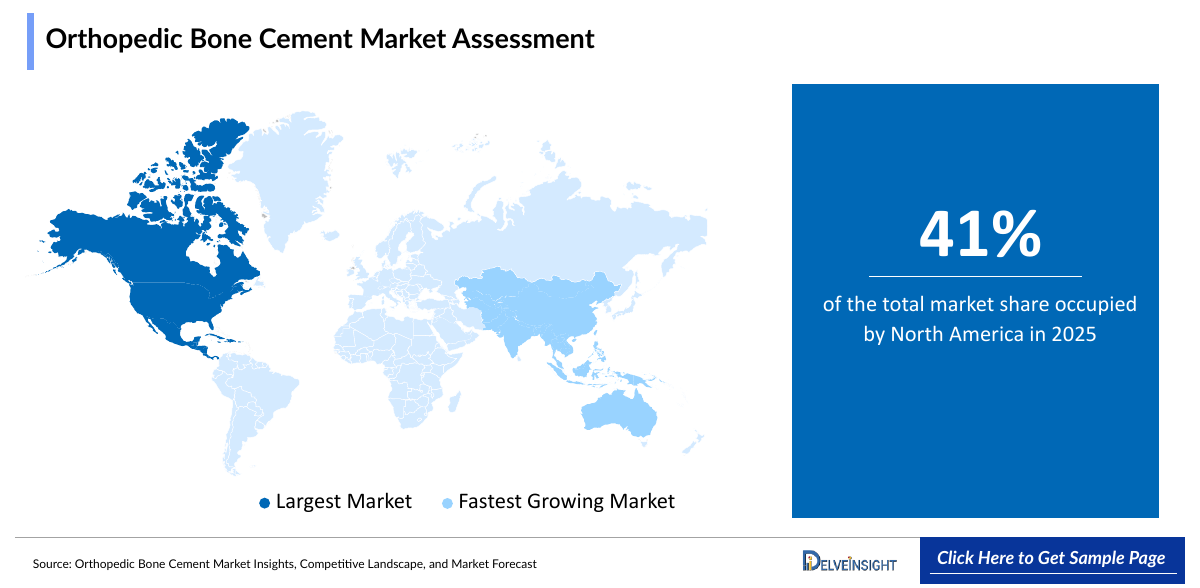
- North America dominated the global Orthopedic Bone Cement market revenue with a 41% share in 2025, representing the highest regional market share globally.
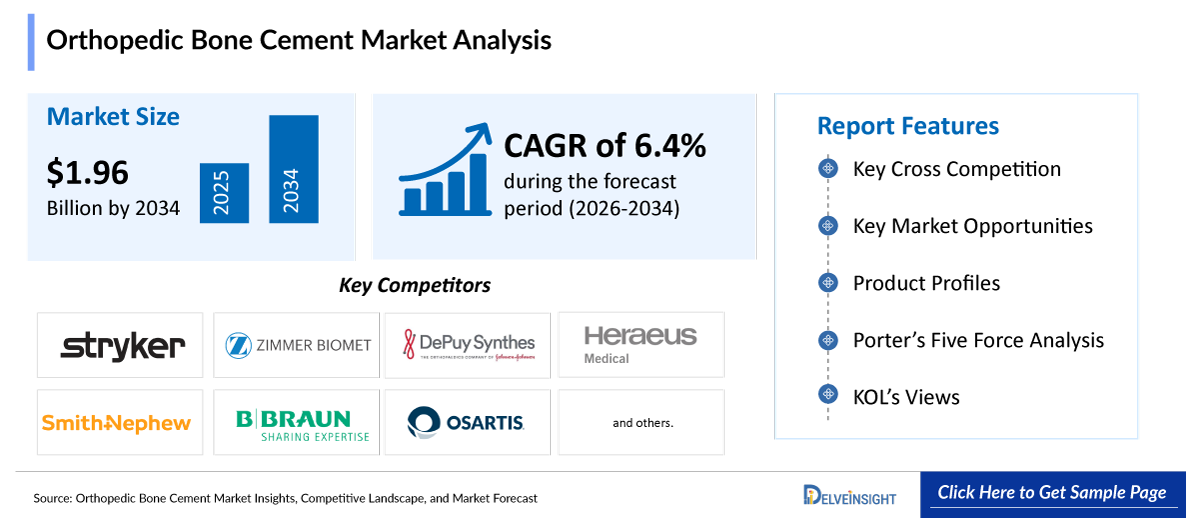
Orthopedic bone cement is a self-curing biomaterial used in orthopedic and spine surgery to anchor joint implants to living bone, fill bone voids, and stabilize fractured or weakened vertebrae. The most widely used form is polymethyl methacrylate (PMMA) cement, prepared in the operating room by mixing a powder polymer with a liquid monomer, which then polymerizes in situ and forms a load-transferring interface between the implant and bone. Alternative chemistries, including calcium phosphate and calcium sulfate cements, are used where osteoconductive or resorbable behavior is preferred. Cements may be loaded with antibiotics such as gentamicin, tobramycin, vancomycin, or clindamycin to lower the risk of infection, and are supplied in low-, medium-, and high-viscosity formulations to match surgical technique, from cemented arthroplasty to percutaneous vertebroplasty and kyphoplasty. Products are increasingly delivered in pre-filled, closed vacuum-mixing systems that reduce porosity and handling variability. The market is organized by product type across PMMA, calcium phosphate, calcium sulfate, and other cements; by antibiotic content; by viscosity; by application across arthroplasty, vertebroplasty, kyphoplasty, trauma and fracture fixation, and other uses; and by end user across hospitals, ambulatory surgical centers, orthopedic clinics, and specialty surgical centers. Driven by population aging, growing joint replacement and fragility-fracture volumes, and the clinical emphasis on infection prevention and reproducible cement preparation, orthopedic bone cement remains an essential consumable in modern musculoskeletal surgery.
Orthopedic Bone Cement Market Key Growth Drivers
- The aging global population and the rising burden of osteoarthritis and osteoporosis are expanding the pool of patients needing joint replacement and fracture stabilization, with the International Osteoporosis Foundation estimating roughly 8.9 million osteoporotic fractures worldwide each year.
- Growing volumes of hip and knee arthroplasty, with more than one million such procedures performed annually in the United States alone, sustain recurring demand for cement used to fixate implants.
- Wider use of antibiotic-loaded bone cement, including dual-antibiotic formulations, is supported by clinical emphasis on preventing periprosthetic joint infection, which affects roughly 1% to 2% of primary joint replacements.
- Expanding minimally invasive vertebral augmentation, including vertebroplasty and kyphoplasty for osteoporotic compression fractures, is broadening the use of low- and medium-viscosity cements.
- Product innovation in pre-filled, closed vacuum-mixing systems and medium-viscosity formulations, such as Heraeus Medical's Palacos pro systems, is improving consistency and workflow efficiency in the operating room.
- The migration of joint replacement into ambulatory surgical centers and outpatient pathways is increasing demand for efficient, ready-to-use cement systems.
- The 2026 Heraeus Medical supply disruption has underlined the strategic need for multi-sourcing, prompting hospitals and health systems to qualify alternative cements and supporting sustained mid-single-digit growth in the market through 2034.
Key Companies in Orthopedic Bone Cement Market
The competitive landscape is led by the following active manufacturers:
- Stryker Corporation
- Zimmer Biomet Holdings, Inc.
- DePuy Synthes (Johnson & Johnson)
- Heraeus Medical GmbH
- Smith+Nephew plc
- B. Braun Melsungen AG
- OSARTIS GmbH
- Tecres S.p.A.
- TEKNIMED S.A.
- G21 S.r.l.
For illustrative purposes, only the top 10 companies are listed in the Table of Contents. The report may include analysis and references to additional companies relevant to the market assessment.
Orthopedic Bone Cement Market Size
The following snapshot summarizes the principal report metrics for the Orthopedic Bone Cement market.
|
Report Metrics |
Details |
|
2025 Market Size |
USD 1.12 billion |
|
2034 Projected Market Size |
USD 1.96 billion |
|
Growth Rate (2026-2034) |
6.4% CAGR |
|
Largest Market |
North America |
|
Fastest Growing Market |
Asia-Pacific |
|
Market Structure |
Highly Concentrated |
All market values are expressed in USD and represent DelveInsight estimates synthesized from primary and secondary research.
Factors Contributing to the Growth of the Orthopedic Bone Cement Market
Market Drivers
Aging Population and Rising Burden of Osteoarthritis and Osteoporosis
The most fundamental driver of the Orthopedic Bone Cement market is demographic. The World Health Organization projects that the global population aged 60 and over will reach about 1.4 billion by 2030, and this cohort carries the highest prevalence of osteoarthritis, osteoporosis, and fragility fractures. The International Osteoporosis Foundation estimates that roughly 8.9 million osteoporotic fractures occur worldwide each year, including hip, wrist, and vertebral fractures that frequently require surgical fixation or augmentation. Advanced osteoarthritis of the hip and knee, in turn, leads to a steady flow of patients to total joint replacement, where cement is the standard method of fixation in many markets, particularly for older patients with reduced bone quality. As life expectancy rises and populations age across North America, Europe, and Asia-Pacific, the addressable patient base for cemented procedures expands in step, anchoring recurring demand for bone cement through 2034.
Growing Volume of Hip and Knee Arthroplasty
Rising arthroplasty volumes provide the largest and most dependable demand base for bone cement. More than one million total hip and knee replacements are performed annually in the United States, and procedure rates continue to climb in Europe and in fast-developing Asia-Pacific health systems as access to elective orthopedic surgery improves. Cemented fixation remains the preferred technique for most total knee replacements and for a large share of hip replacements, especially hemiarthroplasty after femoral neck fracture and in elderly patients. Each procedure consumes one or more cement units, so higher procedure counts translate directly into consumable demand. Backlog reduction in public health systems after pandemic-era delays, together with younger and more active patients entering the joint replacement pool, further supports volume growth and strengthens the outlook for cement manufacturers across the forecast period.
Antibiotic-Loaded Bone Cement and Infection Prevention
Infection prevention is a powerful driver of product mix and value. Periprosthetic joint infection affects roughly 1% to 2% of primary joint replacements but carries severe consequences, including revision surgery, prolonged hospitalization, and high cost. Antibiotic-loaded bone cement, which elutes antibiotics such as gentamicin locally at the implant site, is widely used as prophylaxis in arthroplasty and is the standard in many European markets, while adoption in the United States continues to broaden for higher-risk patients and for revision procedures. Dual-antibiotic formulations combining agents such as gentamicin with clindamycin or vancomycin, along with antibiotic cement spacers for two-stage revision of infected joints, are expanding the clinical use of antibiotic-loaded products. Because these products command premium pricing relative to plain cement, their growing share lifts average selling prices and supports above-volume revenue growth through the forecast period.
Expansion of Minimally Invasive Vertebral Augmentation
Minimally invasive spine procedures are broadening the applications of bone cement beyond joint replacement. Vertebroplasty and kyphoplasty stabilize painful osteoporotic vertebral compression fractures by percutaneously injecting radiopaque cement into the vertebral body, offering rapid pain relief and a short hospital stay. With vertebral fractures among the most common manifestations of osteoporosis in older adults, procedure demand is closely tied to population aging. These applications rely on specially formulated low- and medium-viscosity cements with extended working times and high radiopacity for fluoroscopic visualization, and on dedicated delivery systems, which support product differentiation and premium positioning. Advances in navigation, balloon and implant-based vertebral restoration, and delivery devices continue to expand the clinical use of vertebral augmentation, adding a growth-oriented application segment alongside mature arthroplasty demand.
Product Innovation in Pre-Filled Systems and Viscosity Options
Continuous innovation in cement preparation and delivery is improving clinical consistency and operating-room efficiency. Manufacturers have introduced pre-filled, closed vacuum-mixing systems that reduce monomer exposure, limit contamination risk, lower porosity, and standardize cement quality, such as Heraeus Medical's Palacos R & R+G pro All-in-One Fixation System launched for the United States market. Medium-viscosity formulations, extended-working-time cements, radiopaque and low-exotherm variants, and combined mixing and delivery devices are giving surgeons more control across arthroplasty, spine, and trauma use. These developments support conversion from legacy hand-mixed products to premium systems, raise average selling prices, and strengthen competitive differentiation among established players, while evidence from joint registries and clinical studies reinforces surgeon confidence in modern cement technologies.
Shift of Joint Replacement to Ambulatory and Outpatient Settings
The migration of orthopedic procedures to ambulatory surgical centers and outpatient pathways is reshaping demand and purchasing patterns. Total joint replacement for appropriately selected patients is increasingly performed in ambulatory surgical centers and specialty surgical centers, driven by payer incentives, shorter recovery protocols, and patient preference. These settings prioritize workflow efficiency, predictable preparation times, and inventory simplicity, which favors ready-to-use, pre-filled cement systems and consolidated supplier relationships. As the share of procedures performed outside traditional inpatient hospital settings grows, manufacturers are tailoring pack configurations, training, and service models to ambulatory customers, creating an incremental growth channel and encouraging product innovation oriented toward efficiency and cost-effectiveness across the forecast period.
Supply-Chain Resilience and Multi-Sourcing After the 2026 Heraeus Disruption
The February 2026 packaging fault at Heraeus Medical's main production site, which halted shipments of Palacos and Copal pouch cements and caused a global shortage, has become a catalyst for supply diversification. UK clinicians reported that Heraeus supplied roughly 82% of the UK market, and national health authorities moved quickly to qualify and distribute alternatives, including Zimmer Biomet's Hi-Fatigue G cement, which received MHRA approval on 23 February 2026, as well as Stryker's Simplex and other cements. Hospitals and group purchasing bodies are now more likely to qualify at least two cement suppliers, standardize surgeon training across viscosities, and hold safety stock. This rebalancing creates opportunities for challengers and regional specialists to win share, raises the strategic value of redundant, multi-site manufacturing, and is expected to reshape purchasing behavior across the forecast period.
Market Restraints
Despite steady momentum, the Orthopedic Bone Cement market faces notable constraints. Supply concentration and single-site manufacturing create fragility: the 2026 Heraeus Medical packaging fault showed that a disruption at one facility can cause global shortages, cancelled elective operations, and urgent product substitution. Surgeons must adapt to differences in working time, viscosity, and handling when switching cements, which complicates rapid substitution. Cement-related complications, including bone cement implantation syndrome, cardiovascular events during cementation, thermal necrosis from the exothermic reaction, allergic reactions, and cement leakage in vertebral procedures, together with product safety actions such as the August 2026 field safety corrective action on Palacos and Copal Pro systems, sustain regulatory and clinical scrutiny. Stringent regulatory requirements, including FDA oversight in the United States and the European Union Medical Device Regulation, which treats antibiotic-containing cements as higher-risk products, lengthen approval timelines and raise compliance costs. The growing use of cementless fixation in hip and knee arthroplasty, bioresorbable bone substitutes, and 3D-printed implants moderates growth in some procedures, and uncertain clinical evidence for vertebroplasty in some patient groups tempers adoption. Price pressure from group purchasing organizations, national tenders, and volume-based procurement programs, particularly in China and public health systems, compresses margins, while limited access to elective surgery and reimbursement in emerging economies slows penetration. Together, these supply, clinical, regulatory, and pricing barriers temper the pace of growth, even as the demographic and procedural drivers of the market remain firmly intact.
Orthopedic Bone Cement Market Segment Analysis
The Orthopedic Bone Cement Market is segmented by product type (polymethyl methacrylate (pmma) bone cement, calcium phosphate bone cement, calcium sulfate bone cement, other bone cements), antibiotic content (antibiotic-loaded bone cement, non-antibiotic bone cement), viscosity (low-viscosity bone cement, medium-viscosity bone cement, high-viscosity bone cement), application (arthroplasty, vertebroplasty, kyphoplasty, trauma and fracture fixation, other applications), end user (hospitals, ambulatory surgical centers, orthopedic clinics, specialty surgical centers), and geography (North America, Europe, Asia-Pacific, and Rest of World).
By Product Type
Dominant Subsegment: Polymethyl Methacrylate (PMMA) Bone Cement.
The polymethyl methacrylate (PMMA) bone cement segment accounted for 82% of the Orthopedic Bone Cement market in 2025. PMMA is the leading product type because it has been the established standard for implant fixation for more than half a century, with an extensive body of clinical evidence, joint registry data, and surgeon familiarity. Its reliable mechanical strength, predictable handling, radiopacity, and ability to carry antibiotics make it the default choice for cemented hip and knee arthroplasty, hemiarthroplasty, and vertebral augmentation. PMMA cements are available in multiple viscosities, with and without antibiotics, and in pre-filled vacuum-mixing systems, giving manufacturers a broad portfolio and giving hospitals a standardized, cost-effective option. Calcium phosphate and calcium sulfate cements are valued for osteoconductive and resorbable behavior in bone void filling, fracture augmentation, and local antibiotic delivery, but are not designed for load-bearing implant fixation and therefore serve narrower niches. While these bioresorbable and composite materials are expected to grow faster from a smaller base, the volume of arthroplasty and the clinical dependence on PMMA secure its leadership across the forecast period.
By Antibiotic Content
Dominant Subsegment: Antibiotic-Loaded Bone Cement.
The antibiotic-loaded bone cement segment accounted for 57% of the Orthopedic Bone Cement market in 2025. Antibiotic-loaded bone cement leads because infection after joint replacement is among the most feared and costly complications, and local antibiotic elution from cement is a well-established prophylactic measure. Gentamicin-loaded products such as Palacos R+G and Hi-Fatigue G are standard in many European markets, while dual-antibiotic cements combining gentamicin with clindamycin or vancomycin, and antibiotic spacers for two-stage revision of infected joints, are expanding the clinical use of these products. Adoption is also rising in the United States, where surgeons increasingly use antibiotic cement for higher-risk primary patients and for revision and hemiarthroplasty cases. Premium pricing relative to plain cement lifts value share beyond volume share. Non-antibiotic cement remains important for low-risk primary procedures, cost-sensitive systems, and surgeon-customized, hand-loaded approaches, and is also used in vertebral augmentation, where antibiotic loading is not indicated. Nevertheless, growing infection-prevention awareness secures the leadership of antibiotic-loaded cement across the forecast period.
By Viscosity
Dominant Subsegment: High-Viscosity Bone Cement.
The high-viscosity bone cement segment accounted for 46% of the Orthopedic Bone Cement market in 2025. High-viscosity cements lead because they reach a dough-like state quickly after mixing, are easy to handle and apply by hand, and are preferred by many surgeons for total knee and hip arthroplasty, where a controlled, low-leakage application is valued. Widely used products such as Palacos R+G, Simplex P, and Hi-Fatigue G are high-viscosity cements supported by long clinical track records. Medium-viscosity cements, which offer a longer working window and are suited to vacuum-mixed, syringe, and pressurized application, are gaining share as pre-filled systems and surgeon preference for flexible timing spread. Low-viscosity cements remain important in revision surgery and in vertebroplasty, where flow through narrow cannulae and radiopacity are critical, while kyphoplasty typically uses higher-viscosity formulations to reduce leakage. Differences in working time and handling became highly visible during the 2026 shortage, when surgeons moved between cements, reinforcing the importance of viscosity-specific training. The scale of high-viscosity use in arthroplasty secures its leadership across the forecast period.
By Application
Dominant Subsegment: Arthroplasty.
The arthroplasty segment accounted for 72% of the Orthopedic Bone Cement market in 2025. Arthroplasty is the leading application because cement fixation of knee, hip, shoulder, and other joint replacement implants represents the largest and most recurring consumption of bone cement worldwide. Total knee replacement is predominantly cemented, and cemented stems are widely used in hip replacement for elderly patients and for hemiarthroplasty after femoral neck fracture. Rising procedure volumes, an aging population, and the clinical emphasis on infection prevention reinforce demand, and antibiotic-loaded products are concentrated in this segment. Vertebroplasty and kyphoplasty are important growth applications tied to osteoporotic vertebral compression fractures, with kyphoplasty the faster-growing of the two as balloon and implant-assisted systems expand, although evidence debates over vertebroplasty temper adoption in some settings. Trauma and fracture fixation use cement to augment fixation in osteoporotic bone and to fill defects. Despite growth in these adjacent applications, the sheer volume of joint replacement secures the leadership of arthroplasty across the forecast period.
By End User
Dominant Subsegment: Hospitals.
The hospitals segment accounted for 76% of the Orthopedic Bone Cement market in 2025. Hospitals lead because they perform the large majority of joint replacement, fracture, and spine procedures, particularly complex, revision, and trauma cases that require inpatient care, and because their purchasing is organized through value analysis committees, group purchasing organizations, and national tenders that standardize supplier relationships. The 2026 supply disruption illustrated how dependent hospital-based operating theatres are on a stable cement supply, with national health systems coordinating alternative stock to protect procedures. Ambulatory surgical centers are the fastest-growing end user as elective total joint replacement shifts to outpatient settings, favoring ready-to-use, pre-filled systems and streamlined inventory. Orthopedic clinics and specialty surgical centers contribute smaller but growing volumes, particularly for vertebral augmentation and focused orthopedic procedures. Even as procedures migrate outside the hospital, its breadth of case mix and procurement scale secure hospital leadership across the forecast period.
Orthopedic Bone Cement Market Region Analysis
Dominant Region: North America
North America accounted for 41% of the global Orthopedic Bone Cement market revenue in 2025, representing the highest regional market share globally. The region's dominance reflects high joint replacement volumes, a large aging population, favorable reimbursement, and the presence of leading manufacturers and a mature orthopedic device ecosystem, particularly in the United States. North America hosts the headquarters and principal commercial operations of companies such as Stryker, Zimmer Biomet, and DePuy Synthes, along with the broad U.S. operations of Heraeus Medical and Smith+Nephew, giving surgeons access to a wide range of cements and mixing systems. Procedure volumes continue to grow as younger patients and baby-boomers seek joint replacement, while the shift of arthroplasty into ambulatory surgical centers is accelerating demand for efficient, pre-filled cement systems. Strong awareness of infection prevention supports the expanding use of antibiotic-loaded cement, and the FDA's clear regulatory pathways for PMMA cements support innovation. These factors anchor the region's continued leadership across the forecast period.
Fastest Growing Region: Asia-Pacific
Asia-Pacific is the fastest-growing region in the Orthopedic Bone Cement market. The region's elevated CAGR is driven by rapidly aging populations in Japan, China, and South Korea, expanding access to elective orthopedic surgery, rising osteoporosis prevalence, and growing healthcare investment across China, Japan, India, South Korea, and Australia. China's large procedure base, supported by national volume-based procurement of joint implants, is expanding access while increasing price competition; Japan has one of the world's oldest populations and a high burden of vertebral and hip fractures, and India's expanding private hospital network and rising medical-device investment, illustrated by Zimmer Biomet India's launch of Teknimed's Tekcem gentamicin bone cements, are broadening access to advanced products. Australia contributes a mature, registry-driven arthroplasty market. Rising health insurance coverage, growing surgeon training, and the localization of manufacturing and distribution by multinational and regional companies position Asia-Pacific as the principal source of incremental growth over the forecast period.
Regional Commentary
North America
North America accounted for 41% of the global Orthopedic Bone Cement market revenue in 2025. The United States dominates on the strength of its high arthroplasty volumes, aging population, outpatient shift, and the concentration of leading manufacturers, while Canada and Mexico contribute growing procedure volumes and expanding access to orthopedic care.
Europe
Europe is a large and advanced regional market, characterized by high adoption of antibiotic-loaded cement, strong joint registries, and the home bases of Heraeus Medical, OSARTIS, B. Braun, Tecres, TEKNIMED, and G21. The 2026 Heraeus Medical supply disruption highlighted regional dependence, with the United Kingdom, where Heraeus supplied roughly 82% of the market, moving quickly to qualify alternatives such as Zimmer Biomet's Hi-Fatigue G. Germany, France, the United Kingdom, Italy, and Spain remain the principal demand centers, supported by the EU Medical Device Regulation framework.
Asia-Pacific
Asia-Pacific is the fastest-growing region, propelled by rapid population aging, expanding access to elective orthopedic surgery, and growing healthcare investment across China, Japan, India, South Korea, and Australia. China's volume-based procurement, Japan's high fracture burden, India's expanding private hospital network, and Australia's registry-driven arthroplasty market are shaping regional demand and competitive strategies.
Rest of World
The Rest of World region, spanning Latin America, the Middle East, and Africa, is an emerging growth frontier. Expanding private hospital capacity, medical tourism, rising orthopedic procedure volumes, and efforts to strengthen regulatory frameworks are gradually broadening access to cemented arthroplasty and vertebral augmentation, while distributor-led models and public tenders remain the primary routes to market.
Orthopedic Bone Cement Market Competitive Landscape
The Orthopedic Bone Cement market is classified as Highly Concentrated. A group of global orthopedic leaders and specialist cement makers, including Heraeus Medical, Stryker, Zimmer Biomet, DePuy Synthes, and Smith+Nephew, anchors the top tier through established brands, broad surgeon relationships, and integrated implant portfolios, while specialist and regional manufacturers such as B. Braun, OSARTIS, Tecres, TEKNIMED, and G21 compete through antibiotic-loaded formulations, spacer and spine-focused products, and private-label and distribution partnerships, increasing competition in selected application and geographic niches.
The competitive landscape can be evaluated across the following dimensions:
- Market concentration: Highly concentrated, with a handful of global leaders holding the majority of revenue and specialist manufacturers competing in antibiotic, spacer, and spine niches.
- Leading players: Heraeus Medical, Stryker, Zimmer Biomet, DePuy Synthes, and Smith+Nephew anchor the top tier through established brands and broad hospital relationships.
- Geographic reach: Leaders operate global distribution networks; Heraeus Medical alone was reported to supply roughly 82% of the UK market ahead of the 2026 disruption.
- Product portfolio strength: Top players offer plain and antibiotic-loaded PMMA cements across viscosities, pre-filled vacuum-mixing systems, spacers, and vertebral augmentation cements.
- Supply-chain resilience: Multi-site manufacturing and qualified alternative sourcing have become decisive advantages after the February 2026 Heraeus packaging fault.
- Strategic partnerships: Supply and distribution partnerships, such as Zimmer Biomet's distribution of OSARTIS-manufactured Hi-Fatigue cements and Teknimed's Tekcem range in India, extend reach.
- M&A and portfolio expansion: Companies are broadening into resorbable biomaterials, as with Heraeus Medical's INNOTERE acquisition and Heracure brand, and consolidating specialist capabilities.
- Manufacturing capabilities: Sterile pouch and pre-filled system production, quality control of monomer and powder components, and validated packaging are key competitive moats.
- Innovation focus: Pre-filled closed vacuum-mixing systems, medium-viscosity formulations, dual-antibiotic cements, low-exotherm and resorbable composites, and improved delivery devices.
Orthopedic Bone Cement Market Recent Developmental Activities
In February 2026, Heraeus Medical GmbH reported a packaging fault at its main production site that halted output of Palacos and Copal pouch cements, creating a global shortage; newly manufactured stock could not be distributed until processes were validated, and supply was prioritized by clinical need. Strategic significance: Exposed the risk of single-site manufacturing and accelerated hospital multi-sourcing.
In February 2026, Zimmer Biomet Holdings, Inc., secured MHRA approval on 23 February 2026 for Hi-Fatigue G Bone Cement, which NHS England selected as an alternative supply, and deployed sales representatives and training across the United Kingdom. Strategic significance: Converts a competitor's disruption into UK share gains and validates Zimmer Biomet's cement portfolio.
In 2026, OSARTIS GmbH, as the legal manufacturer of the Hi-Fatigue and Hi-Fatigue G high-viscosity cements supplied through Zimmer Biomet, saw its range adopted as an alternative cement across the UK health system. Strategic significance: Raises the profile of a specialist manufacturer and its partnership-led route to market.
In 2026, Stryker Corporation supported supply continuity through its Simplex range, with NHS Supply Chain reporting that Simplex availability was greater than expected during the shortage. Strategic significance: Reinforces Stryker's position as a scaled, resilient alternative supplier in cemented arthroplasty.
In October 2025, Heraeus Medical GmbH expanded into resorbable bone regeneration through the integration of INNOTERE GmbH and the introduction of the heracure brand, including heracure one and heracure 3D, at DKOU 2025. Strategic significance: Diversifies Heraeus Medical beyond cements for arthroplasty into resorbable biomaterials.
In 2025 and 2026, TEKNIMED S.A. expanded its international reach, including Zimmer Biomet India's launch of Teknimed's Tekcem gentamicin bone cements, and was reported in private-market data to have undergone a buyout transaction in July 2026. Strategic significance: Strengthens a specialist's distribution through a global orthopedic partner and signals investor interest in niche cement makers.
In 2024, Heraeus Medical GmbH launched the Palacos R & R+G pro All-in-One Fixation System in the United States, integrating Palacos cement into a ready-to-mix closed vacuum system. Strategic significance: Advances the shift to pre-filled, standardized cement preparation and strengthens Heraeus's U.S. direct presence.
In August 2026, Heraeus Medical GmbH issued a field safety corrective action for Palacos R+G pro and MV+G pro systems and Copal pro systems, adding product-handling advice. Strategic significance: Underlines ongoing regulatory and safety scrutiny of cement systems during the supply recovery.
In 2025 and 2026, DePuy Synthes (Johnson & Johnson) continued to support its CMW and CEMEX cement portfolio alongside its joint reconstruction and VELYS ecosystem. Strategic significance: Leverages implant relationships to retain cement share in cemented arthroplasty.
In 2025 and 2026, Smith+Nephew plc continued to position bone cement within its orthopedic reconstruction portfolio as hospitals qualified additional suppliers. Strategic significance: Captures incremental demand from multi-sourcing within an integrated reconstruction offering.
In 2025 and 2026, B. Braun Melsungen AG, Tecres S.p.A., and G21 S.r.l., continued to serve European and international hospitals with antibiotic-loaded cements, spacers, and spinal cements through the Aesculap, spacer, and spine-focused portfolios. Strategic significance: Specialists benefit as health systems broaden supplier panels after the 2026 disruption.
Orthopedic Bone Cement Market Segmentation
Orthopedic Bone Cement Market by Product Type
- Polymethyl Methacrylate (PMMA) Bone Cement
- Calcium Phosphate Bone Cement
- Calcium Sulfate Bone Cement
- Other Bone Cements
Orthopedic Bone Cement Market by Antibiotic Content
- Antibiotic-Loaded Bone Cement
- Non-Antibiotic Bone Cement
Orthopedic Bone Cement Market by Viscosity
- Low-Viscosity Bone Cement
- Medium-Viscosity Bone Cement
- High-Viscosity Bone Cement
Orthopedic Bone Cement Market by Application
- Arthroplasty
- Vertebroplasty
- Kyphoplasty
- Trauma and Fracture Fixation
- Other Applications
Orthopedic Bone Cement Market by End User
- Hospitals
- Ambulatory Surgical Centers
- Orthopedic Clinics
- Specialty Surgical Centers
Orthopedic Bone Cement Market by Geography
- North America Orthopedic Bone Cement Market
- United States Orthopedic Bone Cement Market Size in USD million (2023-2034)
- Canada Orthopedic Bone Cement Market Size in USD million (2023-2034)
- Mexico Orthopedic Bone Cement Market Size in USD million (2023-2034)
- Europe Orthopedic Bone Cement Market
- Germany Orthopedic Bone Cement Market Size in USD million (2023-2034)
- United Kingdom Orthopedic Bone Cement Market Size in USD million (2023-2034)
- France Orthopedic Bone Cement Market Size in USD million (2023-2034)
- Italy Orthopedic Bone Cement Market Size in USD million (2023-2034)
- Spain Orthopedic Bone Cement Market Size in USD million (2023-2034)
- Rest of Europe Orthopedic Bone Cement Market Size in USD million (2023-2034)
- Asia-Pacific Orthopedic Bone Cement Market
- China Orthopedic Bone Cement Market Size in USD million (2023-2034)
- Japan Orthopedic Bone Cement Market Size in USD million (2023-2034)
- India Orthopedic Bone Cement Market Size in USD million (2023-2034)
- Australia Orthopedic Bone Cement Market Size in USD million (2023-2034)
- South Korea Orthopedic Bone Cement Market Size in USD million (2023-2034)
- Rest of Asia-Pacific Orthopedic Bone Cement Market Size in USD million (2023-2034)
- Rest of the World (RoW) Orthopedic Bone Cement Market
- Middle East Orthopedic Bone Cement Market Size in USD million (2023-2034)
- Africa Orthopedic Bone Cement Market Size in USD million (2023-2034)
- South America Orthopedic Bone Cement Market Size in USD million (2023-2034)
Orthopedic Bone Cement Market Recent Industry Trends and Milestones (2023-2026)
|
Category |
Key Developments |
|
Orthopedic Bone Cement Market Product Approval |
Regulatory and clinical momentum continues to shape product choice. In the United States, PMMA bone cements are regulated as Class II devices, while in the European Union the Medical Device Regulation applies stricter requirements to cements that incorporate antibiotics. MHRA approved Zimmer Biomet's Hi-Fatigue G Bone Cement on 23 February 2026 for use across the United Kingdom, enabling NHS England to secure an alternative supply during the Heraeus Medical shortage. Heraeus Medical launched the Palacos R & R+G pro All-in-One Fixation System in the United States and issued an August 2026 field safety corrective action for Palacos and Copal pro systems. Each approval, launch, and safety action influences surgeon preference, hospital formulary decisions, and supplier qualification. |
|
Orthopedic Bone Cement Market Expansion |
Manufacturers broadened portfolios and delivery formats across the value chain. Pre-filled, closed vacuum-mixing systems, medium-viscosity cements, dual-antibiotic formulations, and antibiotic spacers expanded alongside vertebral augmentation cements and delivery devices. Heraeus Medical added resorbable biomaterials through INNOTERE and the heracure brand, Zimmer Biomet extended Teknimed's Tekcem range in India, and companies increased training and technical support so that surgeons could move safely between cements with differing working times and viscosities. |
|
Orthopedic Bone Cement Market Investment |
Investment centered on supply resilience, portfolio diversification, and specialist assets. Heraeus Medical integrated INNOTERE GmbH to enter resorbable bone regeneration, and private-market data indicated a buyout of TEKNIMED in July 2026. The 2026 shortage prompted health systems and manufacturers to evaluate redundant manufacturing capacity, safety stock, and multi-supplier contracting, redirecting capital toward sterile packaging, quality systems, and capacity expansion across the cement supply chain. |
|
Company Strategy |
Stryker Corporation: Broad Simplex, VertaPlex, and SpinePlex portfolio spanning arthroplasty and spine. Zimmer Biomet Holdings, Inc.: Integrated cement and implant offering, with Hi-Fatigue G and Refobacin cements supplied alongside Teknimed and OSARTIS partners. DePuy Synthes (Johnson & Johnson): CMW and CEMEX cements linked to its joint reconstruction ecosystem. Heraeus Medical GmbH: Palacos and Copal leadership, pre-filled pro systems, and expansion into resorbable biomaterials. Smith+Nephew plc and B. Braun Melsungen AG: Reconstruction-linked and hospital-focused cement offerings. OSARTIS GmbH, Tecres S.p.A., TEKNIMED S.A., and G21 S.r.l.: Specialist antibiotic, spacer, spine, and private-label capabilities. |
|
Emerging Technologies |
Pre-filled closed vacuum-mixing systems, medium-viscosity and extended-working-time cements, and dual-antibiotic formulations are the leading edge of product innovation. Bioresorbable and composite materials, including calcium phosphate and calcium sulfate cements, resorbable bone substitutes, and antibiotic-eluting spacers, are expanding in bone void filling and infection management. Robotic-assisted arthroplasty, improved delivery devices for vertebral augmentation, and registry-driven evidence generation are reinforcing surgeon confidence, while 3D-printed implants and cementless fixation remain competing technologies that shape the long-term role of cement. |
Orthopedic Bone Cement Market Startup Funding and Investment Trends
|
Company |
Total Funding |
Funding Stage |
Main Offering |
Core Technology |
|
INNOTERE GmbH |
Undisclosed |
Acquired by Heraeus Medical (integration from 2025) |
Resorbable bone regeneration products (Heracure) |
Resorbable biomaterials |
|
Request to unlock the report on the @ Orthopedic Bone Cement Market | ||||
Investment in the Orthopedic Bone Cement ecosystem has concentrated on resorbable biomaterials, antibiotic-loaded and spine-focused cement technologies, and supply resilience. The following companies illustrate recent funding and investment activity and technology focus.
Capital is flowing toward providers that secure resilient supply, resorbable alternatives, and differentiated delivery technologies. Heraeus Medical's integration of INNOTERE and launch of the heracure brand, together with private-market data indicating a buyout of TEKNIMED in July 2026, illustrates strategic interest in biomaterials and specialist cement platforms. Emerging and specialist providers such as BONESUPPORT are scaling injectable calcium-based biomaterials, while established manufacturers evaluate redundant manufacturing and packaging capacity following the 2026 shortage. Collectively, these investments signal conviction that supply resilience, antibiotic-loaded and pre-filled systems, and resorbable technologies will define the next phase of competitive advantage in the global Orthopedic Bone Cement market.
Key Takeaways from the Orthopedic Bone Cement Market Report Study
- Market size analysis for the current Orthopedic Bone Cement market size (2025), and market forecast for 9 years (2026 to 2034).
- Top key product/technology developments, mergers, acquisitions, partnerships, and joint ventures that happened over the last 3 years.
- Key companies dominating the global Orthopedic Bone Cement market.
- Various opportunities available for competitors in the Orthopedic Bone Cement market space.
- What are the top-performing segments in 2025? How will these segments perform in 2034?
- Which are the top-performing regions and countries in the current Orthopedic Bone Cement market scenario?
- Which are the regions and countries where companies should concentrate their opportunities for Orthopedic Bone Cement market growth in the future?
Target audience who can benefit from this Orthopedic Bone Cement market report study
- Orthopedic Bone Cement product providers
- Research organizations and consulting companies
- Orthopedic Bone Cement -related organizations, associations, forums, and other alliances
- Government and corporate offices
- Start-up companies, venture capitalists, and private equity firms
- Distributors and traders dealing in Orthopedic Bone Cement
- Various end-users who want to know more about the Orthopedic Bone Cement market and the latest technological developments in the Orthopedic Bone Cement market.