PD-1 and PD-L1 Market Summary
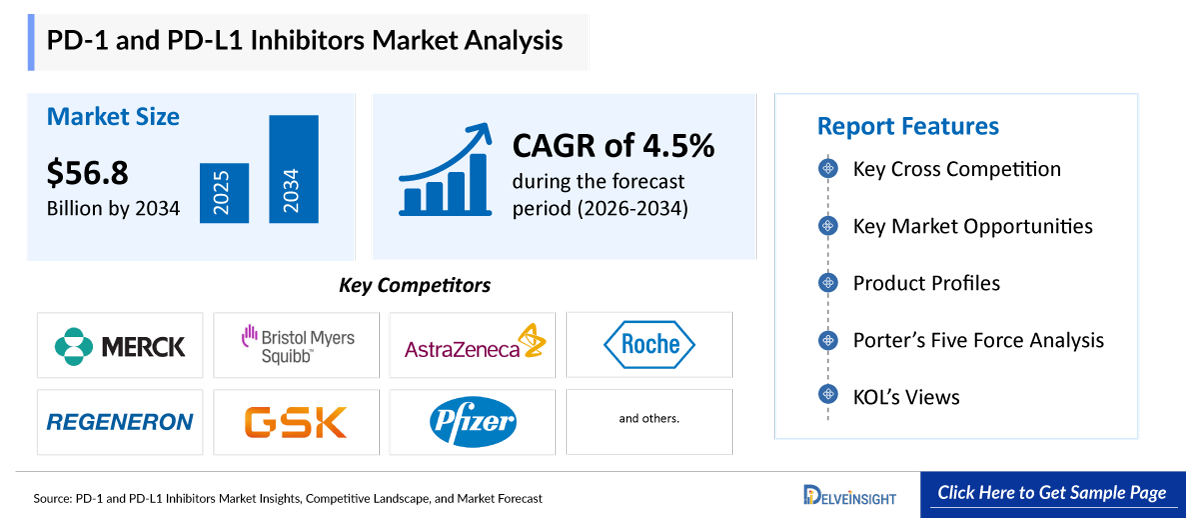
- The PD-1 and PD-L1 Inhibitors market size is estimated at USD 56.8 billion in 2025 and is projected to reach USD 84.4 billion by 2034. Growth is anchored in entrenched first-line standard of care across solid tumours, migration into perioperative and adjuvant settings, and the emergence of PD-1 and PD-L1 bispecific antibodies, tempered by pembrolizumab loss of exclusivity in 2028.
- The global PD-1 and PD-L1 Inhibitors market is growing at a CAGR of 4.5% during the forecast period from 2026 to 2034.
- By drug class, the PD-1 inhibitors segment dominated the PD-1 and PD-L1 Inhibitors market with an 80% share in 2025.
- By indication, the lung cancer segment dominated the PD-1 and PD-L1 Inhibitors market with a 42% share in 2025.
- By line of therapy, the first-line segment dominated the PD-1 and PD-L1 Inhibitors market with a 54% share in 2025.
- By route of administration, the intravenous segment dominated the PD-1 and PD-L1 Inhibitors market with a 96% share in 2025.
- By end user, the hospitals and cancer treatment centers segment dominated the PD-1 and PD-L1 Inhibitors market with a 56% share in 2025.
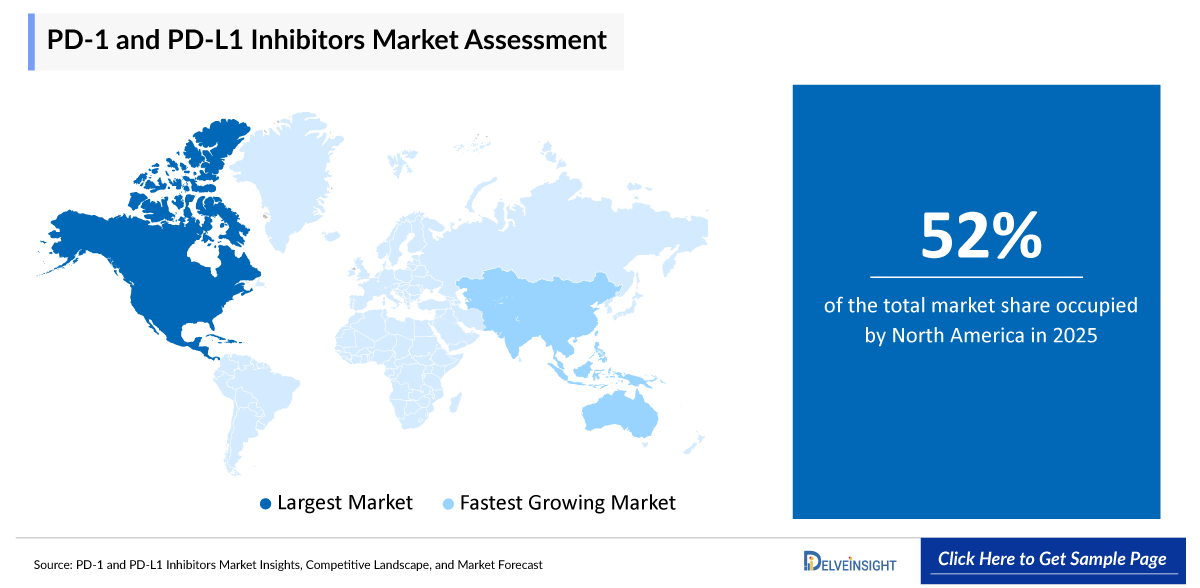
- North America dominated the global PD-1 and PD-L1 Inhibitors market revenue with a 52% share in 2025, representing the highest regional market share globally.
PD-1 and PD-L1 inhibitors are monoclonal antibodies that restore antitumour T-cell activity by blocking an immune checkpoint the tumour exploits to evade destruction. Programmed cell death protein 1 is an inhibitory receptor expressed on activated T cells; when it engages its ligand, programmed death-ligand 1, presented on tumour cells and antigen-presenting cells within the tumour microenvironment, the T cell receives a suppressive signal and becomes functionally exhausted. Antibodies directed against either partner interrupt that interaction and release the pre-existing immune response, producing durable remissions in a minority of patients across a strikingly broad range of malignancies.
The class spans PD-1 antibodies including pembrolizumab, nivolumab, cemiplimab, dostarlimab, tislelizumab, toripalimab, sintilimab, and camrelizumab; PD-L1 antibodies including durvalumab, atezolizumab, avelumab, and cosibelimab; fixed-dose combinations pairing PD-1 blockade with CTLA-4 or LAG-3 inhibition; and an emerging generation of bispecific antibodies that couple PD-1 or PD-L1 blockade to vascular endothelial growth factor neutralisation. Agents are administered intravenously and, increasingly, subcutaneously with recombinant hyaluronidase, across lung, melanoma, head and neck, genitourinary, gastrointestinal, and gynaecologic cancers. Since the first approvals in melanoma, the class has become the single largest therapeutic franchise in oncology and the combination backbone onto which conjugates and engagers are layered.
PD-1 and PD-L1 Inhibitors Market Key Growth Drivers
- Checkpoint blockade is entrenched as first-line standard of care across most major solid tumours, with Merck reporting Keytruda and Keytruda Qlex sales of USD 31.7 billion in 2025, growth of 7%, alongside positive results from 18 Phase 3 trials during the year.
- Migration into perioperative, adjuvant, and earlier-line settings is enlarging treated populations well beyond metastatic disease, with Merck attributing pembrolizumab growth principally to earlier-stage non-small cell lung cancer.
- Subcutaneous reformulation is defending franchise economics and shifting care to lower-cost settings, exemplified by Opdivo Qvantig, approved in December 2024 and launched in January 2025, and Keytruda Qlex.
- Label expansion continues to open new indications, with the Food and Drug Administration and European Commission approving Libtayo in October 2025 for high-risk adjuvant cutaneous squamous cell carcinoma, lifting full-year 2025 sales to USD 1.45 billion.
- PD-1 and PD-L1 bispecific antibodies coupling checkpoint blockade to vascular endothelial growth factor neutralisation have attracted multi-billion-dollar commitments, including Bristol Myers Squibb’s partnership with BioNTech on BNT327 and Pfizer’s acquisition of rights to a 3SBio bispecific.
- Checkpoint inhibitors function as the combination backbone onto which antibody-drug conjugates and T-cell engagers are layered, so growth in adjacent modalities pulls checkpoint volume with it.
- Chinese origination and Western in-licensing of checkpoint and bispecific assets is replenishing the pipeline ahead of the pembrolizumab patent cliff and expanding access across Asia-Pacific.
Key Companies in PD-1 and PD-L1 Inhibitors Market
The competitive landscape is led by the following originators, bispecific developers, and enabling technology providers:
- Merck & Co., Inc.
- Bristol Myers Squibb Company
- AstraZeneca plc
- F. Hoffmann-La Roche Ltd
- Regeneron Pharmaceuticals, Inc.
- GSK plc
- Merck KGaA
- Pfizer Inc.
- BioNTech SE
- Summit Therapeutics Inc., and others
For illustrative purposes, only the top 10 companies are listed in the Table of Contents. The report may include analysis and references to additional companies relevant to the market assessment.
PD-1 and PD-L1 Inhibitors Market Size
The following snapshot summarizes the principal report metrics for the PD-1 and PD-L1 Inhibitors market.
All market values are expressed in USD and represent DelveInsight estimates synthesized from primary and secondary research.
Factors Contributing to the Growth of the PD-1 and PD-L1 Inhibitors Market
PD-1 and PD-L1 Inhibitors Market Drivers
- Entrenched First-Line Standard of Care across Solid Tumours: The foundational driver of the market is that checkpoint blockade has become the default first-line therapy across most major solid tumours, embedded in treatment guidelines and reimbursed as standard of care rather than as an option. Merck reported full-year 2025 sales of Keytruda and Keytruda Qlex of USD 31.7 billion, an increase of 7% both nominally and excluding foreign exchange, following growth of 18% to USD 29.5 billion in 2024, and reported positive results from 18 Phase 3 trials during the year. Bristol Myers Squibb recorded first-quarter 2025 Opdivo revenue of USD 2,265 million and guided to high-single-digit to low-double-digit full-year growth for Opdivo together with Opdivo Qvantig, while the fixed-dose LAG-3 combination Opdualag grew 23%. Regeneron reported Libtayo full-year 2025 net product sales of USD 1.45 billion, up 13% at constant exchange rates. The durability of this position reflects an unusually broad label spanning many tumour types, a well-characterised safety profile managed by established immune-related adverse event protocols, and the biological generality of immune evasion through checkpoint engagement, which is a shared hallmark of solid tumours rather than a lineage-specific vulnerability. Guideline entrenchment converts epidemiological growth directly into class revenue and anchors the market through 2034.
- Migration into Perioperative, Adjuvant, and Earlier-Line Settings: The most reliable source of volume growth is the movement of checkpoint inhibitors out of metastatic salvage and into neoadjuvant, adjuvant, and perioperative regimens, where eligible patient populations are far larger and treatment duration is defined by protocol rather than by progression. Merck attributes recent pembrolizumab growth principally to uptake in earlier-stage non-small cell lung cancer rather than to incremental metastatic share, a pattern repeating across tumour types as perioperative trials read out. AstraZeneca secured United States approval for Imfinzi in limited-stage small cell lung cancer on the ADRIATIC trial and in endometrial cancer in Japan on DUO-E. Regeneron obtained Food and Drug Administration and European Commission approval for Libtayo in high-risk adjuvant cutaneous squamous cell carcinoma in October 2025, making it the only Category One preferred immunotherapy in National Comprehensive Cancer Network guidelines for that setting, and management expects the approval to drive growth from 2026. Earlier-line positioning multiplies eligible patients, extends the treated interval, raises the probability of long-term disease control, and supports premium pricing on outcomes grounds. This structural shift is the single most dependable growth vector through 2034.
- Subcutaneous Reformulation and Lifecycle Defence: Subcutaneous co-formulation with recombinant hyaluronidase has become the principal lifecycle strategy for the class, compressing administration from an hour-long infusion to minutes, shifting care into lower-cost settings, improving patient convenience, extending patent life, and blunting intravenous biosimilar entry after loss of exclusivity. Bristol Myers Squibb secured United States approval of Opdivo Qvantig, subcutaneous nivolumab co-formulated with hyaluronidase, in December 2024 and launched it in January 2025, guiding to high-single-digit to low-double-digit combined growth for the nivolumab franchise. Merck followed with Keytruda Qlex, subcutaneous pembrolizumab with berahyaluronidase alfa, recording an initial USD 40 million of sales within full-year 2025 Keytruda franchise revenue and booking a USD 705 million liability for regulatory and sales-based milestone payments to Alteogen, of which USD 680 million is contingent on future Qlex sales. Roche obtained approval for subcutaneous atezolizumab. The economic logic is stark: if a substantial share of patients converts to a differentiated subcutaneous presentation before the intravenous molecule loses exclusivity, the originator retains volume that biosimilars cannot address. Conversion pace will materially shape revenue trajectories after 2028.
- Emergence of PD-1 and PD-L1 Bispecific Antibodies Targeting VEGF: The most consequential scientific development in the class is the arrival of bispecific antibodies that couple checkpoint blockade to neutralisation of vascular endothelial growth factor, targeting two of the most commercially important pathways of the past two decades within a single molecule. The field was galvanised when Akeso and Summit Therapeutics reported that ivonescimab, a PD-1 and VEGF-A bispecific, outperformed pembrolizumab in a head-to-head Phase 3 lung cancer trial. Capital followed immediately. Merck paid USD 588 million upfront to LaNova Medicines. BioNTech, which had licensed ex-China rights to BNT327 in 2023 for USD 55 million upfront, acquired its partner Biotheus outright for USD 800 million upfront. Pfizer paid 3SBio USD 1.25 billion upfront in a transaction valued at up to USD 6 billion, closing in July 2025. In June 2025, Bristol Myers Squibb entered a global co-development and co-commercialisation partnership with BioNTech on BNT327, a PD-L1 and VEGF-A bispecific, with a 50/50 profit and loss split, USD 1.5 billion upfront, a further USD 2 billion payable through 2028, and up to USD 7.6 billion in milestones. BNT327 had treated 1,000 patients and entered Phase 3 in first-line small cell and non-small cell lung cancer.
- Combination Backbone Economics with Conjugates and Engagers: Checkpoint inhibitors derive durable value from their role as the backbone onto which newer modalities are layered, which converts competitive innovation in adjacent classes into incremental checkpoint volume rather than substitution. Antibody-drug conjugates are being tested extensively in combination with PD-1 and PD-L1 blockade, on the rationale that cytotoxic payload delivery produces immunogenic cell death that primes the very immune response checkpoint inhibition unleashes. BioNTech has articulated exactly this strategy, pursuing combinations of its PD-L1 and VEGF-A bispecific with conjugate candidates and reporting validation of its oncology combination approach across medical meetings. T-cell engagers, LAG-3 and CTLA-4 antibodies, and tumour-infiltrating lymphocyte therapies are similarly positioned as additions rather than replacements, with the fixed-dose LAG-3 combination Opdualag growing 23% in the first quarter of 2025. Because the checkpoint antibody is administered alongside the partner agent, each successful combination expands the addressable population and lengthens the treated interval for the backbone. This architecture insulates the class from displacement and sustains volume even where individual agents face competitive pressure.
- Biomarker Refinement and Broadening Eligible Populations: Patient selection has become the principal lever for expanding the treatable population without expanding toxicity. Programmed death-ligand 1 expression, measured by immunohistochemistry, remains the most widely used predictive biomarker, but its limitations are well documented: assays are not interchangeable across products, expression is spatially and temporally heterogeneous, and a substantial fraction of responders are found among patients scored as low or negative. The field has therefore layered additional selection criteria, including microsatellite instability and mismatch repair deficiency, tumour mutational burden, and emerging composite signatures of immune infiltration, each of which converts a previously ineligible population into a reimbursed one. Tissue-agnostic approvals for pembrolizumab and dostarlimab in mismatch-repair-deficient tumours illustrate how biomarker definition can create markets that anatomical classification would not reach. In parallel, the search for predictors of primary resistance is intended to withdraw treatment from patients who cannot benefit, protecting payer confidence in a high-cost class. Better selection raises response rates, strengthens health-economic arguments, and sustains reimbursement across the forecast period.
- Chinese Origination and Western In-Licensing of Checkpoint Assets: The centre of gravity for checkpoint innovation has shifted materially toward China, and Western originators are acquiring rather than replicating that capability. Domestic PD-1 antibodies including tislelizumab from BeiGene, sintilimab from Innovent Biologics, toripalimab from Junshi Biosciences, and camrelizumab from Jiangsu Hengrui have achieved substantial volume within China at prices far below Western equivalents, and several have secured Western approvals. The bispecific wave originated almost entirely in Chinese laboratories: ivonescimab from Akeso, BNT327 from Biotheus, LM-299 from LaNova Medicines, and the asset Pfizer licensed from 3SBio. At the 2025 American Society of Clinical Oncology meeting, mid-stage data for BNT327 were presented alongside results for bispecifics from Pfizer’s partner 3SBio and from Huabo, underlining the density of Chinese origination. Western acquirers gain de-risked, clinically advanced molecules and compressed timelines; Chinese developers gain global commercialisation and capital. For the class, the effect is a replenished pipeline ahead of the pembrolizumab patent cliff and expanding access across Asia-Pacific.
PD-1 and PD-L1 Inhibitors Market Restraints
Despite entrenched clinical position, the PD-1 and PD-L1 inhibitors market faces constraints severe enough to hold class growth to mid-single digits. The dominant one is concentration risk: pembrolizumab alone represents 56% of class revenue, and its United States patent expiry in 2028 will expose the single largest oncology franchise in the world to biosimilar competition, with nivolumab following. Erosion will absorb much of the growth generated elsewhere, and the extent to which subcutaneous conversion can protect volume remains unproven. Pricing and reimbursement pressure is intensifying through government negotiation programmes, European health technology assessment, and Chinese volume-based procurement and national reimbursement listing, which have already compressed domestic checkpoint prices to a fraction of Western levels. Clinical risk is material and recent: ivonescimab delivered positive progression-free survival in Summit’s global Phase 3 trial but a 21% reduction in death risk that was not statistically significant, missing on overall survival and unsettling the thesis that head-to-head superiority in a Chinese population would generalise. Safety imposes a real ceiling, as immune-related adverse events span colitis, pneumonitis, hepatitis, endocrinopathy, and myocarditis, requiring monitoring, corticosteroid management, and permanent discontinuation in a subset. Most patients still do not respond, primary and acquired resistance remain poorly understood, and programmed death-ligand 1 assays are neither interchangeable nor reliably predictive. The field is crowded, with numerous functionally similar antibodies competing on price rather than differentiation, and payers scrutinise incremental benefit accordingly. Geopolitical friction over Chinese-originated assets, tariff exposure, and manufacturing concentration introduce further uncertainty. Together these factors moderate net revenue conversion even as treated volumes expand.
PD-1 and PD-L1 Inhibitors Market Segment Analysis
The PD-1 and PD-L1 Inhibitors Market by Drug Class (PD-1 Inhibitors, PD-L1 Inhibitors, PD-1 and PD-L1 Bispecific Antibodies), Indication (Lung Cancer, Melanoma and Skin Cancers, Head and Neck Cancer, Genitourinary Cancers, Gastrointestinal Cancers, Gynaecologic Cancers, Others), Line of Therapy (First-Line, Second-Line and Later, Perioperative and Adjuvant), Route of Administration (Intravenous, Subcutaneous), End User (Hospitals and Cancer Treatment Centers, Specialty Oncology Clinics, Ambulatory Infusion Centers, Others), and Geography (North America, Europe, Asia-Pacific, Rest of World).
By Drug Class
Dominant Subsegment: PD-1 Inhibitors. The PD-1 inhibitors category is expected to dominate the market.
Dominant: PD-1 Inhibitors ~ 80%
The PD-1 inhibitors segment accounted for an 80% share of the PD-1 and PD-L1 Inhibitors market in 2025. Antibodies directed against the receptor rather than the ligand dominate because the two largest products in oncology belong to this subclass. Pembrolizumab generated USD 31.7 billion for Merck in 2025; nivolumab anchors the Bristol Myers Squibb oncology franchise alongside the LAG-3 fixed-dose combination Opdualag, and cemiplimab delivered USD 1.45 billion for Regeneron with 13% constant-currency growth. Dostarlimab, tislelizumab, toripalimab, sintilimab, and camrelizumab add materially. The mechanistic rationale for receptor blockade is that PD-1 engagement can be driven by PD-L2 as well as PD-L1, so blocking the receptor interrupts both interactions, and the earliest and broadest clinical evidence accumulated on this side of the axis, entrenching it in guidelines. PD-L1 inhibitors, comprising durvalumab, atezolizumab, avelumab, and cosibelimab, hold a defensible position where ligand-directed blockade offers tolerability or combination advantages, notably durvalumab in limited-stage small cell lung cancer. PD-1 and PD-L1 bispecific antibodies are the fastest-growing subclass from a negligible base and will capture a rising share of incremental value as ivonescimab, BNT327, and competing molecules progress. PD-1 inhibitors retain clear leadership across the forecast period.
By Indication
Dominant Subsegment: Lung Cancer. The lung cancer category is expected to dominate the market.
Dominant: Lung Cancer ~ 42%
The lung cancer segment accounted for a 42% share of the PD-1 and PD-L1 Inhibitors market in 2025. Lung cancer dominates because it combines the highest global incidence with the deepest checkpoint penetration across every disease stage. Merck attributes the majority of recent pembrolizumab growth to uptake in early-stage non-small cell lung cancer, while durvalumab, atezolizumab, and nivolumab hold substantial positions across perioperative, unresectable, and metastatic settings, and AstraZeneca secured United States approval for Imfinzi in limited-stage small cell lung cancer on the ADRIATIC trial. The indication is also where the class is being contested most directly: every PD-1 and PD-L1 bispecific in late-stage development targets it first, with ivonescimab, BNT327, and Pfizer’s PF-08634404 all running Phase 3 trials in first-line non-small cell lung cancer, and HARMONi-6 reporting a 40% reduction in the risk of progression or death against tislelizumab with chemotherapy in squamous disease. Melanoma and skin cancers form the historical foundation of the class and the setting of Libtayo’s adjuvant approval, followed by head and neck, genitourinary, gastrointestinal, and gynaecologic cancers. Lung cancer retains leadership on incidence, stage breadth, and combination intensity.
By Line of Therapy
Dominant Subsegment: First-Line. The first-line category is expected to dominate the market.
Dominant: First-Line ~ 54%
The first-line segment accounted for a 54% share of the PD-1 and PD-L1 Inhibitors market in 2025. First-line therapy dominates because checkpoint blockade displaced chemotherapy monotherapy as the initial treatment of choice across most advanced solid tumours, and because patients entering treatment in the first line are more numerous, fitter, and treated for longer than those reaching later lines. The segment captures the full duration of therapy until progression, which in responders can extend for years, and it commands the strongest guideline endorsement and payer coverage. Every late-stage bispecific programme is aimed squarely at displacing incumbent agents in this setting, which is itself evidence of where value concentrates. Perioperative and adjuvant use is the fastest-growing line of therapy, expanding as neoadjuvant and adjuvant trials read out and as approvals such as Libtayo in high-risk adjuvant cutaneous squamous cell carcinoma and Imfinzi in limited-stage small cell lung cancer convert curative-intent populations into treated ones; treatment duration here is protocol-defined, making revenue more predictable. Second-line and later use is declining in relative terms as agents move forward and as patients progressing on first-line checkpoint therapy are unlikely to benefit from rechallenge. First-line retains clear leadership across the forecast period.
By Route of Administration
Dominant Subsegment: Intravenous. The intravenous category is expected to dominate the market.
Dominant: Intravenous ~ 96%
The intravenous segment accounted for a 96% share of the PD-1 and PD-L1 Inhibitors market in 2025. Intravenous infusion remains overwhelmingly dominant because it is the route on which the entire clinical evidence base, every pivotal trial, and essentially all approved labels were built, and because hospital and infusion-centre economics, including buy-and-bill reimbursement in the United States, entrench it. Subcutaneous administration is nevertheless the fastest-growing route and the most consequential commercial variable in the class. Bristol Myers Squibb obtained United States approval for Opdivo Qvantig, subcutaneous nivolumab with hyaluronidase, in December 2024 and launched it in January 2025. Merck launched Keytruda Qlex, subcutaneous pembrolizumab with berahyaluronidase alfa, recording USD 40 million of initial sales in 2025 and booking a USD 705 million milestone liability to Alteogen, of which USD 680 million is contingent on future Qlex sales. Roche secured approval for subcutaneous atezolizumab. Co-formulation compresses administration from an hour to minutes, frees infusion chairs, and, critically, creates a differentiated presentation that intravenous biosimilars cannot address after 2028. Intravenous retains leadership in 2025, but conversion pace will define post-cliff revenue.
By End User
Dominant Subsegment: Hospitals and Cancer Treatment Centers. The hospitals and cancer treatment centers category is expected to dominate the market.
Dominant: Hospitals and Cancer Treatment Centers ~ 56%
The hospitals and cancer treatment centers segment accounted for a 56% share of the PD-1 and PD-L1 Inhibitors market in 2025. Hospitals and comprehensive cancer centres dominate because checkpoint therapy demands infrastructure that smaller settings cannot supply: infusion suites, pharmacy compounding, companion diagnostic testing for programmed death-ligand 1 expression and mismatch repair status, cross-sectional imaging for response assessment, multidisciplinary tumour boards, and, decisively, the capacity to recognise and manage immune-related adverse events spanning colitis, pneumonitis, hepatitis, endocrinopathy, and myocarditis, which may require inpatient admission and high-dose corticosteroids. These centres also concentrate clinical trial activity, positioning them to adopt new approvals first, and they hold the purchasing scale that underpins buy-and-bill economics. Specialty oncology clinics form the next segment and are gaining share rapidly as subcutaneous formulations reduce chair time and monitoring burden, followed by ambulatory infusion centres benefiting from payer site-of-care steering away from higher-cost hospital outpatient departments. Hospitals and cancer treatment centers retain clear leadership on capability, complexity, and toxicity management across the forecast period.
PD-1 and PD-L1 Inhibitors Market Region Analysis
Dominant Region: North America
Dominant: North America ~ 52% (Largest)
North America accounted for a 52% share of the global PD-1 and PD-L1 Inhibitors market revenue in 2025, representing the highest regional market share globally. Dominance is driven by price and access velocity rather than patient volume. United States net prices for checkpoint inhibitors exceed those of every other market by a wide margin, buy-and-bill reimbursement supports rapid uptake in hospital and infusion settings, and Medicare Part B coverage underwrites administration of high-cost infused biologics. Merck reports that United States demand anchored Keytruda growth, and Bristol Myers Squibb recorded 15% United States growth for Opdivo in the first quarter of 2025. The Food and Drug Administration typically approves checkpoint agents ahead of other regulators and operates accelerated approval, breakthrough therapy, and priority review pathways that compress time to market, as with the October 2025 Libtayo approval in adjuvant cutaneous squamous cell carcinoma. The region also concentrates originator headquarters, comprehensive cancer centres, dense biomarker testing infrastructure, and the strategic capital funding for bispecific in-licensing. Countervailing pressure from government price negotiation and the 2028 pembrolizumab patent cliff will temper growth, but North America retains clear leadership. Source: company disclosures and United States FDA, 2024-2026.
Fastest Growing Region: Asia-Pacific
Asia-Pacific is the fastest-growing region in the PD-1 and PD-L1 Inhibitors market. The region combines the largest and fastest-growing cancer population with rising treatment penetration from a low base and, uniquely, with origination of the innovation now reshaping the class. China hosts a dense domestic checkpoint industry, with tislelizumab from BeiGene, sintilimab from Innovent Biologics, toripalimab from Junshi Biosciences, and camrelizumab from Jiangsu Hengrui achieving substantial volume at prices far below Western equivalents through national reimbursement listing. The bispecific wave originated there almost entirely: ivonescimab from Akeso, BNT327 from Biotheus, LM-299 from LaNova Medicines, and the asset licensed by Pfizer from 3SBio, with mid-stage results for several presented alongside one another at the 2025 American Society of Clinical Oncology meeting. Japan, South Korea, and Australia contribute mature reimbursement and trial infrastructure, and Alteogen in South Korea supplies the hyaluronidase platform underpinning subcutaneous pembrolizumab. Expanding reimbursement, rising incidence, and domestic innovation position Asia-Pacific as the principal source of incremental volume through 2034.
PD-1 and PD-L1 Inhibitors Regional Commentary
North America
North America accounted for a 52% share of the global PD-1 and PD-L1 Inhibitors market revenue in 2025. The United States dominates through premium net pricing, buy-and-bill reimbursement, first-in-world regulatory approvals, and the densest network of comprehensive cancer centres, while facing the sharpest exposure to the 2028 pembrolizumab patent cliff and to government price negotiation. Canada contributes through public formulary coverage and multinational trial participation.
Europe
Europe represents the second-largest regional market, led by Germany, France, the United Kingdom, Italy, and Spain. Uptake is high, but net pricing is compressed by health technology assessment, reference pricing, and tendering. The region hosts significant originator capability through AstraZeneca, Roche, Merck KGaA, and BioNTech, whose PD-L1 and VEGF-A bispecific BNT327 is partnered with Bristol Myers Squibb.
Asia-Pacific
Asia-Pacific is the fastest-growing region, propelled by the largest global cancer incidence, expanding national reimbursement, and a domestic industry that has become the world’s principal source of checkpoint bispecific innovation through Akeso, Biotheus, LaNova Medicines, and 3SBio, alongside established PD-1 antibodies from BeiGene, Innovent Biologics, Junshi Biosciences, and Jiangsu Hengrui.
Rest of World
The Rest of World region, spanning the Middle East, Africa, and South America, remains constrained by affordability, infusion infrastructure, and biomarker testing availability. Incidence in low and medium human-development-index countries is projected to rise fastest, and the arrival of lower-cost Chinese-originated checkpoint antibodies, alongside eventual biosimilar entry, is expected to widen access materially from a small base.
PD-1 and PD-L1 Inhibitors Market Competitive Landscape
The PD-1 and PD-L1 Inhibitors market is classified as Consolidated. Pembrolizumab alone represents 56% of class revenue, and Merck, Bristol Myers Squibb, AstraZeneca, and Roche together control the overwhelming majority, with Regeneron, GSK, and Merck KGaA holding smaller franchises. Concentration is reinforced by the breadth of label required to compete, the capital intensity of perioperative trial programmes, and guideline entrenchment that disadvantages later entrants offering no differentiation. The competitive frontier has moved decisively to PD-1 and PD-L1 bispecific antibodies targeting vascular endothelial growth factor, where Summit Therapeutics with Akeso, BioNTech with Bristol Myers Squibb, and Pfizer with 3SBio are racing toward first-line lung cancer ahead of the 2028 pembrolizumab patent cliff.
The competitive landscape can be evaluated across the following dimensions:
- Market concentration: Consolidated, with a single asset representing 56% of class revenue and four originators holding the overwhelming majority.
- Leading players: Merck & Co. leads through pembrolizumab, followed by Bristol Myers Squibb, AstraZeneca, and F. Hoffmann-La Roche, with Regeneron, GSK, and Merck KGaA in supporting positions.
- Geographic reach: Western originators operate global development and commercial networks; BeiGene, Innovent Biologics, Junshi Biosciences, and Jiangsu Hengrui anchor China and increasingly export innovation.
- Product portfolio strength: Leaders hold multi-tumour labels spanning metastatic, perioperative, and adjuvant settings, fixed-dose CTLA-4 and LAG-3 combinations, and subcutaneous presentations.
- Pipeline strength: Three PD-1 or PD-L1 bispecific antibodies are in Phase 3 testing in first-line non-small cell lung cancer, with BNT327 having treated 1,000 patients and Phase 3 programmes extending into small cell lung cancer and triple negative breast cancer.
- Strategic partnerships: Bristol Myers Squibb with BioNTech on BNT327 under a 50/50 profit and loss split; Summit Therapeutics with Akeso on ivonescimab; Pfizer with 3SBio; Merck with LaNova Medicines; Merck with Alteogen and Bristol Myers Squibb with Halozyme on subcutaneous delivery.
- M&A activity: BioNTech acquired Biotheus for USD 800 million upfront; Pfizer closed a transaction with 3SBio valued at up to USD 6 billion; consolidation is concentrated on bispecific platforms.
- Manufacturing and delivery capabilities: Recombinant hyaluronidase co-formulation, held through Alteogen and Halozyme licences, is the principal defence against intravenous biosimilar entry.
- Innovation focus: PD-1 and PD-L1 bispecifics against VEGF, conjugate and engager combination backbones, subcutaneous conversion, and biomarker-defined tissue-agnostic indications.
PD-1 and PD-L1 Inhibitors Market Recent Developmental Activities
- In February 2026, Merck & Co., Inc. reported full-year 2025 sales of Keytruda and Keytruda Qlex of USD 31.7 billion, growth of 7% both nominally and excluding foreign exchange, including USD 40 million from subcutaneous Keytruda Qlex, alongside positive results from 18 Phase 3 trials during the year. Strategic significance: Confirms pembrolizumab as the commercial anchor of oncology while establishing the subcutaneous transition ahead of 2028 exclusivity loss.
- In January 2026, Regeneron Pharmaceuticals, Inc. reported full-year 2025 Libtayo net product sales of USD 1.45 billion, an increase of 13% at constant exchange rates, with fourth-quarter sales of USD 425 million, and identified the recent adjuvant cutaneous squamous cell carcinoma approvals as a significant growth driver from 2026. Strategic significance: Demonstrates that adjuvant label expansion can reaccelerate a mid-sized checkpoint franchise.
- In November 2025, Summit Therapeutics Inc. and Akeso, Inc. presented HARMONi-6 results at the European Society for Medical Oncology Congress showing that ivonescimab with chemotherapy reduced the risk of progression or death by 40% compared with tislelizumab and chemotherapy in first-line squamous non-small cell lung cancer, with an objective response rate of 75.9%. Strategic significance: Reinforces the bispecific thesis in squamous disease even as global overall survival evidence remains unsettled.
- In November 2025, Pfizer Inc. detailed its Phase 3 development plan for PF-08634404, the PD-1 and VEGF bispecific licensed from 3SBio, citing a Phase 2 objective response rate of 58.6% in non-squamous non-small cell lung cancer at 10 mg/kg with chemotherapy, placing the programme in direct competition with ivonescimab and BNT327. Strategic significance: Establishes a three-way race to displace pembrolizumab in first-line lung cancer.
- In October 2025, Regeneron Pharmaceuticals, Inc. received Food and Drug Administration and European Commission approval for Libtayo in high-risk adjuvant cutaneous squamous cell carcinoma following surgery and radiation, and Libtayo was added to National Comprehensive Cancer Network guidelines as the only Category One preferred immunotherapy in that setting. Strategic significance: Extends checkpoint blockade into a curative-intent population with protocol-defined treatment duration.
- In July 2025, Pfizer Inc. closed its transaction with 3SBio, Inc., announced in May 2025 with USD 1.25 billion upfront and an equity investment, valued at up to USD 6 billion, securing rights to a PD-1 and VEGF bispecific antibody. Strategic significance: Confirms that incumbents will pay premium valuations for Chinese-originated checkpoint bispecifics.
- In June 2025, Bristol Myers Squibb Company and BioNTech SE entered a global co-development and co-commercialisation partnership for BNT327, a PD-L1 and VEGF-A bispecific antibody, with a 50/50 profit and loss split, USD 1.5 billion upfront, a further USD 2 billion payable through 2028, and up to USD 7.6 billion in milestones; BNT327 had treated 1,000 patients and entered global Phase 3 trials in first-line extensive-stage small cell and non-small cell lung cancer, with a triple negative breast cancer Phase 3 planned. Strategic significance: The largest commitment yet to the checkpoint bispecific class and a direct hedge against the pembrolizumab patent cliff.
- In May 2025, Summit Therapeutics Inc. reported topline results from its global Phase 3 HARMONi trial of ivonescimab, showing positive progression-free survival but a 21% reduction in risk of death that was not statistically significant, missing the overall survival endpoint. Strategic significance: Introduces material uncertainty over whether Chinese head-to-head superiority generalises to global populations.
- In 2025, Merck & Co., Inc. launched Keytruda Qlex, subcutaneous pembrolizumab co-formulated with berahyaluronidase alfa, and recognised a USD 705 million liability for regulatory and sales-based milestone payments to Alteogen Inc., of which USD 680 million is contingent on future Qlex sales. Strategic significance: Establishes the economic scale of the subcutaneous defence against intravenous biosimilars.
- In December 2024, Bristol Myers Squibb Company received United States approval for Opdivo Qvantig, subcutaneous nivolumab co-formulated with hyaluronidase, launching it in January 2025 and guiding to high-single-digit to low-double-digit full-year growth for Opdivo together with Qvantig. Strategic significance: Opens the subcutaneous checkpoint inhibitor market and sets the template for franchise defence.
- In late 2024, BioNTech SE acquired its partner Biotheus outright for USD 800 million upfront, having licensed ex-China rights to BNT327 in 2023 for USD 55 million upfront; the following day, Merck & Co. paid USD 588 million upfront to LaNova Medicines Limited for the PD-1 and VEGF bispecific LM-299. Strategic significance: Marks the start of a bidding surge for checkpoint bispecific assets.
- In 2024, Akeso, Inc. and Summit Therapeutics Inc. reported that ivonescimab, a PD-1 and VEGF-A bispecific, outperformed pembrolizumab in a head-to-head Phase 3 lung cancer trial. Strategic significance: The first demonstration that any agent can beat pembrolizumab head-to-head, catalysing the entire bispecific investment wave.
PD-1 and PD-L1 Inhibitors Market Segmentation
- PD-1 and PD-L1 Inhibitors Market by Drug Class
- PD-1 Inhibitors
- PD-L1 Inhibitors
- PD-1 and PD-L1 Bispecific Antibodies
- PD-1 and PD-L1 Inhibitors Market by Indication
- Lung Cancer
- Melanoma and Skin Cancers
- Head and Neck Cancer
- Genitourinary Cancers
- Gastrointestinal Cancers
- Gynaecologic Cancers
- Others
- PD-1 and PD-L1 Inhibitors Market by Line of Therapy
- First-Line
- Second-Line and Later
- Perioperative and Adjuvant
- PD-1 and PD-L1 Inhibitors Market by Route of Administration
- Intravenous
- Subcutaneous
- PD-1 and PD-L1 Inhibitors Market by End User
- Hospitals and Cancer Treatment Centers
- Specialty Oncology Clinics
- Ambulatory Infusion Centers
- Others
PD-1 and PD-L1 Inhibitors Market by Geography
- North America PD-1 and PD-L1 Inhibitors Market
- United States PD-1 and PD-L1 Inhibitors Market Size in USD million (2023-2034)
- Canada PD-1 and PD-L1 Inhibitors Market Size in USD million (2023-2034)
- Mexico PD-1 and PD-L1 Inhibitors Market Size in USD million (2023-2034)
- Europe PD-1 and PD-L1 Inhibitors Market
- Germany PD-1 and PD-L1 Inhibitors Market Size in USD million (2023-2034)
- United Kingdom PD-1 and PD-L1 Inhibitors Market Size in USD million (2023-2034)
- France PD-1 and PD-L1 Inhibitors Market Size in USD million (2023-2034)
- Italy PD-1 and PD-L1 Inhibitors Market Size in USD million (2023-2034)
- Spain PD-1 and PD-L1 Inhibitors Market Size in USD million (2023-2034)
- Rest of Europe PD-1 and PD-L1 Inhibitors Market Size in USD million (2023-2034)
- Asia-Pacific PD-1 and PD-L1 Inhibitors Market
- China PD-1 and PD-L1 Inhibitors Market Size in USD million (2023-2034)
- Japan PD-1 and PD-L1 Inhibitors Market Size in USD million (2023-2034)
- India PD-1 and PD-L1 Inhibitors Market Size in USD million (2023-2034)
- Australia PD-1 and PD-L1 Inhibitors Market Size in USD million (2023-2034)
- South Korea PD-1 and PD-L1 Inhibitors Market Size in USD million (2023-2034)
- Rest of Asia-Pacific PD-1 and PD-L1 Inhibitors Market Size in USD million (2023-2034)
- Rest of the World (RoW) PD-1 and PD-L1 Inhibitors Market
- Middle East PD-1 and PD-L1 Inhibitors Market Size in USD million (2023-2034)
- Africa PD-1 and PD-L1 Inhibitors Market Size in USD million (2023-2034)
- South America PD-1 and PD-L1 Inhibitors Market Size in USD million (2023-2034)
PD-1 and PD-L1 Inhibitors Market Recent Industry Trends and Milestones (2023-2026):
|
Category |
Key Developments |
|
Product Approval |
Regulatory activity concentrated on route conversion and earlier-line expansion rather than on new molecular entities. Bristol Myers Squibb secured United States approval of subcutaneous nivolumab, Opdivo Qvantig, in December 2024, launching in January 2025. Merck launched Keytruda Qlex, subcutaneous pembrolizumab with berahyaluronidase alfa. Roche obtained approval for subcutaneous atezolizumab. Regeneron secured Food and Drug Administration and European Commission approval for Libtayo in high-risk adjuvant cutaneous squamous cell carcinoma in October 2025, with National Comprehensive Cancer Network Category One preferred status. AstraZeneca obtained United States approval for Imfinzi in limited-stage small cell lung cancer on ADRIATIC and Japanese approval in endometrial cancer on DUO-E. No PD-1 or PD-L1 bispecific antibody holds Western approval. |
|
Product Expansion |
Expansion proceeded along three axes. Indication migration moved agents into perioperative, adjuvant, and earlier-line settings, with Merck attributing pembrolizumab growth principally to early-stage non-small cell lung cancer and Regeneron entering curative-intent adjuvant skin cancer. Route expansion delivered subcutaneous presentations of nivolumab, pembrolizumab, and atezolizumab. Modality expansion introduced bispecific antibodies coupling PD-1 or PD-L1 blockade to VEGF neutralisation, with ivonescimab, BNT327, and PF-08634404 in Phase 3 first-line non-small cell lung cancer, BNT327 extending into extensive-stage small cell lung cancer and planned triple negative breast cancer, and ivonescimab entering colorectal cancer. |
|
Product Investment |
Capital concentrated overwhelmingly on checkpoint bispecifics. Bristol Myers Squibb committed USD 1.5 billion upfront to BioNTech for BNT327 with a further USD 2 billion payable through 2028 and up to USD 7.6 billion in milestones under a 50/50 profit and loss split. Pfizer paid 3SBio USD 1.25 billion upfront plus equity in a transaction valued at up to USD 6 billion, closing in July 2025. BioNTech acquired Biotheus for USD 800 million upfront after licensing ex-China BNT327 rights for USD 55 million in 2023. Merck paid LaNova Medicines USD 588 million upfront for LM-299. Merck also recognised a USD 705 million milestone liability to Alteogen for subcutaneous pembrolizumab, of which USD 680 million is sales-contingent. |
|
Company Strategy |
Merck & Co., Inc.: Defend and extend the pembrolizumab franchise through subcutaneous conversion, earlier-line indications, and bispecific in-licensing ahead of 2028 exclusivity loss. Bristol Myers Squibb Company: Sustain nivolumab through Qvantig conversion and Opdualag while acquiring a 50% stake in a leading bispecific. AstraZeneca plc: Extend durvalumab across perioperative and limited-stage settings. F. Hoffmann-La Roche Ltd: Defend atezolizumab through subcutaneous presentation. Regeneron Pharmaceuticals, Inc.: Own non-melanoma skin cancer and expand into adjuvant use. Pfizer Inc.: Enter the class through a licensed bispecific. Akeso, BeiGene, Innovent Biologics, Junshi Biosciences, and Jiangsu Hengrui: Export Chinese-originated checkpoint innovation. |
|
Emerging Technologies |
Bispecific antibodies coupling PD-1 or PD-L1 blockade to VEGF-A neutralisation within a single molecule; recombinant hyaluronidase co-formulation enabling minutes-long subcutaneous administration and franchise defence against intravenous biosimilars; fixed-dose combinations with LAG-3 and CTLA-4 blockade; combination backbones pairing checkpoint inhibition with antibody-drug conjugates to exploit immunogenic cell death; trispecific and costimulatory checkpoint constructs; tissue-agnostic biomarker-defined indications based on mismatch repair deficiency, microsatellite instability, and tumour mutational burden; and machine-learning approaches to response prediction and resistance characterisation. |
PD-1 and PD-L1 Inhibitors Market Startup Funding and Investment Trends
Investment in the PD-1 and PD-L1 ecosystem has moved decisively away from checkpoint monotherapy, where the incumbent position is unassailable, toward bispecific antibodies coupling checkpoint blockade to VEGF neutralisation and toward the subcutaneous delivery platforms that defend franchises after exclusivity loss. The following companies illustrate recent funding activity, partnership scale, and technology focus.
|
Company |
Funding / Scale |
Stage |
Main Focus |
Core Technology |
|
BioNTech SE |
USD 1.5 billion upfront from BMS |
Public (Nasdaq) |
BNT327 (pumitamig) |
PD-L1 and VEGF-A bispecific antibody |
|
Summit Therapeutics Inc. |
Public equity funded |
Public (Nasdaq) |
Ivonescimab |
PD-1 and VEGF-A bispecific licensed from Akeso |
|
Request for unlocking the report of the @ PD-1 and PD-L1 Inhibitors Market Insights | ||||
The capital flows in this class are unusually legible. A single trial result, ivonescimab beating pembrolizumab head-to-head in Chinese lung cancer patients, redirected several billion dollars of commitment within eighteen months. Merck paid USD 588 million upfront to LaNova Medicines the day after BioNTech disclosed the Biotheus takeover; BioNTech had acquired Biotheus for USD 800 million upfront having licensed ex-China rights to the same molecule for USD 55 million in 2023; Pfizer paid 3SBio USD 1.25 billion upfront in a transaction valued at up to USD 6 billion; and Bristol Myers Squibb committed USD 1.5 billion upfront, a further USD 2 billion through 2028, and up to USD 7.6 billion in milestones for a 50% stake in BNT327. Every one of those assets originated in China. The strategic logic is defensive: pembrolizumab loses United States exclusivity in 2028, and no incumbent wishes to face that cliff without a next-generation asset. The thesis is not yet validated, since Summit’s global HARMONi trial delivered positive progression-free survival but missed overall survival, and the valuations assume that head-to-head superiority generalises beyond the originating population. Enabling technology providers Alteogen and Halozyme capture value from the parallel subcutaneous defence.
Key Takeaways from the PD-1 and PD-L1 Inhibitors Market Report Study
- Market size analysis for the current PD-1 and PD-L1 inhibitors market size (2025), and market forecast for 9 years (2026 to 2034).
- Top key product/technology developments, mergers, acquisitions, partnerships, and joint ventures that happened over the last 3 years.
- Key companies dominating the global PD-1 and PD-L1 inhibitors market.
- Various opportunities available for competitors in the PD-1 and PD-L1 inhibitors market space.
- What are the top-performing segments in 2025? How will these segments perform in 2034?
- Which are the top-performing regions and countries in the current PD-1 and PD-L1 inhibitors market scenario?
- Which are the regions and countries where companies should concentrate their opportunities for PD-1 and PD-L1 inhibitors market growth in the future?
Target audience who can benefit from this PD-1 and PD-L1 inhibitors market report study
- PD-1 and PD-L1 Inhibitors product providers
- Research organizations and consulting companies
- PD-1 and PD-L1 Inhibitors-related organizations, associations, forums, and other alliances
- Government and corporate offices
- Start-up companies, venture capitalists, and private equity firms
- Distributors and traders dealing in PD-1 and PD-L1 inhibitors
- Various end-users who want to know more about the PD-1 and PD-L1 inhibitors market and the latest technological developments in the PD-1 and PD-L1 inhibitors market.
Frequently Asked Questions
Q1. What is the growth rate of the PD-1 and PD-L1 Inhibitors market?
The PD-1 and PD-L1 Inhibitors market is projected to expand at a CAGR of 4.5% during the forecast period of 2026-2034.
Q2. What is the market size of the PD-1 and PD-L1 Inhibitors market?
The PD-1 and PD-L1 Inhibitors market size is estimated at USD 56.8 billion in 2025 and is projected to reach USD 84.4 billion by 2034.
Q3. Which region dominates the PD-1 and PD-L1 Inhibitors market?
North America dominated the PD-1 and PD-L1 Inhibitors market with a 52% share of global revenue in 2025, reflecting premium net pricing, buy-and-bill reimbursement, first-in-world regulatory approvals, and a dense network of comprehensive cancer centres. Asia-Pacific is the fastest-growing region, driven by the largest global cancer incidence, expanding national reimbursement, and a domestic industry that has become the principal source of checkpoint bispecific innovation.
Q4. What are the key drivers of the PD-1 and PD-L1 Inhibitors market?
The principal drivers are entrenched first-line standard of care across solid tumours, with Keytruda and Keytruda Qlex reaching USD 31.7 billion in 2025; migration into perioperative and adjuvant settings; subcutaneous reformulation through Opdivo Qvantig and Keytruda Qlex; the emergence of PD-1 and PD-L1 bispecific antibodies targeting VEGF, backed by multi-billion-dollar commitments from Bristol Myers Squibb, Pfizer, and Merck; combination backbone economics with conjugates and engagers; biomarker refinement; and Chinese origination with Western in-licensing.
Q5. Who are the major players in the PD-1 and PD-L1 Inhibitors market?
The major PD-1 and PD-L1 Inhibitors companies in the market include - Merck & Co., Inc., Bristol Myers Squibb Company, AstraZeneca plc, F. Hoffmann-La Roche Ltd, Regeneron Pharmaceuticals, Inc., GSK plc, Merck KGaA, Pfizer Inc., BioNTech SE, and Summit Therapeutics Inc., among other companies profiled in the Competitive Landscape section. Revenue is highly concentrated, with pembrolizumab representing 56% of the class, while Akeso, BeiGene, Innovent Biologics, Junshi Biosciences, Jiangsu Hengrui, 3SBio, and LaNova Medicines compete across checkpoint and bispecific formats.