PSMA-Targeted Therapy Market
- In prostate cancer cells, PSMA is highly expressed. PSMA-targeted therapy works by binding to PSMA and damaging the antigen, which leads to the killing of prostate cancer cells.
- Since PSMA is highly expressed on the surface of prostate cancer cells but minimally or not at all in normal tissues. PSMA-targeted therapy can selectively kill cancer cells while sparing healthy cells, thereby reducing the side effects commonly associated with traditional chemotherapy or radiation therapy.
- The primary benefit of PSMA-targeted therapy is that it helps in prostate cancer treatment, slows the spread of the disease, and improves prostate cancer symptoms.
- In 2022, the US Food and Drug Administration (FDA) approved PLUVICTO (lutetium Lu 177 vipivotide tetraxetan, or 177 Lu-PSMA-617) as the first PSMA-targeted therapy for adult patients with PSMA-positive metastatic castration-resistant prostate cancer who had been previously treated with androgen receptor pathway inhibitors and taxane-based chemotherapy.
- PLUVICTO generated approximately USD 1,392 million in revenue globally achieving the blockbuster status in 2024.
In March 2025, Novartis announced that the US FDA approved the expanded use of PLUVICTO for the treatment of PSMA-positive metastatic castration-resistant prostate cancer. - In a nutshell, it is estimated that the PSMA-targeted space will experience significant changes during the forecast period of 2026–2036, owing to the launch of novel therapies that are in clinical development.
- In April 2023, the FDA granted Fast Track designation to the PSMA-targeted therapy 177Lu-PNT2002 for the treatment of patients with metastatic castration-resistant prostate cancer.
-
PSMA-Targeted Therapies have a potent pipeline, with candidates such as 177Lu-PSMA-I&T (Curium), 177Lu-DOTA-rosopatamab tetraxetan (TLX591) (Telix Pharmaceutical), FPI-2265 (AstraZeneca), and others, in trials targeting various patient segments of prostate cancer.
- Lantheus, Telix Pharmaceuticals, and several other companies are actively involved in the development and production of PSMA-targeted therapies, which have the potential to significantly impact and enhance the PSMA-targeted therapy market.
In 2024, the United States holds the largest share of the PSMA-targeted therapy market among the 7MM.
DelveInsight’s “Prostate-Specific Membrane Antigen (PSMA) Targeted Therapy – Target Population, Competitive Landscape, and Market Forecast – 2036” report delivers an in-depth understanding of the PSMA-targeted therapy, historical and Competitive Landscape as well as the PSMA-targeted therapy market trends in the United States, EU4 (Germany, France, Italy, and Spain) and the United Kingdom, and Japan.
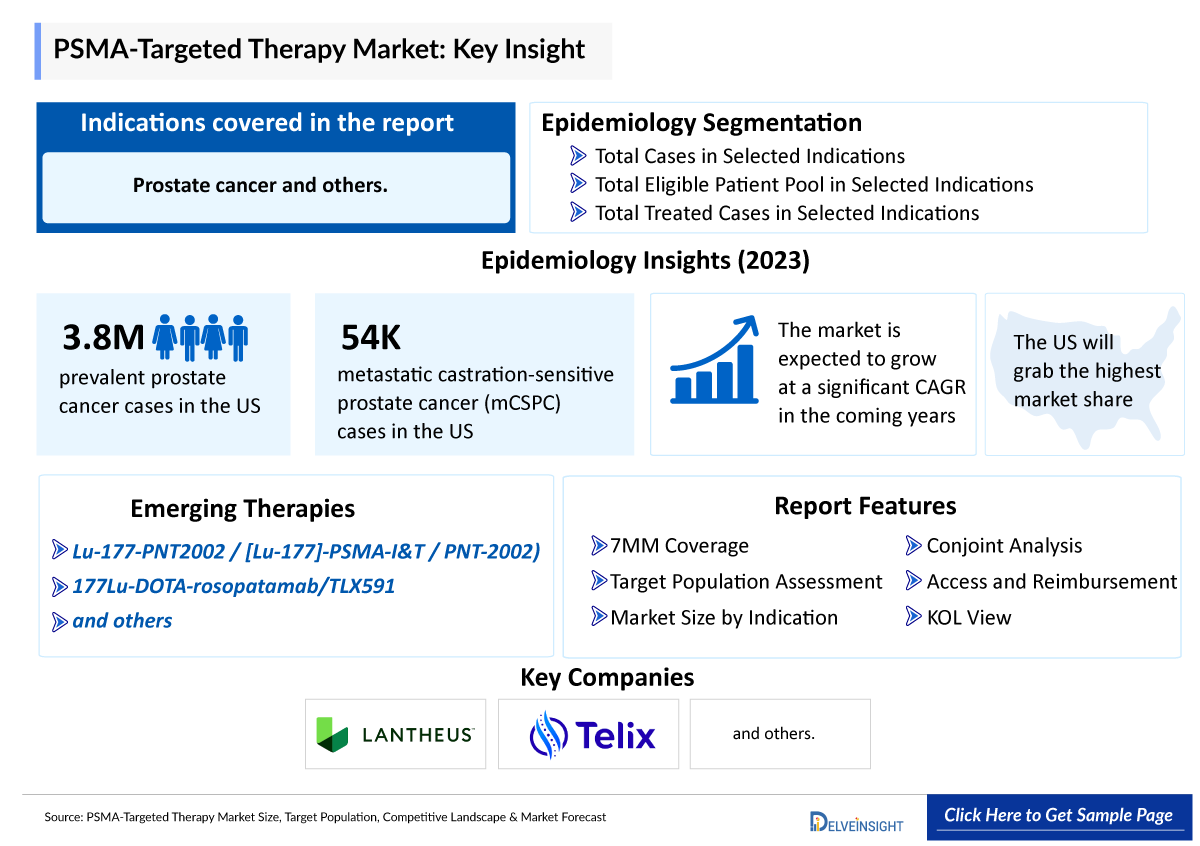
The PSMA-targeted therapy market report provides current treatment practices, emerging drugs, market share of the therapy, and current and forecasted 7MM PSMA-targeted therapy market size from 2022 to 2036 The report also covers current PSMA-targeted therapy treatment practices/algorithms and unmet medical needs to curate the best opportunities and assess the market’s potential.
Geography Covered
- The United States
- EU4 (Germany, France, Italy, and Spain) and the United Kingdom
- Japan
|
Study Period |
2022–2036 |
|
Forecast Period |
2026–2036 |
|
Geographies Covered |
US, EU4 (Germany, France, Italy, and Spain) the UK, and Japan |
|
PSMA-targeted Therapy Epidemiology |
Segmented by:
|
|
PSMA-targeted Therapy Key Companies |
|
|
PSMA-targeted Therapy Key Therapies |
|
|
PSMA-targeted Therapy Market |
Segmented by:
|
|
PSMA-targeted Therapy Market Analysis |
|
Key Factors
Target Population Analysis
Uncovering potential indications of interest to provide accurate estimates of patient burden eligible for treatment over the study period.
Emerging Therapies
Assessing the therapies in the pipeline (mid-to-late stage) for analyzing safety efficacy data along with their potential market positioning.
Competitive Landscape
Comprehensive Insights into the key competitors, emerging therapies R&D activities, RoA, MoA, and clinical trial analysis.
Market Outlook and Forecast
Future perspective and forecasted Market Size for the study period (2022 to 2036), segmented by share of therapies.
Pricing Trends and Analogue Analysis
Providing insights around current therapy price calculations, and best possible analogues for emerging therapy price analysis with detailed assumptions.
Therapy Launch, Market Access, and Rebates
Revenue assessment based on estimated therapy launches, peak shares, pricing, along with several conversion factors that includes consideration of rebates, price growth, compliance and market access.
PSMA-targeted Therapy Understanding and Treatment Algorithm
PSMA-targeted Therapy Overview
PSMA is a protein found on the surface of prostate cancer cells. PSMA-targeted therapy is an advanced form of cancer treatment that uses a radioactive tracer to specifically seek out and destroy these PSMA-expressing cells. It is typically used for treating advanced or metastatic prostate cancer, especially in cases where the disease no longer responds to standard treatments like surgery or radiation. While this therapy does not cure cancer, its primary goals are to relieve symptoms, reduce tumor size, and slow the cancer’s progression.
Further details related to country-based variations are provided in the report…
PSMA-targeted Therapy Treatment
PSMA-targeted therapy is typically offered to patients after they have undergone other standard prostate cancer treatments, such as chemotherapy, hormone therapy, or chemical castration. If the cancer does not respond to these approaches, a healthcare provider may recommend PSMA-targeted therapy. Before beginning treatment, a thorough review of the patient's medical history and a physical examination are conducted, along with blood tests and imaging studies. Imaging may include a CT scan for detailed 3D images of bones and soft tissues and an MRI for high-resolution images of soft tissue structures. A PSMA PET scan is also performed, using a radiotracer to detect PSMA proteins on cancer cells, helping to precisely locate tumors. During treatment, a small needle is used to inject a standard dose of PSMA therapy, which contains lutetium-177, into a vein, usually in the arm. The injection takes only a few minutes, and patients are typically discharged the same day. Treatments are administered every six weeks, with a total of six sessions over approximately 36 weeks. Blood tests are done between each session to monitor the patient’s response and check for side effects. If the treatment is effective, it concludes after the final session, a little over eight months from the start.
Further details related to country-based variations are provided in the report...
PSMA-targeted Therapy Drug Chapters
The drug chapter segment of the PSMA-targeted therapy reports encloses a detailed analysis of PSMA-targeted therapy marketed drugs and late-stage (Phase III and Phase I/II) pipeline drugs. It also helps understand the PSMA-targeted therapy's clinical trial details, expressive pharmacological action, agreements and collaborations, approval and patent details, advantages and disadvantages of each included drug and the latest news and press releases.
Marketed PSMA-targeted Therapy Drugs
PLUVICTO (Lutetium LU-177 Vipivoide Tetraxetan): Novartis
Lutetium-177 is a radioactive chemical element that destroys prostate cancer cells. The PSMA therapy dose takes the lutetium-177 directly to prostate cancer tumors so that the radiation will have minimal effect on other parts of the body.
It is indicated for the treatment of adult patients with PSMA-positive metastatic castration-resistant prostate cancer (mCRPC) who have been treated with androgen receptor pathway inhibition and taxane-based chemotherapy.
Approval: US: 2022; EU: 2022; JP: 2025
|
PSMA-targeted Therapy Drugs |
PSMA-targeted Therapy Companies |
Indication |
|
PLUVICTO (Lutetium LU-177 Vipivoide Tetraxetan) |
Novartis |
Treatment of adult patients with PSMA-positive metastatic castration-resistant prostate cancer (mCRPC) who have been treated with androgen receptor pathway inhibition and taxane-based chemotherapy. |
Note: Detailed current therapies assessment will be provided in the full report of PSMA-targeted therapy…
Emerging PSMA-targeted Therapy Drugs
177Lu-PSMA-I&T: Curium
177Lu-PSMA-I&T is a radiopharmaceutical used to treat mCRPC. It works by binding to PSMA-expressing tumor cells and destroying them with beta particle radiation. Curium continues to provide clinical trial supplies in the Pivotal ECLIPSE clinical trial (NCT05204927) with no disruptions. Currently, it is being evaluated in Phase III for mCRPC. In February 2026, Curium together with PeptiDream and PDRadiopharma announced that the first patient has been dosed in the companies' registrational clinical trial of 177Lu-PSMA-I&T in Japan for patients with PSMA-positive mCRPC.
177Lu-DOTA-rosopatamab tetraxetan (TLX591): Telix Pharmaceuticals
It is a radioimmunoconjugate comprised of the humanized IgG1 monoclonal antibody rosopatamab, linked to the low-energy beta-emitting radioisotope lutetium-177 via the bifunctional chelating agent DOTA-NHS ester. It is being developed by Telix Pharmaceuticals and is also known as TLX591.
It works by delivering a radioactive payload, lutetium-177, directly to cancer cells expressing PSMA. This targeted approach allows for precise radiation therapy while minimizing damage to surrounding healthy tissue.
Clinical trials have shown promising results for TLX591 in treating advanced prostate cancer, including metastatic castration-resistant prostate cancer. The therapy has demonstrated efficacy in both reducing tumor size and prolonging progression-free survival in patients.
FPI-2265: AstraZeneca
FPI-2265 is an actinium-225-based PSMA-targeting radio-conjugate for mCRPC. FPI-2265 is evaluating 225Ac-PSMA I&T, a small molecule targeting PSMA expressed in prostate cancers. The alpha-emitting radiopharmaceutical is being evaluated in the Phase II TATCIST trial (NCT06402331, AlphaBreak). The TATCIST trial is designed to evaluate patients with mCRPC with progressive disease, including patients who are naive to PSMA-targeted radiopharmaceuticals and those who have been pretreated with 177Lu-based PSMA radiopharmaceuticals such as PLUVICTO. Currently, AstraZeneca has begun evaluating FPI-2265 in Phase II for PSMA-positive mCRPC.
In January 2026, Telix announced that the first patient has been dosed in the Phase III registration study of TLX591-Px (ILLUCCIX, Kit for the preparation of 68Ga-PSMA-11) for prostate cancer imaging in Japanese patients. The patient was dosed at Shonan Kamakura General Hospital (SKGH) in Kamakura, Japan.
Note: Detailed emerging therapies assessment will be provided in the final report…
|
Comparison of Key Emerging AXL Receptor Tyrosine Kinase Inhibitors (TKI) | ||||
|
PSMA-targeted Therapy Drugs |
PSMA-targeted Therapy Companies |
PSMA-targeted Therapy ROA |
PSMA-targeted Therapy Phases |
Indication |
|
Lu-177-PNT2002 / [Lu-177]-PSMA-I&T / PNT-2002) |
Lantheus |
IV |
III |
Prostate Cancer |
|
177Lu-DOTA-rosopatamab/TLX591 |
Telix pharmaceuticals |
IV |
III |
Metastatic Prostate Cancer |
Note: The emerging drug list is indicative; the full list will be given in the final report…
PSMA-targeted Therapy Market Outlook
The PSMA-targeted therapy market is expected to grow significantly in the coming years. This is due to the increasing number of patients who are being diagnosed with prostate cancer, the growing awareness of PSMA-targeted therapy, and the increasing number of PSMA-targeted therapies that are under clinical trials by various companies.
The cell surface glycoprotein PSMA has proven to be an ideal therapeutic target in prostate cancer as it is highly expressed by malignant prostate cells.
Currently, approved PSMA-targeted therapy includes PLUVICTO (Lutetium LU-177 Vipivoide Tetraxetan) by Novartis. It is the only regulatory-approved PSMA-targeted radioligand therapy to date in the setting of PSMA-positive metastatic castration-resistant prostate cancer that has failed androgen receptor pathway inhibitors and taxane chemotherapy.
Currently, PLUVICTO is dominating the PSMA-targeted therapy market, but various PSMA-targeted therapies are under clinical studies which can significantly challenge PLUVICTO's dominance in the future.
In May 2025, Lantheus discontinued development and will not pursue approval of PNT2002 after final SPLASH data showed no overall survival benefit, leaving Novartis's PLUVICTO dominant in the pre-chemo mCRPC setting.
Several key players, including Telix Pharmaceuticals, and others, are involved in developing PSMA-targeted therapy for indications such as Prostate cancer.
According to DelveInsight's analysis, the dynamics of the PSMA-targeted therapies' market are anticipated to change due to extensive R&D activities, and increase in investment for research and development of new PSMA-targeted therapies, and high effectivity of these therapies over other conventional drugs. The market size is expected to increase at a significant CAGR during the study period (2022–2036).
Overall, this is an exciting new class of agents with great potential for development. The maturation of current studies over the next few years will lead to a better understanding of PSMA-targeted therapy and define their role in the therapy of cancer.
PSMA-targeted therapy Drugs Uptake
This section focuses on the uptake rate of potential approved and emerging PSMA-targeted therapy expected to be launched in the market during 2022–2036.
PSMA-targeted therapy Pipeline Development Activities
The PSMA-targeted therapy pipeline report provides insights into different therapeutic candidates in Phase III, Phase II, and Phase I. It also analyzes key players involved in developing targeted therapeutics.
The presence of numerous drugs at different stages is expected to generate immense opportunities for the PSMA-targeted therapy market growth over the forecasted period.
PSMA-targeted therapy Pipeline development activities
The PSMA-targeted therapy clinical trials analysis report covers information on collaborations, acquisitions and mergers, licensing, and patent details for PSMA-targeted therapy emerging therapies.
The increasing strategic collaborations among major market players to enhance the growth of their pipeline products are anticipated to drive market expansion. For example, In November 2022, Point Biopharma entered into a strategic collaboration and exclusive license agreement with Lantheus for the commercialization of PNT2002 (PSMA-targeted therapy). Lantheus received exclusive worldwide rights, excluding certain territories for PNT2002.
The agreement has been finalized with an initial payment of USD 250 million and the potential for an additional USD 250 million contingent upon approval from US regulators. Also, there is a potential for an additional US 1.3 billion in various net sales and royalties of 20% on net sales, upon completion of certain milestones.
KOL Views
To keep up with current and future market trends, we take Industry Experts’ opinions working in the domain through primary research to fill the data gaps and validate our secondary research. Industry experts were contacted for insights on PSMA-targeted therapy's evolving treatment landscape, patient reliance on conventional therapies, patient therapy switching acceptability, drug uptake, along challenges related to accessibility.
DelveInsight’s analysts connected with 25+ KOLs to gather insights; however, interviews were conducted with 10+ KOLs in the 7MM. Centers such as Genomic Oncology Clinic and others.
Their opinion helps understand and validate current and emerging therapy treatment patterns or PSMA-targeted therapy market trends. This will support the clients in potential upcoming novel treatments by identifying the overall scenario of the PSMA-targeted Therapy market and the unmet needs.
|
KOL Views |
|
“PSMA imaging allows for more precise staging and detection of biochemical recurrence, often outperforming traditional imaging techniques. The next step is to harness this precision for targeted radiotherapeutics, particularly in men with metastatic castration-resistant prostate cancer (mCRPC).” MD, PhD, University of Southern California, US "Molecular profiling helps make correct treatment-related decisions and to assess the response of patients toward targeted therapy. For example, 2–3% of prostate cancers have microsatellite instability or high tumor mutational burden, and these tumors respond to immune checkpoint inhibitors. In other cases, homologous recombination-deficient tumors are known to respond to PARP inhibitors. There are many other biomarkers too, including PSMA, that aid in overcoming the challenges with targeted therapy." MD, UH Seidman Cancer Center, US "Astatine can be manufactured domestically using an accelerator, and by establishing a manufacturing base, it is expected that a number of patients will be able to receive the treatment without hospitalization. In the future, it is expected that astatine will be used as a Japan-originated therapy for prostate cancer patients in need of treatment around the world." Professor, Osaka University, Japan
|
PSMA-targeted Therapy Qualitative Analysis
We perform Qualitative and market Intelligence analysis using various approaches, such as SWOT analysis and Conjoint Analysis. In the SWOT analysis, strengths, weaknesses, opportunities, and threats in terms of gaps in disease diagnosis, patient awareness, physician acceptability, competitive landscape, cost-effectiveness, and geographical accessibility of therapies are provided.
Conjoint Analysis analyzes multiple approved and emerging therapies based on relevant attributes such as safety, efficacy, frequency of administration, route of administration, and order of entry. Scoring is given based on these parameters to analyze the effectiveness of therapy.
In efficacy, the trial’s primary and secondary outcome measures are evaluated; for instance, in event-free survival, one of the most important primary outcome measures is event-free survival and overall survival.
Further, the therapies’ safety is evaluated wherein the acceptability, tolerability, and adverse events are majorly observed, and it sets a clear understanding of the side effects posed by the drug in the trials. In addition, the scoring is also based on the probability of success, and the addressable patient pool for each therapy. According to these parameters, the final weightage score and the ranking of the emerging therapies are decided.
SWOT Analysis
STRENGTH
- High specificity for PSMA-expressing tumors enables precise delivery of radiation or payloads, minimizing damage to healthy tissues and reducing side effects compared to chemotherapy.
- Proven clinical efficacy, with trials like VISION showing improved overall survival, radiographic progression-free survival, and quality of life in advanced prostate cancer patients.
WEAKNESS
- Limited efficacy in PSMA-low/negative tumors or non-prostate cancers; requires prior PSMA-PET confirmation, which may exclude some patients.
- High costs, need for specialized facilities, and supply chain issues for radioisotopes like lutetium-177 hinder accessibility.
OPPORTUNITY
- Potential pipeline with next-gen agents (e.g., 177Lu-PSMA-I&T, TLX591) and combinations with immunotherapy or chemotherapy could expand to earlier lines and other PSMA-expressing cancers.
- Alpha-emitters and novel constructs promise higher potency with shorter range, improving outcomes in resistant disease.
THREAT
- Emerging resistance mechanisms and tumor heterogeneity may reduce long-term efficacy, necessitating combination strategies.
- Regulatory hurdles for new indications and geographic disparities in access, particularly in low-resource settings.
PSMA-targeted Therapy Market Access and Reimbursement
Reimbursement for PSMA-targeted therapy has been universal in the United States and other 7MM Countries.
In the UK NICE has evaluated Lutetium-177 vipivotide tetraxetan and concluded that it does not recommend it, within its marketing authorization, for treating PSMA-positive hormone-relapsed metastatic prostate cancer in adults. This recommendation is not intended to affect treatment with lutetium‑177 vipivotide tetraxetan which was started in the NHS before this guidance was published. People having treatment outside this recommendation may continue without change to the funding arrangements in place for them before this guidance was published until they and their NHS clinician consider it appropriate to stop.
The appraisal committee made these recommendations because of the high cost-effectiveness estimates and a lack of new data comparing lutetium‑177 vipivotide tetraxetan with relevant medicines, and stated lutetium‑177 vipivotide tetraxetan cannot be recommended for use in the Cancer Drugs Fund.
The PSMA-targeted Therapy therapeutics market report further provides detailed insights on the country-wise accessibility and reimbursement scenarios, cost-effectiveness scenario of approved therapies, programs making accessibility easier and out-of-pocket costs more affordable, insights on patients insured under federal or state government prescription drug programs, etc.
Key Updates on PSMA-targeted Therapy Market
- In February 2026, Curium together with PeptiDream and PDRadiopharma announced that the first patient has been dosed in the companies' registrational clinical trial of 177Lu-PSMA-I&T in Japan for patients with PSMA-positive mCRPC.
- In January 2026, Telix announced that the first patient has been dosed in the Phase III registration study of TLX591-Px (ILLUCCIX, Kit for the preparation of 68Ga-PSMA-11) for prostate cancer imaging in Japanese patients. The patient was dosed at Shonan Kamakura General Hospital (SKGH) in Kamakura, Japan.
- In May 2025, Lantheus discontinued development and will not pursue approval of PNT2002 after final SPLASH data showed no overall survival benefit, leaving Novartis's PLUVICTO dominant in the pre-chemo mCRPC setting.
The above list is not exhaustive and will be provided in the final report.
Scope of the PSMA-targeted Therapy Treatment Market Report
- The PSMA-targeted Therapy therapeutics market report covers a segment of key events, an executive summary, and a descriptive overview of PSMA-targeted therapy, explaining its Scope, Approved drugs, ongoing PSMA-targeted Therapy clinical trials, etc.
- Comprehensive insight into the Competitive Landscape, and forecasts, the future growth potential of diagnosis rate, disease progression, and treatment guidelines have been provided.
- Additionally, an all-inclusive account of the current and emerging PSMA-targeted Therapy therapies and the elaborative profiles of late-stage and prominent therapies will impact the current PSMA-targeted Therapy treatment landscape.
- A detailed review of the PSMA-targeted therapy market, historical and forecasted PSMA-targeted Therapy market size, market share of PSMA-targeted therapy, detailed assumptions, and rationale behind our approach is included in the report, covering the 7MM drug outreach.
- The report provides an edge while developing business strategies, by understanding trends, through SWOT analysis expert insights/KOL views, and treatment preferences that help shape and drive the 7MM PSMA-targeted therapy market.
PSMA-targeted Therapy Treatment market report insights
- PSMA-targeted therapy Targeted Patient Pool
- Therapeutic Approaches
- PSMA-targeted therapy Pipeline Analysis
- PSMA-targeted therapy Market Size and Trends
- Existing and future Market Opportunity
PSMA-targeted therapy treatment market report key strengths
- Eleven years Forecast
- The 7MM Coverage
- Key Cross Competition
- PSMA-targeted Therapy Drugs Uptake and Key PSMA-targeted Therapy Market Forecast Assumptions
PSMA-targeted therapy treatment market report assessment
- Current PSMA-targeted Therapy Treatment Practices
- PSMA-targeted therapy Unmet Needs
- PSMA-targeted Therapy Pipeline Product Profiles
- Market Attractiveness
- Qualitative Analysis (SWOT)
Key Questions
- What was the total PSMA-targeted therapy market size, market share (%) distribution in 2026, and what would it look like in 2036? What are the contributing factors for this growth?
- Which drug is going to be the largest contributor in 2036?
- Which is the most lucrative market for PSMA-targeted therapy?
- Which drug type segment accounts for maximum PSMA-targeted therapy sales?
- What are the pricing variations among different geographies for approved PSMA-targeted Therapy drugs?
- How the reimbursement landscape has for PSMA-targeted therapy evolved since the first one was approved? Do patients have any access issues that are driven by reimbursement decisions?
- What are the risks, burdens, and unmet needs of PSMA-targeted therapy? What will be the growth opportunities across the 7MM concerning the patient population about PSMA-targeted therapy?
- What are the key factors hampering the growth of the PSMA-targeted therapy?
- What are the recent novel therapies, targets, PSMA-targeted Therapy mechanism of action, and technologies developed to overcome the limitations of existing PSMA-targeted Therapy therapies?
- What key designations have been granted for the emerging PSMA-targeted Therapy therapies?
- What is the cost burden of approved drugs of PSMA-targeted therapy on the patient?
- Patient acceptability in terms of preferred PSMA-targeted Therapy treatment options as per real-world scenarios?
- What are the country-specific accessibility issues of expensive, recently approved PSMA-targeted Therapy drugs?
Reasons to buy
- The PSMA-targeted Therapy therapeutics market report will help develop business strategies by understanding the latest trends and changing treatment dynamics driving the PSMA-targeted therapy market.
- Understand the existing market opportunities in varying geographies and the growth potential over the coming years.
- Distribution of historical and current patient share based on real-world prescription data along with reported sales of approved products in the US, EU4 (Germany, France, Italy, and Spain) the United Kingdom, and Japan.
- Identifying strong upcoming PSMA-targeted Therapy companies in the PSMA-targeted Therapy market will help devise strategies to help get ahead of competitors.
- Detailed analysis and ranking of potential current and emerging PSMA-targeted Therapy therapies under the conjoint analysis section to provide visibility around leading therapies.
- Highlights of Access and Reimbursement policies of approved drugs, barriers to accessibility of expensive off-label PSMA-targeted Therapy drugs, and patient assistance programs.
- To understand Key Opinion Leaders’ perspectives around the accessibility, acceptability, and compliance-related challenges of existing PSMA-targeted Therapy treatment to overcome barriers in the future.
- Detailed insights on the unmet needs of the existing market so that the upcoming players can strengthen their development and launch strategy.
Visit delveinsight latest blogs @ Latest Delveinsight Blogs

