
Retinoscope Market Summary
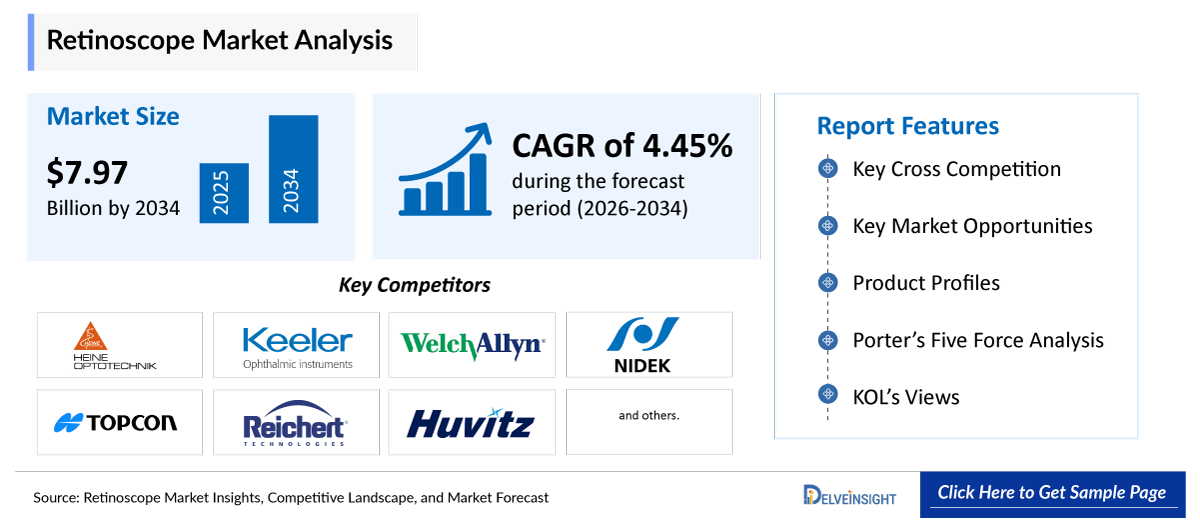
- The Global Retinoscope Market was valued at USD 4.70 billion in 2025 and is expected to reach USD 7.97 billion by 2034, reflecting steady and sustained growth driven by the escalating global burden of refractive errors and vision impairment, rising geriatric populations with increasing incidence of age-related ocular conditions, rapid adoption of LED-illuminated and digital Retinoscope platforms, and continuous expansion of ophthalmic diagnostic infrastructure across both developed and emerging healthcare markets.
- The Global Retinoscope Market is growing at a CAGR of 4.45% during the forecast period from 2026 to 2034.
Retinoscope Market Size and Forecasts
- The rising global burden of vision impairment with the World Health Organization (WHO, 2023) reporting that at least 2.2 billion people worldwide have a vision impairment or blindness with uncorrected refractive errors being the leading cause affecting over 500 million people globally, the International Agency for the Prevention of Blindness (IAPB, 2022) projecting myopia to affect 4.9 billion people by 2050, the growing aging global population with the WHO estimating over 2.1 billion people aged 60 or older by 2050 creating disproportionate demand for refractive error diagnostics, rapid technological innovation in LED-based and digital Retinoscope platforms improving illumination and diagnostic precision, and expanding ophthalmic care infrastructure across Asia-Pacific driving high-volume device deployments are collectively accelerating the Retinoscope market through the forecast period from 2026 to 2034.
- The leading Retinoscope Companies include HEINE Optotechnik GmbH & Co. KG, Keeler Ltd., Welch Allyn (Baxter International Inc.), NIDEK Co., Ltd., Topcon Corporation, Reichert Technologies (AMETEK, Inc.), Huvitz Co., Ltd., Carl Zeiss AG, Volk Optical Inc., NEITZ INSTRUMENTS Co., Ltd., Kowa Company Ltd., Optovue, Inc., Rudolf Riester GmbH, Zumax Medical Co., Ltd., Suzhou Kangjie Medical Co., Ltd., Opticlar Vision Ltd., US Ophthalmic Inc., Naugra Medical, Advin Health Care, Halma plc. and others.
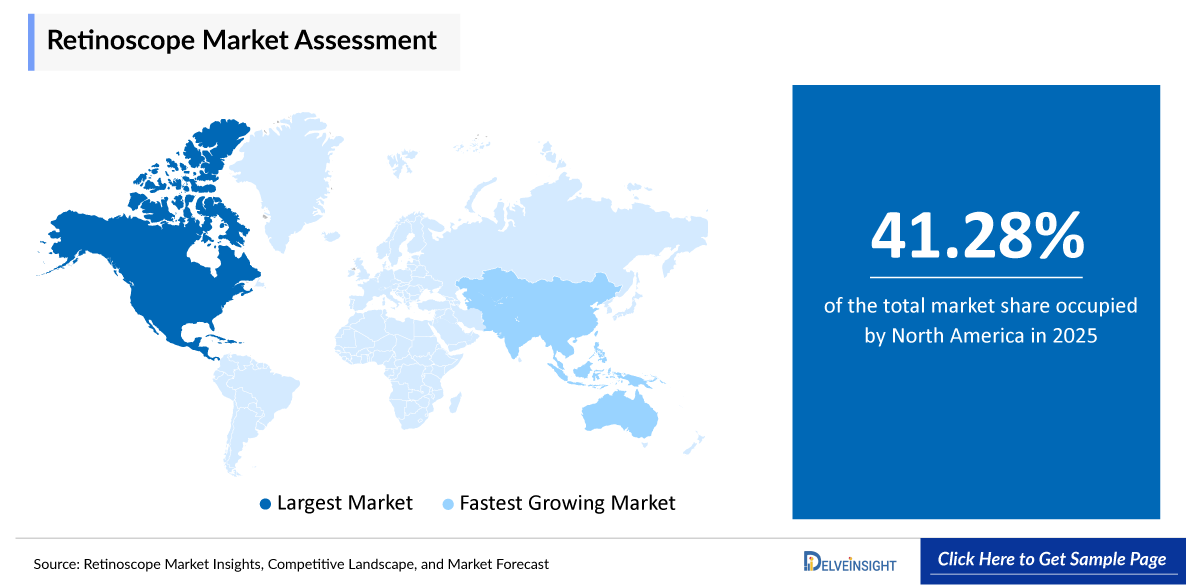
- North America is expected to dominate the Retinoscope market with 38.46% of global Retinoscope market revenue in 2025, driven by the highest per-capita ophthalmic care utilization globally with over 110 million annual eye exams performed in the United States alone, well-developed ophthalmology and optometry infrastructure with more than 94,000 licensed eye care professionals performing retinoscopy as a routine diagnostic standard, strong FDA regulatory frameworks enabling rapid adoption of advanced Retinoscope technologies, and robust private healthcare investment supporting continuous diagnostic instrument upgrades across hospital and specialty eye clinic networks.
- In the product type segment of the Retinoscope Market, the handheld Retinoscope category accounted for 34.27% of global Retinoscope Market revenue in 2025, driven by its portability, wide clinical applicability across hospital wards, outpatient clinics, mobile eye camps, and school screening programs, ease of use in diverse examination environments, and strong preference among eye care professionals for flexible field-deployable diagnostic tools that do not require fixed clinical infrastructure.
Request for unlocking the report of the @ Retinoscope Market
Retinoscope Market Size and Forecasts
|
Report Metrics |
Details |
|
2025 Retinoscope Market Size |
USD 4.70 billion |
|
2034 Projected Retinoscope Market Size |
USD 7.97 billion |
|
Retinoscope Growth Rate (2026-2034) |
4.45% CAGR |
|
Largest Retinoscope Market |
North America |
|
Fastest Growing Retinoscope Market |
Asia-Pacific |
|
Retinoscope Market Structure |
Moderately Concentrated |
Factors Contributing to the Growth of the Retinoscope Market
-
Rising global prevalence of refractive errors and vision impairment driving diagnostic demand
The escalating global burden of refractive errors is the foundational structural growth driver for the Retinoscope market. According to the World Health Organization (WHO, 2023), at least 2.2 billion people worldwide have a vision impairment or blindness, with uncorrected refractive errors identified as the leading cause, affecting over 500 million people. The National Library of Medicine (NLM, 2021) reported that the prevalence of myopia accounted for 27.0% of the global population in 2010 and is projected to reach 52.0% by 2050.
In 2024, the global ophthalmic diagnostic devices market reported that more than 2.6 billion people were affected by vision impairment, with refractive errors accounting for 49% of cases. Retinoscopy is routinely used in over 82% of eye examinations conducted in secondary and tertiary care facilities globally, making the Retinoscope an indispensable and non-substitutable diagnostic instrument for the world's growing population of refractive error patients.
-
Aging global population creating sustained demand for ophthalmic diagnostics
The rapidly aging global population is creating a structural and sustained expansion in demand for retinoscopy and ophthalmic diagnostic services. According to the World Health Organization (WHO, 2022), the proportion of the global population aged 60 or over is projected to double to 2.1 billion by 2050, with age-related refractive conditions, including presbyopia, cataracts, and hyperopia, creating disproportionately higher diagnostic service demands. The WHO estimates over 95 million people aged 50 and older are visually impaired due to uncorrected refractive errors.
According to the National Library of Medicine (NLM, 2021), the prevalence of myopia in China is estimated at 10% and in India at 20%, with these two nations alone representing over 2.8 billion people whose growing elderly populations will require increasing retinoscopic examination services. In the United States alone, over 166 million Americans used prescription eyewear in 2024, with 79% of pediatric eye examinations relying on objective retinoscopy findings, illustrating the sustained institutional demand for precision retinoscopic instruments.
-
Technological advances in LED illumination, digital Retinoscopes, and portable platforms
Continuous technological innovation in Retinoscope design and functionality is creating active product replacement cycles and expanding the clinical utility of Retinoscopes across new deployment settings. LED-based Retinoscopes dominated the technology segment in 2025, offering superior illumination consistency, energy efficiency, longer device lifetime, and more stable light sources compared to conventional halogen or incandescent designs, making them the preferred platform across both high-income and cost-sensitive clinical markets.
Digital Retinoscopes are expected to grow at the fastest CAGR through 2034, integrating data storage, diagnostic software connectivity, telemedicine platform compatibility, and digital display capabilities that transform the Retinoscope from a standalone manual instrument into a connected diagnostic data capture tool. In February 2025, HEINE Optotechnik GmbH & Co. KG enhanced its Retinoscope lineup with advanced LED illumination and high-precision optics. In January 2025, Keeler Ltd. introduced upgraded Retinoscopes featuring LED technology and improved portability.
What are the Latest Retinoscope Market Dynamics and Trends?
The rising global prevalence of refractive errors and vision impairment, the accelerating aging of the global population creating sustained growth in ophthalmic diagnostic service demand, continuous technological advances in LED illumination and digital Retinoscope platforms, and the rapid expansion of ophthalmic infrastructure in the Asia-Pacific and developing economies are collectively driving exceptional and sustained growth in the global Retinoscope market.
According to the World Health Organization (WHO, 2023), at least 2.2 billion people worldwide have a vision impairment or blindness, representing the most prevalent non-communicable disease burden globally, with uncorrected refractive errors constituting the leading single cause of vision impairment worldwide. The National Library of Medicine (NLM, 2021) reported that myopia prevalence accounted for 27.0% of the global population in 2010 and is projected to reach 52.0% by 2050, representing a doubling of the world's myopic population within the clinical careers of today's practicing eye care professionals.
In the United States alone, Retinoscopes are utilized in over 88% of ophthalmology and optometry clinics, with annual eye examinations exceeding 110 million, reinforcing steady market demand. Data reported for the U.S. market indicates that more than 94,000 licensed optometrists and ophthalmologists perform retinoscopy as part of routine clinical diagnostics, with 79% of pediatric eye examinations depending on objective retinoscopy findings - illustrating the clinical non-substitutability of the Retinoscope in pediatric ophthalmic assessment where reliable subjective responses cannot be obtained.
Globally, ophthalmology visits are estimated to exceed 4.1 billion annually, with Retinoscopes routinely employed across 82% of examinations conducted in secondary and tertiary care facilities.
The technological evolution of Retinoscope platforms from conventional halogen illumination through LED-based systems to digitally integrated smart devices is the most commercially significant trend reshaping market dynamics. LED Retinoscopes dominated the technology market in 2025, displacing halogen instruments across new installations due to their superior illumination stability, extended battery life enabling uninterrupted mobile clinical use, and more consistent reflex quality that reduces clinician effort and improves diagnostic reliability.
Digital Retinoscopes are growing at the fastest CAGR through 2034, integrating Bluetooth connectivity, digital display interfaces, electronic data storage, and telemedicine platform compatibility that transform the Retinoscope into a connected clinical data capture device.
- In September 2023, HEINE Optotechnik GmbH & Co. KG launched the HEINE BETA 520, a cutting-edge Retinoscope and ophthalmoscope set featuring digital displays and Bluetooth connectivity for enhanced data management.
- In February 2025, HEINE further enhanced its lineup with advanced LED illumination and high-precision optics.
- In January 2025, Keeler Ltd. introduced upgraded Retinoscopes with LED technology, ergonomic designs, and improved portability.
- In March 2025, Welch Allyn expanded its ophthalmic portfolio with advanced Retinoscope sets combining precision optics and improved ergonomics for clinical workflow optimization. In November 2023, Oftalmika Medical Equipment partnered with NIDEK Co. to distribute the Retinomax K-1, a portable digital Retinoscope, strengthening European market coverage.
The expansion of ophthalmic care infrastructure across Asia-Pacific and emerging markets represents the third critical market growth dynamic. Asia-Pacific is the fastest-growing regional Retinoscope market through 2034, driven by rising rates of eye-related disorders, particularly myopia among school-aged populations in China, Japan, South Korea, and India, government-backed vision care programs including school-based myopia screening mandates, and rapid expansion of private ophthalmology and optometry clinic networks.
Government-funded ophthalmic screening programs in India and China are creating institutional procurement demand for affordable, reliable Retinoscope instruments at community health centers, school screening programs, and mobile eye camps. The International Agency for the Prevention of Blindness (IAPB, 2022) estimates that over 80% of vision impairment cases globally are preventable or treatable, directing significant public health investment toward early detection programs where Retinoscopes are indispensable diagnostic tools.
However, the Retinoscope Market faces several significant growth constraints. The high acquisition cost of advanced digital Retinoscopes and premium LED platforms can deter adoption among smaller optometry practices and healthcare facilities in cost-sensitive developing market segments, where budget-priced instruments from Chinese manufacturers represent the accessible procurement option. The growing availability of automated refraction technologies, including autorefractors and wavefront aberrometers, creates partial competitive substitution pressure in practice settings where objectivity and throughput efficiency may be prioritized over the manual retinoscopy technique.
Regulatory requirements for medical device CE marking in Europe and FDA clearance in the United States create compliance investment requirements and market entry delays that constrain the commercialization timelines of smaller device innovators. Additionally, COVID-19 created lasting inhibition of hands-on retinoscopy training among new clinicians, as the proximity requirements of the technique create infection transmission concerns in post-pandemic clinical environments, with some clinical programs having permanently increased their reliance on automated refraction as a substitute response.
Retinoscope Market Report Segmentation
This Retinoscope market report offers a comprehensive overview of the global Retinoscope market, highlighting key trends, growth drivers, challenges, and opportunities. It covers detailed market segmentation by Type (Streak Retinoscope and Spot Retinoscope), Product Form (Handheld Retinoscope and Tabletop Retinoscope), Light Source Technology (LED Retinoscope, Halogen Retinoscope, and Hybrid Retinoscope), Technology (Conventional Retinoscope and Digital Retinoscope), Distribution Channel (Direct Sales, Distributor Sales, and Online Sales), End-User (Hospitals, Ophthalmic Centers, Optometry Clinics, and Others), and Geography.
The Retinoscope Market Report provides valuable insights into the competitive landscape, regulatory environment, and market dynamics across major markets, including North America, Europe, and Asia-Pacific. A Retinoscope is a specialized ophthalmic diagnostic instrument used by ophthalmologists and optometrists to objectively measure the refractive error of the human eye, determining the degree of myopia (nearsightedness), hyperopia (farsightedness), and astigmatism without requiring subjective responses from the patient.
The instrument operates by projecting a beam of light into the patient's eye through a rotating mirror and observing the movement of the resultant light reflex reflected from the patient's retina. By observing whether the reflex moves with or against the direction of the light beam sweep, and by inserting trial lenses until a neutralization point is reached, the examiner quantifies the refractive correction needed. Retinoscopy is particularly indispensable for patients who cannot provide reliable subjective responses, including infants and young children, non-verbal patients, patients with cognitive impairments, and individuals from language-barrier backgrounds, making it uniquely valuable across diverse clinical populations.
Retinoscopes are classified into streak Retinoscopes, which project a slit-shaped beam of light enabling precise axis identification for astigmatic correction, and spot Retinoscopes, which project a circular beam of light suited for myopia and hyperopia screening. Within each classification, instruments vary by light source technology (LED, halogen, or hybrid), form factor (handheld portable or tabletop clinical station), functionality (conventional manual or digitally enhanced with data connectivity), and power source (battery-operated or mains-connected).
The instrument is deployed across a broad spectrum of clinical settings from high-volume hospital ophthalmology departments through specialist eye clinics, optometry practices, school-based vision screening programs, and mobile community eye care outreach programs.
The Retinoscope Market is driven by the converging forces of the global vision impairment burden affecting 2.2 billion people (WHO, 2023), the technological shift toward LED and digital diagnostic platforms enabling improved accuracy and clinical workflow connectivity, and the sustained demographic trend of a rapidly aging global population requiring increasingly frequent ophthalmic examination services. These forces ensure that Retinoscope demand grows proportionally with the global expansion of eye care services while technology-driven replacement cycles generate additional commercial momentum independent of underlying volume growth.
Get More Insights into the Report @ Retinoscope Market
Retinoscope Market Segment Analysis
Retinoscope Market by Type (Streak Retinoscope and Spot Retinoscope), Product Form (Handheld Retinoscope and Tabletop Retinoscope), Light Source Technology (LED Retinoscope, Halogen Retinoscope, and Hybrid Retinoscope), Technology (Conventional Retinoscope and Digital Retinoscope), Distribution Channel (Direct Sales, Distributor Sales, and Online Sales), End-User (Hospitals, Ophthalmic Centers, Optometry Clinics, and Others), and Geography (North America, Europe, Asia-Pacific, and Rest of the World).
-
Retinoscope Market Segmentation By Type
The Streak Retinoscope category is expected to dominate the market with the largest revenue share. In the type segment of the Retinoscope market, streak Retinoscopes account for 61% of total global market revenue in 2025. The dominance of streak Retinoscopes reflects their superior clinical versatility compared to spot instruments, as the slit-shaped beam projection enables simultaneous assessment of refractive power and astigmatic axis in a single examination sequence, providing the full prescription data needed for spectacle lens fabrication from a single instrument technique.
Streak Retinoscopes are the standard clinical instrument taught across ophthalmology and optometry training programs globally, resulting in a large installed base of trained practitioners who prefer streak instruments for routine clinical practice. HEINE Optotechnik's Retinoscope portfolio is anchored by streak instruments recognized for their optical precision and illumination quality, while Keeler's streak Retinoscope range maintains a strong market presence, particularly in the United Kingdom and Commonwealth countries.
The clinical superiority of streak retinoscopy over spot technique in detecting and quantifying astigmatism has made it the preferred methodology in clinical education and practice guidelines from major professional bodies, including the American Academy of Ophthalmology and the World Council of Optometry, reinforcing institutional preference for streak instruments across clinical procurement cycles. In pediatric retinoscopy, over 79% of U.S. pediatric eye examinations rely on objective retinoscopy.
The streak Retinoscope is the standard of care instrument, as the linear reflex provides clearer visual information for reflex movement interpretation in challenging pediatric examination scenarios. Spot Retinoscopes retain a significant market share in screening contexts where speed of examination and simplified operation are prioritized over comprehensive prescription determination, particularly in large-volume community and school screening programs.
-
Retinoscope Market Segmentation By Light Source Technology
The LED Retinoscope category is expected to dominate the market with the largest revenue share. In the light source technology segment of the Retinoscope market, LED Retinoscopes accounted for 48.19% of total global market revenue in 2025.
The dominant market position of LED technology reflects its decisive performance advantages over conventional halogen illumination across the dimensions most critical to clinical utility: consistent illumination intensity that does not change as battery charge depletes, significantly extended device runtime enabling full clinical sessions without battery replacement, longer device lifetime with LED elements rated for tens of thousands of hours compared to hundreds of hours for halogen bulbs, higher energy efficiency enabling lighter and more portable device designs, and more stable light color temperature providing consistent reflex quality across examination sessions.
HEINE Optotechnik's February 2025 enhancement of its Retinoscope lineup with advanced LED illumination underscores how the market's quality leader has fully committed to LED as the illumination technology of choice for premium clinical instruments. Keeler's January 2025 launch of upgraded LED Retinoscopes with improved portability further demonstrates the industry-wide transition to LED across both established European manufacturers.
The LED segment's dominance is particularly pronounced in new instrument installations across hospital ophthalmology departments and organized optical chains that prioritize reliability and workflow consistency over the lowest acquisition cost. Hybrid Retinoscopes, combining LED and other light source technologies, are projected to grow at the fastest CAGR through 2034, reflecting the demand for instruments offering multiple illumination modes for different clinical applications from a single device platform.
-
Retinoscope Market Segmentation By Distribution Channel
The Direct Sales channel accounted for the largest revenue share in 2025. In the distribution channel segment of the Retinoscope market, direct sales accounted for 39.56% of total global market revenue in 2025. The dominance of direct sales channels reflects the institutional procurement patterns of the market's primary buyers: hospitals, hospital eye departments, ophthalmology specialty centers, and organized optometry chains that purchase Retinoscopes through direct manufacturer or authorized distributor contracts, often as part of broader ophthalmic diagnostic equipment procurement packages that include slit lamps, autorefractors, tonometers, and other instruments.
HEINE Optotechnik, Keeler, and Welch Allyn all maintain strong direct sales relationships with institutional procurement departments, supported by clinical account managers, demonstration programs, and service contract frameworks that make direct channel engagement the preferred procurement approach for high-value clinical buyers.
Online sales are expected to grow at the fastest CAGR through 2034, driven by increasing digital purchasing adoption across smaller optometry practices and independent eye care providers who prioritize price comparison, product specification comparison, and procurement convenience through online medical device platforms. The expansion of medical device e-commerce platforms and manufacturer direct-to-practitioner online stores is enabling previously distributor-dependent small practices to access broader product ranges at competitive prices, supporting online channel growth.
The distributor sales channel, serving mid-size regional buyers and geographically dispersed markets, maintains a significant secondary share, particularly important for market penetration in Asia-Pacific and Latin American markets, where established regional medical device distributors serve as the primary commercial infrastructure for international manufacturers' market access.
-
Retinoscope Market Segmentation By End-User
The Hospitals segment accounted for the highest market share in 2025. In the end-user segment of the Retinoscope market, hospitals accounted for 41.28% of total global Retinoscope market revenue in 2025. Hospital dominance in the Retinoscope end-user segment reflects the high patient volumes processed through hospital-based ophthalmology and optometry departments, the institutional procurement capabilities that support investment in premium Retinoscope platforms, and the diverse clinical applications of retinoscopy across hospital settings that range from routine adult refractive assessment through specialized pediatric eye care, pre-surgical screening, and emergency vision assessment.
This dominance is supported by the role of hospital ophthalmology departments as the primary training environment for new ophthalmologists and optometrists, creating institutional commitment to maintaining current, high-quality Retinoscope instrumentation.
Hospitals also benefit from the integration of Retinoscopes within comprehensive ophthalmic diagnostic suites that combine retinoscopy with slit lamp examination, autorefraction, and fundus photography in complete eye examination workflows. The U.S. hospital-based eye care market alone supports over 130,000 annual cataract surgeries requiring pre-operative refractive assessment, along with approximately 15 million annual pediatric eye examinations, where retinoscopy provides the objective measurement backbone.
Ophthalmic centers are expected to grow at the fastest CAGR through 2034, driven by the global proliferation of specialty eye care facilities, the increasing availability of advanced diagnostic equipment in non-hospital settings, and patient preference for specialized outpatient care settings over general hospital environments for routine eye care services.
Retinoscope Market Regional Analysis
-
North America Retinoscope Market Trends
North America accounted for 38.46% of the global Retinoscope market revenue in 2025, representing the highest regional market share globally. North America's market leadership is anchored by the United States' position as the world's largest single national ophthalmic care market, with annual eye examinations exceeding 110 million, over 94,000 licensed eye care professionals performing retinoscopy in routine practice, and 88% of ophthalmology and optometry clinics utilizing Retinoscopes as standard diagnostic equipment.
According to the National Eye Institute (NIH, 2023), myopia prevalence among Americans aged 12 to 54 is 41.6%, representing over 150 million Americans with corrective lens requirements, a patient population that generates continuous high-volume demand for retinoscopic examination services. The U.S. market benefits from strong FDA regulatory frameworks providing institutional confidence in device safety and quality, and well-developed private healthcare investment supporting rapid adoption of advanced LED and digital Retinoscope platforms across hospital and specialty eye clinic networks.
Industry investment trends in North America are strongly supportive of continued market growth. Welch Allyn's March 2025 expansion of its ophthalmic diagnostic portfolio with advanced Retinoscope and combined diagnostic sets strengthens North American market coverage and drives replacement of legacy instruments. The 2023 acquisition by Hillrom (Welch Allyn's parent) of Telemed Corporation's ophthalmic assets demonstrated the active M&A investment in expanding the ophthalmic diagnostic technology footprint.
-
Europe Retinoscope Market Trends
Europe held 31% of the global Retinoscope market revenue in 2025, representing the second-largest regional market globally. Europe benefits from the presence of the world's two leading Retinoscope manufacturers, HEINE Optotechnik GmbH & Co. KG (Germany) and Keeler Ltd. (United Kingdom), whose global leadership positions support strong regional demand and serve as technological reference points for the global market.
Europe's well-developed ophthalmic care systems across Germany, France, the United Kingdom, and the Nordic countries, combined with universal or near-universal healthcare system investment in ophthalmic diagnostic equipment, create stable institutional procurement demand for premium Retinoscope platforms. The EU MDR regulatory framework ensures high product quality standards that drive systematic instrument upgrade cycles.
The November 2023 partnership between Oftalmika Medical Equipment and NIDEK Co. for European distribution of the Retinomax K-1 portable digital Retinoscope demonstrates active market development across European distribution networks. Carl Zeiss AG's December 2023 acquisition of the Dutch Ophthalmic Research Center expanded its ophthalmic device portfolio, reinforcing European investment in advanced diagnostic instrument technology. The rapidly aging European population, with Eurostat projecting EU citizens aged 65 and over to reach 29.4% of the total population by 2100, creates sustained structural demand for retinoscopy services.
-
Asia-Pacific Retinoscope Market Trends
Asia-Pacific is the fastest-growing regional Retinoscope Market, expected to register a CAGR of 6.30% through 2034, the highest of any global region. The region's rapid growth is driven by the world's highest rates of myopia particularly among school-aged populations in China, Japan, South Korea, and India, rapid expansion of organized ophthalmology and optometry infrastructure in China and India, government-backed myopia control and school vision screening programs creating institutional procurement demand for affordable diagnostic instruments, and a rapidly growing middle class with increasing access to and demand for eye care services.
The National Library of Medicine data (NLM, 2021) indicates myopia prevalence of 10% in China and 20% in India, with rapidly rising prevalence particularly among urban youth populations. China's government myopia prevention initiative mandates systematic school eye screening requiring ophthalmic diagnostic equipment, including Retinoscopes, at educational facilities and community health centers, creating large-scale institutional procurement demand across one of the world's most populous markets.
India's Ayushman Bharat scheme and National Programme for Control of Blindness and Visual Impairment are expanding the network of vision correction centers, each requiring Retinoscope equipment. The Asia-Pacific market is also served by cost-competitive domestic manufacturers, including Suzhou Kangjie Medical Co., Ltd. (China), which upgraded optical components in 2024, improving streak definition accuracy by 29%, and Zumax Medical Co., Ltd. (China), which launched lightweight handheld Retinoscopes weighing under 300 grams in 2024, addressing the region's demand for affordable and ergonomically optimized field-deployable instruments.
-
Rest of World Retinoscope Market Trends
The Rest of World region, encompassing the Middle East, Africa, and South America, accounted for 9% of global Retinoscope market revenue in 2025 and represents a steadily growing opportunity as healthcare infrastructure expands and public health programs address the substantial unaddressed vision impairment burden in low- and middle-income countries. The International Agency for the Prevention of Blindness (IAPB, 2022) estimates that over 80% of global vision impairment is preventable or treatable, and that the majority of unaddressed cases are concentrated in low- and middle-income countries, creating a significant long-term market development opportunity as healthcare investment increases.
The Middle East's rapid private healthcare expansion, particularly across Gulf Cooperation Council countries, is driving ophthalmic infrastructure investment that includes Retinoscope procurement. South America's growing private ophthalmology sector, led by Brazil's expanding private healthcare market, contributes to regional Retinoscope demand.
WHO-supported universal eye health programs and initiatives from the IAPB's Vision 2020 legacy are progressively expanding eye care facility networks in Sub-Saharan Africa, with mobile eye camp programs relying on portable handheld Retinoscopes as the primary refractive assessment tool.
Who are the Major Players in the Retinoscope Market?
Retinoscope Companies
- HEINE Optotechnik GmbH & Co. KG
- Keeler Ltd.
- Welch Allyn (Baxter International Inc.)
- NIDEK Co., Ltd.
- Topcon Corporation
- Reichert Technologies (AMETEK, Inc.)
- Huvitz Co., Ltd.
- Carl Zeiss AG
- Volk Optical Inc.
- NEITZ INSTRUMENTS Co., Ltd.
- Kowa Company Ltd.
- Optovue, Inc.
- Rudolf Riester GmbH
- Zumax Medical Co., Ltd.
- Suzhou Kangjie Medical Co., Ltd.
- Opticlar Vision Ltd.
- US Ophthalmic Inc.
- Naugra Medical
- Advin Health Care
- Halma plc
- Others.
How is the Competitive Landscape Shaping the Retinoscope Market?
The competitive landscape of the Retinoscope Market is moderately concentrated, with HEINE Optotechnik GmbH & Co. KG, Keeler Ltd., and Welch Allyn collectively accounting for an estimated more than 35% of the premium clinical Retinoscope segment by revenue. HEINE Optotechnik is widely recognized as the global quality leader and benchmark for premium Retinoscope instrumentation, with its German engineering heritage, extensive product portfolio covering streak and spot Retinoscopes in handheld and diagnostic set configurations, continuous investment in LED illumination technology and optical precision, and established clinical preference among demanding ophthalmic specialists across all global markets. HEINE's February 2025 launch of enhanced LED illumination Retinoscopes and the September 2023 introduction of the HEINE BETA 520 with Bluetooth connectivity and digital displays demonstrate an active innovation strategy, maintaining competitive advantage at the premium market tier.
Keeler Ltd. occupies a strong second-tier position, particularly dominant in the United Kingdom and Commonwealth market segments, with a product range emphasizing ergonomic design, LED illumination, and competitive pricing relative to HEINE's premium positioning. Keeler's January 2025 launch of upgraded LED Retinoscopes with improved portability reinforces its strategy of competing on technology advancement at more accessible price points.
Welch Allyn (Baxter International Inc.), with its March 2025 expansion of combined ophthalmic diagnostic sets including advanced Retinoscopes, leverages its broader diagnostic instrument portfolio and extensive U.S. hospital distribution network to drive Retinoscope sales within comprehensive ophthalmic examination equipment procurement programs.
Geographic reach represents a critical competitive differentiator in the Retinoscope market, as manufacturers with established global distribution networks and local service infrastructure can win hospital and institutional procurement contracts that require ongoing calibration support, maintenance, and accessories supply. HEINE, Keeler, and Welch Allyn all maintain global distribution networks spanning North America, Europe, and Asia-Pacific. NIDEK Co., Ltd. and Topcon Corporation bring strong Asia-Pacific regional reach through their broad ophthalmic instrument portfolios.
The November 2023 Oftalmika-NIDEK distribution partnership for the Retinomax K-1 in Europe exemplifies the geographic expansion strategies pursued by Japanese manufacturers in the European market. Pipeline strength in the Retinoscope market centers on digital connectivity, AI-assisted reflex analysis, multi-mode illumination platforms, and miniaturized portable designs for mobile deployment. Manufacturing capabilities remain a critical competitive factor, with European manufacturers maintaining premium engineering benchmarks while Chinese manufacturers, including Suzhou Kangjie Medical and Zumax Medical, deliver competitive quality at lower price points, expanding market access in cost-sensitive segments and geographies.
Retinoscope Market Recent Breakthroughs and Developments
- In March 2025, Welch Allyn (Baxter International Inc.) expanded its ophthalmic diagnostic portfolio with advanced Retinoscopes and combined diagnostic sets designed to improve precision, ergonomics, and workflow efficiency for clinicians. Strategic significance: Reinforces Welch Allyn's competitive positioning in the integrated ophthalmic diagnostic instrument segment and strengthens adoption across hospital and outpatient clinic networks globally.
- In February 2025, HEINE Optotechnik GmbH & Co. KG enhanced its Retinoscope product lineup with advanced LED illumination and high-precision optics, focusing on durability, accuracy, and clinician comfort. Strategic significance: Reinforces HEINE's global quality leadership and drives replacement demand among premium clinical buyers upgrading to superior LED illumination platforms.
- In January 2025, Keeler Ltd. introduced upgraded Retinoscopes featuring LED technology, ergonomic designs, and improved portability targeted at enhancing diagnostic efficiency and user convenience across ophthalmic centers and healthcare facilities. Strategic significance: Positions Keeler competitively in the rapidly growing LED Retinoscope segment while maintaining its accessibility advantage relative to HEINE's premium pricing.
- In December 2023, Luneau Technology Group announced the iLuneau Retino, an AI-powered Retinoscope device providing real-time guidance and data analysis for healthcare professionals. Strategic significance: Represents the most advanced AI integration yet attempted in a Retinoscope platform, signaling the future competitive direction of the digital Retinoscope segment toward AI-assisted reflex analysis and automated prescription determination.
- In November 2023, Oftalmika Medical Equipment partnered with NIDEK Co., Ltd. to distribute the Retinomax K-1, a compact and portable digital Retinoscope, across the European market. Strategic significance: Strengthens NIDEK's European market coverage for its digital Retinoscope portfolio and expands access to portable retinoscopy technology across European clinical settings.
- In September 2023, HEINE Optotechnik GmbH & Co. KG launched the HEINE BETA 520, a cutting-edge ophthalmoscope and Retinoscope set featuring digital displays and Bluetooth connectivity. Strategic significance: Marks HEINE's strategic entry into the digital-connected Retinoscope segment, integrating data capture and wireless connectivity into its premium ophthalmic diagnostic instrument platform.
- In May 2023, Hillrom (Welch Allyn's parent company, Baxter International Inc.) augmented its ophthalmic portfolio by acquiring Telemed Corporation's ophthalmic assets, including innovative digital Retinoscopes. Strategic significance: Expanded Welch Allyn's digital Retinoscope product range and enhanced its competitive positioning in the growing digital ophthalmic diagnostic instrument segment.
- In December 2023, Carl Zeiss Meditec AG announced the acquisition of the Dutch Ophthalmic Research Center, expanding its ophthalmic device portfolio for addressing a range of eye conditions, including refractive errors. Strategic significance: Strengthens Carl Zeiss's ophthalmic diagnostic instrument ecosystem and research capabilities, potentially broadening its Retinoscope-adjacent product development pipeline.
- In 2024, Zumax Medical Co., Ltd. launched lightweight handheld Retinoscopes weighing under 300 grams, reducing clinician fatigue by 32% compared to previous generation models. Strategic significance: Addresses a practical clinical ergonomics need in mobile and high-volume examination settings, differentiating Zumax's emerging market competitive positioning through weight optimization.
- In 2024, Suzhou Kangjie Medical Co., Ltd. upgraded its optical components, improving streak definition accuracy by 29% across its Retinoscope product line. Strategic significance: Demonstrates the rapid quality advancement of Chinese Retinoscope manufacturers, narrowing the performance gap with premium European brands and expanding competitive options for cost-sensitive market segments.
- In 2025, Opticlar Vision Ltd. enhanced battery efficiency across its Retinoscope platform, increasing average device runtime by 44% in clinical usage scenarios. Strategic significance: Addresses a critical operational need for mobile and high-volume clinical settings where extended battery life directly translates into improved clinical workflow and reduced examination interruptions.
- In 2023, Halma plc expanded ophthalmic diagnostic offerings through its subsidiary portfolio, increasing Retinoscope availability across 28% more hospital procurement contracts. Strategic significance: Demonstrates the ongoing expansion of Retinoscope market penetration within organized hospital procurement programs, and Halma's strategy of leveraging its multi-brand ophthalmic portfolio to secure broader institutional purchasing commitments.
|
Report Metrics |
Details |
|
Study Period |
2023 to 2034 |
|
Base Year |
2025 |
|
Forecast Period |
2026 to 2034 |
|
Retinoscope Market CAGR | |
|
Retinoscope Companies |
HEINE Optotechnik GmbH & Co. KG, Keeler Ltd., Welch Allyn (Baxter International Inc.), NIDEK Co., Ltd., Topcon Corporation, Reichert Technologies (AMETEK, Inc.), Huvitz Co., Ltd., Carl Zeiss AG, Volk Optical Inc., NEITZ INSTRUMENTS Co., Ltd., Kowa Company Ltd., Optovue, Inc., Rudolf Riester GmbH, Zumax Medical Co., Ltd., Suzhou Kangjie Medical Co., Ltd., Opticlar Vision Ltd., US Ophthalmic Inc., Naugra Medical, Advin Health Care, Halma plc, and others. |
|
Retinoscope Market Segments |
By Type, By Product Form, By Light Source Technology, By Technology, By Distribution Channel, By End-User, and By Geography |
|
Retinoscope Regional Scope |
North America, Europe, Asia Pacific, Middle East, Africa, and South America |
|
Retinoscope Country Scope |
U.S., Canada, Mexico, Germany, United Kingdom, France, Italy, Spain, China, Japan, India, Australia, South Korea, and key countries |
Retinoscope Market Segmentation
Retinoscope Market by Type
- Streak Retinoscope
- Spot Retinoscope
Retinoscope Market by Product Form
- Handheld Retinoscope
- Tabletop Retinoscope
Retinoscope Market by Light Source Technology
- LED Retinoscope
- Halogen Retinoscope
- Hybrid Retinoscope
Retinoscope Market by Technology
- Conventional Retinoscope
- Digital Retinoscope
Retinoscope Market by Distribution Channel
- Direct Sales
- Distributor Sales
- Online Sales
Retinoscope Market by End-User
- Hospitals
- Ophthalmic Centers
- Optometry Clinics
- Others
Retinoscope Market by Geography
- North America Retinoscope Market
- United States Retinoscope Market Size in USD million (2023-2034)
- Canada Retinoscope Market Size in USD million (2023-2034)
- Mexico Retinoscope Market Size in USD million (2023-2034)
- Europe Retinoscope Market
- Germany Retinoscope Market Size in USD million (2023-2034)
- United Kingdom Retinoscope Market Size in USD million (2023-2034)
- France Retinoscope Market Size in USD million (2023-2034)
- Italy Retinoscope Market Size in USD million (2023-2034)
- Spain Retinoscope Market Size in USD million (2023-2034)
- Rest of Europe Retinoscope Market Size in USD million (2023-2034)
- Asia-Pacific Retinoscope Market
- China Retinoscope Market Size in USD million (2023-2034)
- Japan Retinoscope Market Size in USD million (2023-2034)
- India Retinoscope Market Size in USD million (2023-2034)
- Australia Retinoscope Market Size in USD million (2023-2034)
- South Korea Retinoscope Market Size in USD million (2023-2034)
- Rest of Asia-Pacific Retinoscope Market Size in USD million (2023-2034)
- Rest of the World (RoW) Retinoscope Market
- Middle East Retinoscope Market Size in USD million (2023-2034)
- Africa Retinoscope Market Size in USD million (2023-2034)
- South America Retinoscope Market Size in USD million (2023-2034)
Retinoscope Market Recent Industry Trends and Milestones (2023-2026)
|
Category |
Key Developments |
|
Retinoscope Market Product Approval |
HEINE BETA 520 ophthalmoscope and Retinoscope set with Bluetooth and digital display launched (September 2023); HEINE enhanced LED illumination Retinoscope lineup (February 2025); Keeler LED upgraded portable Retinoscopes (January 2025); Welch Allyn advanced combined ophthalmic diagnostic sets with Retinoscope (March 2025); Opticlar 44% battery runtime improvement (2025); Luneau iLuneau Retino AI-powered Retinoscope announced (December 2023) |
|
Retinoscope Market Product Expansion |
Zumax Medical sub-300 gram handheld Retinoscope launched in 2024; Suzhou Kangjie 29% streak definition accuracy improvement in 2024; Welch Allyn Telemed ophthalmic asset acquisition, including digital Retinoscopes (May 2023); Oftalmika-NIDEK Retinomax K-1 European distribution partnership (November 2023); Halma expanded hospital procurement contracts by 28% (2023) |
|
Retinoscope Market Product Investment |
Carl Zeiss Meditec AG's acquisition of Dutch Ophthalmic Research Center, expanding ophthalmic device portfolio (December 2023); LED Retinoscope segment investment driving substantial market share; digital Retinoscope segment projected to grow at a remarkable CAGR through 2034, attracting platform development investment. |
|
Company Strategy |
HEINE Optotechnik: Premium LED illumination and digital connectivity leadership through HEINE BETA 520 and February 2025 lineup enhancement. Keeler Ltd.: LED technology adoption and ergonomic portability competitive positioning at accessible price points. Welch Allyn (Baxter): Integrated diagnostic portfolio strategy through Telemed acquisition and March 2025 combined set expansion. NIDEK Co., Ltd.: European distribution expansion through Oftalmika partnership for portable Retinomax K-1. Zumax/Suzhou Kangjie: Cost-performance competitive positioning through weight and optical quality optimization for Asia-Pacific markets. |
|
Emerging Technologies |
AI-powered retinoscopy with real-time guidance (Luneau iLuneau Retino December 2023); Bluetooth and digital display integration in clinical instruments (HEINE BETA 520); LED illumination with extended battery life replacing halogen across market; sub-300 gram portable handheld form factors for mobile deployment; digital Retinoscopes with telemedicine platform compatibility; smartphone-coupled refraction screening enabling community-level diagnosis (EyeNetra) |
Key Takeaways from the Retinoscope Market Report Study
- Market size analysis for the current Retinoscope market size (2025), and market forecast for 9 years (2026 to 2034).
- Top key product/technology developments, mergers, acquisitions, partnerships, and joint ventures that happened over the last 3 years.
- Key companies dominating the global Retinoscope market.
- Various opportunities available for the other competitors in the Retinoscope market space.
- What are the top-performing segments in 2025? How these segments will perform in 2034?
- Which are the top-performing regions and countries in the current Retinoscope market scenario?
- Which are the regions and countries where companies should have concentrated on opportunities for the Retinoscope market growth in the future?
Startup Funding & Investment Trends
|
Company Name |
Total Funding |
Stage of Development |
Main Product |
Core Technology |
|
EyeNetra Inc. (U.S.) |
USD 7.15 million |
Series A |
NETRA-G smartphone-based refractive error screening system for myopia, hyperopia, and astigmatism assessment |
Smartphone-coupled auto-refractometer using wavefront aberrometry through a clip-on device, enabling community-level refractive screening without specialist clinicians |
|
Opticlar Vision Ltd. (UK) |
Private (Growth Stage) |
Growth Stage |
Range of LED Retinoscopes and diagnostic instruments for ophthalmic and general medical examinations |
LED illumination engineering and battery optimization technology; 2025 battery efficiency enhancement, achieving 44% runtime improvement across the clinical Retinoscope product line |
|
Zumax Medical Co., Ltd. (China) |
Private (Growth Stage) |
Growth Stage |
Lightweight handheld Retinoscopes under 300 grams for mobile and field clinical examination settings |
Precision optical miniaturization engineering enabling clinical-grade streak retinoscopy in a sub-300 gram portable form factor; 32% clinician fatigue reduction documented in 2024 clinical testing. |
|
Suzhou Kangjie Medical Co., Ltd. (China) |
Private (Established Growth) |
Established Growth Stage |
Full range of ophthalmic diagnostic instruments, including streak Retinoscopes for Asian clinical markets |
Advanced optical component manufacturing with 2024 streak definition accuracy improvement of 29%; competitive cost-performance positioning targeting Asia-Pacific clinical expansion |
Stay updated with us for Recent Articles @ New DelveInsight Blogs

