Septic Shock Market Summary
Septic Shock Market Insights & Forecast Forecast
- The Septic Shock Market is expected to strengthen as awareness of the disease increases and more effective interventions are being developed.
- The Septic Shock Companies such as Adrenomed AG, Vivacelle Bio, Inotrem, Atox Bio, AM-Pharma, and others.
Request for unlocking the CAGR of the Septic Shock Drugs Market
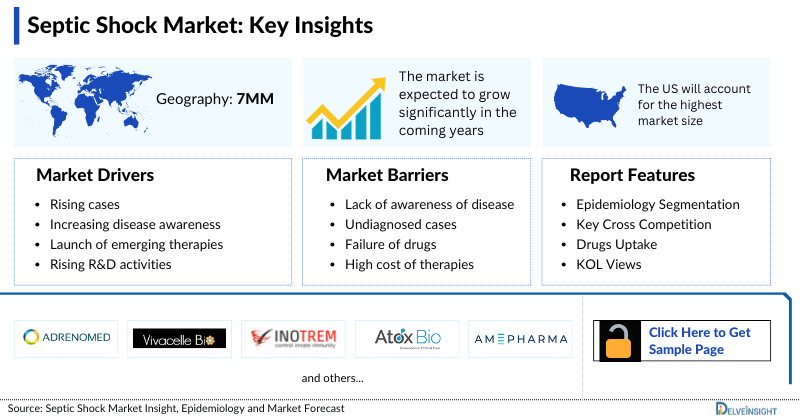
Factors Affecting the Septic Shock Market Growth
-
Rising Incidence of Sepsis and Critical Illnesses
The global burden of sepsis and septic shock continues to rise, driven by aging populations, increased hospitalizations, and a higher prevalence of chronic diseases such as diabetes, cancer, and cardiovascular disorders. This growing patient base is significantly boosting the demand for advanced septic shock management solutions.
-
Advancements in Diagnostic Technologies
The development of rapid diagnostic tests, biomarker-based assays (e.g., procalcitonin, lactate levels), and point-of-care devices has improved early detection and risk stratification in septic patients. Early diagnosis facilitates timely intervention, which is crucial for survival and fuels the adoption of new diagnostic tools.
-
Increasing Adoption of Advanced Therapeutics and Supportive Care
The growing use of vasopressors, fluid resuscitation protocols, corticosteroids, and novel immunomodulatory agents is improving treatment outcomes. The rising adoption of targeted anti-infective therapies and adjunctive treatments (like extracorporeal blood purification) is further driving market expansion.
-
Growing Research on Immunopathogenesis and Precision Medicine
Enhanced understanding of the molecular mechanisms underlying sepsis and immune dysregulation has led to a surge in R&D efforts for targeted therapies. The focus on cytokine modulation, endotoxin removal, and immune checkpoint therapies represents a strong driver for innovation in the septic shock treatment market.
-
Government Initiatives and Awareness Programs
National and international organizations - including the World Health Organization (WHO) and Surviving Sepsis Campaign-are implementing programs to improve sepsis recognition, treatment protocols, and outcomes. These initiatives are driving early diagnosis, standardized care, and overall market growth.
-
Rising ICU Admissions and Technological Advancements in Critical Care
The expansion of intensive care unit (ICU) infrastructure and the availability of advanced monitoring systems, mechanical ventilation, and hemodynamic support technologies enhance survival rates and expand the adoption of septic shock management solutions.
DelveInsight’s “Septic Shock Market Insights, Epidemiology, and Market Forecast – 2034” report delivers an in-depth understanding of the Septic Shock, historical and forecasted epidemiology as well as the Septic Shock market trends in the United States, EU4 (Germany, France, Italy, and Spain) and the United Kingdom, and Japan.
The Septic Shock Treatment Market report provides current treatment practices, emerging drugs, Septic Shock market share of individual therapies, and current and forecasted Septic Shock market size from 2020 to 2034, segmented by seven major markets. The report also covers current Septic Shock treatment market practices/algorithms and unmet medical needs to curate the best of the opportunities and assess the underlying potential of the Septic Shock Drugs Market.
Scope of the Septic Shock Market | |
|
Study Period |
2020 to 2034 |
|
Forecast Period |
2024 to 2034 |
|
Geographies Covered |
|
|
Septic Shock Drugs Market |
|
|
Septic Shock Market Size | |
|
Septic Shock Companies |
|
Septic Shock Treatment Market
The DelveInsight’s Septic Shock treatment market report gives a thorough understanding of Septic Shock by including details such as disease definition, symptoms, causes, pathophysiology, diagnosis, and treatment. Septic shock is a serious condition that occurs when a body-wide infection leads to dangerously low blood pressure. Septic shock occurs in a subset of patients with sepsis and comprises of an underlying circulatory and cellular/metabolic abnormality that is associated with increased mortality.
Septic shock is defined by persisting hypotension requiring vasopressors to maintain a mean arterial pressure of 65 mm Hg or higher and a serum lactate level greater than 2 mmol/L (18 mg/dL) despite adequate volume resuscitation. The transition from the onset of sepsis to severe sepsis and septic shock can happen quickly, and once the condition has transitioned, the mortality rate can increase. The symptoms of severe sepsis and septic shock can overlap and can include noticeably lower amounts of urine, acute confusion, dizziness, severe breathing problems, and bluish discoloration of the digits or lips (cyanosis).
Specifically, people experiencing septic shock will also have very low blood pressure that doesn’t respond to fluid replacement and have abnormalities in blood flow which can result in organ dysfunction. The risk of septic shock is higher in newborns and infants, elderly people, pregnant women, and individuals with chronic diseases. The chronic diseases that increase the risk of septic shock include diabetes, cirrhosis, cancer, AIDS/HIV, kidney, and heart disease. Pathogenesis involves a complex response of cellular activation that triggers the release of a multitude of proinflammatory mediators. This inflammatory response causes the activation of leukocytes and endothelial cells, as well as the activation of the coagulation system. Cytokines tumor necrosis factor-alpha (TNF-α) and interleukin-1 (IL-1) are central to the pathophysiology of septic shock and act synergistically to induce hypotension in experimental models, several other vital mediators are also known to play a major role including high-mobility group box 1 (HMGB1) protein.
Septic Shock Diagnosis
The initial evaluation of a patient with sepsis includes medical history, physical examination, and clinical symptoms, along with the detection of some biomarkers (such as C reactive protein and procalcitonin), which are crucial elements for early diagnosis of sepsis and the timely establishment of its appropriate clinical management. Tests that may help confirm sepsis and septic shock include blood cultures, urine tests, wound secretions, and respiratory secretions. In many patients, the exact site of the infection will not be apparent. In these cases, a doctor can use imaging scans, such as X-rays, CT scans, MRI scans, and ultrasounds to help identify infected areas of the body.
Septic Shock Treatment
Septic shock is a severe illness and studies have shown that even minor delays in treating severe sepsis and septic shock may increase the risk of death. Medications to treat sepsis and septic shock include antibiotics which should begin within the first hour after diagnosis and are administered directly into the vein. Vasopressors are necessary to maintain adequate blood pressure in people with septic shock. A doctor will use these if blood pressure remains too low after a person receives fluids.
Corticosteroids are anti-inflammatory drugs administered when a patient’s blood pressure and heart rate continue to be unstable even after receiving fluids and vasopressors. Reviews suggest that patients with more severe septic shock may benefit more from corticosteroid application. However, researchers concluded that further controlled studies were required to confirm the findings. Additional medications may include insulin to stabilize blood sugar levels and prevent the patient from developing hyperglycemia. Large amounts of intravenous fluids will be administered to treat dehydration and help increase blood pressure and blood flow to the organs. A respirator for breathing may also be necessary. Surgery may be performed to remove a source of infection, such as draining a pus-filled abscess or removing infected tissue.
Septic Shock Epidemiology
The Septic Shock epidemiology section provides insights into the historical and current Septic Shock patient pool and forecasted trends for seven individual major countries. It helps recognize the causes of current and forecasted trends by exploring numerous studies and views of key opinion leaders. This part of the Septic Shock report also provides the diagnosed patient pool, their trends, and assumptions undertaken.
Key Findings from Septic Shock Epidemiological Analyses and Forecast
- A study conducted by Hari et al. (2017), shows that the sepsis-2 septic shock and sepsis-3 septic shock accounted for 23.4%, and 6.0%, respectively, of admissions to adult general ICUs in England over the five year period.
- The study revealed that sepsis-2 septic shock accounted for three-quarters of the severe sepsis population and the extrapolated population incidence increased from 69–79 per 100,000 person-years. In contrast, sepsis-3 septic shock was only one-fifth of the sepsis population and with minimal change in the extrapolated population incidence over the five year period (approximately 19 per 100,000 person-years).
- Also, the Sepsis-2 severe sepsis and Sepsis-3 sepsis accounted for a third of admissions to adult general ICUs in England over the five year period. The extrapolated population incidence increased similarly for both from 88 to 102 per 100,000 person-years.
- The Septic Shock epidemiology covered in the report provides historical as well as forecasted Septic Shock epidemiology [segmented as Total Incident Cases of Septic Shock, Gender-specific Incident Cases of Septic Shock, and Treatable Cases of Septic Shock in the 7MM covering the United States, EU4 (Germany, France, Italy, and Spain) and the United Kingdom, and Japan from 2020 to 2034.
Country-wise Septic Shock Epidemiology
The epidemiology segment also provides the Septic Shock epidemiology data and findings across the United States, EU4 (Germany, France, Italy, and Spain) and the United Kingdom, and Japan.
Septic Shock Market Recent Developments
The drug chapter segment of the Septic Shock drugs market report encloses a detailed analysis of Septic Shock marketed drugs and late-stage (Phase III and Phase II) Septic Shock pipeline drugs. It also helps understand the Septic Shock clinical trials details, expressive pharmacological action, agreements and collaborations, approval and patent details, advantages and disadvantages of each included drug, and the latest Septic Shock news and press releases.
Emerging Septic Shock drugs
The Septic Shock therapeutics market report details the emerging Septic Shock therapies under the late and mid-stage of development for Septic Shock treatment.
Septic Shock Market Outlook
The Septic Shock market outlook of the report helps to build a detailed comprehension of the historical, current, and forecasted Septic Shock market trends by analyzing the impact of current therapies on the market, unmet needs, and demand for better technology.
This segment gives a thorough detail of the Septic Shock market trend of each marketed drug and late-stage pipeline therapy by evaluating their impact based on the annual cost of therapy, inclusion and exclusion criteria, mechanism of action, compliance rate, growing need for the Septic Shock therapeutics market, increasing patient pool, covered patient segment, expected launch year, competition with other therapies, brand value, their impact on the Septic Shock therapeutics market and view of the key opinion leaders. The calculated Septic Shock Therapeutics Market data are presented with relevant tables and graphs to give a clear view of the market at first sight.
"According to DelveInsight, the Septic Shock Therapeutics Market in the 7MM is expected to witness a major change in the study period 2020–2034"
Key findings in the Septic Shock Market Report
This section includes a glimpse of the Septic Shock Therapeutics Market in the 7MM.
The United States: Septic Shock Market Outlook
This section provides the total Septic Shock market size and market size by therapies in the United States.
EU4 and the UK Countries: Septic Shock Market Outlook
The total Septic Shock market size and market size by therapies in Germany, France, Italy, Spain, and the United Kingdom are provided in this section.
Japan: Septic Shock Market Outlook
The total Septic Shock market size and market size by therapies in Japan are also mentioned.
Septic Shock Drugs Uptake
This section focuses on the rate of uptake of the potential Septic Shock drugs recently launched in the Septic Shock Therapeutics Market or expected to get launched in the market during the study period 2020–2034. The analysis covers the Septic Shock therapeutics Therapeutics Market uptake by drugs, patient uptake by therapies, and sales of each drug. This will help in understanding the Septic Shock drugs with the most rapid uptake and the reasons behind the maximal use of new Septic Shock drugs and allows the comparison of the drugs based on market share and size, which again will be useful in investigating factors important in the market uptake and in making financial and regulatory decisions.
Septic Shock Pipeline Development Analysis
The Septic Shock treatment market segment provides insights into different therapeutic candidates in Phase II, and Phase III stages. It also analyses Septic Shock’s Companies involved in developing targeted therapeutics. The Septic Shock therapeutics market covers detailed information on collaborations, acquisitions, and mergers, licensing patent details, and other information on Septic Shock emerging therapies.
Septic Shock Market Access and Reimbursement
Approaching reimbursement proactively can have a positive impact both during the late stages of product development and well after product launch. In a Septic ShockTherapeutics Market Report, we consider reimbursement to identify economically attractive indications and market opportunities. When working with finite resources, the ability to select the markets with the fewest reimbursement barriers can be a critical business and price strategy.
Latest KOL Views on Septic Shock
To keep up with current epidemiology and market trends, we take KOLs and SMEs' opinions working in the Septic Shock domain through primary research to fill the data gaps and validate our secondary research. Their opinion helps to understand and validate current and emerging therapies and treatment patterns along with Septic Shock market trends. This will support the clients in potential upcoming novel treatments by identifying the overall scenario of the market and the unmet needs.
Septic Shock Competitive Intelligence Analysis
We perform competitive and Septic Shock Therapeutics Market intelligence analysis of the Septic Shock market by using various competitive intelligence tools that include – SWOT analysis, PESTLE analysis, Porter's five forces, BCG Matrix, Market entry strategies, etc. The inclusion of the analysis entirely depends upon the data availability.
Septic Shock Market Report Scope
- Descriptive overview of Septic Shock, disease overview, patient journeys, treatment algorithms, diagnosis, and currently available therapies
- Comprehensive insight into the Septic Shock epidemiology and forecasts in the 7MM
- An all-inclusive account of both the current and emerging therapies for Septic Shock, along with the assessment of new therapies, expected to have an impact on the current treatment landscape
- Exhaustive analysis of the Septic Shock market; historical and forecasted covering drug outreach in the 7MM
- Detailed patient-based market forecasting determines the trends shaping and driving the global Septic Shock market
Septic Shock Market Report Highlights
- In the coming years, the Septic Shock treatment market is set to change due to the rising awareness of the disease and incremental healthcare spending across the world; which would expand the size of the market to enable the drug manufacturers to penetrate more into the Septic Shock treatment market
- The Septic Shock Companies and academics are working to assess challenges and seek opportunities that could influence Septic Shock R&D. The therapies under development are focused on novel approaches to treat/improve the disease condition
- Major Septic Shock Companies are involved in developing Septic Shock therapies. The launch of emerging therapies will significantly impact the Septic Shock treatment market
- A better understanding of Septic Shock pathogenesis will also contribute to the development of novel therapeutics for Septic Shock
- Our in-depth analysis of the Septic Shock pipeline assets across different stages of development (Phase III and Phase II), emerging trends, and comparative analysis of pipeline products with detailed clinical profiles, key cross-competition, launch date along with product development activities will support the clients in the decision-making process regarding their therapeutic portfolio by identifying the overall scenario of the research and development activities
Septic Shock Treatment Market Report Insights
- Patient-Based Septic Shock Market Forecasting
- Septic Shock Therapeutic approaches
- Septic Shock Pipeline Analysis
- Septic Shock Market Size
- Septic Shock Market Trends
- Septic Shock Treatment Market opportunities
- Impact of upcoming therapies
Septic Shock Treatment Market Key Strengths
- 11 years Septic Shock Market Forecast
- 7MM Coverage
- Septic Shock Epidemiology segmentation
- Key Cross Competition
- Septic Shock KOL views
- Septic Shock Drugs uptake
Septic Shock Treatment Market Report Assessment
- Current Septic Shock Treatment Market Practices
- Septic Shock Unmet needs
- Septic Shock Pipeline product profiles
- Septic Shock Treatment Market attractiveness
Key Questions Answered in the Septic Shock Treatment Market Report
Septic Shock Treatment Market insights
- What would be the Septic Shock market growth till 2034, and what will be the resultant market size in 2034?
- What was the Septic Shock drug class share (in percentage) distribution in 2020, and how would it look in 2034?
- What would be the Septic Shock Market Size and market size by therapies across the 7MM during the forecast period (2024–2034)?
- What are the key findings of the market across 7MM, and which country will have the largest Septic Shock market size during the forecast period (2024–2034)?
- How would the unmet needs affect the Septic Shock market dynamics and subsequent analysis of the associated trends?
Septic Shock Epidemiology Insights
- What are the disease risk, burden, and regional/ethnic differences of Septic Shock?
- What is the historical and forecasted Septic Shock patient pool in the 7MM, and where can one observe the highest patient population and growth opportunities?
- What are the key factors driving the epidemiology trends for seven major markets covering the United States, EU4 (Germany, France, Italy, and Spain) and the United Kingdom, and Japan?
Current Septic Shock Treatment Market Scenario, Marketed Drugs, and Emerging Therapies
- What are the current treatment guidelines and treatment options, in addition to approved therapies for Septic Shock in the US, Europe, and Japan?
- What are the key collaborations (Industry–Industry, Industry-Academia), mergers and acquisitions, and licensing activities related to Septic Shock therapies?
- What are the recent novel therapies, targets, mechanisms of action, and technologies being developed to overcome the limitation of existing therapies?
- What are the clinical studies going on for Septic Shock and its status, along with the challenges faced?
Reasons to Buy Septic Shock Treatment Market Report
- The patient-based Septic Shock market forecast analysis will help in developing business strategies by understanding trends shaping and driving the Septic Shock market
- Organize sales and marketing efforts by identifying the best opportunities for Septic Shock in the US, EU4 (Germany, France, Italy, and Spain) and the United Kingdom, and Japan
- Identification of strong upcoming players in the Septic Shock treatment market that will help devise strategies that will help in getting ahead of competitors
Stay updated with us for Recent Articles @ New DelveInsight Blogs