
Uncomplicated Urinary Tract Infection Market
- The Uncomplicated Urinary Tract Infection Market Growth is expected to be mainly driven by therapies with a novel Uncomplicated Urinary Tract Infection mechanism of action that is under investigation, the use of combination therapies for a solution to antibiotic resistance, antibiotic stewardship programs, non-antibiotic prophylaxis strategies, and an increase in UTI infections mainly due to lifestyle changes.
- Urinary Tract Infection (UTI) is the most common bacterial infection caused by a range of pathogens, but most commonly by Escherichia coli, Klebsiella pneumoniae, Proteus mirabilis, Enterococcus faecalis, and Staphylococcus saprophyticus.
- Uncomplicated UTI (uUTI) typically affects individuals who are otherwise healthy and have no structural or neurological urinary tract abnormalities. Complicated UTI is associated with factors that compromise the urinary tract or host defense.
- Uncomplicated Urinary Tract Infection Symptoms vary depending on the extent of the infection. Lower Uncomplicated Urinary Tract Infection mainly involve the urethra, and bladder, and tend to present with localized symptoms such as strong and frequent urge to urinate, cloudy, bloody, or strong-smelling urine, pain, or a burning sensation when urinating. uUTI extending to the ureter or kidneys (i.e., pyelonephritis) often involves more systemic signs and symptoms, such as leukocytosis, fever, chills, abdominal pain, flank pain, and nausea/vomiting.
- The gold standard for Uncomplicated Urinary Tract Infection Diagnosis is the urine examination, including quantitative urine culture and its assessment, with appropriate clinical examinations and typical symptom assessment. A negative test for nitrite/leukocytes may be considered to rule out UTI with sufficient certainty in patients with a low pretest probability. The detection of blood, leukocytes, and nitrite independently increases the likelihood of the presence of a UTI. The combination of the positive findings further increases the possibility of the Uncomplicated Urinary Tract Infection diagnosis.
- The differential Uncomplicated Urinary Tract Infection diagnosis includes consideration of other types of non-bacterial infection and the causes of recurrent UTI.
- Antibiotics are still considered the gold standard of Uncomplicated Urinary Tract Infection treatments and are the first line of Uncomplicated Urinary Tract Infection treatment.
- The antimicrobial agents most commonly used to treat Uncomplicated Urinary Tract Infection include the combination drug trimethoprim and sulfamethoxazole (TMP-SMX), trimethoprim, ß-lactams, fluoroquinolones, nitrofurantoin, and fosfomycin tromethamine.
- The burden of recurrent Uncomplicated Urinary Tract Infection, inappropriate empirical treatment, and decreasing market scope of antibiotics will hit the Uncomplicated Urinary Tract Infection Market.
- After years of no new drug approval for the Uncomplicated Urinary Tract Infection Treatment ORLYNVAH was approved by the FDA in October 2024. This approval represents a significant advancement, offering a new therapeutic option for treating uncomplicated UTIs and filling a critical gap in available treatments.
- A few emerging therapies like Gepotidacin (GSK2140944), LBP-EC01, and others are being developed in late-stage clinical development. The expected launch of potential therapies in the Uncomplicated Urinary Tract Infection therapeutics market by key players during the forecast period [2024–2034], shall create a positive impact on the Uncomplicated Urinary Tract Infection Market Size in the US.
- In the 7MM, the United States accounted for the highest number of Occurrence-specific cases of Uncomplicated Urinary Tract Infection in 2023.
- In 2023, the age group of 30–49 years accounted for the majority of cases, contributing to 35% of all cases across the 7MM.
- France and the UK had the highest occurrence-specific Cases of uUTI among the EU4 and the UK, each accounting for more than 20% of cases in 2023.
Request for Unlocking the Sample Page of the "Uncomplicated Urinary Tract Infection Treatment Market"
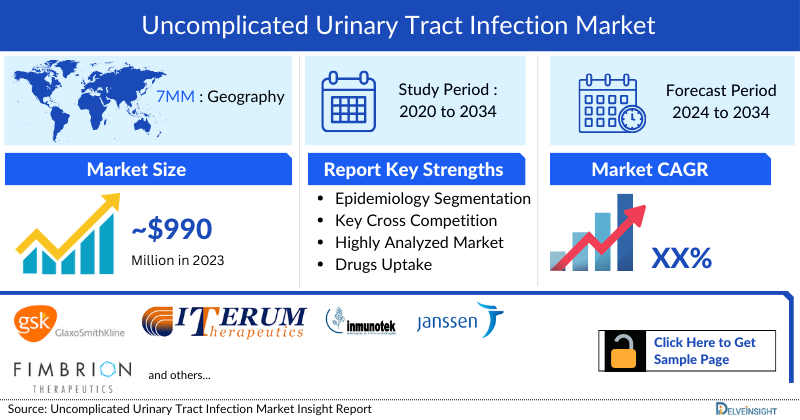
Key Factors Driving Uncomplicated Urinary Tract Infection Market
Rising UTI Burden Across Key Markets
Urinary Tract Infection remains the most common bacterial infection, predominantly caused by Escherichia coli, along with Klebsiella pneumoniae, Proteus mirabilis, Enterococcus faecalis, and Staphylococcus saprophyticus. In the 7MM, the United States accounted for the highest number of occurrence-specific uUTI cases in 2023, with the 30–49 years age group contributing to nearly 35% of cases. This rising burden is amplified by recurrent infections, increasing antibiotic resistance, and inappropriate empirical treatment, all of which pose major challenges to disease management.
Advancements in UTI Diagnosis
The gold standard for uncomplicated UTI diagnosis is urine culture alongside clinical symptom assessment. The presence of leukocytes, nitrite, and blood significantly increases the probability of a positive diagnosis, while a negative test may effectively rule out infection in low-risk patients. Advances in rapid diagnostic assays and point-of-care testing are expected to enhance early detection, reduce misdiagnosis, and optimize antibiotic stewardship programs.
UTI Treatment Landscape
Antibiotics remain the cornerstone of uUTI treatment, with commonly prescribed options including trimethoprim-sulfamethoxazole (TMP-SMX), trimethoprim, β-lactams, fluoroquinolones, nitrofurantoin, and fosfomycin tromethamine. However, recurrent infections and the decreasing effectiveness of existing antibiotics due to resistance have constrained market growth. A major milestone was reached in October 2024 with the FDA approval of ORLYNVAH, the first new drug for uncomplicated UTI in years, representing a breakthrough in addressing unmet therapeutic needs.
Launch of Emerging UTI Drugs
Key candidates include Gepotidacin (GlaxoSmithKline), a first-in-class triazaacenaphthylene antibacterial agent; UROMUNE (Inmunotek), a sublingual bacterial vaccine designed to reduce recurrence; and LBP-EC01 (Locus Biosciences), a CRISPR-enhanced bacteriophage therapy. These innovative approaches target unmet needs in recurrence prevention, resistance management, and long-term disease control, positioning them as potential game changers in the uUTI treatment landscape.
Uncomplicated Urinary Tract Infection Treatment Market Report Summary
- The Uncomplicated Urinary Tract Infection treatment market report offers extensive knowledge regarding the epidemiology segments and predictions, presenting a deep understanding of the potential future growth in Uncomplicated Urinary Tract Infection diagnosis rates, disease progression, and treatment guidelines. It provides comprehensive insights into these aspects, enabling a thorough assessment of the subject matter.
- Additionally, an all-inclusive account of the current management techniques and emerging therapies and the elaborative profiles of late-stage (Phase III and Phase II) and prominent therapies that would impact the current Uncomplicated Urinary Tract Infection treatment market landscape and result in an overall market shift has been provided in the report.
- The Uncomplicated Urinary Tract Infection therapeutics market report also encompasses a comprehensive analysis of the Uncomplicated Urinary Tract Infection market, providing an in-depth examination of its historical and projected market size (2020–2034). It also includes the Uncomplicated Urinary Tract Infection drugs market share of therapies, detailed assumptions, and the underlying rationale for our methodology. The report also includes drug outreach coverage in the 7MM region.
- The Uncomplicated Urinary Tract Infection therapeutics market report includes qualitative insights that provide an edge while developing business strategies by understanding trends through SWOT analysis and expert insights/KOL views, including experts from various hospitals and prominent universities, patient journey, and treatment preferences that help shape and drive the 7MM Uncomplicated Urinary Tract Infection market.
Uncomplicated Urinary Tract Infection Therapeutics Market
- The leading Uncomplicated Urinary Tract Infection Companies such as Iterum Therapeutics, GlaxoSmithKline, Inmunotek, Locus Biosciences, and Others. The details of the country-wise and therapy-wise market size have been provided below.
- In the total Uncomplicated Urinary Tract Infection Treatment Market Size in the 7MM, the United States accounted for the highest market share, i.e. ~60% in 2023, followed by Japan.
- Among EU4 and the UK, France and the United Kingdom accounted for the highest Uncomplicated Urinary Tract Infection treatment market size in 2023.
- The United States accounted for approximately USD 500 million in 2023.
- Among the emerging therapies, Gepotidacin and LBP-EC01 appear to be the drugs that can potentially transform the Uncomplicated Urinary Tract Infection drugs market.
- By 2034, among the emerging therapies, the highest revenue is expected to be generated by Gepotidacin i.e., nearly USD 1000 million in the United States.

Uncomplicated Urinary Tract Infection Recent Developments
- In March 2025, GSK plc announced that the FDA has approved Blujepa (gepotidacin) for treating uncomplicated urinary tract infections (uUTIs) in female adults (≥40 kg) and pediatric patients (≥12 years, ≥40 kg) caused by Escherichia coli, Klebsiella pneumoniae, Citrobacter freundii complex, Staphylococcus saprophyticus, and Enterococcus faecalis.
Uncomplicated Urinary Tract Infection Drugs Market Chapters
The section dedicated to drugs in the Uncomplicated Urinary Tract Infection drugs market report provides an in-depth evaluation of late-stage Uncomplicated Urinary Tract Infection pipeline drugs analysis (Phase III and Phase II). The drug chapters section provides valuable information on various aspects related to Uncomplicated Urinary Tract Infection clinical trials such as the pharmacological mechanisms of the drugs involved, designations, approval status, patent information, and a comprehensive analysis of the pros and cons associated with each drug. Furthermore, it presents the most recent news updates and press releases on drugs targeting Uncomplicated Urinary Tract Infection.
Uncomplicated Urinary Tract Infection Marketed Therapies
- ORLYNVAH: Iterum Therapeutics
ORLYNVAH (sulopenem etzadroxil and probenecid) tablets were approved by the US FDA in October 2024 for the treatment of uncomplicated urinary tract infections (uUTI) in adult women. It is indicated for infections caused by Escherichia coli, Klebsiella pneumoniae, or Proteus mirabilis, particularly when alternative oral antibacterial options are limited. The combination of sulopenem etzadroxil, a penem antibacterial, and probenecid works by inhibiting OAT3-mediated renal clearance of sulopenem, which increases its plasma concentrations. This Uncomplicated Urinary Tract Infection Mechanism of Action enhances the effectiveness of sulopenem in treating uUTIs.
The US FDA has granted Special Protocol Agreements (SPA) and Qualified Infectious Disease Product (QIDP) designations for oral and IV sulopenem under the Generating Antibiotics Incentives Now (GAIN) Act.
Uncomplicated Urinary Tract Infection Emerging Therapies
- Gepotidacin (GSK2140944): GlaxoSmithKline
Gepotidacin (GSK2140944), a triazaacenaphthylene bacterial type II topoisomerase inhibitor, is being developed by GlaxoSmithKline (GSK) to treat uncomplicated urinary tract infection. Gepotidacin is the first in a new class of antibiotics developed at GSK in 2007 with a novel dual-targeting MOA and oral formulation. Its MOA is distinct from any currently approved antibiotic. Gepotidacin works by selectively interacting with two key bacterial enzymes, DNA gyrase and topoisomerase IV (type II topoisomerases), responsible for bacterial replication.
The development of Gepotidacin comes out of a public-private partnership between GSK, the US government’s Biomedical Advanced Research and Development Authority (BARDA), and the Defense Threat Reduction Agency (DTRA).
- UROMUNE (MV140): Inmunotek
UROMUNE is a glycerinated suspension containing whole cell-inactivated bacteria for sublingual administration. It is administered by spraying over the sublingual area. UROMUNE is intended to be self-administered by the patient.
Currently, UROMUNE, in Phase III development, is accessible through named patient programs in 26 countries including the UK, New Zealand, Netherlands, Germany, Spain, and others. Additionally, an expanded access program targets patients with recurrent/chronic UTIs unresponsive to antibiotics.
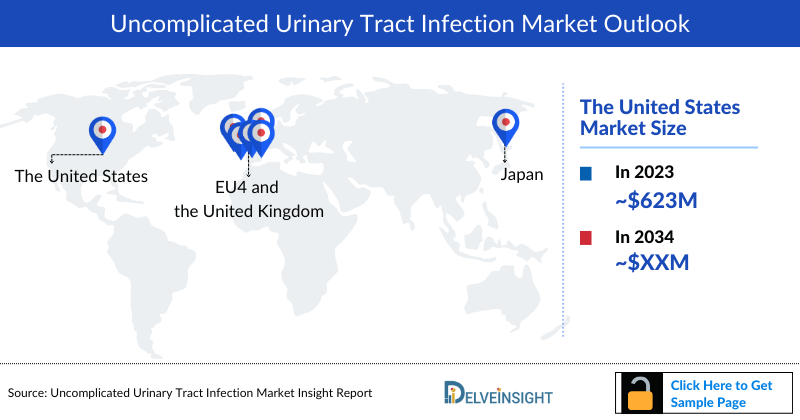
Uncomplicated Urinary Tract Infection Market Outlook
Uncomplicated urinary tract infections (uUTIs) represent a significant burden on healthcare systems, with high prevalence among women globally. Despite their common occurrence, treatment options have remained limited, often relying on older antibiotics. ORLYNVAH’s recent FDA approval in 2024 marks a breakthrough in uUTI therapy, offering a novel approach after years without innovation. Meanwhile, other promising Uncomplicated Urinary Tract Infection drugs like Gepotidacin, UROMUNE, and LBP-EC01 are advancing in Uncomplicated Urinary Tract Infection clinical trials, highlighting a renewed focus on addressing this Uncomplicated Urinary Tract Infection unmet medical needs.
In a nutshell, many potential therapies are being investigated to manage Uncomplicated Urinary Tract Infection. Even though it is too soon to comment on the above-mentioned promising candidate to enter the market during the forecast period (2024–2034), it is safe to assume that the future of this market is bright. Eventually, these drugs will create a significant difference in the landscape of uUTI in the coming years. The treatment space is expected to experience a significant positive shift in the coming years owing to the improvement in healthcare spending worldwide.
Further details are provided in the report…
Uncomplicated Urinary Tract Infection Treatment Market: Understanding and Algorithm
Urinary tract infection (UTI) is caused by a range of pathogens, but most commonly by Escherichia coli, Klebsiella pneumoniae, Proteus mirabilis, Enterococcus faecalis, and Staphylococcus saprophyticus. A Uncomplicated Urinary Tract Infection can develop in any part of the urinary tract, including the urethra, bladder, ureters, or kidneys. A UTI (also known as a bladder infection) is a common condition that occurs when bacteria migrate into the usually sterile urinary tract and multiply. Bladder infections are common, especially among women. Research suggests that at least 40–60% of women develop a UTI during their lifetime, and most of these infections are bladder infections. One in four women is likely to have a repeat infection. UTI is classified as either complicated or uncomplicated.
Further details are provided in the report…
Uncomplicated Urinary Tract Infection Diagnosis
Uncomplicated Urinary Tract Infection Diagnostic methods are designed to detect the presence, but also, when appropriate, to ascertain the etiology (bacterial spectrum) that triggered the infection and how it can be treated (susceptibility to antibiotics). The gold standard for Uncomplicated Urinary Tract Infection diagnosis is the urine examination, including quantitative urine culture and its assessment, with appropriate clinical examinations and typical symptom assessment. A negative test for nitrite/leukocytes may be considered to rule out UTI with sufficient certainty in patients with a low pretest probability. The detection of blood, leukocytes, and nitrite independently increases the likelihood of the presence of a UTI. The combination of the positive findings further increases the likelihood of the diagnosis.
Further details related to country-based variations are provided in the report…
Uncomplicated Urinary Tract Infection Treatment
Uncomplicated Urinary Tract Infection is treated with antibiotics and sometimes-additional medication for pain relief. Antibiotics are still considered the gold standard of Uncomplicated Urinary Tract Infection treatments. Antibiotics are the first line of Uncomplicated Urinary Tract Infection treatment. While most Uncomplicated Urinary Tract Infection are considered simple or uncomplicated, the particulars regarding which antibiotics are prescribed and for how long, depend on factors such as the type of bacteria detected in the urine and current health. If the patient has been treated for a UTI in the past, the doctor may recommend a different antibiotic when the patient gets an infection. This is because some types of bacteria that cause UTI have become resistant to certain antibiotics.
Uncomplicated Urinary Tract Infection treatment is based on pathogen identification the type and degree of clinical illness and the presence or absence of predisposing host factors. In general, the treatment consists of hydration, relief of urinary tract obstruction if present, removal of foreign body or catheter if a feasible and judicious use of antibiotics. The type and duration of antibiotic treatment are dependent on the site of infection (pyelonephritis, cystitis), host factors, and severity of illness. Most antibiotics are highly concentrated in the urine and, therefore, effectively clearing bacteria from the urinary tract.
Uncomplicated Urinary Tract Infection Epidemiology
The Uncomplicated Urinary Tract Infection epidemiology chapter in the report provides historical as well as forecasted epidemiology segmented by total Occurrence-specific Cases, total Diagnosed Cases, Age group-specific Cases, Pathogen-specific Cases, and total Treated Cases of Uncomplicated Urinary Tract Infection in the United States, EU4 countries (Germany, France, Italy, Spain) and the United Kingdom, and Japan from 2020 to 2034.
- The total Occurrence-specific cases of Uncomplicated Urinary Tract Infection in the US were around 15,300,000 cases in 2023.
- In the United States, the highest number of Uncomplicated Urinary Tract Infection age-specific cases were recorded for 30–49 years of age, i.e., ~3,300,000 cases in 2023. Followed by the age group of 18–29 years and 50–69 years and the least cases were recorded in the=70 years age group.
- France and the UK had the highest occurrence-specific cases of Uncomplicated Urinary Tract Infection among the EU4 and the UK, each accounting for more than 20% of cases in 2023.
- Uropathogenic Escherichia Coli (UPEC) was responsible for the majority of uUTI cases, accounting for 75% of them.
- In 2023, the total treated cases of uncomplicated urinary tract infection in the US were ~9,000,000 for the first-line treated patients.
KOL Views
To stay abreast of the latest trends in the Uncomplicated Urinary Tract Infection Market, we conduct primary research by seeking the opinions of Key Opinion Leaders (KOLs) and Subject Matter Experts (SMEs) who work in the relevant field. This helps us fill any gaps in data and validate our secondary research.
We have reached out to industry experts to gather insights on various aspects of Uncomplicated Urinary Tract Infection, including the evolving Uncomplicated Urinary Tract Infection Treatment Landscape, patients’ reliance on conventional therapies, their acceptance of therapy switching, drug uptake, and challenges related to accessibility. The experts we contacted included medical/scientific writers, professors, and researchers from prestigious universities in the US, Europe, the UK, and Japan.
Our team of analysts at Delveinsight connected with more than 15 KOLs across the 7MM. We contacted institutions such as the University of Munich, the University of Tokyo, the European Dialysis and Transplant Association, the American Society of Nephrology, etc., among others. By obtaining the opinions of these experts, we gained a better understanding of the current and emerging treatment patterns in the Uncomplicated Urinary Tract Infection market, which will assist our clients in analyzing the overall epidemiology and market scenario.
Uncomplicated Urinary Tract Infection Therapeutics Market: Qualitative Analysis
We perform Qualitative and Uncomplicated Urinary Tract Infection Therapeutics Market Intelligence analysis using various approaches, such as SWOT analysis and Conjoint Analysis. In the SWOT analysis, strengths, weaknesses, opportunities, and threats in terms of disease Uncomplicated Urinary Tract Infection diagnosis, patient awareness, patient burden, competitive landscape, cost-effectiveness, and geographical accessibility of therapies are provided. These pointers are based on the Analyst’s discretion and assessment of the patient burden, cost analysis, and existing and evolving treatment landscape.
Conjoint Analysis analyzes multiple approved and emerging therapies based on relevant attributes such as safety, efficacy, frequency of administration, designation, route of administration, and order of entry. Scoring is given based on these parameters to analyze the effectiveness of therapy. In efficacy, the trial’s primary and secondary outcome measures are evaluated; for instance, in trials for Uncomplicated Urinary Tract Infection, one of the most important primary endpoints was achieving hemolysis control, LDH normalization, etc. Based on these, the overall efficacy is evaluated.
Further, the therapies’ safety is evaluated wherein the acceptability, tolerability, and adverse events are majorly observed, and it sets a clear understanding of the side effects posed by the drug in the trials. In addition, the scoring is also based on the route of administration, order of entry and designation, probability of success, and the addressable patient pool for each therapy. According to these parameters, the final weightage score and the ranking of the emerging therapies are decided.
Uncomplicated Urinary Tract Infection Therapeutics Market Access and Reimbursement
Because newly authorized Uncomplicated Urinary Tract Infection drugs are often expensive, some patients escape receiving proper treatment or use off-label, less expensive prescriptions. Reimbursement plays a critical role in how innovative treatments can enter the market. The cost of the medicine, compared to the benefit it provides to patients who are being treated, sometimes determines whether or not it will be reimbursed. Regulatory status, target population size, the setting of treatment, unmet needs, the number of incremental benefit claims, and prices can all affect market access and reimbursement possibilities.
The Uncomplicated Urinary Tract Infection therapeutics market report further provides detailed insights on the country-wise accessibility and reimbursement scenarios, cost-effectiveness scenario of approved therapies, programs making accessibility easier and out-of-pocket costs more affordable, insights on patients insured under federal or state government prescription drug programs, etc.
Uncomplicated Urinary Tract Infection Therapeutics Market Report Insights
- Patient-based Uncomplicated Urinary Tract Infection Market Forecasting
- Therapeutic Approaches
- Uncomplicated Urinary Tract Infection Market Size and Trends
- Existing Uncomplicated Urinary Tract Infection Drugs Market Opportunity
Uncomplicated Urinary Tract Infection Therapeutics Market Report Key Strengths
- 11 -year Uncomplicated Urinary Tract Infection Market Forecast
- The 7MM Coverage
- Uncomplicated Urinary Tract Infection Epidemiology Segmentation
- Key Cross Competition
Uncomplicated Urinary Tract Infection Therapeutics Market Report Assessment
- Current Uncomplicated Urinary Tract Infection Treatment Market Practices
- Uncomplicated Urinary Tract Infection Reimbursements
- Uncomplicated Urinary Tract Infection Drugs Market Attractiveness
- Qualitative Analysis (SWOT, Conjoint Analysis, Unmet needs)
Key Questions
- Would there be any changes observed in the current Uncomplicated Urinary Tract Infection treatment approach?
- Will there be any improvements in Uncomplicated Urinary Tract Infection management recommendations?
- Would research and development advances pave the way for future tests and therapies for Uncomplicated Urinary Tract Infection?
- Would the diagnostic testing space experience a significant impact and lead to a positive shift in the treatment landscape of Uncomplicated Urinary Tract Infection?
- What kind of uptake will the new therapies witness in the coming years in Uncomplicated Urinary Tract Infection patients?
Stay Updated with us for Recent Articles