
Urinary Incontinence Devices Market
Urinary Incontinence Devices Market by Product (Urinary Catheters, Urethral Slings, Electrical Stimulation Devices, Artificial Urinary Sphincters, Others), Type (External Devices, Internal Devices), Patient Type (Male, Female), End-User (Hospitals and Clinics, Ambulatory Surgery Centers, Others), and Geography (North America, Europe, Asia-Pacific, and Rest of the World) is expected to advance at a substantial CAGR forecast till 2030 owing to the increasing instances of neurological disorders and rising cases of prostate cancer across the globe.
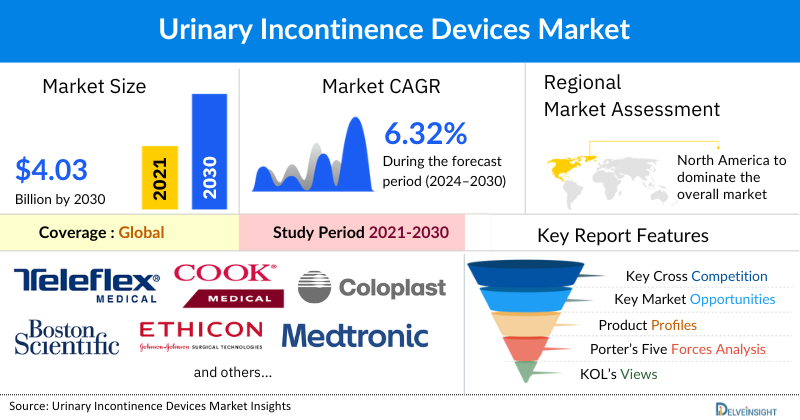
The urinary incontinence devices market was valued at USD 2.8 billion in 2023, growing at a CAGR of 6.32% during the forecast period from 2024 to 2030 to reach USD 4.03 billion by 2030. The urinary incontinence devices market is experiencing significant growth due to the increasing instances of neurological disorders such as multiple sclerosis & spinal cord injuries, increasing cases of prostate cancer, and rising prevalence of benign prostatic hyperplasia which are acting as major factors contributing to the overall growth of the urinary incontinence devices market during the forecast period from 2024 to 2030.
Urinary Incontinence Devices Market Dynamics:
According to the data provided by the Global Cancer Observatory (2024), in 2022, Europe accounted for 473,011 prostate cancer cases, Asia accounted for 386,424 prostate cancer cases, Latin American and the Caribbean (LAC) accounted for 225,985 prostate cancer cases, and Africa accounted for 103,050 prostate cancer cases. In regions with high prostate cancer incidence, urinary incontinence devices are used to manage the common side effect of urinary leakage, often resulting from the disease itself or its treatments. These devices help improve quality of life by providing reliable control and comfort, enabling individuals to better manage their symptoms and maintain daily activities.
As per data from the World Health Organization (2023), it was reported that over 1.8 million people worldwide are affected by Multiple sclerosis (MS). It impacts various functions including cognitive, emotional, motor, sensory, and visual abilities. It occurs when the immune system mistakenly attacks the brain and spinal cord. Urinary incontinence devices are used in multiple sclerosis (MS) to manage bladder dysfunction caused by the disease. MS can disrupt the nerve signals that control bladder function, leading to symptoms like urgency, frequency, and incontinence. These devices support individuals in managing these symptoms, improving comfort, and maintaining daily activities.
According to the World Health Organization (WHO) (2024) in 2021, 15.4 million people were living with spinal cord injuries globally. Most cases of spinal cord injury result from trauma, including falls, or acts of violence, and are therefore preventable. Since spinal cord injuries often disrupt the nerves that control bladder function, individuals may experience difficulty with urinary control. Devices such as catheters, external collection systems, and absorbent pads can help manage urinary incontinence by providing reliable methods for urine collection and preventing leakage. These devices are designed to enhance comfort, maintain hygiene, and support individuals in managing their condition more effectively, ultimately improving their quality of life.
Data from the National Institute of Health (2024) stated that the current prevalence of benign prostatic hyperplasia (BPH) is 50% to 60% for people in their 60s, increasing to 80% to 90% of those older than 70 years of age, globally. Moreover, the World Health Organization (2021) further stated between 2015 and 2050, people falling between 60 years and above will be doubled from 12-22%, and will eventually reach 2.1 billion by the year 2050, globally. Urinary incontinence devices are used to manage symptoms associated with benign prostatic hyperplasia (BPH) and aging. For individuals with BPH, these devices help control effluence and maintain comfort as prostate enlargement affects bladder function. As the global population ages, the prevalence of urinary incontinence increases, making these devices essential for managing bladder control and improving the quality of life in older adults.
Hence, the interplay of all the above-mentioned factors are expected to drive the market for urinary incontinence devices market during the given forecast period from 2024 to 2030.
However, skin irritation, rashes, or sores associated with prolonged contact and allergic reactions to the material of the device, among others may restrict the market growth.
Urinary Incontinence Devices Market Segment Analysis:
Urinary Incontinence Devices Market by Product (Urinary Catheters, Urethral Slings, Electrical Stimulation Devices, Artificial Urinary Sphincters, Others), Type (External Devices, Internal Devices), Patient Type (Male, Female), End-User (Hospitals and Clinics, Ambulatory Surgery Centers, Others), and Geography (North America, Europe, Asia-Pacific, and Rest of the World)
In the product segment of the urinary incontinence devices market, the urethral slings category is expected to have a significant revenue share in the year 2023. This is because of the widespread uses and various advantages of urethral slings which significantly reduce the risk of infection.
Urethral slings are specialized urinary incontinence devices designed to support the urethra and prevent involuntary leakage. These slings feature a supportive mesh made from either synthetic materials or biological substances, offering a stable framework beneath the urethra. They are typically inserted through small incisions using minimally invasive techniques, which helps to reduce recovery time and post-operative discomfort. Some slings come with adjustable tension, allowing for customization to ensure optimal support and effectiveness.
A key feature of the urethral slings is the characteristic to effectively prevent leakage, thereby improving the quality of life for individuals by reducing or eliminating involuntary urine leakage. This can lead to enhanced comfort and confidence, enabling people to participate more fully in daily activities. Additionally, the minimally invasive procedure associated with urethral slings usually results in a shorter recovery period compared to traditional surgical methods and often reduces the need for continuous management with products like pads or catheters. The low risk of complications and the versatility of the device make it a favorable option for managing various forms of urinary incontinence, including stress incontinence.
Therefore the widespread uses and various advantages of urethral slings enhance performance and usability, solidifying the significant impact on the growth of the overall urinary incontinence devices market during the forecast period from 2024 to 2030.
North America Is Expected To Dominate The Overall Global Urinary Incontinence Devices Market:
Among all the regions, North America is estimated to hold a significant revenue share in the urinary incontinence devices market. This can be attributed to several factors including the increasing cases of urinary incontinence, growing prevalence of diabetes, ongoing diagnosis of Parkinson’s disease and awareness programs by the government authorities acting as key factors contributing to the growth of the urinary incontinence devices market in the North America region during the forecast period from 2024 to 2030.
According to data from the National Association for Continence (2024), currently more than 33 million are affected by some type of urinary incontinence or bladder condition. Urinary incontinence devices are used to manage and alleviate symptoms of urinary incontinence and related bladder conditions. They help by providing containment, reducing leakage, and improving comfort.
According to data from the Centers of Disease Control and Prevention (2024), stated that in 2021, in the US, 38.4 million people of all ages, or 11.6% of the population, were affected by diabetes. Among adults aged 18 years and older, 38.1 million, or 14.7%, were affected by the condition. In individuals with diabetes, urinary incontinence devices help manage bladder control issues often associated with the condition. Diabetes can lead to complications such as neuropathy and frequent urinary tract infections, which can contribute to incontinence. Urinary incontinence devices assist in managing leakage and improving quality of life by providing reliable protection and comfort.
Parkinson's Foundation in 2024 stated that, currently, nearly about one million people in the U.S. are living with Parkinson's disease. This number is projected to increase to 1.2 million by 2030. Parkinson's disease is the second-most common neurodegenerative disorder, following Alzheimer's disease. Each year, approximately 90,000 new cases of Parkinson's are diagnosed in the U.S. In individuals with Parkinson's disease, urinary incontinence devices are employed to manage bladder dysfunction resulting from the disease's impact on the nervous system. These devices assist in controlling urinary efflux and maintaining patient comfort by addressing issues related to urinary urgency and frequency associated with the progression of Parkinson's disease.
Additionally, major awareness programs by government authorities across the region play a major role in pushing forward the revenue shares of urinary incontinence devices in the region. For example, in September 2021, at the American Urological Association Annual Meeting, a novel, ultra-miniaturized sacral nerve modulation (SNM) system was shown to be both efficacious and safe in treating patients with urge urinary incontinence.
Therefore, the interplay of all the factors mentioned above would provide a conducive growth environment for the North America region in the urinary incontinence devices market during the forecast period from 2024 to 2030.
Urinary Incontinence Devices Market Key Players:
Some the key market players operating in the urinary incontinence devices market include NeoTract, Inc, Cook Medical Inc, C.R. Bard Inc, Coloplast Corporation, Boston Scientific Corporation, Ethicon US, LLC, Medtronic PLC, A.M.I. Ltd, Teleflex Incorporated, Hollister Incorporated, ConvaTec Group PLC, Caldera Medical Inc, Prosurg, Inc, Laborie, Inc, Becton, Dickinson and Company, ZSI Surgical Implants, Atlantic Therapeutics, B. Braun Melsungen AG, Flexicare Group Limited, InControl Medical, and others.
Recent Developmental Activities in the Urinary Incontinence Devices Market:
- In May 2021, the University of Washington School of Medicine developed and tested 3 new devices to relieve symptoms of urinary incontinence. The first device tested in a clinical trial was a neuromodulation device. The second device involved an electrode about the size of a small pill and is implanted through a needle in the lower back alongside one of the main pelvic nerves. The third device was a soft, rubber ring with embedded electrodes placed in the vagina like a pessary or diaphragm.
- In April 2021, in Australia, Analytica Ltd. signed a joint venture agreement with Hebei Nacol Bio-Technology Co. Ltd. and Shijiazhuang Biosphere Pty Ltd., of Hebei Province, China, to manufacture and distribute its Pericoach device for urinary incontinence in China, Macau, Hong Kong, and Taiwan.
Key Takeaways from the Urinary Incontinence Devices Market Report Study
- Market size analysis for current urinary incontinence devices market size (2023), and market forecast for 6 years (2024 to 2030)
- Top key product/services developments, mergers, acquisitions, partnerships, and joint ventures happened for the last 3 years
- Key companies dominating the urinary incontinence devices market
- Various opportunities available for the other competitors in the urinary incontinence devices market space
- What are the top-performing segments in 2023? How these segments will perform in 2030?
- Which are the top-performing regions and countries in the current urinary incontinence devices market scenario?
- Which are the regions and countries where companies should have concentrated on opportunities for urinary incontinence devices market growth in the coming future?
Target Audience who can be benefited from this Urinary Incontinence Devices Market Report Study
- Urinary incontinence device providers
- Research organizations and consulting companies
- Urinary incontinence devices related organizations, associations, forums, and other alliances
- Government and corporate offices
- Start-up companies, venture capitalists, and private equity firms
- Distributors and traders dealing in urinary incontinence devices
- Various end-users who want to know more about the urinary incontinence devices market and the latest developments in the urinary incontinence devices market