
Voice Prosthesis Devices Market Summary
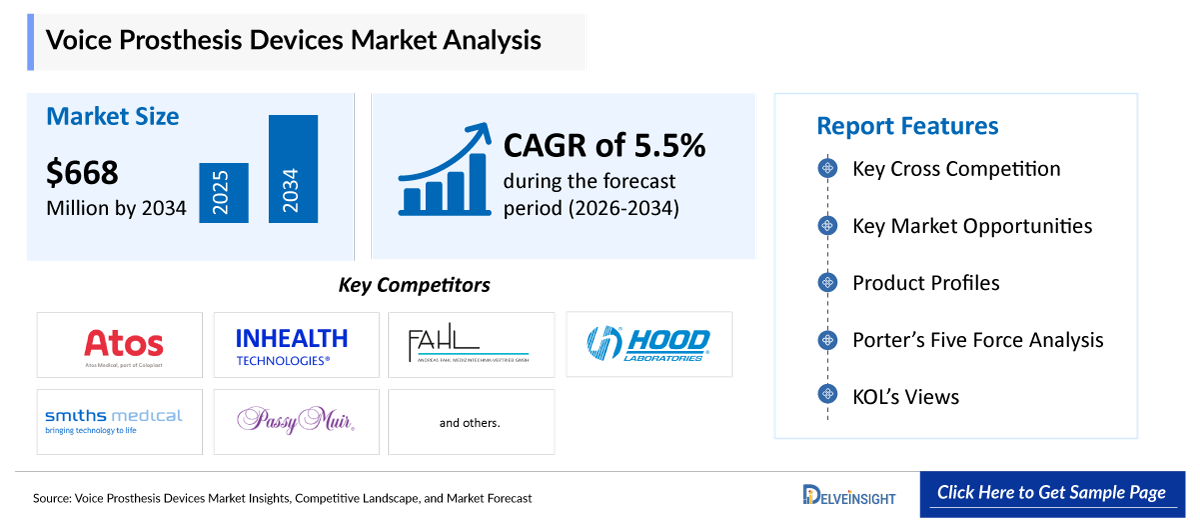
- The voice prosthesis devices market is estimated at USD 414 million in 2025 and is projected to reach USD 668 million by 2034. Growth is anchored in the rising global incidence of laryngeal and head & neck cancers, the growing number of total laryngectomy procedures, expanding awareness of voice rehabilitation, and continuous innovation in low-resistance, anti-reflux indwelling valve technology.
- The global voice prosthesis devices market is growing at a CAGR of 5.5% during the forecast period from 2026 to 2034.
- By device type, the indwelling voice prosthesis segment dominated the Voice Prosthesis Devices market with a 66% share in 2025.
- By valves, Provox dominated the Voice Prosthesis Devices market with a 45% share in 2025, reflecting Atos Medical's (Coloplast A/S) leadership across the indwelling and non-indwelling categories.
- By material, the silicone segment dominated the Voice Prosthesis Devices market with a 78% share in 2025, owing to its biocompatibility, flexibility, and proven durability in tracheoesophageal placement.
- By end-user, the hospitals and clinics segment dominated the Voice Prosthesis Devices market with a 58% share in 2025.
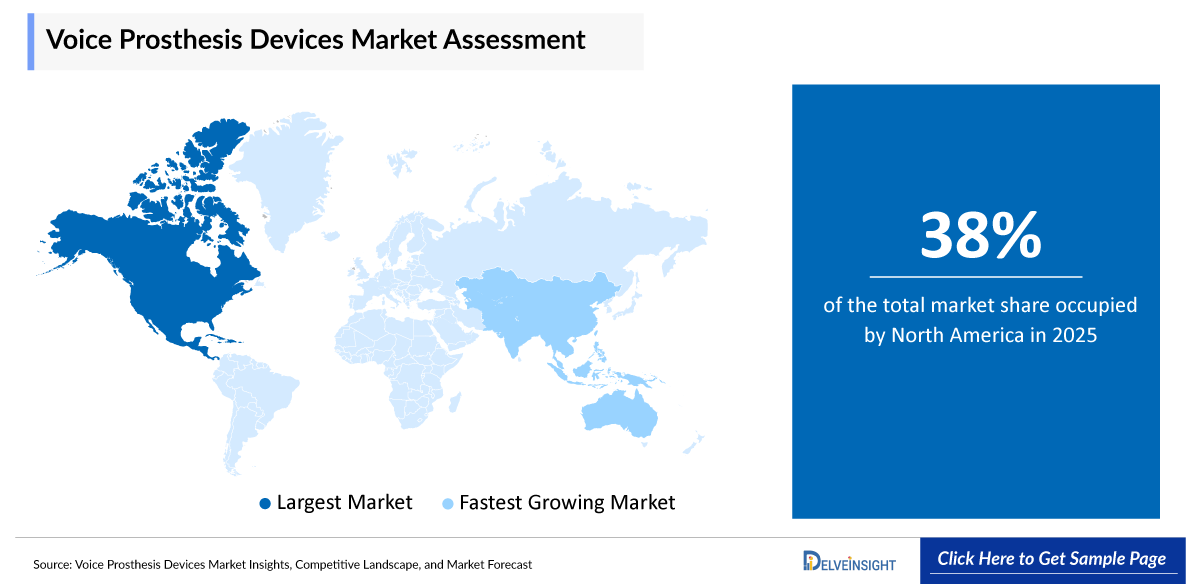
- North America dominated the global Voice Prosthesis Devices market revenue with a 38% share in 2025, representing the highest regional market share globally.
A voice prosthesis is a small one-way silicone valve implanted in the tracheoesophageal puncture of patients who have undergone a total laryngectomy, most commonly for laryngeal or hypopharyngeal cancer, enabling pulmonary air to be redirected into the esophagus to produce fluent, hands-free or hands-occluded speech. Because the device sits at the interface of the trachea and esophagus and is exposed to saliva, biofilm, and mechanical stress, voice prostheses require periodic clinical replacement, precise sizing, and ongoing patient education, and demand spans hospitals, ENT and head & neck oncology clinics, dedicated rehabilitation centers, and increasingly homecare settings. The market is organized by device type across indwelling and non-indwelling prostheses; by valve brand, led by Provox and Blom-Singer; by material, spanning silicone and polyurethane; and by end-user, led by hospitals and clinics. Driven by the rising global burden of laryngeal cancer, growing laryngectomy volumes, expanding ENT specialty and rehabilitation infrastructure, and continued innovation in low-resistance, anti-leakage, and antimicrobial valve design, voice prosthesis devices have become essential, recurring-use infrastructure underpinning post-laryngectomy speech rehabilitation worldwide.
Voice Prosthesis Devices Market Key Growth Drivers
- The rising global incidence of laryngeal cancer is expanding the pool of total laryngectomy patients who require voice restoration, with the International Agency for Research on Cancer estimating well over 180,000 new laryngeal cancer cases diagnosed worldwide each year.
- Growing awareness of voice rehabilitation among patients, caregivers, and clinicians, supported by laryngectomee advocacy groups and structured speech-language pathology programs, is increasing adoption of indwelling prostheses over surgical alternatives.
- Continuous technological advancement, including magnet-based anti-leakage valves, low-resistance designs that reduce speaking effort, and antimicrobial or anti-biofilm coatings, is extending device life and improving patient outcomes.
- Expansion of ENT specialty clinics, head & neck oncology centers, and dedicated laryngectomy rehabilitation programs is broadening access to fitting, replacement, and follow-up care.
- The rising geriatric population, which carries a disproportionate share of head & neck cancer incidence, is expanding the addressable patient base for voice prosthesis devices.
- Growing adoption of homecare-based device maintenance, cleaning accessories, and patient self-management kits is extending the care pathway beyond the clinic and supporting recurring consumable demand.
Key Companies in Voice Prosthesis Devices Market
The competitive landscape is led by the following active device manufacturers:
- Atos Medical (Coloplast A/S)
- InHealth Technologies
- Andreas Fahl Medical Technology Sales GmbH
- Hood Laboratories
- Main Medical
- Smiths Medical
- Passy-Muir, Inc.
- Seda S.p.A.
- SHREYAAS HEALTH CARE PVT LTD.
- Severn Healthcare Technologies Limited
For illustrative purposes, only the top 10 companies are listed in the Table of Contents. The report may include analysis and references to additional companies relevant to the market assessment.
Voice Prosthesis Devices Market Size
The following snapshot summarizes the principal report metrics for the voice prosthesis devices market.
|
Report Metrics |
Details |
|
2025 Market Size |
USD 414 million |
|
2034 Projected Market Size |
USD 668 million |
|
Growth Rate (2026-2034) |
5.5% CAGR |
|
Largest Market |
North America |
|
Fastest Growing Market |
Asia-Pacific |
|
Market Structure |
Highly Consolidated |
All market values are expressed in USD and represent DelveInsight estimates synthesized from primary and secondary research.
Factors Contributing to the Growth of the Voice Prosthesis Devices Market
Market Drivers
Rising Incidence of Laryngeal Cancer and Laryngectomy Procedures
The most powerful driver of the Voice Prosthesis Devices market is the rising global incidence of laryngeal and hypopharyngeal cancer, which continues to be a leading cause of total laryngectomy. As tobacco- and alcohol-related head & neck malignancies remain prevalent in both developed and emerging economies, the annual volume of laryngectomy procedures continues to grow, directly expanding the pool of patients who require tracheoesophageal voice restoration. Because a voice prosthesis is typically fitted at the time of, or shortly after, primary or secondary tracheoesophageal puncture, and requires periodic replacement over the patient's lifetime, every new laryngectomy generates recurring device demand for years afterward. As cancer screening and treatment access improve and laryngectomy survival rates increase, the installed base of prosthesis users, and the associated replacement and consumables market, is expected to expand steadily through 2034.
Growing Awareness and Advocacy for Voice Rehabilitation
Rising awareness among patients, caregivers, and clinicians of tracheoesophageal voice restoration as the gold-standard rehabilitation option after laryngectomy is broadening adoption of indwelling voice prostheses over older esophageal or electrolarynx-based speech methods. Patient advocacy organizations and laryngectomee support networks are increasingly directing newly diagnosed patients toward structured, multidisciplinary rehabilitation pathways involving ENT surgeons and speech-language pathologists. This growing awareness is also improving compliance with device maintenance and replacement schedules, reducing complication rates, and increasing satisfaction with speech outcomes. As health systems and clinicians place greater emphasis on quality of life after laryngectomy, demand for both primary placement and ongoing device replacement is expected to rise consistently across the forecast period.
Technological Advancements in Voice Prosthesis Design
Continuous innovation in valve engineering is a central growth driver. Magnet-based designs that prevent inadvertent valve opening, low-resistance flap geometries that reduce speaking effort and improve voice quality, and materials engineered to resist Candida-related biofilm formation are extending device life and lowering replacement frequency-related complications. Complementary innovations in heat-and-moisture exchangers, adhesive baseplates, and hands-free speaking valves are improving the overall care ecosystem around the prosthesis itself. As manufacturers continue to introduce next-generation valve platforms and antimicrobial coatings, clinicians are increasingly able to match device selection to individual patient physiology, supporting adoption of premium, higher-value indwelling systems and sustaining innovation-led growth through 2034.
Expansion of ENT and Head & Neck Oncology Care Infrastructure
The expansion of dedicated ENT specialty clinics, head & neck oncology centers, and structured laryngectomy rehabilitation programs is broadening patient access to voice prosthesis fitting, sizing, and follow-up replacement services. Many emerging economies are investing in cancer-care infrastructure and training additional speech-language pathologists and ENT surgeons capable of performing tracheoesophageal puncture and prosthesis management, reducing the historical concentration of this expertise in a small number of tertiary centers. As this specialized infrastructure decentralizes into secondary hospitals and regional rehabilitation centers, more laryngectomy patients gain timely access to voice restoration, supporting broader geographic penetration of the market.
Rising Geriatric Population and Head & Neck Cancer Burden
The rising global geriatric population is expanding the addressable patient base for voice prosthesis devices, since head & neck cancer incidence, including laryngeal cancer, rises sharply with age and with cumulative tobacco and alcohol exposure. Older laryngectomy patients often require more frequent device replacement due to age-related changes in tissue and saliva composition, and increasingly rely on caregiver- or homecare-supported device maintenance. As life expectancy after laryngectomy improves alongside advances in oncologic and reconstructive surgery, the number of long-term prosthesis users, and the associated recurring replacement demand, is expected to grow steadily across the forecast period.
Increasing Adoption of Homecare and Self-Management Solutions
A growing shift toward homecare-based device maintenance and patient self-management is extending the voice prosthesis care pathway beyond hospitals and clinics. Manufacturers increasingly offer cleaning brushes, flushing devices, adhesive removers, and patient education programs designed to help laryngectomy patients and family caregivers manage day-to-day device care at home, reducing the frequency of clinical visits required for routine maintenance. This trend is particularly pronounced in markets with well-developed home healthcare infrastructure and is expected to expand further as manufacturers invest in patient-support programs, telehealth-enabled follow-up, and simplified consumable kits tailored to the homecare setting.
Market Restraints
Despite steady momentum, the Voice Prosthesis Devices market faces material constraints. Voice prostheses remain vulnerable to biofilm formation, Candida colonization, and peri-prosthetic leakage, which shorten device life, necessitate frequent clinical replacement, and can cause patient discomfort or aspiration risk. The need for periodic in-clinic replacement by trained ENT specialists or speech-language pathologists limits access in regions with a shortage of qualified head & neck rehabilitation professionals, particularly in rural and lower-income areas. Reimbursement policies and out-of-pocket cost burden for devices and consumables vary widely across geographies, constraining adoption of premium indwelling systems in price-sensitive markets. Limited awareness of tracheoesophageal voice restoration relative to older speech rehabilitation methods persists in several emerging economies, while a shortage of specialized ENT surgeons trained in tracheoesophageal puncture and prosthesis management further constrains market penetration. Together, these clinical, workforce, cost, and awareness barriers temper the pace of growth, even as the underlying drivers of rising laryngectomy volumes and technological innovation remain firmly intact.
Voice Prosthesis Devices Market Segment Analysis
The voice prosthesis devices market is segmented by device type (indwelling, non-indwelling), valves (provox, blom-singer, others), material (silicone, polyurethane, others), end-user (hospitals and clinics, rehabilitation centers, homecare settings), and geography (North America, Europe, Asia-Pacific, and Rest of World).
By Device Type
Dominant Subsegment: Indwelling.
Dominant: Indwelling ~ 66%
The indwelling segment accounted for 66% of the Voice Prosthesis Devices market in 2025. Indwelling devices are the leading device type because they are designed to remain in place for extended periods, are placed and replaced by a clinician, and deliver more consistent voice quality and lower day-to-day management burden than non-indwelling alternatives. The growing number of total laryngectomy procedures, combined with clinician preference for indwelling systems in patients able to attend regular follow-up appointments, sustains large and dependable replacement demand. Continuous innovation, including magnet-based anti-leakage valves and low-resistance flap designs, further reinforces clinician and patient preference for indwelling systems. While non-indwelling prostheses remain important for patients who prefer self-managed replacement or lack convenient access to clinical follow-up, the durability, voice-quality performance, and clinical preference associated with indwelling devices secure the segment's leadership across the forecast period.
By Valves
Dominant Subsegment: Provox.
Dominant: Provox ~ 45%
The Provox valve platform, marketed by Atos Medical (Coloplast A/S), accounted for approximately 45% of the Voice Prosthesis Devices market in 2025. Provox is the leading valve brand because of its long clinical track record, broad indwelling product range spanning Provox2, Provox Vega, and the magnet-based Provox ActiValve, and an extensive global distribution and clinical training footprint built up over more than three decades. Clinical studies cited by the manufacturer associate Provox Vega with strong device longevity, low speaking effort, and ease of cleaning, reinforcing clinician preference across hospitals and rehabilitation centers. Blom-Singer, marketed by InHealth Technologies, holds the second-largest position on the strength of its long-standing indwelling and non-indwelling portfolio and dedicated tracheoesophageal puncture and insertion systems. Other valve brands, offered by regional and specialized manufacturers, continue to compete on price and localized clinical support, but Provox's scale, innovation cadence, and global brand recognition secure its leadership across the forecast period.
By Material
Dominant Subsegment: Silicone.
Dominant: Silicone ~ 78%
The silicone segment accounted for approximately 78% of the Voice Prosthesis Devices market in 2025. Medical-grade silicone is the leading material because it offers proven biocompatibility, flexibility that conforms to the tracheoesophageal puncture, and a long history of safe clinical use, making it the default material across both indwelling and non-indwelling valve bodies and flanges. Silicone's resistance to deformation under repeated valve-flap cycling supports consistent airflow performance and speech quality over the device's functional life. Polyurethane and other specialty materials are used selectively, including in components engineered for enhanced resistance to Candida-related biofilm degradation, and represent an area of active material-science innovation. Nonetheless, silicone's established regulatory track record, manufacturing scalability, and broad clinician familiarity secure its leadership across the forecast period.
By End-User
Dominant Subsegment: Hospitals and Clinics.
Dominant: Hospitals and Clinics ~ 58%
The hospitals and clinics segment accounted for approximately 58% of the Voice Prosthesis Devices market in 2025. Hospitals and ENT clinics are the leading end-user setting because primary and secondary tracheoesophageal puncture, initial device fitting, and most device replacements require direct clinician involvement, specialized instrumentation, and access to endoscopic visualization. Head & neck oncology centers performing laryngectomy surgery typically retain long-term follow-up relationships with their patients, concentrating replacement volume within hospital-affiliated ENT departments. Rehabilitation centers are an important and growing setting for structured speech-language therapy and device management following the initial post-surgical period, while homecare settings are the fastest-growing end-user category as manufacturers expand patient self-management kits and caregiver-support programs. Nonetheless, the clinical complexity of device placement and replacement secures the leadership of hospitals and clinics across the forecast period.
Voice Prosthesis Devices Market Region Analysis
Dominant Region: North America
North America accounted for 38% of the global Voice Prosthesis Devices market revenue in 2025, representing the highest regional market share globally. The region's leadership reflects a mature head & neck oncology treatment infrastructure, a high volume of total laryngectomy procedures, strong reimbursement coverage for post-laryngectomy rehabilitation, and the concentrated presence of leading manufacturers and distributors, including Atos Medical's U.S. operations and InHealth Technologies, a business unit of Freudenberg Medical. Established speech-language pathology training programs and structured laryngectomee support networks in the United States and Canada further reinforce early and consistent adoption of indwelling voice prostheses. Continued investment in ENT specialty care and favorable device reimbursement anchor the region's continued leadership across the forecast period.
Dominant: North America ~ 38% (Largest)
Fastest Growing Region: Asia-Pacific
Asia-Pacific is the fastest-growing region in the Voice Prosthesis Devices market. The region's elevated CAGR is driven by rising laryngeal and head & neck cancer incidence linked to tobacco use, rapidly expanding ENT and oncology care infrastructure, and growing healthcare investment across China, Japan, India, South Korea, and Australia. China and India are expanding access to laryngectomy surgery and post-operative rehabilitation as cancer-care infrastructure decentralizes into secondary cities, Japan continues to refine advanced indwelling prosthesis adoption within its established universal healthcare system, and Australia benefits from well-developed ENT and rehabilitation networks. Growing awareness campaigns, expanding insurance coverage, and rising disposable incomes are accelerating adoption of premium indwelling systems, positioning Asia-Pacific as the principal source of incremental growth over the forecast period.
Regional Commentary
North America
North America accounted for 38% of the global Voice Prosthesis Devices market revenue in 2025. The United States dominates on the strength of its large laryngectomy patient population, comprehensive insurance and Medicare coverage for post-laryngectomy rehabilitation devices, and proximity to leading manufacturers, while growing adoption of homecare maintenance programs and continued innovation from Atos Medical and InHealth Technologies reinforce its leadership.
Europe
Europe is a large and advanced regional market, supported by well-established ENT and head & neck oncology networks, strong CE-marked device regulatory frameworks, and a concentration of leading manufacturers headquartered in the region, including Atos Medical (Sweden, part of Coloplast A/S, Denmark), Andreas Fahl Medical Technology Sales GmbH (Germany), and Seda S.p.A. (Italy). Structured national cancer-screening and rehabilitation programs across Germany, the United Kingdom, France, Italy, and Spain continue to support consistent replacement demand.
Asia-Pacific
Asia-Pacific is the fastest-growing region, propelled by rising laryngeal cancer incidence, rapid expansion of ENT and oncology care infrastructure, and growing healthcare investment across China, Japan, India, South Korea, and Australia. Expanding local distribution partnerships and growing awareness of tracheoesophageal voice restoration are accelerating regional adoption and clinical training activity.
Rest of World
The Rest of World region, spanning Latin America, the Middle East, and Africa, is an emerging growth frontier. Expanding head & neck oncology and ENT infrastructure, rising awareness of voice rehabilitation options, and efforts to broaden access to trained speech-language pathology support are gradually improving access, while regional distributors and international manufacturer partnerships support the build-out of local training and supply capacity.
Voice Prosthesis Devices Market Competitive Landscape
The Voice Prosthesis Devices market is classified as Highly Consolidated. A small group of established manufacturers with global distribution and long clinical track records, including Atos Medical (Coloplast A/S), InHealth Technologies, and Andreas Fahl Medical Technology Sales GmbH, anchor the top tier, while regional and specialized providers such as Hood Laboratories, Main Medical, Smiths Medical, Passy-Muir, Inc., Seda S.p.A., SHREYAAS HEALTH CARE PVT LTD., and Severn Healthcare Technologies Limited compete through localized clinical relationships, price positioning, and adjacent tracheostomy and speaking-valve product lines.
The competitive landscape can be evaluated across the following dimensions:
- Market concentration: Highly concentrated, with a small number of global manufacturers, led by Atos Medical, holding the majority of worldwide revenue.
- Leading players: Atos Medical (Coloplast A/S), InHealth Technologies, and Andreas Fahl Medical Technology Sales GmbH anchor the top tier through brand strength, clinical evidence, and global distribution.
- Geographic reach: Leaders operate global distribution and clinical training networks; Atos Medical markets its Provox platform across more than 90 countries.
- Product portfolio strength: Top players offer end-to-end laryngectomy and tracheostomy portfolios spanning voice prostheses, heat-and-moisture exchangers, adhesives, and speaking valves.
- Clinical training and support: Structured clinician and patient education programs, such as Atos Medical's Atos Learning Institute, are a decisive differentiator supporting adoption of premium indwelling systems.
- Strategic partnerships and acquisitions: Consolidation among laryngectomy and tracheostomy portfolio companies, including Atos Medical's acquisitions of TRACOE Medical, Kapitex Healthcare, and MC Europe, has broadened category coverage.
- Brand identity evolution: Atos Medical's 2026 rebrand under the Coloplast Group reflects continued integration following its acquisition by Coloplast A/S.
- Innovation focus: Magnet-based anti-leakage valves, low-resistance flap design, antimicrobial and anti-biofilm materials, and expanding homecare self-management kits are key competitive differentiators.
Voice Prosthesis Devices Market Recent Developmental Activities
In 2026, Atos Medical (Coloplast A/S) unveiled a refreshed visual identity across its Provox and Freevent product lines as part of its continued integration into the Coloplast Group. Strategic significance: Reinforces brand consolidation and long-term commitment to the laryngectomy and tracheostomy portfolio.
In 2025, Atos Medical (Coloplast A/S) marked the 35th anniversary of the Provox voice prosthesis platform, highlighting its continued global expansion since the original Provox launch. Strategic significance: Underscores Provox's long-standing clinical track record and reinforces its position as the category's leading valve brand.
In 2025, Atos Medical (Coloplast A/S) continued the global rollout of the Provox Life heat-and-moisture exchanger and adhesive system to additional countries following its initial launch in Nordic markets and the Netherlands. Strategic significance: Broadens the adjacent product ecosystem supporting voice prosthesis users and strengthens patient retention.
Voice Prosthesis Devices Market Segmentation
Voice Prosthesis Devices Market by Device Type
- Indwelling
- Non-Indwelling
Voice Prosthesis Devices Market by Valves
- Provox
- Blom-Singer
- Others
Voice Prosthesis Devices Market by Material
- Silicone
- Polyurethane
- Others
Voice Prosthesis Devices Market by End-User
- Hospitals and Clinics
- Rehabilitation Centers
- Homecare Settings
Voice Prosthesis Devices Market by Geography
- North America Voice Prosthesis Devices Market
- United States Voice Prosthesis Devices Market Size in USD million (2023-2034)
- Canada Voice Prosthesis Devices Market Size in USD million (2023-2034)
- Mexico Voice Prosthesis Devices Market Size in USD million (2023-2034)
- Europe Voice Prosthesis Devices Market
- Germany Voice Prosthesis Devices Market Size in USD million (2023-2034)
- United Kingdom Voice Prosthesis Devices Market Size in USD million (2023-2034)
- France Voice Prosthesis Devices Market Size in USD million (2023-2034)
- Italy Voice Prosthesis Devices Market Size in USD million (2023-2034)
- Spain Voice Prosthesis Devices Market Size in USD million (2023-2034)
- Rest of Europe Voice Prosthesis Devices Market Size in USD million (2023-2034)
- Asia-Pacific Voice Prosthesis Devices Market
- China Voice Prosthesis Devices Market Size in USD million (2023-2034)
- Japan Voice Prosthesis Devices Market Size in USD million (2023-2034)
- India Voice Prosthesis Devices Market Size in USD million (2023-2034)
- Australia Voice Prosthesis Devices Market Size in USD million (2023-2034)
- South Korea Voice Prosthesis Devices Market Size in USD million (2023-2034)
- Rest of Asia-Pacific Voice Prosthesis Devices Market Size in USD million (2023-2034)
- Rest of the World (RoW) Voice Prosthesis Devices Market
- Middle East Voice Prosthesis Devices Market Size in USD million (2023-2034)
- Africa Voice Prosthesis Devices Market Size in USD million (2023-2034)
- South America Voice Prosthesis Devices Market Size in USD million (2023-2034)
Voice Prosthesis Devices Market Recent Industry Trends and Milestones (2023-2026)
|
Category |
Key Developments |
|
Voice Prosthesis Devices Market Product Approval |
Manufacturers continue to refine indwelling valve platforms, including magnet-based anti-leakage designs and low-resistance flap geometries, alongside expanding heat-and-moisture exchanger and adhesive ecosystems such as Provox Life. Each refinement supports longer device life and improved voice quality, sustaining demand for premium indwelling systems. |
|
Voice Prosthesis Devices Market Expansion |
Leading manufacturers expanded clinical training programs and distribution networks, including Atos Medical's Atos Learning Institute and InHealth Technologies' updated Blom-Singer product catalog, broadening access to fitting and replacement expertise across hospitals, ENT clinics, and rehabilitation centers. |
|
Voice Prosthesis Devices Market Investment |
Consolidation among laryngectomy and tracheostomy portfolio companies continued, exemplified by Atos Medical's acquisitions of TRACOE Medical, Kapitex Healthcare, and MC Europe, expanding category coverage under the Coloplast Group. Regional distributors in Asia-Pacific and Rest of World continued to build local supply and training capacity. |
|
Company Strategy |
Atos Medical (Coloplast A/S): Global category leadership through the Provox platform, clinical training infrastructure, and adjacent portfolio acquisitions. InHealth Technologies: Long-standing Blom-Singer indwelling and non-indwelling portfolio under Freudenberg Medical. Andreas Fahl Medical Technology Sales GmbH: European laryngectomy and tracheostomy specialization. Hood Laboratories, Main Medical, Smiths Medical, Passy-Muir, Inc., Seda S.p.A., SHREYAAS HEALTH CARE PVT LTD., and Severn Healthcare Technologies Limited: Regional distribution depth and adjacent airway-management portfolios. |
|
Emerging Technologies |
Antimicrobial and anti-biofilm materials engineered to resist Candida-related device degradation, magnet-based anti-leakage valve mechanisms, and expanding homecare self-management kits represent the leading edge of innovation. Early-stage AI-driven voice restoration and voice-modulation technologies from companies such as Laronix Inc. and Respeecher are also emerging as adjacent, complementary approaches to traditional tracheoesophageal voice prostheses. |
Voice Prosthesis Devices Market Startup Funding and Investment Trends
Investment activity adjacent to the Voice Prosthesis Devices ecosystem has increasingly extended toward AI-driven voice restoration and voice-modulation technologies that complement traditional tracheoesophageal prostheses. The following companies illustrate recent funding and technology focus.
|
Company |
Total Funding |
Funding Stage |
Main Offering |
Core Technology |
|
Laronix Inc. |
Venture-backed / early stage |
AI-powered vibrant electrolarynx and voice restoration devices |
AI-driven voice synthesis and vibration-based speech generation |
Laronix Inc. |
|
Request for unlocking the report of the @ Voice Prosthesis Devices Market | ||||
Capital continues to flow toward providers that combine established clinical device platforms with adjacent digital and AI-enabled voice technologies. While core tracheoesophageal voice prosthesis manufacturing remains dominated by established players such as Atos Medical and InHealth Technologies, emerging voice-technology companies such as Laronix Inc. and Respeecher are attracting investor interest as complementary or alternative approaches to post-laryngectomy voice rehabilitation. Collectively, these investments signal growing conviction that innovation at the intersection of traditional prosthetic devices and AI-enabled voice technology will shape the next phase of competitive advantage in the global Voice Prosthesis Devices market.
Key Takeaways from the Voice Prosthesis Devices Market Report Study
- Market size analysis for the current voice prosthesis devices market size (2025), and market forecast for 9 years (2026 to 2034).
- Top key product/technology developments, mergers, acquisitions, partnerships, and joint ventures that happened over the last 3 years.
- Key companies dominating the global voice prosthesis devices market.
- Various opportunities available for competitors in the voice prosthesis devices market space.
- What are the top-performing segments in 2025? How will these segments perform in 2034?
- Which are the top-performing regions and countries in the current voice prosthesis devices market scenario?
- Which are the regions and countries where companies should concentrate their opportunities for voice prosthesis devices market growth in the future?
Target audience who can benefit from this Voice Prosthesis Devices market report study
- Voice prosthesis devices product providers
- Research organizations and consulting companies
- Voice prosthesis devices-related organizations, associations, forums, and other alliances.
- Government and corporate offices
- Start-up companies, venture capitalists, and private equity firms
- Distributors and traders dealing in voice prosthesis devices
- Various end-users who want to know more about the voice prosthesis devices market and the latest technological developments in the voice prosthesis devices market.