
YUTIQ Market Summary
Key Factors Driving YUTIQ Growth
1. Increasing Prevalence of Non-Infectious Posterior Uveitis
- One of the primary drivers for YUTIQ growth is the growing global burden of uveitis and associated vision complications. In the United States alone, more than 100,000 adults are estimated to suffer from non-infectious uveitis affecting the posterior segment of the eye, a chronic inflammatory disease that can lead to severe vision impairment or blindness if untreated.
- Globally, the uveitis treatment market was estimated at roughly ~USD 0.8 billion in 2022, with continued expansion expected as diagnosis rates improve and new targeted therapies become available.
- Because chronic uveitis often requires long-term steroid therapy to control inflammation and prevent recurrence, sustained-release implants like YUTIQ are increasingly being considered by retinal specialists as a long-term management option.
2. Long-Acting Drug Delivery Offering Clinical Advantages
YUTIQ is a non-biodegradable intravitreal implant that delivers fluocinolone acetonide continuously for up to three years. This extended duration differentiates it from many competing therapies that require frequent injections.
Key advantages include:
- Continuous drug release for approximately 36 months
- Reduced treatment burden compared with repeated steroid injections
- Long-term inflammation control in chronic disease
Sustained-release ocular implants are gaining traction in retinal disease management because they reduce treatment frequency and improve patient adherence, which can drive physician adoption and long-term market uptake.
3. Strong Revenue Growth in Early Commercialization
YUTIQ has already demonstrated rapid revenue growth during early commercialization. According to company reports:
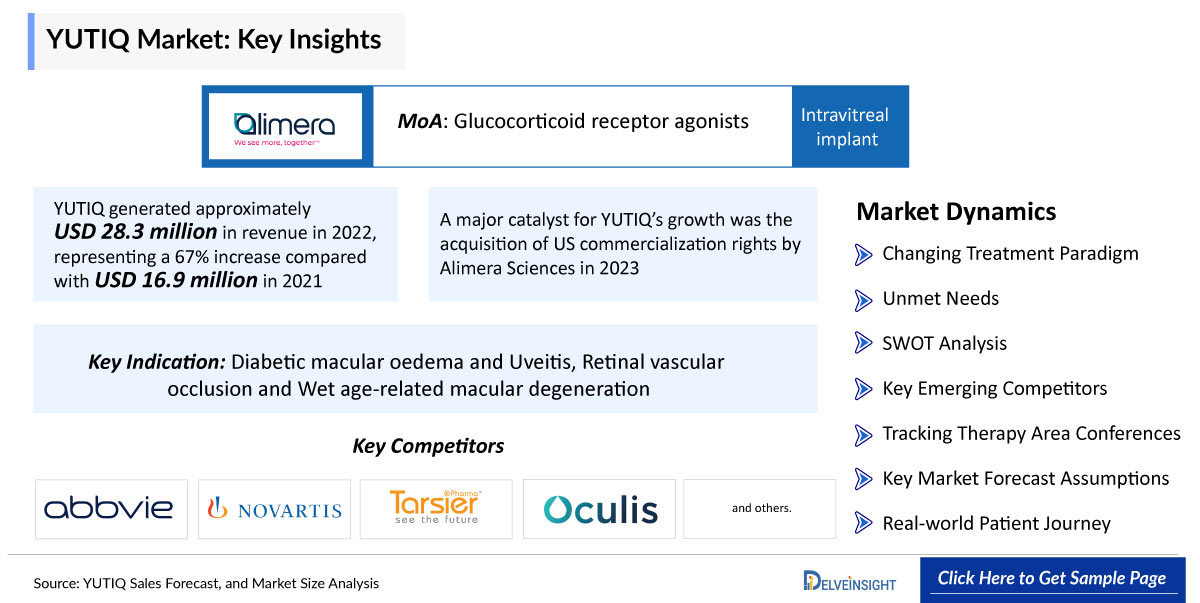
- YUTIQ generated approximately USD 28.3 million in revenue in 2022, representing a 67% increase compared with USD 16.9 million in 2021.
- Quarterly revenue also rose significantly, with Q1 2023 sales reaching USD 7.4 million, up 60% year-over-year.
This rapid growth during early market adoption indicates strong demand among ophthalmologists treating chronic uveitis.
4. Expanded Commercialization Through Alimera Sciences
A major catalyst for YUTIQ’s growth was the acquisition of US commercialization rights by Alimera Sciences in 2023. The transaction provided:
- Expanded ophthalmology sales infrastructure
- Synergies with ILUVIEN, another fluocinolone implant marketed by Alimera
- Broader physician outreach and marketing capabilities
Following this acquisition, Alimera projected that combined revenues from ILUVIEN and YUTIQ could exceed USD 100 million annually, supported by increased physician awareness and a larger commercial team. This expanded commercialization network is expected to accelerate YUTIQ adoption across retina and uveitis specialists.
5. Favorable Pricing and Reimbursement Dynamics
The commercial economics of YUTIQ are also favorable. The implant typically carries an average selling price (ASP) of around USD 4,000–5,000 per implant, reflecting the long duration of therapy and specialty ophthalmology pricing models.
Even moderate market penetration can generate meaningful revenue. For example:
- 10% penetration of the US addressable market could generate roughly USD 40–50 million annually, based on pricing and patient population estimates. Strong reimbursement coverage for vision-saving treatments further supports physician adoption.
6. Growing Market for Intravitreal Implants
Another structural driver is the broader growth of intravitreal drug delivery technologies in ophthalmology. Long-acting implants are becoming an important treatment modality for retinal diseases such as uveitis, diabetic macular edema, and macular degeneration. Industry analyses estimate that fluocinolone-based intravitreal implant franchises (including YUTIQ and ILUVIEN) could collectively generate between USD 100 million and USD 200 million in annual sales around 2024, highlighting the growing demand for sustained-release retinal therapies.
YUTIQ Market Recent Developments
- In March 2025, ANI Pharmaceuticals bought out the 3.125% perpetual royalty obligation on YUTIQ and ILUVIEN net revenues from SWK Funding LLC for USD 17.25 million, effective January 1, 2025. This follows the September 2024 completion of ANI's acquisition of Alimera Sciences, which brought YUTIQ into their portfolio to strengthen their retina-focused business.
“YUTIQ Sales Forecast, and Market Size Analysis – 2034” report provides comprehensive insights of YUTIQ for approved indication like Diabetic macular oedema and Uveitis; as well as potential indication like Retinal vascular occlusion and Wet age-related macular degeneration in the 7MM. A detailed picture of YUTIQ’s existing usage in approved and anticipated entry and performance in potential indications in the 7MM, i.e., the United States, EU4 (Germany, France, Italy, and Spain) and the United Kingdom, and Japan for the study period 2020 –2034 is provided in this report along with a detailed description of the YUTIQ for approved and potential indications.
The YUTIQ Market Report provides insights about YUTIQ’s sales forecast, YUTIQ Mechanism of Action (MoA), dosage and administration, as well as research and development including regulatory milestones, along with other developmental activities. Further, it also consists of historical and current YUTIQ performance, future market assessments inclusive of the YUTIQ market forecast analysis for approved and potential indications in the 7MM, SWOT, analysts’ views, comprehensive overview of market competitors, and brief about other emerging therapies in respective indications. It also provides analysis of YUTIQ sales forecasts, along with factors driving its market.
YUTIQ Drug Summary
YUTIQ (fluocinolone acetonide intravitreal implant) 0.18 mg is an FDA-approved, sterile, non-bioerodible intravitreal micro-insert utilizing EyePoint Pharmaceuticals' Durasert™ sustained-release technology, indicated for the treatment of chronic non-infectious uveitis affecting the posterior segment of the eye. It delivers fluocinolone acetonide, a potent synthetic corticosteroid, at an initial rate of 0.25 μg/day over 36 months to provide continuous anti-inflammatory and immunosuppressive effects, reducing uveitis recurrence rates, prolonging time to flare onset, and minimizing the need for systemic rescue therapy while improving visual acuity.
Preloaded in a single-use applicator for office-based intravitreal implantation, it offers a lower steroid dose than prior implants like Retisert, aiming to decrease risks of elevated intraocular pressure, cataracts, and frequent interventions. The report provides YUTIQ’s sales, growth barriers and drivers, post usage and approvals in multiple indications.
Scope of the YUTIQ Market Report
The report provides insights into:
A comprehensive product overview including the YUTIQ MOA, description, dosage and administration, research and development activities in approved indications like Diabetic Macular Edema and Uveitis; as well as potential indication like Retinal vascular occlusion and Wet Age-related Macular Degeneration.
- Elaborated details on YUTIQ regulatory milestones and other development activities have been provided in the YUTIQ market report.
- The YUTIQ Market Report also highlights YUTIQ‘s cost estimates and regional variations, reported and estimated sales performance, research and development activities in approved and potential indications across the United States, Europe, and Japan.
- The YUTIQ market report also covers the patents information, generic entry and impact on cost cut.
- The YUTIQ market report contains current and forecasted YUTIQ sales for approved and potential indications till 2034.
- Comprehensive coverage of the late-stage emerging therapies for respective indications.
- The YUTIQ market report also features the SWOT analysis with analyst views for YUTIQ in approved and potential indications.
YUTIQ Methodology
The YUTIQ market report is built using data and information sourced primarily from internal databases, primary and secondary research and in-house analysis by DelveInsight’s team of industry experts. Information and YUTIQ Sales Data from the secondary sources have been obtained from various printable and nonprintable sources like search engines, news websites, global regulatory authorities websites, trade journals, white papers, magazines, books, trade associations, industry associations, industry portals and access to available databases.
YUTIQ Analytical Perspective by DelveInsight
- In-depth YUTIQ Market Assessment
This YUTIQ sales market forecast report provides a detailed market assessment of YUTIQ for approved indication like Diabetic Macular Edema and Uveitis, as well as potential indication like Retinal vascular occlusion and Wet age-related macular degeneration in the seven major markets, i.e., the United States, EU4 (Germany, France, Italy, and Spain), the United Kingdom, and Japan. This segment of the report provides current and forecasted YUTIQ sales data until 2034.
- YUTIQ Clinical Assessment
The YUTIQ market report provides the clinical trials information of YUTIQ for approved and potential indications, covering trial interventions, trial conditions, trial status, start and completion dates.
YUTIQ Competitive Landscape
The YUTIQ Market Report provides insights into competitors and marketed products within the domain, along with a summary of emerging products and their respective launch dates, posing significant competition in the market.
YUTIQ Market Potential & Revenue Forecast
- Projected YUTIQ Market Size and its key indications
- Estimated YUTIQ sales potential (YUTIQ peak sales forecasts)
- YUTIQ Pricing strategies and reimbursement landscape
YUTIQ Competitive Intelligence
- Number of competing drugs in development (pipeline analysis)
- YUTIQ Market positioning compared to existing treatments
- YUTIQ Strengths & Weaknesses relative to competitors
YUTIQ Regulatory & Commercial Milestones
- YUTIQ Key regulatory approvals & expected launch timelines
- Commercial partnerships, licensing deals, and M&A activity
YUTIQ Clinical Differentiation
- YUTIQ Efficacy & safety advantages over existing drugs
- YUTIQ Unique selling points
YUTIQ Market Report Highlights
- In the coming years, the YUTIQ market scenario is set to change due to strong adoption, increased prescriptions and broader uptake in multiple immunological indications; which would expand the size of the market.
- The YUTIQ Companies are developing therapies that focus on novel approaches to treat/improve the disease condition, assess challenges, and seek opportunities that could influence YUTIQ’s dominance.
- Other emerging products for Diabetic Macular Edema and Uveitis, as well as potential indication like Retinal vascular occlusion and Wet age-related macular degeneration are expected to give tough market competition to YUTIQ and launch of late-stage emerging therapies in the near future will significantly impact the market.
- A detailed description of regulatory milestones, and developmental activities, provide the current development scenario of YUTIQ in approved and potential indications.
- Analyse YUTIQ cost, pricing trends and market positioning to support strategic decision-making in the immunology landscape.
- Our in-depth analysis of the forecasted YUTIQ sales data uptil 2034 will support the clients in decision-making process regarding their therapeutic portfolio by identifying the overall scenario of YUTIQ in approved and potential indications.
Key Questions Answered in the YUTIQ Market Report
- What is the class of therapy, route of administration and mechanism of action of YUTIQ? How strong is YUTIQ’s clinical and commercial performance?
- What is YUTIQ’s clinical trial status in each individual indications such as Diabetic Macular Edema and Uveitis, as well as potential indication like Retinal vascular occlusion and Wet age-related macular degeneration and study completion date?
- What are the key collaborations, mergers and acquisitions, licensing and other activities related to the YUTIQ Manufacturers?
- What are the key designations that have been granted to YUTIQ for approved and potential indications? How are they going to impact YUTIQ’s penetration in various geographies?
- What is the current and forecasted YUTIQ market scenario for approved and potential indications? What are the key assumptions behind the forecast?
- What are the current and forecasted YUTIQ Sales in the seven major countries, including the United States, Europe (Germany, France, Italy, Spain) and the United Kingdom, and Japan?
- What are the other emerging products available and how are these giving competition to YUTIQ for approved and potential indications?
- Which are the late-stage emerging therapies under development for the treatment of approved and potential indications?
- How cost-effective is YUTIQ? What is the duration of therapy and what are the geographical variations in cost per patient?
Stay updated with us for Recent Articles @ New DelveInsight Blogs

