CTLA-4 Inhibitors Market
- The CTLA-4 inhibitors market is expected to grow significantly in the coming years. This is due to the increasing number of clinical studies of CTLA-4 inhibitors in various types of cancer, increasing the number of cancer patients
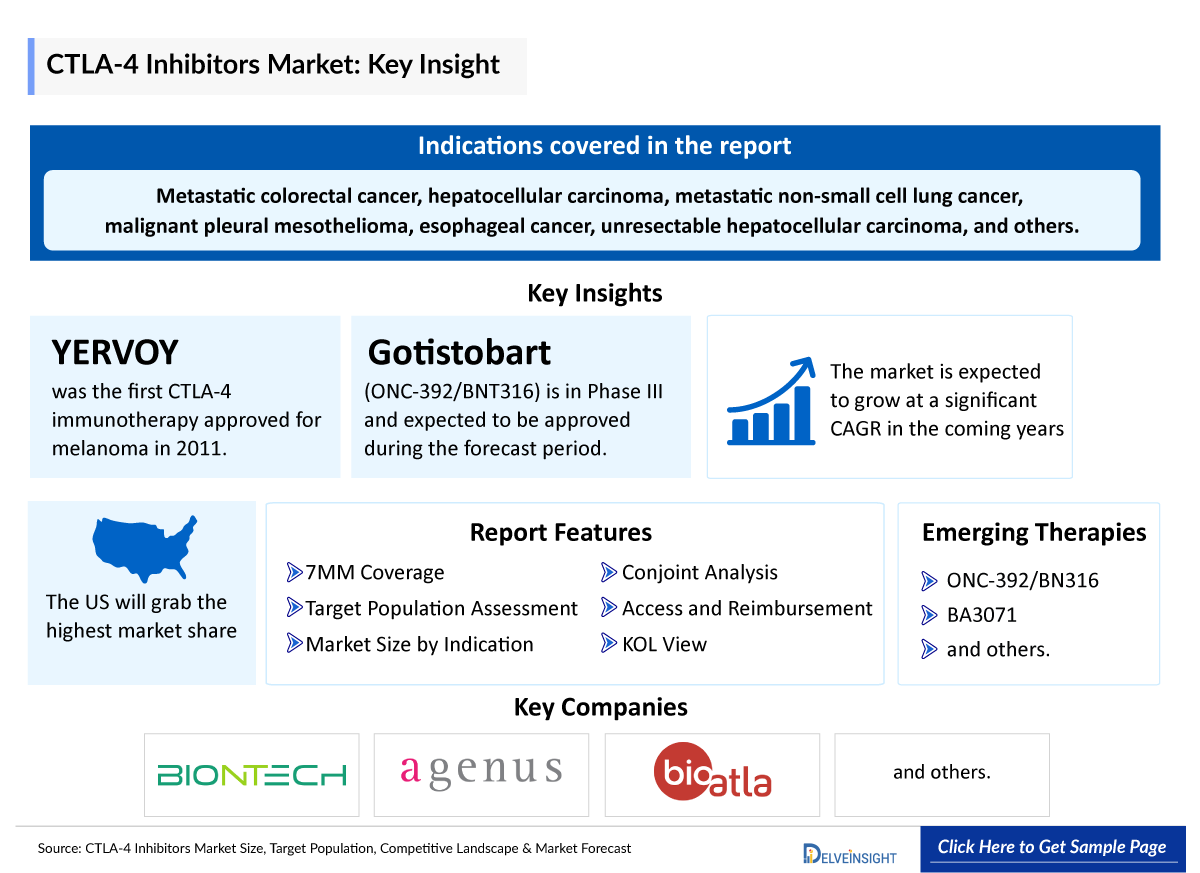
- In March 2011, YERVOY (ipilimumab) became the first approved cancer immunotherapy for melanoma, which targets CTLA-4. At that time It was the first and only approved therapy for unresectable or metastatic melanoma to demonstrate a significant improvement in Overall Survival.
- In 2023, YERVOY registered global sales of more than USD 2 billion, followed by IMJUDO which closed 2023 with more than USD 200 million in global sales. IMJUDO is also a CTLA-4 inhibitor that got its approval from the FDA in October 2022, launched by Bristol Myers Squibb in the market in Q4 2022.
- The CTLA-4 inhibitors market insights includes YERVOY and IMJUDO, getting their approvals from US FDA for the treatment of various types of cancer such as unresectable or metastatic melanoma, advanced renal cell carcinoma, microsatellite instability-high or mismatch repair deficient metastatic colorectal cancer, hepatocellular carcinoma, metastatic non-small cell lung cancer, malignant pleural mesothelioma, esophageal cancer, unresectable hepatocellular carcinoma and Others.
- Numerous CTLA-4 inhibitor drugs are presently under clinical investigation. One such inhibitor is gotistobart (ONC-392/BNT316), a product of BioNTech and OncoC4. This drug is currently in the clinical development Phase III and is expected to gain regulatory approval within the projected timeline.
- CTLA-4 inhibitors work by blocking CTLA-4. When CTLA-4 is bound to another protein called B7, it helps keep T cells from killing other cells, including cancer cells so when CTLA 4 blocker blocks this protein then the “brakes” on the immune system are released and the ability of T cells to kill cancer cells is increased.
- Recently researchers from the University of Michigan and Takeda Pharmaceuticals have discovered a mechanism by which anti-CTLA-4 antibodies induce inflammatory toxicities during antitumor immune checkpoint inhibitor therapies. These findings may advance the development of next-generation CTLA-4 inhibitors that promote antitumor responses without triggering intestinal disease.
- BioNTech, Agenus, Bioatla OncoC4, and several other CTLA-4 inhibitors companies are currently engaged in the development and production of selective CTLA-4 inhibitors, which have the potential to significantly impact and enhance the CTLA-4i market.
Request for unlocking the sample for "CTLA-4 Inhibitors Market Size"
DelveInsight’s “CTLA-4 Inhibitors Market Size, Target Population, Competitive Landscape, and Market Forecast – 2034” report delivers an in-depth understanding of the CTLA-4 inhibitors, historical and forecasted epidemiology, competitive landscape as well as the CTLA-4 inhibitors market trends in the United States, EU4 (Germany, France, Italy, and Spain) and the United Kingdom, and Japan.
The CTLA-4 inhibitors market insights report provides current treatment practices, emerging drugs, market share of individual therapies, and current and forecasted 7MM CTLA-4 inhibitors market size from 2020 to 2034. The CTLA-4 inhibitors market report also covers current CTLA-4 inhibitors treatment practices/algorithms and unmet medical needs to curate the best opportunities and assess the market’s potential.
CTLA-4 Inhibitors Market: Understanding and Treatment Algorithm
Cytotoxic T lymphocyte antigen-4 (CTLA-4) is an immune checkpoint molecule that is mainly expressed on activated T cells and regulatory T cells that inhibit T-cell activation and regulate immune homeostasis. It is composed of a leader peptide, a ligand binding domain, a transmembrane domain, and a cytoplasmic domain. Due to the crucial functions of CTLA-4 in T-cell biology, CTLA-4-targeted immunotherapies have been developed for autoimmune diseases as well as cancers.
CTLA-4 Expression
CTLA-4 is expressed in multiple types of cancer such as cervical cancer (80% of patients), small intestine cancer (33.3%), melanoma (33.3%), and others.
Further details related to country-based variations are provided in the report
CTLA-4 Inhibitors Treatment Market
CTLA-4 (cytotoxic T-lymphocyte associated protein 4, CD152) is an important inhibitory immune checkpoint receptor. It is expressed on various subtypes of T-lymphocytes including CD4+ and CD8+ T-cells as well as regulatory T-cells1. When CTLA-4 is bound to another protein called B7, it helps keep T cells from killing other cells, including cancer cells. Some anticancer drugs, called immune checkpoint inhibitors, are used to block CTLA-4. When this protein is blocked, the “brakes” on the immune system are released and the ability of T cells to kill cancer cells is increased.
CTLA-4 can compete with its stimulating counterpart CD28 for ligand binding to CD80 and CD862, CD28 co-stimulation is required for T-cell activation, whereas CTLA-4 inhibits T-cell response by opposing the actions of CD28-mediated co-stimulation. Even though CTLA-4 is also expressed on activated CD8+ cytotoxic T-cells, the major physiologic role of CTLA-4 appears to be through down-modulation of non-regulatory T-cell activity and supportively enhancement of regulatory T-cell suppressive activity The CTLA-4 pathway is commonly targeted in cancer immunotherapy. For example, the CTLA-4 inhibitor ipilimumab alone or in combination has been approved for the treatment of advanced malignant melanoma, renal cell, and microsatellite instability-high colorectal cancer by the US FDA.
Further details related to country-based variations are provided in the report
NOTE: Above graph is indicative and are subject to change as per report updation
CTLA-4 Inhibitors Drug Chapters
The CTLA-4 inhibitors drugs market chapter reports encloses a detailed analysis of CTLA-4 inhibitors marketed drugs and late-stage (Phase III and Phase II) CTLA-4 inhibitors pipeline drugs. It also helps understand the CTLA-4 inhibitors clinical trials details, expressive pharmacological action, agreements and collaborations, approval and patent details, advantages and disadvantages of each included drug and the latest CTLA-4 inhibitors news and press releases.
Marketed CTLA-4 Inhibitors Drugs
- YERVOY (ipilimumab): Bristol Myers Squibb
YERVOY (ipilimumab) is a first-in-class human cytotoxic T-lymphocyte antigen 4 (CTLA-4) blocking antibody. At that time it was the First and Only Approved Therapy for Unresectable or Metastatic Melanoma to Demonstrate a Significant Improvement in Overall Survival.
Upon approval YERVOY provided oncologists, the option to have a treatment for patients with unresectable or metastatic melanoma that has been proven in a randomized Phase III clinical trial to significantly extend the lives of patients.
The FDA approval of YERVOY is the culmination of more than 14 years of research and development done by BMS development teams and clinical trial investigations done on 676 patients with unresectable or metastatic melanoma previously treated with one or more of the following: aldesleukin, dacarbazine, temozolomide, fotemustine, or carboplatin in randomized Phase III clinical trial.
- IMJUDO (tremelimumab-actl): Astrazeneca
Note: Detailed current therapies assessment will be provided in the full report of CTLA-4 inhibitors
Emerging CTLA-4 Inhibitors Drugs- ONC-392/BN316 (gotistobart): OncoC4/BioNTech
BNT316/ONC-392 (gotistobart) is a next-generation anti-CTLA-4 antibody candidate jointly developed by BioNTech and OncoC4. Gotistobart is currently in late-stage clinical development as monotherapy or combination in various cancer indications such as non-small cell lung cancer, ovarian cancer, high-grade serous adenocarcinoma of the ovary, primary peritoneal carcinoma, fallopian tube cancer, etc.
The immune checkpoint receptor CTLA-4 inhibits T cell immune response and reduces the activity of T cells in recognizing and eliminating cancer cells. Gotistobart was designed to address this mechanism while preserving CTLA-4 recycling and thus the immunosuppressive T cell function in the peripheral tissues. The aim of this approach, which is currently under clinical evaluation, is to give rise to fewer immune-related adverse effects.
- BA3071: BioAtla
BA3071 is a CAB (conditionally active biologic) anti-CTLA-4 antibody that is being developed as an immuno-oncology agent to deliver efficacy at least comparable to the approved anti-CTLA-4 antibodies, but with lower toxicities due to the CAB's tumor microenvironment-restricted activity.
Although inhibition of CTLA-4 has been shown to significantly improve antitumor response, it may also lead to immune attack of healthy cells. To minimize on-target off-tumor toxicity, BioAtla has applied its proprietary CAB technology with the intent to activate binding to the CTLA-4 receptor only on T cells in the tumor microenvironment. BA3071 is designed to improve the efficacy and safety of anti-CTLA-4 therapy, as a monotherapy and in combination with other therapies, by restricting its activation and that of tumor-specific T cells to the tumor microenvironment
It is in Phase 2 development as a potential therapeutic for multiple solid tumor indications known to be responsive to CTLA-4 treatment in combination with a PD-1 blocking agent.
Note: Detailed emerging therapies assessment will be provided in the final report.
Note: The emerging drug list is indicative, the full list will be given in the final report.
CTLA-4 Inhibitors Market Outlook
The market for CTLA-4 inhibitors is expected to grow significantly in the coming years. This is due to the increasing number of clinical studies of CTLA-4 inhibitors in various types of cancer, increasing the number of cancer patients.
Currently, approved CTLA-4 inhibitors include YERVOY (ipilimumab) and IMJUDO (tremelimumab-actl). Currently, YERVOY is dominating the CTLA-4 inhibitors market with more than USD 2 billion in sales in 2023 followed by IMJUDO which closed 2023 with more than 200 million USD in sales but many CTLA-4 inhibitors are under clinical studies out of which some have innovative properiatry technology used in there development which can significantly challenge the YERVOY dominance in future.
Several key players, including BioNTech, Agenus, BioAtla, and others, are involved in developing drugs for CTLA-4 inhibitors for various indications such as metastatic castration-resistant prostate cancer, breast cancer, cervical cancer, non-squamous cell lung cancer, and others.
Overall, this is an exciting new class of agents with great potential for development. The maturation of current studies over the next few years will lead to a better understanding of CTLA-4 inhibitors and define their role in the therapy of cancer.
Get more insights by downloading the full report @ CTLA-4 Inhibitors Market Size
CTLA-4 Inhibitors Drugs UptakeThis section focuses on the uptake rate of potential approved and emerging CTLA-4 inhibitors expected to be launched in the market during 2020–2034.
CTLA-4 Inhibitors Pipeline Development Activities
The CTLA-4 Inhibitors market report provides insights into different therapeutic candidates in Phase III, Phase II, and Phase I stage. It also analyzes key CTLA-4 Inhibitors companies involved in developing targeted therapeutics.
The presence of numerous drugs under different stages is expected to generate immense opportunity for CTLA-4i market growth over the forecasted period.
CTLA-4 Inhibitors Clinical Trial activities
The CTLA-4 Inhibitors drugs market report covers information on collaborations, acquisitions and mergers, licensing, and patent details for CTLA-4 inhibitors emerging therapies.
The increasing strategic collaborations among major CTLA-4 Inhibitors companies to enhance the growth of their pipeline products are anticipated to drive CTLA-4 Inhibitors market expansion. For example, In March 2023, BioNTech and OncoC4 announced a strategic collaboration to co-develop and commercialize novel checkpoint antibodies in multiple solid tumor indications and BioNTech received an exclusive worldwide license from OncoC4 to develop and commercialize its anti-CTLA-4 monoclonal antibody candidate, ONC-392. BioNTech and OncoC4 will co-develop ONC-392 as monotherapy or in combination with anti-PD1 in various solid tumor indications. BioNTech also plans to combine ONC-392 with its proprietary oncology product candidates to evaluate complementary modes of action to increase therapeutic effect and unlock larger patient populations.
KOL Views on CTLA-4 Inhibitors
To keep up with current and future CTLA-4 Inhibitors market trends, we take Industry Experts’ opinions working in the domain through primary research to fill the data gaps and validate our secondary research. Industry experts were contacted for insights on CTLA-4 inhibitors' evolving treatment landscape, patient reliance on conventional therapies, patient therapy switching acceptability, drug uptake, along challenges related to accessibility.
DelveInsight’s analysts connected with 25+ KOLs to gather insights; however, interviews were conducted with 10+ KOLs in the 7MM. Centers such as Johns Hopkins Kimmel Cancer Center, Instituto de Biomedicina de Seville Spain, Cancer Institute Hospital of Japanese Foundation for Cancer Research, and others were contacted.
Their opinion helps understand and validate current and emerging therapy treatment patterns or CTLA-4 inhibitors market trends. This will support the clients in potential upcoming novel treatments by identifying the overall scenario of the CTLA-4 Inhibitors market and the unmet needs.
Qualitative Analysis for CTLA-4 Inhibitors Market Size
We perform Qualitative and market Intelligence analysis using various approaches, such as SWOT analysis. In the SWOT analysis, strengths, weaknesses, opportunities, and threats in terms of disease diagnosis, patient awareness, patient burden, competitive landscape, cost-effectiveness, and geographical accessibility of therapies are provided. These pointers are based on the analyst’s discretion and assessment of the patient burden, cost analysis, and existing and evolving treatment landscape.
CTLA-4 Inhibitors Drugs Market Access and Reimbursement
Reimbursement for CTLA-4 inhibition has been universal in the United States and Europe. In the UK, NICE recommends nivolumab in combination with ipilimumab, for the treatment of advanced (unresectable or metastatic) melanoma in adults, only when the company provides ipilimumab with the discount agreed in the patient access scheme.
The appraisal committee accepted that the combination of nivolumab plus ipilimumab is a promising new advance in the treatment of melanoma regardless of BRAF mutation status, but only for people who are fit enough to tolerate the considerable related adverse effects. It also concluded that the incremental cost‑effectiveness ratio (ICER) for nivolumab plus ipilimumab compared with pembrolizumab (the most clinically relevant comparator) was likely to be less than £30,000 per quality-adjusted life year (QALY) gained.
The report further provides detailed insights on the country-wise accessibility and reimbursement scenarios, cost-effectiveness scenario of approved therapies, programs making accessibility easier and out-of-pocket costs more affordable, insights on patients insured under federal or state government prescription drug programs, etc.
CTLA-4 Inhibitors Key Updates
Some of the CTLA-4 Inhibitors companies presented the data of their CTLA-4 inhibitors during the ASCO 2023 and others are also expected to present recent data in upcoming ASCO 2024 including BioNTech, Oncoc4, Xilio Development, Roche Inc., and others.
In June 2024, BioAtla is expected to give a poster presentation at the upcoming 2024 American Society of Clinical Oncology (ASCO) Annual Meeting. The study is titled “Phase I study of BA3071, an anti-CTLA-4 conditionally active biologic, in combination with nivolumab in advanced solid tumors” and has Abstract number 2602.
In March 2023, BioNTech and OncoC4 team up to co-develop and market checkpoint antibodies for solid tumors. BioNTech gains exclusive global rights to develop and commercialize ONC-392, OncoC4's anti-CTLA-4 monoclonal antibody candidate.
CTLA-4 Inhibitors Market Size Report Scope
- The CTLA-4 Inhibitors market size report covers a segment of key events, an executive summary, and a descriptive overview, explaining its mechanism, and therapies (current and emerging).
- Comprehensive insight into the Competitive Landscape, and forecasts, the future growth potential of treatment rate, drug uptake, and drug information have been provided.
- Additionally, an all-inclusive account of the current and emerging therapies and the elaborative profiles of late-stage and prominent therapies will impact the current landscape.
- A detailed review of the CTLA-4 inhibitors market, historical and forecasted market size, market share by therapies, detailed assumptions, and rationale behind our approach is included in the report, covering the 7MM drug outreach.
- The CTLA-4 Inhibitors market size report provides an edge while developing business strategies, by understanding trends, through SWOT analysis expert insights/KOL views, and treatment preferences that help shape and drive the 7MM CTLA-4 inhibitors drugs market.
CTLA-4 Inhibitors Market Forecast Report Insights
- CTLA-4 Targeted Patient Pool
- Therapeutic Approaches
- CTLA-4 Inhibitors Pipeline Analysis
- CTLA-4 Inhibitors Market Size
- CTLA-4 Inhibitors Market Trends
- Existing and future CTLA-4 Inhibitors Market Opportunity
CTLA-4 Inhibitors Market Forecast Report Key Strengths
- 11 Years CTLA-4 inhibitors Market Forecast
- The 7MM Coverage
- Key Cross Competition
- CTLA-4 Inhibitors Drugs Uptake
- Key CTLA-4 inhibitors Market Forecast Assumptions
CTLA-4 Inhibitors Drugs Market Report Assessment
- Current CTLA-4 inhibitors Treatment Market Practices
- CTLA-4 inhibitors Unmet Needs
- CTLA-4 inhibitors Pipeline Product Profiles
- CTLA-4 inhibitors Drugs Market Attractiveness
- Qualitative Analysis (SWOT)
Key Questions
- What was the CTLA-4 Inhibitors Market Size, the market size by therapies, market share (%) distribution, and what would it look like in 2034? What are the contributing factors for this growth?
- Which CTLA-4 Inhibitors is going to be the largest contributor in 2034?
- Which is the most lucrative CTLA-4 Inhibitors Market Size?
- Which drug type segment accounts for maximum CTLA-4 inhibitors sales?
- What are the pricing variations among different geographies for approved therapies?
- How has the reimbursement landscape for CTLA-4 inhibitor Drug evolved since the first one was approved? Do patients have any access issues that are driven by reimbursement decisions?
- What are the risks, burdens, and unmet needs of treatment with CTLA-4 inhibitors? What will be the growth opportunities across the 7MM for the patient population of CTLA-4 inhibitors?
- What are the key factors hampering the growth of the CTLA-4 inhibitors market size?
- What are the indications for which recent novel therapies and technologies have been developed to overcome the limitations of existing treatments?
- What key designations have been granted to the therapies for CTLA-4 inhibitors?
- What is the cost burden of approved therapies on the patient?
- Patient acceptability in terms of preferred therapy options as per real-world scenarios?
- What are the country-specific accessibility issues of expensive, recently approved therapies?
Reasons to buy
- The CTLA-4 inhibitors Market Forecast report will help develop business strategies by understanding the latest trends and changing dynamics driving the CTLA-4 inhibitors Market.
- Understand the existing CTLA-4 Inhibitors market opportunities in varying geographies and the growth potential over the coming years.
- Distribution of historical and current patient share based on real-world prescription data along with reported sales of approved products in the US, EU4 (Germany, France, Italy, and Spain) the United Kingdom, and Japan.
- Identifying strong upcoming CTLA-4 Inhibitors companies in the CTLA-4 inhibitors treatment market will help devise strategies to help get ahead of competitors.
- Detailed analysis and ranking of indication-wise current and emerging therapies under the conjoint analysis section to provide visibility around leading indications.
- Highlights of Access and Reimbursement policies of approved therapies, barriers to accessibility of expensive off-label therapies, and patient assistance programs.
- To understand Key Opinion Leaders’ perspectives around the accessibility, acceptability, and compliance-related challenges of existing treatment to overcome barriers in the future.
- Detailed insights on the unmet needs of the existing CTLA-4 Inhibitors market so that the upcoming CTLA-4 Inhibitors companies can strengthen their development and launch strategy.
Click here for New Articles-
Find More article on Latest DelveInsight Blogs