High-Grade Glioma Market Summary
- The High-Grade Glioma Therapeutics Market Size in the 7MM was estimated to be nearly USD 800 million in 2025, and it is expected to grow positively by 2036. This change is mainly due to the increase in incidence and the launch of upcoming therapies during the forecast period.
- The leading High-Grade Glioma Companies such as Chimerix, Aivita Biomedical, Denovo Biopharma, Northwest Therapeutics, Orbus Therapeutics, Tvax Biomedical, Laminar Pharmaceuticals, Recursion Pharmaceuticals, Vigeo Therapeutics, Eli Lilly, Incyte Corporation, Kazia Therapeutics, Biomimetix, Medicenna Therapeutics, Immunomic Therapeutics, Mimivax, Oblato, CNS Pharmaceuticals, Epitopoietic Research Corporation (ERC), Imvax, BeiGene, Enterome, VBI Vaccines, Genenta Science, TME Pharma, Inovio Pharmaceuticals, Istari Oncology, Plus Therapeutics, and others.
High-Grade Glioma Market and Epidemiology Analysis
- Only 5% of new investigational drug applications submitted to the US FDA for cancer therapies are successful, and for brain cancer, the rate of success has been closer to 1% over the past two decades.
- Based on DelveInsight's assessment in 2025, the 7MM had approximately 40,000 High-Grade Glioma Incident Cases.
- Anaplastic Astrocytoma and Glioblastoma increase in incidence with age, peaking in the 75–84 age group.
- Numerous cancer vaccines for first-line and second-line Glioblastoma are in the development phases as part of the glioblastoma pipeline. Many companies have been attempting for decades to achieve success in glioblastoma, such as Northwest Therapeutics, which has yet to achieve success with its dendritic cell cancer vaccine.
Request for Unlocking the Sample Page of the Report @ High-Grade Glioma Treatment Market
Key Factors Impacting the High-Grade Glioma Market Growth
-
High-Grade Glioma Patient Pool
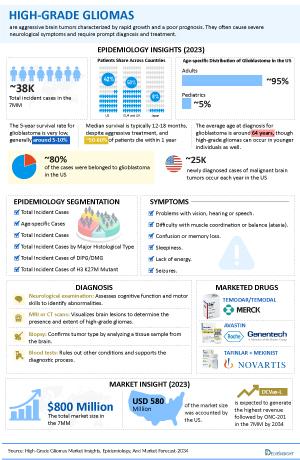
In the US, approximately 25,000 new cases of malignant brain tumors are diagnosed annually, with gliomas representing around 80% of these cases. Among them, glioblastoma accounts for roughly 13,000 cases each year. The incidence of anaplastic astrocytoma and glioblastoma increases with age, peaking in the 75–84 age group.
-
Current High-Grade Glioma Treatment Landscape
Despite decades of research, glioblastoma remains challenging to treat, with only ~1% of brain cancer drug applications achieving FDA approval. Standard care involves surgery, radiation, and chemotherapy, but emerging strategies aim to improve outcomes. Numerous cancer vaccines and immunotherapies are in development, reflecting efforts to target tumor-specific mechanisms and enhance survival.
-
High-Grade Glioma Market Drivers and Emerging Therapies
The glioblastoma market is propelled by innovations in targeted therapies, cancer vaccines, and imaging agents. Key emerging drugs include ONC201 (Chimerix/Oncoceutics), AV-GBM-1 (Avita Biomedical), Enzastaurin (DB-102) (Denovo Biopharma), DCVax-L (Northwest Therapeutics), Eflornithine (Orbus Therapeutics), Ofranergene obadenovec/VB-111 (VBL Therapeutics), TVI-Brain-1 (TVAX Biomedical), ITI-1000 (Immunomic Therapeutics), and SurVaxM (MimiVax). Positive regulatory feedback and rare disease designations, such as MAIA Biotechnology’s THIO for pediatric-type diffuse high-grade gliomas, further stimulate innovation.
-
High-Grade Glioma Clinical Trials
Several pivotal trials are underway, including Imvax’s Phase IIb trial of IGV-001 in newly diagnosed glioblastoma and CNS Pharmaceuticals’ Phase II study of berubicin, with topline data expected in H1 2025. FluoGuide’s FG001 intraoperative imaging agent also received positive FDA pre-IND feedback supporting future IND and NDA filings, highlighting a robust pipeline of novel therapeutics and diagnostic innovations.
DelveInsight’s "High-grade Glioma Market Insight, Epidemiology, and Market Forecast – 2036" report delivers an in-depth understanding of high-grade glioma, historical and forecasted epidemiology as well as the high-grade glioma therapeutics market trends in the United States, EU4 (Germany, France, Italy, and Spain) and the United Kingdom, and Japan.
The High-Grade Glioma Treatment Market Report provides current treatment practices, emerging drugs, high-grade glioma market share of individual therapies, and current and forecasted high-grade glioma market size from 2022 to 2036, segmented by seven major markets. The report also covers current high-grade glioma treatment practices/algorithms and unmet medical needs to curate the best of the opportunities and assess the underlying potential of the market.
Scope of the High-Grade Glioma Market Report | |
|
Study Period |
2022 to 2036 |
|
Forecast Period |
2026-2036 |
|
Geographies Covered |
|
|
High-Grade Glioma Market |
|
|
High-Grade Gliomas Market Size | |
|
High-Grade Glioma Companies |
Chimerix, Aivita Biomedical, Denovo Biopharma, Northwest Therapeutics, Orbus Therapeutics, Tvax Biomedical, Laminar Pharmaceuticals, Recursion Pharmaceuticals, Vigeo Therapeutics, Eli Lilly, Incyte Corporation, Kazia Therapeutics, Biomimetix, Medicenna Therapeutics, Immunomic Therapeutics, Mimivax, Oblato, CNS Pharmaceuticals, Epitopoietic Research Corporation (ERC), Imvax, BeiGene, Enterome, VBI Vaccines, Genenta Science, TME Pharma, Inovio Pharmaceuticals, Istari Oncology, Plus Therapeutics, and others. |
|
High-Grade Glioma Epidemiology Segmentation |
|
High-grade Glioma Understanding
High-grade Glioma Overview
Highly malignant or high-grade gliomas are tumors of the central nervous system (CNS), wherein high-grade means glioma is proliferating. They are solid tumors arising from transformed brain and/or spinal cord cells. Since they directly originate from the CNS, they are also called primary CNS tumors, differentiating them from malignant tumors of other organs that have spread (metastasized) to the CNS. High-grade gliomas can occur in different parts of the central nervous system and can affect children of any age.
The tumors most often originate in the supratentorial region of the brain and the brain stem; high-grade gliomas originating from the supratentorial region are often called supratentorial high-grade gliomas. Symptoms primarily result from the pressure the tumor first exerts on the adjacent brain tissue and, later on, in an advanced stage, on the entire brain (or spinal cord). The local swelling (edema) of adjacent normal brain (or spinal cord) tissue caused by the tumor plays a major role during the development of clinical symptoms.
High-grade Glioma Diagnosis
The initial diagnostic procedures for a patient presenting with a suspected CNS tumor at a childhood cancer center include an assessment of the patient’s history, a thorough physical/neurological exam, and imaging diagnostic, such as Magnetic Resonance Imaging (MRI). The MRI is needed to determine the tumor’s localization, size, and demarcation from the surrounding brain (or spinal cord) tissue.
High-grade Glioma Treatment
High-Grade Glioma treatment usually includes a combination of surgery, chemotherapy, radiation, or stereotactic radiosurgery. Surgery is usually one of the most important aspects of treatment, although rarely used alone. Since glioblastomas develop very rapidly, they are often difficult to remove in their entirety. Therefore, surgery is performed to achieve a maximum safe resection – removing as much of the tumor as possible while preserving the patient’s brain function and sparing healthy tissues. After surgery, residual cancer cells can be targeted with additional treatments, such as chemotherapy or radiation therapy.
.jpg)
High-grade Glioma Epidemiology Insights
The high-grade glioma epidemiology chapter in the report provides historical as well as forecasted epidemiology segmented by the total incident cases of glioma, total incident cases of high-grade glioma, total incident cases of DIPG/DMG, total incident cases of H3 K27M mutant glioma, incident cases of high-grade glioma by major histological type, and age-specific cases of high-grade glioma in the 7MM market covering the United States, EU4 (Germany, France, Italy, and Spain) and the United Kingdom, and Japan from 2022 to 2036.
Key Findings from High-Grade Glioma Epidemiological Analyses and Forecast
- Based on DelveInsight's assessment in 2025, the 7MM had approximately 40,000 High-Grade Glioma Incident Cases.
- In the 7MM, the US accounted for the highest number of High-Grade Glioma Incident Cases, with nearly 16,700 in 2025.
- In 2025, EU4 and the UK accounted for nearly 630 cases of DIPG/DMG.
- The number of Glioblastoma Incident Cases is much higher than that of anaplastic astrocytoma. In the US, in 2025, the former accounted for ~90% of the cases, while ~10% cases belonged to anaplastic astrocytoma.
- In 2025, Japan accounted for more than hundred cases of H3 K27M mutant glioma.
High-Grade Glioma Epidemiology Segmentation
- Total Incident Cases of DIPG/DMG in the 7MM
- Total Incident Cases of High-Grade Glioma in the 7MM
- Total Incident Cases of Glioma in the 7MM
- Age-specific Cases of High-Grade Glioma in the 7MM
- Total Incident Cases of High-Grade Glioma by Major Histological Type in the 7MM
- Total Incident Cases of H3 K27M Mutant in the 7MM
.jpg)
High-grade Glioma Market Recent Developments and Developments
- In November 2025, Purdue Pharma announced that the US FDA has granted Orphan Drug Designation to tinostamustine for the treatment of malignant glioma. The company also plans to evaluate the bifunctional alkylating and HDAC-inhibiting agent in the adaptive GBM AGILE Phase II/III platform trial for glioblastoma.
- In November 2025, Juncell Therapeutics presented data at the Society for Immunotherapy of Cancer Annual Meeting (SITC 2025) highlighting a case in which a patient with grade IV glioblastoma achieved complete tumor eradication four weeks after a single infusion of GC101 tumor-infiltrating lymphocytes (TIL), with tumor-free survival maintained for more than 20 months.
- In September 2025, BioLineRx and Hemispherian announced that the FDA has cleared an Investigational New Drug (IND) application for GLIX1, a first-in-class oral small molecule targeting DNA damage response pathways. The companies plan to initiate a Phase I/IIa clinical trial in patients with newly diagnosed and recurrent glioblastoma in 2026, following promising preclinical data demonstrating anti-tumor activity and blood-brain barrier penetration.
High-grade Glioma Drug Analysis
The high-grade glioma drug chapter segment of the High-Grade Glioma therapeutics market report encloses a detailed analysis of the late-stage (Phase III and Phase II/III) and early-stage (Phase I/II) High-Grade Glioma Pipeline Drugs. The current key players for emerging drugs and their respective drug candidates include Chimerix/Oncoceutics (ONC201), Immunomic Therapeutics (ITI-1000), MimiVax (SurVaxM), Aivita Biomedical (AV-GBM-1), DNAtrix (DNX-2401), and others. The drug chapter also helps understand the high-grade glioma clinical trial details, expressive pharmacological action, agreements and collaborations, approval, and patent details, and the latest news and press releases.
High-grade Glioma Marketed Drugs
-
TEMODAR/TEMODAL (Temozolomide): Merck
The active pharmaceutical ingredient in TEMODAR/TEMODAL is an imidazotetrazine derivative of the alkylating agent dacarbazine. It is used for treating several brain cancer forms, e.g., as a second-line treatment for astrocytoma and a first-line treatment for GBM. The therapeutic benefit of TEMODAR is its ability to alkylate/methylate DNA.
-
- TEMODAR is indicated for the treatment of adults with newly diagnosed glioblastoma concomitantly with radiotherapy and then as maintenance treatment and anaplastic astrocytoma. It was granted the first US FDA approval in 1999 for recurrent anaplastic astrocytoma.
- In September 2023, the US FDA approved new and updated indications for TEMODAR capsules and injections, including for the adjuvant treatment of adults with newly diagnosed anaplastic astrocytoma and the treatment of adults with refractory anaplastic astrocytoma.
-
AVASTIN (Bevacizumab): Roche (Genentech)
AVASTIN is a recombinant humanized monoclonal IgG1 antibody, which acts as an angiogenesis inhibitor by blocking its target, vascular endothelial growth factor (VEGF). It binds to the VEGF with its receptors VEGFR-1 and VEGFR-2, which are present on the surface of endothelial cells. AVASTIN is indicated for treating GBM with progressive disease in adult patients following prior therapy. In December 2017, the US FDA granted full approval for AVASTIN for the treatment of adults with glioblastoma that progressed following prior therapy. AVASTIN was previously granted provisional approval in this setting under the FDA's accelerated approval program. Currently, the US FDA has approved five biosimilars of AVASTIN.
High-grade Glioma Emerging Drugs
-
Paxalisib (GDC-0084): Kazia Therapeutics
Paxalisib is an investigational PI3K/mTOR pathway inhibitor designed to penetrate the blood–brain barrier and target aberrant signaling pathways involved in glioblastoma growth. The therapy is being developed by Kazia Therapeutics for the treatment of glioblastoma, particularly in patients with newly diagnosed glioblastoma with an unmethylated MGMT promoter.
Paxalisib is currently being evaluated in the adaptive Phase II/III GBM AGILE trial, which investigates multiple therapies for newly diagnosed and recurrent glioblastoma. In the trial, paxalisib demonstrated a clinically meaningful improvement in overall survival. Based on these findings, the company plans to engage with the US FDA regarding potential accelerated approval pathways. However, paxalisib has not yet received regulatory approval and remains under clinical development, although it has been granted ODD and FTD by the FDA to support its development in this patient population.
-
LAM561: Laminar Pharmaceuticals
LAM561 is a first-in-class anticancer agent that works through cell membrane lipid modification, disrupting tumor cell membrane structure and signaling pathways. It is being developed by Laminar Pharmaceuticals for the treatment of glioblastoma and other solid tumors. Early clinical development includes completed Phase I/IIa and Phase Ib studies that evaluated the safety and tolerability of LAM561 in adults, including patients with newly diagnosed glioblastoma receiving standard-of-care therapy.
Currently, LAM561 is being investigated in the Phase IIb/III CLINGLIO trial in Europe for adult patients with newly diagnosed glioblastoma, which is considered a pivotal study to evaluate efficacy and survival outcomes. In addition, a Phase I/II pediatric clinical trial in the United States is ongoing for children with advanced solid tumors, including Malignant Glioma. If the CLINGLIO study demonstrates meaningful clinical benefit, interactions with the European Medicines Agency could support a conditional marketing authorization submission in the future; however, LAM561 remains an investigational therapy as of 2026–2026.
High-Grade Glioma Drugs Market Insights
A few targeted therapies inhibit specific molecular targets involved in signaling pathways. A few common targets include EGFR (epidermal growth factor receptor), mTOR (mammalian target of rapamycin), PI3K (phosphatidylinositol 3-kinase), and VEGF (vascular endothelial growth factor). AVASTIN belongs to the VEGF inhibitors.
Numerous clinical trials are testing new therapeutic approaches with Tyrosine Kinase Inhibitors and angiogenesis inhibitors. ONC-201 selectively targets DRD2 and ClpP and has demonstrated remarkable efficacy in patients with gliomas that carry the H3K27M mutation.
High-grade Glioma Market Outlook
The most commonly used chemotherapy drug to treat glioblastoma is TEMODAR/TEMODAL. It belongs to a class of drugs known as alkylating agents that work by slowing or stopping the growth of cancer cells. Immunotherapy provides another opportunity for treatment. It is a new, promising, exciting treatment area designed to trigger the body’s immune system to fight and halt tumor growth. Immunotherapy or “vaccine” therapy involves the induction of an immune response against an individual tumor. Currently, Chimerix is the only company in the advanced stages of developing treatments for the H3K27M mutation.
Other key players in the early stages of development include Rigel Pharmaceuticals, Aminex Therapeutics, Bexion Pharmaceuticals, OX2 Therapeutics, Neonc Technologies, and others. It is interesting to note that the emerging market of GBM includes budding gene therapy by VBL Therapeutics, followed by a few vaccine/immunotherapy candidates such as DCVax-L, SurVaxM, and others. Due to the high costs, lengthy development period, and low approval rate of new oncology drugs, there is a growing interest in repurposing approved drugs for potential cancer treatments. Utilizing these drugs, with established dosing schedules and toxicity profiles, can significantly cut down on the time and expenses required to introduce them as treatments.
Key Findings from High-Grade Glioma Market Forecast Report
- The High-Grade Glioma Therapeutics Market Size in the 7MM was estimated to be nearly USD 800 million in 2025, and it is expected to grow positively by 2036. This change is mainly due to the increase in incidence and the launch of upcoming therapies during the forecast period.
- The US accounted for the largest High-Grade Glioma Market Size in 2025, which was nearly USD 580 million, compared to EU4 (Germany, Italy, France, and Spain), the UK, and Japan.
- Vaccine approaches are an attractive therapy for solid tumors because they can generate long-term immune surveillance against cancer cells. MimiVax (SurVaxM), Northwest Biotherapeutics (DCVax-L), Aivita Biomedical (AV-GBM-1), and IMVAX (IGV-001) are some of the key players developing therapeutic vaccines for GBM.
- By 2036, among all the emerging therapies in the High-Grade Glioma Market Size, the highest revenue is expected to be generated by DCVax.
.jpg)
High-grade Glioma Drugs Uptake
This section focuses on the rate of uptake of the potential High-Grade Glioma drugs expected to be launched in the market during the study period. The analysis covers high-grade glioma market uptake by drugs; patient uptake by therapies; and sales of each drug. As per the analysis, SurVaxM + temozolomide ± sargramostim drug uptake in the US is expected to be medium-fast. Out of all the vaccines in the pipeline, SurVaxM and DCVax-L are top contenders in the first-line setting. DCVax-L is also among the few top contenders in the second-line setting.
High-grade Glioma Clinical Trials Activities
The High-Grade Glioma Therapeutics Market Report provides insights into different High-grade Glioma clinical trials within Phase III, Phase II, and Phase I/II stage. It also analyzes key High-Grade Glioma Companies involved in developing targeted therapeutics.
High-Grade Pipeline Development Activities
The High-Grade Glioma Therapeutics Market Report covers detailed information on collaborations, acquisitions and mergers, licensing, and patent details for high-grade glioma emerging therapies.
Latest KOL Views on High-Grade Glioma
To keep up with current market trends, we take KOLs and SMEs' opinions working in the domain through primary research to fill the data gaps and validate our secondary research. Some of the leaders like MD, Professor and Vice Chair Department of Critical Care Medicine and Director, PhD, and others. Their opinion helps to understand and validate current and emerging therapies and treatment patterns or high-grade glioma market trends. This will support the clients in potential upcoming novel treatments by identifying the overall scenario of the market and the High-Grade Glioma Unmet Needs.
Delveinsight’s analysts connected with 30+ KOLs to gather insights; however, interviews were conducted with 10+ KOLs in the 7MM. Centers such as the Radiation and Oncology Miami Cancer Institute, Johns Hopkins University School of Medicine, University of California, etc., were contacted. Their opinion helps understand and validate high-grade glioma epidemiology and market trends.
High-Grade Glioma Report Qualitative Analysis
We perform Qualitative and market Intelligence analysis using various approaches, such as SWOT and conjoint analysis. In the SWOT analysis, strengths, weaknesses, opportunities, and threats in terms of disease diagnosis, patient awareness, patient burden, competitive landscape, cost-effectiveness, and geographical accessibility of therapies are provided. These pointers are based on the Analyst’s discretion and assessment of the patient burden, cost analysis, and existing and evolving High-Grade Glioma Treatment Landscape.
The analyst analyzes multiple emerging therapies based on relevant attributes such as safety, efficacy, frequency of administration, route of administration, and order of entry. In efficacy, the trial’s primary and secondary outcome measures are evaluated. Further, the therapies’ safety is evaluated wherein the acceptability, tolerability, and adverse events are majorly observed, and it sets a clear understanding of the side effects posed by the drug in the trials.
High-Grade GliomaMarket Access and Reimbursement
With the Genentech Oncology Co-pay Assistance Program, eligible patients with commercial insurance could pay as little as USD USD 0 per treatment for AVASTIN. Co-pay assistance of up to USD 25,000 is provided per calendar year. An independent co-pay assistance foundation is a charitable organization providing financial assistance to patients with specific disease states, regardless of treatment. Patients who are commercially or publicly insured, including those covered by Medicare and Medicaid, can contact the foundations directly to request assistance.
Eligibility requirements, all aspects of the application process, turnaround times, and the type or amount of assistance available (if any) can vary by foundation. Independent co-pay assistance foundations have their own eligibility rules. They have no involvement or influence in independent foundation decision-making or eligibility criteria and do not know if a foundation will be able to help. They can only refer the patients to a foundation that supports the disease state.
Scope of the High-grade Glioma Market Report
- The High-Grade Glioma Therapeutics Market Report covers a descriptive overview, explaining its causes, signs and symptoms, pathogenesis, and currently available therapies.
- Comprehensive insight has been provided into high-grade glioma epidemiology and treatment.
- Additionally, an all-inclusive account of both the current and emerging therapies for high-grade glioma is provided, along with the assessment of new therapies, which will have an impact on the current treatment landscape.
- A detailed review of the high-grade glioma Treatment Market, historical and forecasted is included in the report, covering the 7MM drug outreach.
- The High-Grade Glioma Therapeutics Market Report provides an edge while developing business strategies, by understanding trends shaping and driving the 7MM High-Grade Glioma Drugs Market.
High-grade Glioma Market Report Insights
- High-grade Glioma Patient Population
- High-grade Glioma Therapeutic Approaches
- High-grade Glioma Pipeline Analysis
- High-grade Glioma Market Size and Trends
- High-grade Glioma Market Opportunities
- Impact of Upcoming High-grade Glioma Therapies
High-grade Glioma Market Report Key Strengths
- 11 Years High-Grade Glioma Market Forecast
- 7MM Coverage
- High-grade Glioma Epidemiology Segmentation
- Key Cross Competition
- Highly Analyzed High-Grade Glioma Drugs Market
- High-grade Glioma Drugs Uptake
High-grade Glioma Market Report Assessment
- Current High-grade Glioma Treatment Practices
- High-grade Glioma Unmet Needs
- High-grade Glioma Pipeline Product Profiles
- High-grade Glioma Market Attractiveness
- Qualitative Analysis (SWOT and Conjoint Analysis)
- High-grade Glioma Market Drivers
- High-grade Glioma Market Barriers
Key Questions Answered in the High-Grade Glioma Market Report
High-Grade Glioma Treatment Market Insights
- What was the high-grade glioma market share (%) distribution in 2022 and what it would look like in 2036?
- What would be the high-grade glioma market size as well as market size by therapies across the 7MM during the study period (2022–2036)?
- What are the key findings about the market across the 7MM and which country will have the largest high-grade glioma market size during the study period (2022–2036)?
- At what CAGR is the high-grade glioma market expected to grow at the 7MM level during the study period (2022–2036)?
- What would be the high-grade glioma market outlook across the 7MM during the study period (2022–2036)?
- What would be the high-grade glioma market growth till 2036 and what will be the resultant market size in the year 2036?
- What are the disease risks, burdens, and unmet needs of high-grade glioma?
- What is the historical high-grade glioma patient pool in the United States, EU4 (Germany, France, Italy, and Spain), and the UK, and Japan?
- What would be the forecasted patient pool of high-grade glioma at the 7MM level?
- What will be the growth opportunities across the 7MM concerning the patient population of high-grade glioma?
- Out of the above-mentioned countries, which country would have the incident population of high-grade glioma during the study period (2022–2036)?
- At what CAGR is the population expected to grow across the 7MM during the study period (2022–2036)?
- How many companies are developing therapies for the treatment of high-grade glioma?
- How many emerging therapies are in the mid-stage and late stage of development for the treatment of high-grade glioma?
- What are the key collaborations (Industry–Industry, Industry-Academia), Mergers and acquisitions, and licensing activities related to high-grade glioma therapies?
- What are the recent novel therapies, targets, mechanisms of action, and technologies developed to overcome the limitations of existing therapies?
- What are the clinical studies going on for high-grade glioma and their status?
- What are the key designations that have been granted for the emerging therapies for high-grade glioma?
- What are the 7MM historical and forecasted market of high-grade glioma?
Reasons to Buy the High-grade Glioma Market Forecast Report
- The High-Grade Glioma Therapeutics Market Report will help in developing business strategies by understanding trends shaping and driving high-grade glioma.
- To understand the future High-Grade Glioma Drugs Market competition in the high-grade glioma market and Insightful review of the SWOT analysis of high-grade glioma.
- Organize sales and marketing efforts by identifying the best opportunities for high-grade glioma in the US, EU4 (Germany, France, Italy, and Spain), the United Kingdom, and Japan.
- Identification of strong upcoming players in the High-Grade Glioma Drugs Market will help in devising strategies that will help in getting ahead of competitors.
- Organize sales and marketing efforts by identifying the best opportunities for the High-Grade Glioma Drugs Market.
- To understand the future market competition in the High-Grade Glioma Drugs Market.
Stay updated with us for Recent Articles