Hyperparathyroidism Market Summary
- The Hyperparathyroidism market in the 7MM is valued at approximately USD 1,487 million in 2025.
- The Hyperparathyroidism market is projected to grow at a CAGR of 1.2% by 2034 in leading countries like US, EU4, UK and Japan.
Hyperparathyroidism Market and Epidemiology Analysis
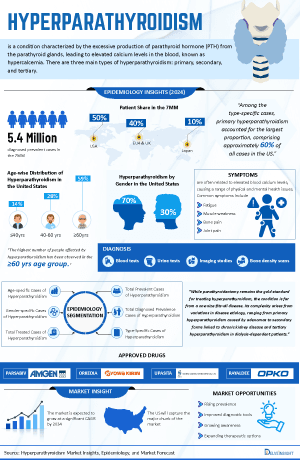
- Hyperparathyroidism is a condition characterized by the excessive production of parathyroid hormone (PTH) from the parathyroid glands, leading to elevated calcium levels in the blood, known as hypercalcemia. There are three main types of hyperparathyroidism: primary, seconday and tertiary.
- Diagnosis is usually made through routine blood tests that reveal elevated serum calcium and PTH levels. Imaging studies may also be used to identify any abnormalities in the parathyroid glands.
- The condition is notably more prevalent in females, who accounted for approximately 70% of gender-specific cases in the United States.
- Tertiary hyperparathyroidism accounts for the highest prevalence among the subtype classifications, with secondary hyperparathyroidism following closely behind.
- Treatment primarily involves surgical removal of the overactive parathyroid gland(s). In cases where surgery is not an option or in asymptomatic patients, monitoring or medications like cinacalcet may be used to manage calcium levels.
- Drugs for hyperparathyroidism include cinacalcet, vitamin D analogues, phosphate binders, bisphosphonates, and Estrogen or Selective Estrogen Receptor Modulators (SERMs), used to manage PTH levels, calcium balance, and bone health.
- PARSABIV and RAYALDEE are approved in the US for secondary hyperparathyroidism, whereas ORKEDIA and UPASITA are approved in Japan for secondary hyperparathyroidism, only PARSABIV is the only drug with is approved in 7MM.
- The pipeline for hyperparathyroidism remains limited, with few active development programs underway—reflecting both the maturity of current treatment options and the need for more innovative, long-term solutions.
Hyperparathyroidism Market size and forecast
- 2025 Market Size: USD 1,487 million in 2025
- 2034 Projected Market Size: USD 1,650 million in 2034
- Growth Rate (2025-2034): 1.2% CAGR
- Largest Market: United States

Key factors driving Hyperparathyroidism market
Rising Hyperparathyroidism Burden in the Aging Population
In 2024, the United States reported approximately 2.6 million diagnosed prevalent cases of hyperparathyroidism, with individuals aged ≥60 years representing the largest patient group. Primary hyperparathyroidism (PHPT) accounted for nearly 60% of all cases, underscoring its clinical dominance. The increasing prevalence reflects not only aging demographics but also improved detection through advanced diagnostic tools.
Advances in Diagnosis and Treatment Approaches
Management strategies vary across primary, secondary, and tertiary hyperparathyroidism, ranging from surgical removal of hyperfunctioning parathyroid glands in PHPT to medical therapies such as phosphate binders, vitamin D analogs, and calcimimetics in SHPT and THPT. Surgical intervention remains the only curative option, though localization challenges persist in cases with small adenomas, ectopic glands, or multiglandular disease. Advanced imaging, including sestamibi scans, high-resolution ultrasound, and 4D-CT, continues to improve surgical precision.
Approved Therapies and Emerging Pipeline
The treatment landscape has expanded with approved options such as PARSABIV and RAYALDEE in the US and ORKEDIA and UPASITA in Japan for secondary hyperparathyroidism. Notably, PARSABIV remains the only therapy approved across the 7MM. Despite these advances, the pipeline for hyperparathyroidism is limited, with few active development programs underway, highlighting the need for innovative long-term solutions.
Report Summary
- The report offers extensive knowledge regarding the epidemiology segments and predictions, presenting a deep understanding of the potential future growth in diagnosis rates, disease progression, and treatment guidelines. It provides comprehensive insights into these aspects, enabling a thorough assessment of the subject matter.
- Additionally, an all-inclusive account of the current management techniques and emerging therapies and the elaborative profiles of late-stage (Phase III and Phase II) and prominent therapies that would impact the current treatment landscape and result in an overall market shift has been provided in the report.
- The report also encompasses a comprehensive analysis of the hyperparathyroidism market, providing an in-depth examination of its historical and projected market size (2020–2034). It also includes the market share of therapies, detailed assumptions, and the underlying rationale for our methodology. The report also includes drug outreach coverage in the 7MM region.
- The report includes qualitative insights that provide an edge while developing business strategies by understanding trends through SWOT analysis and expert insights/KOL views, including experts from various hospitals and prominent universities, patient journey, and treatment preferences that help shape and drive the 7MM ET market.
The table given below further depicts the key segments provided in the report
|
Study Period |
2020–2034 |
|
Forecast Period |
2025–2034 |
|
Geographies Covered |
US, EU4 (Germany, France, Italy, and Spain) and the UK, and Japan |
|
Epidemiology |
Segmented by: · Total Prevalent Cases of Hyperparathyroidism · Total Diagnosed Prevalence Cases of Hyperparathyroidism · Type-Specific Cases of Hyperparathyroidism · Age-specific Cases of Hyperparathyroidism · Gender-specific Cases of Hyperparathyroidism · Total Treated cases of Hyperparathyroidism |
|
Market |
Segmented by: · Region · Therapies |
|
Market Analysis |
· KOL Views · SWOT Analysis · Reimbursement · Conjoint Analysis · Unmet needs |
Hyperparathyroidism Market
Various key players are leading the treatment landscape of hyperparathyroidism, such as Amgen, Kyowa Kirin, SANWA KAGAKU KENKYUSHO, OPKO Health, and Others. The details of the country-wise and therapy-wise market size have been provided below.
- In 2024, the United States dominated the hyperparathyroidism market among the 7MM, capturing approximately 80% of the total market share.
- In 2024, the PARSABIV represented approximately 50% of the market share across the EU4 and the UK.
- In 2024, the secondary hyperparathyroidism type accounted for approximately 261,000 cases of hyperparathyroidism cases in Japan.
Hyperparathyroidism Drug Chapters
The section dedicated to drugs in the Hyperparathyroidism report provides an in-depth evaluation of late-stage pipeline drugs (Phase III and Phase II) related to Hyperparathyroidism. The drug chapters section provides valuable information on various aspects related to clinical trials of Hyperparathyroidism, such as the pharmacological mechanisms of the drugs involved, designations, approval status, patent information, and a comprehensive analysis of the pros and cons associated with each drug. Furthermore, it presents the most recent news updates and press releases on drugs targeting Hyperparathyroidism.
Marketed Therapies
PARSABIV (Etelcalcetide): Amgen & Ono Pharmaceutical
PARSABIV is a novel calcimimetic agent indicated for the treatment of secondary hyperparathyroidism in adult patients with chronic kidney disease (CKD) on hemodialysis. A calcimimetic is a drug that mimics the action of calcium by activating the calcium-sensing receptors on the parathyroid gland. PARSABIV binds to and activates the calcium-sensing receptor on the parathyroid gland, thereby decreasing PTH levels.
In February, 2017, the FDA granted approval to PARSABIV (etelcalcetide) for the treatment of secondary hyperparathyroidism in adult patients with chronic kidney disease (CKD) on hemodialysis
UPASITA (Upacicalcet): SANWA KAGAKU KENKYUSHO
UPASITA (Upacicalcet) is an intravenous calcimimetic agent being developed by Sanwa Kagaku Kenkyusho, under license from EA Pharma, for the treatment of secondary hyperparathyroidism, a common and early complication of chronic kidney disease, in patients undergoing haemodialysis. By acting directly on parathyroid cell membrane calcium-sensing receptors, upacicalcet suppresses excessive parathyroid hormone (PTH) secretion, thereby lowering blood PTH levels.
In June 2021, Sanwa kagaku kenkyusho has received Marketing Authorization approval today for UPASITA IV Injection Syringes (Upacicalcet) for the treatment of secondary hyperparathyroidism in patients on hemodialysis
Note: Detailed assessment will be provided in the final report of Hyperparathyroidism …
Hyperparathyroidism Market Outlook
Each type requires distinct management strategies, ranging from surgical intervention in PHPT to medical therapies such as phosphate binders, vitamin D analogs, and calcimimetics in SHPT and THPT. Early diagnosis and targeted treatment are essential to prevent complications such as osteoporosis, nephrolithiasis, cardiovascular risks, and metabolic disturbances. Surgical removal of the hyperfunctioning parathyroid gland(s) remains the definitive treatment, offering a potential cure. However, localization of the hyperfunctioning gland can be complex, particularly in cases involving small adenomas, ectopic lesions, or multiglandular disease. Advanced imaging techniques, such as sestamibi scans, high-resolution ultrasound, and 4D-CT, aid in preoperative localization but may not always yield conclusive results. Surgical removal of the hyperfunctioning parathyroid gland(s) remains the definitive treatment, offering a potential cure. However, localization of the hyperfunctioning gland can be complex, particularly in cases involving small adenomas, ectopic lesions, or multiglandular disease. Advanced imaging techniques, such as sestamibi scans, high-resolution ultrasound, and 4D-CT, aid in preoperative localization but may not always yield conclusive results. The treatment landscape for hyperparathyroidism has evolved significantly, particularly with the advent of calcimimetics and refined surgical techniques.
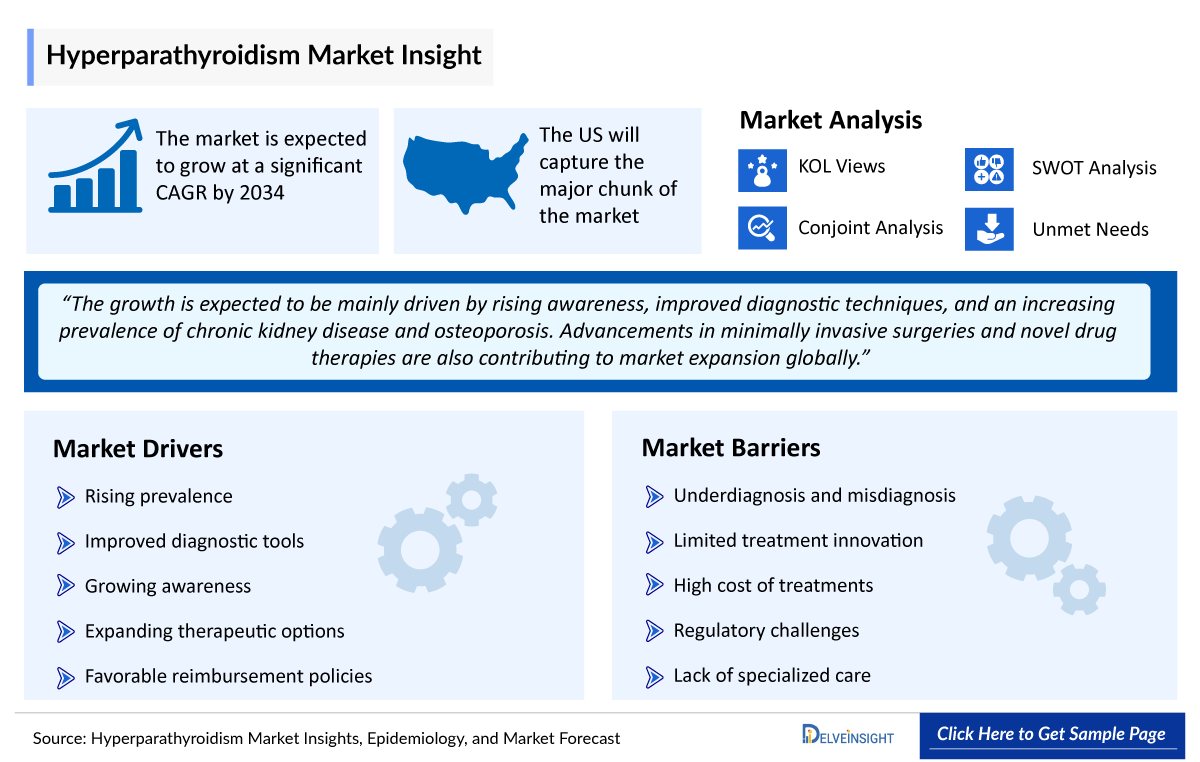
Despite advances in pharmacotherapy, unmet needs persist in long-term disease control, treatment adherence, and prevention of complications such as vascular calcification and cardiovascular morbidity. The development of next-generation calcimimetics with improved tolerability, extended-release formulations, or combination therapies with vitamin D analogs could further enhance management outcomes. Additionally, biomarker-driven treatment approaches and precision medicine strategies may play an increasing role in optimizing therapy selection.
Further details are provided in the report…
Hyperparathyroidism Disease Understanding and Treatment
Hyperparathyroidism Overview
Hyperparathyroidism is a condition characterized by excessive production of parathyroid hormone (PTH) from the parathyroid glands, which are located near the thyroid gland in the neck. This overproduction leads to elevated calcium levels in the blood, a condition known as hypercalcemia, which can cause various health issues. There are three forms of hyperparathyroidism, each with a different cause.
- Primary hyperparathyroidism: One or more of the parathyroid glands grows too large and releases too much PTH, which leads to elevated levels of calcium (because of excessive production of calcitriol and release of calcium from the bones).
- Secondary hyperparathyroidism: Blood-calcium or vitamin D levels are so low—often due to dietary deficiency—they cause the parathyroid glands to release excessive levels of PTH to counteract the deficiency by inducing excessive release of calcium from bone.
- Tertiary hyperparathyroidism: Chronically reduced calcium and vitamin D deficiency—or reduced calcitriol synthesis due to kidney disease—cause all four parathyroid glands to grow and produce PTH regardless of whether the body needs the hormone, leading to elevated levels of calcium levels (because of excessive release of calcium from the bones
Further details are provided in the report…
Hyperparathyroidism Diagnosis
Hyperparathyroidism is commonly diagnosed during routine blood tests, which check blood-calcium levels. It’s less common for people to be diagnosed with the condition because of symptoms or complications. In those instances, however, doctors will diagnose the condition after learning about a patient’s medical history, performing a physical examination, and giving diagnostic tests.
Further details related to country-based variations are provided in the report…
Hyperparathyroidism Treatment
Treatment for hyperparathyroidism primarily involves surgical options for symptomatic cases, while medical management can be effective for asymptomatic patients or those unable to undergo surgery. Regular monitoring is crucial in all cases to manage calcium levels and prevent complications
Further details related to treatment and management are provided in the report…
Hyperparathyroidism Epidemiology
The Hyperparathyroidism epidemiology chapter in the report provides historical as well as forecasted epidemiology segmented by Total Prevalent Cases of Hyperparathyroidism, Total Diagnosed Prevalence Cases of Hyperparathyroidism, Type-Specific Cases of Hyperparathyroidism, Age-specific Cases of Hyperparathyroidism, Gender-specific Cases of Hyperparathyroidism, and Total Treated cases of Hyperparathyroidism in the United States, EU4 countries (Germany, France, Italy, Spain) and the United Kingdom, and Japan from 2020 to 2034.
- In 2024, the total diagnosed prevalent cases of hyperparathyroidism in the United States stood at 2,607,000
- In 2024, individuals aged ≥60 years accounted for the highest number of cases
- In 2024, aproximately 70% of hyperparathyroidism cases accounted by females in 7MM.
- In Japan, the diagnosed prevalence of hyperparathyroidism was approximately 479,000 in 2024.
.png)
Further details related to epidemiology will be provided in the report…
KOL Views
To stay abreast of the latest trends in the market, we conduct primary research by seeking the opinions of Key Opinion Leaders (KOLs) and Subject Matter Experts (SMEs) who work in the relevant field. This helps us fill any gaps in data and validate our secondary research.
We have reached out to industry experts to gather insights on various aspects of Hyperparathyroidism, including the evolving treatment landscape, patients’ reliance on conventional therapies, their acceptance of therapy switching, drug uptake, and challenges related to accessibility. The experts we contacted included medical/scientific writers, professors, and researchers from prestigious universities in the US, Europe, the UK, and Japan.
Our team of analysts at Delveinsight connected with more than 15 KOLs across the 7MM. We contacted institutions such as the University of Munich, the University of Tokyo, MD Anderson Cancer Center, Johns Hopkins Kimmel Cancer Center, etc., among others. By obtaining the opinions of these experts, we gained a better understanding of the current and emerging treatment patterns in the Hyperparathyroidism market, which will assist our clients in analyzing the overall epidemiology and market scenario.
Qualitative Analysis
We perform Qualitative and Market Intelligence analysis using various approaches, such as SWOT analysis and Conjoint Analysis. In the SWOT analysis, strengths, weaknesses, opportunities, and threats in terms of disease diagnosis, patient awareness, patient burden, competitive landscape, cost-effectiveness, and geographical accessibility of therapies are provided. These pointers are based on the Analyst’s discretion and assessment of the patient burden, cost analysis, and existing and evolving treatment landscape.
Conjoint Analysis analyzes multiple approved and emerging therapies based on relevant attributes such as safety, efficacy, frequency of administration, designation, route of administration, and order of entry. Scoring is given based on these parameters to analyze the effectiveness of therapy.
In efficacy, the trial’s primary and secondary outcome measures are evaluated; for instance, in trials for Hyperparathyroidism, one of the most important primary endpoints was achieving hemolysis control, LDH normalization, etc. Based on these, the overall efficacy is evaluated.
Further, the therapies’ safety is evaluated wherein the acceptability, tolerability, and adverse events are majorly observed, and it sets a clear understanding of the side effects posed by the drug in the trials. In addition, the scoring is also based on the route of administration, order of entry and designation, probability of success, and the addressable patient pool for each therapy. According to these parameters, the final weightage score and the ranking of the emerging therapies are decided.
Market Access and Reimbursement
Because newly authorized drugs are often expensive, some patients escape receiving proper treatment or use off-label, less expensive prescriptions. Reimbursement plays a critical role in how innovative treatments can enter the market. The cost of the medicine, compared to the benefit it provides to patients who are being treated, sometimes determines whether or not it will be reimbursed. Regulatory status, target population size, the setting of treatment, unmet needs, the number of incremental benefit claims, and prices can all affect market access and reimbursement possibilities.
The report further provides detailed insights on the country-wise accessibility and reimbursement scenarios, cost-effectiveness scenario of approved therapies, programs making accessibility easier and out-of-pocket costs more affordable, insights on patients insured under federal or state government prescription drug programs, etc.
Hyperparathyroidism Report Insights
- Patient Population
- Therapeutic Approaches
- Hyperparathyroidism Market Size and Trends
- Existing Market Opportunity
Hyperparathyroidism Report Key Strengths
- Ten-year Forecast
- The 7MM Coverage
- Hyperparathyroidism Epidemiology Segmentation
- Key Cross Competition
Hyperparathyroidism Report Assessment
- Current Treatment Practices
- Reimbursements
- Market Attractiveness
- Qualitative Analysis (SWOT, Conjoint Analysis, Unmet needs)
Key Questions
- Would there be any changes observed in the current treatment approach?
- Will there be any improvements in Hyperparathyroidism management recommendations?
- Would research and development advances pave the way for future tests and therapies for Hyperparathyroidism?
- Would the diagnostic testing space experience a significant impact and lead to a positive shift in the treatment landscape of Hyperparathyroidism?
- What kind of uptake will the new therapies witness in the coming years in Hyperparathyroidism patients?