
Infusion Pumps Market Summary
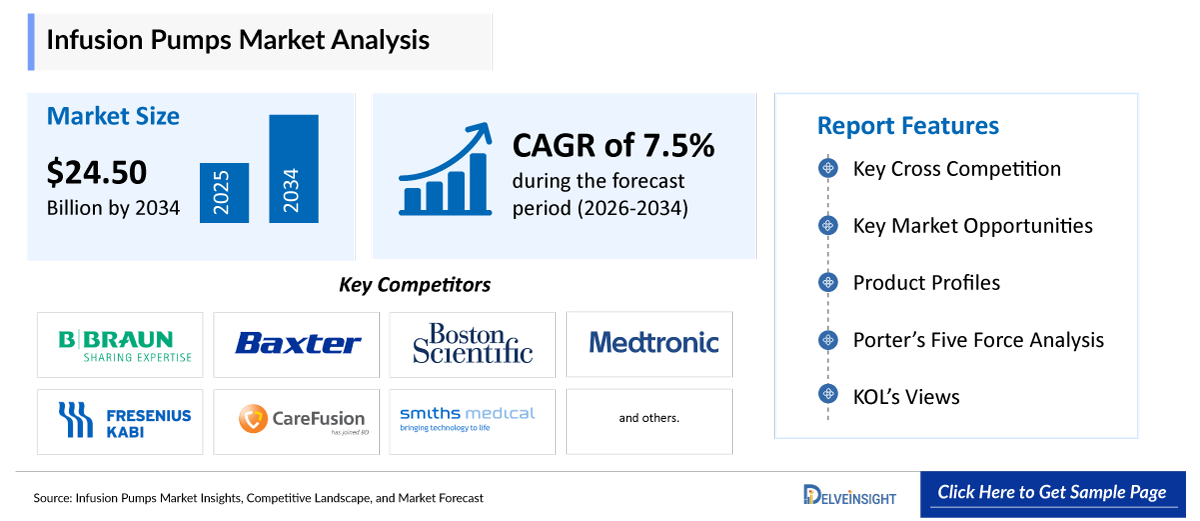
- The infusion pumps market size is estimated at USD 12.80 billion in 2025 and is projected to reach USD 24.50 billion by 2034. Growth is anchored in the rising global burden of chronic and lifestyle diseases, rapid expansion of home and ambulatory infusion therapy, and growing adoption of smart, connected drug-delivery platforms.
- The global infusion pumps market is growing at a CAGR of 7.5% during the forecast period from 2026 to 2034.
- By type, the volumetric pumps segment dominated the Infusion Pumps market with a 29% share in 2025.
- By application, the diabetes segment dominated the Infusion Pumps market with a 34% share in 2025.
- By end-user, the hospitals & clinics segment dominated the Infusion Pumps market with a 49% share in 2025.
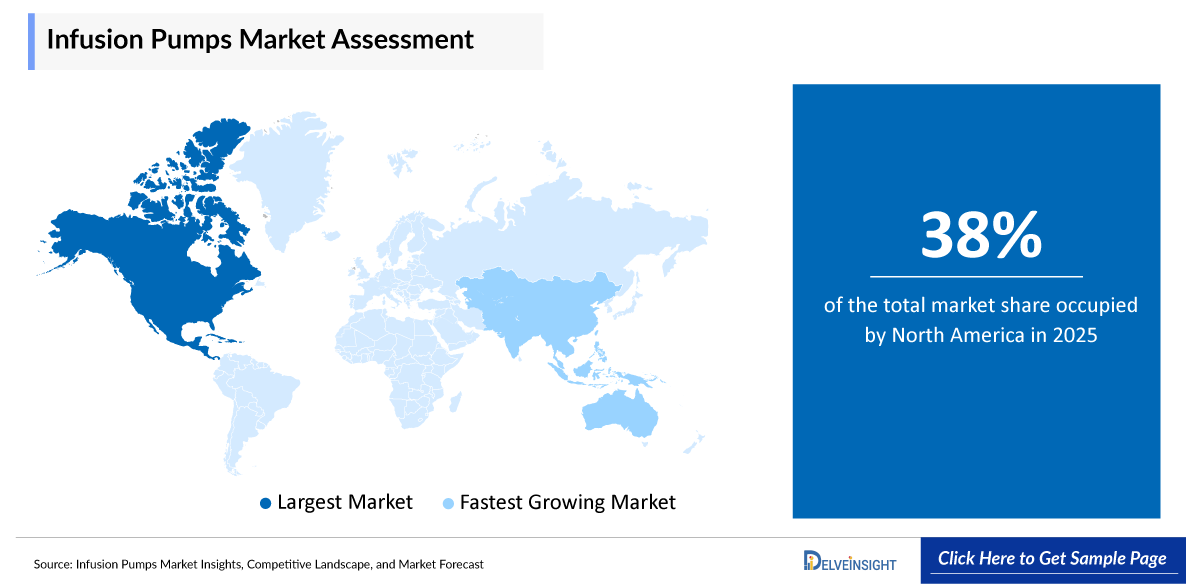
- North America dominated the global Infusion Pumps market revenue with a 38% share in 2025, representing the highest regional market share globally.
An infusion pump is a medical device used to deliver fluids, including medications, nutrients, blood products, and hormones, into a patient's body in precisely controlled volumes and at programmable rates, either intravenously, subcutaneously, epidurally, or enterally. Because high-risk therapies such as chemotherapy, insulin, opioids, and parenteral nutrition require accurate, continuous, and error-free administration, infusion pumps have become indispensable across hospitals, ambulatory care settings, and home care, replacing manual gravity-drip delivery with programmable, alarm-equipped systems that reduce dosing errors and improve patient safety.
The market is organized by type across volumetric pumps, syringe pumps, enteral pumps, insulin pumps, elastomeric pumps, implantable pumps, and patient-controlled analgesia (PCA) pumps; by application across diabetes, oncology, pain management, gastroenterology, and other therapeutic uses; and by end-user across hospitals and clinics, ambulatory care settings, home care settings, and other providers. Driven by the rising global prevalence of diabetes and cancer, the accelerating shift toward home-based and outpatient infusion therapy, and continuous innovation in smart, wireless-enabled, and AI-supported infusion platforms, infusion pumps have become foundational infrastructure underpinning safe and precise drug delivery across the modern care continuum.
Infusion Pumps Market Key Growth Drivers
- The rising global burden of chronic and lifestyle diseases, including diabetes, cancer, and cardiovascular conditions, is expanding demand for precise, programmable drug-delivery systems across care settings.
- The rapid shift toward home healthcare and ambulatory infusion therapy is reducing hospitalization costs and driving adoption of compact, portable, and wearable infusion pumps.
- Continuous technological innovation, including smart pumps, wireless connectivity, dose-error-reduction software, and AI-enabled dosage monitoring, is improving safety and expanding hospital adoption.
- Expanding use of automated insulin delivery systems, such as Medtronic's MiniMed 780G, is accelerating insulin pump adoption for diabetes management.
- The rising global cancer burden is increasing demand for oncology infusion therapy, including ambulatory and portable pumps for outpatient chemotherapy administration.
- Accelerating regulatory clearances and new product launches, including Baxter's Novum IQ platform and Smiths Medical's CADD-Solis VIP ambulatory pump, are expanding available device capacity.
- A growing hospital focus on medication safety and dose-error reduction, supported by EMR-integrated smart pump software, is concentrating demand among compliant, technologically advanced manufacturers.
- The convergence of chronic disease prevalence, home-care expansion, and connected-device innovation is expected to sustain steady growth in the market through 2034.
Key Companies in Infusion Pumps Market
The competitive landscape is led by the following active players:
- B. Braun Melsungen AG
- Baxter International Inc.
- Boston Scientific Corporation
- Medtronic plc.
- Fresenius Kabi
- CareFusion Corporation
- Smiths Medical
- Koninklijke Philips NV
- Micrel Medical Devices SA
- Terumo Corporation, and others
For illustrative purposes, only the top 10 companies are listed in the Table of Contents. The report may include analysis and references to additional companies relevant to the market assessment.
Infusion Pumps Market Size
The following snapshot summarizes the principal report metrics for the Infusion Pumps market.
|
Report Metrics |
Details |
|
2025 Market Size |
USD 12.80 billion |
|
2034 Projected Market Size |
USD 24.50 billion |
|
Growth Rate (2026-2034) |
7.5% CAGR |
|
Largest Market |
North America |
|
Fastest Growing Market |
Asia-Pacific |
|
Market Structure |
Moderately Consolidated |
All market values are expressed in USD and represent DelveInsight estimates synthesized from primary and secondary research.
Factors Contributing to the Growth of the Infusion Pumps Market
Infusion Pumps Market Drivers
- Rising Global Burden of Chronic and Lifestyle Diseases: The most powerful driver of the infusion pumps market is the escalating global prevalence of chronic and lifestyle diseases, including diabetes, cancer, and cardiovascular conditions. The World Health Organization attributes more than 75% of global deaths to noncommunicable diseases, and an aging population is compounding demand for precise, controlled drug and fluid administration. Infusion pumps allow clinicians to deliver medications, nutrients, and hormones at programmable rates with built-in safety alarms for occlusion, air-in-line, and dosing errors, making them essential wherever high-risk therapies are administered. As the population of patients requiring insulin therapy, chemotherapy, and long-term parenteral nutrition continues to expand, demand for infusion pump capacity across hospitals, clinics, and home settings grows directly, anchoring market growth through 2034.
- Growing Adoption of Home Healthcare and Ambulatory Infusion Therapy: A structural shift toward home-based and ambulatory care is a central growth engine for the market. Government initiatives aimed at reducing the cost of prolonged hospitalization, combined with patient preference for receiving treatment outside acute-care settings, are driving adoption of compact, lightweight, and wearable infusion pumps for chemotherapy, pain management, and parenteral nutrition. Ambulatory and portable pumps allow patients to continue daily activities while receiving continuous therapy, and outpatient cancer treatment centers increasingly rely on portable pumps for chemotherapy administration. As healthcare systems continue prioritizing decentralized, patient-centric care models, the volume of infusion therapy delivered outside the hospital rises, translating into sustained demand for ambulatory and home-care-compatible infusion pump technology across the forecast period.
- Technological Advancements: Smart, Connected, and AI-Enabled Infusion Systems: Continuous innovation in smart, wireless-enabled, and AI-supported infusion platforms is expanding hospital adoption and improving patient safety. Modern infusion pumps increasingly integrate dose-error-reduction software, EMR connectivity, and centralized wireless monitoring that allow clinicians to track dosage accuracy and patient response in real time, reducing medication errors and adverse drug events. Manufacturers are embedding machine-learning-based anomaly detection to predict maintenance needs and optimize delivery, while centralized hospital networks use connected pump fleets to monitor infusion status remotely. As hospitals prioritize infusion safety systems and digital integration, demand for next-generation smart pumps over legacy manual and semi-automated devices continues to rise, reinforcing sustained replacement-cycle demand through 2034.
- Expanding Insulin Pump Adoption in Diabetes Management: The rising global prevalence of diabetes is driving strong adoption of insulin pumps equipped with automated insulin delivery technology. In January 2025, Medtronic plc received FDA approval for its MiniMed 780G insulin pump, which uses automated insulin delivery technology and smart algorithms to improve glucose control and treatment accuracy. Clinicians increasingly deploy programmable insulin pumps to administer boluses with precise, adjustable rates that stabilize glucose levels in ambulatory settings, reducing the burden of manual injections and improving patient adherence. As diabetic populations grow worldwide and insulin pump technology advances toward closed-loop, AI-enabled systems, this segment is expected to remain among the fastest-growing contributors to overall market demand through the forecast period.
- Rising Oncology Infusion Therapy Demand: The growing global cancer burden is expanding demand for infusion pumps used in chemotherapy and oncology care. Infusion pumps are essential for administering cytotoxic drugs with the accuracy, continuity, and programmable delivery rates required to minimize toxicity while maximizing therapeutic efficacy, and they play a central role in reducing medication errors during complex chemotherapy protocols. The increasing use of ambulatory and portable pumps for outpatient cancer treatment is further accelerating adoption, as hospitals and infusion centers extend chemotherapy administration beyond traditional inpatient settings. As global cancer incidence continues to rise and outpatient oncology infrastructure expands, this driver is expected to sustain strong demand for both stationary and ambulatory oncology infusion pumps through 2034.
- Accelerating Regulatory Clearances and New Product Launches: A steady wave of regulatory clearances and new product launches is expanding available device capacity and reinforcing competitive intensity. Baxter International received FDA 510(k) clearance for its Novum IQ large-volume infusion pump with Dose IQ Safety Software, and has continued to expand the platform with AI-based dosage and patient-response monitoring. Smiths Medical received FDA clearance for its CADD-Solis VIP ambulatory infusion pump for pain management and chemotherapy in outpatient and home-care settings, while B. Braun Melsungen AG has expanded connected-pump collaborations, including joining the National Infusion Collaborative to strengthen infusion-safety data sharing. Terumo Corporation has extended its TERUFUSION smart infusion and syringe pump platform into new geographies, including a 2025 launch in India. Each clearance and launch creates durable demand for compliant manufacturing and reinforces the strategic value of proven regulatory track records across the forecast period.
- Growing Focus on Medication Safety and Dose-Error Reduction: Hospitals are prioritizing infusion safety systems to reduce medication errors and adverse drug events, concentrating demand among manufacturers offering dose-error-reduction software and EMR-integrated smart pumps. Regulatory agencies and hospital procurement teams increasingly require documented safety features, including occlusion and air-in-line alarms, programmable dose limits, and centralized data logging, raising barriers to entry for smaller or less sophisticated device makers. As a result, healthcare providers preferentially partner with manufacturers that combine proven safety software, connectivity, and regulatory depth, consolidating demand among established, technologically advanced infusion pump providers across the forecast period.
Infusion Pumps Market Restraints
Despite strong momentum, the Infusion Pumps market faces material constraints. The high cost of advanced smart and ambulatory infusion pumps limits adoption in price-sensitive and emerging healthcare markets, while stringent regulatory approval pathways across major markets lengthen product development and commercialization timelines. Device safety incidents, including the June 2025 FDA notice flagging an under-infusion risk in Baxter's Novum IQ large-volume pumps that required an updated instructions-for-use notice, underscore the reputational and compliance exposure manufacturers face and can temporarily slow adoption. The growing connectivity of smart infusion pumps introduces cybersecurity risk, requiring ongoing investment in data security and software validation. Reimbursement and insurance coverage for home and ambulatory infusion therapy remain uneven across geographies, and a shortage of trained clinical and biomedical personnel to manage complex smart-pump fleets constrains scale-up in some regions. Intensifying price competition from lower-cost manufacturers, particularly across Asia, further pressures margins for established players. Together, these cost, regulatory, safety, and reimbursement barriers temper the pace of growth, even as the underlying drivers of chronic disease prevalence, home-care expansion, and connected-device innovation remain firmly intact.
Infusion Pumps Market Segment Analysis
The Infusion Pumps by Type (Volumetric Pumps, Syringe Pumps, Enteral Pumps, Insulin Pumps, Elastomeric Pumps, Implantable Pumps, and Patient-Controlled Analgesia Pumps), Application (Diabetes, Oncology, Pain Management, Gastroenterology, and Others), End-User (Hospitals & Clinics, Ambulatory Care Settings, Home Care Settings, and Others), and Geography (North America, Europe, Asia-Pacific, and Rest of World).
By Type
Dominant Subsegment: Volumetric Pumps. The volumetric pumps category is expected to dominate the market.
Dominant: Volumetric Pumps ~ 29%
The volumetric pumps segment accounted for 29% of the infusion pumps market in 2025. Volumetric pumps are the leading type because they are the standard workhorse of hospital fluid and drug delivery, motor-driven to deliver medications, nutrients, and blood products into the bloodstream at precisely controlled rates across intensive care units, surgical suites, and general wards. Their built-in safety features, including occlusion, air-in-line, low-battery, and end-of-infusion alarms, combined with rechargeable batteries and lightweight designs, make them the default choice across the broadest range of clinical applications. Hospitals and health systems continue to standardize on multi-channel, wirelessly connected volumetric platforms to support centralized infusion safety programs. While insulin pumps and ambulatory pumps are growing quickly on the back of diabetes management and home-care expansion, the breadth of clinical use, established hospital penetration, and continuous safety-software upgrades secure volumetric pumps' leadership across the forecast period.
By Application
Dominant Subsegment: Diabetes. The diabetes category is expected to dominate the market.
Dominant: Diabetes ~ 34%
The diabetes segment accounted for 34% of the infusion pumps market in 2025. Diabetes is the leading application because the rising global diabetic population drives sustained, recurring demand for insulin pumps that deliver programmable, precise boluses to stabilize glucose levels in ambulatory and home settings. Advances in automated insulin delivery technology, exemplified by Medtronic's FDA-approved MiniMed 780G, are accelerating adoption by improving glucose control, reducing the burden of manual injections, and supporting closed-loop management. The chronic, lifelong nature of diabetes treatment generates continuous replacement and upgrade demand that is largely absent in episodic applications. While oncology is a fast-growing application given rising cancer incidence and expanding outpatient chemotherapy infrastructure, the sheer size and recurring nature of the diabetic patient population secures diabetes' leadership across the forecast period.
By End-User
Dominant Subsegment: Hospitals & Clinics. The hospitals & clinics category is expected to dominate the market.
Dominant: Hospitals & Clinics ~ 49%
The hospitals & clinics segment accounted for 49% of the infusion pumps market in 2025. Hospitals and clinics are the leading end-user because they manage the highest volume of patients requiring continuous, precise medication delivery in critical care, surgical, and oncology units. Hospitals are the primary location for high-acuity infusion therapy, including chemotherapy, blood product administration, and post-operative pain management, and typically standardize on fleets of connected smart pumps to support centralized medication-safety programs. The concentration of skilled clinical staff, regulatory oversight, and capital investment capacity within hospital systems reinforces their role as the largest purchasers of both stationary and ambulatory infusion pump technology. While home care settings are the fastest-growing end-user as government initiatives and patient preference drive care outside the hospital, the scale, acuity, and safety-infrastructure requirements of hospital-based infusion therapy secure the segment's leadership across the forecast period.
Infusion Pumps Market Region Analysis
Dominant Region: North America
Dominant: North America ~ 38% (Largest)
North America accounted for 38% of the global Infusion Pumps market revenue in 2025, representing the highest regional market share globally. The region's dominance reflects high diagnosis and treatment rates for chronic diseases, strong adoption of ambulatory and smart connected pumps, and favorable reimbursement policies, particularly in the United States. North America hosts the largest concentration of hospital smart-pump deployments and home-infusion programs, and sponsors benefit from proximity to leading manufacturers including Baxter International, Medtronic, and Boston Scientific, alongside a dense network of clinical and homecare distribution channels. Increasing preference for home-based infusion therapies, supported by advancements in wireless-enabled smart infusion systems, is reinforcing demand, while government initiatives to reduce the cost of prolonged hospitalization are expanding home and ambulatory adoption. Strong reimbursement, regulatory clarity, and continuous product innovation anchor the region's continued leadership across the forecast period.
Fastest Growing Region: Asia-Pacific
Asia-Pacific is the fastest-growing region in the Infusion Pumps market. The region's elevated CAGR is driven by rising chronic disease incidence, rapid healthcare infrastructure modernization, and growing medical device investment across China, Japan, India, South Korea, and Australia. China is expanding hospital infusion capacity and domestic device manufacturing; Japan continues to lead in smart syringe and infusion pump innovation through established manufacturers such as Terumo Corporation; and India is emerging as a high-growth market as global manufacturers localize advanced infusion platforms, exemplified by Terumo India's 2025 launch of its Terufusion Advanced Infusion Systems to serve the country's expanding critical-care infrastructure. Rising government healthcare investment, expanding diabetic and oncology patient populations, and growing adoption of connected infusion technology are accelerating regional uptake, positioning Asia-Pacific as the principal source of incremental growth over the forecast period.
Infusion Pumps Regional Commentary
North America
North America accounted for 38% of the global Infusion Pumps market revenue in 2025. The United States dominates on the strength of its hospital infrastructure, favorable reimbursement environment, and concentration of leading manufacturers, while rising adoption of home-based infusion therapy and smart, connected pump systems reinforces its leadership.
Europe
Europe is a large and advanced regional market, supported by a strong healthcare infrastructure base, established EMA regulatory frameworks, and rising healthcare expenditure directed toward chronic disease management. Manufacturers including B. Braun Melsungen AG and Fresenius Kabi maintain deep manufacturing and distribution footprints across Germany, the United Kingdom, France, Italy, and Spain, supporting both hospital and home-care infusion programs.
Asia-Pacific
Asia-Pacific is the fastest-growing region, propelled by rising chronic disease incidence, rapid hospital infrastructure build-out, and growing healthcare investment across China, Japan, India, South Korea, and Australia. Localization of advanced smart infusion platforms, exemplified by Terumo India's 2025 rollout of its Terufusion Advanced Infusion Systems, and continued investment by regional and global manufacturers, are accelerating adoption and clinical uptake across the region.
Rest of World
The Rest of World region, spanning Latin America, the Middle East, and Africa, is an emerging growth frontier. Expanding hospital and homecare infrastructure, rising demand for chronic disease management, and gradual improvement in reimbursement frameworks are broadening access, while international manufacturers extend distribution partnerships to support the build-out of regional infusion therapy capacity.
Infusion Pumps Market Competitive Landscape
The Infusion Pumps market is classified as Moderately Consolidated. A group of large, diversified medical device manufacturers with broad hospital-network penetration, including B. Braun Melsungen AG, Baxter International Inc., Medtronic plc., and Fresenius Kabi, anchor the top tier through end-to-end infusion portfolios spanning volumetric, syringe, and insulin pumps, while established providers such as Boston Scientific Corporation, CareFusion Corporation, Smiths Medical, Koninklijke Philips NV, Micrel Medical Devices SA, and Terumo Corporation compete through specialized ambulatory, pain-management, and regional distribution strength, increasing competition in the fastest-growing home-care and diabetes-management segments.
The competitive landscape can be evaluated across the following dimensions:
- Market concentration: Moderately consolidated, with diversified global leaders anchoring the top tier and a fast-growing field of specialized ambulatory and home-care pump providers.
- Leading players: B. Braun Melsungen AG, Baxter International Inc., Medtronic plc., and Fresenius Kabi anchor the top tier through broad infusion portfolios and deep hospital-network penetration.
- Geographic reach: Leaders operate global, regionally distributed manufacturing and distribution networks; Terumo Corporation holds a leading position in Japan and is actively localizing smart infusion platforms across Asia-Pacific.
- Product portfolio strength: Top players offer end-to-end volumetric, syringe, insulin, elastomeric, implantable, and PCA pump platforms integrated with dose-error-reduction and EMR-connectivity software.
- Technology and connectivity: Ownership of smart, wireless-enabled, and AI-supported infusion platforms, including Baxter's Dose IQ Safety Software and Medtronic's automated insulin delivery algorithms, is a decisive competitive advantage.
- Strategic partnerships: Collaborations between manufacturers and health-system data platforms, such as B. Braun Melsungen AG's participation in the National Infusion Collaborative, extend safety-data reach and clinical adoption.
- Regulatory track record: Consistent achievement of FDA and international regulatory clearances, including Smiths Medical's CADD-Solis VIP clearance, underpins sponsor and hospital trust.
- Manufacturing capabilities: Scaled precision manufacturing, rigorous quality-control systems, and global service and support networks are key competitive moats.
- Innovation focus: AI-enabled dose monitoring, wireless connectivity, miniaturized ambulatory and wearable pump design, and closed-loop insulin delivery define the next phase of competition.
Infusion Pumps Market Recent Developmental Activities
- In February 2026, Baxter International Inc. launched next-generation smart infusion systems incorporating AI-based monitoring to track dosage accuracy and patient response in real time. Strategic significance: Strengthens Baxter's smart-pump portfolio and reinforces its position in hospital medication-safety programs.
- In June 2025, B. Braun Melsungen AG joined the National Infusion Collaborative alongside Bainbridge Health to strengthen infusion-safety data sharing and benchmarking across health systems. Strategic significance: Extends B. Braun's clinical-data reach and reinforces its role in hospital infusion-safety programs.
- In June 2025, Baxter International Inc. received an FDA notice flagging an under-infusion risk in its Novum IQ large-volume infusion pumps, prompting an updated Instructions for Use. Strategic significance: Highlights ongoing safety vigilance and reinforces the importance of proactive regulatory compliance in the segment.
- In Q2 2025, Smiths Medical received FDA clearance for its CADD-Solis VIP ambulatory infusion pump, designed for pain management and chemotherapy in outpatient and home-care settings. Strategic significance: Expands Smiths Medical's ambulatory infusion therapy portfolio and supports the shift toward home-based care.
- In April 2025, Medtronic plc. received FDA approval for its MiniMed 780G insulin pump, which uses automated insulin delivery technology and smart algorithms to improve glucose control and treatment accuracy. Strategic significance: Reinforces Medtronic's leadership in automated diabetes management technology.
- In August 2025, Terumo Corporation launched its Terufusion Advanced Infusion Systems in India through its Terumo India subsidiary, combining a smart syringe pump, smart volumetric infusion pump, and pump monitoring system software. Strategic significance: Extends Terumo's smart infusion platform into a high-growth Asia-Pacific market and supports India's expanding critical-care infrastructure.
- In 2025, Fresenius Kabi advanced miniaturization of its portable infusion systems to improve usability for home care and ambulatory use. Strategic significance: Strengthens Fresenius Kabi's home-infusion product line as demand for outpatient therapy grows.
- In 2025, Boston Scientific Corporation continued to expand its implantable and targeted drug-delivery pump technologies for chronic pain management and intrathecal therapy. Strategic significance: Reinforces Boston Scientific's position in the specialized implantable infusion pump segment.
- In 2025, Koninklijke Philips NV continued to integrate connected monitoring and data-management capabilities across its hospital device ecosystem, supporting infusion-therapy workflow integration. Strategic significance: Strengthens Philips' role in connected hospital infrastructure supporting infusion safety.
- In 2025, Micrel Medical Devices SA continued to expand its Rythmic ambulatory infusion pump range and remote patient infusion monitoring services across international distribution markets. Strategic significance: Reinforces Micrel's specialized position in ambulatory and home-based infusion therapy.
Infusion Pumps Market Segmentation
Infusion Pumps Market by Type
Volumetric Pumps
Syringe Pumps
Enteral Pumps
Insulin Pumps
Elastomeric Pumps
Implantable Pumps
Patient-Controlled Analgesia Pumps
Infusion Pumps Market by Application
Diabetes
Oncology
Pain Management
Gastroenterology
Others
Infusion Pumps Market by End-User
Hospitals & Clinics
Ambulatory Care Settings
Home Care Settings
Others
Infusion Pumps Market by Geography
North America Infusion Pumps Market
United States Infusion Pumps Market Size in USD million (2023-2034)
Canada Infusion Pumps Market Size in USD million (2023-2034)
Mexico Infusion Pumps Market Size in USD million (2023-2034)
Europe Infusion Pumps Market
Germany Infusion Pumps Market Size in USD million (2023-2034)
United Kingdom Infusion Pumps Market Size in USD million (2023-2034)
France Infusion Pumps Market Size in USD million (2023-2034)
Italy Infusion Pumps Market Size in USD million (2023-2034)
Spain Infusion Pumps Market Size in USD million (2023-2034)
Rest of Europe Infusion Pumps Market Size in USD million (2023-2034)
Asia-Pacific Infusion Pumps Market
China Infusion Pumps Market Size in USD million (2023-2034)
Japan Infusion Pumps Market Size in USD million (2023-2034)
India Infusion Pumps Market Size in USD million (2023-2034)
Australia Infusion Pumps Market Size in USD million (2023-2034)
South Korea Infusion Pumps Market Size in USD million (2023-2034)
Rest of Asia-Pacific Infusion Pumps Market Size in USD million (2023-2034)
Rest of the World (RoW) Infusion Pumps Market
Middle East Infusion Pumps Market Size in USD million (2023-2034)
Africa Infusion Pumps Market Size in USD million (2023-2034)
South America Infusion Pumps Market Size in USD million (2023-2034)
Infusion Pumps Market Recent Industry Trends and Milestones (2023-2026):
|
Category |
Key Developments |
|
Infusion Pumps Market Product Approval |
Regulatory momentum continues to expand device capacity. Medtronic plc. received FDA approval in January 2025 for its MiniMed 780G automated insulin delivery pump, Baxter International received FDA 510(k) clearance for its Novum IQ large-volume infusion pump with Dose IQ Safety Software, and Smiths Medical received FDA clearance for its CADD-Solis VIP ambulatory infusion pump in Q2 2025. Each clearance creates durable demand for compliant manufacturing and reinforces regulatory track records among established providers. |
|
Infusion Pumps Market Expansion |
Manufacturers broadened smart and connected pump capability across the value chain. Baxter International launched next-generation smart infusion systems with AI-based dosage monitoring in February 2026, Terumo Corporation extended its Terufusion Advanced Infusion Systems into India in August 2025, and Fresenius Kabi advanced miniaturized portable infusion systems for home and ambulatory use. Wireless connectivity, EMR integration, and centralized monitoring continued to expand across hospital fleets. |
|
Infusion Pumps Market Investment and Collaboration |
Strategic collaboration accelerated safety-data sharing and clinical integration. B. Braun Melsungen AG joined the National Infusion Collaborative with Bainbridge Health in June 2025 to strengthen infusion-safety benchmarking, while manufacturers continued to invest in domestic manufacturing capacity to meet rising hospital and homecare demand for connected infusion platforms. |
|
Company Strategy |
B. Braun Melsungen AG: Broad hospital-network penetration and infusion-safety data collaborations. Baxter International Inc.: AI-enabled smart-pump innovation and large-volume infusion leadership. Medtronic plc.: Leadership in automated insulin delivery technology. Fresenius Kabi: Miniaturized portable infusion systems for home care. Boston Scientific Corporation: Specialized implantable and targeted drug-delivery pumps. Smiths Medical: Ambulatory pain-management and chemotherapy infusion platforms. Terumo Corporation: Smart syringe and volumetric pump expansion across Asia-Pacific. Koninklijke Philips NV: Connected hospital device ecosystem integration. Micrel Medical Devices SA: Specialized ambulatory infusion and remote monitoring services. CareFusion Corporation: Established hospital infusion device portfolio and safety software. |
|
Emerging Technologies |
Smart, wireless-enabled, and AI-supported infusion platforms are the leading edge of innovation, with automated insulin delivery and closed-loop diabetes management scaling rapidly. Miniaturized, wearable, and ambulatory pump designs are expanding home and outpatient adoption, while EMR-integrated dose-error-reduction software and centralized wireless monitoring continue to improve medication safety. Cybersecurity hardening for connected pump fleets and AI-driven predictive maintenance are emerging priorities as device connectivity expands. |
Infusion Pumps Market Startup Funding and Investment Trends
Investment in the Infusion Pumps ecosystem has concentrated on smart connectivity, automated insulin delivery, and ambulatory and home-care pump technology. Established manufacturers are directing capital toward AI-enabled dosage monitoring, EMR-integrated safety software, and miniaturized wearable platforms, while emerging providers are scaling decentralized, connected infusion systems targeted at home and outpatient care. Capital continues to flow toward providers that combine proven regulatory track records with differentiated connectivity and safety software. Collectively, these investments signal conviction that automated insulin delivery, smart-pump connectivity, and ambulatory infusion technology will define the next phase of competitive advantage in the global Infusion Pumps market.
|
Company |
Total Funding |
Funding Stage |
Main Offering |
Core Technology |
|
ViCentra |
US$98 million (Series D total); ~US$200 million cumulative funding |
Series D |
Kaleido® Insulin Patch Pump |
Miniaturized wearable insulin patch pump using pulse-based insulin delivery, smartphone connectivity, and personalized diabetes management |
|
Request for unlocking the report of the @ Infusion Pumps Market Insights | ||||
Capital and strategic investment activity are increasingly directed toward companies advancing wearable, connected, and software-enabled infusion pump technologies. Venture funding in firms such as ViCentra, Bigfoot Biomedical, and Flowonix Medical highlights growing investor confidence in insulin patch pumps, automated insulin delivery (AID) systems, and implantable drug infusion platforms. At the same time, established manufacturers including ICU Medical, Baxter International, B. Braun Melsungen AG, Fresenius Kabi, and Smiths Medical continue to invest in smart infusion systems featuring wireless connectivity, dose error reduction software (DERS), interoperability with electronic health records (EHRs), and cybersecurity enhancements. Collectively, these investments indicate that digital integration, miniaturized wearable technologies, AI-enabled dosing support, and scalable manufacturing capabilities will shape the next phase of competitive differentiation and long-term growth in the global infusion pumps market.
Key Takeaways from the Infusion Pumps Market Report Study
- Market size analysis for the current infusion pumps market size (2025), and market forecast for 9 years (2026 to 2034).
- Top key product/technology developments, mergers, acquisitions, partnerships, and joint ventures that happened over the last 3 years.
- Key companies dominating the global infusion pumps market.
- Various opportunities available for competitors in the infusion pumps market space.
- What are the top-performing segments in 2025? How will these segments perform in 2034?
- Which are the top-performing regions and countries in the current infusion pumps market scenario?
- Which are the regions and countries where companies should concentrate their opportunities for infusion pumps market growth in the future?
Target audience who can benefit from this Infusion Pumps market report study
- Infusion pumps product providers
- Research organizations and consulting companies
- Infusion Pumps-related organizations, associations, forums, and other alliances
- Government and corporate offices
- Start-up companies, venture capitalists, and private equity firms
- Distributors and traders dealing in Infusion Pumps
- Various end-users who want to know more about the Infusion Pumps market and the latest technological developments in the Infusion Pumps market.
Frequently Asked Questions
Q1. What is the growth rate of the infusion pumps market?
The infusion pumps market is projected to expand at a CAGR of 7.5% during the forecast period from 2026-2034.
Q2. What is the market size of the infusion pumps market?
The infusion pumps market is estimated at USD 12.80 billion in 2025 and is projected to reach USD 24.50 billion by 2034.
Q3. Which region dominates the infusion pumps market?
North America dominated the infusion pumps market with a 38% share of global revenue in 2025, supported by high diagnosis and treatment rates for chronic diseases, strong adoption of ambulatory and smart connected pumps, favorable reimbursement policies, and the largest concentration of hospital smart-pump deployments and home-infusion programs. Asia-Pacific is the fastest-growing region over the forecast period.
Q4. What are the key drivers of the infusion pumps market?
The principal drivers are the rising global burden of chronic and lifestyle diseases, including diabetes and cancer; the rapid shift toward home healthcare and ambulatory infusion therapy; continuous technological innovation in smart, connected, and AI-enabled infusion systems; expanding insulin pump adoption supported by automated insulin delivery technology; rising oncology infusion therapy demand; and accelerating regulatory clearances and new product launches.
Q5. Who are the major players in the infusion pumps market?
The leading Infusion Pumps in the market include - B. Braun Melsungen AG, Baxter International Inc., Boston Scientific Corporation, Medtronic plc., Fresenius Kabi, CareFusion Corporation, Smiths Medical, Koninklijke Philips NV, Micrel Medical Devices SA, and Terumo Corporation, among other active providers profiled in the Competitive Landscape section. B. Braun Melsungen AG, Baxter International Inc., Medtronic plc., and Fresenius Kabi lead through broad infusion portfolios and deep hospital-network penetration.