
Single-Use Bioprocessing Market Summary
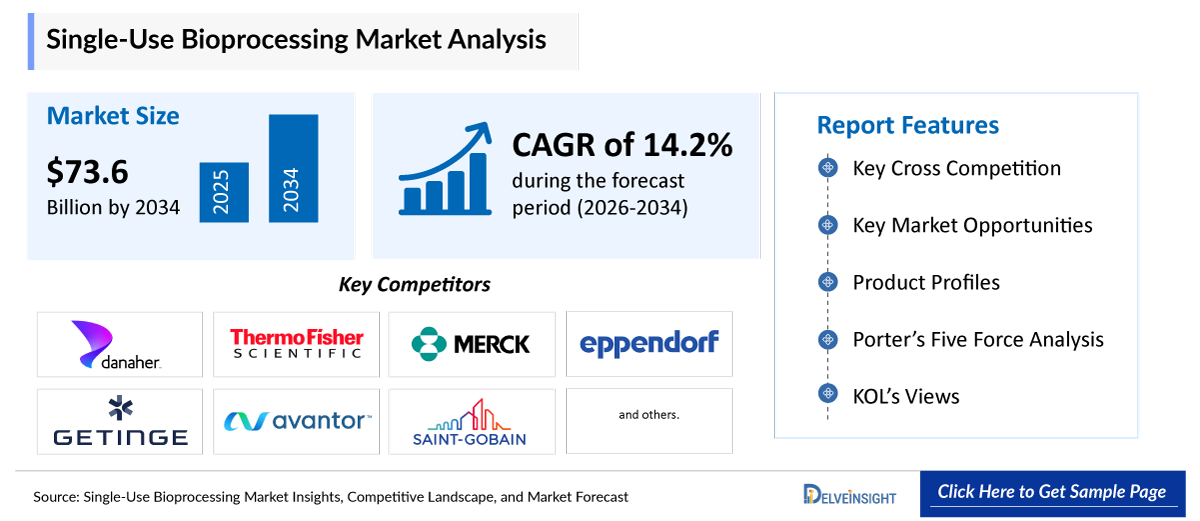
- The Global Single-Use Bioprocessing Market is expected to increase from USD 21.5 billion in 2025 to USD 73.6 billion by 2034, reflecting strong and sustained growth.
- The Global Single-Use Bioprocessing Market is growing at a CAGR of 14.2% during the forecast period from 2026 to 2034.
Single-Use Bioprocessing Market Size and Forecasts
- The Single-Use Bioprocessing Market Growth is being significantly driven by the increasing demand for biopharmaceuticals, the rapid expansion of cell and gene therapy manufacturing, rising outsourcing activities to CDMOs and CMOs, and growing vaccine production worldwide. As pharmaceutical and biotechnology companies expand the development of biologics, personalized therapies, and vaccines, there is a greater need for flexible, scalable, and cost-efficient manufacturing solutions.
- Single-use technologies enable faster production setup, reduce contamination risks, and eliminate extensive cleaning and validation requirements, making them ideal for multiproduct and small-batch manufacturing environments. Additionally, CDMOs and CMOs increasingly rely on single-use systems to efficiently manage diverse client projects and fluctuating production volumes. Together, these factors are accelerating the adoption of disposable bioprocessing equipment across upstream and downstream operations, thereby driving overall market growth.
- The leading Single-Use Bioprocessing Companies include Danaher Corporation, Thermo Fisher Scientific Inc., Merck KGaA, Sartorius AG, Eppendorf SE, ABEC, Inc., Getinge AB, Avantor, Inc., Compagnie de Saint-Gobain S.A., Repligen Corporation, Meissner Corporation, Parker-Hannifin Corporation, Corning Incorporated, Lonza Group AG, Entegris, Inc., Finesse Solutions, Inc., Broadley-James Corporation, PBS Biotech, Inc., CerCell A/S, Levitronix LLC, Foxx Life Sciences, LLC, TekniPlex Healthcare, Donaldson Company, Inc., 3M Company, Asahi Kasei Corporation, Adolf Kühner AG, Solaris Biotechnology S.r.l.., and others.
- North America is expected to dominate the Single-Use Bioprocessing market due to its strong biopharmaceutical manufacturing infrastructure, high concentration of leading biotechnology and pharmaceutical companies, and extensive adoption of advanced bioprocessing technologies. The region is home to major Single-Use Bioprocessing Companies include Danaher Corporation, Thermo Fisher Scientific Inc., and Repligen Corporation, which continuously invest in innovative single-use solutions.
- Additionally, the growing production of biologics, increasing cell and gene therapy clinical trials, expanding vaccine manufacturing activities, and rising investments in biomanufacturing facilities are accelerating market growth across the region. Favorable regulatory support and the strong presence of CDMOs further contribute to North America's leadership in the global Single-Use Bioprocessing market.
- In the product segment of the single-use bioprocessing market, the consumables category is estimated to account for the largest market share in 2025.
Request for unlocking the report of the @ Single-Use Bioprocessing Market
Single-Use Bioprocessing Market Size and Forecasts
|
Report Metrics |
Details |
|
2025 Single-Use Bioprocessing Market Size | |
|
2034 Projected Single-Use Bioprocessing Market Size | |
|
Single-Use Bioprocessing Growth Rate (2026-2034) | |
|
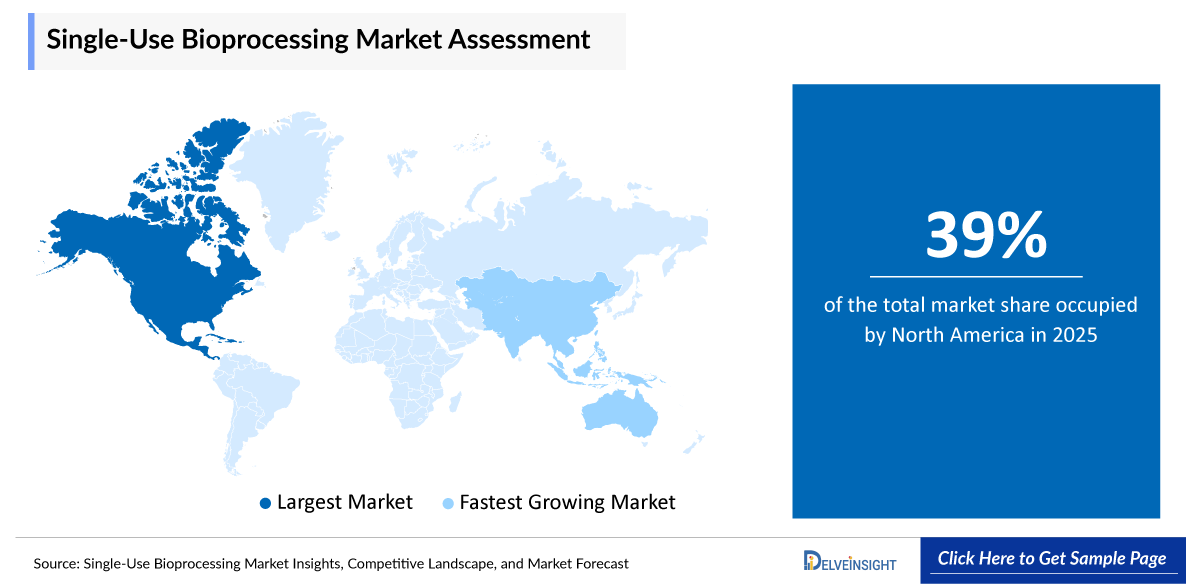
Largest Single-Use Bioprocessing Market |
North America |
|
Fastest Growing Single-Use Bioprocessing Market |
Asia-Pacific |
|
Single-Use Bioprocessing Market Structure |
Moderately Concentrated |
Factors Contributing to the Growth of the Single-Use Bioprocessing Market
-
The growing demand for biopharmaceuticals is leading to a surge in single-use bioprocessing
The increasing production of biologics such as monoclonal antibodies, recombinant proteins, vaccines, and biosimilars is driving the adoption of single-use bioprocessing systems. These technologies offer the flexibility and scalability required to meet the rising global demand for biologic therapies.
-
Rapid expansion of cell and gene therapy manufacturing is escalating the market of single-use bioprocessing
The growing number of cell and gene therapy products entering clinical trials and commercialization is accelerating the use of single-use technologies. Disposable bioreactors, bags, and fluid-management systems help manufacturers reduce contamination risks while supporting small-batch, high-value production.
-
Increasing outsourcing to CDMOs and CMOs
The growing reliance on Contract Development and Manufacturing Organizations (CDMOs) and Contract Manufacturing Organizations (CMOs) is boosting demand for flexible manufacturing platforms. Single-use technologies allow these organizations to efficiently handle multiple client projects and varying production volumes.
-
Rising vaccine production activities
Global efforts to improve pandemic preparedness and expand routine immunization programs have increased vaccine manufacturing capacity. Single-use bioprocessing systems support rapid scale-up and flexible production of viral and recombinant vaccines.
What are the latest Single-Use Bioprocessing Market Dynamics and Trends?
The single-use bioprocessing market is being strongly driven by the growing demand for biopharmaceuticals, the rapid expansion of cell and gene therapy manufacturing, increasing outsourcing to CDMOs and CMOs, and rising vaccine production activities. These factors are creating a need for manufacturing technologies that offer greater flexibility, faster deployment, lower operational costs, and reduced contamination risks compared to traditional stainless-steel systems.
Single-use bioreactors, filtration systems, cell culture systems, and fluid-management solutions allow manufacturers to quickly scale production, switch between products, and accelerate time-to-market, making them increasingly essential in modern biopharmaceutical manufacturing.
Additionally, the rising development and commercialization of biologics, including monoclonal antibodies, recombinant proteins, and biosimilars, require flexible and scalable manufacturing platforms. Single-use systems help manufacturers rapidly increase production capacity while reducing cleaning, validation, and maintenance requirements. Reflecting this trend, in April 2025, WuXi Biologics completed its first commercial Process Performance Qualification (PPQ) campaign using three 5,000 L single-use bioreactors at its Hangzhou facility, highlighting the growing adoption of large-scale single-use technologies for biologics production.
Furthermore, the cell and gene therapies are often produced in smaller batches and require highly controlled manufacturing environments to avoid cross-contamination. Single-use technologies provide the flexibility and sterility needed for these complex therapies while supporting faster process development and scale-up. Demonstrating this trend, in December 2025, Cellipont Bioservices expanded its manufacturing capabilities with a new ballroom-style cleanroom and a 50-liter single-use bioreactor to support commercial-scale cell therapy production.
Additionally, the pharmaceutical and biotechnology companies are increasingly outsourcing manufacturing activities to CDMOs and CMOs to reduce costs and accelerate product development. Since contract manufacturers handle multiple products for different clients, they require adaptable production systems that can be rapidly changed between batches.
Single-use bioprocessing technologies are ideal for such environments because they minimize downtime and eliminate extensive cleaning requirements. For example, in April 2025, AGC Biologics installed large-scale 5,000 L single-use bioreactors at its new Yokohama manufacturing facility to expand biologics production capabilities for its global client base.
Moreover, the growing investments in vaccine development, routine immunization programs, and pandemic preparedness initiatives are increasing demand for flexible manufacturing infrastructure. Single-use systems enable rapid facility deployment and efficient production scale-up, making them particularly valuable for vaccine manufacturing. Supporting this trend, in March 2025, Merck & Co. opened a new vaccine manufacturing facility in North Carolina to strengthen vaccine production capacity and support future global demand.
Collectively, these factors are accelerating the adoption of single-use bioprocessing technologies across both upstream and downstream operations, positioning them as a critical component of next-generation biopharmaceutical manufacturing and a major driver of overall market growth. Thus, the factors mentioned above are expected to boost the overall market of single-use bioprocessing during the forecast period from 2026 to 2034.
However, limited scalability for very large-volume production and plastic waste generation are two key challenges restraining the growth of the Single-Use Bioprocessing market. Although single-use systems offer flexibility and cost advantages, they may not be suitable for certain large-scale commercial manufacturing operations where higher production volumes require the capacity and long-term efficiency of traditional stainless-steel systems.
In addition, single-use bioprocessing relies on disposable plastic components such as bioreactor bags, filters, tubing, and connectors, which are discarded after use and contribute to significant plastic waste. The growing focus on environmental sustainability, waste management, and stricter regulatory requirements regarding industrial waste disposal is increasing concerns about the environmental impact of single-use technologies, thereby limiting their broader adoption in some manufacturing settings.
Single-Use Bioprocessing Market Report Segmentation
This single-use bioprocessing market report offers a comprehensive overview of the global single-use bioprocessing market, highlighting key trends, growth drivers, challenges, and opportunities. It covers detailed market segmentation by Product (Equipment {Bioreactors & Fermenters, Cell Culture Systems, Filtration Systems, Chromatography Equipment, and Others} and Consumables {Single-Use Bags, Single-Use Filteration Assemblies, and Others}), Workflow (Upstream Processing and Downstream Processing), Molecule Type (Monoclonal Antibodies (mAbs), Vaccines, Recombinant Proteins, and Others), End-User (Biopharmaceutical & Pharmaceutical Companies, Contract Development and Manufacturing Organizations (CDMOs), Contract Research Organizations (CROs), and Others), and geography.
The Single-Use Bioprocessing market report provides valuable insights into the competitive landscape, regulatory environment, and market dynamics across major markets, including North America, Europe, and Asia-Pacific. Featuring in-depth profiles of leading industry players and recent product innovations, this report equips businesses with essential data to identify market potential, develop strategic plans, and capitalize on emerging opportunities in the rapidly growing single-use bioprocessing market.
Single-use bioprocessing refers to the use of disposable, pre-sterilized bioprocessing equipment and consumables such as bioreactors, cell culture systems, filtration units, bags, mixers, tubing, and sensors in the manufacturing of biologics, vaccines, cell and gene therapies, and other biopharmaceutical products. Unlike traditional stainless-steel systems, single-use technologies are designed for one-time use and then discarded, eliminating the need for cleaning and sterilization between batches.
This approach helps reduce contamination risks, lower operational costs, improve manufacturing flexibility, and accelerate production timelines, making it increasingly popular in modern biopharmaceutical manufacturing.
The Single-Use Bioprocessing market growth is being significantly driven by the increasing demand for biopharmaceuticals, the rapid expansion of cell and gene therapy manufacturing, rising outsourcing activities to CDMOs and CMOs, and growing vaccine production worldwide. As pharmaceutical and biotechnology companies continue to invest in the development of biologics, biosimilars, personalized medicines, and advanced therapeutic products, the need for flexible, scalable, and cost-efficient manufacturing solutions has intensified.
Single-use technologies offer substantial advantages over traditional stainless-steel systems by reducing capital expenditure, minimizing contamination risks, and eliminating the time-consuming cleaning, sterilization, and validation processes required between production batches.
The rapid growth of cell and gene therapies is further accelerating adoption, as these therapies are often produced in smaller batches and require highly controlled manufacturing environments where single-use systems provide greater operational flexibility.
At the same time, increasing vaccine production activities, driven by global immunization programs and pandemic preparedness initiatives, are creating strong demand for disposable bioprocessing equipment that can be deployed quickly and scaled efficiently. Additionally, the growing reliance on Contract Development and Manufacturing Organizations (CDMOs) and Contract Manufacturing Organizations (CMOs) is boosting market expansion, as these organizations require adaptable manufacturing platforms capable of supporting multiple clients, diverse product portfolios, and varying production volumes. As a result, single-use bioreactors, cell culture systems, filtration units, mixers, bags, and fluid-management solutions are witnessing widespread adoption across both upstream and downstream bioprocessing operations, making single-use technologies a cornerstone of modern biopharmaceutical manufacturing and a key driver of overall market growth.
Get More Insights into the Report @ Single-Use Bioprocessing Market
Single-Use Bioprocessing Market Segment Analysis
Single-Use Bioprocessing Market Product (Equipments {Bioreactors & Fermenters, Cell Culture Systems, Filtration Systems, Chromatography Equipments, and Others} and Consumables {Single-Use Bags, Single-Use Filteration Assemblies, and Others}), Workflow (Upstream Processing and Downstream Processing), Molecule Type (Monoclonal Antibodies (mAbs), Vaccines, Recombinant Proteins, and Others), End-User (Biopharmaceutical & Pharmaceutical Companies, Contract Development and Manufacturing Organizations (CDMOs), Contract Research Organizations (CROs), and Others), and Geography (North America, Europe, Asia-Pacific, and Rest of the World).
-
Single-Use Bioprocessing Market Segmentation By Product
Single-Use Bags Under the Consumables Category Dominates the Market
In the product segment of the single-use bioprocessing market, the single-use bags under the consumables category are estimated to account for the largest market share of 40% in 2025. Their dominance is attributed to their extensive utilization across both upstream and downstream bioprocessing operations, where they serve critical functions including media preparation, buffer storage, cell culture, mixing, sampling, transportation, and bulk product storage.
The growing adoption of biologics, biosimilars, vaccines, and advanced therapies has significantly increased demand for flexible and scalable manufacturing solutions. Single-use bags offer several operational advantages over traditional stainless-steel systems, including reduced cleaning and sterilization requirements, lower risk of cross-contamination, shorter turnaround times, and decreased capital investment. These benefits have made them an essential component of modern biopharmaceutical manufacturing facilities, particularly among contract development and manufacturing organizations (CDMOs) and emerging biotech companies seeking rapid production scalability.
The segment also benefits from the recurring nature of consumable purchases. Unlike capital equipment, single-use bags must be replaced after each production cycle, creating a continuous revenue stream for manufacturers. The increasing implementation of single-use technologies in commercial-scale biologics production, coupled with advancements in bag materials, film technologies, and sensor integration, is further strengthening market growth.
As biopharmaceutical manufacturers increasingly prioritize manufacturing efficiency, flexibility, and cost optimization, Single-Use Bags are expected to maintain their leadership position throughout the forecast period. Their importance is particularly evident in facilities producing monoclonal antibodies and next-generation biologics, where rapid batch changeovers and contamination control are critical. Furthermore, ongoing innovations in high-capacity storage bags, integrated sensors, and robust multilayer film technologies are expected to expand their application scope and reinforce their position as the cornerstone consumable segment within the single-use bioprocessing ecosystem.
-
Single-Use Bioprocessing Market By Workflow
Upstream Processing Category Dominates the Market
In the workflow segment of the single-use bioprocessing market, the upstream processing category is estimated to account for the largest market share of 57% in 2025. Upstream processing involves critical stages such as cell line development, media preparation, cell culture, fermentation, and cell expansion, where single-use technologies are most extensively utilized. Single-use bioreactors, cell culture systems, mixers, bags, sensors, and tubing assemblies offer significant advantages during upstream operations by reducing contamination risks, eliminating cleaning and sterilization requirements, lowering capital investment, and enabling rapid production scale-up.
These benefits are particularly important for the manufacturing of monoclonal antibodies, recombinant proteins, vaccines, and cell and gene therapies, where flexibility, speed, and sterility are essential. The growing number of biologics in development, increasing demand for personalized medicines, and expansion of biopharmaceutical manufacturing facilities worldwide are further driving the adoption of single-use technologies in upstream processing. According to industry analyses, upstream processing accounted for the largest share of the global single-use bioprocessing market, reflecting the widespread use of disposable systems during the initial stages of biomanufacturing.
Recent industry developments further demonstrate the strength of this segment. In April 2025, Thermo Fisher Scientific Inc. launched the 5L DynaDrive Single-Use Bioreactor, designed to simplify and accelerate upstream process development while providing seamless scalability from 1 L to 5,000 L, enabling faster transition from laboratory-scale development to commercial manufacturing. Earlier, in September 2023, Getinge AB introduced the AppliFlex ST GMP single-use bioreactor, specifically developed to support upstream manufacturing of mRNA therapeutics and cell and gene therapies.
Additionally, In April 2023, Danaher Corporation launched its X-platform bioreactors, designed to streamline upstream bioprocessing for monoclonal antibodies, protein therapeutics, and advanced therapies. These continuous product innovations, combined with the increasing demand for biologics and advanced therapies, are expected to strengthen the dominance of the upstream processing segment and significantly boost the overall growth of the Single-Use Bioprocessing market.
-
Single-Use Bioprocessing Market Segmentation By Molecule Type
Monoclonal Antibodies (mAbs) Category Dominates the Market
In the molecule type segment of the single-use bioprocessing market, the monoclonal antibodies category is estimated to account for the largest market share of 48% in 2025. Monoclonal antibodies are among the most widely produced biologic drugs due to their extensive use in the treatment of cancer, autoimmune disorders, infectious diseases, and inflammatory conditions. The increasing global prevalence of chronic diseases, coupled with the growing number of approved antibody-based therapies and robust clinical pipelines, has significantly increased the demand for efficient and scalable manufacturing solutions.
Single-use bioprocessing technologies are particularly well-suited for mAb production because they offer reduced contamination risks, lower capital investment, faster facility turnaround times, and greater manufacturing flexibility compared to traditional stainless-steel systems.
Furthermore, the production of monoclonal antibodies relies heavily on upstream processes such as cell culture and bioreactor operations, where single-use bioreactors, filtration systems, mixing systems, and disposable fluid-management components are extensively utilized. The rapid expansion of biosimilar development and increasing investments in biologics manufacturing facilities by pharmaceutical companies and CDMOs are further driving the adoption of single-use technologies for mAb production.
As demand for high-volume antibody manufacturing continues to rise worldwide, monoclonal antibodies are expected to remain the leading molecule type, significantly contributing to the growth and expansion of the global Single-Use Bioprocessing market.
-
Single-Use Bioprocessing Market By End-Users
Biopharmaceutical & Pharmaceutical Companies Category Dominates the Market
The biopharmaceutical and pharmaceutical companies segment significantly drives the growth of the Single-Use Bioprocessing market due to the increasing demand for biologics, vaccines, monoclonal antibodies, and advanced therapies. These Single-Use Bioprocessing Companies are rapidly adopting single-use technologies such as bioreactors, mixers, bags, and filtration systems to reduce contamination risks, lower capital investment, and improve manufacturing flexibility.
Single-use systems also enable faster production scale-up, shorter turnaround times, and cost-effective operations, making them ideal for both clinical and commercial manufacturing. As biopharmaceutical firms continue to expand their biologics pipelines and invest in modern production facilities, the adoption of single-use bioprocessing solutions continues to accelerate globally.
Single-Use Bioprocessing Market Regional Analysis
-
North America Single-Use Bioprocessing Market Trends
North America is poised to secure the largest share of 39% in the global single-use bioprocessing market in 2025. North America significantly boosts the global single-use bioprocessing market due to its strong biopharmaceutical manufacturing base, high R&D investments, and early adoption of advanced disposable technologies.
The region, particularly the United States, hosts a large number of biopharma companies, CDMOs, and research institutes that are rapidly shifting from traditional stainless-steel systems to flexible single-use platforms to improve production efficiency, reduce contamination risk, and lower operational costs.
Additionally, the continuous expansion of biologics, vaccines, and cell & gene therapy pipelines further accelerates demand for single-use bioreactors, bags, and filtration systems. The presence of key industry players and strong regulatory and industry collaboration through organizations such as the Bio-Process Systems Alliance (BPSA) further supports standardization and adoption of these technologies.
Recent developments in single-use bioprocessing further boost the overall market in North America. For instance, in March 2025, Thermo Fisher Scientific expanded its bioprocessing capacity in the U.S. to support growing demand for single-use systems in biologics manufacturing.
Furthermore, the increasing number of biologic drug approvals and commercial-scale manufacturing projects across the United States and Canada continues to accelerate the adoption of disposable bioprocessing technologies. Supporting this trend, in May 2024, FUJIFILM Diosynth Biotechnologies announced progress on its large-scale biopharmaceutical manufacturing expansion in North Carolina, which incorporates advanced single-use manufacturing capabilities for biologics production.
Overall, North America remains the dominant and most innovative region, driving both technological advancement and commercial-scale implementation of single-use bioprocessing solutions.
-
Europe Single-Use Bioprocessing Market Trends
Europe plays a pivotal role in the growth of the single-use bioprocessing market due to its strong biopharmaceutical manufacturing ecosystem, expanding biosimilars industry, increasing investments in cell and gene therapy production, and supportive regulatory environment for advanced biomanufacturing technologies. Countries such as Germany, France, the United Kingdom, Switzerland, and Ireland are major hubs for biologics development and manufacturing, driving significant demand for single-use bioreactors, mixers, filtration systems, and disposable assemblies.
The region's focus on flexible manufacturing, cost optimization, contamination control, and faster product changeovers has accelerated the transition from traditional stainless-steel facilities to single-use technologies. Furthermore, the growing number of biotechnology startups, increasing contract manufacturing activities, and rising demand for personalized medicines are encouraging biopharmaceutical companies to adopt scalable and modular bioprocessing platforms.
Europe also benefits from substantial public and private investments in life sciences infrastructure and bioproduction capacity expansion, which continue to strengthen the adoption of single-use systems across research, clinical, and commercial manufacturing applications.
Recent developments further highlight the region's leadership in the single-use bioprocessing market
- In April 2025, Sartorius Stedim Biotech entered a strategic partnership with Tulip Interfaces in France to enhance digitalization and operational efficiency in single-use bioprocessing environments through integrated manufacturing solutions. This collaboration aims to improve process visibility, reduce variability, and support scalable biologics production.
- Additionally, in September 2024, Merck KGaA launched the Mobius® ADC Reactor in Germany, the industry's first dedicated single-use reactor designed specifically for antibody-drug conjugate (ADC) manufacturing, enabling faster and more efficient production of next-generation oncology therapies. These developments, combined with ongoing investments in biologics and advanced therapy manufacturing, reinforce Europe's position as one of the most important and fastest-growing markets for single-use bioprocessing technologies.
-
Asia-Pacific Single-Use Bioprocessing Market Trends
The Asia-Pacific region is emerging as a major growth driver in the Single-Use Bioprocessing market due to the rapid expansion of the biopharmaceutical and biotechnology sectors, increasing investments in biologics and biosimilars manufacturing, and growing demand for advanced healthcare products. Countries such as China, India, Japan, South Korea, Singapore, and Australia are significantly expanding their biomanufacturing capabilities through new production facilities, research centers, and biotechnology parks. The region is also witnessing a surge in vaccine production, cell and gene therapy development, and contract manufacturing activities, all of which require flexible, scalable, and contamination-free production systems.
Single-use bioprocessing technologies are increasingly being adopted because they reduce capital investment, lower operational costs, minimize cleaning and validation requirements, and enable faster production turnaround times compared to traditional stainless-steel systems.
Furthermore, supportive government initiatives, rising foreign investments, growing collaborations between global biopharmaceutical companies and regional manufacturers, and the increasing presence of CDMOs are accelerating the adoption of single-use bioreactors, filtration systems, bags, and mixing technologies.
As pharmaceutical companies continue to modernize their manufacturing operations and expand biologics production capacity, the Asia-Pacific is expected to remain one of the fastest-growing and most attractive markets for single-use bioprocessing technologies.
Who are the major players in the Single-Use Bioprocessing Market?
Single-Use Bioprocessing Companies
- Danaher Corporation
- Thermo Fisher Scientific Inc.
- Merck KGaA
- Sartorius AG
- Eppendorf SE
- ABEC, Inc.
- Getinge AB
- Avantor, Inc.
- Compagnie de Saint-Gobain S.A.
- Repligen Corporation
- Meissner Corporation
- Parker-Hannifin Corporation
- Corning Incorporated
- Lonza Group AG
- Entegris, Inc.
- Finesse Solutions, Inc.
- Broadley-James Corporation
- PBS Biotech, Inc.
- CerCell A/S
- Levitronix LLC
- Foxx Life Sciences, LLC
- TekniPlex Healthcare
- Donaldson Company, Inc.
- 3M Company
- Asahi Kasei Corporation
- Adolf Kühner AG
- Solaris Biotechnology S.r.l.
- Others.
How is the competitive landscape shaping the single-use bioprocessing market?
The competitive landscape of the Single-Use Bioprocessing market is characterized by intense competition among established bioprocessing technology providers, life science companies, and specialized manufacturers focused on expanding their product portfolios and global presence. Leading Single-Use Bioprocessing Companies are investing heavily in research and development to introduce advanced single-use bioreactors, filtration systems, mixing technologies, sensors, and disposable assemblies that improve process efficiency, scalability, and contamination control.
Strategic initiatives such as mergers and acquisitions, partnerships, facility expansions, and new product launches are common as companies seek to strengthen their market position and address the growing demand for biologics, vaccines, and cell and gene therapies. In addition, manufacturers are increasingly focusing on automation, digital bioprocessing solutions, and sustainable single-use technologies to differentiate themselves in the market.
The presence of strong global players alongside emerging regional companies has intensified innovation and price competitiveness, driving continuous technological advancements and broader adoption of single-use bioprocessing systems across biopharmaceutical manufacturing facilities worldwide.
Single-Use Bioprocessing Market Recent Breakthroughs and Developments
- In December 2025, Cellipont Bioservices expanded its manufacturing capabilities with a new ballroom-style cleanroom and a 50-liter single-use bioreactor to support commercial-scale cell therapy production.
- In April 2025, WuXi Biologics completed its first commercial Process Performance Qualification (PPQ) campaign using three 5,000 L single-use bioreactors at its Hangzhou facility, highlighting the growing adoption of large-scale single-use technologies for biologics production.
- In April 2025, AGC Biologics installed large-scale 5,000 L single-use bioreactors at its new Yokohama manufacturing facility to expand biologics production capabilities for its global client base.
- In April 2025, Thermo Fisher Scientific Inc. launched the 5L DynaDrive Single-Use Bioreactor, designed to simplify and accelerate upstream process development while providing seamless scalability from 1 L to 5,000 L, enabling faster transition from laboratory-scale development to commercial manufacturing.
- In April 2025, Sartorius Stedim Biotech entered a strategic partnership with Tulip Interfaces in France to enhance digitalization and operational efficiency in single-use bioprocessing environments through integrated manufacturing solutions.
- In November 2024, Freudenberg announced the commitment to launch new products, including single-use assemblies & ASTC UV-Shielding Tubing for Indian customers at CPhl & PMEC India 2024.
- In September 2024, Merck KGaA launched the Mobius® ADC Reactor in Germany, the industry's first dedicated single-use reactor designed specifically for antibody-drug conjugate (ADC) manufacturing, enabling faster and more efficient production of next-generation oncology therapies.
- In April 2024, Cytiva introduced its Xcellerex compact single-use magnetic mixing system designed for large-scale monoclonal antibody, vaccine, and advanced therapy manufacturing, supporting the broader trend toward integrated single-use bioprocessing workflows.
- In September 2023, Getinge AB introduced the AppliFlex ST GMP single-use bioreactor, specifically developed to support upstream manufacturing of mRNA therapeutics and cell and gene therapies.
- In April 2023, Danaher Corporation launched its X-platform bioreactors, designed to streamline upstream bioprocessing for monoclonal antibodies, protein therapeutics, and advanced therapies.
|
Report Metrics |
Details |
|
Study Period |
2023 to 2034 |
|
Base Year |
2025 |
|
Forecast Period |
2026 to 2034 |
|
Single-Use Bioprocessing Market CAGR (2026-2034) |
XX% |
|
Single-Use Bioprocessing Companies |
Danaher Corporation, Thermo Fisher Scientific Inc., Merck KGaA, Sartorius AG, Eppendorf SE, ABEC, Inc., Getinge AB, Avantor, Inc., Compagnie de Saint-Gobain S.A., Repligen Corporation, Meissner Corporation, Parker-Hannifin Corporation, Corning Incorporated, Lonza Group AG, Entegris, Inc., Finesse Solutions, Inc., Broadley-James Corporation, PBS Biotech, Inc., CerCell A/S, Levitronix LLC, Foxx Life Sciences, LLC, TekniPlex Healthcare, Donaldson Company, Inc., 3M Company, Asahi Kasei Corporation, Adolf Kühner AG, Solaris Biotechnology S.r.l., and others. |
|
Single-Use Bioprocessing Market Segments |
by Product, by Workflow, by Molecule Type, by End-Users, and by Geography |
|
Single-Use Bioprocessing Regional Scope |
North America, Europe, Asia Pacific, Middle East, Africa, and South America |
|
Single-Use Bioprocessing Country Scope |
U.S., Canada, Mexico, Germany, United Kingdom, France, Italy, Spain, China, Japan, India, Australia, South Korea, and key Countries |
Single-Use Bioprocessing Market Segmentation
- Single-Use Bioprocessing by Product Exposure
- Equipments
- Bioreactors & Fermenters
- Cell Culture Systems
- Filtration Systems
- Chromatography Equipments
- Others
- Consumables
- Single-Use Bags
- Single-Use Filteration Assemblies
- Others
- Single-Use Bioprocessing by Workflow Exposure
- Upstream Processing
- Downstream Processing
- Single-Use Bioprocessing by Molecule Type Exposure
- Monoclonal Antibodies (mAbs)
- Vaccines
- Recombinant Proteins
- Others
- Single-Use Bioprocessing End-Users Exposure
- Biopharmaceutical & Pharmaceutical Companies
- Contract Development and Manufacturing Organizations (CDMOs)
- Contract Research Organizations (CROs)
- Others
- Single-Use Bioprocessing Geography Exposure
- United States Single-Use Bioprocessing Market
- Canada Single-Use Bioprocessing Market
- Mexico Single-Use Bioprocessing Market
- United Kingdom Single-Use Bioprocessing Market
- Germany Single-Use Bioprocessing Market
- France Single-Use Bioprocessing Market
- Italy Single-Use Bioprocessing Market
- Spain Single-Use Bioprocessing Market
- Rest of Europe Single-Use Bioprocessing Market
- China Single-Use Bioprocessing Market
- Japan Single-Use Bioprocessing Market
- India Single-Use Bioprocessing Market
- Australia Single-Use Bioprocessing Market
- South Korea Single-Use Bioprocessing Market
- Rest of Asia-Pacific Single-Use Bioprocessing Market
- South America Single-Use Bioprocessing Market
- Middle East Single-Use Bioprocessing Market
- Africa Single-Use Bioprocessing Market
- North America Single-Use Bioprocessing Market
- Europe Single-Use Bioprocessing Market
- Asia-Pacific Single-Use Bioprocessing Market
- Rest of the World Single-Use Bioprocessing Market
Single-Use Bioprocessing Market Recent Industry Trends and Milestones (2022-2026)
|
Category |
Key Developments |
|
Single-Use Bioprocessing Product Partnership |
Sartorius Stedim Biotech entered a strategic partnership with Tulip Interfaces in France. |
|
Single-Use Bioprocessing Product Launch |
Thermo Fisher Scientific Inc. launched the 5L DynaDrive Single-Use Bioreactor, Freudenberg announced the commitment to launch new products, including single-use assemblies & ASTC UV-Shielding Tubing for Indian customers, and Merck KGaA launched the Mobius® ADC Reactor in Germany. |
|
Single-Use Bioprocessing Expansion |
Cellipont Bioservices expanded its manufacturing capabilities with a new ballroom-style cleanroom and a 50-liter single-use bioreactor. |
|
Company Strategy |
Danaher Corporation
Sartorius AG
|
|
Emerging Technology |
single-use bioreactors, continuous bioprocessing systems, process analytical technology (PAT), automated and digital bioprocessing platforms, artificial intelligence (AI)-enabled process optimization, machine learning-based predictive analytics, smart single-use sensors, integrated single-use mixing systems, single-use tangential flow filtration (TFF), single-use chromatography systems, modular biomanufacturing facilities, and others |
Key Takeaways from the Single-Use Bioprocessing Market Report Study
- Market size analysis for the current single-use bioprocessing market size (2025), and market forecast for 8 years (2026 to 2034)
- Top key product/technology developments, mergers, acquisitions, partnerships, and joint ventures happened over the last 3 years.
- Key companies dominating the single-use bioprocessing market.
- Various opportunities available for the other competitors in the single-use bioprocessing market space.
- What are the top-performing segments in 2025? How will these segments perform in 2034?
- Which are the top-performing regions and countries in the current single-use bioprocessing market scenario?
- Which are the regions and countries where companies should have concentrated on opportunities for the single-use bioprocessing market growth in the future?
Stay updated with us for Recent Articles @ New DelveInsight Blogs