
Spinal Decompression/Traction Devices Market
Spinal Decompression/Traction Devices Market by Type (Manual Spinal Traction and Mechanical Spinal Traction), Application (Slipped Discs, Degenerative Disc Disease, Herniated Discs, and Others), End-User (Hospitals, Ambulatory Surgical Centers, and Others), and Geography (North America, Europe, Asia-Pacific, and Rest of the World) is expected to advance at a respectable CAGR forecast till 2030 owing the rising instances of spinal cord injuries and the increasing cases of chronic pain across the globe
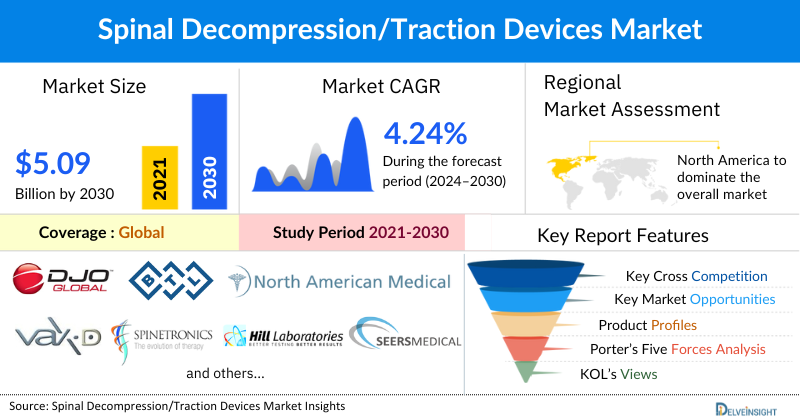
The spinal decompression/traction devices market was valued at USD 3.98 billion in 2023, growing at a CAGR of 4.24% during the forecast period from 2024 to 2030 to reach 5.09 billion by 2030. The spinal decompression/traction devices market is witnessing positive growth owing to factors such as the rising instances of spinal cord injuries and the increasing prevalence of chronic pain globally. Conditions such as degenerative disc disease, spondylolisthesis, and spinal stenosis are becoming more common, especially among the aging population, and the surge in the number of road traffic accidents further highlights the need for effective spinal decompression/traction devices. Together these factors are expected to propel the growth of the spinal decompression/traction devices market during the forecast period from 2024 to 2030.
Spinal Decompression/Traction Devices Market Dynamics:
According to the World Health Organization (WHO) (2024) in 2021, 15.4 million people were living with spinal cord injuries globally. Most cases of spinal cord injury result from trauma, including falls, or acts of violence, and are therefore preventable. Spinal decompression and traction devices manage spinal cord injuries by gently stretching the spine to relieve pressure on compressed nerves and discs. These devices help to reduce pain, promote healing, and improve mobility, particularly in cases where the injury has led to spinal misalignment or nerve impingement.
Data from the WHO in the year 2022 stated that approximately 1.71 billion people were affected by musculoskeletal conditions worldwide. Further, it stated that low back pain is the main contributor to the overall burden of musculoskeletal conditions, contributing to 570 million prevalent cases worldwide. Musculoskeletal conditions, affecting a significant portion of the global population, often include low back pain as a major issue.
As per the data from WHO (2023), in 2020, there were 619 million cases of lower back pain (LBP) and it is projected that the number of LBP cases will rise to 843 million by 2050.
As per data by the European Pain Federation (2023), it was stated that 740 million people globally experience an episode of severe pain at some point in their lives on average. For approximately 20% of these individuals, the pain persists for longer than three months, thereby categorizing it as chronic pain.
Spinal decompression and traction devices are used in alleviating pressure on the spinal cord and nerves, which is particularly beneficial for conditions like lower back pain. These devices gently stretch the spine, promoting the retraction of bulging or herniated discs, enhancing blood flow, and reducing nerve compression. This non-invasive treatment can help in managing pain, improving mobility, and potentially delaying or avoiding the need for surgical intervention.
As stated by WHO in 2022, by 2030, 1 in 6 people worldwide will be 60 years old or older. The global population of individuals aged 60 and over is expected to rise from 1 billion in 2020 to 1.4 billion. By 2050, this number will double to 2.1 billion. Additionally, the number of people aged 80 and older is projected to triple from 2020 to 2050, reaching 426 million. As the global population of elderly individuals continues to rise, conditions such as degenerative disc disease, spondylolisthesis, and spinal stenosis are becoming increasingly prevalent. This rise in age-related spinal disorders aligns with the expanding demographic of older adults, highlighting a growing need for effective treatments and interventions for these conditions.
Therefore, the factors stated above collectively will drive the overall spinal decompression/traction devices market growth.
However, injury to blood vessels or nerves in and around the spine, causing infections, the presence of alternative procedures such as discectomy, laminectomy, or spinal fusion, and others may prove to be challenging factors for the spinal decompression/traction devices market growth.
Spinal Decompression/Traction Devices Market Segment Analysis:
Spinal Decompression/Traction Devices Market by Type (Manual Spinal Traction and Mechanical Spinal Traction), Application (Slipped Discs, Degenerative Disc Disease, Herniated Discs, and Others), End-User (Hospitals, Ambulatory Surgical Centers, and Others), and Geography (North America, Europe, Asia-Pacific, and Rest of the World)
In the type segment of the spinal decompression/traction devices market, the manual spinal traction category is expected to have a significant revenue share in the year 2023. This is because of the features and various advantages of manual spinal traction devices that enhance their utility and effectiveness.
Manual spinal traction involves the controlled application of force to the spine by a trained therapist, gently stretching the spinal vertebrae. One key advantage is its ability to provide immediate relief from pain by reducing pressure on compressed spinal discs and nerves.
Manual traction can also improve spinal alignment, which may help alleviate symptoms related to herniated discs, sciatica, and vertebral compression fractures. Unlike mechanical traction devices, manual traction allows for precise adjustments tailored to the patient's specific needs, making it a versatile option in a clinical setting. Additionally, it offers a non-invasive, drug-free alternative for managing chronic back pain, contributing to improved mobility and a higher quality of life for patients.
Therefore the features and various advantages of manual spinal traction devices that enhance performance and usability, solidify the significant impact on the growth of the overall spinal decompression/traction devices market during the forecast period from 2024 to 2030.
|
Report Metrics |
Details |
|
Study Period |
2021 to 2030 |
|
Forecast Period |
2024-2030 |
|
CAGR |
4.24% (Request Sample To Know More) |
|
Spinal Decompression/Traction Devices Market |
~USD 5.09 billion by 2030 |
|
Key Spinal Decompression/Traction Devices Companies |
DJO LLC, BTL, Vax-D Medical Technologies, CERT Health Sciences, LLC, Spinal Designs International, Inc., North American Medical Corporation, Spinetronics, LLC, Hill Laboratories Company, Chattanooga, v2uhealth, SEERS Medical Limited, gbo Medizintechnik AG, Bıçakcılar, CHINESPORT S.p.a., Manumed, OG Wellness Technologies Co, Ltd., CORE Medical Equipment, LLC, Satisform, SpineMED, Mettler Electronics Corp., and others. |
North America is expected to dominate the overall spinal decompression/traction devices market:
Among all the regions, North America is expected to dominate the spinal decompression/traction devices market in the year 2023 and is expected to do the same during the forecast period from 2024 to 2030. This growth can be attributed to the large patient population suffering from vertebral compression fractures (VCFs) and the rising incidence of chronic pain in the region. The demand is further increased by rising government initiatives in the region such as the awareness programs, which are acting as key factors contributing to the growth of the spinal decompression/traction devices market in the North America region during the forecast period from 2024 to 2030.
The National Institute of Health (2023) stated that VCFs are the most frequently reported type of fragility fracture. In the US, approximately 1 to 1.5 million VCFs occur each year. Studies suggest that about 25% of women aged 50 and older have at least one VCF. Additionally, between 40% and 50% of individuals over the age of 80 are estimated to have experienced a VCF, either as an acute event or discovered incidentally during the evaluation of other health issues.
According to data from the Centers for Disease Control and Prevention (2023), it stated that in 2021 there were 51.6 million US adults who were suffering from chronic pain. In addition to this, 17.1 million individuals had experienced high-impact chronic pain (i.e., chronic pain that results in substantial restriction to daily activities). Moreover, as per data from the Public Health Agency of Canada (2023), 8 million individuals live with chronic pain in Canada.
Spinal decompression and traction devices are commonly used to alleviate pressure on the spinal nerves or vertebrae, providing relief in conditions like vertebral compression fractures (VCFs) and chronic pain. These devices work by gently stretching the spine, which can help to realign vertebrae, reduce nerve compression, and promote healing, ultimately reducing pain and improving mobility in affected individuals.
Rising government initiatives in the region such as the awareness programs in the US aimed at addressing chronic pain focusing on education, prevention, and early detection also boost the market of spinal decompression/traction devices market. Public awareness campaigns educate individuals about the importance of regular screenings and preventive measures. For example, September is designated as a pain awareness month in the US, during which various organizations, including the National Institute of Health (NIH), participate and promote awareness through campaigns, events, and educational materials. These efforts emphasize the importance of managing chronic pain.
Therefore, the interplay of all the aforementioned factors would provide a conducive growth environment for the North American spinal decompression/traction devices market.
Key Spinal Decompression/Traction Devices Companies In The Market Landscape:
Some of the key spinal decompression/traction devices companies operating in the market include DJO LLC, BTL, Vax-D Medical Technologies, CERT Health Sciences, LLC, Spinal Designs International, Inc., North American Medical Corporation, Spinetronics, LLC, Hill Laboratories Company, Chattanooga, v2uhealth, SEERS Medical Limited, gbo Medizintechnik AG, Bıçakcılar, CHINESPORT S.p.a., Manumed, OG Wellness Technologies Co, Ltd., CORE Medical Equipment, LLC, Satisform, SpineMED, Mettler Electronics Corp., and others.
Recent Developmental Activities in the Spinal Decompression/Traction Devices Market:
- In October 2021, Bioventus announced its complete acquisition of Misonix for an undisclosed amount. The acquisition accelerated the adoption of its neXus platform for ultrasonic procedures across spinal decompression using the BoneScalpel, SonaStar for tumor ablation in the cranium, and SonicOne for tissue debridement in chronic wounds.
Key Takeaways from the Spinal Decompression/Traction Devices Market Report Study
- Market size analysis for current spinal decompression/traction devices market size (2024), and market forecast for 6 years (2024 to 2030)
- Top key product/technology developments, mergers, acquisitions, partnerships, and joint ventures happened over the last 3 years
- Key companies dominating the spinal decompression/traction devices market
- Various opportunities available for the other competitors in the spinal decompression/traction devices market space.
- What are the top-performing segments in 2023? How these segments will perform in 2030?
- Which are the top-performing regions and countries in the current spinal decompression/traction devices market scenario?
- Which are the regions and countries where companies should have concentrated on opportunities for spinal decompression/traction devices market growth in the coming future?
Target Audience who can be benefited from this Spinal Decompression/Traction Devices Market Report Study
- Spinal decompression/traction devices product providers
- Research organizations and consulting companies
- Spinal decompression/traction devices-related organizations, associations, forums, and other alliances
- Government and corporate offices
- Start-up companies, venture capitalists, and private equity firms
- Distributors and traders dealing in spinal decompression/traction devices
- Various end-users who want to know more about the spinal decompression/traction devices market and the latest technological developments in the spinal decompression/traction devices market