Endoscopy Fluid Management Systems Market Summary
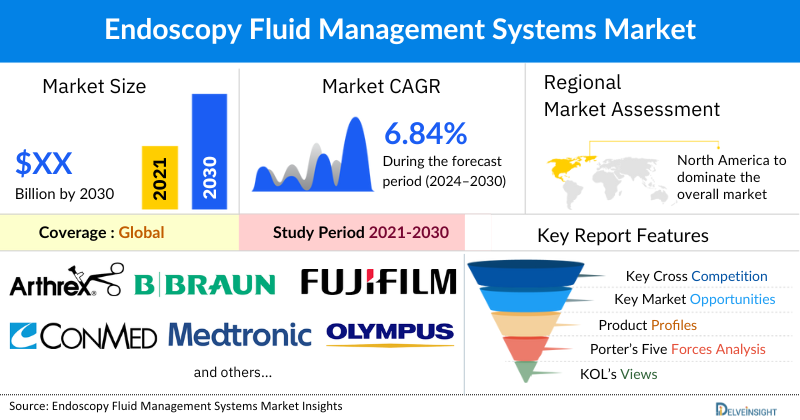
- Global Endoscopy Fluid Management Systems Market will grow at a CAGR of 6.84% during the forecast period from 2024 to 2030.
- The global structural heart devices market is expected to increase from USD XX million in 2024 to USD XX million by 2030 reflecting strong and sustained growth.
Endoscopy Fluid Management Systems Market Trends & Insights
- The market expansion is supported by several factors including the increasing number of gastrointestinal and lung cancer cases, technological innovation in surgical equipment, and the increasing preference for minimally invasive procedures.
- North America currently holds the largest market share due to advanced healthcare infrastructure, strong reimbursement policies, and high adoption rates of innovative medical technologies. Meanwhile, Asia-Pacific is expected to witness rapid growth due to expanding healthcare access and rising medical tourism.
- Leading Endoscopy Fluid Management Systems companies working in the market are Arthrex Inc., B. Braun Melsungen AG, Cantel Medical Systems, Comeg Medical Technologies (Acteon group), Conmed Corporation, Endomed Systems, Fujifilm Corporation, Gimmi GmbH, Hologic Inc., Johnson & Johnson, KARL STORZ SE & Co. KG, Medtronic PLC, Olympus Medical Corporation, Richard Wolf GmbH, Serres Group Oy (Paree Group), Smith & Nephew PLC, Steris PLC, Stryker, Thermedx LLC, Vimex Sp. z o.o., and others.
Endoscopy Fluid Management Systems Market Size and Forecasts
- 2030 Projected Market Size: Request for sample report
- Growth Rate (2024-2030): 6.84% CAGR
- Largest Market: North America
- Fastest Growing Market: Asia-Pacific
- Market Structure: Moderately Consolidated
Factors Contributing to the Growth of Endoscopy Fluid Management Systems
Rising Volume of Minimally Invasive Surgeries
The increasing preference for minimally invasive procedures is one of the primary drivers of the Endoscopy Fluid Management Systems market. These systems play a crucial role in maintaining clear visualization during endoscopic procedures by regulating fluid pressure and flow, which enhances surgical precision and patient outcomes.
Increasing Prevalence of Gastrointestinal and Urological Disorders
The growing incidence of gastrointestinal diseases, urological conditions, and other chronic disorders is leading to a higher number of diagnostic and therapeutic endoscopic procedures. This rising disease burden is significantly boosting the demand for efficient fluid management systems in healthcare facilities.
Technological Advancements in Endoscopic Equipment
Continuous innovations in endoscopy technologies, including automated fluid management systems, improved pump mechanisms, and digital monitoring features, are enhancing the efficiency and safety of procedures. These advancements are encouraging healthcare providers to adopt advanced fluid management solutions.
Growing Demand for Outpatient and Ambulatory Surgical Centers
The expansion of ambulatory surgical centers (ASCs) and outpatient facilities is driving the need for compact, efficient, and easy-to-operate endoscopy fluid management systems. These facilities prefer advanced systems that reduce procedure time while ensuring optimal patient safety.
Increasing Healthcare Expenditure and Infrastructure Development
Rising healthcare investments across developed and emerging economies are improving access to advanced medical devices and surgical technologies. Hospitals and specialty clinics are increasingly adopting modern endoscopy equipment, thereby supporting market growth.
Aging Global Population
The global aging population is more susceptible to chronic diseases such as gastrointestinal disorders, colorectal cancer, and urological conditions. This demographic trend is increasing the number of endoscopic procedures performed worldwide, driving demand for fluid management systems.
Emphasis on Infection Control and Patient Safety
Healthcare providers are focusing more on maintaining sterile environments and preventing procedure-related infections. Advanced fluid management systems with disposable components and improved fluid control capabilities help reduce contamination risks and enhance patient safety.
Endoscopy Fluid Management Systems Market By Product Type (Standalone Systems, Disposables And Accessories), By Modality Type (Bench-Top, Floor-Standing), By Application (Hysteroscopy, Laparoscopy, Arthroscopy, Others), By End-User (Hospitals And Clinics, Ambulatory Surgical Centers, Diagnostic Centers, Others), and by geography is expected to grow at a steady CAGR forecast till 2030 owing to increasing prevalence of gastrointestinal cancer and growing adoption of minimally invasive procedures.
Global Endoscopy Fluid Management Systems Market will grow at a CAGR of 6.84% during the forecast period from 2024 to 2030. The demand for Endoscopy Fluid Management Systems is primarily being boosted by the increasing prevalence of various cancers mainly gastrointestinal cancer, innovation in product development, and growing adoption of minimally invasive procedures, thereby contributing to the growth of the Endoscopy Fluid Management Systems market during the forecast period from 2024 to 2030
What are the latest Endoscopy Fluid Management Systems Market Dynamics and Trends?
The Endoscopy Fluid Management Systems market is witnessing a growth in product demand owing to various reasons, one of the key factors being the increasing prevalence of Gastrointestinal Cancer. According to the World Cancer Research Fund 2018, Stomach cancer is the fifth most common cancer worldwide. It is the fourth most commonly occurring cancer in men and the seventh most commonly occurring cancer in women.
Moreover, Lung cancer metastases to the small bowel often present as intestinal perforation. As per the data provided by the GLOBOCAN 2020 study cited by the WHO, in 2020, lung cancer was the second most diagnosed cancer type with 2,206,771 new cases across the globe. In addition to that, lung cancer was the leading cause of death among all cancer types accounting for 1,796,144 deaths globally. It has been established that bronchoscopy is the primary procedure conducted to collect a biopsy sample for the diagnosis of lung cancer.
Furthermore, bronchoscopy has proven to help detect precancerous lesions associated with lung cancer thereby helping in the early cancer diagnosis. Gastrointestinal cancer is a major public health problem worldwide. Detection of early neoplastic lesions in the gastrointestinal tract is essential for a cure because prognosis and survival are related to the size and stage of malignant lesions. With proper endoscopy fluid, management systems visualization becomes better. Therefore, the increasing prevalence of Gastrointestinal Cancer is projected to result in the growing demand for Endoscopy Fluid Management Systems, thereby contributing to the growth of the Endoscopy Fluid Management Systems market during the forecast period.
Additionally, another key factor responsible for the boost in the growth of the Endoscopy Fluid Management Systems is innovation in product development and their rising approvals worldwide. For instance, the Stryker CrossFlow Integrated Arthroscopy Pump was approved by the FDA on July 12, 2019. This product is CE marked according to the European Medical Device Directive. Similarly, on August 3, 2018, Hologic Inc. announced that the FDA approved fluent fluid management system. Hologic Inc. had received a CE-marked for fluent fluid management system in Europe. Therefore, this may indicate that the key manufacturers are involved actively and may result in the higher demand for Endoscopy Fluid Management Systems, thereby taking the Endoscopy Fluid Management Systems market growth forward during the forecast period.
Along with the factors mentioned above, multiple new and exciting technologies are emerging with these devices that promise rapid, safe, and effective diagnostics. Combined irrigation and a suction pump are promising technological advancements that will eventually have a positive impact on the Endoscopic Fluid Management Systems market. Moreover, the development of new bronchoscopic techniques such as autofluorescence bronchoscopy (AFB) and high magnification bronchovideoscopy (HMB) to enhance the yield and diagnostic accuracy are also expected to aid in the growth of the Endoscopy Fluid Management Systems market.
However, the lack of trained physicians and no universally standardized training or educational curricula to effectively deliver service, thus involving risks and limitations of the procedure may restrict the Endoscopy Fluid Management Systems market growth.
Along with the above-mentioned factors, the Endoscopy Fluid Management Systems market witnessed a period of temporary setback owing to the imposing of the lockdown restrictions as necessary measures to contain the COVID-19 spread. One of the major steps during this was the suspension of numerous elective procedures and outpatient visits which reduced the demand for Endoscopy Fluid Management Systems in the market as a large number of surgeries across different medical specialties were suspended during the initial lockdown period, thereby limiting the market growth for a short time.
Nevertheless, the market for Endoscopy Fluid Management Systems is in the period of recovery with the resumption of activities across various domains including healthcare services owing to the approval and administration of numerous COVID-19 vaccines across the globe, thereby presenting a positive future outlook for the Endoscopy Fluid Management Systems market during the forecast period.
Endoscopy Fluid Management Systems Market Report Segmentation
The Endoscopy Fluid Management Systems Market is segmented based on product type, modality type, application, end-user, and geography.
Endoscopy Fluid Management Systems Market Segmentation Analysis
Endoscopy Fluid Management Systems Market By Product Type (Standalone Systems, Disposables and Accessories), By Modality Type (Bench-top, Floor-standing), By Application (Hysteroscopy, Laparoscopy, Arthroscopy, Others), By End-user (Hospitals and Clinics, Ambulatory Surgical Centers, Diagnostic Centers, Others), and By Geography (North America, Europe, Asia-Pacific, and Rest of the World)
In the product type segment of the Endoscopy Fluid Management Systems Market, the Standalone Systems category is expected to account for a significant revenue share during the forecast period. This can be ascribed to the fact that they improve visibility during endoscopic surgeries by providing precise fluid pressure to internal cavities.
Moreover, their advantageous properties such as these devices assure good visibility and a clean operating site during surgeries, reduce tissue adhesion on endoscopic instruments, systemic conducting irrigation using saline solution increases tissue conductivity, and provides faster electrosurgical effects. Additionally, these devices are cost-effective when compared to other procedures.
Therefore, the advantages offered by the Standalone Systems in Endoscopy Fluid Management Systems are predicted to contribute to the increasing demand, thereby driving the growth of the overall Endoscopy Fluid Management Systems market during the forecast period.
Endoscopy Fluid Management Systems Market Regional Analysis
The global market is geographically segmented into North America, Europe, Asia-Pacific, and the Rest of the World.
North America is expected to dominate the Overall Endoscopy Fluid Management Systems Market:
Among all the regions, North America is expected to account for the largest share in the Global Endoscopy Fluid Management Systems market. Factors such as the increasing prevalence of various cancers including gastrointestinal cancer and lung cancers, rising government initiatives, and increased product launches are expected to aid in the growth of the North America Endoscopy Fluid Management Systems Market. Furthermore, high disposable income, sophisticated healthcare infrastructure, and increased awareness regarding disease progression and new treatments are also expected to aid in the Endoscopy Fluid Management Systems market growth in this region.
According to the data provided by the National Cancer Institute, United States, in 2020, 1,806,590 new cases of various cancers were estimated to be diagnosed in the United States, and 606,520 people were predicted to succumb to various types of cancer.
Moreover, as per the American Cancer Society 2021, in the United States, about 26,560 new cases of stomach cancer (16,160 in men and 10,400 in women) and about 11,180 deaths from this type of cancer (6,740 men and 4,440 women) have been estimated. Moreover, according to the same statistics, stomach cancer accounts for about 1.5% of all new cancers diagnosed in the US each year. Therefore, the rising prevalence of various cancers in the country would result in the rising demand for treatments that make use of Endoscopy Fluid Management, which in turn would provide a conducive growth environment for the United States Endoscopy Fluid Management Systems market as well as the North American region.
Furthermore, the increased emphasis on product development activities and the high interest of device manufacturers in accessing local markets further aid in the growth of the regional markets for Endoscopy Fluid Management Systems. For instance, on October 31, 2018, the EndoMat select/EquiMat fluid management system was approved by the US FDA. Additionally, in January 2018, FMS VUE® II Fluid Management and Tissue Debridement System received approval from the FDA. The product launches in the local markets correlate to a significant reduction in costs thereby making them affordable for end-users which in turn drives the product demand in the market. Therefore, the interplay of various factors such as the presence of a large patient population, encouraging reimbursement policies as well as new product launches in the region is expected to boost the North America Endoscopy Fluid Management Systems market during the forecast period.
Europe Endoscopy Fluid Management Systems Market Trends
Europe represents a mature market driven by advanced healthcare systems, increasing cancer screening programs, and growing adoption of minimally invasive surgeries.
Several European countries are investing in modern surgical technologies to enhance healthcare delivery and improve patient outcomes.
Asia-Pacific Endoscopy Fluid Management Systems Market Trends
Asia-Pacific is expected to witness rapid growth due to improving healthcare infrastructure, rising healthcare expenditure, and increasing awareness about early disease diagnosis.
Countries such as China, India, and Japan are witnessing rising demand for advanced diagnostic and surgical equipment.
Who are the major players in Endoscopy Fluid Management Systems?
The market features a competitive landscape with several global and regional medical device manufacturers actively participating in product development and technological innovation.
Endoscopy Fluid Management Systems Companies:
- Arthrex Inc.
- B. Braun Melsungen AG
- Cantel Medical Systems
- Conmed Corporation
- Endomed Systems
- Fujifilm Corporation
- Hologic Inc.
- Johnson & Johnson
- KARL STORZ SE & Co. KG
- Medtronic PLC
- Olympus Medical Corporation
- Richard Wolf GmbH
- Smith & Nephew PLC
- Steris PLC
- Stryker
- Thermedx LLC
- Vimex Sp. z o.o.
How is the competitive landscape shaping the Endoscopy Fluid Management Systems market?
The competitive landscape is characterized by continuous product innovation, regulatory approvals, strategic partnerships, and acquisitions.
Companies are focusing on expanding their product portfolios and improving device performance to strengthen their market position. Additionally, partnerships between technology providers and healthcare institutions are supporting product adoption.
Recent Developmental Activities in the Endoscopy Fluid Management Systems Market
- On December 7, 2020, Cantel Medical Corp and Censis Technologies announced a new long-term partnership to combine Cantel’s leading infection prevention endoscope reprocessing workflow portfolio with the surgical asset management and instrument tracking solutions from Censis.
- In November 2018, the CrystalView™ Pro Irrigation System received approval for marketing the product by the FDA.
- On October 31, 2018, the ENDOMAT SELECT hysteroscopic fluid management pump was approved by the US FDA.
- On October 08, 2018, US Endoscopy announced the release of the Torrent™ irrigation pump, completing the existing line of Torrent® irrigation solutions (including the 24-h Torrent® irrigation tubing and single-patient use scope connectors).
Key Takeaways from the Endoscopy Fluid Management Systems Market Report Study
- Market size analysis for current Endoscopy Fluid Management Systems market size (2023), and market forecast for 5 years (2024-2030)
- The effect of the COVID-19 pandemic on this market is significant. To capture and analyze suitable indicators, our experts are closely watching the Endoscopy Fluid Management Systems market.
- Top key product/services/technology developments, merger, acquisition, partnership, joint venture happened for last 3 years
- Key companies dominating the Global Endoscopy Fluid Management Systems Market.
- Various opportunities available for the other competitor in the Endoscopy Fluid Management Systems Market space.
- What are the top performing segments in 2023? How these segments will perform in 2030.
- Which is the top-performing regions and countries in the current Endoscopy Fluid Management Systems market scenario?
- Which are the regions and countries where companies should have concentrated on opportunities for Endoscopy Fluid Management Systems market growth in the coming future?
Target Audience who can be benefited from this Endoscopy Fluid Management Systems Market Report Study
- Endoscopy Fluid Management Systems products providers
- Research organizations and consulting companies
- Endoscopy Fluid Management Systems-related organizations, associations, forums, and other alliances
- Government and corporate offices
- Start-up companies, venture capitalists, and private equity firms
- Distributors and Traders dealing in Endoscopy Fluid Management Systems
- Various End-users who want to know more about the Endoscopy Fluid Management Systems market and latest technological developments in the Endoscopy Fluid Management Systems market.
Frequently Asked Questions for Endoscopy Fluid Management Systems Market:
1. What is Endoscopy Fluid Management Systems?
The Endoscopic Fluid Management System is used to improve visibility during endoscopic surgeries by providing precise fluid pressure to internal cavities. In endoscopy, a flexible tube is used to reach the internal organs or internal cavity of a human body with the help of a miniature camera. The need for an endoscopy fluid management system arose due to the presence of body fluids that hinder the proper working of these endoscopes. Endoscopic fluid management systems help to reduce bleeding in the internal cavities at the time of endoscopic surgeries.
2. What is the market for Global Endoscopy Fluid Management Systems?
Global Endoscopy Fluid Management Systems Market will grow at a CAGR of 6.84% during the forecast period from 2024 to 2030.
3. What are the drivers for Global Endoscopy Fluid Management Systems Market?
The demand for Endoscopy Fluid Management Systems is primarily being boosted by the increasing prevalence of various cancers mainly gastrointestinal cancer, innovation in product development, and growing adoption of minimally invasive procedures, thereby contributing to the growth of the Endoscopy Fluid Management Systems market during the forecast period from 2023-2030.
4. Who are the key players operating in Global Endoscopy Fluid Management Systems Market?
Some of the key market players operating in the Endoscopy Fluid Management Systems market include Arthrex Inc., B. Braun Melsungen AG, Cantel Medical Systems, Comeg Medical Technologies, Conmed Corporation, Endomed Systems, Fujifilm Corporation, Gimmi GmbH, Hologic Inc., Johnson & Johnson, KARL STORZ SE & Co. KG, Medtronic PLC, Olympus Medical Corporation, Richard Wolf GmbH, Serres Group Oy (Paree Group), Smith & Nephew PLC, Steris PLC, Stryker, Thermedx LLC, Vimex Sp. z o.o., and others.
5. Which region has the highest share in Endoscopy Fluid Management Systems market?
North America is expected to dominate the overall Endoscopy Fluid Management Systems market during the forecast period. Factors such as the increasing prevalence of various cancers including gastrointestinal cancer and lung cancers, rising government initiatives, and increased product launches, the North America Endoscopy Fluid Management Systems Market is expected to witness positive growth. Furthermore, high disposable income, sophisticated healthcare infrastructure, new product approvals, and increased awareness also propelled the market growth in this region.