Pemphigus Vulgaris Market Summary
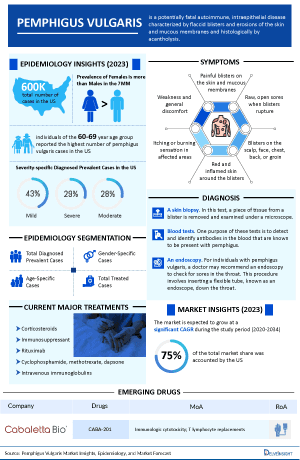
- The Pemphigus Vulgaris Market Size is anticipated to grow with a significant CAGR during the study period (2022-2036).
- The leading Pemphigus Vulgaris companies developing therapies in the treatment market include - Ono Pharmaceutical, Cabaletta Bio, Artiva Biotherapeutics, and others.
Pemphigus Vulgaris Market & Epidemiology Insights
- Pemphigus vulgaris is a rare autoimmune blistering disease, resulting in a relatively small patient population across the 7MM but a high unmet clinical need due to chronic disease burden and frequent relapses.
- Pemphigus vulgaris is the most common form of pemphigus and occurs all over the world. Its frequency is influenced by geographic location and ethnicity. Pemphigus vulgaris occurs between 0.1 and 2.7 per 100,000 people per year.
- Pemphigus vulgaris and nonendemic pemphigus foliaceous typically occur in adults between 40-60 years old. Pemphigus is pretty rare in children (except for endemic pemphigus foliaceous, which affects children and young adults in endemic areas). Neonatal pemphigus is a rare form of pemphigus that happens when an affected mother’s autoantibodies are transferred to the fetus.
- Rituximab remains the cornerstone targeted therapy for moderate-to-severe pemphigus vulgaris, while treatment continues to rely on corticosteroids and off-label immunosuppressants for many patients.
- The availability of rituximab biosimilars has improved patient access to B-cell-depleting therapy and is expected to increase biologic utilization while reducing treatment costs across major markets.
- The pemphigus vulgaris pipeline remains limited, with only a few late-stage or innovative candidates in development. Tirabrutinib (ONO-4059) is undergoing Phase III development in Japan, while resecabtagene autoleucel (CABA-201) is being evaluated in Phase I/II as a potential one-time autologous CAR-T cell therapy.
- Long-term corticosteroid toxicity and frequent disease relapse remain major unmet needs, driving demand for safer steroid-sparing therapies with sustained efficacy.
- The rarity of the disease continues to limit clinical trial recruitment and commercial opportunities, resulting in a relatively sparse development pipeline compared with other autoimmune disorders.
Pemphigus Vulgaris Market Size and Forecast in the 7MM
- 2025 Pemphigus Vulgaris Market Size: XX million
- 2036 Projected Pemphigus Vulgaris Market Size: XX million
- Pemphigus Vulgaris Growth Rate (2026–2036): XX% CAGR
Request for unlocking the sample page of the "Pemphigus Vulgaris Market Forecast"
Key Factors Driving the Pemphigus Vulgaris Market
- Growing Adoption of Rituximab Biosimilars: The increasing availability of rituximab biosimilars has improved patient access to B-cell–depleting therapy by reducing treatment costs. Greater affordability is expected to expand biologic use, particularly in cost-sensitive healthcare systems.
- Favorable Rare Disease Development Environment: Orphan drug incentives, regulatory support, and increasing investment in autoimmune disease research continue to encourage innovation. These factors are accelerating the clinical development of next-generation therapies for pemphigus vulgaris.
- Unmet Need for Steroid-Sparing Therapies: Long-term corticosteroid use is associated with significant adverse effects, while off-label immunosuppressants often provide variable outcomes. This continues to drive demand for safer, targeted therapies capable of achieving durable disease control.
DelveInsight's "Pemphigus Vulgaris Market Insights, Epidemiology and Market Forecast – 2036" report delivers an in-depth understanding of the pemphigus vulgaris, historical and forecasted epidemiology, as well as the pemphigus vulgaris therapeutics market trends in the United States, EU4 (Germany, Spain, Italy, and France) and the United Kingdom, and Japan.
The pemphigus vulgaris market report delivers a comprehensive analysis of the current treatment landscape, including standards of care, clinical practices, and evolving therapeutic algorithms. It evaluates pemphigus vulgaris patient burden trends, revenue & market share dynamics, peak patient share & therapy uptake analysis, and provides an in-depth market size assessment, and growth rate projections (Historical & Forecast 2022–2036) across global regions. The report highlights key unmet medical needs in pemphigus vulgaris and maps the competitive and clinical landscape to uncover high-value opportunities, providing a clear outlook on future market growth potential.
Scope of the Pemphigus Vulgaris Market Report | |
|
Study Period |
2022–2036 |
|
Historical Year |
2022–2025 |
|
Forecast Period |
2026–2036 |
|
Base Year |
2026 |
|
Geographies Covered |
ü North America: The US; ü Europe: Germany, France, Italy, Spain and the UK; ü Asia-Pacific: Japan; |
|
Pemphigus Vulgaris Market CAGR (Forecast period) |
XX% (2026–2036) |
|
Pemphigus Vulgaris Epidemiology Segmentation Analysis |
Patient Burden Assessment
|
|
Pemphigus Vulgaris Companies |
· Ono Pharmaceutical · Cabaletta Bio · Artiva Biotherapeutics, and others |
|
Pemphigus Vulgaris Therapies |
· Tirabrutinib Hydrochloride (ONO-4059/VELEXBRU) · Resecabtagene Autoleucel (rese-cel/CABA-201) · AB-101 (AlloNK), and others |
|
Pemphigus Vulgaris Market |
Segmented by · Region/Geographies · Drugs/Therapies |
|
Analysis |
· Addressable Patient Population · Market Drivers and Market Barriers · Cost Assumptions and Pricing Analogues · KOL Views · SWOT Analysis · Reimbursement · Conjoint Analysis · Unmet Need |
Pemphigus Vulgaris Disease Understanding
Pemphigus Vulgaris Overview and Diagnosis
Pemphigus vulgaris is a rare, chronic, life-threatening autoimmune blistering disease characterized by the production of pathogenic autoantibodies against desmoglein-3 (DSG3) and, in many cases, desmoglein-1 (DSG1). These autoantibodies disrupt cell-to-cell adhesion between keratinocytes, resulting in fragile blisters and painful erosions affecting the mucous membranes and skin. PV most commonly presents with persistent oral ulcers followed by cutaneous blistering and, if left untreated, can lead to severe infections, fluid loss, and significant morbidity. Although its exact cause remains unknown, genetic susceptibility and environmental triggers are believed to contribute to disease development.
The diagnosis of pemphigus vulgaris is based on a combination of clinical presentation, histopathology, immunopathology, and serological testing. Skin or mucosal biopsy typically demonstrates suprabasal acantholysis, while direct immunofluorescence (DIF) is considered the diagnostic gold standard, revealing intercellular deposition of IgG and complement (C3). Indirect immunofluorescence (IIF) and enzyme-linked immunosorbent assays (ELISA) for anti-desmoglein-1 and anti-desmoglein-3 antibodies are widely used to confirm the diagnosis, assess disease activity, and monitor treatment response. Early and accurate diagnosis is critical to prevent disease progression and reduce complications.
Further details are provided in the report...
Current Pemphigus Vulgaris Treatment Landscape
The primary goals of pemphigus vulgaris treatment are to achieve rapid disease control, induce sustained remission, and minimize treatment-related adverse effects. Systemic corticosteroids remain the cornerstone of initial therapy and are frequently combined with rituximab, the only targeted biologic specifically approved for moderate-to-severe pemphigus vulgaris in major markets, which has become the preferred first-line steroid-sparing therapy. Additional off-label immunosuppressants, including azathioprine, mycophenolate mofetil, methotrexate, and cyclophosphamide, are commonly used for maintenance or refractory disease, while Intravenous Immunoglobulin (IVIG) and plasmapheresis/immunoadsorption may be considered in severe cases. Emerging therapies, including BTK inhibitors and CAR-T cell therapies, are being investigated to provide more durable, disease-modifying treatment options.
Further details related to country-based variations are provided in the report...
Pemphigus Vulgaris Unmet Needs
The section “unmet needs of pemphigus vulgaris” outlines the critical gaps between the current state of patient care, diagnosis, and the ideal & effective management of the disease. It highlights the obstacles experienced by patients, clinicians, and researchers and identifies potential solutions for future progress.
1. Limited approved targeted therapies
2. Dependence on long-term immunosuppression
3. Relapse and difficulty achieving durable remission
4. Delayed diagnosis and misdiagnosis, and others…..
Note: Comprehensive unmet needs insights in Pemphigus Vulgaris and their strategic implications are provided in the full report...
Pemphigus Vulgaris Epidemiology
The Pemphigus Vulgaris epidemiology section provides insights about the historical and current Pemphigus Vulgaris patient pool and forecasted trends for individual seven major countries. It helps to recognize the causes of current and forecasted trends by exploring numerous studies and views of key opinion leaders. This part of the Pemphigus Vulgaris market report also provides the diagnosed patient pool and their trends along with assumptions undertaken.
Key Findings from Pemphigus Vulgaris Epidemiological Analysis and Forecast
- Pemphigus vulgaris is most commonly diagnosed between 40–60 years of age.
- As per secondary analysis, pemphigus vulgaris generally affects males and females similarly, although some regions report female predominance.
- Pemphigus vulgaris is estimated to have a prevalence of ~10–20 cases/million population in the US.
Pemphigus Vulgaris Epidemiology Segmentation
- Pemphigus Vulgaris Total Diagnosed Prevalent Cases
- Pemphigus Vulgaris Gender-specific Diagnosed Prevalent Cases
- Pemphigus Vulgaris Age-specific Diagnosed Prevalent Cases
- Pemphigus Vulgaris Severity-specific Diagnosed Prevalent Cases
- Pemphigus Vulgaris Total Treated Cases
Recent Developments in the Pemphigus Vulgaris Treatment Landscape:
- In April 2026, Cabaletta Bio announced multiple upcoming presentations including manufacturing, translational and clinical data on rese-cel at the American Society of Gene & Cell Therapy (ASGCT) 2026 Annual Meeting.
- In January 2026, Ono Pharmaceutical announced INDa clearance for rese-cel to be manufactured using an automated manufacturing platform – the Cell Shuttle TM from Cellares - offering the potential for scalability to produce rese-cel for thousands of patients per year with minimal capital investment by the company.
Pemphigus Vulgaris Drug Analysis & Competitive Landscape
The pemphigus vulgaris drug chapter provides a detailed, market-focused review of the emerging pipeline across Phase III/I-II clinical trials and preclinical trials. It covers the mechanism of action, clinical trial data, regulatory approvals, patents, collaborations, and strategic partnerships for each therapy, along with their advantages, limitations, and recent developments. This section offers critical insights into the pemphigus vulgaris treatment landscape, supporting market assessment, competitive analysis, and growth forecasting for the pemphigus vulgaris therapeutics market.
Approved Therapies for Pemphigus Vulgaris
Although rituximab is the only targeted biologic approved for pemphigus vulgaris in major markets, treatment continues to rely heavily on generic corticosteroids (prednisone/prednisolone) and off-label immunosuppressants such as azathioprine, mycophenolate mofetil, methotrexate, cyclophosphamide, and cyclosporine as steroid-sparing therapies. IVIG and plasmapheresis/immunoadsorption are reserved for refractory or severe cases. Additionally, the widespread availability of rituximab biosimilars has improved treatment accessibility and reduced costs, creating a competitive landscape in which emerging therapies must demonstrate superior efficacy, durable remission, and improved safety to gain adoption.
Note: Detailed marketed therapies assessment will be provided in the final report...
Pemphigus Vulgaris Pipeline Analysis
Tirabrutinib Hydrochloride (ONO-4059/VELEXBRU): Ono Pharmaceutical
Tirabrutinib hydrochloride is an oral, highly selective Bruton's tyrosine kinase (BTK) inhibitor being developed by Ono Pharmaceutical for the treatment of steroid-resistant pemphigus. It is currently in Phase III trial (NCT06696716) in Japan.
Resecabtagene Autoleucel (rese-cel/CABA-201): Cabaletta Bio
It is a 4-1BB co-stimulatory domaincontaining fully human CD19-CAR T construct designed to treat patients with a broad range of autoimmune diseases. The FDA had granted Orphan Drug Designation (ODD) for DSG3-CAART for the treatment of pemphigus vulgaris. Rese-cel is currently being evaluated in the Phase I/II RESET-PV trial. In addition to the development program across multiple indications using standard preconditioning regimens, based on early data from a Phase I/II trial evaluating rese-cel without preconditioning in pemphigus vulgaris patients. Longer-term data from the evaluation of rese-cel without preconditioning in non-renal Systemic Lupus Erythematosus, lupus nephritis, and pemphigus vulgaris patients is expected to be presented in the second half of 2026.
Competitive Landscape of Pemphigus Vulgaris Pipeline Drugs | ||||||
|
Drug Name |
Company |
Highest Phase |
Indication |
RoA |
MoA |
Anticipated Launch in the US |
|
Tirabrutinib Hydrochloride Velexbru (ONO-4059) |
Ono Pharmaceutical |
III |
Steroid-resistant Pemphigus |
Oral |
BTK inhibitor |
Information is available in the full report |
|
Resecabtagene Autoleucel (rese-cel/ CABA-201) |
Cabaletta Bio |
I/II |
Pemphigus Vulgaris |
IV infision |
Deplete CD19-positive B cells |
Information is available in the full report |
|
AB-101 (AlloNK) |
Artiva Biotherapeutics |
I |
Pemphigus Vulgaris |
IV infision |
Immunologic cytotoxicity |
Information is available in the full report |
|
Note: Launch insights are provisional and may change with future report updates or the occurrence of major key catalysts. | ||||||
Note: Detailed emerging therapies assessment will be provided in the final report...
Pemphigus Vulgaris Key Players, Market Leaders and Emerging Companies
- Ono Pharmaceutical
- Cabaletta Bio
- Artiva Biotherapeutics, and others
Pemphigus Vulgaris Market Outlook
The treatment landscape remains characterized by a significant unmet need, with rituximab being the only targeted biologic approved in major markets and treatment otherwise relying heavily on generic corticosteroids, off-label immunosuppressants, and rituximab biosimilars.
The pipeline is currently limited but innovative, with tirabrutinib hydrochloride in Phase III, and resecabtagene autoleucel an autologous CD19-directed CAR-T cell therapy in Phase I/II, representing the most promising emerging candidates. Tirabrutinib aims to provide an effective oral steroid-sparing therapy by suppressing B-cell activation, while rese-cel seeks to achieve long-term immune reset through targeted depletion of autoreactive B cells. If successful, these therapies could shift pemphigus vulgaris management beyond chronic immunosuppression toward more targeted and potentially durable treatment strategies.
No new therapies are currently approved for pemphigus vulgaris beyond rituximab, and the market continues to rely on generic corticosteroids, off-label immunosuppressants, and rituximab biosimilars. The pemphigus vulgaris treatment pipeline remains limited, with only a small number of investigational therapies in clinical development, highlighting continued unmet need for novel targeted treatment options.
Further details will be provided in the report...
Drug Class/Insights into Leading Emerging and Marketed Therapies in Pemphigus Vulgaris (2022–2036 Forecast)
The pemphigus vulgaris market (2022–2036 forecast) is transitioning from broad immunosuppression toward targeted B-cell therapies designed to selectively interrupt the autoimmune processes responsible for disease pathogenesis.
- BTK Inhibitors: Tirabrutinib hydrochloride belongs to the BTK inhibitor class. By selectively inhibiting BTK, tirabrutinib suppresses B-cell activation and autoantibody production against desmogleins, thereby reducing disease activity.
- Autologous CAAR-T/Cell Therapy: Resecabtagene Autoleucel is an autologous CD19-directed CAR-T cell therapy designed to induce deep B-cell depletion and reset the aberrant immune response driving autoimmune disease.
Overall, innovation in pemphigus vulgaris is increasingly centered on precision B-cell-targeted therapies, including oral BTK inhibitors and cell-based immunotherapies. While corticosteroids, rituximab, and conventional immunosuppressants remain the foundation of current management, emerging therapies such as tirabrutinib and rese-cel have the potential to redefine treatment by providing longer-lasting disease control, reducing corticosteroid dependence, and addressing the persistent unmet need for durable remission.
Pemphigus Vulgaris Drug Uptake
This section focuses on the uptake rate of potential drugs expected to be launched in the market during the forecast period (2026–2036). The analysis covers the pemphigus vulgaris drug’s uptake, performance at peak, factors affecting performance during prime years of growth, patient uptake by therapy, and anticipated sales generated by each drug.
Current treatment uptake in pemphigus vulgaris is primarily driven by systemic corticosteroids and B-cell–targeted therapies, particularly rituximab, which has become an important treatment option due to its ability to induce remission and reduce steroid dependency. Emerging therapies such as tirabrutinib and rese-cel are still in early development and are expected to have limited impact on the market in the near term, with future adoption dependent on clinical efficacy, safety, and durability of response.
Detailed insights of emerging therapies' drug uptake is included in the report...
Market Access and Reimbursement of Approved Therapies in Pemphigus Vulgaris
Reimbursement is a crucial factor that affects the drug’s access to the market. Often, the decision to reimburse comes down to the price of the drug relative to the benefit it produces in treated patients. To reduce the healthcare burden of these high-cost therapies, many payment models are being considered by payers and other industry insiders.
The report further provides detailed insights on the country-wise accessibility and reimbursement scenarios, cost-effectiveness scenario of approved therapies, programs making accessibility easier and out-of-pocket costs more affordable, insights on patients insured under federal or state government prescription drug programs, etc..
NOTE: Further Details are provided in the final report...
Pemphigus Vulgaris Therapies Price Scenario & Trends
Pricing and analogue assessment of pemphigus vulgaris therapies highlights evolving price dynamics structures. This section summarizes the cost of approved treatments, closest and most appropriate analogue selection for emerging therapies, and understanding of how pricing influences market access, adherence, and long-term uptake.
Industry Experts and Physician Views for Pemphigus Vulgaris
To keep up with pemphigus vulgaris market trends, we take Key Opinion Leaders (KOLs) and Subject Matter Experts (SMEs) opinions working in the domain through primary research to fill the data gaps and validate our secondary research. Industry experts were contacted for insights on the pemphigus vulgaris emerging therapies, evolving treatment landscape, patient adherence to conventional therapies, therapy switching trends, drug adoption and uptake, accessibility challenges, and epidemiology and real-world prescription patterns in pemphigus vulgaris, including MD, PhD, Instructor, Postdoctoral Researcher, Professor, Researcher, and others.
DelveInsight’s analysts connected with 15+ KOLs to gather insights at the country level. Centers such as Perelman School of Medicine at the University of Pennsylvania, University of North Carolina School of Medicine, and University of Marburg, etc. were contacted. Their opinion helps understand and validate current and emerging pemphigus vulgaris therapies, highlight unmet medical needs, provide epidemiological context, and support strategic decisions for market access, therapy adoption, and pipeline prioritization in pemphigus vulgaris.
|
Region |
Key Opinion Leaders (KOLs) and Subject Matter Experts (SMEs) |
|
United States |
“In the US, pemphigus vulgaris shows a slightly higher prevalence among women, with rituximab becoming the preferred treatment due to its efficacy in achieving sustained remission. Nonetheless, refractory cases and corticosteroid side effects remain significant clinical challenges, particularly in older patients, demanding further research into alternative therapies.” |
|
Germany |
“Future management of pemphigus vulgaris is likely to move beyond broad immunosuppression toward precision therapies that selectively target autoreactive B cells. Advances in BTK inhibitors and antigen-specific cell therapies have the potential to improve long-term outcomes while minimizing treatment-related toxicity.” |
Pemphigus Vulgaris Report Qualitative Analysis: SWOT and Conjoint Analysis
We perform qualitative and market Intelligence analysis using various approaches, such as SWOT analysis and conjoint analysis.
In the SWOT analysis of pemphigus vulgaris, strengths, weaknesses, opportunities, and threats in terms of disease diagnosis, patient awareness, patient burden, competitive landscape, cost-effectiveness, and geographical accessibility of therapies are provided.
Conjoint analysis analyzes emerging therapies based on relevant attributes such as safety, efficacy, frequency of administration, route of administration, and order of entry. Scoring is given based on these parameters to analyze the effectiveness of therapy.
The team of analysts analyzes promising emerging therapies based on relevant attributes such as safety, efficacy, frequency of administration, route of administration, and order of entry. In efficacy, the trial’s primary and secondary outcome measures are evaluated, whereas the therapies’ safety is evaluated, wherein the acceptability, tolerability, and adverse events are majorly observed. In addition, the scoring is also based on the route of administration, order of entry, probability of success, and the addressable patient pool for each therapy. According to these parameters, the final weightage score and the ranking of the emerging therapies are decided.
Scope of the Pemphigus Vulgaris Market Report
- The report covers a segment of key events, an executive summary, a descriptive overview of pemphigus vulgaris, explaining their causes, signs and symptoms, pathogenesis, and currently available treatments.
- Comprehensive insight has been provided into the epidemiology segments and forecasts, the future growth potential of the diagnosis rate, and disease progression along treatment guidelines.
- Additionally, an all-inclusive account of both the current and emerging treatments, along with the elaborative profiles of late-stage and prominent therapies, will have an impact on the current treatment landscape.
- A detailed review of the pemphigus vulgaris market, historical and forecasted market size, market share by therapies, detailed assumptions, and rationale behind our approach is included in the report, covering the 7MM drug outreach.
- The report provides an edge while developing business strategies by understanding trends through SWOT analysis and expert insights/KOL views, patient journey, and treatment preferences that help in shaping and driving the 7MM pemphigus vulgaris market.
Pemphigus Vulgaris Market Report Insights
- Pemphigus Vulgaris Patient Population Forecast
- Pemphigus Vulgaris Therapeutics Market Size
- Pemphigus Vulgaris Pipeline Analysis
- Pemphigus Vulgaris Market Size and Trends
- Pemphigus Vulgaris Market Opportunity (Current and forecasted)
Pemphigus Vulgaris Market Report Key Strengths
- Pemphigus Vulgaris Epidemiology-based (Epi-based) Bottom-up Forecasting
- Artificial Intelligence (AI)-Enabled Market Research Report
- 11-Year Forecast
- Pemphigus Vulgaris Market Outlook (North America, Europe, Asia-Pacific)
- Pemphigus Vulgaris Patient Burden Trends (By Geography)
- Pemphigus Vulgaris Treatment Addressable Market (TAM)
- Pemphigus Vulgaris Competitve Landscape
- Pemphigus Vulgaris) Major Companies Insights
- Pemphigus Vulgaris Price Trends and Analogue Assessment
- Pemphigus Vulgaris Therapies Drug Adoption/Uptake
- Pemphigus Vulgaris Therapies Peak Patient Share Analysis
Pemphigus Vulgaris Market Report Assessment
- Pemphigus Vulgaris Current Treatment Practices
- Pemphigus Vulgaris Unmet Needs
- Pemphigus Vulgaris Clinical Development Analysis
- Pemphigus Vulgaris Emerging Drugs Product Profiles
- Pemphigus Vulgaris Market attractiveness
- Pemphigus Vulgaris Qualitative Analysis (SWOT and conjoint analysis)
- Pemphigus Vulgaris Market Drivers
- Pemphigus Vulgaris Market Barrriers
FAQs Related to the Pemphigus Vulgaris Market Report:
Pemphigus Vulgaris Market Insights
- What was the pemphigus vulgaris market size, the market size by therapies, market share (%) distribution in 2025, and what would it look like by 2036? What are the contributing factors for this growth?
- What are the anticipated pricing variations among different geographies for the emerging therapies in the future?
- What can be the future treatment paradigm of pemphigus vulgaris?
- What are the disease risks, burdens, and unmet needs of pemphigus vulgaris? What will be the growth opportunities across the 7MM concerning the patient population with pemphigus vulgaris?
- Who is the major future competitor in the market, and how will the competitors affect their market share?
- What are the current options for the treatment of pemphigus vulgaris? What are the current guidelines for treating pemphigus vulgaris in the US, Europe, and Japan?
Reasons to Buy Pemphigus Vulgaris Market Forecast Report
- The report will help in developing business strategies by understanding the latest trends and changing treatment dynamics driving the pemphigus vulgaris market.
- Bottom up forecasting builds from the affected population to product forecasts, delivering a robust, data driven approach ideal for new therapies and novel classes.
- Insights on patient burden/disease incidence, evolution in diagnosis, and factors contributing to the change in the epidemiology of the disease during the forecast years.
- Understand the existing market opportunities in varying geographies and the growth potential over the coming years.
- Identifying strong upcoming players in the market will help devise strategies to help get ahead of competitors.
- Detailed analysis and ranking of class-wise potential emerging therapies under the conjoint analysis section to provide visibility around leading classes.
- To understand KOLs’ perspectives on the accessibility, acceptability, and compliance-related challenges of existing treatment to overcome barriers in the future.
- Detailed insights on the unmet needs of the existing market so that the upcoming players can strengthen their development and launch strategy.
- This Artificial Intelligence (AI) enabled report summarize and simplify complex datasets with in the report into clear, actionable insights for stakeholders, investors, and healthcare providers, enabling faster, data driven decisions.