
Peritoneal Carcinomatosis Market Summary
- The Peritoneal Carcinomatosis Market is expected to strengthen as awareness of the disease increases, and more effective interventions are being developed.
- The leading Peritoneal Carcinomatosis Companies such as Genelux Corporation, Oncoinvent AS, Taiho Pharmaceutical Co. Ltd., Neovii Biotech, OncoNano Medicine Inc., Novartis Pharmaceuticals, Ipsen, Lumicell Inc., Merck Sharp & Dohme LLC, Boryung Pharmaceuticals Co. Ltd and others.
Peritoneal Carcinomatosis Market Insights and Forecast
- Peritoneal carcinomatosis is the intraperitoneal dissemination of any tumor that does not originate from the peritoneum itself. It is the most common diffuse peritoneal disease.
- The peritoneum is the second most prevalent site of metastatic spread, following the liver.
- About 7 out of every 1 million people are diagnosed with peritoneal carcinomatosis annually.
- The disease may be more prevalent in certain ethnic groups, with potentially higher incidence rates observed in white women compared to black women.
- Peritoneal carcinomatosis most commonly occurs in women, with the average age at diagnosis being around 60 years.
- Cytoreductive surgery (CRS) combined with hyperthermic intraperitoneal chemotherapy (HIPEC) is increasingly recognized as a standard treatment for patients with peritoneal carcinomatosis. Although most patients experience relapse after multimodal treatment, incorporating surgery is believed to enhance overall survival and maintain quality of life.
- Currently, there are no FDA-approved drugs for the treatment of peritoneal carcinomatosis. However, targeted therapies like bevacizumab (anti-VEGF) and PARP inhibitors are sometimes used, especially for ovarian cancers with BRCA mutations. These therapies show promise when combined with chemotherapy.
- The current development pipeline for peritoneal carcinomatosis features Radspherin, a novel radiopharmaceutical therapy being developed by Oncoinvent.
- In June 2025, Oncoinvent announced positive final data from the Phase I/IIa trial of Radspherin in patients with colorectal peritoneal metastases. Data demonstrate sustained peritoneal disease control and reinforce the potential of Oncoinvent’s novel radiopharmaceutical therapy to target peritoneal disease in Colorectal Cancer.
- Pressurized intraperitoneal aerosolized chemotherapy (PIPAC) is a novel minimally invasive chemotherapy regimen that reduces pain and may benefit patients with peritoneal carcinomatosis when added to systemic therapy.
Request for Unlocking the Sample Page of the "Peritoneal Carcinomatosis Market"
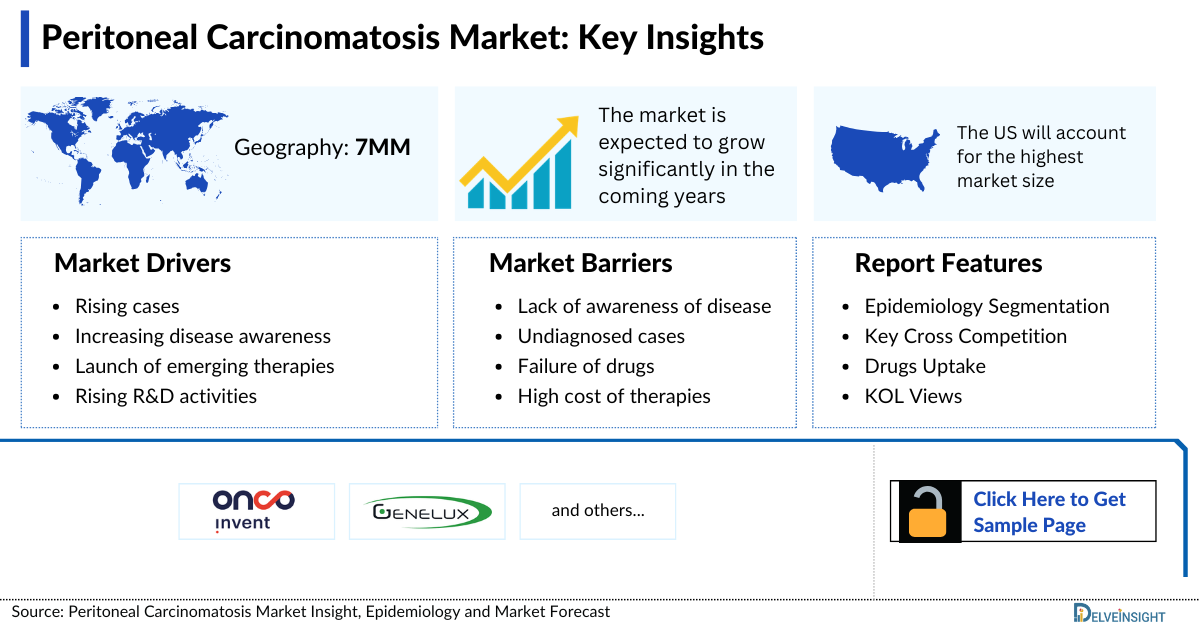
Key Factors Driving the Peritoneal Carcinomatosis Market Growth
-
Rising Incidence of Gastrointestinal and Gynecological Cancers
Peritoneal carcinomatosis commonly develops as a complication of primary cancers such as colorectal, gastric, ovarian, and pancreatic cancers. The increasing global prevalence of these malignancies is significantly contributing to the expansion of the peritoneal carcinomatosis market as more patients require advanced diagnostic and therapeutic interventions.
-
Advancements in Diagnostic Technologies
Improved imaging techniques, including enhanced CT scans, MRI, and PET imaging, are enabling earlier and more accurate detection of peritoneal metastases. These advancements help clinicians identify the disease at earlier stages, which increases the demand for specialized treatments and fuels market growth.
-
Growing Adoption of Cytoreductive Surgery (CRS) and HIPEC
Cytoreductive surgery combined with hyperthermic intraperitoneal chemotherapy (HIPEC) has emerged as a promising treatment approach for selected patients with peritoneal carcinomatosis. The growing clinical acceptance of this treatment strategy is boosting the demand for specialized therapies and driving market expansion.
-
Increasing Research and Development Activities
Pharmaceutical and biotechnology companies are actively investing in research programs aimed at developing innovative targeted therapies, immunotherapies, and novel drug delivery systems for peritoneal metastases. These advancements are expected to improve patient outcomes and accelerate market growth.
-
Expansion of Oncology Drug Pipelines
The development of new oncology drugs targeting metastatic cancers is also influencing the peritoneal carcinomatosis treatment landscape. A strong pipeline of investigational therapies being evaluated in clinical trials is expected to introduce more effective treatment options in the coming years.
-
Improved Healthcare Infrastructure and Access to Cancer Care
The expansion of cancer treatment centers, improved healthcare infrastructure, and increased access to specialized oncology care in developing regions are supporting early diagnosis and treatment, thereby contributing to market growth.
-
Growing Awareness and Screening Programs
Rising awareness about cancer symptoms, early detection programs, and regular screening initiatives are helping identify cancers that may lead to peritoneal carcinomatosis at earlier stages. This trend is increasing the patient pool eligible for treatment and boosting market demand.
DelveInsight's “Peritoneal Carcinomatosis Market Insight, Epidemiology and Market Forecast – 2040” report delivers an in-depth analysis of peritoneal carcinomatosis, market, and clinical development in Peritoneal Carcinomatosis. In addition to this, the report provides historical and forecasted epidemiology and market data as well as a detailed analysis of the peritoneal carcinomatosis market trends in the United States, EU4 (Germany, France, Italy, and Spain ), the United Kingdom, and Japan.
Peritoneal Carcinomatosis Treatment Market Report provides real-world prescription pattern analysis, emerging drugs assessment, market share, and uptake/adoption pattern of individual therapies, as well as historical and forecasted peritoneal carcinomatosis market size from 2020 to 2040 in the 7MM. The report also covers current peritoneal carcinomatosis treatment practices/algorithms and unmet medical needs to curate the best opportunities and assess the market’s underlying potential.
Scope of the Peritoneal Carcinomatosis Market Report | |
|
Study Period |
2020–2040 |
|
Forecast Period |
2025–2040 |
|
Geographies Covered |
US, EU4 (Germany, France, Italy, and Spain), the United Kingdom, and Japan |
|
Peritoneal Carcinomatosis Epidemiology
|
Segmented by:
|
|
Peritoneal Carcinomatosis Companies |
|
|
Peritoneal Carcinomatosis Therapies |
|
|
Peritoneal Carcinomatosis Market |
Segmented by:
|
|
Analysis |
|
Peritoneal Carcinomatosis Understanding and Treatment Algorithm
Peritoneal Carcinomatosis Overview
Peritoneal Carcinomatosis is a rare form of cancer that develops in peritoneum (thin lining of the abdominal cavity). It is primarily caused by the metastasis of other cancers, most commonly from the ovaries, gastrointestinal tract (including colon, stomach, and appendix), and pancreas. The risk factors of peritoneal carcinomatosis includes age, BRCA genetic mutations, hormone replacement therapy, obesity, endometriosis and family history of ovarian or peritoneal cancer.
The symptoms of peritoneal carcinomatosis typically appear in late stages when the cancer cells grow significantly and affect surrounding organs. Diarrhea, constipation, nausea, abdominal swelling and pain, bloating, weight loss or gain, extreme fatigue, and loss of appetite are some its common symptoms. As the cancer spreads, urinary symptoms may occur if nearby organs like the bladder or ureters are affected, along with shortness of breath due to pressure from fluid accumulation.
Peritoneal Carcinomatosis Diagnosis
The diagnosis of peritoneal carcinomatosis typically involves a combination of medical history evaluation, physical examination, imaging tests, and sometimes invasive procedures due to its diffuse spread across the peritoneal lining without distinct masses. Computed tomography (CT) scans, magnetic resonance imaging (MRI), and positron emission tomography (PET scans) are often the initial steps to visualize tumor spread and ascites. Further, peritoneal washing cytology, staging laparoscopy and biopsy are often performed to confirm diagnosis and assess tumor burden accurately. Tumor marker blood tests and newer methods like circulating tumor DNA analysis may assist but are not definitive. The peritoneal carcinomatosis index (PCI) is used to assess tumor spread and guide treatment planning.
Further details related to country-based variations in diagnosis are provided in the report
Peritoneal Carcinomatosis Treatment
The treatment is often challenging because peritoneal carcinomatosis usually arises from advanced invasive cancers that has spread from another cancer. The primary aim of treatment is to manage symptoms, ease pain, and improve patient’s quality of life. The mainstay of treatment is a combination of cytoreductive surgery (CRS) hyperthermic intraperitoneal chemotherapy (HIPEC) and peritonectomy. CRS aims to surgically remove all visible tumor deposits from the peritoneum and affected organs, while HIPEC involves circulating heated chemotherapy directly into the abdominal cavity to kill residual microscopic cancer cells. This approach has significantly improved survival for selected patients, especially those with colorectal, ovarian, gastric cancers, and other peritoneal surface malignancies.
Further details related to treatment will be provided in the report…
Peritoneal Carcinomatosis Epidemiology
The Peritoneal Carcinomatosis epidemiology chapter in the report provides historical as well as forecasted epidemiology segmented as total cases of different cancer types associated with peritoneal carcinomatosis, total Peritoneal Carcinomatosis Diagnosed Cases, and total Peritoneal Carcinomatosis Treated Cases in the 7MM covering the United States, EU4 (Germany, France, Italy, and Spain), and the United Kingdom, and Japan from 2020 to 2040.
- About 7 out of every 1 million people are diagnosed with peritoneal carcinomatosis annually.
- Approximately 40–60% of patients who undergo curative gastrectomy followed by systemic chemotherapy experience peritoneal carcinomatosis as the sole site of cancer recurrence.
- Peritoneal carcinomatosis accounts for approximately 10% of all cases of peritoneal and ovarian cancers combined.
Peritoneal Carcinomatosis Drug Analysis
The drug chapter segment of the Peritoneal Carcinomatosis Treatment Market Report encloses a detailed analysis of peritoneal carcinomatosis-marketed drugs and Peritoneal Carcinomatosis Pipeline Drugs. It also deep dives into peritoneal carcinomatosis’s pivotal clinical trial details, recent and expected market approvals, patent details, the latest news, and recent deals and collaborations.
Peritoneal Carcinomatosis Emerging Therapies
-
Radspherin: Oncoinvent
Radspherin is a novel alpha-emitting radioactive micro particle suspension designed for local treatment of metastatic cancers in body cavities. It consists of an alpha radiating micro particle suspension that is instilled in the targeted body cavity. This allows local radiopharmaceutical therapy of that body cavity, without the need to use systemic administration. Radspherin has received Fast Track Designation (FTD) from FDA for the treatment of patients with peritoneal metastases from ovarian cancer.
Near-term significant milestones for Radspherin:
- Phase I/IIa Colorectal Cancer: Key Readout Expected Late H1 2025
- Phase I Ovarian Cancer: 24-Month Maturity Data Targeted for H2 2025
- Phase II Ovarian Cancer: Interim Readout Projected for Late H2 2026
Table 1: Comparison of Emerging Therapies Under Development | ||||||
|
Drug Name |
Company |
Highest Phase |
Indication |
RoA |
MoA |
Molecule Type |
|
Radspherin |
Oncoinvent |
II |
Peritoneal carcinomatosis from ovarian cancer |
Intraperitoneal |
Ionising radiation emitters |
Micro Particle |
|
GL-ONC1 |
Genelux |
I/II |
Peritoneal carcinomatosis |
Intraperitoneal infusion |
- |
Genetically engineered virus |
Note: Detailed emerging therapies assessment will be provided in the final report.
Peritoneal Carcinomatosis Drug Class Insights
-
Ionizing Radiation Emitters (Radspherin)
Radspherin is a microparticle-based intraperitoneal therapy that delivers alpha-emitting radionuclides directly into the peritoneal cavity following cytoreductive surgery. The drug consists of radium-224, an alpha emitter, encapsulated within biodegradable microspheres.
- Alpha particles have high energy but a very short penetration range (~50–100 μm), which allows them to kill tumor cells with high precision while sparing surrounding healthy tissues.
- When administered intraperitoneally, Radspherin disperses within the peritoneal cavity, where residual microscopic cancer cells remain after surgery.
- The alpha radiation induces double-strand DNA breaks in cancer cells, leading to irreversible cell death (apoptosis or necrosis), particularly in areas where standard systemic chemotherapy has limited access.
This targeted local radiotherapy approach aims to reduce recurrence of peritoneal metastases, especially in peritoneal carcinomatosis from ovarian or colorectal cancer, by eradicating microscopic residual disease post-surgery.
Peritoneal Carcinomatosis Market Outlook
Peritoneal carcinomatosis is commonly associated with advanced stages of gastrointestinal, ovarian, and other abdominal cancers, leading to significant challenges in treatment and poor prognosis. However, advancements in surgical techniques and systemic therapies have led to more comprehensive treatment approaches aimed at improving survival and quality of life. Currently, a combination of cytoreductive surgery (CRS) and intraperitoneal chemotherapy (HIPEC or EPIC) is regarded as the best therapeutic option for patients with peritoneal carcinomatosis. CRS surgically removes visible tumors from the peritoneal cavity, often including organs like bowel and omentum, followed by HIPEC, which delivers heated chemotherapy inside the abdomen to kill remaining microscopic cancer cells.
Systemic chemotherapy with platinum-based drugs and taxanes is used before or after surgery, but poorly penetrates the peritoneum, often leaving residual disease. Neoadjuvant chemotherapy (NACT), given prior to surgery, helps shrink tumors, improving the likelihood of successful cytoreduction and better surgical outcomes in responsive patients. Targeted therapies like bevacizumab (anti-VEGF) and PARP inhibitors are sometimes used, especially for ovarian cancers with BRCA mutations. These therapies show promise when combined with chemotherapy. The development pipeline for peritoneal carcinomatosis currently highlights Radspherin, an emerging radiopharmaceutical therapy being advanced by Oncoinvent.
Peritoneal Carcinomatosis Drug Uptake
This section focuses on the uptake rate of potential Peritoneal Carcinomatosis drugs expected to be launched in the market during 2025–2040. The landscape of peritoneal carcinomatosis treatment has experienced a profound transformation with the uptake of novel medicines. These innovative therapies are redefining standards of care.
Peritoneal Carcinomatosis Clinical Trials Activities
The Peritoneal Carcinomatosis Therapeutics Market Report provides insights into different therapeutic candidates in the marketed and emerging stages. It also analyses key players involved in developing targeted therapeutics.
Peritoneal Carcinomatosis Pipeline Development Activities
The Peritoneal Carcinomatosis therapeutics market report covers information on collaborations, acquisitions and mergers, licensing, and patent details for Peritoneal Carcinomatosis therapies.
Latest KOL Views on Peritoneal Carcinomatosis
To keep up with the real-world scenario in current and emerging market trends, we take opinions from Key Industry leaders working in the domain through primary research to fill the data gaps and validate our secondary research. Industry Experts were contacted for insights on the evolving treatment landscape, patient reliance on conventional therapies, patient therapy switching acceptability, and drug uptake, along with challenges related to accessibility, including Medical/scientific writers, Professors, and others.
DelveInsight’s analysts connected with 15+ KOLs to gather insights; however, interviews were conducted with 5+ KOLs in the 7MM. Centers such as University Hospital Regensburg, Sapienza University of Rome, Hospital Barmherzige Brüder Regensburg, etc., were contacted. Their opinion helps understand and validate current and emerging therapy treatment patterns or Peritoneal Carcinomatosis market trends.
Major Peritoneal Carcinomatosis Companies
Genelux Corporation, Oncoinvent AS, Taiho Pharmaceutical Co. Ltd., Neovii Biotech, OncoNano Medicine Inc., Novartis Pharmaceuticals, Ipsen, Lumicell Inc., Merck Sharp & Dohme LLC, Boryung Pharmaceuticals Co. Ltd and others.
KOL Views |
|
“The three most common imaging findings are ascites, nodular implants, and infiltration of the peritoneal fatty tissue. Several imaging modalities may be applied in patients with peritoneal carcinomatosis. Ultrasound has low sensitivity and specificity, and therefore plays only a marginal role.”
|
|
“Currently, a combination of cytoreductive surgery (CRS) and intraperitoneal chemotherapy (HIPEC or EPIC) is regarded as the best therapeutic option for patients with peritoneal carcinomatosis. The introduction of these methods has significantly improved the life expectancy of patients. Depending on the type of primary malignancy, the increase.”
|
Peritoneal Carcinomatosis Qualitative Analysis Report
We perform qualitative and market intelligence analysis using various approaches, such as SWOT and conjoint analysis. In the SWOT analysis, strengths, weaknesses, opportunities, and threats in terms of disease diagnosis, patient awareness, patient burden, competitive landscape, cost-effectiveness, and geographical accessibility of therapies are provided. These pointers are based on the Analyst’s discretion and assessment of the patient burden, cost analysis, and existing and evolving Peritoneal Carcinomatosis Treatment Market Landscape.
Conjoint Analysis analyzes multiple approved and emerging therapies based on relevant attributes such as safety, efficacy, frequency of administration, designation, route of administration, and order of entry. Scoring is given based on these parameters to analyze the effectiveness of therapy. The analyst analyzes multiple emerging therapies based on relevant attributes such as safety, efficacy, frequency of administration, route of administration, and order of entry. In efficacy, the trial’s primary and secondary outcome measures are evaluated. Further, the therapies’ safety is evaluated wherein the acceptability, tolerability, and adverse events are majorly observed, and it sets a clear understanding of the side effects posed by the drug in the trials.
Peritoneal Carcinomatosis Market Access and Reimbursement
Reimbursement may be referred to as the negotiation of a price between a manufacturer and a payer that allows the manufacturer access to the market. It is provided to reduce the high costs and make the essential drugs affordable. Health technology assessment (HTA) plays an important role in reimbursement decision-making and recommending the use of a drug. These recommendations vary widely throughout the seven major markets, even for the same drug. In the US healthcare system, both Public and Private health insurance coverage are included. Also, Medicare and Medicaid are the largest government-funded programs in the US. The major healthcare programs, including Medicare, Medicaid, Health Insurance Program (CHIP), and the state and federal health insurance marketplaces, are overseen by the Centers for Medicare & Medicaid Services (CMS). Other than these, Pharmacy Benefit Managers (PBMs) and third-party organizations that provide services and educational programs to aid patients are also present.
The Peritoneal Carcinomatosis therapeutics market report further provides detailed insights on the country-wise accessibility and reimbursement scenarios, cost-effectiveness scenario of currently used therapies, programs making accessibility easier and out-of-pocket costs more affordable, insights on patients insured under federal or state government prescription drug programs, etc.
Scope of the Peritoneal Carcinomatosis Market Report
- The Peritoneal Carcinomatosis Therapeutics Market Report covers a segment of key events, an executive summary, a descriptive overview, explaining its causes, signs and symptoms, pathogenesis, and currently available therapies.
- Comprehensive insight has been provided into the epidemiology segments and forecasts, the future growth potential of the diagnosis rate, and treatment guidelines.
- Additionally, an all-inclusive account of both the current and emerging therapies, along with the elaborative profiles of late-stage and prominent therapies, will have an impact on the current treatment landscape.
- A detailed review of the Peritoneal Carcinomatosis Treatment Market, historical and forecasted Peritoneal Carcinomatosis market size, Peritoneal Carcinomatosis market share by therapies, detailed assumptions, and rationale behind our approach is included in the report, covering the 7MM drug outreach.
- The Peritoneal Carcinomatosis therapeutics market report provides an edge while developing business strategies, by understanding trends, through SWOT and conjoint analysis and expert insights/KOL views, patient journey, and treatment preferences that help in shaping and driving the 7MM Peritoneal Carcinomatosis drugs market.
Peritoneal Carcinomatosis Market Report Insights
- Patient-based Peritoneal Carcinomatosis Market Forecasting
- Therapeutic Approaches
- Peritoneal Carcinomatosis Pipeline Drugs Analysis
- Peritoneal Carcinomatosis Market Size and Trends
- Existing and Future Peritoneal Carcinomatosis Drugs Market Opportunity
Peritoneal Carcinomatosis Market Report Key Strengths
- 16-Year Peritoneal Carcinomatosis Market Forecast
- 7MM Coverage
- Peritoneal Carcinomatosis Epidemiology Segmentation
- Key Cross Competition
- Conjoint analysis
- Peritoneal Carcinomatosis Drugs Uptake
- Key Peritoneal Carcinomatosis Market Forecast Assumptions
Peritoneal Carcinomatosis Market Report Assessment
- Current Peritoneal Carcinomatosis Treatment Practices
- Peritoneal Carcinomatosis Unmet Needs
- Peritoneal Carcinomatosis Pipeline Drugs Profiles
- Peritoneal Carcinomatosis Drugs Market Attractiveness
- Peritoneal Carcinomatosis Qualitative Analysis (SWOT and Conjoint)
Key Questions Answered in the Peritoneal Carcinomatosis Market Report
Peritoneal Carcinomatosis Market Insights
- What was the peritoneal carcinomatosis market size, the market size by therapies, market share (%) distribution in 2020, and what would it look like in 2040? What are the contributing factors for this growth?
- At what CAGR, peritoneal carcinomatosis market is expected to grow at the 7MM level during the study period (2020–2040)?
- How is Japan's peritoneal carcinomatosis competitive landscape evolving?
- What are the disease risks, burdens, and unmet needs of peritoneal carcinomatosis?
- What will be the growth opportunities across the 7MM with respect to the patient population pertaining to peritoneal carcinomatosis?
- What is the historical and forecasted peritoneal carcinomatosis patient pool in the United States, EU4 (Germany, France, Italy, and Spain), the United Kingdom, and Japan?
- What factors are affecting the increase in the diagnosis of symptomatic cases?
- What are the current options for the treatment of peritoneal carcinomatosis? What are the current treatment guidelines for the treatment of peritoneal carcinomatosis in the US and Europe?
- How many companies are developing therapies for the treatment of peritoneal carcinomatosis?
- Which key designations have been granted for the emerging therapies for peritoneal carcinomatosis?
- What is the cost burden of approved therapies on the patient?
- Patient acceptability in terms of preferred treatment options as per real-world scenarios?
- What are the country-specific accessibility issues of expensive, recently approved therapies? Focus on reimbursement policies.
Stay updated with us for Recent Articles @ New DelveInsight Blogs

-pipeline.png&w=256&q=75)